
Ezekiel 38:17

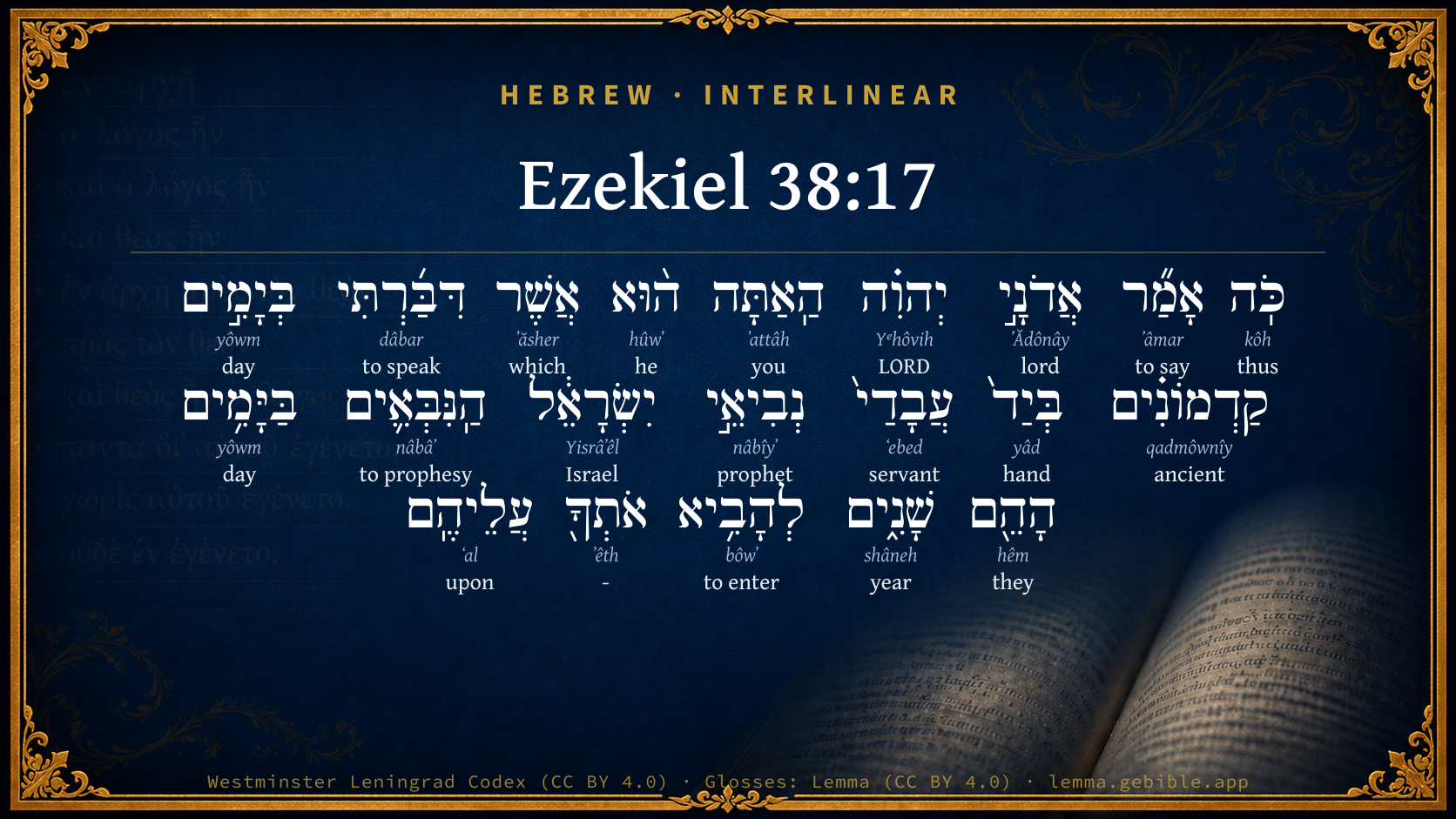
Hebrew (Westminster Leningrad Codex) Ezekiel 38:17 appears in the Hebrew Old Testament. The text above is from the Westminster Leningrad Codex. Each word links to its Strong’s number, a concise gloss, and parsing drawn from the Open Scriptures Hebrew Bible morphology. Click any word for its full Brown-Driver-Briggs (BDB) entry.
Download image
Cite this verse

Ezekiel 38:17 (World English Bible). Public Domain. Lemma interlinear Bible study tool, https://lemma.gebible.app/v/ezekiel/38/17.

Show BibTeX & RIS
BibTeX
RIS
English Translation
Thus says the Lord Yahweh: Are you he of whom I spoke in old time by my servants the prophets of Israel, who prophesied in those days for [many] years that I would bring you against them?
World English Bible · Public Domain
Download a study sheet

One document with this verse’s original text, its word-by-word gloss line, the meaning frame, cross-references with their text, attributed commentary, and full source and license credits — printable, and it pastes into notes with its structure intact.

This verse Autodidact and up

Study sheet (.html) Plain text (.txt)

A passage Seminary Student

Up to 50 verses in one chapter. A passage sheet keeps up to 6 commentary sources and 12 cross-references per verse, in the order this page ranks them, and says so on the sheet whenever that leaves anything out. Ask for a single verse and you get the Autodidact verse sheet above.

Everything on this page stays free to read, with no account — the sheet is a download of what is already on screen, not access to it.

Want to remove ads? Support Godless Engineer
Compare translations 3

The same verse in 3 English versions, stacked beneath the original-language interlinear above. Click any original word for its lexicon entry.

Each is an independent rendering of the whole verse — the interlinear is not word-aligned to these translations.

Highlighted words mark where these versions differ — a whole-verse word diff, not a word-by-word alignment.

  • World English Bible Public Domain
    Thus says the Lord Yahweh: Are you he of whom I spoke in old time by my servants the prophets of Israel, who prophesied in those days for [many] years that I would bring you against them?
  • King James Version Public Domain
    Thus saith the Lord GOD; Art thou he of whom I have spoken in old time by my servants the prophets of Israel, which prophesied in those days many years that I would bring thee against them?
  • unfoldingWord Literal Text CC BY-SA 4.0
    The Lord Yahweh says this: Are you not the one of whom I spoke in former days by the hand of my servants, the prophets of Israel, who prophesied in their own time for years that I would bring you against them?

unfoldingWord Literal Text — © unfoldingWord, licensed CC BY-SA 4.0. Word-aligned USFM3 via Door43 (git.door43.org/unfoldingWord/en_ult).

Versions to compare (up to 4)

3 of 4 selected

Show all 18 translations

Every available English version of this verse, each an independent rendering of the whole verse.

  • World English Bible Public Domain
    Thus says the Lord Yahweh: Are you he of whom I spoke in old time by my servants the prophets of Israel, who prophesied in those days for [many] years that I would bring you against them?
  • Berean Standard Bible Public Domain
    This is what the Lord GOD says: Are you the one of whom I have spoken in former days through My servants, the prophets of Israel, who in those times prophesied for years that I would bring you against them?
  • Majority Standard Bible Public Domain
    This is what the Lord GOD says: Are you the one of whom I have spoken in former days through My servants, the prophets of Israel, who in those times prophesied for years that I would bring you against them?
  • King James Version Public Domain
    Thus saith the Lord GOD; Art thou he of whom I have spoken in old time by my servants the prophets of Israel, which prophesied in those days many years that I would bring thee against them?
  • American Standard Version (1901) Public Domain
    Thus saith the Lord Jehovah: Art thou he of whom I spake in old time by my servants the prophets of Israel, that prophesied in those days for `many' years that I would bring thee against them?
  • Revised Version (1885) Public Domain
    Thus saith the Lord GOD: Art thou he of whom I spake in old time by my servants the prophets of Israel, which prophesied in those days for many years that I would bring thee against them?
  • Geneva Bible (1599) Public Domain
    Thus saith the Lord God, Art not thou he, of whom I haue spoken in olde time, by ye hand of my seruants the Prophets of Israel which prophecied in those dayes and yeeres, that I woulde bring thee vpon them?
  • Douay-Rheims (1899) Public Domain
    Thus saith the Lord God: Thou then art he, of whom I have spoken in the days of old, by my servants the prophets of Israel, who prophesied in the days of those times that I would bring thee upon them.
  • Young's Literal Translation Public Domain
    Thus said the Lord Jehovah: Art thou he of whom I spake in former days, By the hand of My servants, prophets of Israel, Who are prophesying in those days -- years, To bring thee in against them?
  • Literal Standard Version CC BY-SA 4.0
    Thus said Lord YHWH: Are you he of whom I spoke in former days, || By the hand of My servants, prophets of Israel, || Who were prophesying [for] years in those days, || To bring you in against them?
  • Unlocked Literal Bible CC BY-SA 4.0
    The Lord Yahweh says this: Are you not the one of whom I spoke in former days by the hand of my servants, the prophets of Israel, who prophesied in their own time for years that I would bring you against them?
  • unfoldingWord Literal Text CC BY-SA 4.0
    The Lord Yahweh says this: Are you not the one of whom I spoke in former days by the hand of my servants, the prophets of Israel, who prophesied in their own time for years that I would bring you against them?
  • Darby Bible Public Domain
    Thus saith the Lord Jehovah: Art thou not he of whom I have spoken in old time through my servants the prophets of Israel, who prophesied in those days, for [many] years, that I would bring thee against them?
  • World Messianic Bible Public Domain
    “‘The Lord GOD says: “Are you he of whom I spoke in old time by my servants the prophets of Israel, who prophesied in those days for years that I would bring you against them?
  • Webster's Bible Public Domain
    Thus saith the Lord GOD; Art thou he of whom I have spoken in old time by my servants the prophets of Israel, who prophesied in those days many years, that I would bring thee against them?
  • Free Bible Version CC BY-SA 4.0
    This is what the Lord God says: Aren't you the one of whom I spoke about long ago through my servants, the prophets of Israel? During that time didn't they prophesy for years that I would have you come and attack them?
  • Bible in Basic English Public Domain
    This is what the Lord has said: You are he of whom I gave them word in earlier times by my servants, the prophets of Israel, who in those days went on saying, year after year, that I would make you come up against them.
  • JPS Tanakh (1917) Public Domain
    Thus saith the Lord GOD: Art thou he of whom I spoke in old time by My servants the prophets of Israel, that prophesied in those days for many years, that I would bring thee against them?

Literal Standard Version (2020), Covenant Press — licensed CC BY-SA 4.0. Text via the HelloAO Bible API (eBible.org). Unlocked Literal Bible (unfoldingWord) — licensed CC BY-SA 4.0. Text via the HelloAO Bible API (eBible.org). unfoldingWord Literal Text — © unfoldingWord, licensed CC BY-SA 4.0. Word-aligned USFM3 via Door43 (git.door43.org/unfoldingWord/en_ult). Free Bible Version, Dr. Jonathan Gallagher — licensed CC BY-SA 4.0. Text via the HelloAO Bible API (eBible.org).

Word by word

More ways to search: Search by grammar → Find every occurrence → Compare this word →

Practice this passage: Drill this verse → Learn its vocabulary →

קַדְמוֹנִ֗ים
qadmôwnîy
H6931
“ancient”
Adjective, Adjective, Masculine, Plural, Absolute
Part of Speech
Adjective
Type
Adjective
Gender
Masculine
Number
Plural
State
Absolute
Full BDB Definition

Origin: from H6930

TWOT: 1988f

former, ancient, eastern - former, ancient - eastern
  1. כֹּֽה kôh H3541 “thus” Adverb
  2. אָמַ֞ר ʼâmar H559 “to say” Verb, Qal, Perfect, 3rd Person, Masculine, Singular
  3. אֲדֹנָ֣י ʼĂdônây H136 “Lord · my” Noun, Common, Masculine, Plural, Construct + Suffix, Personal, 1st Person, Common, Singular
  4. יְהוִ֗ה Yᵉhôvih H3069 “LORD” Noun, Proper
  5. הַֽאַתָּה ʼattâh H859 “you” Particle, Interrogative + Pronoun, Personal, 2nd Person, Masculine, Singular
  6. ה֨וּא hûwʼ H1931 “he” Pronoun, Personal, 3rd Person, Masculine, Singular
  7. אֲשֶׁר ʼăsher H834 “which” Particle, Relative
  8. דִּבַּ֜רְתִּי dâbar H1696 “to speak” Verb, Piel, Perfect, 1st Person, Common, Singular
  9. בְּיָמִ֣ים yôwm H3117 “in/at · days” Preposition + Noun, Common, Masculine, Plural, Absolute
  10. בְּיַד֙ yâd H3027 “in/at · hand of” Preposition + Noun, Common, Both, Singular, Construct
  11. עֲבָדַי֙ ʻebed H5650 “servants · my” Noun, Common, Masculine, Plural, Construct + Suffix, Personal, 1st Person, Common, Singular
  12. נְבִיאֵ֣י nâbîyʼ H5030 “prophets of” Noun, Common, Masculine, Plural, Construct
  13. יִשְׂרָאֵ֔ל Yisrâʼêl H3478 “Israel” Noun, Proper
  14. הַֽנִּבְּאִ֛ים nâbâʼ H5012 “the · prophesying” Particle, Definite Article + Verb, Niphal, Participle Active, Masculine, Plural, Absolute
  15. בַּיָּמִ֥ים yôwm H3117 “in/at the · days” Preposition, Determined + Noun, Common, Masculine, Plural, Absolute
  16. הָהֵ֖ם hêm H1992 “the · they” Particle, Definite Article + Pronoun, Personal, 3rd Person, Masculine, Plural
  17. שָׁנִ֑ים shâneh H8141 “years” Noun, Common, Feminine, Plural, Absolute
  18. לְהָבִ֥יא bôwʼ H935 “to enter” Preposition + Verb, Hiphil, Infinitive Construct
  19. אֹתְךָ֖ ʼêth H853 “- · you” Particle, Direct Object + Suffix, Personal, 2nd Person, Masculine, Singular
  20. עֲלֵיהֶֽם ʻal H5921 “upon · them” Preposition + Suffix, Personal, 3rd Person, Masculine, Plural

About this verse

These counts appear in no published source. They are computed here, from the morphology-tagged text and Lemma’s own curated glosses. What Lemma adds →

21
words
20
distinct lemmas
Prophets
section

Notable vocabulary

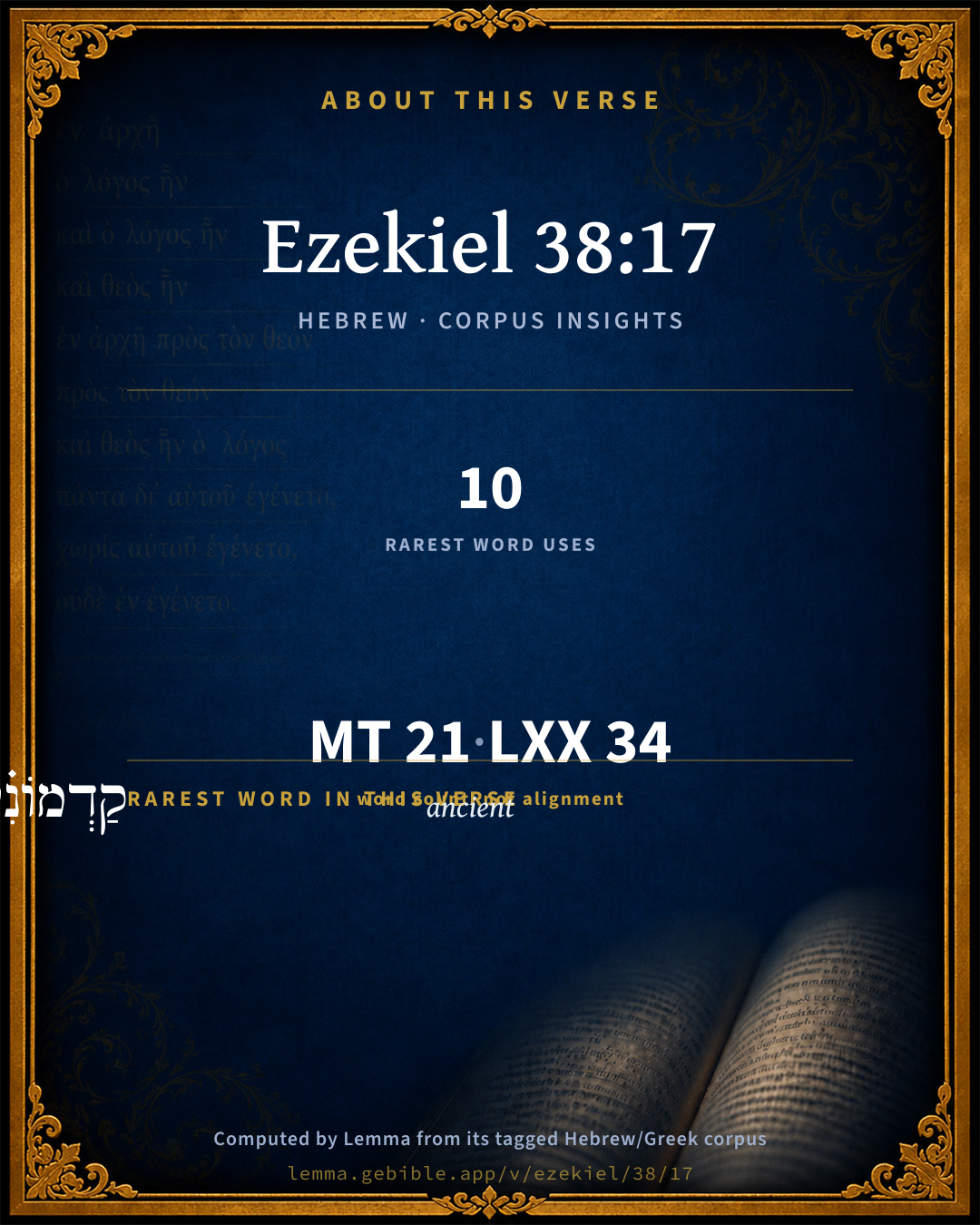
The rarest word here is קַדְמוֹנִ֗ים ancient H6931 — appearing just 10 times in the whole Hebrew Bible.

Shared distinctive vocabulary

קַדְמוֹנִ֗ים ancient H6931 occurs in 10 verses of the Hebrew Bible. Also found in:

Grammatical profile

  • 4 verbs
  • 9 nouns
  • 1 adjective
  • 3 pronouns
  • 1 preposition
  • 1 adverb
  • 2 particles

Verb forms

  • אָמַ֞ר Qal · Perfect
  • דִּבַּ֜רְתִּי Piel · Perfect
  • הַֽנִּבְּאִ֛ים Niphal · Participle Active
  • לְהָבִ֥יא Hiphil · Infinitive Construct

Repetition

A word recurs within this verse — often emphatic in Hebrew:

  • בְּיָמִ֣ים day H3117 ×2

Hebrew & Septuagint length

In English translation the verse runs 37 words from the Hebrew and 40 from the Septuagint (LXX English) — closely comparable.

A rough comparison of the two English renderings, which tokenize alike — not a word-level alignment.

Word counts can differ between the Hebrew and the Greek without any difference in meaning — e.g. the Hebrew direct-object marker אֵת has no separate Greek word, and Greek often adds the article ὁ.

In the original languages it is 21 Hebrew tokens and 34 Greek tokens — but the two are counted differently (Hebrew bundles its prefixes and suffixes into one token; the Greek is in lemma form), so that isn’t a like-for-like length.

Cross-references

11

Topical passages linked to Ezekiel 38:17 in the Treasury of Scripture Knowledge — connected by theme and wording, ordered by reader-vote popularity; previews shown in the World English Bible.

  • Daniel 11:40–45 At the time of the end shall the king of the south contend with him; and the king of the north shall come against him like a whirlwind, with chariots, and with horsemen, and with many ships; and he shall enter into the countries, and shall overflow and pass through.
  • Isaiah 63:1–6 Who is this who comes from Edom, with dyed garments from Bozrah? this who is glorious in his clothing, marching in the greatness of his strength? I who speak in righteousness, mighty to save.
  • Ezekiel 38:16 and you shall come up against my people Israel, as a cloud to cover the land: it shall happen in the latter days, that I will bring you against my land, that the nations may know me, when I shall be sanctified in you, Gog, before their eyes.
  • Joel 3:9–14 Proclaim this among the nations: Prepare war. Stir up the mighty men. Let all the warriors draw near. Let them come up.
  • Isaiah 34:1–6 Come near, you nations, to hear; and listen, you peoples: let the earth hear, and the fullness of it; the world, and all things that come forth from it.
  • Ezekiel 38:10–11 Thus says the Lord Yahweh: It shall happen in that day, that things shall come into your mind, and you shall devise an evil device:
  • Isaiah 66:15–16 For, behold, Yahweh will come with fire, and his chariots shall be like the whirlwind; to render his anger with fierceness, and his rebuke with flames of fire.
  • Zechariah 12:2–8 "Behold, I will make Jerusalem a cup of reeling to all the surrounding peoples, and on Judah also will it be in the siege against Jerusalem.
  • Zechariah 14:1–21 Behold, a day of Yahweh comes, when your spoil will be divided in your midst.
  • Psalms 110:5–6 The Lord is at your right hand. He will crush kings in the day of his wrath.
  • Isaiah 27:1 In that day Yahweh with his hard and great and strong sword will punish leviathan the swift serpent, and leviathan the crooked serpent; and he will kill the monster that is in the sea.

Cross-references courtesy of OpenBible.info (CC BY 4.0).

Hebrew and Greek witnesses Masoretic Hebrew ↔ Greek Septuagint

The same verse in the two great witnesses to the Old Testament, shown verse-for-verse.

These are two independent witnesses, not word-aligned to each other, and the Septuagint is shown in lemma (dictionary) form.

Hebrew Ezekiel 38:17 Masoretic · Westminster Leningrad Codex

כֹּֽה אָמַ֞ר אֲדֹנָ֣י יְהוִ֗ה הַֽאַתָּה ה֨וּא אֲשֶׁר דִּבַּ֜רְתִּי בְּיָמִ֣ים קַדְמוֹנִ֗ים בְּיַד֙ עֲבָדַי֙ נְבִיאֵ֣י יִשְׂרָאֵ֔ל הַֽנִּבְּאִ֛ים בַּיָּמִ֥ים הָהֵ֖ם שָׁנִ֑ים לְהָבִ֥יא אֹתְךָ֖ עֲלֵיהֶֽם

Thus says the Lord Yahweh: Are you he of whom I spoke in old time by my servants the prophets of Israel, who prophesied in those days for [many] years that I would bring you against them?

World English Bible · Public Domain

Greek LXX Ezekiel 38:17 Septuagint · lemma form

ὅδε λέγω κύριος κύριος ὁ γωγ σύ εἰμί περί ὅς λαλέω πρό ἡμέρα ὁ ἔμπροσθεν διά χείρ ὁ δοῦλος ἐγώ προφήτης ὁ ἰσραήλ ἐν ὁ ἡμέρα ἐκεῖνος καί ἔτος ὁ ἄγω σύ ἐπί αὐτός

Thus says the Lord God, to Gog; You are he concerning whom I spoke in former times, by the hand of my servants the prophets of Israel, in those days and years, that I would bring you up against them.

LXX2012 (modern English Septuagint) · Public Domain

On this verse, Keil & Delitzsch discusses the Septuagint’s reading. Read the note in Commentary ↓

Hebrew: Westminster Leningrad Codex (CC BY 4.0). Greek: Septuagint (public domain); English from LXX2012 (modern English Septuagint) (Public Domain). How the Septuagint differs from the Hebrew →

Targum (Aramaic paraphrase)

1

The Targum is the ancient Jewish Aramaic paraphrase of the Hebrew Scriptures — an interpretive translation, not the Hebrew text itself. Onkelos (literal) and Pseudo-Jonathan (expansive) render the Torah, and Jonathan the Prophets. Coverage is partial: where no permissively-licensed English translation exists for a verse, only the Aramaic is shown. This is verse-level text, not a word-by-word alignment to the Hebrew.

  1. Targum Jonathan Prophets (Joshua–Malachi)
    כִּדְנַן אֲמַר יְיָ אֱלֹהִים הַאַתְּ הוּא דְמַלֵלִית בְּיוֹמֵי קֶדֶם בְּיַד עַבְדֵי נְבִיֵי יִשְׂרָאֵל דְאִתְנַבִיאוּ בְּיוֹמַיָא הָאִינוּן מִלְקַדְמַת דְנָא שָׁנִין סַגִיאִין לְאַיְתָאָה יָתָךְ עֲלֵיהוֹן:

    (no public-domain English translation for this verse)

    Targum Jonathan — Aramaic: “Mikraot Gedolot” (public domain). English: “Sefaria Community Translation” (CC0 1.0 (public-domain dedication)); “London "Chaldee Paraphrase," 1871” (public domain). Text via Sefaria.

Commentary

Notes on Ezekiel 38:17 from classic Christian and Jewish commentators (each source and its license shown beneath its notes). The classic Christian expositions comment on the surrounding passage and are grouped to its opening verse, so a note may address several verses; the Jewish commentaries on the Tanakh (Rashi and others) are per-verse, so they appear only where the commentator wrote on this verse.

Lemma curates 59 commentaries, every one of them public domain or Creative Commons licensed, each selected and text-cleaned for this edition rather than reprinted as found. About our sources →

Trapp's Complete Commentary

John Trapp

Eze 38:17 Thus saith the Lord GOD; [Art] thou he of whom I have spoken in old time by my servants the prophets of Israel, which prophesied in those days [many] years that I would bring thee against them?

Ver. 17. Art thou he?] It is sure enough thou art he; for I cannot be deceived in thee, nor shall fail to suppress thee.

By my servants the prophets.] Enoch {Jdg 1:14 Hos 2:1 Joe 3:1 Dan 11:1-2 Zec 14:1-21 : 1Ki 20:8 2Th 2:1}

Which prophesied of thee.] Though under another name.

John Trapp, A Commentary or Exposition upon All the Books of the Old and New Testament (1647–1656) — public domain. Text from a community e-Sword module.

Joseph Benson's Commentary

Eze 38:17. Art thou he? — This would be better translated, Art thou not he? a sense which the Hebrew particle of interrogation often imports; of whom I have spoken in old time by my servants the prophets — “It is doubtful by what prophets God foretold the irruption of Gog; but though nothing of this kind be found in the prophets that remain, it is enough that Ezekiel did not first foretel these things. Many of the sacred pages are lost, which might probably be extant when Ezekiel delivered this prophecy.” — Houbigant. The expressions here used, of old time, and which prophesied in those days, many years, plainly imply that there was to be a succession of many ages between the publishing of these prophecies, and this event foretold by them.

Joseph Benson's Commentary on the Old and New Testaments (1811–1818) — public domain. Text from a community e-Sword module.

Keil & Delitzsch

C. F. Keil & F. Delitzsch

Announcement of the Wrathful Judgment upon Gog, as a Proof of the Holiness of the Lord

Eze 38:17. Thus saith the Lord Jehovah, Art thou he of whom I spoke in the former days through my servants the prophets of Israel, who prophesied for years in those days, that I would bring thee over them? Eze 38:18. And it cometh to pass in that day, in the day when Gog cometh into the land of Israel, is the saying of the Lord Jehovah, that my wrath will ascend into my nose. Eze 38:19. And in my jealousy, in the fire of my anger, have I spoken, Truly in that day will a great trembling come over the land of Israel; Eze 38:20. The fishes of the sea, and the birds of heaven, and the beasts of the field, and every creeping thing that creepeth upon the ground, and all the men that are upon the ground, will tremble before me; and the mountains will be destroyed, and the rocky heights fall, and every wall will fall to the ground. Eze 38:21. I will call the sword against him to all my holy mountains, is the saying of the Lord Jehovah: the sword of the one will be against the other. Eze 38:22. And I will strive with him by pestilence and by blood, and overflowing rain-torrents and hailstones; fire and brimstone will I rain upon him and all his hosts, and upon the many peoples that are with him; Eze 38:23. And will prove myself great and holy, and will make myself known before the eyes of many nations, that they may know that I am Jehovah. - The announcement of the way in which the Lord will sanctify Himself upon Gog (Eze 38:16) commences with the statement in Eze 38:17, that Gog is he of whom God has already spoken by the earlier prophets. This assertion is clothed in the form of a question: האתּה, not הלא אתּה, which is the interrogative form used for an emphatic assurance; whereas האתּה does not set down the point in question as indisputably certain, but suggests the inquiry for the purpose of giving a definite answer. The affirmative reply to the question asked is contained in the last clause of the verse: "to bring thee upon them;" so that האתּה הוּא really means, thou art truly he. The statement, that Gog is he of whom God had already spoken by the earlier prophets, does not mean that those prophets had actually mentioned Gog, but simply that Gog was the enemy of whose rising up against the people of God the prophets of the former time had prophesied, as well as of his destruction by a wrathful judgment of the Lord. שׁנים (for years, or years long) is an accusative of measure, not asyndeton to baבּיּמים, as the lxx and many of the commentators down to Hvernick have taken it to be. The design of this remark is not to accredit the prophecy by referring to the utterances of earlier prophets, but to show that the attack of the peoples gathered together by Gog, upon the land and people of the Lord, is not an unexpected event, or one at variance with the promise of the restoration of Israel as a kingdom of peace. To what utterances of the older prophets these words refer is a question difficult to answer. Zechariah (Zac 12:2-3; Zac 14:2-3) is of course not to be thought of, as Zechariah himself did not prophesy till after the captivity, and therefore not till after Ezekiel. But we may recall Joel 4:2 and 11ff.; Isa 25:5, Isa 25:10., Eze 26:21; Jer 30:23 and 25; and, in fact, all the earlier prophets who prophesied of Jehovah's day of judgment upon all the heathen.

(Note: Aug. Kueper (Jeremias librr. sacrr., interpr. atque vindex, p. 82) has correctly observed concerning this verse, that "it is evident enough that there is no reference here to prophecies concerning Gog and Magog, which have been lost; but those general prophecies, which are met with on every hand directed against the enemies of the church, are here referred to Gog." And before him, J. F. Starck had already said: "In my opinion, we are to understand all those passages in the prophets which treat of the enemies of the church and its persecutions...these afflictions were preludes and shadows of the bloody persecution of Gog.")

Eze 38:18 and Eze 38:19 do not contain words which Jehovah spoke through the ancient prophets, and which Ezekiel now transfers to Gog and the time of his appearing (Hitzig and Kliefoth). The perfect דּבּרתּי in Eze 38:19 by no means warrants such an assumption; for this is purely prophetic, expressing the certainty of the divine determination as a thing clearly proved. Still less can 'נאם אד in Eze 38:18 be taken as a preterite, as Kliefoth supposes; nor can Eze 38:18 and Eze 38:19 be regarded as a thing long predicted, and so be separated from Eze 38:20-23 as a word of God which is now for the first time uttered. For the anthropopathetic expression, "my wrath ascends in my nose," compare Psa 18:9, "smoke ascends in His nose." The outburst of wrath shows itself in the vehement breath which the wrathful man inhales and exhales through his nose (see the comm. on the Psalm, l.c.). The bursting out of the wrath of God is literally explained in Eze 38:19. In the jealousy of His wrath God has spoken, i.e., determined, to inflict a great trembling upon the land of Israel. בּקנאתי (cf. Eze 5:13) is strengthened by בּאשׁ עברתי (cf. Ezekiel 21:36; Eze 22:21). The trembling which will come upon the land of Israel, so that all creatures in the sea, in the air, and upon the ground, tremble before Jehovah (מפּני), who appears to judgment, will rise in nature into an actual earthquake, which overthrows mountains, hills, and walls. מדרגות are steep heights, which can only be ascended by steps (Sol 2:14). This picture of the trembling of the whole world, with all the creatures, before the Lord who is coming to judgment, both here and in Joel 4:16, Zac 14:4-5, rests upon the fact which actually occurred in connection with the revelation of God upon Sinai, when the whole mountain was made to quake (Exo 19:16.). The inhabitants of the land of Israel tremble at the terrible phenomena attending the revelation of the wrath of God, although the wrathful judgment does not apply to them, but to their enemies, Gog and his hosts. The Lord calls the sword against Gog, that his hosts may wound and slay one another. This feature of the destruction of the enemy by wounds inflicted by itself, which we meet with again in Zac 14:13, has its typical exemplar in the defeat of the Midianites in the time of Gideon (Jdg 7:22), and also in that of the enemy invading Judah in the reign of Jehoshaphat (Ch2 20:23). In לכל־הרי the ל is not distributive, but indicates the direction: "to all my mountains." The overthrow of the enemy is intensified by marvellous plagues inflicted by God - pestilence and blood (cf. Eze 28:23), torrents of rain and hailstones (cf. Eze 13:11), and the raining of fire and brimstone upon Gog, as formerly upon Sodom and Gomorrah (Gen 19:24). - Thus will Jehovah prove Himself to be the almighty God by judgment upon His enemies, and sanctify Himself before all the nations (Eze 38:23, compare Eze 38:16 and Eze 36:23).

Keil & Delitzsch — Biblical Commentary on the Old Testament (1861–1891) — public domain (CC PDM 1.0). Text via the HelloAO Bible API. (Old Testament only.)

Tyndale Open Study Notes

Tyndale Open Resources

38:17 Gog was not the prophesied “enemy from the north” of Jer 4–6 that God was talking about long ago. Those prophecies had already found their fulfillment in the devastation that King Nebuchadnezzar of Babylon had wreaked on Judah.

Tyndale Open Study Notes — © Tyndale Open Resources, licensed CC BY-SA 4.0. Text via the HelloAO Bible API.

Geneva Bible (1599)

Geneva Bible translators

Hereby he declareth that none affliction can come to the Church, whereof they have not been advertised aforetime, to teach them to endure all things with more patience, when they know that God hath so ordained.

Geneva Bible (1599) marginal notes — public domain. Text via Bolls.life.

Jamieson, Fausset & Brown

Robert Jamieson, A. R. Fausset & David Brown

thou he of whom I have spoken in old time--Gog, &c. are here identified with the enemies spoken of in other prophecies (Num 24:17-24; Isa 27:1; compare Isa 26:20-21; Jer 30:23-24; Joe 3:1; Mic 5:5-6; Isa 14:12-14; Isa 59:19). God is represented as addressing Gog at the time of his assault; therefore, the "old time" is the time long prior, when Ezekiel uttered these prophecies; so, he also, as well as Daniel (Dan. 11:1-45) and Zechariah (Zec. 14:1-21) are included among "the prophets of Israel" here.

many years--ago.

Jamieson, Fausset & Brown — Commentary Critical and Explanatory on the Whole Bible (1871) — public domain (CC PDM 1.0). Text via the HelloAO Bible API.

Adam Clarke's Commentary

Verse 17. Art thou he of whom I have spoken in old time] This prophecy concerning Antiochus and the Jews was delievered about four hundred years before the events took place. - Martin. Calmet maintains that Cambyses is spoken of, and refers to ancient prophecies, especially Isa 14, Isa 15, Isa 20, Isa 21.

Adam Clarke's Commentary on the Bible (1810–1826) — public domain. Text from a community e-Sword/MySword module.

Ellicott's Commentary for English Readers

(17) Of whom I have spoken in old time.—This is put in that interrogative form which is often used for emphatic assurance. The word many before “years” is not in the original, but is correctly inserted to mark the accusative of duration. The statement is then an emphatic one, that God had of old and for a long time foretold by His prophets this attack of Gog. But the name of Gog is not mentioned in any earlier prophecy now extant, nor is it likely that any such, far less that any long series of such prophecies, have been lost. This concurs with many other indications in the prophecy to show that it does not relate to any particular event, but that Gog and his allies represent the enemies of the Church in general, and that the prophet is here depicting the same great and prolonged struggle between evil and good, between the powers of the world and the kingdom of God, which has formed the burden of so much of both earlier and later prophecy.

A Bible Commentary for English Readers, edited by Charles John Ellicott (1878–1897) — public domain. Text from a community e-Sword module.

The Cambridge Bible for Schools and Colleges

gen. ed. J. J. S. Perowne

17. The question gives vividness to the fact of Gog’s invasion having been long predicted, and identifies him with the subject of these predictions. These former prophecies had not named Gog; the identification is matter of inference.

those days many years] The construction is peculiar, but this is probably the sense. Gog, though not by name, had formed the subject of repeated predictions by many prophets. The prophecies referred to are probably such as Zephaniah 1 (Eze_3:8), which agrees with Ezek. Eze_38:20 in mentioning the fishes of the sea (again only Hos_4:3), and Jeremiah 3-6 (Isa_17:12 seq.). The age of Joel may be later than Ezek., and passages like Joel 3, Zechariah 14, possibly repose rather on him, or at all events shew the continued prevalence of the same ideas, which indeed passed as current conceptions into the Apocalyptic prophecy dating from this age. The passage Mic_4:11 seq. is also of uncertain date. It is possible that the invasion of the Scythians may have suggested the prophecies of Zeph. and Jer., though the supposition is less necessary in the case of the latter prophet. It is not likely, however, that Ezekiel’s renewal of the prophecy was occasioned by any fresh movements among these northern nations occurring in his time (Sm. Kuen.), because he regards the inroad of Gog as an event to happen in the far distant future.

17–23. This invasion of Gog has been long predicted. It shall be the occasion of a final manifestation of himself by Jehovah to creation and the nations, which shall inspire universal awe, and leave in the minds of all mankind the knowledge of Jehovah, and that which he is.

The Cambridge Bible for Schools and Colleges (gen. ed. J. J. S. Perowne; Cambridge University Press, 1878–1918) — public domain. Text from a community e-Sword module.

John Gill's Exposition

And it shall come to pass at the same time, when Gog shall come against the land of Israel, saith the Lord God,.... As before prophesied of and described:

that my fury shall come up in my face; as a man's blood rises up in his face, and his colour appears, when he is wroth and angry: or, "in my nose" (s); as men when they are angry puff and blow, expand their nose, breathe through it; but against whom is all this wrath and fury? Starckius, a modern interpreter, thinks it is against the land of Israel, against the church; but it rather seems to be against Gog himself; the Lord being provoked at his attempt against the land of Israel, and the wicked designs he had to spoil and plunder it.

(s) "in nasum meum", Piscator, Cocceius, Starckius.

John Gill's Exposition of the Whole Bible (1746–1763) — public domain (CC PDM 1.0). Text via the HelloAO Bible API.

Albert Barnes' Notes on the Bible

Gog - is not mentioned by name in any existing prophecy before Ezekiel’s time. The reference here shows

(1) that the conflict with Gog does not represent a particular event, but one of which the prophets in general had to speak;

(2) that in the interpretation of Old Testament prophecy we are to look beyond special fulfillments.

Events in the world’s history come within a prophet’s ken as parts of the divine administration whereby evil struggles against but is overcome by good. As every such conflict is a prelude to the final struggle, so its prediction has reference ultimately to the consummation here foretold.

Albert Barnes' Notes on the Bible (1834–1885) — public domain. Text from a community e-Sword/MySword module.

Haydock's Catholic Bible Commentary

Prophets. See Isaias xiv., and xvi. 21., and xxvi. 1., and Jeremias xxx. 3., and 23., and Joel ii. 30., and iii. 1., &c.

George Leo Haydock (1774–1849), Haydock's Catholic Family Bible and Commentary, 1859 edition — public domain. Excludes Psalms (Douay-Rheims chapter numbering differs from Protestant) and Deuterocanonical books (Catholic canon only).

Matthew Poole's English Annotations

Art thou he? either by way of contempt from God, upon him and all his preparations, or by way of monition: All these enterprises I foresaw, have spoken of them, and I will as well defeat as I did foretell them.

Of whom I have spoken: it is not said it is written, though that be true also, but it was more spoken of.

In old time; in the days of those years past, or of their years, in the times when those prophets lived.

The prophets of Israel; not by prognostication or soothsayers, but by true prophets, my servants whom I sent, Da 11; Zec 14. Now, though they had not foretold this when Ezekiel did, yet when the question shall be asked by the church, it will be so many hundreds of years past, it may well refer to these two prophets; beside Isa 26:20,21, with Isa 27:1; Jer 30:23,24; Joe 3:1,15,16; and Mic 5:5,6, are prophets cited, as those who spake of this mighty enemy and his coming, and from which an understanding reader may soon collect that this foe was intended as well as others in those places.

Matthew Poole's English Annotations on the Holy Bible (1683–1685) — public domain. Text from a community e-Sword/MySword module.

Whedon's Commentary on the Bible

Daniel D. Whedon

17. Of whom I have spoken — No extant ancient prophecy names Gog. Doubtless the predictions referred to are all such as represent the hostility of the world powers concentrating itself in one last tremendous attack (for example, Zep_3:8; Zec_12:7; Zechariah 14; Joe_3:2; Joe_3:4-17; Isa_54:15; Isa_54:17; compare Rev_20:7-10).

Daniel D. Whedon (gen. ed.), Commentary on the Old and New Testaments (1874–1909) — public domain. Text from a community e-Sword module.

The Pulpit Commentary

Art thou he of whom I have spoken in old time? As no existing prophecy, prior to Ezekiel"s time, mentions Cog by name, it must be concluded either

(1) that Ezekiel refers to prophecies known in his day, though no longer extant; or

(2) that his words simply mean that earlier prophets had predicted such an invasion of Israel in the last times as that which he announces under the leadership of Gog. The former opinion, though countenanced by Ewald, Kuenen, and Smend, is less probable than the latter, which expositors both ancient and modern favor. Schroder considers the hypothesis that earlier prophets had spoken of Gog by name as excluded by the interrogatory form of the sentence, since, had Cog been thus explicitly pointed out, there would, he thinks, have been no need to ask, "Art thou he?" But it is doubtful if the interrogatory form of the words had any other intention than to lend emphasis to the assertion that Gog was he to whom the earlier prophets had unconsciously referred. As to which earlier prophets he alluded opinions vary. Ewald cites Isa_10:6 Isa_17:4; Smend adding Mic_5:11; Zep_3:8; Keil, Isa_25:5, Isa_25:10; Jer_30:23Jo Jer_3:2, Jer_3:11, etc.; Hengstenberg, De 32; Isa 24 Isa 27; Isa 34; and Fairbairn, Num_24:17-24; Isa_14:28-32 Isa 18 Joe 3; Dan_2:44, Dan_2:45; though Schroder is probably correct in holding that all should be included which represent the hostility of the heathen world as culminating in the latter days in a grand concentrated attack upon Israel. Smend sees in the unusual phenomenon that Ezekiel reflects upon earlier prophecies an indication of the declining spirit of prophetism; it should, however, rather be regarded as a sign of superior spiritual insight on the part of Ezekiel, who could discern that from the first the prophets had been guided in their utterances by One who was intimately acquainted with the whole world-program, and knew the end from the beginning, so that however dark and enigmatical their predictions might be when taken separately, when viewed in connection they were recognized as forming parts of a harmonious whole.

The Pulpit Commentary (1880–1919), ed. H.D.M. Spence-Jones & Joseph S. Exell — public domain. Text from a community e-Sword module.

John Wesley's Explanatory Notes

Spoken - All these enterprises I have spoken of, and will as well defeat as I did foretel them.

John Wesley, Explanatory Notes Upon the Whole Bible (1754–1765) — public domain. Text via the GEBible commentary corpus.

unfoldingWord translationNotes

Door43 World Missions Community

Connecting Statement:

Yahweh continues telling Ezekiel what he is to say to Gog.

Are you not the one ... bring you against them?

Yahweh uses this question to emphasize that he was the one who brought Gog to the land of Israel. AT: "You are the one ... bring you against them." (See: Rhetorical Question)

of whom I spoke

"that I spoke about"

in former days

"in the past" or "a long time ago"

by the hand of my servants

Here "hand" refers to the fact that these prophets wrote down Yahweh's message. AT: "by means of my servants" or "through my servants" (See: Metonymy)

against them

"against the people of Israel"

this is the Lord Yahweh's declaration

Yahweh speaks of himself by name to express the certainty of what he is declaring. See how you translated this in Ezekiel 5:11. AT: "this is what the Lord Yahweh has declared" or "this is what I, the Lord Yahweh, have declared" (See: First, Second, or Third Person)

my wrath will mount up in my anger

Here "mount up" means "rise up" and expresses that his wrath will increase. The words "wrath" and "anger" mean the same thing and emphasize how intense his anger will be. AT: "my anger will greatly increase" or "I will be very angry with you" (See: Metaphor and Doublet)

translationWords

Lord Yahweh

hand

servant

prophet

declare

unfoldingWord translationNotes — © Distant Shores Media and the Door43 World Missions Community, licensed CC BY-SA 4.0. Source: git.door43.org/Door43/en_tn.

Rashi

Rabbi Shlomo Yitzchaki (Rashi)

Are you he In those days, the Holy One, blessed be He, will say, “Are you the one about whom I spoke in ancient days through My servants, the prophets of Israel, e.g. Ezekiel and Zechariah?” For he [Zechariah] too prophesied about the wars of Gog and Magog (Zech. 14:2): “And I will gather all the nations, etc.” Our Sages said (Sanh. 17a): Eldad and Medad they [also] prophesied about it. That is the שָּׁנִים stated here. Do not read שָּׁנִים, years, but שְּׁנַיִם, two. Two prophets prophesied one prophecy at one time (though not in the same style of expression).

Rashi on the Tanakh — English translations: “The Judaica Press complete Tanach with Rashi, translated by A. J. Rosenberg” (CC BY 4.0); “Pentateuch with Rashi's commentary by M. Rosenbaum and A.M. Silbermann, 1929-1934” (public domain); “The Metsudah Tanach series, Lakewood, N.J” (CC BY 4.0); and “The Book of Joshua, Metsudah Publications, 1997” (CC BY 4.0). Text via Sefaria.

Lesson kit

Teaching starters — assembled from the data on this page, not authored interpretation. Every prompt links to the verse data it draws on. Edit before teaching.

Ezekiel, in the Prophets, opens this verse with 21 words (20 distinct Hebrew lemmas). Its most distinctive word is qadmôwnîy (“ancient”). A historical commentator’s framing appears above. Read the whole chapter for the surrounding context.

Discussion questions

  1. The word qadmôwnîy carries the sense “ancient.” How does it shape the verse?
  2. 1 Samuel 24:13 shares the word «ancient» with this verse. How do the two illuminate each other?
  3. “day” occurs 2× in this one verse. What is the effect of the repetition?
  4. These translations render this verse differently. What is at stake in choosing one wording over another?
  5. The verb «אָמַ֞ר» is Qal Perfect. How does its form color the action?
  6. Reading how Trapp's Complete Commentary and Joseph Benson's Commentary read this verse, where do the two commentators agree and where do they part?

Things to notice

Reading settings

Reading text

Shown beneath each verse's original-language words.

Old Testament
Old Testament edition

Read the OT as the Masoretic Hebrew (MT) or the Greek Septuagint (LXX).

English shown for the Greek Septuagint (in the Hebrew ↔ Greek comparison).

Comparing translations? Open the Compare panel on any verse page to stack up to four side by side.