
Ezekiel 22:28

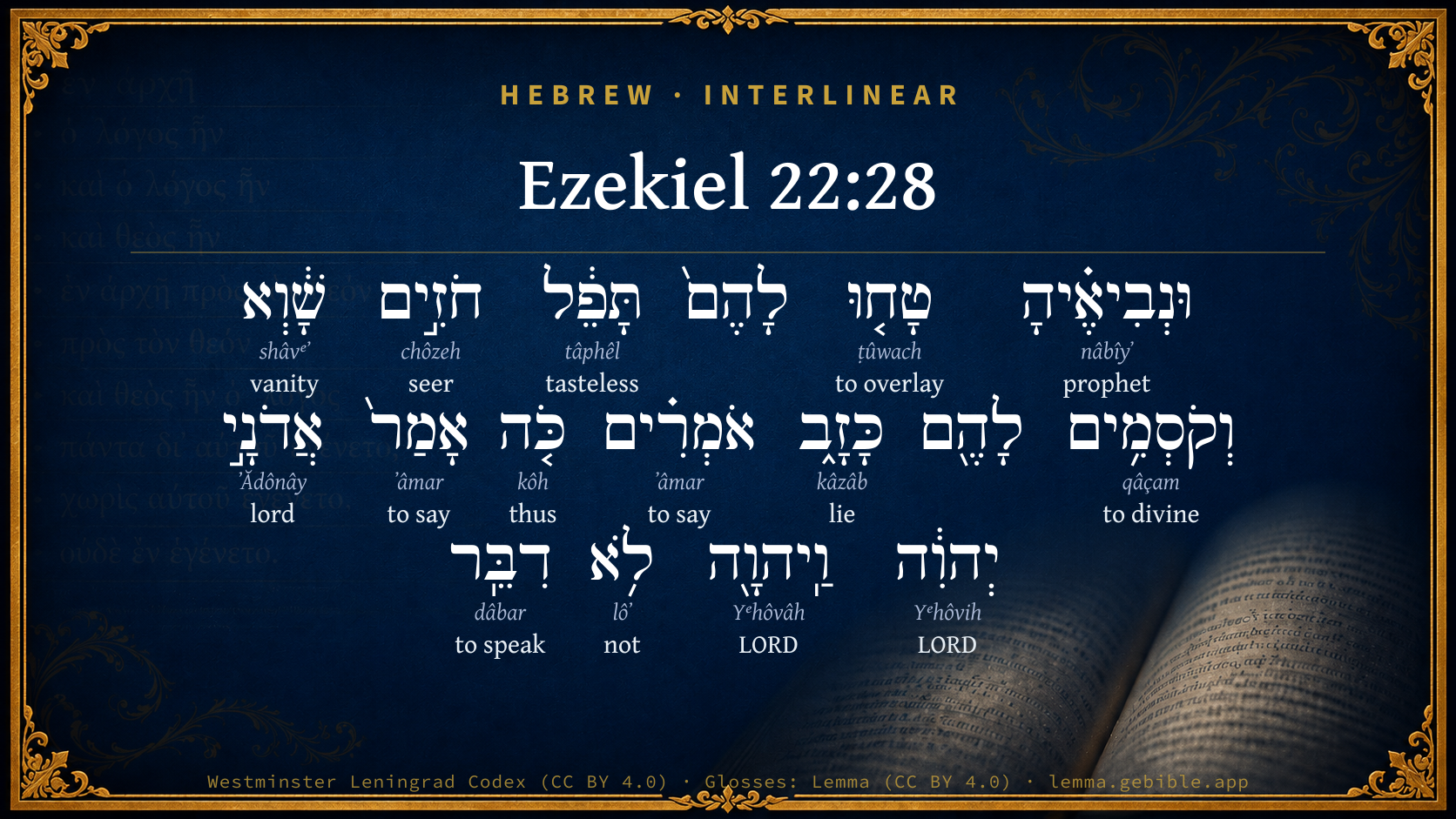
Hebrew (Westminster Leningrad Codex) Ezekiel 22:28 appears in the Hebrew Old Testament. The text above is from the Westminster Leningrad Codex. Each word links to its Strong’s number, a concise gloss, and parsing drawn from the Open Scriptures Hebrew Bible morphology. Click any word for its full Brown-Driver-Briggs (BDB) entry.
Download image
Cite this verse

Ezekiel 22:28 (World English Bible). Public Domain. Lemma interlinear Bible study tool, https://lemma.gebible.app/v/ezekiel/22/28.

Show BibTeX & RIS
BibTeX
RIS
English Translation
Her prophets have daubed for them with whitewash, seeing false visions, and divining lies to them, saying, Thus says the Lord Yahweh, when Yahweh has not spoken.
World English Bible · Public Domain
Download a study sheet

One document with this verse’s original text, its word-by-word gloss line, the meaning frame, cross-references with their text, attributed commentary, and full source and license credits — printable, and it pastes into notes with its structure intact.

This verse Autodidact and up

Study sheet (.html) Plain text (.txt)

A passage Seminary Student

Up to 50 verses in one chapter. A passage sheet keeps up to 6 commentary sources and 12 cross-references per verse, in the order this page ranks them, and says so on the sheet whenever that leaves anything out. Ask for a single verse and you get the Autodidact verse sheet above.

Everything on this page stays free to read, with no account — the sheet is a download of what is already on screen, not access to it.

Want to remove ads? Support Godless Engineer
Compare translations 3

The same verse in 3 English versions, stacked beneath the original-language interlinear above. Click any original word for its lexicon entry.

Each is an independent rendering of the whole verse — the interlinear is not word-aligned to these translations.

Highlighted words mark where these versions differ — a whole-verse word diff, not a word-by-word alignment.

  • World English Bible Public Domain
    Her prophets have daubed for them with whitewash, seeing false visions, and divining lies to them, saying, Thus says the Lord Yahweh, when Yahweh has not spoken.
  • King James Version Public Domain
    And her prophets have daubed them with untempered morter, seeing vanity, and divining lies unto them, saying, Thus saith the Lord GOD, when the LORD hath not spoken.
  • unfoldingWord Literal Text CC BY-SA 4.0
    Her prophets have painted them over with whitewash; they see false visions and predict falsehoods to them. They say “The Lord Yahweh says this” when Yahweh has not spoken.

unfoldingWord Literal Text — © unfoldingWord, licensed CC BY-SA 4.0. Word-aligned USFM3 via Door43 (git.door43.org/unfoldingWord/en_ult).

Versions to compare (up to 4)

3 of 4 selected

Show all 18 translations

Every available English version of this verse, each an independent rendering of the whole verse.

  • World English Bible Public Domain
    Her prophets have daubed for them with whitewash, seeing false visions, and divining lies to them, saying, Thus says the Lord Yahweh, when Yahweh has not spoken.
  • Berean Standard Bible Public Domain
    Her prophets whitewash these deeds by false visions and lying divinations, saying, ‘This is what the Lord GOD says,’ when the LORD has not spoken.
  • Majority Standard Bible Public Domain
    Her prophets whitewash these deeds by false visions and lying divinations, saying, ‘This is what the Lord GOD says,’ when the LORD has not spoken.
  • King James Version Public Domain
    And her prophets have daubed them with untempered morter, seeing vanity, and divining lies unto them, saying, Thus saith the Lord GOD, when the LORD hath not spoken.
  • American Standard Version (1901) Public Domain
    And her prophets have daubed for them with untempered `mortar', seeing false visions, and divining lies unto them, saying, Thus saith the Lord Jehovah, when Jehovah hath not spoken.
  • Revised Version (1885) Public Domain
    And her prophets have daubed for them with untempered mortar, seeing vanity, and divining lies unto them, saying, Thus saith the Lord GOD, when the LORD hath not spoken.
  • Geneva Bible (1599) Public Domain
    And her prophets haue dawbed them with vntempered morter, seeing vanities, and diuining lies vnto them, saying, Thus sayth the Lord God, when the Lord had not spoken.
  • Douay-Rheims (1899) Public Domain
    And her prophets have daubed them without tempering the mortar, seeing vain things, and divining lies unto them, saying: Thus saith the Lord God: when the Lord hath not spoken.
  • Young's Literal Translation Public Domain
    And its prophets have daubed for them with chalk, Seeing a vain thing, and divining for them a lie, Saying, `Thus said the Lord Jehovah:' And Jehovah hath not spoken.
  • Literal Standard Version CC BY-SA 4.0
    And its prophets have coated with chalk for them, || Seeing a vain thing, and divining a lie for them, || Saying, Thus said Lord YHWH, || And YHWH has not spoken.
  • Unlocked Literal Bible CC BY-SA 4.0
    Her prophets have painted them over with whitewash; they see false visions and predict falsehoods to them. They say “The Lord Yahweh says this” when Yahweh has not spoken.
  • unfoldingWord Literal Text CC BY-SA 4.0
    Her prophets have painted them over with whitewash; they see false visions and predict falsehoods to them. They say “The Lord Yahweh says this” when Yahweh has not spoken.
  • Darby Bible Public Domain
    And her prophets have daubed for them with untempered [mortar], seeing vanity and divining lies unto them, saying, Thus saith the Lord Jehovah! and Jehovah hath not spoken.
  • World Messianic Bible Public Domain
    Her prophets have plastered for them with whitewash, seeing false visions, and divining lies to them, saying, ‘The Lord GOD says,’ when the LORD has not spoken.
  • Webster's Bible Public Domain
    And her prophets have daubed them with untempered mortar, seeing vanity, and divining lies to them, saying, Thus saith the Lord GOD, when the LORD hath not spoken.
  • Free Bible Version CC BY-SA 4.0
    Her prophets cover up what they do, using false visions as whitewash and prophecies that are lies, saying, ‘This is what the Lord God says,’ when the Lord hasn't said anything.
  • Bible in Basic English Public Domain
    And her prophets have been using whitewash, seeing foolish visions and making false use of secret arts, saying, This is what the Lord has said, when the Lord has said nothing.
  • JPS Tanakh (1917) Public Domain
    And her prophets have daubed for them with whited plaster, seeing falsehood, and divining lies unto them, saying: Thus saith the Lord GOD, when the LORD hath not spoken.

Literal Standard Version (2020), Covenant Press — licensed CC BY-SA 4.0. Text via the HelloAO Bible API (eBible.org). Unlocked Literal Bible (unfoldingWord) — licensed CC BY-SA 4.0. Text via the HelloAO Bible API (eBible.org). unfoldingWord Literal Text — © unfoldingWord, licensed CC BY-SA 4.0. Word-aligned USFM3 via Door43 (git.door43.org/unfoldingWord/en_ult). Free Bible Version, Dr. Jonathan Gallagher — licensed CC BY-SA 4.0. Text via the HelloAO Bible API (eBible.org).

Word by word

More ways to search: Search by grammar → Find every occurrence → Compare this word →

Practice this passage: Drill this verse → Learn its vocabulary →

תָּפֵ֔ל
tâphêl
H8602
“tasteless”
Noun, Common, Masculine, Singular, Absolute
Part of Speech
Noun
Type
Common
Gender
Masculine
Number
Singular
State
Absolute
Full BDB Definition

Origin: from an unused root meaning to smear

TWOT: 2534a , 2535a

foolish, insipid (adjective) - (BDB) tasteless, unseasoned (adjective) - whitewash (noun masculine) - meaning uncertain
  1. וּנְבִיאֶ֗יהָ nâbîyʼ H5030 “and · prophets · her” Conjunction + Noun, Common, Masculine, Plural, Construct + Suffix, Personal, 3rd Person, Feminine, Singular
  2. טָח֤וּ ṭûwach H2902 “to overlay” Verb, Qal, Perfect, 3rd Person, Common, Plural
  3. חֹזִ֣ים chôzeh H2374 “seer” Verb, Qal, Participle Active, Masculine, Plural, Absolute
  4. שָׁ֔וְא shâvᵉʼ H7723 “vanity” Noun, Common, Masculine, Singular, Absolute
  5. וְקֹסְמִ֥ים qâçam H7080 “and · divining” Conjunction + Verb, Qal, Participle Active, Masculine, Plural, Absolute
  6. כָּזָ֑ב kâzâb H3577 “lie” Noun, Common, Masculine, Singular, Absolute
  7. אֹמְרִ֗ים ʼâmar H559 “saying” Verb, Qal, Participle Active, Masculine, Plural, Absolute
  8. כֹּ֤ה kôh H3541 “thus” Adverb
  9. אָמַר֙ ʼâmar H559 “to say” Verb, Qal, Perfect, 3rd Person, Masculine, Singular
  10. אֲדֹנָ֣י ʼĂdônây H136 “Lord · my” Noun, Common, Masculine, Plural, Construct + Suffix, Personal, 1st Person, Common, Singular
  11. יְהוִ֔ה Yᵉhôvih H3069 “LORD” Noun, Proper
  12. וַֽיהוָ֖ה Yᵉhôvâh H3068 “and · LORD” Conjunction + Noun, Proper
  13. לֹ֥א lôʼ H3808 “not” Particle, Negative
  14. דִבֵּֽר dâbar H1696 “to speak” Verb, Piel, Perfect, 3rd Person, Masculine, Singular

About this verse

These counts appear in no published source. They are computed here, from the morphology-tagged text and Lemma’s own curated glosses. What Lemma adds →

17
words
14
distinct lemmas
Prophets
section

Notable vocabulary

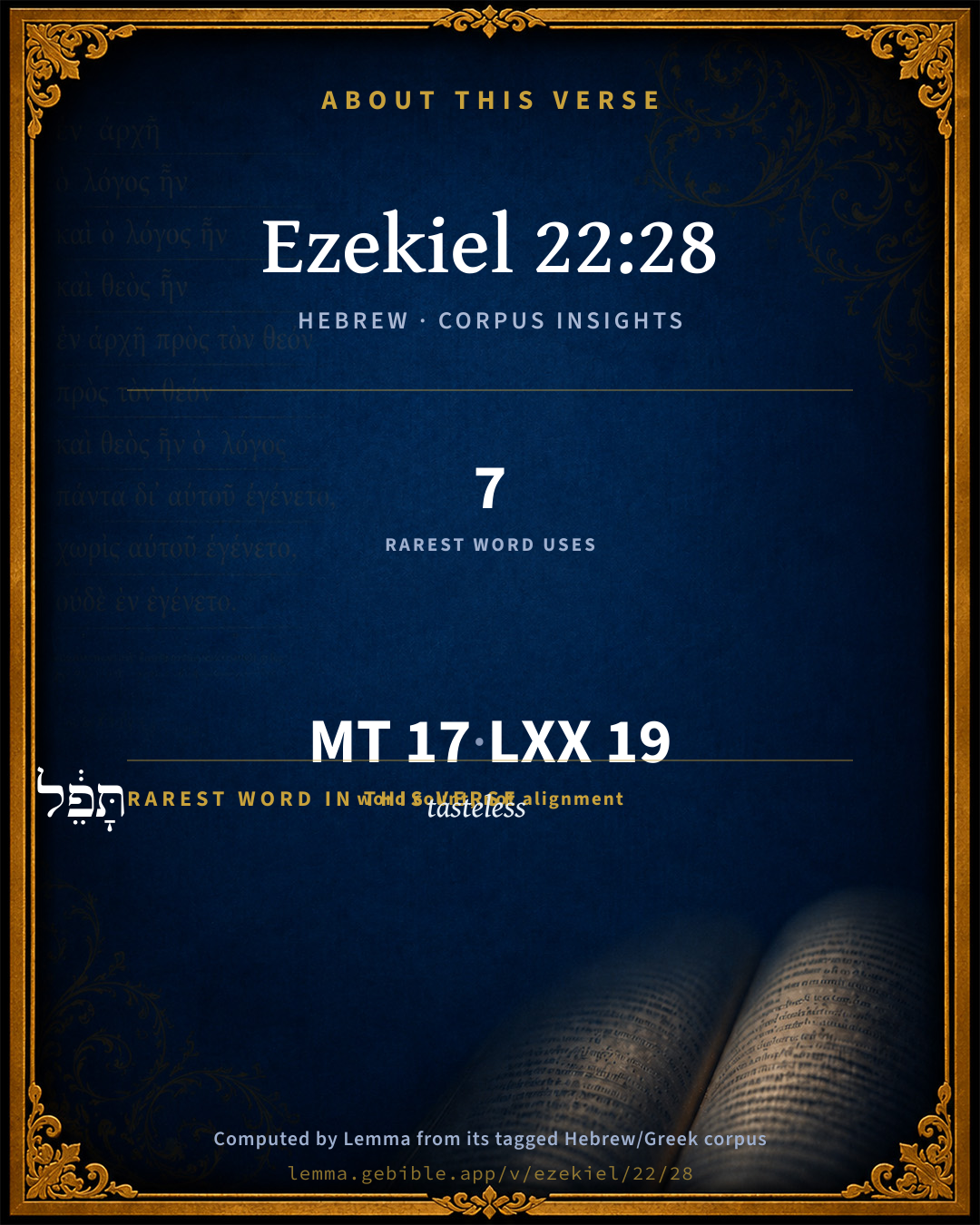
The rarest word here is תָּפֵ֔ל tasteless H8602 — appearing just 7 times in the whole Hebrew Bible.

Shared distinctive vocabulary

תָּפֵ֔ל tasteless H8602 occurs in 7 verses of the Hebrew Bible. Also found in:

Grammatical profile

  • 6 verbs
  • 7 nouns
  • 2 prepositions
  • 1 adverb
  • 1 particle

Verb forms

  • טָח֤וּ Qal · Perfect
  • חֹזִ֣ים Qal · Participle Active
  • וְקֹסְמִ֥ים Qal · Participle Active
  • אֹמְרִ֗ים Qal · Participle Active
  • אָמַר֙ Qal · Perfect
  • דִבֵּֽר Piel · Perfect

Repetition

A word recurs within this verse — often emphatic in Hebrew:

  • אֹמְרִ֗ים to say H559 ×2

Hebrew & Septuagint length

In English translation the verse runs 27 words from the Hebrew and 25 from the Septuagint (LXX English) — closely comparable.

A rough comparison of the two English renderings, which tokenize alike — not a word-level alignment.

Word counts can differ between the Hebrew and the Greek without any difference in meaning — e.g. the Hebrew direct-object marker אֵת has no separate Greek word, and Greek often adds the article ὁ.

In the original languages it is 17 Hebrew tokens and 19 Greek tokens — but the two are counted differently (Hebrew bundles its prefixes and suffixes into one token; the Greek is in lemma form), so that isn’t a like-for-like length.

Cross-references

15

Topical passages linked to Ezekiel 22:28 in the Treasury of Scripture Knowledge — connected by theme and wording, ordered by reader-vote popularity; previews shown in the World English Bible.

  • Ezekiel 13:6–7 They have seen falsehood and lying divination, who say, Yahweh says; but Yahweh has not sent them: and they have made men to hope that the word would be confirmed.
  • Ezekiel 13:10–16 Because, even because they have seduced my people, saying, Peace; and there is no peace; and when one builds up a wall, behold, they daub it with whitewash:
  • Jeremiah 23:25–32 I have heard what the prophets have said, who prophesy lies in my name, saying, I have dreamed, I have dreamed.
  • Isaiah 30:10 who tell the seers, "Don't see;" and to the prophets, "Don't prophesy to us right things, speak to us smooth things, prophesy deceits,
  • Jeremiah 8:10–11 Therefore will I give their wives to others, and their fields to those who shall possess them: for everyone from the least even to the greatest is given to covetousness; from the prophet even to the priest every one deals falsely.
  • Jeremiah 23:21 I sent not these prophets, yet they ran: I didn't speak to them, yet they prophesied.
  • Jeremiah 28:2 Thus speaks Yahweh of Hosts, the God of Israel, saying, I have broken the yoke of the king of Babylon.
  • Jeremiah 28:15 Then said the prophet Jeremiah to Hananiah the prophet, Hear now, Hananiah: Yahweh has not sent you; but you make this people to trust in a lie.
  • Jeremiah 29:8–9 For thus says Yahweh of hosts, the God of Israel: Don't let your prophets who are in the midst of you, and your diviners, deceive you; neither listen you to your dreams which you cause to be dreamed.
  • Jeremiah 37:19 Where now are your prophets who prophesied to you, saying, The king of Babylon shall not come against you, nor against this land?
  • Lamentations 2:14 Your prophets have seen for you false and foolish visions; They have not uncovered your iniquity, to bring back your captivity, But have seen for you false oracles and causes of banishment.
  • Ezekiel 13:22–23 Because with lies you have grieved the heart of the righteous, whom I have not made sad; and strengthened the hands of the wicked, that he should not return from his wicked way, and be saved alive:
  • Ezekiel 21:29 while they see for you false visions, while they divine lies to you, to lay you on the necks of the wicked who are deadly wounded, whose day is come in the time of the iniquity of the end.
  • Ezekiel 22:25 There is a conspiracy of her prophets in the midst of it, like a roaring lion ravening the prey: they have devoured souls; they take treasure and precious things; they have made her widows many in the midst of it.
  • Zephaniah 3:4 Her prophets are arrogant and treacherous people. Her priests have profaned the sanctuary. They have done violence to the law.

Cross-references courtesy of OpenBible.info (CC BY 4.0).

Hebrew and Greek witnesses Masoretic Hebrew ↔ Greek Septuagint

The same verse in the two great witnesses to the Old Testament, shown verse-for-verse.

These are two independent witnesses, not word-aligned to each other, and the Septuagint is shown in lemma (dictionary) form.

Hebrew Ezekiel 22:28 Masoretic · Westminster Leningrad Codex

וּנְבִיאֶ֗יהָ טָח֤וּ לָהֶם֙ תָּפֵ֔ל חֹזִ֣ים שָׁ֔וְא וְקֹסְמִ֥ים לָהֶ֖ם כָּזָ֑ב אֹמְרִ֗ים כֹּ֤ה אָמַר֙ אֲדֹנָ֣י יְהוִ֔ה וַֽיהוָ֖ה לֹ֥א דִבֵּֽר

Her prophets have daubed for them with whitewash, seeing false visions, and divining lies to them, saying, Thus says the Lord Yahweh, when Yahweh has not spoken.

World English Bible · Public Domain

Greek LXX Ezekiel 22:28 Septuagint · lemma form

καί ὁ προφήτης αὐτός ἀλείφω αὐτός πίπτω ὁράω μάταιος μαντεύομαι ψευδής λέγω ὅδε λέγω κύριος καί κύριος οὐ λαλέω

And her prophets that daub them shall fall, that see vanities, that prophesy falsehoods, saying, Thus says the Lord, when the Lord has not spoken.

LXX2012 (modern English Septuagint) · Public Domain

On this verse, Haydock's Catholic Bible Commentary discusses the Septuagint’s reading. Read the note in Commentary ↓

Hebrew: Westminster Leningrad Codex (CC BY 4.0). Greek: Septuagint (public domain); English from LXX2012 (modern English Septuagint) (Public Domain). How the Septuagint differs from the Hebrew →

Targum (Aramaic paraphrase)

1

The Targum is the ancient Jewish Aramaic paraphrase of the Hebrew Scriptures — an interpretive translation, not the Hebrew text itself. Onkelos (literal) and Pseudo-Jonathan (expansive) render the Torah, and Jonathan the Prophets. Coverage is partial: where no permissively-licensed English translation exists for a verse, only the Aramaic is shown. This is verse-level text, not a word-by-word alignment to the Hebrew.

  1. Targum Jonathan Prophets (Joshua–Malachi)
    וּנְבִיֵי שִׁקְרָא דִי בְגַוָה דָמָן לִדְבָנֵי מְחִיצָא וְשָׁעֵיעַ לֵיהּ טִין פַטִיר דְלָא תֶּבֶן מִתְנַבַּן שְׁקַר וּמַלְפִין לְהוֹן כַּדְבִין אָמְרִין כִּדְנַן אֲמַר יְיָ אֱלֹהִים וּמִן קֳדָם יְיָ לָא אִתְמַלָל:

    (no public-domain English translation for this verse)

    Targum Jonathan — Aramaic: “Mikraot Gedolot” (public domain). English: “Sefaria Community Translation” (CC0 1.0 (public-domain dedication)); “London "Chaldee Paraphrase," 1871” (public domain). Text via Sefaria.

Commentary

Notes on Ezekiel 22:28 from classic Christian and Jewish commentators (each source and its license shown beneath its notes). The classic Christian expositions comment on the surrounding passage and are grouped to its opening verse, so a note may address several verses; the Jewish commentaries on the Tanakh (Rashi and others) are per-verse, so they appear only where the commentator wrote on this verse.

Lemma curates 59 commentaries, every one of them public domain or Creative Commons licensed, each selected and text-cleaned for this edition rather than reprinted as found. About our sources →

Trapp's Complete Commentary

John Trapp

Eze 22:28 And her prophets have daubed them with untempered [morter], seeing vanity, and divining lies unto them, saying, Thus saith the Lord GOD, when the LORD hath not spoken.

Ver. 28. And her prophets have daubed them.] Similes iis qui parietem incrustant luto friabili et solubili. See Eze 13:4, &c.

John Trapp, A Commentary or Exposition upon All the Books of the Old and New Testament (1647–1656) — public domain. Text from a community e-Sword module.

Geneva Bible (1599)

Geneva Bible translators

They which should have reproved them, flattered them in their vices, and covered their doings with lies, Ezek. 13:10.

Geneva Bible (1599) marginal notes — public domain. Text via Bolls.life.

Jamieson, Fausset & Brown

Robert Jamieson, A. R. Fausset & David Brown

Referring to the false assurances of peace with which the prophets flattered the people, that they should not submit to the king of Babylon (see on Eze 13:10; Eze 21:29; Jer 6:14; Jer 23:16-17; Jer 27:9-10).

Jamieson, Fausset & Brown — Commentary Critical and Explanatory on the Whole Bible (1871) — public domain (CC PDM 1.0). Text via the HelloAO Bible API.

Adam Clarke's Commentary

Verse 28. Her prophets] Even those who profess themselves to be my prophets, have been unfaithful in the discharge of their office; have soothed the people in their sins, and pretended to have oracles of peace and safety when I had not spoken to them.

Adam Clarke's Commentary on the Bible (1810–1826) — public domain. Text from a community e-Sword/MySword module.

Ellicott's Commentary for English Readers

(28) With untempered morter.—See Note on Eze_13:10. The prophets are here again spoken of in reference to their powerful influence upon the princes in leading them astray by falsehoods. “Seeing vanity” is an expression for pretended and false visions. (Comp. Eze_13:7; Eze_13:9-10.)

A Bible Commentary for English Readers, edited by Charles John Ellicott (1878–1897) — public domain. Text from a community e-Sword module.

The Cambridge Bible for Schools and Colleges

gen. ed. J. J. S. Perowne

28. have daubed them] daubed for them, seconding them. The persons called “princes” may be referred to, but not exclusively. Cf. ch. Eze_13:10, and Eze_13:6-7.

The Cambridge Bible for Schools and Colleges (gen. ed. J. J. S. Perowne; Cambridge University Press, 1878–1918) — public domain. Text from a community e-Sword module.

John Gill's Exposition

And her prophets have daubed them with untempered mortar,.... Palliated their sins, declared it to be right to shed the blood they did; and seize on the estates of men; but this, though it might for a while satisfy the consciences of these princes, and stop the clamours of the people against them; yet would not last long, but be like the building of a wall with bad stuff, which will not stand; and daubing it with mortar, which will soon wash off. So the Targum,

"and the false prophets which are in the midst of her are like to those that build a wall, and daub it with mere clay, without straw;''

See Gill on Eze 13:10.

Seeing vanity, and divining lies unto them; pretending visions from God, when what they see, or pretend to see, is nothing but vanity and emptiness, mere delusions; and prophesying good things, peace and prosperity, when they are all lies; giving out they have messages from God, and are ordered to foretell that happy times will be, when it is all falsehood:

saying, thus saith the Lord God, when the Lord hath not spoken; herein mimicking the true prophets, who came in the name of the Lord, and usually prefaced their prophecies with a thus saith the Lord; and so did these false prophets, when the Lord said nothing to them, and gave them no commission to speak in his name, or say the things they did.

John Gill's Exposition of the Whole Bible (1746–1763) — public domain (CC PDM 1.0). Text via the HelloAO Bible API.

Haydock's Catholic Bible Commentary

Without. Septuagint, "they shall fall, seeing," &c.

George Leo Haydock (1774–1849), Haydock's Catholic Family Bible and Commentary, 1859 edition — public domain. Excludes Psalms (Douay-Rheims chapter numbering differs from Protestant) and Deuterocanonical books (Catholic canon only).

Matthew Poole's English Annotations

Prophets; false prophets.

Have daubed them; flattered their oppressing bloody princes in their ways of sin and violence.

With untempered mortar; with promises and encouragements that, like ill tempered mortar, will deceive them, though all seems for the present smooth and safe. Divining lies; pretending they had by vision from God all the good they promised, whereas it was all a notorious lie and falsehood. God never spake to those prophets, and what by his own prophets he spake was of quite another tenure, it was evil, not good.

Matthew Poole's English Annotations on the Holy Bible (1683–1685) — public domain. Text from a community e-Sword/MySword module.

Whedon's Commentary on the Bible

Daniel D. Whedon

28. Even the prophets — who were an independent order supposed to be bound by no temple prejudices or political alliances, called of God in every generation to rebuke both king and high priest when they failed in duty — even they had become flatterers, “whitewashing” (Hebrews) the sins of the nobles and crying “peace” to every voice that raised itself against the evils of the day. (See Eze_13:6-10.)

Daniel D. Whedon (gen. ed.), Commentary on the Old and New Testaments (1874–1909) — public domain. Text from a community e-Sword module.

The Pulpit Commentary

see Eze_13:10. The fact that the prophets are addressed here gives some force to the idea that "chiefs" or "judges" were addressed in Ver. 27.

The Pulpit Commentary (1880–1919), ed. H.D.M. Spence-Jones & Joseph S. Exell — public domain. Text from a community e-Sword module.

John Wesley's Explanatory Notes

Daubed them - Flattered them, in their ways of sin. Untempered mortar - With promises that like ill-tempered mortar, will deceive them, though all seems at present smooth and safe.

John Wesley, Explanatory Notes Upon the Whole Bible (1754–1765) — public domain. Text via the GEBible commentary corpus.

Rashi

Rabbi Shlomo Yitzchaki (Rashi)

plastered for them with daub They are like those who plaster a building with plaster that is not completely processed, which has no straw; it dissolves by itself when rain falls on it. The expression תָּפֵל means anything that is lacking preparation.

Rashi on the Tanakh — English translations: “The Judaica Press complete Tanach with Rashi, translated by A. J. Rosenberg” (CC BY 4.0); “Pentateuch with Rashi's commentary by M. Rosenbaum and A.M. Silbermann, 1929-1934” (public domain); “The Metsudah Tanach series, Lakewood, N.J” (CC BY 4.0); and “The Book of Joshua, Metsudah Publications, 1997” (CC BY 4.0). Text via Sefaria.

Lesson kit

Teaching starters — assembled from the data on this page, not authored interpretation. Every prompt links to the verse data it draws on. Edit before teaching.

Ezekiel, in the Prophets, opens this verse with 17 words (14 distinct Hebrew lemmas). Its most distinctive word is tâphêl (“tasteless”). A historical commentator’s framing appears above. Read the whole chapter for the surrounding context.

Discussion questions

  1. The word tâphêl carries the sense “tasteless.” How does it shape the verse?
  2. How does Job 6:6, which shares the word «tasteless», read alongside this verse?
  3. What does the repetition of “to say” (2× in this one verse) do in this verse?
  4. These translations render this verse differently. What is at stake in choosing one wording over another?
  5. «טָח֤וּ» is a Qal Perfect verb. How does that grammatical form shape the action described?
  6. Compare how Trapp's Complete Commentary and Geneva Bible (1599) read this verse. Where do they agree or differ?

Things to notice

Reading settings

Reading text

Shown beneath each verse's original-language words.

Old Testament
Old Testament edition

Read the OT as the Masoretic Hebrew (MT) or the Greek Septuagint (LXX).

English shown for the Greek Septuagint (in the Hebrew ↔ Greek comparison).

Comparing translations? Open the Compare panel on any verse page to stack up to four side by side.