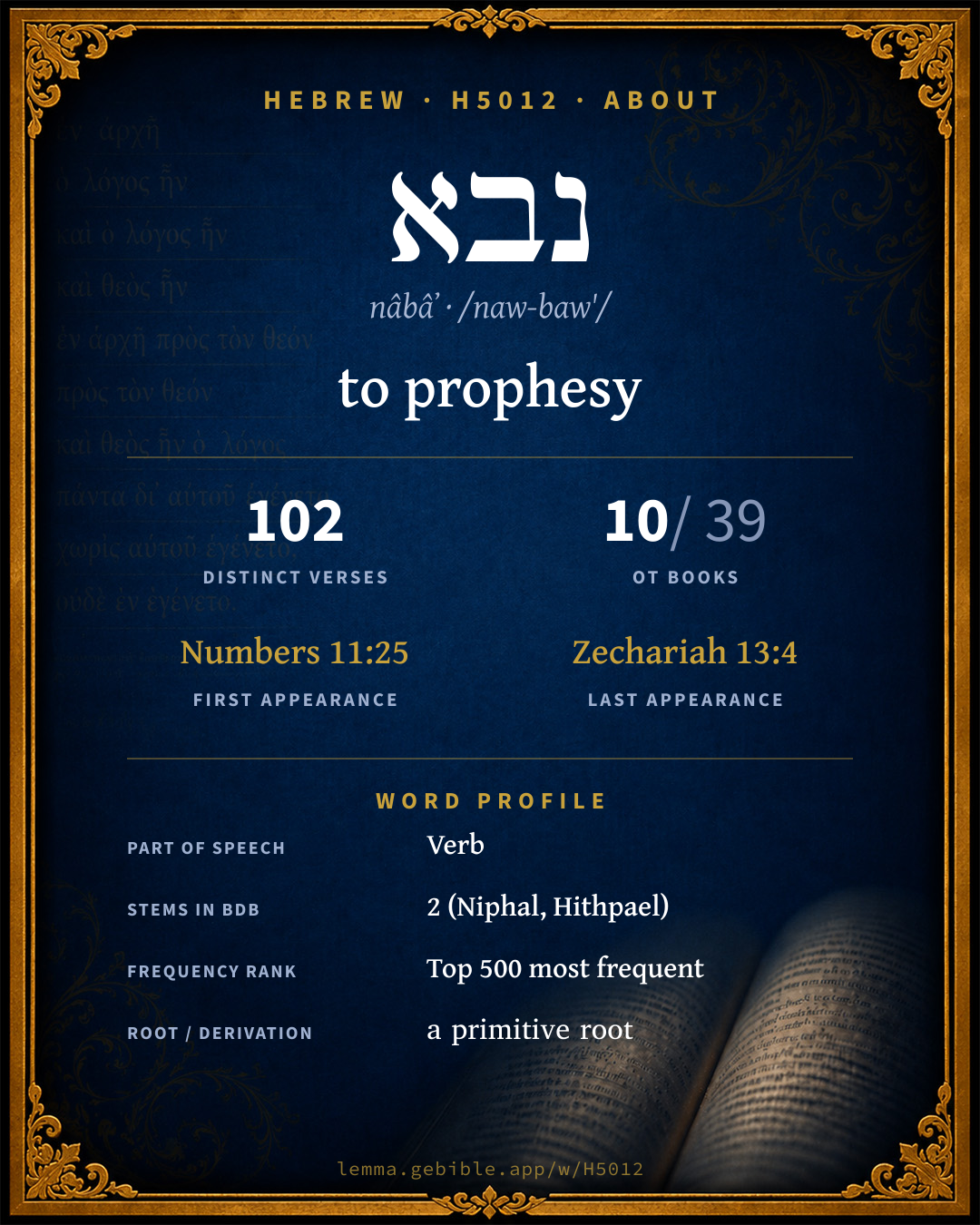
נָבָא
to prophesy
‘to prophesy’ is one of 3 main senses fuller range ↓
Full lexicon entry — Brown-Driver-Briggs (BDB)
From Brown-Driver-Briggs (BDB)
Where this word appears
See every Niphal verb in the Hebrew Bible →
Grammar key — what these labels mean
Part of speech
- Verb
- An action or state-of-being word.
Stem
- Niphal
- Usually the simple passive or reflexive of the Qal (“he was written”). Here: ‘prophesy under influence of divine spirit’
- Hithpael
- The reflexive or reciprocal stem (the subject acts on itself). Here: ‘prophesy under influence of divine spirit’
Form
- Imperative
- A direct command (“write!”).
- Participle Active
- A verbal adjective expressing ongoing or characteristic action (“writing / one who writes”).
- Sequential Imperfect
- An imperfect with prefixed waw — the standard past-narrative form (waw-consecutive imperfect).
- Imperfect
- An incomplete, ongoing, or future action (“he will / would write”).
- Perfect
- A completed action or state — Hebrew marks aspect (completeness) more than strict tense (“he wrote”).
- Infinitive Construct
- A bound verbal noun, frequently with prepositions (“to write / in writing”).
- Sequential Perfect
- A perfect with prefixed waw continuing a preceding imperfect or command (waw-consecutive perfect).
- Participle Passive
- A verbal adjective expressing action received (“written”).
State
- Absolute
- The independent form of a noun, not bound to a following word.
- Construct
- A noun bound to a following noun in a possessive / “of” relationship (the construct chain).
Person
- 2nd Person
- The one addressed (“you”).
- 3rd Person
- The one spoken about (“he / she / it / they”).
- 1st Person
- The speaker (“I / we”).
Gender
- Masculine
- Grammatically masculine.
- Common
- Either gender — not distinguished for this form.
- Feminine
- Grammatically feminine.
Number
- Singular
- One.
- Plural
- More than one (in Hebrew, generally three or more).
Every verse where H5012 appears in the Book of Ezekiel — 31 distinct verses. Click any verse to open its interlinear word-by-word view. Verse text shown in the World English Bible for context — . Each verse’s Hebrew form is shown with its reference; the English is not keyword-highlighted, since the data carries no word-level English alignment. Use “Compare translations” on any verse to read it across multiple English versions. This concordance covers the Hebrew Bible; Septuagint (Greek Old Testament) occurrences are not indexed here.
Ezekiel
- Ezekiel 4:7 וְ/נִבֵּאתָ֖ conj + Niphal wpf 2ms You shall set your face toward the siege of Jerusalem, with your arm uncovered; and you shall prophesy against it.
- Ezekiel 6:2 וְ/הִנָּבֵ֖א conj + Niphal impv 2ms Son of man, set your face toward the mountains of Israel, and prophesy to them,
- Ezekiel 11:4 הִנָּבֵ֣א הִנָּבֵ֖א Niphal impv 2ms Niphal impv 2ms Therefore prophesy against them, prophesy, son of man.
- Ezekiel 11:13 כְּ/הִנָּ֣בְאִ֔/י prep + Niphal inf.cs + sfx pers 1cs It happened, when I prophesied, that Pelatiah the son of Benaiah died. Then fell I down on my face, and cried with a loud voice, and said, Ah Lord Yahweh! will you make a full end of the remnant of Israel?
- Ezekiel 12:27 נִבָּֽא Niphal ptcp.act ms Son of man, behold, they of the house of Israel say, The vision that he sees is for many day to come, and he prophesies of times that are far off.
- Ezekiel 13:2 הִנָּבֵ֛א הַ/נִּבָּאִ֑ים Niphal impv 2ms ptcl def.art + Niphal ptcp.act mp Son of man, prophesy against the prophets of Israel who prophesy, and say you to those who prophesy out of their own heart, Hear you the word of Yahweh:
- Ezekiel 13:16 הַֽ/נִבְּאִים֙ ptcl def.art + Niphal ptcp.act mp [to wit], the prophets of Israel who prophesy concerning Jerusalem, and who see visions of peace for her, and there is no peace, says the Lord Yahweh.
- Ezekiel 13:17 הַ/מִּֽתְנַבְּא֖וֹת וְ/הִנָּבֵ֖א ptcl def.art + Hithpael ptcp.act fp conj + Niphal impv 2ms You, son of man, set your face against the daughters of your people, who prophesy out of their own heart; and prophesy you against them,
- Ezekiel 20:46 וְ/הִנָּבֵ֛א conj + Niphal impv 2ms Son of man, set your face toward the south, and drop [your word] toward the south, and prophesy against the forest of the field in the South;
- Ezekiel 21:2 וְ/הִנָּבֵ֖א conj + Niphal impv 2ms Son of man, set your face toward Jerusalem, and drop [your word] toward the sanctuaries, and prophesy against the land of Israel;
- Ezekiel 21:9 הִנָּבֵא֙ Niphal impv 2ms Son of man, prophesy, and say, Thus says Yahweh: Say, A sword, a sword, it is sharpened, and also furbished;
- Ezekiel 21:14 הִנָּבֵ֕א Niphal impv 2ms You therefore, son of man, prophesy, and strike your hands together; and let the sword be doubled the third time, the sword of the deadly wounded: it is the sword of the great one who is deadly wounded, which enters into their chambers.
- Ezekiel 21:28 הִנָּבֵ֤א Niphal impv 2ms You, son of man, prophesy, and say, Thus says the Lord Yahweh concerning the children of Ammon, and concerning their reproach; and say you, A sword, a sword is drawn, for the slaughter it is furbished, to cause it to devour, that it may be as lightning;
- Ezekiel 25:2 וְ/הִנָּבֵ֖א conj + Niphal impv 2ms Son of man, set your face toward the children of Ammon, and prophesy against them:
- Ezekiel 28:21 וְ/הִנָּבֵ֖א conj + Niphal impv 2ms Son of man, set your face toward Sidon, and prophesy against it,
- Ezekiel 29:2 וְ/הִנָּבֵ֣א conj + Niphal impv 2ms Son of man, set your face against Pharaoh king of Egypt, and prophesy against him, and against all Egypt;
- Ezekiel 30:2 הִנָּבֵא֙ Niphal impv 2ms Son of man, prophesy, and say, Thus says the Lord Yahweh: Wail, Alas for the day!
- Ezekiel 34:2 הִנָּבֵ֖א הִנָּבֵ֣א Niphal impv 2ms Niphal impv 2ms Son of man, prophesy against the shepherds of Israel, prophesy, and tell them, even to the shepherds, Thus says the Lord Yahweh: Woe to the shepherds of Israel who feed themselves! Shouldn't the shepherds feed the sheep?
- Ezekiel 35:2 וְ/הִנָּבֵ֖א conj + Niphal impv 2ms Son of man, set your face against Mount Seir, and prophesy against it,
- Ezekiel 36:1 הִנָּבֵ֖א Niphal impv 2ms You, son of man, prophesy to the mountains of Israel, and say, You mountains of Israel, hear the word of Yahweh.
- Ezekiel 36:3 הִנָּבֵ֣א Niphal impv 2ms therefore prophesy, and say, Thus says the Lord Yahweh: Because, even because they have made you desolate, and swallowed you up on every side, that you might be a possession to the residue of the nations, and you are taken up in the lips of talkers, and the evil report of the people;
- Ezekiel 36:6 הִנָּבֵ֖א Niphal impv 2ms Therefore prophesy concerning the land of Israel, and tell the mountains and to the hills, to the watercourses and to the valleys, Thus says the Lord Yahweh: Behold, I have spoken in my jealousy and in my wrath, because you have borne the shame of the nations:
- Ezekiel 37:4 הִנָּבֵ֖א Niphal impv 2ms Again he said to me, Prophesy over these bones, and tell them, you dry bones, hear the word of Yahweh.
- Ezekiel 37:7 וְ/נִבֵּ֖אתִי כְּ/הִנָּֽבְאִ/י֙ conj + Niphal pf 1cs prep + Niphal inf.cs + sfx pers 1cs So I prophesied as I was commanded: and as I prophesied, there was a noise, and, behold, an earthquake; and the bones came together, bone to its bone.
- Ezekiel 37:9 הִנָּבֵ֖א הִנָּבֵ֣א Niphal impv 2ms Niphal impv 2ms Then said he to me, Prophesy to the wind, prophesy, son of man, and tell the wind, Thus says the Lord Yahweh: Come from the four winds, breath, and breathe on these slain, that they may live.
- Ezekiel 37:10 וְ/הִנַּבֵּ֖אתִי conj + Hithpael pf 1cs So I prophesied as he commanded me, and the breath came into them, and they lived, and stood up on their feet, an exceeding great army.
- Ezekiel 37:12 הִנָּבֵ֨א Niphal impv 2ms Therefore prophesy, and tell them, Thus says the Lord Yahweh: Behold, I will open your graves, and cause you to come up out of your graves, my people; and I will bring you into the land of Israel.
- Ezekiel 38:2 וְ/הִנָּבֵ֖א conj + Niphal impv 2ms Son of man, set your face toward Gog, of the land of Magog, the prince of Rosh, Meshech, and Tubal, and prophesy against him,
- Ezekiel 38:14 הִנָּבֵ֣א Niphal impv 2ms Therefore, son of man, prophesy, and tell Gog, Thus says the Lord Yahweh: In that day when my people Israel dwells securely, shall you not know it?
- Ezekiel 38:17 הַֽ/נִּבְּאִ֛ים ptcl def.art + Niphal ptcp.act mp Thus says the Lord Yahweh: Are you he of whom I spoke in old time by my servants the prophets of Israel, who prophesied in those days for [many] years that I would bring you against them?
- Ezekiel 39:1 הִנָּבֵ֣א Niphal impv 2ms You, son of man, prophesy against Gog, and say, Thus says the Lord Yahweh: Behold, I am against you, Gog, prince of Rosh, Meshech, and Tubal:
About this entry
At a glance — auto-summarized from this page’s data, not written by a person. Every figure links to its source below. This summary describes the numbers; it doesn’t interpret them.
נבא — transliterated nâbâʼ — is a Hebrew verb carrying the sense “to prophesy.” Debuting at Numbers 11:25, it then recurs through the corpus. It appears 102 verses across 10 books of the Hebrew Bible, among its common vocabulary. More than a third of its appearances fall in Jeremiah. Different stems carry different senses — BDB groups them under 2 stems, among them Niphal and Hithpael. Each statement above links to its evidence; the full detail follows below.
Gloss history
Strong's 1890 vs modern scholarship
About this word
Strong's H5012 catalogs a Hebrew word from the Hebrew Old Testament.
These counts are not copied from any lexicon or concordance. They are computed here, from the morphology-tagged Hebrew Old Testament. What Lemma adds →
- 102
- distinct verses
- The word appears in 102 distinct verses.
- 10 / 39
- OT books
- The word appears in 10 of 39 Old Testament books.
- #382
- by frequency
- Top 500 most frequent Hebrew words (rank 382 of 8,640 Hebrew words by occurrence).
View all 102 occurrences in the concordance →
By section of the Old Testament
By traditional corpus
Conventional, traditional groupings — biblical authorship is debated, so this is a traditional corpus grouping, not an authorship claim. Each share is this word’s portion of its verses in that division of the Hebrew canon. Each figure is a share of the word’s 102 distinct verses.
- Prophets (Nevi'im) 91 verses · 89%
- Writings (Ketuvim) 8 verses · 8%
- Torah (Pentateuch) 3 verses · 3%
How translations render this word
Counts come from each version’s own published word-to-Strong’s tagging or interlinear alignment — an approximate guide to how each version renders this word, not a word-level alignment the data otherwise carries. Because each total is that version’s own tagged count, the per-version totals vary from one another and need not match the appearance or distinct-verse counts above. These counts may also differ from a printed concordance because Lemma counts each distinctly tagged rendering and does not collapse phrase taggings into a single head-word total. This is a fixed set of word-tagged versions (KJV, ASV, BSB, ULT) and does not change with the reading translation you choose elsewhere. Each version’s license is shown beside its name below (and on Sources).
- King James Version: Prophesy 42×, Prophesied 17×, They prophesy 7×
- American Standard Version: Prophesy 28×, Prophesied 11×, They prophesy 6×
- Berean Standard Bible: Prophesy 47×, Prophesied 10×, Prophesying 10×
- unfoldingWord Literal Text: Prophesy 41×, Are prophesying 12×, Prophesied 8×
King James Version Public Domain
Renders H5012 across 115 tagged occurrences — most commonly:
Plus 24 renderings that appear only once — usually multi-word phrases or single function words the recovered tagging swept in, not distinct renderings.
American Standard Version Public Domain
Renders H5012 across 114 tagged occurrences — most commonly:
Plus other, less common renderings. Plus 40 renderings that appear only once — usually multi-word phrases or single function words the recovered tagging swept in, not distinct renderings.
Berean Standard Bible Public Domain
Renders H5012 across 114 tagged occurrences — most commonly:
Plus 14 renderings that appear only once — usually multi-word phrases or single function words the recovered tagging swept in, not distinct renderings.
unfoldingWord Literal Text CC BY-SA 4.0
Renders H5012 across 121 tagged occurrences — most commonly:
Plus other, less common renderings. Plus 12 renderings that appear only once — usually multi-word phrases or single function words the recovered tagging swept in, not distinct renderings.
12 senses and sub-senses in the full BDB
Hebrew verbs can shift meaning by stem (binyan): Qal is the basic action, Niphal is often passive or reflexive, Piel often intensifies or makes it factitive, and Hiphil is typically causative. The senses below are grouped under the stem BDB assigns to each. This entry also uses Hithpael (reflexive or reciprocal).
What do BDB’s symbols mean?
BDB uses these scholarly abbreviations:
| Symbol | Meaning |
|---|---|
| 𝔊 | the Septuagint (the ancient Greek translation, LXX) |
| 𝔙 | the Vulgate (the Latin translation) |
| 𝔖 | the Syriac version (the Peshitta) |
| 𝔗 | the Targum (the Aramaic translation) |
| ψ | the Psalms |
| √ | root (the underlying root or stem) |
| ‖ | parallel passage (a synonymous or contrasted parallel) |
| † | the dagger: every passage where the word occurs is cited |
The 12 senses and sub-senses the full Brown-Driver-Briggs lexicon distinguishes for this word, in lexicon order (not ranked by frequency), with BDB’s own verbatim wording and sub-sense lettering. Shown in Hebrew script with BDB’s own scholarly abbreviations. The condensed entry is in the Lexicon Entry tab. See also the Forms in the corpus table below.
Niphal
- Pf. 3 ms. נִבָּא Je 20:1 + 7 times; 2 ms. נִבֵּאתָ Je 20:6 + 2 times; נִבֵּיתָ Je 26:9; 1 s. נִבֵּאתִי Ez 37:7; 3 pl. נִבְּאוּ Je 2:8 + 3 times; נִבָּ֑נוּ Je 23:21; Impf. 3 ms. יִנָּבֵא Am 3:8 + 9 times Impf.; Imv. הִנָּבֵא Am 7:15 + 27 times; Inf. הִנָּבֵא Am 7:13; sf. הִנָּֽבְאוֹ Zc 13:3; הִנָּֽבְאֹתוֹ Zc 13:4, + 4 times Inf.; Pt. נִבָּא Je 26:18 + (Ges§ 93 oo);— e.g. Jeremiah 20:1
- 1. prophesy under influence of divine spirit:
- a. in the ecstatic state, with song 1 S 10:11; 19:20 and music 1 Ch 25:1, 2, 3. e.g. 1 Samuel 10:11
- b. the word of י׳: abs. Am 2:12; 3:8 (emend. יחרד We Now needless), 7:12, 13 Jo 3:1 Je 19:14; 26:18; 28:9; 32:3 Ez 11:13; 12:27; 21:19; 37:7; 38:17 but especially in phr. הִנָּבֵא וְאָמַרְתָּ Ez 12:27; 21:14, 33; 30:2; 34:2; 36:3; 37:7, 12; 38:14, 17; c. acc. Je 20:1; 25:30; 28:6; sq. עַל against Am 7:16 Je 25:13; 26:20 Ez 4:7; 11:4; 13:17; 25:2; 28:21; 29:2; 34:2; 35:2; 36:6; 38:2; 39:1; unto Ez 37:4; אֶל unto Am 7:15 Je 26:11, 12; 28:8 Ez 36:1; 37:9; against 6:2; 13:2; 21:2, 7; בְּשֵׁם י׳ Je 11:21; 14:15; 23:25; 26:9. e.g. Amos 2:12
- 2. of false prophets: abs. Je 23:21 Ez 13:2 Zc 13:3(×2), 4; c. acc. 1 K 22:12 = 2 Ch 18:11; שֶׁקֶר Je 14:14; 23:25; 27:10, 14, 16; 29:21; לַשָּׁ֑קֶר 27:15; בַּשֶּׁקֶר 5:31; 20:6, 29:9; נִבְּאֵי הַשּׁ׳ 23:26, cf. v 32; c. לְ 14:16; 23:16; 27:15, 16; 29:31; 37:19; sq. אֶל concerning Ez 13:16. e.g. Jeremiah 23:21
- 3. cf. heathen prophets, בַּבַּעַל Je 2:8. e.g. Jeremiah 2:8
Hithpael
- Pf. 2 ms. הִתְנַבִּיתָ 1 S 10:6; 1 s. הִנַּבֵּאתִי Ez 37:10; 3 pl. הִנַּבְּאוּ Je 23:13; Impf. יִתְנַבֵּא 1 S 10:10 + 7 times; 3 mpl. יִתְנַבְּאוּ Nu 11:25 + 5 times; Inf. הִתְנַבּוֹת 1 S 10:13; Pt. מִתְנַבֵּא Je 26:20 + 9 times Pt.;— e.g. 1 Samuel 10:6
- 1. prophesy under influence of divine spirit:
- a. in the ecstatic state Nu 11:25, 26, 27 (J), with music 1 S 10:5, 6, 10, 13, in frenzy 1 S 19:20, 21(×2), 23, 24; excited to violence 1 S 18:10 (= מְשֻׁגָּע mad 2 K 9:11); Je 29:26. e.g. Numbers 11:25
- b. apart from ecstatic state, abs. Ez 37:10, c. לְ 1 K 22:8 Je 29:27; על 1 K 22:18 = 2 Ch 18:17, 2 Ch 18:7; 20:37; בְּשֵׁם י׳ Je 26:20. e.g. Ezekiel 37:10
- 2. of heathen prophets of Baal in ecstatic state 1 K 18:29; בַּבַּעַל Je 23:13. e.g. 1 Kings 18:29
- 3. of false prophets 1 K 22:10 = 2 Ch 18:9, Je 14:14 Ez 13:17. e.g. 1 Kings 22:10
Senses from the full Brown-Driver-Briggs lexicon (Brown, Driver, Briggs; Oxford 1906 — public domain), digitized via Sefaria, supplemented by the OpenScriptures HebrewLexicon (CC BY 4.0). Full attribution on Sources.
Word origin
vb. denom. prophesy (in oldest forms, of religious ecstasy with or without song and music; later, essentially religious instruction, with occasional predictions);—
— Brown-Driver-Briggs (Oxford 1906, public domain), digitized via Sefaria, supplemented by the OpenScriptures HebrewLexicon (CC BY 4.0). See Sources.
Origin: a primitive root
Jastrow Dictionary
A second Hebrew/Aramaic lexicon for comparison, covering Aramaic and post-biblical (Talmudic, Targumic, Midrashic) usage that the biblical-Hebrew BDB does not. Matched by lemma rather than by Strong’s number, so a lemma may carry more than one Jastrow headword (shown separately below), and the entries cover usage well beyond the Bible.
*נִבָּא
- eggs of lice, Var. in Ar. for אִנְבָּא II.
נָבָא
- , v. נבי II
נבי II
- to burst forth, blow.
- to be inspired, to prophesy. Snh. 39ᵇ יבא … ויִנָּבֵא על וכ׳ let Obadiah come … and prophesy against &c.; a. e.
- same. Ex. R. s. 4. כמה … שלא להִתְנַבְּאוֹת ונ׳ וכ׳ how much Jeremiah desired not to be a prophet, and yet he prophesied against his will. Sot. 12ᵇ נִתְנַבְּאָה שלא מדעתה she prophesied unwittingly. Ib. מִתְנַבְּאָה ואינה וכ׳ she prophesied but did not know what she prophesied. Meg. 14ᵃ ארְבעים … נִתְנַבְּאוּ להם וכ׳ forty-eight prophets and seven prophetesses prophesied to Israel &c. B. Bath. 15ᵇ; a. fr.
נְבֵי
- Ithpa. אִיתְנַבָּא, אִיתְנַבֵּי, אִינַּבֵּי same. Targ. Num. XI, 25, sq.; a. fr.—Meg. 14ᵇ ובמקום דקאי ירמיהו היכי מִיתְנַבְּיָא איהי how could she (Huldah) dare to prophesy in the same place with Jeremiah? Snh. 96ᵇ דאינ׳ להו לישראל בחורבתא וכ׳ who had prophesied to Israel the destruction of the Temple. B. Bath. 15ᵇ אִינַּבּוּיֵ אינבי לאומות העולם (read. אינַבּוּ; Ms. M. אִינַּבִּיאוּ) they prophesied for the gentiles; ib. הכא נמי איוב אינבוי אינבי לעכ"ום so Job likewise prophesied for the gentiles. Ib. [read:] אטו כולהו נביאי מי לא אִינַּבּוּ וכ׳ (Ms. M. אינביאו, v. Rabb. D. S. a. l. note) did not all prophets prophesy for the gentiles?
A Dictionary of the Targumim, the Talmud Babli and Yerushalmi, and the Midrashic Literature (Marcus Jastrow; London, Luzac, 1903) — Public Domain. Digitized via Sefaria. Digitized via Sefaria. Full attribution on Sources.
Forms in the corpus
The 77 distinct written forms H5012 takes in the Hebrew Bible, most frequent first — each parse links to that stem’s occurrences in the concordance. Hebrew forms include their vowel points and cantillation, so a single lemma takes many written forms.
The 60 most common forms are shown; 17 rarer forms follow in the full concordance.
Same root — word family
Other BDB entries built from the same root as H5012, grouped by Strong’s listed origin. These share a root / origin per the lexicon — not necessarily a shared meaning. Each links to that word’s own entry.
Derived from this word
Compare all same-root words → They share a root, not necessarily a meaning.
Septuagint verse parallels
This word appears in 94 verses that also exist in the Greek Old Testament (Septuagint), out of the 102 Hebrew verses it occurs in. You can read those verses in Greek by switching the Old Testament edition to the Septuagint.
Read these verses in the Septuagint
- Numbers 11:25
- 1 Samuel 10:5
- 1 Kings 18:29
- 1 Chronicles 25:1
- 2 Chronicles 18:7
- Jeremiah 2:8
- Ezekiel 4:7
- Amos 2:12
- Zechariah 13:3
This is a verse-level parallel only — the same verses exist in both the Hebrew and Greek Old Testaments. No word-level Hebrew↔Greek correspondence is claimed: the data carries no such alignment, so no Greek word is shown as this Hebrew word’s translation. Coverage is not total — the Septuagint omits the deuterocanon and renumbers the Psalms, so some Hebrew verses have no direct Greek parallel.