1 Chronicles 25:2

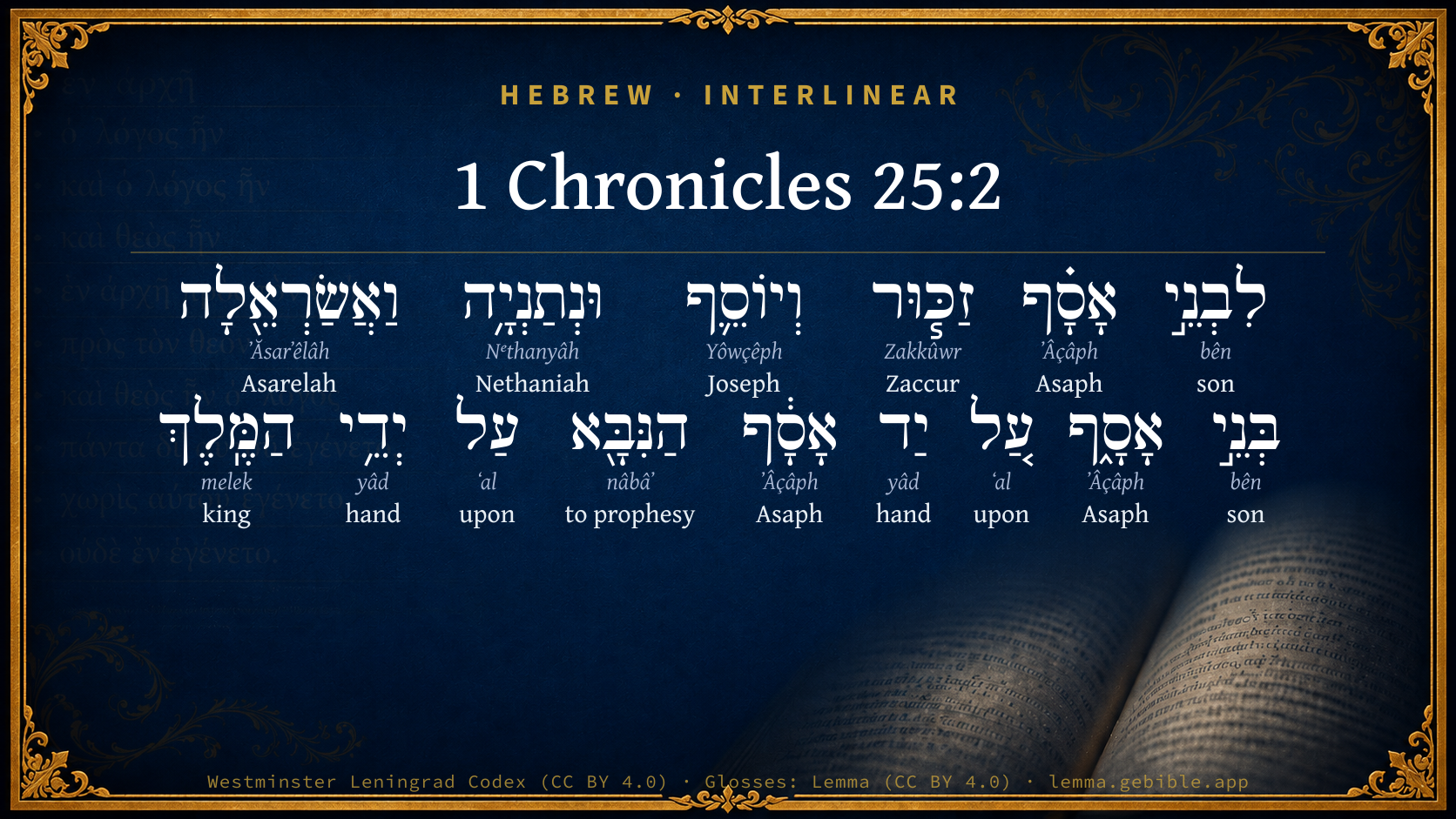
Hebrew (Westminster Leningrad Codex) 1 Chronicles 25:2 appears in the Hebrew Old Testament. The text above is from the Westminster Leningrad Codex. Each word links to its Strong’s number, a concise gloss, and parsing drawn from the Open Scriptures Hebrew Bible morphology. Click any word for its full Brown-Driver-Briggs (BDB) entry.
Download image
Cite this verse

1 Chronicles 25:2 (World English Bible). Public Domain. Lemma interlinear Bible study tool, https://lemma.gebible.app/v/1-chronicles/25/2.

Show BibTeX & RIS
BibTeX
RIS
English Translation
of the sons of Asaph: Zaccur, and Joseph, and Nethaniah, and Asharelah, the sons of Asaph, under the hand of Asaph, who prophesied after the order of the king.
World English Bible · Public Domain
Highlights Full analysis ↓
Download a study sheet

One document with this verse’s original text, its word-by-word gloss line, the meaning frame, cross-references with their text, attributed commentary, and full source and license credits — printable, and it pastes into notes with its structure intact.

This verse Autodidact and up

Study sheet (.html) Plain text (.txt)

A passage Seminary Student

Up to 50 verses in one chapter. A passage sheet keeps up to 6 commentary sources and 12 cross-references per verse, in the order this page ranks them, and says so on the sheet whenever that leaves anything out. Ask for a single verse and you get the Autodidact verse sheet above.

Everything on this page stays free to read, with no account — the sheet is a download of what is already on screen, not access to it.

Want to remove ads? Support Godless Engineer
Compare translations 3

The same verse in 3 English versions, stacked beneath the original-language interlinear above. Click any original word for its lexicon entry.

Each is an independent rendering of the whole verse — the interlinear is not word-aligned to these translations.

Highlighted words mark where these versions differ — a whole-verse word diff, not a word-by-word alignment.

  • World English Bible Public Domain
    of the sons of Asaph: Zaccur, and Joseph, and Nethaniah, and Asharelah, the sons of Asaph, under the hand of Asaph, who prophesied after the order of the king.
  • King James Version Public Domain
    Of the sons of Asaph; Zaccur, and Joseph, and Nethaniah, and Asarelah, the sons of Asaph under the hands of Asaph, which prophesied according to the order of the king.
  • unfoldingWord Literal Text CC BY-SA 4.0
    From the sons of Asaph: Zaccur and Joseph and Nethaniah and Asharelah, the sons of Asaph, at the hand of Asaph, prophesying at the hands of the king.

unfoldingWord Literal Text — © unfoldingWord, licensed CC BY-SA 4.0. Word-aligned USFM3 via Door43 (git.door43.org/unfoldingWord/en_ult).

Versions to compare (up to 4)

3 of 4 selected

Show all 18 translations

Every available English version of this verse, each an independent rendering of the whole verse.

  • World English Bible Public Domain
    of the sons of Asaph: Zaccur, and Joseph, and Nethaniah, and Asharelah, the sons of Asaph, under the hand of Asaph, who prophesied after the order of the king.
  • Berean Standard Bible Public Domain
    From the sons of Asaph: Zaccur, Joseph, Nethaniah, and Asarelah. These sons of Asaph were under the direction of Asaph, who prophesied under the direction of the king.
  • Majority Standard Bible Public Domain
    From the sons of Asaph: Zaccur, Joseph, Nethaniah, and Asarelah. These sons of Asaph were under the direction of Asaph, who prophesied under the direction of the king.
  • King James Version Public Domain
    Of the sons of Asaph; Zaccur, and Joseph, and Nethaniah, and Asarelah, the sons of Asaph under the hands of Asaph, which prophesied according to the order of the king.
  • American Standard Version (1901) Public Domain
    of the sons of Asaph: Zaccur, and Joseph, and Nethaniah, and Asharelah, the sons of Asaph, under the hand of Asaph, who prophesied after the order of the king.
  • Revised Version (1885) Public Domain
    of the sons of Asaph; Zaccur, and Joseph, and Nethaniah, and Asharelah, the sons of Asaph; under the hand of Asaph, who prophesied after the order of the king.
  • Geneva Bible (1599) Public Domain
    Of the sonnes of Asaph, Zaccur, and Ioseph, and Nethaniah, and Asharelah the sonnes of Asaph were vnder the hand of Asaph, which sang prophesies by the commission of the King.
  • Douay-Rheims (1899) Public Domain
    Of the sons of Asaph: Zacchur, and Joseph, and Nathania, and Asarela, sons of Asaph: under the hand of Asaph prophesying near the king.
  • Young's Literal Translation Public Domain
    Of sons of Asaph: Zaccur, and Joseph, and Nethaniah, and Asharelah, sons of Asaph, `are' by the side of Asaph, who is prophesying by the side of the king.
  • Literal Standard Version CC BY-SA 4.0
    Of sons of Asaph: Zaccur, and Joseph, and Nethaniah, and Asharelah; sons of Asaph [are] by the side of Asaph, who is prophesying by the side of the king.
  • Unlocked Literal Bible CC BY-SA 4.0
    From the sons of Asaph: Zaccur, Joseph, Nethaniah, and Asharelah, the sons of Asaph, under the direction of Asaph, who prophesied under the king's supervision.
  • unfoldingWord Literal Text CC BY-SA 4.0
    From the sons of Asaph: Zaccur and Joseph and Nethaniah and Asharelah, the sons of Asaph, at the hand of Asaph, prophesying at the hands of the king.
  • Darby Bible Public Domain
    of the sons of Asaph: Zaccur, and Joseph, and Nethaniah, and Asharelah, the sons of Asaph under the direction of Asaph, who prophesied at the direction of the king.
  • World Messianic Bible Public Domain
    of the sons of Asaph: Zaccur, Joseph, Nethaniah, and Asharelah. The sons of Asaph were under the hand of Asaph, who prophesied at the order of the king.
  • Webster's Bible Public Domain
    Of the sons of Asaph; Zaccur, and Joseph, and Nethaniah, and Asarelah, the sons of Asaph under the hands of Asaph, who prophesied according to the order of the king.
  • Free Bible Version CC BY-SA 4.0
    From the sons of Asaph: Zaccur, Joseph, Nethaniah, and Asarelah. These sons of Asaph were under the supervision of Asaph, who prophesied under the supervision of the king.
  • Bible in Basic English Public Domain
    Of the sons of Asaph: Zaccur and Joseph and Nethaniah and Asharelah, sons of Asaph; under the direction of Asaph, acting as a prophet under the orders of the king;
  • JPS Tanakh (1917) Public Domain
    of the sons of Asaph: Zaccur, and Joseph, and Nethaniah, and Asarelah, the sons of Asaph; under the hand of Asaph, who prophesied according to the direction of the king.

Literal Standard Version (2020), Covenant Press — licensed CC BY-SA 4.0. Text via the HelloAO Bible API (eBible.org). Unlocked Literal Bible (unfoldingWord) — licensed CC BY-SA 4.0. Text via the HelloAO Bible API (eBible.org). unfoldingWord Literal Text — © unfoldingWord, licensed CC BY-SA 4.0. Word-aligned USFM3 via Door43 (git.door43.org/unfoldingWord/en_ult). Free Bible Version, Dr. Jonathan Gallagher — licensed CC BY-SA 4.0. Text via the HelloAO Bible API (eBible.org).

Word by word

More ways to search: Search by grammar → Find every occurrence → Compare this word →

Practice this passage: Drill this verse → Learn its vocabulary →

וַאֲשַׂרְאֵ֖לָה
ʼĂsarʼêlâh
H841
“and · Asarelah”
Conjunction + Noun, Proper
Part of Speech
Conjunction + Noun
Type
Proper
Full BDB Definition

Origin: from the same as H840

TWOT: None

Asarelah = "God holds" - a son of Asaph, appointed sanctuary musician by David
  1. לִבְנֵ֣י bên H1121 “to/for · sons of” Preposition + Noun, Common, Masculine, Plural, Construct
  2. אָסָ֗ף ʼÂçâph H623 “Asaph” Noun, Proper
  3. זַכּ֧וּר Zakkûwr H2139 “Zaccur” Noun, Proper
  4. וְיוֹסֵ֛ף Yôwçêph H3130 “and · Joseph” Conjunction + Noun, Proper
  5. וּנְתַנְיָ֥ה Nᵉthanyâh H5418 “and · Nethaniah” Conjunction + Noun, Proper
  6. בְּנֵ֣י bên H1121 “sons of” Noun, Common, Masculine, Plural, Construct
  7. אָסָ֑ף ʼÂçâph H623 “Asaph” Noun, Proper
  8. עַ֚ל ʻal H5921 “upon” Preposition
  9. יַד yâd H3027 “hand of” Noun, Common, Both, Singular, Construct
  10. אָסָ֔ף ʼÂçâph H623 “Asaph” Noun, Proper
  11. הַנִּבָּ֖א nâbâʼ H5012 “the · prophesying” Particle, Definite Article + Verb, Niphal, Participle Active, Masculine, Singular, Absolute
  12. עַל ʻal H5921 “upon” Preposition
  13. יְדֵ֥י yâd H3027 “hands of” Noun, Common, Both, Dual, Construct
  14. הַמֶּֽלֶךְ melek H4428 “the · king” Particle, Definite Article + Noun, Common, Masculine, Singular, Absolute

About this verse

These counts appear in no published source. They are computed here, from the morphology-tagged text and Lemma’s own curated glosses. What Lemma adds →

15
words
10
distinct lemmas
Historical
section

Notable vocabulary

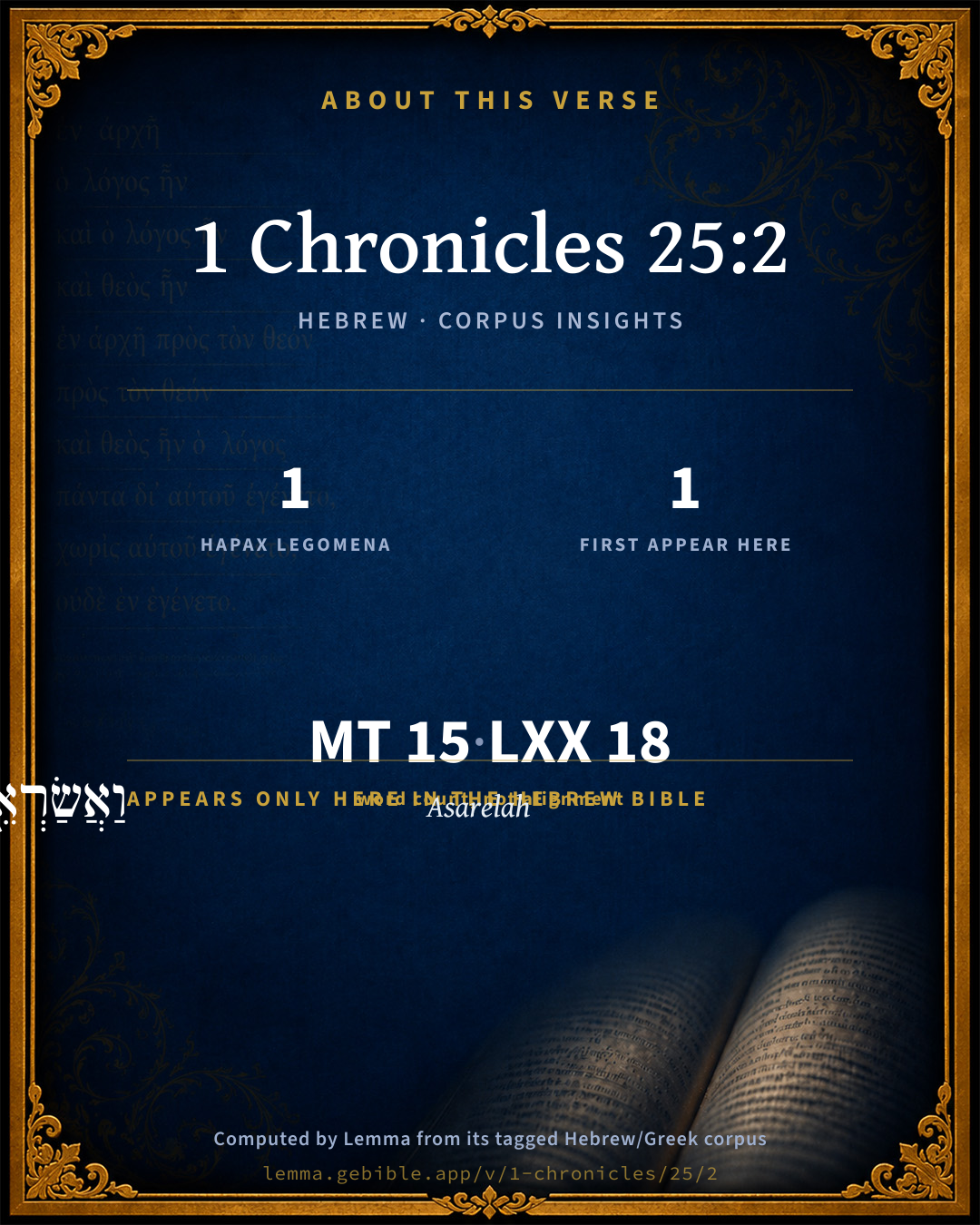
1 hapax legomenon — a word that appears only here in the entire Hebrew Bible:

  • וַאֲשַׂרְאֵ֖לָה Asarelah H841

First appearance in Scripture

This word makes its first canonical appearance in the Hebrew Bible here:

  • וַאֲשַׂרְאֵ֖לָה Asarelah H841

Shared distinctive vocabulary

זַכּ֧וּר Zaccur H2139 occurs in 10 verses of the Hebrew Bible. Also found in:

Grammatical profile

  • 1 verb
  • 12 nouns
  • 2 prepositions

Verb forms

  • הַנִּבָּ֖א Niphal · Participle Active

Repetition

Words recur within this verse — often emphatic in Hebrew:

  • אָסָ֗ף Asaph H623 ×3
  • לִבְנֵ֣י son H1121 ×2
  • עַ֚ל upon H5921 ×2
  • יַד hand H3027 ×2

Hebrew & Septuagint length

In English translation the verse runs 29 words from the Hebrew and 18 from the Septuagint (LXX English) — the Septuagint runs noticeably shorter here. See the side-by-side →

A rough comparison of the two English renderings, which tokenize alike — not a word-level alignment.

Word counts can differ between the Hebrew and the Greek without any difference in meaning — e.g. the Hebrew direct-object marker אֵת has no separate Greek word, and Greek often adds the article ὁ.

In the original languages it is 15 Hebrew tokens and 18 Greek tokens — but the two are counted differently (Hebrew bundles its prefixes and suffixes into one token; the Greek is in lemma form), so that isn’t a like-for-like length.

Cross-references

18

Topical passages linked to 1 Chronicles 25:2 in the Treasury of Scripture Knowledge — connected by theme and wording, ordered by reader-vote popularity; previews shown in the World English Bible.

  • 1 Chronicles 25:6 All these were under the hands of their father for song in the house of Yahweh, with cymbals, psalteries, and harps, for the service of the house of God; Asaph, Jeduthun, and Heman being under the order of the king.
  • 1 Chronicles 16:5 Asaph the chief, and second to him Zechariah, Jeiel, and Shemiramoth, and Jehiel, and Mattithiah, and Eliab, and Benaiah, and Obed-edom, and Jeiel, with psalteries and with harps; and Asaph with cymbals, sounding aloud;
  • 1 Chronicles 25:1 Moreover, David and the captains of the host set apart for the service certain of the sons of Asaph, and of Heman, and of Jeduthun, who should prophesy with harps, with psalteries, and with cymbals: and the number of those who did the work according to their service was:
  • 1 Chronicles 6:39 His brother Asaph, who stood on his right hand, even Asaph the son of Berechiah, the son of Shimea,
  • 1 Chronicles 15:17 So the Levites appointed Heman the son of Joel; and of his brothers, Asaph the son of Berechiah; and of the sons of Merari their brothers, Ethan the son of Kushaiah;
  • 1 Chronicles 25:3 Of Jeduthun; the sons of Jeduthun: Gedaliah, and Zeri, and Jeshaiah, Hashabiah, and Mattithiah, six, under the hands of their father Jeduthun with the harp, who prophesied in giving thanks and praising Yahweh.
  • Psalms 73:1 Surely God is good to Israel, To those who are pure in heart.
  • Psalms 74:1 God, why have you rejected us forever? Why does your anger smolder against the sheep of your pasture?
  • Psalms 75:1 We give thanks to you, God, We give thanks, for your Name is near. Men tell about your wondrous works.
  • Psalms 76:1 In Judah, God is known. His name is great in Israel.
  • Psalms 77:1 My cry goes to God! Indeed, I cry to God for help, And for him to listen to me.
  • Psalms 78:1 Hear my law, my people. Turn your ears to the words of my mouth.
  • Psalms 79:1 God, the nations have come into your inheritance. They have defiled your holy temple. They have laid Jerusalem in heaps.
  • Psalms 80:1 Hear us, Shepherd of Israel, You who lead Joseph like a flock, You who sit above the cherubim, shine forth.
  • Psalms 81:1 Sing aloud to God, our strength! Make a joyful shout to the God of Jacob!
  • Psalms 82:1 God presides in the great assembly. He judges among the gods.
  • Psalms 83:1 God, don't keep silent. Don't keep silent, And don't be still, God.
  • Isaiah 3:6 Indeed a man shall take hold of his brother in the house of his father, saying, "You have clothing, you be our ruler, And let this ruin be under your hand."

Cross-references courtesy of OpenBible.info (CC BY 4.0).

Hebrew and Greek witnesses Masoretic Hebrew ↔ Greek Septuagint

The same verse in the two great witnesses to the Old Testament, shown verse-for-verse.

Here the Septuagint runs noticeably shorter than the Hebrew — LXX2012 (modern English Septuagint) 18 words vs World English Bible 29. A rough length comparison of the two English translations, not a word-level alignment — read both below.

These are two independent witnesses, not word-aligned to each other, and the Septuagint is shown in lemma (dictionary) form.

Hebrew 1 Chronicles 25:2 Masoretic · Westminster Leningrad Codex

לִבְנֵ֣י אָסָ֗ף זַכּ֧וּר וְיוֹסֵ֛ף וּנְתַנְיָ֥ה וַאֲשַׂרְאֵ֖לָה בְּנֵ֣י אָסָ֑ף עַ֚ל יַד אָסָ֔ף הַנִּבָּ֖א עַל יְדֵ֥י הַמֶּֽלֶךְ

of the sons of Asaph: Zaccur, and Joseph, and Nethaniah, and Asharelah, the sons of Asaph, under the hand of Asaph, who prophesied after the order of the king.

World English Bible · Public Domain

Greek LXX 1 Chronicles 25:2 Septuagint · lemma form

υἱός ασαφ ζακχουρ καί ιωσηφ καί ναθανιας καί εραηλ υἱός ασαφ ἔχω ασαφ ὁ προφήτης ἔχω ὁ βασιλεύς

The sons of Asaph; Sacchur, Joseph, and Nathanias, and Erael: the sons of Asaph were next the king.

LXX2012 (modern English Septuagint) · Public Domain

Hebrew: Westminster Leningrad Codex (CC BY 4.0). Greek: Septuagint (public domain); English from LXX2012 (modern English Septuagint) (Public Domain). How the Septuagint differs from the Hebrew →

Commentary

Notes on 1 Chronicles 25:2 from classic Christian and Jewish commentators (each source and its license shown beneath its notes). The classic Christian expositions comment on the surrounding passage and are grouped to its opening verse, so a note may address several verses; the Jewish commentaries on the Tanakh (Rashi and others) are per-verse, so they appear only where the commentator wrote on this verse.

Lemma curates 59 commentaries, every one of them public domain or Creative Commons licensed, each selected and text-cleaned for this edition rather than reprinted as found. About our sources →

Ellicott's Commentary for English Readers

(2) Of the sons of Asaph; Zaccur.—Literally, To the sons of Asaph belonged Zaccur. In 1Ch_25:2-7 the term “sons” appears to mean trained members of the musical guilds, of which the three chiefs, Asaph, Heman, and Jeduthun, were masters.

Asarelah.—This singular name is spelt “Jesharelah” in 1Ch_25:14. Ewald identifies it with “Israel,” the unaccented ending ah having the force belonging to—literally, towards, unto—so that Jesharelah is in effect the modern Jewish surname Israels. (Comp. “Jaakobah,” 1Ch_4:36, to Jacob, i.e., Jacobs.)

Under the hands of Asaph.—Rather, at the hand of Asaph. It is implied that the four leaders here named were subordinate to Asaph, and under his direction. (Comp. 1Ch_25:3; 1Ch_25:6; 2Ch_23:18; 2Ch_29:27; Ezr_3:10.)

Which prophesied according to the order of the king.—Literally (Asaph), who prophesied (or should prophesy, the participle, as in 1Ch_25:1) at the hands of the king: that is, either according to the royal arrangements (2Ch_23:18), under David’s own appointment, or under the royal direction.

Prophesied.—That is, made music. (See 1Ch_25:1.)

A Bible Commentary for English Readers, edited by Charles John Ellicott (1878–1897) — public domain. Text from a community e-Sword module.

Trapp's Complete Commentary

John Trapp

1Ch 25:2 Of the sons of Asaph; Zaccur, and Joseph, and Nethaniah, and Asarelah, the sons of Asaph under the hands of Asaph, which prophesied according to the order of the king.

Ver. 2. According to the order of the king.] Heb., By the hand of the king; who as he penned most of the Psalms, so he appointed the singers, the instruments, the tunes, the times, and the uses of them, as appeareth by the titles of divers of David’s Psalms. Some render it iuxta regem, nigh to the king; near his seat in the holy assembly, where these holy musicians, by their melodious noises, stirred up David to true faith and piety. Non dispuduit tantum Prophetam, saith Lavater. So great a prophet held it no shame thus to excite his devotion. There are too many now-a-days addicted to music, but of another nature, and for a worse purpose.

John Trapp, A Commentary or Exposition upon All the Books of the Old and New Testament (1647–1656) — public domain. Text from a community e-Sword module.

Joseph Benson's Commentary

1Ch 25:2-3. Under the hands of Asaph — Under his oversight and direction. According to the order of the king — In such manner and order as David appointed. The sons of Jeduthun, six — Jeduthun, their father, being included in that number; or Shimei, mentioned 1Ch 25:17.

Joseph Benson's Commentary on the Old and New Testaments (1811–1818) — public domain. Text from a community e-Sword module.

Tyndale Open Study Notes

Tyndale Open Resources

25:2-3 Asaph and Jeduthun . . . proclaimed God’s messages, meaning they were prophets as well as musicians.

Tyndale Open Study Notes — © Tyndale Open Resources, licensed CC BY-SA 4.0. Text via the HelloAO Bible API.

Geneva Bible (1599)

Geneva Bible translators

Hebrew, hands.

Geneva Bible (1599) marginal notes — public domain. Text via Bolls.life.

Jamieson, Fausset & Brown

Robert Jamieson, A. R. Fausset & David Brown

according to the order of the king--Hebrew, "by the hands of the king," that is, "according to the king's order," under the personal superintendence of Asaph and his colleagues.

which prophesied--that is, in this connection, played with instruments. This metaphorical application of the term "prophecy" most probably originated in the practice of the prophets, who endeavored to rouse their prophetic spirit by the animating influence of music (see on Kg2 3:15). It is said that Asaph did this "according to David's order," because by royal appointment he officiated in the tabernacle on Zion (Ch1 16:37-41), while other leaders of the sacred music were stationed at Gibeon.

Jamieson, Fausset & Brown — Commentary Critical and Explanatory on the Whole Bible (1871) — public domain (CC PDM 1.0). Text via the HelloAO Bible API.

Adam Clarke's Commentary

Verse 2. Which prophesied] Sung hymns and prayed. But the Targum understands this of prophesying in the proper sense of the term; and therefore says, "Who prophesied by the Holy Spirit." Jarchi is of the same opinion and quotes the case of Elisha, 2Kg 3:15; While the minstrel played, the hand of the Lord [i.e., the spirit of prophecy] was upon him.

Adam Clarke's Commentary on the Bible (1810–1826) — public domain. Text from a community e-Sword/MySword module.

The Cambridge Bible for Schools and Colleges

gen. ed. J. J. S. Perowne

2. Asaph] See 1Ch_15:17, note.

Asarelah] R.V. Asharelah; in 1Ch_25:14 “Jesharelah.”

under the hands] R.V. under the hand.

prophesied] i.e. sang and praised in the manner of prophets; cp. 1Ch_25:3, “prophesied with a harp, to give thanks and to praise the Lord.” There is no reference to prediction here. Cp. 1Sa_10:5.

according to the order] R.V. after the order. All was done according to the order established by king David.

The Cambridge Bible for Schools and Colleges (gen. ed. J. J. S. Perowne; Cambridge University Press, 1878–1918) — public domain. Text from a community e-Sword module.

John Gill's Exposition

Of the sons of Asaph,.... Who were separated, and by lot appointed, to the service of singers in the temple:

Zaccur, and Joseph, and Nethaniah, and Asarelah; called Jesharelah, Ch1 25:14, these had the third fourth, fifth, and seventh lots, Ch1 25:9,

under the hands of Asaph; under his instruction and authority:

which prophesied according to the order of the king; which Asaph composed psalms under the inspiration of the Spirit of God, and was ordered by King David to sing them, and by whose command they were inserted in the book of Psalms, where they now stand with his name to them.

John Gill's Exposition of the Whole Bible (1746–1763) — public domain (CC PDM 1.0). Text via the HelloAO Bible API.

Albert Barnes' Notes on the Bible

Under the hands of Asaph ... - That is to say, “under the direction of Asaph” - who himself “prophesied,” or performed the sacred services, “under the direction of the king.”

Albert Barnes' Notes on the Bible (1834–1885) — public domain. Text from a community e-Sword/MySword module.

Haydock's Catholic Bible Commentary

King, who sat in a separate tribune. Asaph presided in the royal city, at court, and in the tabernacle, while some of the singers were fixed at Gabaon, chap. xvi. 7, 37, and 41. (Calmet) --- Hebrew may signify, "at the king’s command. (Pagnin) --- He sometimes condescended to direct the singers, ver. 6. (Haydock)

George Leo Haydock (1774–1849), Haydock's Catholic Family Bible and Commentary, 1859 edition — public domain. Excludes Psalms (Douay-Rheims chapter numbering differs from Protestant) and Deuterocanonical books (Catholic canon only).

Matthew Poole's English Annotations

Under the hands of Asaph, i.e. under his oversight and direction. According to the order of the king; in such manner and order as David appointed.

Matthew Poole's English Annotations on the Holy Bible (1683–1685) — public domain. Text from a community e-Sword/MySword module.

Whedon's Commentary on the Bible

Daniel D. Whedon

2. Prophesied according to the order of the king — That is, in accordance with David’s arrangements and orders.

Daniel D. Whedon (gen. ed.), Commentary on the Old and New Testaments (1874–1909) — public domain. Text from a community e-Sword module.

The Pulpit Commentary

Four sons of Asaph are hero given, the number, however, not being ex. pressed, although it is expressed in the cases of Jeduthun and Heman (vers. 3, 5). "For Asaph," we find twelve psalms inscribed, viz. Ps 1 Ps 73 Ps 83.; of some of which he was himself the inspired composer. When it is said "for Asaph," the meaning is for those "under his hand," or direction, and who as a band bore his name, and performed among other odes those which he prophesied. Zaccur. A descendant after the Return is mentioned in Neh_12:35. Asarelah. This last of the four sons of Asaph is called in ver. 14, Jesharelah. Under the hands of according to the order of. The Hebrew words are "to the hand of" and "to the hands of." Between the signification of these two forms, the one expressed in the singular number and the ether in the plural, there does not seem to be any distinction, and accordingly they might be better translated, under the direction of under the directions of. The latter form is that found in vers. 3, 6.

The Pulpit Commentary (1880–1919), ed. H.D.M. Spence-Jones & Joseph S. Exell — public domain. Text from a community e-Sword module.

John Wesley's Explanatory Notes

Of Asaph - Under his direction. Of the king - In such manner and order as David appointed.

John Wesley, Explanatory Notes Upon the Whole Bible (1754–1765) — public domain. Text via the GEBible commentary corpus.

Keil & Delitzsch

C. F. Keil & F. Delitzsch

Of the sons of Asaph,.... Who were separated, and by lot appointed, to the service of singers in the temple:

Zaccur, and Joseph, and Nethaniah, and Asarelah; called Jesharelah, Ch1 25:14, these had the third fourth, fifth, and seventh lots, Ch1 25:9,

under the hands of Asaph; under his instruction and authority:

which prophesied according to the order of the king; which Asaph composed psalms under the inspiration of the Spirit of God, and was ordered by King David to sing them, and by whose command they were inserted in the book of Psalms, where they now stand with his name to them.

Keil & Delitzsch — Biblical Commentary on the Old Testament (1861–1891) — public domain (CC PDM 1.0). Text via the HelloAO Bible API. (Old Testament only.)

Lesson kit

Teaching starters — assembled from the data on this page, not authored interpretation. Every prompt links to the verse data it draws on. Edit before teaching.

1 Chronicles, in the Historical, opens this verse with 15 words (10 distinct Hebrew lemmas). Its most distinctive word is ʼĂsarʼêlâh (“Asarelah”). The Greek Septuagint runs shorter here. A historical commentator’s framing appears above. Read the whole chapter for the surrounding context.

Discussion questions

  1. How does “Asarelah” (ʼĂsarʼêlâh) shape what this verse is saying?
  2. This verse holds 1 word here found nowhere else in the Hebrew Bible. What might the rare word draw attention to?
  3. The word “Asarelah” first appears here in Scripture. What is being introduced at this debut?
  4. Numbers 13:4 shares the word «Zaccur» with this verse. How do the two illuminate each other?
  5. “Asaph” occurs 3× in this one verse. What is the effect of the repetition?
  6. Compared with the Hebrew, the Septuagint runs shorter here. What questions does that raise?
  7. These translations render this verse differently; the difference is in the English rendering, not the original. What questions does that raise?
  8. The verb «הַנִּבָּ֖א» is Niphal Participle Active. How does its form color the action?

Things to notice

  • 1 word in this verse appears nowhere else in the Hebrew Bible.
  • 1 word makes its first canonical appearance in Scripture here.
  • This verse counts 15 Hebrew ↔ 18 Greek words.
  • These translations choose different wording for 12 words in this verse.
  • “Asaph” occurs 3× in this single verse.

Reading settings

Reading text

Shown beneath each verse's original-language words.

Old Testament
Old Testament edition

Read the OT as the Masoretic Hebrew (MT) or the Greek Septuagint (LXX).

English shown for the Greek Septuagint (in the Hebrew ↔ Greek comparison).

Comparing translations? Open the Compare panel on any verse page to stack up to four side by side.