
Ezekiel 21:28

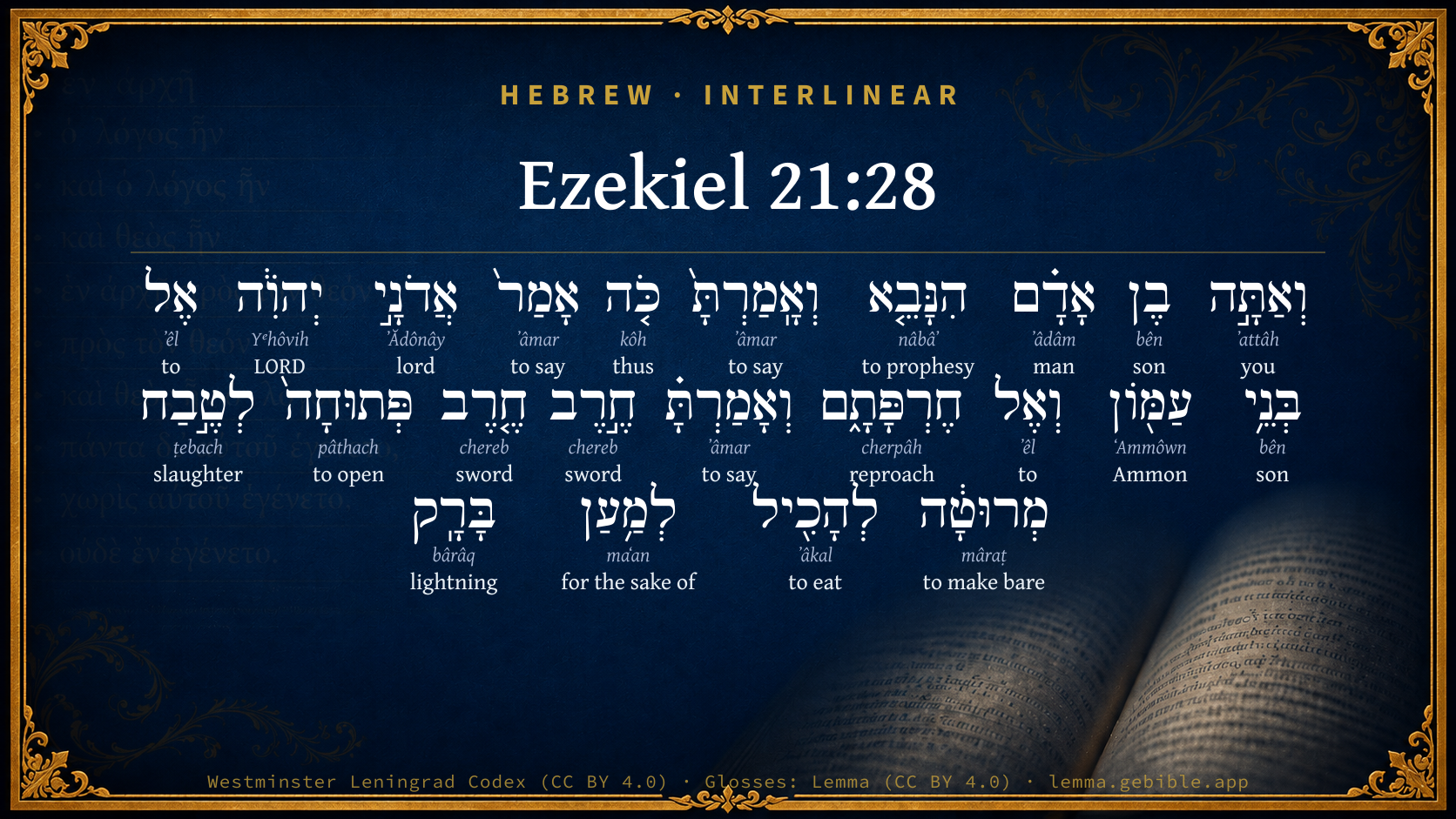
Hebrew (Westminster Leningrad Codex) Ezekiel 21:28 appears in the Hebrew Old Testament. The text above is from the Westminster Leningrad Codex. Each word links to its Strong’s number, a concise gloss, and parsing drawn from the Open Scriptures Hebrew Bible morphology. Click any word for its full Brown-Driver-Briggs (BDB) entry.
Download image
Cite this verse

Ezekiel 21:28 (World English Bible). Public Domain. Lemma interlinear Bible study tool, https://lemma.gebible.app/v/ezekiel/21/28.

Show BibTeX & RIS
BibTeX
RIS
English Translation
You, son of man, prophesy, and say, Thus says the Lord Yahweh concerning the children of Ammon, and concerning their reproach; and say you, A sword, a sword is drawn, for the slaughter it is furbished, to cause it to devour, that it may be as lightning;
World English Bible · Public Domain
Download a study sheet

One document with this verse’s original text, its word-by-word gloss line, the meaning frame, cross-references with their text, attributed commentary, and full source and license credits — printable, and it pastes into notes with its structure intact.

This verse Autodidact and up

Study sheet (.html) Plain text (.txt)

A passage Seminary Student

Up to 50 verses in one chapter. A passage sheet keeps up to 6 commentary sources and 12 cross-references per verse, in the order this page ranks them, and says so on the sheet whenever that leaves anything out. Ask for a single verse and you get the Autodidact verse sheet above.

Everything on this page stays free to read, with no account — the sheet is a download of what is already on screen, not access to it.

Want to remove ads? Support Godless Engineer
Compare translations 3

The same verse in 3 English versions, stacked beneath the original-language interlinear above. Click any original word for its lexicon entry.

Each is an independent rendering of the whole verse — the interlinear is not word-aligned to these translations.

Highlighted words mark where these versions differ — a whole-verse word diff, not a word-by-word alignment.

  • World English Bible Public Domain
    You, son of man, prophesy, and say, Thus says the Lord Yahweh concerning the children of Ammon, and concerning their reproach; and say you, A sword, a sword is drawn, for the slaughter it is furbished, to cause it to devour, that it may be as lightning;
  • King James Version Public Domain
    And thou, son of man, prophesy and say, Thus saith the Lord GOD concerning the Ammonites, and concerning their reproach; even say thou, The sword, the sword is drawn: for the slaughter it is furbished, to consume because of the glittering:
  • unfoldingWord Literal Text CC BY-SA 4.0
    So you, son of man, prophesy and say, ‘The Lord Yahweh says this to the people of Ammon concerning their coming disgrace: A sword, a sword is drawn! It is sharpened for the slaughter in order to devour, so it will be like lightning!

unfoldingWord Literal Text — © unfoldingWord, licensed CC BY-SA 4.0. Word-aligned USFM3 via Door43 (git.door43.org/unfoldingWord/en_ult).

Versions to compare (up to 4)

3 of 4 selected

Show all 18 translations

Every available English version of this verse, each an independent rendering of the whole verse.

  • World English Bible Public Domain
    You, son of man, prophesy, and say, Thus says the Lord Yahweh concerning the children of Ammon, and concerning their reproach; and say you, A sword, a sword is drawn, for the slaughter it is furbished, to cause it to devour, that it may be as lightning;
  • Berean Standard Bible Public Domain
    Now prophesy, son of man, and declare that this is what the Lord GOD says concerning the Ammonites and their contempt: ‘A sword! A sword is drawn for slaughter, polished to consume, to flash like lightning—
  • Majority Standard Bible Public Domain
    Now prophesy, son of man, and declare that this is what the Lord GOD says concerning the Ammonites and their contempt: ‘A sword! A sword is drawn for slaughter, polished to consume, to flash like lightning—
  • King James Version Public Domain
    And thou, son of man, prophesy and say, Thus saith the Lord GOD concerning the Ammonites, and concerning their reproach; even say thou, The sword, the sword is drawn: for the slaughter it is furbished, to consume because of the glittering:
  • American Standard Version (1901) Public Domain
    And thou, son of man, prophesy, and say, Thus saith the Lord Jehovah concerning the children of Ammon, and concerning their reproach; and say thou, A sword, a sword is drawn, for the slaughter it is furbished, to cause it to devour, that it may be as lightning;
  • Revised Version (1885) Public Domain
    And thou, son of man, prophesy, and say, Thus saith the Lord GOD concerning the children of Ammon, and concerning their reproach; and say thou, A sword, a sword is drawn, for the slaughter it is furbished, to cause it to devour, that it may be as lightning:
  • Geneva Bible (1599) Public Domain
    And thou, sonne of man, prophecie, and say, Thus saith the Lord God to the children of Ammon, and to their blasphemie: say thou, I say, The sword, the sword is drawen foorth, and fourbished to the slaughter, to consume, because of the glittering:
  • Douay-Rheims (1899) Public Domain
    And thou son of man, prophesy, and say: Thus saith the Lord God concerning the children of Ammon, and concerning their reproach, and thou shalt say: sword, O sword, come out of the scabbard to kill, be furbished to destroy, and to glitter,
  • Young's Literal Translation Public Domain
    And thou, son of man, prophesy, and thou hast said: Thus said the Lord Jehovah concerning the sons of Ammon, and concerning their reproach: and thou hast said: A sword, a sword, open for slaughter, Polished to the utmost for brightness!
  • Literal Standard Version CC BY-SA 4.0
    And you, son of man, prophesy, and you have said, Thus said Lord YHWH concerning the sons of Ammon, and concerning their reproach, and you have said: A sword, a sword, open for slaughter, || Polished to the utmost for brightness!
  • Unlocked Literal Bible CC BY-SA 4.0
    So you, son of man, prophesy and say, 'The Lord Yahweh says this to the people of Ammon concerning their coming disgrace: A sword, a sword is drawn! It is sharpened for the slaughter in order to devour, so it will be like lightning!
  • unfoldingWord Literal Text CC BY-SA 4.0
    So you, son of man, prophesy and say, ‘The Lord Yahweh says this to the people of Ammon concerning their coming disgrace: A sword, a sword is drawn! It is sharpened for the slaughter in order to devour, so it will be like lightning!
  • Darby Bible Public Domain
    And thou, son of man, prophesy and say, Thus speaketh the Lord Jehovah concerning the children of Ammon, and concerning their reproach; and thou shalt say, A sword, a sword is drawn; for the slaughter is it furbished, that it may consume, that it may glitter:
  • World Messianic Bible Public Domain
    “You, son of man, prophesy and say, ‘The Lord GOD says this concerning the children of Ammon, and concerning their reproach: “A sword! A sword is drawn! It is polished for the slaughter, to cause it to devour, that it may be as lightning;
  • Webster's Bible Public Domain
    And thou, son of man, prophesy and say, Thus saith the Lord GOD concerning the Ammonites, and concerning their reproach; even say thou, The sword, the sword is drawn: for the slaughter it is furbished, to consume because of the glittering:
  • Free Bible Version CC BY-SA 4.0
    Prophesy, son of man, and announce that this is what the Lord God says about the Ammonites and their insults: A sword! A sword is ready for killing, polished to destroy, to flash like lightning,
  • Bible in Basic English Public Domain
    And you, son of man, say as a prophet, This is what the Lord has said about the children of Ammon and about their shame: Say, A sword, even a sword let loose, polished for death, to make it shining so that it may be like a flame:
  • JPS Tanakh (1917) Public Domain
    (21-33) And thou, son of man, prophesy, and say: Thus saith the Lord GOD concerning the children of Ammon, and concerning their taunt; and say thou: O sword, O sword keen-edged, furbished for the slaughter, to the uttermost, because of the glitterings;

Literal Standard Version (2020), Covenant Press — licensed CC BY-SA 4.0. Text via the HelloAO Bible API (eBible.org). Unlocked Literal Bible (unfoldingWord) — licensed CC BY-SA 4.0. Text via the HelloAO Bible API (eBible.org). unfoldingWord Literal Text — © unfoldingWord, licensed CC BY-SA 4.0. Word-aligned USFM3 via Door43 (git.door43.org/unfoldingWord/en_ult). Free Bible Version, Dr. Jonathan Gallagher — licensed CC BY-SA 4.0. Text via the HelloAO Bible API (eBible.org).

Word by word

More ways to search: Search by grammar → Find every occurrence → Compare this word →

Practice this passage: Drill this verse → Learn its vocabulary →

לְטֶ֣בַח
ṭebach
H2874
“to/for · slaughter”
Preposition + Noun, Common, Masculine, Singular, Absolute
Part of Speech
Preposition + Noun
Type
Common
Gender
Masculine
Number
Singular
State
Absolute
Full BDB Definition

Origin: from H2873

TWOT: 786a

slaughter, slaughtering, animal - slaughtering, slaughter (of animals) - slaughter (figuratively)
  1. וְאַתָּ֣ה ʼattâh H859 “and · you” Conjunction + Pronoun, Personal, 2nd Person, Masculine, Singular
  2. בֶן bên H1121 “son of” Noun, Common, Masculine, Singular, Construct
  3. אָדָ֗ם ʼâdâm H120 “man” Noun, Common, Masculine, Singular, Absolute
  4. הִנָּבֵ֤א nâbâʼ H5012 “prophesy” Verb, Niphal, Imperative, 2nd Person, Masculine, Singular
  5. וְאָֽמַרְתָּ֙ ʼâmar H559 “and · to say” Conjunction + Verb, Qal, Sequential Perfect, 2nd Person, Masculine, Singular
  6. כֹּ֤ה kôh H3541 “thus” Adverb
  7. אָמַר֙ ʼâmar H559 “to say” Verb, Qal, Perfect, 3rd Person, Masculine, Singular
  8. אֲדֹנָ֣י ʼĂdônây H136 “Lord · my” Noun, Common, Masculine, Plural, Construct + Suffix, Personal, 1st Person, Common, Singular
  9. יְהֹוִ֔ה Yᵉhôvih H3069 “LORD” Noun, Proper
  10. אֶל ʼêl H413 “to” Preposition
  11. בְּנֵ֥י bên H1121 “sons of” Noun, Common, Masculine, Plural, Construct
  12. עַמּ֖וֹן ʻAmmôwn H5983 “Ammon” Noun, Proper
  13. וְאֶל ʼêl H413 “and · to” Conjunction + Preposition
  14. חֶרְפָּתָ֑ם cherpâh H2781 “reproach · their” Noun, Common, Feminine, Singular, Construct + Suffix, Personal, 3rd Person, Masculine, Plural
  15. וְאָמַרְתָּ֗ ʼâmar H559 “and · to say” Conjunction + Verb, Qal, Sequential Perfect, 2nd Person, Masculine, Singular
  16. חֶ֣רֶב chereb H2719 “sword” Noun, Common, Feminine, Singular, Absolute
  17. חֶ֤רֶב chereb H2719 “sword” Noun, Common, Feminine, Singular, Absolute
  18. פְּתוּחָה֙ pâthach H6605 “opened” Verb, Qal, Participle Passive, Feminine, Singular, Absolute
  19. מְרוּטָ֔ה mâraṭ H4803 “made bare” Verb, Qal, Participle Passive, Feminine, Singular, Absolute
  20. לְהָכִ֖יל ʼâkal H398 “to eat” Preposition + Verb, Hiphil, Infinitive Construct
  21. לְמַ֥עַן maʻan H4616 “for the sake of” Preposition
  22. בָּרָֽק bârâq H1300 “lightning” Noun, Common, Masculine, Singular, Absolute

About this verse

These counts appear in no published source. They are computed here, from the morphology-tagged text and Lemma’s own curated glosses. What Lemma adds →

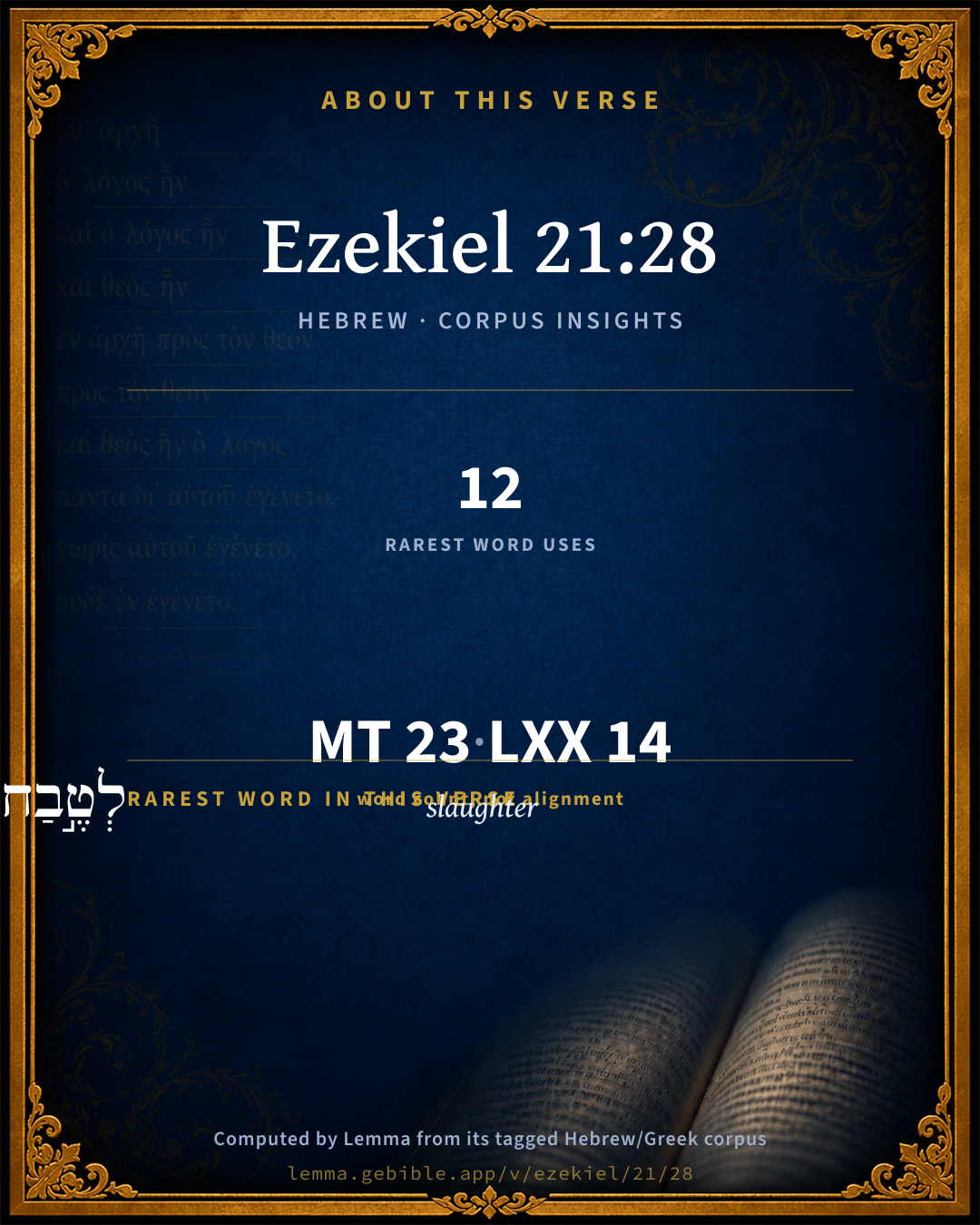
23
words
18
distinct lemmas
Prophets
section

Notable vocabulary

The rarest word here is לְטֶ֣בַח slaughter H2874 — appearing just 12 times in the whole Hebrew Bible.

Shared distinctive vocabulary

לְטֶ֣בַח slaughter H2874 occurs in 12 verses of the Hebrew Bible. Also found in:

Grammatical profile

  • 7 verbs
  • 11 nouns
  • 1 pronoun
  • 3 prepositions
  • 1 adverb

Verb forms

  • הִנָּבֵ֤א Niphal · Imperative
  • וְאָֽמַרְתָּ֙ Qal · Sequential Perfect
  • אָמַר֙ Qal · Perfect
  • וְאָמַרְתָּ֗ Qal · Sequential Perfect
  • פְּתוּחָה֙ Qal · Participle Passive
  • מְרוּטָ֔ה Qal · Participle Passive
  • לְהָכִ֖יל Hiphil · Infinitive Construct

Repetition

Words recur within this verse — often emphatic in Hebrew:

  • וְאָֽמַרְתָּ֙ to say H559 ×3
  • בֶן son H1121 ×2
  • חֶ֣רֶב sword H2719 ×2
  • אֶל to H413 ×2

Hebrew & Septuagint length

In English translation the verse runs 47 words from the Hebrew and 42 from the Septuagint (LXX English) — closely comparable.

A rough comparison of the two English renderings, which tokenize alike — not a word-level alignment.

Word counts can differ between the Hebrew and the Greek without any difference in meaning — e.g. the Hebrew direct-object marker אֵת has no separate Greek word, and Greek often adds the article ὁ.

In the original languages it is 23 Hebrew tokens and 14 Greek tokens — but the two are counted differently (Hebrew bundles its prefixes and suffixes into one token; the Greek is in lemma form), so that isn’t a like-for-like length.

Cross-references

7

Topical passages linked to Ezekiel 21:28 in the Treasury of Scripture Knowledge — connected by theme and wording, ordered by reader-vote popularity; previews shown in the World English Bible.

  • Ezekiel 21:9–10 Son of man, prophesy, and say, Thus says Yahweh: Say, A sword, a sword, it is sharpened, and also furbished;
  • Ezekiel 21:20 You shall appoint a way for the sword to come to Rabbah of the children of Ammon, and to Judah in Jerusalem the fortified.
  • Zephaniah 2:8–10 I have heard the reproach of Moab, and the insults of the children of Ammon, with which they have reproached my people, and magnified themselves against their border.
  • Jeremiah 12:12 Destroyers are come on all the bare heights in the wilderness; for the sword of Yahweh devours from the one end of the land even to the other end of the land: no flesh has peace.
  • Jeremiah 49:1–5 Of the children of Ammon. Thus says Yahweh: Has Israel no sons? has he no heir? why then does Malcam possess Gad, and his people well in the cities of it?
  • Ezekiel 25:2–7 Son of man, set your face toward the children of Ammon, and prophesy against them:
  • Amos 1:13–15 Thus says Yahweh: "For three transgressions of the children of Ammon, yes, for four, I will not turn away its punishment; Because they have ripped open the pregnant women of Gilead, That they may enlarge their border.

Cross-references courtesy of OpenBible.info (CC BY 4.0).

Hebrew and Greek witnesses Masoretic Hebrew ↔ Greek Septuagint

The same verse in the two great witnesses to the Old Testament, shown verse-for-verse.

These are two independent witnesses, not word-aligned to each other, and the Septuagint is shown in lemma (dictionary) form.

Hebrew Ezekiel 21:28 Masoretic · Westminster Leningrad Codex

וְאַתָּ֣ה בֶן אָדָ֗ם הִנָּבֵ֤א וְאָֽמַרְתָּ֙ כֹּ֤ה אָמַר֙ אֲדֹנָ֣י יְהֹוִ֔ה אֶל בְּנֵ֥י עַמּ֖וֹן וְאֶל חֶרְפָּתָ֑ם וְאָמַרְתָּ֗ חֶ֣רֶב חֶ֤רֶב פְּתוּחָה֙ לְטֶ֣בַח מְרוּטָ֔ה לְהָכִ֖יל לְמַ֥עַן בָּרָֽק

You, son of man, prophesy, and say, Thus says the Lord Yahweh concerning the children of Ammon, and concerning their reproach; and say you, A sword, a sword is drawn, for the slaughter it is furbished, to cause it to devour, that it may be as lightning;

World English Bible · Public Domain

Greek LXX Ezekiel 21:28 Septuagint · lemma form

καί αὐτός αὐτός ὡς μαντεύομαι μαντεία ἐνώπιον αὐτός καί αὐτός ἀναμιμνήσκω ἀδικία αὐτός μιμνήσκω

And you, son of man, prophesy, and you shall say, Thus says the Lord, concerning the children of Ammon, and concerning their reproach; and you shall say, O sword, sword, drawn for slaughter, and drawn for destruction, awake, that you may gleam.

LXX2012 (modern English Septuagint) · Public Domain

Hebrew: Westminster Leningrad Codex (CC BY 4.0). Greek: Septuagint (public domain); English from LXX2012 (modern English Septuagint) (Public Domain). How the Septuagint differs from the Hebrew →

Targum (Aramaic paraphrase)

1

The Targum is the ancient Jewish Aramaic paraphrase of the Hebrew Scriptures — an interpretive translation, not the Hebrew text itself. Onkelos (literal) and Pseudo-Jonathan (expansive) render the Torah, and Jonathan the Prophets. Coverage is partial: where no permissively-licensed English translation exists for a verse, only the Aramaic is shown. This is verse-level text, not a word-by-word alignment to the Hebrew.

  1. Targum Jonathan Prophets (Joshua–Malachi)
    וַהֲוָה לְהוֹן קִסוּמֵיהוֹן כַּדִיבִין בְּעֵינֵיהוֹן נַחֲשִׁין דַהֲוָה מְנַחַשׁ לְהוֹן וְאִינוּן לָא יָדְעִין דְאַרְבְּעִין וּתְשַׁע זַמְנִין הֲוָה כְמַן וּמִתְּתֵיב עַל פִּתְגָמָא עַד דְתֵיתֵי לֵיהּ שַׁעְתָּא דְיִתְמַסְרוּן בִּידֵיהּ:

    (no public-domain English translation for this verse)

    Targum Jonathan — Aramaic: “Mikraot Gedolot” (public domain). English: “Sefaria Community Translation” (CC0 1.0 (public-domain dedication)); “London "Chaldee Paraphrase," 1871” (public domain). Text via Sefaria.

Commentary

Notes on Ezekiel 21:28 from classic Christian and Jewish commentators (each source and its license shown beneath its notes). The classic Christian expositions comment on the surrounding passage and are grouped to its opening verse, so a note may address several verses; the Jewish commentaries on the Tanakh (Rashi and others) are per-verse, so they appear only where the commentator wrote on this verse.

Lemma curates 59 commentaries, every one of them public domain or Creative Commons licensed, each selected and text-cleaned for this edition rather than reprinted as found. About our sources →

Matthew Henry's Commentary

The prediction of the destruction of the Ammonites, which was effected by Nebuchadnezzar about five years after the destruction of Jerusalem, seems to come in here upon occasion of the king of Babylon's diverting his design against Rabbath, when he turned it upon Jerusalem. Upon this the Ammonites grew very insolent, and triumphed over Jerusalem; but the prophet must let them know that forbearance is no acquittance; the reprieve is not a pardon; their day also is at hand; their turn comes next, and it will be but a poor satisfaction to them that they are to be devoured last, to be last executed.

I. The sin of the Ammonites is here intimated; it is their reproach, Eze 21:28. 1. The reproach they put upon themselves when they hearkened to their false prophets (for such it seems there were among them as well as among the Jews), who pretended to foretel their perpetual safety in the midst of the desolations that were made of the countries round about them: "They see vanity unto thee and divine a lie, Eze 21:29. They flatter thee with promises of peace, and thou art such a fool as to suffer thyself to be imposed upon by them and to encourage them therein by giving credit to them." Note, Those that feed themselves with a self-conceit in the day of their prosperity prepare matter for a self-reproach in the day of their calamity. 2. The reproach they put upon the Israel of God, when they triumphed in their afflictions, and thereby added affliction to them, which was very barbarous and inhuman. Their divines, by puffing them up with a conceit that they were a better people than Israel, being spared when they were cut off, and with a confidence that their prosperity should always continue, made them so very haughty and insolent that they did even tread on the necks of the Israelites that were slain, slain by the wicked Chaldeans, who had commission to execute God's judgments upon them when their iniquity had an end, that is, when the measure of it was full. We shall meet with this again, Eze 25:3, etc. Note, Those are ripening apace for misery who trample upon the people of God in their distress, whereas they ought to tremble when judgment begins at the house of God.

II. The utter destruction of the Ammonites is threatened. For the reproach cast on the church by her neighbours will be returned into their own bosom, Psa 79:12. Let us see how terrible the threatening is and the destruction will be. 1. It shall come from the wrath of God, who resents the indignities and injuries done to his people as done to himself (Eze 21:31): I will pour out my indignation as a shower of fire and brimstone upon thee. The least drop of divine indignation and wrath will create tribulation and anguish enough to the soul of man that does evil; what then would a full stream of that indignation and wrath do? "I will blow against thee in the fire of my wrath; that is, I will blow up the fire of my wrath against thee; it shall burn with the utmost vehemence." Thou shalt be for fuel to this fire, Eze 21:32. Note, Wicked men make themselves fuel to the fire of God's wrath; they are consumed by it, and it is inflamed by them. 2. It shall be effected by the sword of war; to them he must cry, as before to Israel, because they had triumphed in Israel's overthrow: The sword, the sword is drawn (Eze 21:28, compare Eze 21:9, Eze 21:10); it is drawn to consume because of the glittering, because it is brandished and glitters, and is fit to be made use of. God's executions will answer his preparations. This sword, when it is drawn, shall not return into its sheath (Eze 21:30) till it has done the work for which it was drawn. When the sword is drawn it does not return till God causes it to return, and he is in one mind and who can turn him? Who can change his purpose? 3. The persons employed in it are brutish men, and skilful to destroy. Men of such a bad character as this, who have the wit of men to do the work of wild beasts - human reason, which makes them skilful, but no human compassion, which makes them skilful only to destroy - though they are the scandal of mankind, yet sometimes are made use of to serve God's purposes. God delivers the Ammonites into the hands of such, and justly, for they themselves were brutish, and delighted in the destruction of God's Israel. We have reason to pray, as Paul desired to be prayed for, that we may be delivered from wicked and unreasonable men (Th2 3:2), men that seem made for doing mischief. 4. The place where they should thus be reckoned with: "I will judge thee where thou wast created, where thou wast first formed into a people, and where thou hast been settled ever since, and therefore where thou seemest to have taken root; the land of thy nativity shall be the land of thy destruction." Note, God can bring ruin upon us even where we are most secure, and turn us out of that land which we thought we had a title to not to be disputed and a possession of not to be disturbed. Thy blood shall be shed not only in thy borders, but in the midst of thy land. Lastly, I shall be an irreparable ruin: "Though thou mayest think to recover thyself, it is in vain to think of it; thou shalt be no more remembered with any respect," Psa 9:6. Justly is their name blotted out who would have Israel's name for ever lost.

Matthew Henry's Commentary on the Whole Bible (1708–1710) — public domain (CC PDM 1.0). Text via the HelloAO Bible API.

The Cambridge Bible for Schools and Colleges

gen. ed. J. J. S. Perowne

28. the sword … is drawn] Rather with disregard of the accents: a sword, a sword is drawn for slaughter; it is furbished to the uttermost in order that it may glitter.

to consume] Rather: to the uttermost, lit. as far as it can hold or receive. Corn. amends: to flash (hahel for hakil).

Appendix. 28–32. Threatening prophecy against Ammon

The passage is obscure, but several things seem evident. 1. In spite of the similarities between the language of Eze_21:28 and that in Eze_21:9-10, the sword here is that of Ammon. This is certain from the words Eze_21:30 “return it to its sheath.” 2. It is against Israel, not against the Chaldeans, that the Ammonites furbish and draw their sword. This appears from the words “concerning Ammon, and concerning their reproach” Eze_21:28. Deceived by false prophecies they cherish purposes of conquest outside their own borders, which shall be far from being realized; on the contrary they shall be assailed in their own home and there annihilated (Eze_21:25, cf. Eze_25:4). History does not enable us to follow the progress of events. It is possible that simultaneously with Judah all the neighbouring peoples threw off the yoke of Babylon, so that it might be doubtful which of them Nebuchadnezzar would attack first (Eze_21:20-21), but that in the course of events Ammon, true to its instincts, assumed an attitude hostile to Judah (cf. 2Ki_24:2). The date of the present passage is no doubt later than that of the rest of the chapter, and may owe some of its colour to events subsequent to the fall of Jerusalem. Cf. Eze_25:1-7.

The Cambridge Bible for Schools and Colleges (gen. ed. J. J. S. Perowne; Cambridge University Press, 1878–1918) — public domain. Text from a community e-Sword module.

Trapp's Complete Commentary

John Trapp

Eze 21:28 And thou, son of man, prophesy and say, Thus saith the Lord GOD concerning the Ammonites, and concerning their reproach; even say thou, The sword, the sword [is] drawn: for the slaughter [it is] furbished, to consume because of the glittering:

Ver. 28. Concerning the Ammonites.] Who had likewise rebelled against Nebuchadnezzar, and were very injurious to God’s people. See Eze 25:3; Eze 25:6 Zep 2:8-9.

“Tβρις και Mαγνμτας απωλεσε και Kολοφωνα.”

John Trapp, A Commentary or Exposition upon All the Books of the Old and New Testament (1647–1656) — public domain. Text from a community e-Sword module.

Joseph Benson's Commentary

Eze 21:28-29. Thus saith the Lord concerning the Ammonites — Because the Ammonites were reprieved by Nebuchadnezzar’s decision to besiege Jerusalem, they were ready to promise themselves security, and to insult over the calamities brought on the Jews; a practice for which they are often reproved very severely by the prophets, and threatened with the like judgments. And concerning their reproach — Wherewith they reproached Israel in the day of Israel’s afflictions; say thou, The sword is drawn, is drawn — Warlike preparations are made against you, the war is declared, and your enemy hath drawn the sword. For the slaughter it is furbished — It is prepared to make dreadful destruction, to lay waste your country, and consume its inhabitants. While they see vanity unto thee — While the soothsayers and pretenders to divination foretel nothing but happy events to thee, O Ammon! the sword is preparing to destroy thee. To bring thee upon the necks of them that are slain — To add thy people to the number of those who are slain in Judea, (Eze 21:14-15,) and to make thy condition like theirs; whose day is come — See Eze 21:25. When their iniquity shall have an end — When their deserved punishment, coming upon them, shall put a stop to their wickedness. This prophecy concerning the Ammonites was fulfilled by the Babylonians, about five years after the destruction of Jerusalem, because the Ammonites assisted Ishmael to wrest the government of Judea out of the hands of Gedaliah, whom the king of Babylon had fixed there as his deputy.

Joseph Benson's Commentary on the Old and New Testaments (1811–1818) — public domain. Text from a community e-Sword module.

Whedon's Commentary on the Bible

Daniel D. Whedon

THE AMMONITES, REJOICING IN JERUSALEM’S CALAMITY, SHALL THEMSELVES SUFFER EVEN MORE BITTERLY, Eze_21:28-32.

The Ammonites who have rejoiced because Nebuchadnezzar has taken the road to Jerusalem instead of to their own capital (Eze_21:20) cannot boast long against the Lord’s people, for against them also is the sword drawn.

28. The sword — This description of the sword which falls upon the Ammonites strikingly resembles that which fell upon Jerusalem (Eze_21:8-11). It is the same sword; it is the sword of the Lord! (Eze_21:15.) The passage is very obscure. The R.V. reads: “A sword, a sword is drawn, for the slaughter it is furbished, to cause it to devour, that it may be as lightning: whiles they see vanity unto thee, whiles they divine lies unto thee, to lay thee upon the necks of the wicked that are deadly wounded, whose day is come, in the time of the iniquity [or, punishment] of the end. Cause it to return into its sheath.”

Daniel D. Whedon (gen. ed.), Commentary on the Old and New Testaments (1874–1909) — public domain. Text from a community e-Sword module.

The Preacher's Complete Homiletical Commentary

Joseph S. Exell (gen. ed.)

EXEGETICAL NOTES.—Eze_21:28-32. The overthrow of the Ammonites. Israel is to rise after judgment, but Ammon is to be utterly destroyed.

Eze_21:28. “Concerning the Ammonites, and concerning their reproach even say thou, the sword, the sword is drawn.” “Lest it should be supposed that because Nebuchadnezzar had taken the route to Jerusalem, and not that to Rabbah, therefore the Ammonites should escape being invaded by his army, the prophet is instructed to denounce judgment against them also. The reproach with which the Ammonites are here charged, was their opprobrious and insulting treatment of the Hebrews at different periods of their history, and especially when Jerusalem was taken by the Chaldeans.”—(Henderson). “The children of Ammon represents the world—power hostile to the kingdom of God. Yet the representative is not taken accidentally out of the multitude of the heathen peoples hostile to the kingdom of God; but the prophet takes occasion from the circumstances of the time. Ammon had at that time, no less than Judah, incurred the anger of the Chaldeans, and so it was natural to exemplify in him the general truth, the more natural because the vengeance was first to fall on Judah, while Ammon appeared to come out of the affair with high shoes, and mocked Judah, who had to pay the score. “Their reproval”—the insults which they heaped upon Judah. The prophet forsees that the Ammonites, on the approach of danger, will withdraw from the coalition (Lam_1:2), and on the catastrophe of Jerusalem, give free course to their ancient hatred against Judah. Judah exchanges the prophecy that was unfavourable to him for the divination (Eze_21:23), and by this fatal exchange, falls; Ammon exchanges (Eze_21:29) the divination favourable to him, for the prophecy, and thereby prepares himself at all events, for the downfall.”—(Hengstenberg).

Eze_21:29. “Whiles they see vanity unto thee, whiles they divine a lie unto thee.” (Heb). They have seen falsehood for thee, they have divined for thee a lie. The Ammonites also had those among them who practised divination. But these had divined a “lie” for them, promising them peace and safety when judgment was hard at hand. “To bring thee upon the necks of them that are slain.” The Ammonites are to be involved in one common ruin with the Jews.

Eze_21:30. “I will judge thee in the place where thou wast created.” “The Ammonites were not to be carried away captives, like the Jews to Babylon, but were to perish in their own land. While the Jews were to be restored after the captivity had cured them of idolatry, the Ammonitish kingdom was to cease for ever. The prophecy was fulfilled five years after the destruction of Jerusalem.”—(Henderson.)

Eze_21:31. “I will blow against thee in the fire of my wrath.” The idea is not to blow with fire—which is an unnatural figure—but rather a blowing which increases the intensity of the flame. “Brutish men, and skilful to destroy.” “The word must be explained from Psa_92:7, ‘brutish,’ foolish, always bearing in mind that the Hebrew associated the idea of Godlessness with folly, and that cruelty naturally follows in its train.”—(Keil)

Eze_21:32. “Thou shalt be no more remembered.” Ammon was to perish utterly. For her there was no hope of restoration, like that held out to Israel in Eze_21:27. “From the times of the Maccabees, the Ammonites and Moabites have quite disappeared out of history.”—(Hengstenberg.)

HOMILETICS

(Eze_21:28-29).

1. When God brings judgments upon His people for their iniquities, then their enemies take advantage and revile them. The Ammonites were glad that the calamity of Jerusalem was at hand. They were neighbours of the Jews, brethren also as coming from the brother of Abraham; yet they reproached the Jews and added affliction to affliction (Zep_2:8). The rabbies say, that when the Chaldeans carried the Jews captive, through the land of the Ammonites and Moabites, the Jews wept, and they reproached them saying, why do ye afflict yourselves? Why do you weep? Are you not going to your father’s house? They meant Chaldea, which was Abraham’s country and habitation. These and many other reproachful speeches they used against the Jews, when they were spoiled and led into capitivity, and “magnified themselves against their border.” They said, now their border—their land—should become theirs. Thus they reproached and wronged the Jews. So likewise did the Edomites in “the day of Jerusalem” (Psa_137:7), that was in the day when Nebuchadnezzar’s force took and plundered it. They cried, “Rase it, rase it, even to the foundation.” The adversaries saw Jerusalem, and did mock at her Sabbaths; they scoffed at all her festivals, religion, and worship. Where is your God, whose days you have so religiously observed? Why did He not defend you from this day of your sufferings? Either He was infirm, and could not, or unfaithful, and would not.

2. The Lord takes notice of the enemies reproaching His people. He tells the prophet of the reproachings of the Ammonites. Ezekiel was in Babylon, and knew nothing of it, but God heard and observed it (Zep_2:8). God saith in His indignation unto Moab, “Was not Israel a derision unto Thee?” Deny it, if thou darest. I saw it; I heard it This is some comfort to the Church and people of God, that He observes not only the wrongs wicked men do unto His people, but also the reproaching speeches they utter against them (Lam_3:6.)

3. Reproaching and reviling God’s people, when they are in affliction, draws judgments upon the reproachers and revilers. The Ammonites reproached the Jews when the Babylonish sword came upon them, and here the prophet must tell them the sword is drawn and furbished for slaughter. Reproach of this kind is a provoking sin; God’s name, truth, ordinances, suffer when His people are reproached for His correcting hand upon them for their iniquities. Moab for reproaching should be reproached; yea, grievously afflicted, yea, utterly destroyed.

4. When the Lord threatens sinful nations with sore judgments, they have those amongst them which divert them from the truth, possess them with delusions, and put them upon destructive practices. The Ammonites were threatened here with the Babylonish sword, but they neither believed Ezekiel nor Jeremiah, who told them the same thing. Their false prophets, their diviners, beat them off from it, possessed them with vanities and lies, put them upon insulting over the Jews when the hand of the Lord was most heavy upon them, and so brought them to suffer by the same sword the Jews did. It is just with God to give men and nations over to believe lies and lying prophets, which shall lead them to destruction, when they have stopped their ears against the true prophets. Ahab would not believe Micaiah, but the false prophets who spake words according to his mind; but they were vanity, lies and he smarted for it (1 Kings 22)

5. Though the Lord bears long with sinful nations, yet He hath His days and times of reckoning with them. The day of the Jews was come, and their iniquity had an end. The day of the Ammonites came, and their iniquity had an end. God punished them severely for their sins (Ezekiel 25) Babylon and its king had a time to sin and a time to suffer. God stayed many days, yet had His day, and came at the day appointed (Jer_50:31; Jer_51:13). Babylon was insatiably covetous, robbing the nations of their riches, but all her wealth could not purchase one day’s respite from the wrath of God, nor all her waters preserve her from the fire of His indignation. The fire God sent in His day burnt up their habitations, and licked up the water of Euphrates whereon Babylon sat. God bare long with us, and the nations about us, but His day is come, He is visiting; we, they, have had our times of sinning, and must now have our times of suffering.—(Greenhill.)

The Preacher's Complete Homiletical Commentary (gen. ed. Joseph S. Exell; Funk & Wagnalls, c. 1892) — public domain (pre-1929). A full-Bible homiletical/sermon-outline anthology covering 65 of 66 books (2 John is absent from the source module). Text from a community e-Sword module.

Keil & Delitzsch

C. F. Keil & F. Delitzsch

Overthrow of the Ammonites

Eze 21:28. And thou, son of man, prophesy and say, Thus saith the Lord Jehovah, concerning the sons of Ammon, and concerning their scorn, sword, sword, drawn to slay, polished, that it may devour, that it may flash! Eze 21:29. While they prophesy deceit to thee, while they divine lying to thee, it shall lay thee by the necks of the sinners slain, whose day cometh at the time of the final transgression. Eze 21:30. Put it in its scabbard again. At the place where thou wast created, in the land of thy birth will I judge thee, Eze 21:31. And pour out my anger upon thee, kindle the fire of my wrath against thee, and give thee into the hand of foolish men, of smiths of destruction. Eze 21:32. Thou shalt be for the fire to devour; thy blood shall remain in the midst of the land; thou shalt be remembered no more; for I Jehovah have spoken it. - As Judah in Jerusalem will fall by the sword of the king of Babylon, contrary to all expectation; so will the Ammonites be punished for their scorn with utter extermination. חרפּה is scorn at the overthrow of Israel (cf. Eze 25:3, Eze 25:6, and Zep 2:8). The sword is already drawn against them. פּתוּחה, taken out of the scabbard, as in Psa 37:14. לטבח is to be connected with פּתוּחה, notwithstanding the accents, and להכיל להכיל with מרוּטה. This is required by the correspondence of the clauses. הכיל is regarded as a derivative of כּוּל by Ewald and others, in the sense of ad sustinendum, according to capacity, i.e., as much as possible. But the adverbial rendering it opposed to the context, and cannot be sustained from Eze 23:32. Moreover, כּוּל, to contain, is applicable enough to goblets and other vessels, but not to a sword. Hitzig therefore explains it from the Arabic kll, to blunt (sc., the eyes), i.e., to blind. But this is open to the objection that the form הכיל points to the verb כּוּל rather than כּלל; and also to a still greater one, - namely, that there is nothing in the Hebrew usage to suggest the use of כלל in such a sense as this, and even if it were used in the sense of blunting, it would be perfectly arbitrary to supply עינים; and lastly, that even the flashing of the sword does not suggest the idea of blinding, but is intended to heighten the terror occasioned by the sharpness of the sword. We therefore adhere to the derivation of הכיל from אכל, and regard it as a defective form for האכיל, like תּמרוּ for תּאמרוּ in Sa2 19:14, יהל as syncopated form for יאהל (Isa 13:20), and watochez ותּחז for ותּאחז in Sa2 20:9; literally, to cause it to eat or devour, i.e., to make it fit for the work of devouring. למען , literally, for the sake of the lightning (flash) that shall issue therefrom (cf. Eze 21:10). - In Eze 21:29 (34), לתת (to lay, or place) is also dependent upon חרב פּתוּחה, drawn to lay thee; so that the first half of the verse is inserted as a parenthesis, either to indicate the occasion for bringing the sword into the land (Hitzig), or to introduce an attendant circumstance, according to the sense in which the ב in בּחזות is taken. The parenthetical clause is understood by most of the commentators as referring to deceptive oracles of Ammonitish soothsayers, which either determined the policy of Ammon, as Hitzig supposes (cf. Jer 27:9-10), or inspired the Ammonites with confidence, that they had nothing to fear from the Chaldeans. Kliefoth, on the other hand, refers the words to the oracles consulted by Nebuchadnezzar, according to Eze 21:23. "These oracles, which directed the king not to march against the Ammonites, but against Jerusalem, proved themselves, according to Eze 21:29, to be deceptive prophesying to the Ammonites, inasmuch as they also afterwards fell by the sword; just as, according to Eze 21:23, they proved themselves to be genuine so far as the Israelites were concerned, inasmuch as they were really the first to be smitten." This view is a very plausible one, if it only answered in any degree to the words. But it is hard to believe that the words, "while it (one) prophesies falsehood to thee," are meant to be equivalent to "while its prophecy proves itself to be false to thee." Moreover, Nebuchadnezzar did not give the Ammonites any oracle, either false or true, by the circumstance that his divination at the cross-road led him to decide in favour of the march to Jerusalem; for all that he did in consequence was to postpone his designs upon the Ammonites, but not to relinquish them. We cannot understand the words in any other sense, therefore, than as relating to oracles, which the Ammonites received from soothsayers of their own.

Hitzig takes offence at the expression, "that it (the sword) may lay thee by (to) the necks of the sinners slain," because colla cannot stand for corpora decollata, and consequently proposes to alter אותך into אותהּ, to put it (the sword) to the necks. But by this conjecture he gets the not less striking thought, that the sword was to be put to the necks of those already slain; a thing which would be perfectly unmeaning, and is therefore not generally done. The sinners slain are the Judaeans who have fallen. The words point back to Eze 21:25, the second half of which is repeated here, and predict the same fate to the Ammonites. It is easy to supply חרב to השׁב אל־תּערהּ: put the sword into its scabbard again. These words can only be addressed to the Ammonites; not to the Chaldeans, as Kliefoth imagines, for the latter does not harmonize in any way with what follows, viz., in the place of thy birth will I judge thee. God does not execute the judgment independently of the Chaldeans, but through the medium of their sword. The difficulties occasioned by taking the words as referring to the Ammonites are not so great as to necessitate an alteration of the text (Hitzig), or to call for the arbitrary explanation: put it now or for the present into the scabbard (Kliefoth). The use of the masculine השׁב (with Patach for השׁב, as in Isa 42:22), if Ammon is addressed by the side of the feminine אותך, may be explained in a very simple way, from the fact that the sword is carried by men, so that here the thought of the people, the warriors, is predominant, and the representation of the kingdom of the Ammonites as a woman falls into the background. The objection that the suffix in תּערהּ can only refer to the sword (of the Chaldean) mentioned in Eze 21:28, is more plausible than conclusive. For inasmuch as the scabbard presupposes a sword, and every sword has a scabbard, the suffix may be fully accounted for from the thing itself, as the words, "put the sword into its scabbard," would lead any hearer to think at once of the sword of the person addressed, without considering whether that particular sword had been mentioned before or not. The meaning of the words is this: every attempt to defend thyself with the sword and avert destruction will be in vain. In thine own land will God judge thee. For מכרותיך, see the comm. on Eze 16:3. This judgment is still further explained in Eze 21:31, where the figure of the sword is dropped, and that of the fire of the wrath of God introduced in its place. אפיח...בּאשׁ, we render: "the fire of my wrath I blow (kindle) against thee," after Isa 54:16, and not "with the fire...do I blow, or snort, against thee," as others have done; because blowing with the fire is an unnatural figure, and the interpretation of the words in accordance with Isa. l.c. is all the more natural, that in the closing words of the verse, חרשׁי משׁחית, the allusion to that passage is indisputable, and it is only from this that the combination of the two words can be accounted for. - Different explanations have been given of בּערים. Some render it ardentes, and in accordance with Isa 30:27 : burning with wrath. But בּער is never used in this sense. Nor can the rendering "scorching men" (Kliefoth) be sustained, for בּער, to burn, only occurs in connection with things which are combustible, e.g., fire, pitch, coals, etc. The word must be explained from Psa 92:7, "brutish," foolish, always bearing in mind that the Hebrew associated the idea of godlessness with folly, and that cruelty naturally follows in its train. - Eze 21:32. Thus will Ammon perish through fire and sword, and even the memory of it be obliterated. For Eze 21:32 compare Eze 15:4. The words, "thy blood will be בּתוך הארץ in the midst of the land," can hardly be understood in any other sense than "thy blood will flow over all the land." For the rendering proposed by Ewald, "remain in the midst of the earth, without thy being mentioned," like that given by Kliefoth, "thy blood will the earth drink," does not harmonize with Eze 24:7, where דּמהּ בּתוכהּ היה is affirmed of blood, which cannot penetrate into the earth, or be covered with dust. For תּזּכרי, see Eze 25:10. Ammon as the enemy of the kingdom of God will utterly perish, leaving no trace behind, and without any such hope of restoration as that held out in Eze 21:27 to the kingdom of Judah or the people of Israel.

Keil & Delitzsch — Biblical Commentary on the Old Testament (1861–1891) — public domain (CC PDM 1.0). Text via the HelloAO Bible API. (Old Testament only.)

Fairbairn on Ezekiel, Jonah & the Pastoral Epistles

Patrick Fairbairn

Eze 21:28. And thou, son of man, prophesy and say: Thus saith the Lord Jehovah concerning the Ammonites and their reproach (or scorn); even say thou, A sword, a sword, drawn for slaughter, furbished to the utmost, (The literal rendering here (taking לְהָכִיל as the infinitive of כּווֹל which seems the most natural derivation) would be—furbished for what it was capable, or as much as possible; the infinitive of the verb being taken adverbially.) that it might flash!

Eze 21:29. While they see nothingness for thee, while they divine lies to thee (while this delusive process is going on, and thou art giving heed to it, there is that drawn and furbished sword flashing in the distance), to lay thee upon the necks of the pierced-through godless ones, whose day has come, at the time of the final iniquity. (The meaning seems to be, that these Ammonites were to be added to the slain in Judah, —thrown, as it were, upon the decapitated bodies of those wicked men who had there perished in judgment, and whom they had imitated in their foolhardy and sinful ways.)

Eze 21:30. Let it return to the scabbard; in the place where thou wast formed, in the land of thy nativity, will I judge thee. (The destruction was to overtake them in their own territory; and the sentence at the beginning of the verse, “Let it return to the scabbard,” may be understood thus:—The sword must do the work of destruction for which it is drawn; do not trouble yourselves to move out of your place; let it do its work, and then be sheathed; it is in vain to resist or strive against the doom.)

Eze 21:31. And I will pour out my indignation upon thee; with the fire of my wrath will I blow upon thee, and will give thee into the hand of savage men, forgers of destroying weapons. (The word here is singular in the Hebrew, מַשְּׁחִית, though it scarcely admits of being rendered but in the plural,—forgers of that which destroys—slaughter-weapons. There is an evident allusion to the language in Isa 54:16. But compare also Jer 5:26.)

Eze 21:32. Thou shalt be for fuel to the fire; thy blood shall be in the midst of the land; thou shalt not be remembered, for I Jehovah have spoken it.

Here all is darkness, trouble, and desolation. The Ammonites had not only sinned, like other heathen nations, but they had also taken up a taunt and reproach against the covenant-people in the time of their declension, and had pressed forward, and, in the proud spirit of conquerors, spread themselves over a part of Israel’s territory (Zep 2:8; Jer 49:1). They might, therefore, be fitly taken here as representatives of the enemies generally of the people of God. And in them the Lord was going to show, by a palpable demonstration, that while Israel could not escape this righteous judgment, when they walked like the heathen, their fall would be no gain to the heathen adversaries, but only the forerunner of a still more severe, even a remediless destruction. A germ of life and blessing still existed in the one, which Babylon with all its might could not extirpate; but in the other there was no such divine element, and when the sword of vengeance was drawn, it must accomplish a final end. So was it with the Ammonites as a people. A few years after the fall of Jerusalem,, the arms of the king of Babylon were turned against them, and desolated their country. But this was only the beginning of their troubles, for they never attained again to political power and importance; they gradually dwindled away, till their separate existence ceased, and their place was no more known. “So let all thine enemies perish, O Lord (so shall they indeed perish—in the destruction of these aliens and scorners the doom of all is reflected); but let them that love thee be as the sun when he goeth forth in his strength.”

Patrick Fairbairn — An Exposition of Ezekiel (1851), Jonah (1849), and The Pastoral Epistles (1874) — public domain. Text from a community e-Sword module.

Tyndale Open Study Notes

Tyndale Open Resources

21:28-29 The Ammonites had no cause to rejoice in the reprieve that came when Nebuchadnezzar went toward Jerusalem rather than Rabbah (21:18-20)—they, too, were among the wicked for whom the day of final reckoning had come.

Tyndale Open Study Notes — © Tyndale Open Resources, licensed CC BY-SA 4.0. Text via the HelloAO Bible API.

Jamieson, Fausset & Brown

Robert Jamieson, A. R. Fausset & David Brown

Lest Ammon should think to escape because Nebuchadnezzar had taken the route to Jerusalem, Ezekiel denounces judgment against Ammon, without the prospect of a restoration such as awaited Israel. Jer 49:6, it is true, speaks of a "bringing again of its captivity," but this probably refers to its spiritual restoration under Messiah; or, if referring to it politically, must refer to but a partial restoration at the downfall of Babylon under Cyrus.

their reproach--This constituted a leading feature in their guilt; they treated with proud contumely the covenant-people after the taking of Jerusalem by Nebuchadnezzar (Eze 25:3, Eze 25:6; Zep 2:9-10), and appropriated Israel's territory (Jer 49:1; Amo 1:13-15).

furbished, to consume--MAURER punctuates thus, "Drawn for the slaughter, it is furbished to devour ('consume'), to glitter." English Version, "to consume because of the glittering," means, "to consume by reason of the lightning, flash-like rapidity with which it falls." Five years after the fall of Jerusalem, Ammon was destroyed for aiding Ishmael in usurping the government of Judea against the will of the king of Babylon (Kg2 25:25; Jer 41:15) [GROTIUS].

Jamieson, Fausset & Brown — Commentary Critical and Explanatory on the Whole Bible (1871) — public domain (CC PDM 1.0). Text via the HelloAO Bible API.

Adam Clarke's Commentary

Verse 28. Concerning the Ammonites] They had reproached and insulted Judea in its low estate, see Eze 25:3; Eze 25:6. This prophecy against them was fulfilled about five years after the taking of Jerusalem. See Joseph. Ant. lib. x. c. 11; and Jer 27, Jer 48, Jer 49; Eze 25.

Adam Clarke's Commentary on the Bible (1810–1826) — public domain. Text from a community e-Sword/MySword module.

Ellicott's Commentary for English Readers

(28) Concerning the Ammonites.—At the opening of this prophecy (Eze_21:19-20) the king of Babylon was represented as hesitating whether to attack Jerusalem or Rabbah, and as being led to the determination of attacking the former. This would leave the inference that the Ammonites might escape altogether; and from the destruction of God’s peculiar people, along with the immunity of their ancient enemies, the heathen would be likely to draw conclusions inconsistent with the power and majesty of God. Hence this prophecy is added to show that His judgments shall certainly fall on them also, and in this case the ruin foretold is final and hopeless, without the promise given to Israel in Eze_21:27. Another prophecy against Ammon is given in Eze_25:1-7. As a matter of history, the Ammonites were conquered, and their country desolated, by Nebuchadnezzar a few years after the destruction of Jerusalem, and they gradually dwindled away until their name and place among the nations finally disappeared.

Their reproach—i.e., their exultation in the desolation of Israel. (See Eze_25:3; Zep_2:8.)

A Bible Commentary for English Readers, edited by Charles John Ellicott (1878–1897) — public domain. Text from a community e-Sword module.

John Gill's Exposition

Shall I cause it to return into his sheath?.... The drawn and furbished sword of the Chaldeans? no, I will not; it shall never return or be put up until the Ammonites are utterly consumed. Some read these words in the imperative, as the Targum,

"return the sword to its sheath;''

so the Vulgate Latin version, "return to thy sheath"; and so may be considered as a direction to the Ammonites to put up their swords, and not stand in their own defence, since it would be to no purpose; though Jerom, and Grotius after him, take the words to be an apostrophe to the drawn sword of the Chaldeans to sheath itself, having done its work upon the Jews and Ammonites; or to the Chaldeans to return to Babylon, and where they also should be punished; and so interpret all that follows of the destruction of the Babylonians by the Medes and Persians; but the first sense is best:

I will judge thee in the place where thou wast created, in the land of thy nativity; not in the place where their father Ammon was born, which was at Zoar; but where they first became a kingdom and state, a body politic; or where the present generation of them were born; they should not be carried out of their own land, but destroyed in it.

John Gill's Exposition of the Whole Bible (1746–1763) — public domain (CC PDM 1.0). Text via the HelloAO Bible API.

Haydock's Catholic Bible Commentary

Reproach, by which they had reproached and insulted over the Jews, at the time of the destruction of Jerusalem. (Challoner) (chap. xxv. 6., and Sophonias ii. 8.) --- They were punished five years later (Calmet) by the same Babylonians whom they had encouraged. (Worthington)

George Leo Haydock (1774–1849), Haydock's Catholic Family Bible and Commentary, 1859 edition — public domain. Excludes Psalms (Douay-Rheims chapter numbering differs from Protestant) and Deuterocanonical books (Catholic canon only).

Matthew Poole's English Annotations

In Eze 21:19,20 you had the mention of Rabbath, chief city of the Ammonites, in equal danger with Jerusalem; but while Jerusalem is threatened, Rabbath is no further minded, till now God directs the prophet to declare the ruin thereof.

The Ammonites; a stout, but proud, injurious, and insulting people.

Their reproach, wherewith they reproached Israel in the day of Israel’s afflictions, as Jer 49:1, and Eze 25:3,5,6, and blasphemed the God of Israel.

The sword; all warlike preparations are made against you.

The sword is drawn; the war is declared, and your enemy hath drawn the sword: see Eze 21:9-11.

For the slaughter; to make waste, by avenging former quarrels and affronts. The Babylonish king comes out with bloody mind against you, O Ammonites! You countenanced Ishmael, who slew Gedaliah, viceroy by Nebuchadnezzar’s appointment, and you would have set Ishmael on the throne; this affront you shall satisfy for with your blood.

Because of the glittering: see Eze 21:9,10.

Matthew Poole's English Annotations on the Holy Bible (1683–1685) — public domain. Text from a community e-Sword/MySword module.

The Pulpit Commentary

Thus saith the Lord God concerning the Ammonites. Ezekiel has not forgotten that scene at the parting of the ways. The Ammonites, when they saw the issue of the divination, and the march of the Chaldean army to the west, thought themselves safe. They took up their reproach against Jerusalem, and exulted in its fall. They are warned, as in another strophe of the "Lay of the Sword of Jehovah," that their confidence is vain. (comp. Zep_2:8 for a like exultation at an earlier period)

Vers. 28-32. The judgment of Ammon.

thou, son of man, prophesy and say, Thus saith the Lord God concerning the children of Ammon," etc. The following points are presented to our notice.

I THE CAUSE OF THIS JUDGMENT. This was threefold.

1. They had provoked the anger of the Chaldeans by joining the coalition against them. (Cf. ver. 20; (Jer_27:2-10)

2. They had cast bitter reproaches upon the Jews. "Thus saith the Lord God concerning the children of Ammon, and concerning their reproach." Reproach is injury by words; and it may be inflicted directly by reviling another, or indirectly by self-aggrandizement. The Ammonites reproached the Israelites:

(1) By words. As Kitto remarks, they were particularly loud and offensive in their exultation at the downfall, first of the kingdom of Israel, and then of Judah, with the desolation of the land and the destruction of the temple" (Eze_25:3, Eze_25:6; Zep_2:8) It is probable that when Nebuchadnezzar besieged Jerusalem, the Ammonites upbraided the people of Judah that Jehovah their God had not protected them from his attack, while Moloch, which they worshipped as god, had not permitted the conquering monarch to attack their city, Rabbath. Reproach is a hitter thing, and hard to bear. David found it so, and said, "Reproach hath broken my heart." And it is a mean and cruel thing to inflict reproaches, especially upon the weak, the unfortunate, or the suffering. The Ammonites reproached the Israelites:

(2) By deeds. Rabbath, their capital city, was situated "in the country east of the Jordan, and east of the possessions of the Israelites on that side the river. David, in his war with the Ammonites, took it from them, and annexed it to the territories of the tribe of Gad On the separation of the realm into two kingdoms, this, with all the territory beyond the Jordan, went to the kingdom of Israel; and when that kingdom was dissolved by the Assyrians, or rather, probably, when the tribes beyond the Jordan were first of all led into captivity, the Ammonites quietly took possession of their ancient territories, and apparently of something more" (Kitto). This seizure of a portion of the territory of the former kingdom of Israel is sternly denounced by the prophets. (cf. Jer_49:1, Jer_49:2; Amo_1:13-15; Zep_2:8) It was a practical reproach of the vanquished people.

3. They had trusted in their diviners. "Whiles they see vanity unto thee, whiles they divine lies unto thee." The Ammonites preferred false divinations to true prophets, especially as their diviners buoyed them up with vain assurances of their safety. If men will believe a lie, the lie will prove disastrous to them.

II THE NATURE OF THIS JUDGMENT.

1. Terrible slaughter. "A sword, a sword is drawn: for the slaughter it is furbished, to cause it to devour, that it may be as lightning." The seer beheld a sword drawn for execution, sharpened for slaughter, and glittering so as to strike terror into those against whom it was drawn. The line, "To cast thee upon the necks of them that are slain," is rendered in the "Speaker"s Commentary," "To give thee over to the heaps of the slain," and is thus explained: necks of them that are slain" is simply a poetical expression for the slain, perhaps because the corpses were headless." It seems to indicate that the slaughter of the Ammonites would be so terrible that the slain would not lie apart, but in revolting heaps. The clause, "Thy blood shall be in the midst of the land," probably also points to the dreadful extent of the slaughter.

2. Complete overthrow. "Thou shalt be no morn remembered." The ruin of the Ammonites was to be irreparable. Thus saith the Lord God to them, "I will cut thee off from the peoples, and I will cause thee to perish out of the countries". (Eze_25:7) Not until long after the time of Ezekiel was this part of the judgment executed, but in due season it was completely accomplished. "From the times of the Maccabees, the Ammonites and Moabites have quite disappeared out of history" (Hengstenberg).

III THE AUTHOR OF THIS JUDGMENT. "I will judge thee .... and I will pour out mine indignation upon thee; I will blow upon thee with the fire of my wrath, and I will deliver thee into the hand of brutish men, skilful to destroy." God himself was the Author of this judgment. The sword was his, though it was wielded by the hand of Nebuchadnezzar. By their sins the Ammonites had aroused the indignation of the Lord; and he would pour out that indignation upon them.

1. That this judgment proceeded from him was a guarantee of its irresistibleness. When he puts forth his hand to smite his obdurate foes, he breaks them as "with a rod of iron," or dashes "them in pieces like a potter"s vessel." To attempt to resist him is utterly useless, vain, and ruinous. "Hast thou an arm like God"s?" "He is wise in heart, and mighty in strength: who hath hardened himself against him, and prospered?

2. That this judgment proceeded from him was a guarantee of its righteousness. "He loveth righteousness and judgment" "His work is perfect; For all his ways are judgment: A God of faithfulness and without iniquity. Just and right is he.

IV THE INSTRUMENTS OF THIS JUDGMENT. "I will deliver thee into the hand of brutish men, skilful to destroy;" margin, "burning men." So also Hengstenberg, Schroder, "consuming men." Thus the Chaldeans are designated. They are so called because they were to prepare "the fire," or because they were filled with glowing anger. They were the unconscious instruments accomplishing the purpose of the Lord Jehovah. Thus he made the wrath of man to praise him. He can never lack fitting instruments for the execution of his designs; for he can employ whomsoever and whatsoever he will.

V THE SCENE OF HIS JUDGMENT. "In the place where thou wast created, in the land of thy birth, will I judge thee." They were not to be carried into captivity as the people of Israel and Judah were. In their own land they were to suffer the retribution of their evil doings. The scene of their sin was to be also the scene of their punishment. The Lord can find out the wicked anywhere; and no place can hide them from his judgments when the time for their infliction arrives. "Though they dig into hell, thence shall mine hand take them," etc.. (Amo_9:2, Amo_9:3)

VI THE CERTAINTY OF THIS JUDGMENT. "I the Lord have spoken it." The Ammonites deemed themselves quite safe when Nebuchadnezzar turned away from Rahbath, and went to besiege Jerusalem; and in their triumph they reproached the suffering people of Judah. But they had to learn that the postponement of their judgment was not its revocation; that their reprieve was not their pardon. Sentence against them here goes forth from Jehovah. Its fulfilment was rendered certain by both his power and his faithfulness. He is all-mighty. He "is not a man, that he should lie," etc. (Num_23:19) And, according to Josephus ("Ant.," 10:9. 7), in the fifth year after the destruction of Jerusalem, Nebuchadnezzar made war against the Ammonites, and subdued them. "God"s words of mercy and of judgment are alike sure. W.J.

The Pulpit Commentary (1880–1919), ed. H.D.M. Spence-Jones & Joseph S. Exell — public domain. Text from a community e-Sword module.

John Wesley's Explanatory Notes

Their reproach - Wherewith they reproached Israel in the day of Israel's afflictions.

John Wesley, Explanatory Notes Upon the Whole Bible (1754–1765) — public domain. Text via the GEBible commentary corpus.

unfoldingWord translationNotes

Door43 World Missions Community

concerning their coming disgrace

The word "disgrace" can be expressed as a verb. AT: "about how he will disgrace them" (See: Abstract Nouns)

A sword, a sword is drawn! It is sharpened for the slaughter

This refers to the sword of Yahweh which is a metaphor for the soldiers that Yahweh uses to kill a large number of people who have been disobedient to him. AT: "Swords! My soldiers have drawn their swords! They are sharpened for the slaughter" (See: Metaphor)

is drawn

This can be stated in active form. AT: "is out of its sheath"

It is sharpened for the slaughter in order to devour

This speaks of the soldiers killing people as if they were animals devouring their prey. This can be stated in active form. AT: "It is sharp in order to slaughter and to kill people"

so it will be like lightning

This means that the sword is so shiny that light reflects off of it easily and brightly. AT: "and light reflects off of it as brightly as lightning" (See: Simile)

empty visions for you ... with lies for you

"empty visions for you Ammonites ... with lies for you Ammonites." The word "you" refers to the people of Ammon. In the original Biblical language, the word "your" is feminine singular and refers to the nation of Ammon. Nations were often thought of as a woman. (See: When Masculine Words Include Women)

empty visions

This speaks of visions being false and meaningless as if they were empty containers. AT: "visions that are not true" or "false visions" (See: Metaphor)

the wicked

This refers to wicked people. AT: "those who are wicked" (See: Nominal Adjectives)

who are about to be killed

This can be stated in active form. AT: "who are about to die" (See: Active or Passive)

whose day of punishment has come and whose time of iniquity is about to end

The phrases "day of" and "time of" are idioms. AT: "for the time has come for them to be punished and for their iniquity to end" or "for the time has come for me to punish them and for them to no longer be able to commit wickedness" (See: Idiom)

translationWords

people group

Ammon

sword

devour

false prophet

vision

unfoldingWord translationNotes — © Distant Shores Media and the Door43 World Missions Community, licensed CC BY-SA 4.0. Source: git.door43.org/Door43/en_tn.

Rashi

Rabbi Shlomo Yitzchaki (Rashi)

And it was to them To Israel what Nebuchadnezzar did.

like a false divination and they will not believe that he would succeed, but indeed, they had seven sevens. Nebuchadnezzar divined forty-nine times, and all the divinations coincided exactly.

and he brings iniquity to be remembered in order that they be seized And Nebuchadnezzar, in his divinations, would cause the iniquities that Israel committed to be remembered, for Ammon and Moab, their neighbors, would make them known to him because they would hear the reproofs of the prophets.

in order that they be seized [lit. to be seized.] That Israel be seized in his hand.

Rashi on the Tanakh — English translations: “The Judaica Press complete Tanach with Rashi, translated by A. J. Rosenberg” (CC BY 4.0); “Pentateuch with Rashi's commentary by M. Rosenbaum and A.M. Silbermann, 1929-1934” (public domain); “The Metsudah Tanach series, Lakewood, N.J” (CC BY 4.0); and “The Book of Joshua, Metsudah Publications, 1997” (CC BY 4.0). Text via Sefaria.

Lesson kit

Teaching starters — assembled from the data on this page, not authored interpretation. Every prompt links to the verse data it draws on. Edit before teaching.

Ezekiel, in the Prophets, opens this verse with 23 words (18 distinct Hebrew lemmas). Its most distinctive word is ṭebach (“slaughter”). A historical commentator’s framing appears above. Read the whole chapter for the surrounding context.

Discussion questions

  1. How does “slaughter” (ṭebach) shape what this verse is saying?
  2. Genesis 43:16 shares the word «slaughter» with this verse. How do the two illuminate each other?
  3. “to say” occurs 3× in this one verse. What is the effect of the repetition?
  4. These translations render this verse differently; the difference is in the English rendering, not the original. What questions does that raise?
  5. The verb «הִנָּבֵ֤א» is Niphal Imperative. How does its form color the action?
  6. Reading how Matthew Henry's Commentary and The Cambridge Bible for Schools and Colleges read this verse, where do the two commentators agree and where do they part?

Things to notice

Reading settings

Reading text

Shown beneath each verse's original-language words.

Old Testament
Old Testament edition

Read the OT as the Masoretic Hebrew (MT) or the Greek Septuagint (LXX).

English shown for the Greek Septuagint (in the Hebrew ↔ Greek comparison).

Comparing translations? Open the Compare panel on any verse page to stack up to four side by side.