
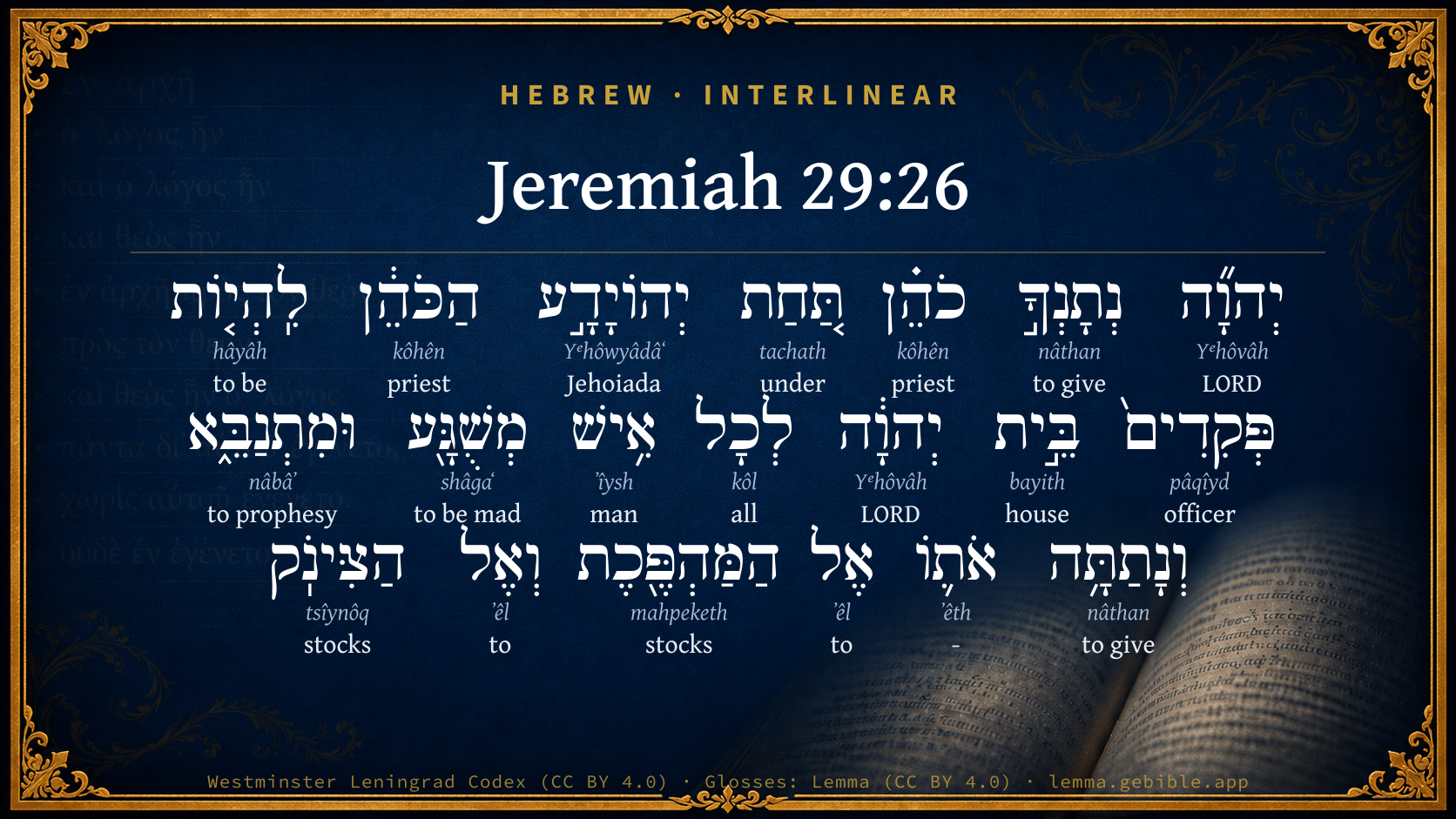
Jeremiah 29:26

Hebrew (Westminster Leningrad Codex) Jeremiah 29:26 appears in the Hebrew Old Testament. The text above is from the Westminster Leningrad Codex. Each word links to its Strong’s number, a concise gloss, and parsing drawn from the Open Scriptures Hebrew Bible morphology. Click any word for its full Brown-Driver-Briggs (BDB) entry.
Download image
Cite this verse

Jeremiah 29:26 (World English Bible). Public Domain. Lemma interlinear Bible study tool, https://lemma.gebible.app/v/jeremiah/29/26.

Show BibTeX & RIS
BibTeX
RIS
English Translation
Yahweh has made you priest in the place of Jehoiada the priest, that there may be officers in the house of Yahweh, for every man who is mad, and makes himself a prophet, that you should put him in the stocks and in shackles.
World English Bible · Public Domain
Highlights
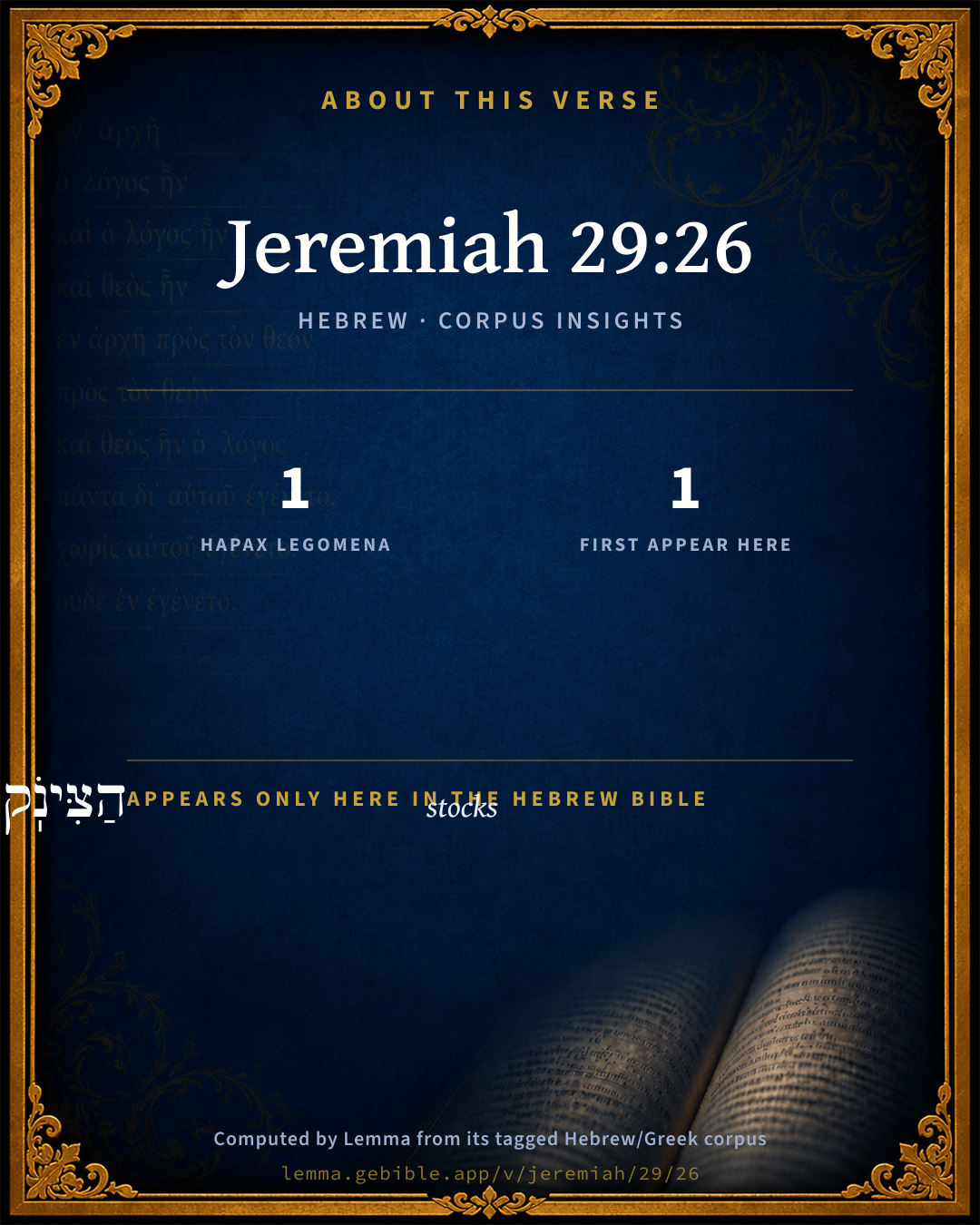
  • 1 hapax legomenon — only here in the Hebrew Bible
  • 1 first appearance in the Hebrew Bible
Full analysis ↓
Download a study sheet

One document with this verse’s original text, its word-by-word gloss line, the meaning frame, cross-references with their text, attributed commentary, and full source and license credits — printable, and it pastes into notes with its structure intact.

This verse Autodidact and up

Study sheet (.html) Plain text (.txt)

A passage Seminary Student

Up to 50 verses in one chapter. A passage sheet keeps up to 6 commentary sources and 12 cross-references per verse, in the order this page ranks them, and says so on the sheet whenever that leaves anything out. Ask for a single verse and you get the Autodidact verse sheet above.

Everything on this page stays free to read, with no account — the sheet is a download of what is already on screen, not access to it.

Want to remove ads? Support Godless Engineer
Compare translations 3

The same verse in 3 English versions, stacked beneath the original-language interlinear above. Click any original word for its lexicon entry.

Each is an independent rendering of the whole verse — the interlinear is not word-aligned to these translations.

Highlighted words mark where these versions differ — a whole-verse word diff, not a word-by-word alignment.

  • World English Bible Public Domain
    Yahweh has made you priest in the place of Jehoiada the priest, that there may be officers in the house of Yahweh, for every man who is mad, and makes himself a prophet, that you should put him in the stocks and in shackles.
  • King James Version Public Domain
    The LORD hath made thee priest in the stead of Jehoiada the priest, that ye should be officers in the house of the LORD, for every man that is mad, and maketh himself a prophet, that thou shouldest put him in prison, and in the stocks.
  • unfoldingWord Literal Text CC BY-SA 4.0
    “Yahweh has made you priest instead of Jehoiada the priest, for you to be in charge of Yahweh’s house. You are in control of all the people who rave and make themselves into prophets. You should put them in stocks and chains.

unfoldingWord Literal Text — © unfoldingWord, licensed CC BY-SA 4.0. Word-aligned USFM3 via Door43 (git.door43.org/unfoldingWord/en_ult).

Versions to compare (up to 4)

3 of 4 selected

Show all 18 translations

Every available English version of this verse, each an independent rendering of the whole verse.

  • World English Bible Public Domain
    Yahweh has made you priest in the place of Jehoiada the priest, that there may be officers in the house of Yahweh, for every man who is mad, and makes himself a prophet, that you should put him in the stocks and in shackles.
  • Berean Standard Bible Public Domain
    ‘The LORD has appointed you priest in place of Jehoiada, to be the chief officer in the house of the LORD, responsible for any madman who acts like a prophet—you must put him in stocks and neck irons.
  • Majority Standard Bible Public Domain
    ‘The LORD has appointed you priest in place of Jehoiada, to be the chief officer in the house of the LORD, responsible for any madman who acts like a prophet—you must put him in stocks and neck irons.
  • King James Version Public Domain
    The LORD hath made thee priest in the stead of Jehoiada the priest, that ye should be officers in the house of the LORD, for every man that is mad, and maketh himself a prophet, that thou shouldest put him in prison, and in the stocks.
  • American Standard Version (1901) Public Domain
    Jehovah hath made thee priest in the stead of Jehoiada the priest, that there may be officers in the house of Jehovah, for every man that is mad, and maketh himself a prophet, that thou shouldest put him in the stocks and in shackles.
  • Revised Version (1885) Public Domain
    The LORD hath made thee priest in the stead of Jehoiada the priest, that ye should be officers in the house of the LORD, for every man that is mad, and maketh himself a prophet, that thou shouldest put him in the stocks and in shackles.
  • Geneva Bible (1599) Public Domain
    The Lord hath made thee Priest for Iehoiada the Priest, that yee should bee officers in the House of the Lord, for euery man that raueth and maketh himselfe a Prophet, to put him in prison and in the stockes.
  • Douay-Rheims (1899) Public Domain
    The Lord hath made thee priest in- stead of Joiada the priest, that thou shouldst be ruler in the house of the Lord, over every man that raveth and prophesieth, to put him in the stocks, and into prison.
  • Young's Literal Translation Public Domain
    Jehovah hath made thee priest instead of Jehoiada the priest, for there being inspectors of the house of Jehovah, for every one mad and making himself a prophet, and thou hast put him unto the torture and unto the stocks.
  • Literal Standard Version CC BY-SA 4.0
    YHWH has made you priest instead of Jehoiada the priest, for there being inspectors of the house of YHWH over every man [who] is mad and making himself a prophet, and you have put him in the stocks and in the pillory.
  • Unlocked Literal Bible CC BY-SA 4.0
    “Yahweh has made you priest instead of Jehoiada the priest, for you to be in charge of Yahweh's house. You are in control of all the people who rave and make themselves into prophets. You should put them in stocks and chains.
  • unfoldingWord Literal Text CC BY-SA 4.0
    “Yahweh has made you priest instead of Jehoiada the priest, for you to be in charge of Yahweh’s house. You are in control of all the people who rave and make themselves into prophets. You should put them in stocks and chains.
  • Darby Bible Public Domain
    Jehovah hath made thee priest in the stead of Jehoiada the priest, that there should be officers [in] the house of Jehovah, over every madman and self-made prophet, that thou shouldest put him in the stocks and in the shackles.
  • World Messianic Bible Public Domain
    “The LORD has made you priest in the place of Jehoiada the priest, that there may be officers in the LORD’s house, for every man who is crazy and makes himself a prophet, that you should put him in the stocks and in shackles.
  • Webster's Bible Public Domain
    The LORD hath made thee priest in the stead of Jehoiada the priest, that ye should be officers in the house of the LORD, for every man that is mad, and maketh himself a prophet, that thou shouldest put him in prison, and in the stocks.
  • Free Bible Version CC BY-SA 4.0
    “Zephaniah, the Lord has chosen you as priest to replace Jehoiada, to be in charge of the Lord's Temple. In that capacity you are required to put in the stocks and neck irons any crazy person who claims to be a prophet.
  • Bible in Basic English Public Domain
    The Lord has made you priest in place of Jehoiada the priest, to be an overseer in the house of the Lord for every man who is off his head and is acting as a prophet, to put such men in prison and in chains.
  • JPS Tanakh (1917) Public Domain
    'The LORD hath made thee priest in the stead of Jehoiada the priest, that there should be officers in the house of the LORD for every man that is mad, and maketh himself a prophet, that thou shouldest put him in the stocks and in the collar.

Literal Standard Version (2020), Covenant Press — licensed CC BY-SA 4.0. Text via the HelloAO Bible API (eBible.org). Unlocked Literal Bible (unfoldingWord) — licensed CC BY-SA 4.0. Text via the HelloAO Bible API (eBible.org). unfoldingWord Literal Text — © unfoldingWord, licensed CC BY-SA 4.0. Word-aligned USFM3 via Door43 (git.door43.org/unfoldingWord/en_ult). Free Bible Version, Dr. Jonathan Gallagher — licensed CC BY-SA 4.0. Text via the HelloAO Bible API (eBible.org).

Word by word

More ways to search: Search by grammar → Find every occurrence → Compare this word →

Practice this passage: Drill this verse → Learn its vocabulary →

הַצִּינֹֽק
tsîynôq
H6729
“the · stocks”
Particle, Definite Article + Noun, Common, Masculine, Singular, Absolute
Part of Speech
Particle + Noun
Type
Common
Gender
Masculine
Number
Singular
State
Absolute
Full BDB Definition

Origin: from an unused root meaning to confine

TWOT: 1941a

pillory, stocks
  1. יְהוָ֞ה Yᵉhôvâh H3068 “LORD” Noun, Proper
  2. נְתָנְךָ֣ nâthan H5414 “to give · you” Verb, Qal, Perfect, 3rd Person, Masculine, Singular + Suffix, Personal, 2nd Person, Masculine, Singular
  3. כֹהֵ֗ן kôhên H3548 “priest” Noun, Common, Masculine, Singular, Absolute
  4. תַּ֚חַת tachath H8478 “under” Preposition
  5. יְהוֹיָדָ֣ע Yᵉhôwyâdâʻ H3077 “Jehoiada” Noun, Proper
  6. הַכֹּהֵ֔ן kôhên H3548 “the · priest” Particle, Definite Article + Noun, Common, Masculine, Singular, Absolute
  7. לִֽהְי֤וֹת hâyâh H1961 “to be” Preposition + Verb, Qal, Infinitive Construct
  8. פְּקִדִים֙ pâqîyd H6496 “officers” Noun, Common, Masculine, Plural, Absolute
  9. בֵּ֣ית bayith H1004 “house of” Noun, Common, Masculine, Singular, Construct
  10. יְהוָ֔ה Yᵉhôvâh H3068 “LORD” Noun, Proper
  11. לְכָל kôl H3605 “to/for · all of” Preposition + Noun, Common, Masculine, Singular, Construct
  12. אִ֥ישׁ ʼîysh H376 “man” Noun, Common, Masculine, Singular, Absolute
  13. מְשֻׁגָּ֖ע shâgaʻ H7696 “mad” Verb, Pual, Participle Passive, Masculine, Singular, Absolute
  14. וּמִתְנַבֵּ֑א nâbâʼ H5012 “and · prophesying” Conjunction + Verb, Hithpael, Participle Active, Masculine, Singular, Absolute
  15. וְנָתַתָּ֥ה nâthan H5414 “and · to give” Conjunction + Verb, Qal, Sequential Perfect, 2nd Person, Masculine, Singular
  16. אֹת֛וֹ ʼêth H853 “- · him” Particle, Direct Object + Suffix, Personal, 3rd Person, Masculine, Singular
  17. אֶל ʼêl H413 “to” Preposition
  18. הַמַּהְפֶּ֖כֶת mahpeketh H4115 “the · stocks” Particle, Definite Article + Noun, Common, Feminine, Singular, Absolute
  19. וְאֶל ʼêl H413 “and · to” Conjunction + Preposition

About this verse

These counts appear in no published source. They are computed here, from the morphology-tagged text and Lemma’s own curated glosses. What Lemma adds →

20
words
16
distinct lemmas
Prophets
section

Notable vocabulary

1 hapax legomenon — a word that appears only here in the entire Hebrew Bible:

  • הַצִּינֹֽק stocks H6729

First appearance in Scripture

This word makes its first canonical appearance in the Hebrew Bible here:

  • הַצִּינֹֽק stocks H6729

Shared distinctive vocabulary

הַמַּהְפֶּ֖כֶת stocks H4115 occurs in 4 verses of the Hebrew Bible. Also found in:

Grammatical profile

  • 5 verbs
  • 11 nouns
  • 3 prepositions
  • 1 particle

Verb forms

  • נְתָנְךָ֣ Qal · Perfect
  • לִֽהְי֤וֹת Qal · Infinitive Construct
  • מְשֻׁגָּ֖ע Pual · Participle Passive
  • וּמִתְנַבֵּ֑א Hithpael · Participle Active
  • וְנָתַתָּ֥ה Qal · Sequential Perfect

Repetition

Words recur within this verse — often emphatic in Hebrew:

  • יְהוָ֞ה LORD H3068 ×2
  • נְתָנְךָ֣ to give H5414 ×2
  • כֹהֵ֗ן priest H3548 ×2
  • אֶל to H413 ×2

Cross-references

26

Topical passages linked to Jeremiah 29:26 in the Treasury of Scripture Knowledge — connected by theme and wording, ordered by reader-vote popularity; previews shown in the World English Bible.

  • Jeremiah 20:1–2 Now Pashhur, the son of Immer the priest, who was chief officer in the house of Yahweh, heard Jeremiah prophesying these things.
  • 2 Kings 9:11 Then Jehu came forth to the servants of his lord: and one said to him, Is all well? why came this mad fellow to you? He said to them, You know the man and what his talk was.
  • Hosea 9:7 The days of visitation have come. The days of reckoning have come. Israel will consider the prophet to be a fool, And the man who is inspired to be insane, Because of the abundance of your sins, And because your hostility is great.
  • John 10:20 Many of them said, "He has a demon, and is insane! Why do you listen to him?"
  • Acts 26:24 As he thus made his defense, Festus said with a loud voice, "Paul, you are crazy! Your great learning is driving you insane!"
  • Deuteronomy 13:1–5 If there arise in the midst of you a prophet, or a dreamer of dreams, and he give you a sign or a wonder,
  • Mark 3:21 When his friends heard it, they went out to seize him: for they said, "He is insane."
  • Acts 16:24 who, having received such a charge, threw them into the inner prison, and secured their feet in the stocks.
  • 2 Kings 11:15 Jehoiada the priest commanded the captains of hundreds who were set over the host, and said to them, Have her forth between the ranks; and him who follows her kill with the sword. For the priest said, Don't let her be slain in the house of Yahweh.
  • 2 Kings 11:18 All the people of the land went to the house of Baal, and broke it down; his altars and his images broke they in pieces thoroughly, and killed Mattan the priest of Baal before the altars. The priest appointed officers over the house of Yahweh.
  • 2 Chronicles 16:10 Then Asa was angry with the seer, and put him in the prison-house; for he was in a rage with him because of this thing. Asa oppressed some of the people at the same time.
  • 2 Chronicles 18:26 and say, Thus says the king, Put this fellow in the prison, and feed him with bread of affliction and with water of affliction, until I return in peace.
  • Jeremiah 29:27 Now therefore, why have you not rebuked Jeremiah of Anathoth, who makes himself a prophet to you,
  • Jeremiah 38:6 Then took they Jeremiah, and cast him into the dungeon of Malchijah the king's son, that was in the court of the guard: and they let down Jeremiah with cords. In the dungeon there was no water, but mire; and Jeremiah sank in the mire.
  • Jeremiah 38:28 So Jeremiah abode in the court of the guard until the day that Jerusalem was taken.
  • Zechariah 13:3–6 It will happen that, when anyone still prophesies, then his father and his mother who bore him will tell him, 'You must die, because you speak lies in the name of Yahweh;' and his father and his mother who bore him will stab him when he prophesies.
  • Matthew 21:23 When he had come into the temple, the chief priests and the elders of the people came to him as he was teaching, and said, "By what authority do you do these things? Who gave you this authority?"
  • John 8:53 Are you greater than our father, Abraham, who died? The prophets died. Who do you make yourself out to be?"
  • John 10:33 The Jews answered him, "We don't stone you for a good work, but for blasphemy: because you, being a man, make yourself God."
  • Acts 4:1 As they spoke to the people, the priests and the captain of the temple and the Sadducees came to them,
  • Acts 5:18 and laid hands on the apostles, and put them in public custody.
  • Acts 5:24 Now when the high priest, the captain of the temple, and the chief priests heard these words, they were very perplexed about them and what might become of this.
  • Acts 26:11 Punishing them often in all the synagogues, I tried to make them blaspheme. Being exceedingly enraged against them, I persecuted them even to foreign cities.
  • 2 Corinthians 5:13–15 For if we are beside ourselves, it is for God. Or if we are of sober mind, it is for you.
  • 2 Corinthians 11:33 Through a window I was let down in a basket by the wall, and escaped his hands.
  • Revelation 2:10 Don't be afraid of the things which you are about to suffer. Behold, the devil is about to throw some of you into prison, that you may be tested; and you will have oppression for ten days. Be faithful to death, and I will give you the crown of life.

Cross-references courtesy of OpenBible.info (CC BY 4.0).

Hebrew and Greek witnesses Masoretic Hebrew ↔ Greek Septuagint

The same verse in the two great witnesses to the Old Testament, shown verse-for-verse.

These are two independent witnesses, not word-aligned to each other, and the Septuagint is shown in lemma (dictionary) form.

Hebrew Jeremiah 29:26 Masoretic · Westminster Leningrad Codex

יְהוָ֞ה נְתָנְךָ֣ כֹהֵ֗ן תַּ֚חַת יְהוֹיָדָ֣ע הַכֹּהֵ֔ן לִֽהְי֤וֹת פְּקִדִים֙ בֵּ֣ית יְהוָ֔ה לְכָל אִ֥ישׁ מְשֻׁגָּ֖ע וּמִתְנַבֵּ֑א וְנָתַתָּ֥ה אֹת֛וֹ אֶל הַמַּהְפֶּ֖כֶת וְאֶל הַצִּינֹֽק

Yahweh has made you priest in the place of Jehoiada the priest, that there may be officers in the house of Yahweh, for every man who is mad, and makes himself a prophet, that you should put him in the stocks and in shackles.

World English Bible · Public Domain

Greek LXX Structure differs

In the Septuagint, Jeremiah is about an eighth shorter than the Hebrew and arranges its material differently — the Oracles Against the Nations (Hebrew chapters 46–51) appear in the middle of the Greek book, after 25:13. Because the chapter and verse boundaries do not line up, a verse-for-verse comparison with the Hebrew is not shown.

A verse-for-verse comparison isn’t shown here because the chapters and verses don’t line up. Switch to the LXX edition with the MT / LXX toggle above to read the Greek directly.

On this verse, The Cambridge Bible for Schools and Colleges discusses the Septuagint’s reading. Read the note in Commentary ↓

Hebrew: Westminster Leningrad Codex (CC BY 4.0). Greek: Septuagint (public domain); English from a public-domain English Septuagint. How the Septuagint differs from the Hebrew →

Targum (Aramaic paraphrase)

1

The Targum is the ancient Jewish Aramaic paraphrase of the Hebrew Scriptures — an interpretive translation, not the Hebrew text itself. Onkelos (literal) and Pseudo-Jonathan (expansive) render the Torah, and Jonathan the Prophets. Coverage is partial: where no permissively-licensed English translation exists for a verse, only the Aramaic is shown. This is verse-level text, not a word-by-word alignment to the Hebrew.

  1. Targum Jonathan Prophets (Joshua–Malachi)
    יְיָ מַנְיָךְ כָּהֵן חֲלַף יְהוֹיָדָע כַּהֲנָא לְמֶהֱוֵי מְמַנָא סְגַן כַּהֲנַיָא בְּבֵית מַקְדְשָׁא דַייָ לְכָל גְבַר דְמִשְׁתְּלִי וּמְטַפֵּשׁ וְתִתֵּן יָתֵיהּ לְכֵיפְתָא וּלְגוֹ צִינוֹקָא:

    (no public-domain English translation for this verse)

    Targum Jonathan — Aramaic: “Mikraot Gedolot” (public domain). English: “Sefaria Community Translation” (CC0 1.0 (public-domain dedication)); “London "Chaldee Paraphrase," 1871” (public domain). Text via Sefaria.

Commentary

Notes on Jeremiah 29:26 from classic Christian and Jewish commentators (each source and its license shown beneath its notes). The classic Christian expositions comment on the surrounding passage and are grouped to its opening verse, so a note may address several verses; the Jewish commentaries on the Tanakh (Rashi and others) are per-verse, so they appear only where the commentator wrote on this verse.

Lemma curates 59 commentaries, every one of them public domain or Creative Commons licensed, each selected and text-cleaned for this edition rather than reprinted as found. About our sources →

Trapp's Complete Commentary

John Trapp

Jer 29:26 The LORD hath made thee priest in the stead of Jehoiada the priest, that ye should be officers in the house of the LORD, for every man [that is] mad, and maketh himself a prophet, that thou shouldest put him in prison, and in the stocks.

Ver. 26. The Lord hath made thee priest instead of Jehoiada the priest.] That heroic reformer in the days of Joash {2Ki 11:4; 2Ki 11:17} Therefore, as he did by Mattan the Baalite, so do thou by Jeremiah the Anathothite. But neither was Zephaniah a Jehoiada, nor Jeremiah a Mattan. Shemaiah himself was more like a Baalite, and better deserved that punishment which shortly after also befell him, as was foretold. {Jer 29:32} A hot spirited man he was, and a firebrand, being therefore the more dangerous. He also seemed to himself to be so much the more holy, by how much the prophet whom he set against was more famous for his holiness.

For every one that is mad.] Maniacus, arreptitius, fanaticus; so God’s zealous servants have always been esteemed by the mad world, ever beside itself in point of salvation. See 2Ki 9:11 Act 26:24 Jer 43:2.

That thou shouldest put him in prison.] As Jer 20:2.

John Trapp, A Commentary or Exposition upon All the Books of the Old and New Testament (1647–1656) — public domain. Text from a community e-Sword module.

Geneva Bible (1599)

Geneva Bible translators

Shemaiah the false prophet flattereth Zephaniah the chief Priest, as though God had given him the spirit and zeal of Jehoiada to punish whosoever trespassed against the word of God, of the which he would have made Jeremiah one, calling him a raver and a false prophet.

Geneva Bible (1599) marginal notes — public domain. Text via Bolls.life.

Jamieson, Fausset & Brown

Robert Jamieson, A. R. Fausset & David Brown

thee . . . in the stead of Jehoiada--Zephaniah's promotion as second priest, owing to Jehoiada's being then in exile, was unexpected. Shemaiah thus accuses him of ingratitude towards God, who had so highly exalted him before his regular time.

ye should be officers . . . for every man--Ye should, as bearing rule in the temple (see on Jer 20:1), apprehend every false prophet like Jeremiah.

mad--Inspired prophets were often so called by the ungodly (Kg2 9:11; Act 26:24; Act 2:13, Act 2:15, Act 2:17-18). Jeremiah is in this a type of Christ, against whom the same charge was brought (Joh 10:20).

prison--rather, "the stocks" (see on Jer 20:2).

stocks--from a root, "to confine"; hence rather, "a narrow dungeon." According to Deu 17:8-9, the priest was judge in such cases, but had no right to put into the stocks; this right he had assumed to himself in the troubled state of the times.

Jamieson, Fausset & Brown — Commentary Critical and Explanatory on the Whole Bible (1871) — public domain (CC PDM 1.0). Text via the HelloAO Bible API.

Adam Clarke's Commentary

Verse 26. For every man that is mad, and maketh himself a prophet] Mad, משגע meshugga, in ecstatic rapture; such as appeared in the prophets, whether true or false, when under the influence, the one of God, the other of a demon. See 2Kg 9:11; Ho 9:7.

Adam Clarke's Commentary on the Bible (1810–1826) — public domain. Text from a community e-Sword/MySword module.

John Calvin's Commentaries

Here follows the subject of the letter, Jehovah hath made thee a priest, etc. Here the impostor Shemaiah accuses the high-priest of ingratitude, because he had been chosen in the place of another. For it is probable that Jehoiada was still living, but that he had been led away into Chaldea with the other exiles. As then so high a dignity had, beyond hope, and before the time, come to the high-priest, the false prophet reproves him, because he did not rightly acknowledge this favor of God, as though he had said, that he was rendering an unworthy reward to God, who had raised him to that high station: God, he said, hath made thee a priest in the place of Jehoiada the priest Thus the ministers of Satan transform themselves into angels of light; and yet they cannot so dexterously imitate God’s servants, but that their deceit makes itself presently known; for craftiness is very different from a right and prudent counsel. God endues his servants with counsel and wisdom; but Satan, with craft and guile. Though, then, at the first view, some artifice appears in this letter of the false prophet, yet we may gather from its contents, that he falsely pretended the name of God, that he falsely alleged that the chief priest was chosen in the place of Jehoiada. That ye should be, he says: at first he addresses the high-priest, but now he includes also others, that ye should be the keepers, or the rulers of the house of God For though the chief power was in the high-priest, yet as he could not alone undertake everything, it was necessary for him to have others connected with him. This is the reason why Shemaiah not only says that the high-priest was a ruler in the Temple of God, but after having placed him in the highest honor, mentions also others.

He says against every man that is mad; so משגע, meshego, is rendered by Jerome, and I think not unsuitably; for the word means properly one that is insane: but this was applied to false teachers, because they boasted that they were under a divine impulse, when they spoke their own thoughts. This appears evident from the ninth chapter of Hosea, where it is said that the people would at length acknowledge that the prophets, who had flattered them, were insane, and that the men of the Spirit were mad. The Prophet conceded to them both names, that they were prophets and men of the Spirit, that is, spiritual; but he proved that they had only the names and not the reality: for prophets were called spiritual men, because God inspired them with his Spirit; but the ungodly, when they wished to revile the true prophets, called them mad. So did they speak who were with Jehu, when a prophet came to anoint him, “What means this mad fellow?” this word משגע, meshego, is what they used; and they called him in contempt mad, who had yet spoken by the secret impulse of the Spirit. (2 Kings 9:11.) So, in like manner, do the ungodly rave in contempt of God against everything found in Scripture.

But as it has been already stated, it was necessary to distinguish between the true servants of God and those only in name; for many boasted that they were called by God, and yet were impostors. God then called these mad and insane; but what did the ungodly do? they transferred the reproach to the lawful servants of God. So, in this place, Shemaiah says, that Jeremiah was mad, who falsely pretended the name of God, and prophesied falsely.

He adds, That thou shouldest put him in prison, or cast him into prison or the stocks, as some render the word. Then he says, in manacles, that is, thou shouldest bind him, until his impiety be known, so that thou mayest detain him in prison. It is, indeed, probable that the chief priests had assumed this power during the disordered state of things. This proceeding no doubt resulted from a good principle; for God ever designed that his Church should be well governed: he therefore commanded in his Law, that when any dispute or question arose, the chief priest was to be the judge, (Deuteronomy 17:8, 9;) but when mention is here made of prison and of manacles, it: was an act, no doubt, beyond the Law. It is therefore probable that it was added to the Law of God when the state of things was in disorder and confusion among the Jews. And whence was the origin of the evil? from the ignorance and sloth of the priests. They ought to have been the messengers of the God of hosts, the interpreters of the Law, the truth ought to have been sought from their mouth; but they were dumb dogs, nay, they had so degenerated, that nothing priestly was found in them; they had forgotten the Law, there was no religion in them. As then they had neglected their office, it was necessary to choose other prophets: and as we have said elsewhere, it was as it were accidental that God raised up prophets from the common people. There was, indeed, a necessity of having prophets always in the ancient Church; but God would have taken them from the Levites, except that he designed to expose them to reproach before the whole people, when he made prophets even of herdsmen, as in the case of Amos.

As then the priests suffered the prophetic office to be transferred to the common people, a new way was devised, that it might, not be any loss to them, as under the Papacy; for we know that bishops are for no other reason made rulers in the Church, but that there might be pastors and teachers. For of what use could these asses be, whom we know to be for the most part destitute of any learning? What could these men do, who are profane, and given up to their own pleasures and enjoyments? In short, what could gamesters and panders do? for such are almost all the Papal bishops. It was therefore necessary to give up their office to brawling monks, “You shall teach, for we resign to you the pulpits.” But, at the same time, they retained the power of judgment in their own hands: when any controversy arose, neither the noisy brawlers nor the dumb beasts could of themselves decide anything; for ignorance prevented the latter, and power was wanting to the former. How, then, did the bishops formerly condemn heretics? and how do they condemn them still? Why, thus: When one was a Carmelite, they called in the Franciscans; and when one was an Augustinian, the Dominicans were summoned. For, as I have said, these mute animals had no knowledge nor wisdom. And yet a certain dignity was maintained by the bishops or their vicars, when they pronounced sentence in condemning heretics. And such was probably the case among the ancient people; for those who pretended to be prophets were summoned, and that by the authority of the high-priest, under the pretext of law, but not without some corruption added to it; for God had not given fetters and manacles to the priests, that they might thus restrain those who might create disturbance and corrupt the pure truth. But what remains I shall defer to the next Lecture.

John Calvin's Commentaries (1540-1563) — public domain. Text from the Calvin Translation Society English edition (1840s-50s) via the Christian Classics Ethereal Library (ccel.org). Calvin's coverage is partial (roughly two-thirds of the Bible); uncommented books and verses are honest gaps, never fabricated. The 19th-century editor's footnotes and remarks are omitted so the notes are faithfully Calvin's own voice.

Ellicott's Commentary for English Readers

(26) The Lord hath made thee priest in the stead of Jehoiada . . .—The priest so named had apparently been deposed, as not favouring the stringent policy of the party of revolt. As Sagan, it was probably his special duty to maintain order in the Temple, and punish pretenders to the gift of prophecy, and the letter reproaches him for his lukewarm timidity in discharging that duty. In the word “mad,” as in 2Ki_9:11, Hos_9:7, we have the habitual term of scorn applied to such pretenders. On the punishment of the stocks, see Note on Jer_20:2. The word translated “prison” is probably another form of punishment like that of the stocks.

A Bible Commentary for English Readers, edited by Charles John Ellicott (1878–1897) — public domain. Text from a community e-Sword module.

The Cambridge Bible for Schools and Colleges

gen. ed. J. J. S. Perowne

26. This and the two following verses give us the words of Shemaiah’s letter to Zephaniah, as quoted in Jeremiah’s reply.

thee] Zephaniah.

in the stead of Jehoiada] See on Jer_20:1. The title “officers” here is the same in the original as the one given there to Pashhur. It is possible that the reference may be to the high-priest in the days of Joash (2Ki_9:4 ff.), who “appointed officers over the house of the Lord” (Jer_29:18). It is best here, however, with LXX, Targ. and other authorities to read “to be an officer.”

that is mad] Madness was looked on in the East as a sort of gift of prophecy perverted. Cp. “mad” (same Heb.) in 2Ki_9:11; Hos_9:7.

the stocks] See on ch. Jer_20:2.

shackles] mg. rightly, the collar. The word is found here only in the Heb., but a cognate Arabic word indicates that it is an iron band fastened round the neck.

The Cambridge Bible for Schools and Colleges (gen. ed. J. J. S. Perowne; Cambridge University Press, 1878–1918) — public domain. Text from a community e-Sword module.

John Gill's Exposition

The Lord hath made thee priest in the stead of Jehoiada the priest,.... The same with Seraiah, who might have more names than one, and Jehoiada be one of them, who either was removed, or carried captive; and this Zephaniah, his sagan of deputy, succeeded him. Some think he refers to the famous Jehoiada in the times of Joash, a great reformer; and that this man was another such an one for his zeal, or at least ought to be, which he would have him exert against Jeremiah; but the former seems most probable:

that ye should be officers in the house of the Lord; or "visitors", or "overseers" (i) there; that is, Zephaniah, and the rest of the priests; or that he should see to it, that there were proper officers set there, to take care of it, and suffer none to come in and prophesy there, to the hurt of the people, as he would insinuate:

for every man that is mad, and maketh himself a prophet; or, "against every man" (k); to prevent all enthusiastic persons, and such as are troubled with a frenzy in their brain, and set up themselves for prophets, from speaking in the name of the Lord; so the true prophets of old, and the apostles of Christ, and faithful ministers of the word, have always been represented as beside themselves, and as taking upon them an office that did not belong to them; and therefore should be restrained and persecuted by the higher powers:

that thou shouldest put him in prison, and in the stocks; the former of these words, according to the Hebrew, signifies an engine or instrument, in which the neck was put, like our pillory; and the latter an iron instrument for the hands, a manacle, or handcuff, as Kimchi; see Jer 20:2; though this rather better agrees with the pillory, being a strait narrow place, in which the hands, feet, and neck, were put (l).

(i) "inspectores", Cocceius, Gataker. (k) "adversus omnem virum", Calvin; "contra omnem virum", Schmidt. (l) Vid. Hottinger. Smegma Orientale, l. 1. c. 7. p. 190.

John Gill's Exposition of the Whole Bible (1746–1763) — public domain (CC PDM 1.0). Text via the HelloAO Bible API.

Haydock's Catholic Bible Commentary

Joiada, whose zeal had been conspicuous long before, under Joas, in persuading him to destroy the false prophets, 4 Kings xi. 17. Sophonias is exhorted to imitate him, by treating Jeremias in like manner. (Calmet) --- Thou. Hebrew, "ye should be officers." (Protestants) (Haydock) --- There were many chief priests. --- Raveth. Hebrew, "is possessed, and counterfeits the prophet." Such were to be slain, being confined till sentence had been passed, Deuteronomy xviii. 20. (Calmet)

George Leo Haydock (1774–1849), Haydock's Catholic Family Bible and Commentary, 1859 edition — public domain. Excludes Psalms (Douay-Rheims chapter numbering differs from Protestant) and Deuterocanonical books (Catholic canon only).

Matthew Poole's English Annotations

Priest, that is, high priest, as some have thought; but it appears from 2Ki 25:18, that Seraiah was at this time the high priest, and this Zephaniah was the second priest, as he is there styled, as also Jer 52:24; nor must any think that the Jehoiada here meant was the immediate predecessor of Zephaniah, for besides that Jehoiada was high priest, which Zephaniah never was, there were near two hundred years betwixt the death of Jehoiada and this time; in the stead therefore here signifieth, that thou shouldst be like the good high priest Jehoiada; unless some other Jehoiada was meant, who was turned out, and this Zephaniah put in his room.

That ye should be officers in the house of the Lord, for every man that is mad; that thou mightest have a care of religion, and particularly take care of persons who being mad or phrenetic make themselves prophets. The priests had a power to restrain such persons by imprisoning them, or putting them in the stocks, by which most agree a particular punishment is expressed, but for the nature and way of it is not determined. Those who in so uncertain a thing have a mind to read what hath been said, may find it both in Mr. Pool’s Synopsis Criticorum, and the English Annotations upon this verse, but the learned author of them reciting what authors have said, concludes it at last not with any certainty to be determined.

Matthew Poole's English Annotations on the Holy Bible (1683–1685) — public domain. Text from a community e-Sword/MySword module.

Whedon's Commentary on the Bible

Daniel D. Whedon

26. The Lord hath made thee priest — An adroit appeal to his fanatical zeal. Jeremiah charges his failure to punish him as ingratitude to God.

Officers — Literally, overseers, men in charge; the police force of the temple.

Prison, and in the stocks — As Pashur had already done to Jeremiah. Jer_20:2.

Daniel D. Whedon (gen. ed.), Commentary on the Old and New Testaments (1874–1909) — public domain. Text from a community e-Sword module.

The Pulpit Commentary

In the stead of Jehoiada the priest. Some (Grotius, Hitzig, Graf) think that this Jehoiada was the famous high priest of that name, who is said to have "appointed officers over the house of the Lord". (2Ki_11:18 2Ch_23:18) It is true that Zephaniah was not literally the successor of Jehoiada, but he was so in the same metaphorical sense in which the scribes are said by our Lord to "sit in Moses" seat". (Mat_23:2) It is safer, however, to suppose that another Jehoiada is meant, of whom we have no further information. It is not said that either Jehoiada or Zephaniah was high priest, and as the special object of the elevation of the latter is said to be the supervision of the temple police, it is more probable that Jehoiada and he were successively "second priests," or, to use a phrase which seems to be synonymous, "deputy governors in the house of the Lord". (Jer_20:1) The passage may thus without violence be harmonized with Jer_52:24 2Ki_25:18, where Seraiah is called "the chief priest" and Zephaniah "the second priest." It is possible that Jehoiada "had been favorable to the better class of prophets. In this case there will be a delicate hint to Zephaniah that God had his own purpose in promoting him to honor, viz. that unruly prophets like Jeremiah might be held in with a tighter hand (Ewald). That ye should be officers; rather, that there should be officers. Zephaniah himself was an "officer" or "deputy" (see above); but he was also "chief in the house of the Lord," and had the appointment of inferior "officers," whose duty it was to preserve order in the temple. To understand the following words, we must remember that the outer court of the temple was a favorite place for prophetic teaching. (comp. Jer_7:2 Jer_26:2) For every man that is mad, and maketh himself a prophet; i.e. to keep an eye upon "madmen" and prophetizers. The term "mad" is used in a disparaging sense, (as 2Ki_9:11; comp. Hos_9:7) with regard to the apparently senseless behavior of those who were overpowered by the spirit of prophecy. In earlier times, no doubt, the phenomena of prophecy were more violently opposed to everyday life than in Jeremiah"s time; but such symbolic acts as appearing in public with a yoke upon his neck would at least excuse the application of the epithet even to Jeremiah. It is more than probable, however, that it was not so much the abnormal actions as the contents of Jeremiah"s prophecies which stirred up such vehement opposition; observe how in the next verse only the sound of these descriptive nouns is retained ("which maketh himself a prophet"). It was the making prophecy a reality which disturbed the men of routine, and Shemaiah well knew this when he made this appeal to Zephaniah. There was no harm in being nominally a "prophet," but to "make," or rather, "show one"s self as a prophet," to be an energetic prophet, a prophetizer (if the word may be invented), this was wormwood to those who cried, "Peace, peace," when there was no peace. In prison, and in the stocks; rather, in the stocks (see on Jer_20:2) and in the collar. The meaning seems to be that Jeremiah was subjected to both forms of punishment at once.

The Pulpit Commentary (1880–1919), ed. H.D.M. Spence-Jones & Joseph S. Exell — public domain. Text from a community e-Sword module.

John Wesley's Explanatory Notes

Priest - Zephaniah was the second priest. In the stead - In the stead signifies, that thou shouldest be like the good high priest Jehoiada. Mad - That thou mightest take care of persons, who being mad or frantick make themselves prophets.

John Wesley, Explanatory Notes Upon the Whole Bible (1754–1765) — public domain. Text via the GEBible commentary corpus.

Rashi

Rabbi Shlomo Yitzchaki (Rashi)

made you a priest He wrote this to Zephaniah.

officers appointees.

the prison כִּפָה

the stocks a tree trunk (ceps in French).

Rashi on the Tanakh — English translations: “The Judaica Press complete Tanach with Rashi, translated by A. J. Rosenberg” (CC BY 4.0); “Pentateuch with Rashi's commentary by M. Rosenbaum and A.M. Silbermann, 1929-1934” (public domain); “The Metsudah Tanach series, Lakewood, N.J” (CC BY 4.0); and “The Book of Joshua, Metsudah Publications, 1997” (CC BY 4.0). Text via Sefaria.

Lesson kit

Teaching starters — assembled from the data on this page, not authored interpretation. Every prompt links to the verse data it draws on. Edit before teaching.

Jeremiah, in the Prophets, opens this verse with 20 words (16 distinct Hebrew lemmas). Its most distinctive word is tsîynôq (“stocks”). A historical commentator’s framing appears above. Read the whole chapter for the surrounding context.

Discussion questions

  1. How does “stocks” (tsîynôq) shape what this verse is saying?
  2. This verse holds 1 word here found nowhere else in the Hebrew Bible. What might the rare word draw attention to?
  3. The word “stocks” first appears here in Scripture. What is being introduced at this debut?
  4. 2 Chronicles 16:10 shares the word «stocks» with this verse. How do the two illuminate each other?
  5. “LORD” occurs 2× in this one verse. What is the effect of the repetition?
  6. These translations render this verse differently. What is at stake in choosing one wording over another?
  7. The verb «נְתָנְךָ֣» is Qal Perfect. How does its form color the action?
  8. Reading how Trapp's Complete Commentary and Geneva Bible (1599) read this verse, where do the two commentators agree and where do they part?

Things to notice

  • 1 word in this verse appears nowhere else in the Hebrew Bible.
  • 1 word makes its first canonical appearance in Scripture here.
  • These translations choose different wording for 33 words in this verse.
  • “LORD” occurs 2× in this single verse.
  • 16 distinct Hebrew lemmas span 20 words in this verse.

Reading settings

Reading text

Shown beneath each verse's original-language words.

Old Testament
Old Testament edition

Read the OT as the Masoretic Hebrew (MT) or the Greek Septuagint (LXX).

English shown for the Greek Septuagint (in the Hebrew ↔ Greek comparison).

Comparing translations? Open the Compare panel on any verse page to stack up to four side by side.