
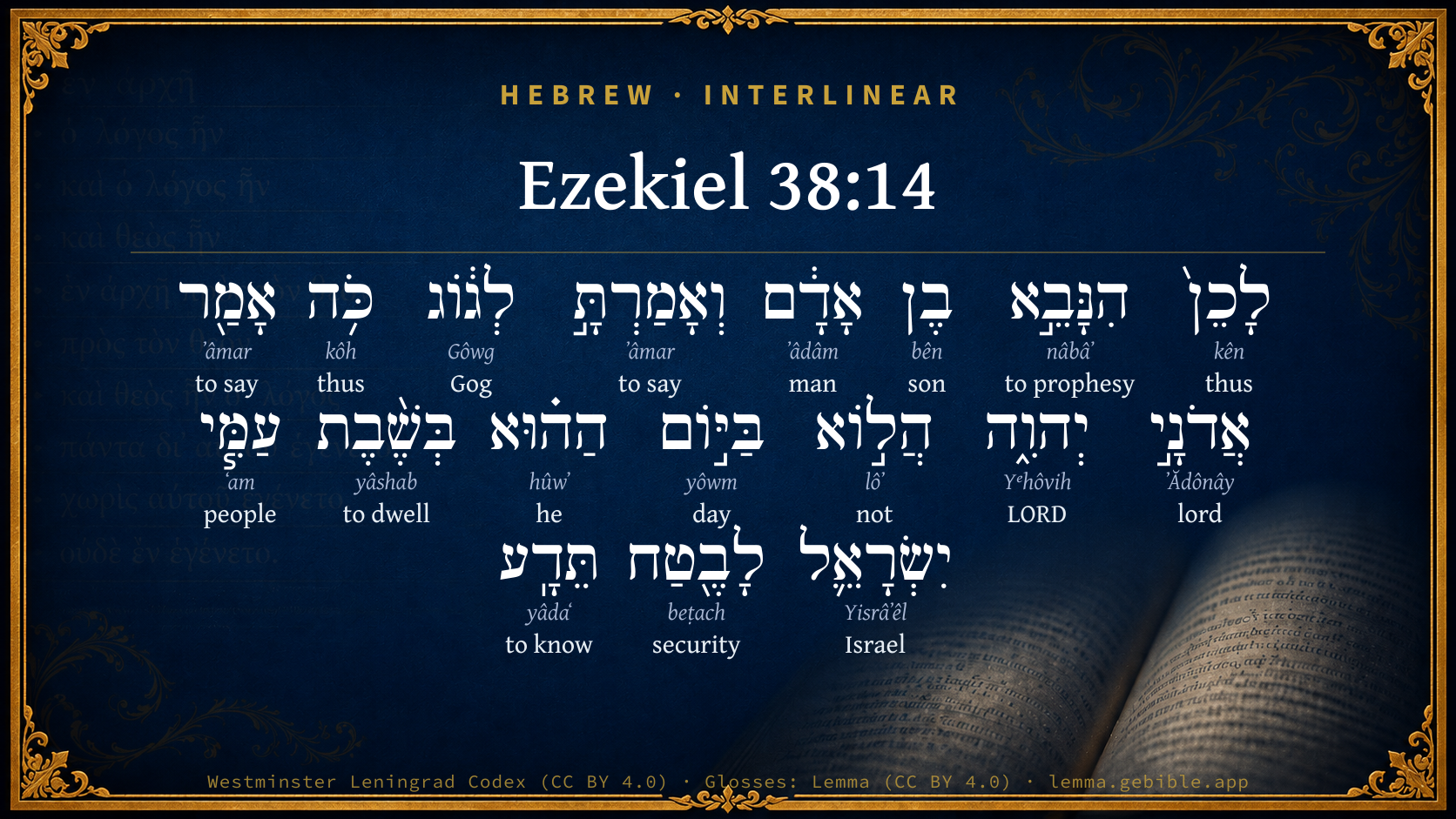
Ezekiel 38:14

Hebrew (Westminster Leningrad Codex) Ezekiel 38:14 appears in the Hebrew Old Testament. The text above is from the Westminster Leningrad Codex. Each word links to its Strong’s number, a concise gloss, and parsing drawn from the Open Scriptures Hebrew Bible morphology. Click any word for its full Brown-Driver-Briggs (BDB) entry.
Download image
Cite this verse

Ezekiel 38:14 (World English Bible). Public Domain. Lemma interlinear Bible study tool, https://lemma.gebible.app/v/ezekiel/38/14.

Show BibTeX & RIS
BibTeX
RIS
English Translation
Therefore, son of man, prophesy, and tell Gog, Thus says the Lord Yahweh: In that day when my people Israel dwells securely, shall you not know it?
World English Bible · Public Domain
Download a study sheet

One document with this verse’s original text, its word-by-word gloss line, the meaning frame, cross-references with their text, attributed commentary, and full source and license credits — printable, and it pastes into notes with its structure intact.

This verse Autodidact and up

Study sheet (.html) Plain text (.txt)

A passage Seminary Student

Up to 50 verses in one chapter. A passage sheet keeps up to 6 commentary sources and 12 cross-references per verse, in the order this page ranks them, and says so on the sheet whenever that leaves anything out. Ask for a single verse and you get the Autodidact verse sheet above.

Everything on this page stays free to read, with no account — the sheet is a download of what is already on screen, not access to it.

Want to remove ads? Support Godless Engineer
Compare translations 3

The same verse in 3 English versions, stacked beneath the original-language interlinear above. Click any original word for its lexicon entry.

Each is an independent rendering of the whole verse — the interlinear is not word-aligned to these translations.

Highlighted words mark where these versions differ — a whole-verse word diff, not a word-by-word alignment.

  • World English Bible Public Domain
    Therefore, son of man, prophesy, and tell Gog, Thus says the Lord Yahweh: In that day when my people Israel dwells securely, shall you not know it?
  • King James Version Public Domain
    Therefore, son of man, prophesy and say unto Gog, Thus saith the Lord GOD; In that day when my people of Israel dwelleth safely, shalt thou not know it?
  • unfoldingWord Literal Text CC BY-SA 4.0
    Therefore prophesy, son of man, and say to Gog, ‘The Lord Yahweh says this: On that day, when my people Israel are living securely, will you not learn about them?

unfoldingWord Literal Text — © unfoldingWord, licensed CC BY-SA 4.0. Word-aligned USFM3 via Door43 (git.door43.org/unfoldingWord/en_ult).

Versions to compare (up to 4)

3 of 4 selected

Show all 18 translations

Every available English version of this verse, each an independent rendering of the whole verse.

  • World English Bible Public Domain
    Therefore, son of man, prophesy, and tell Gog, Thus says the Lord Yahweh: In that day when my people Israel dwells securely, shall you not know it?
  • Berean Standard Bible Public Domain
    Therefore prophesy, son of man, and tell Gog that this is what the Lord GOD says: On that day when My people Israel are dwelling securely, will you not take notice of this?
  • Majority Standard Bible Public Domain
    Therefore prophesy, son of man, and tell Gog that this is what the Lord GOD says: On that day when My people Israel are dwelling securely, will you not take notice of this?
  • King James Version Public Domain
    Therefore, son of man, prophesy and say unto Gog, Thus saith the Lord GOD; In that day when my people of Israel dwelleth safely, shalt thou not know it?
  • American Standard Version (1901) Public Domain
    Therefore, son of man, prophesy, and say unto Gog, Thus saith the Lord Jehovah: In that day when my people Israel dwelleth securely, shalt thou not know it?
  • Revised Version (1885) Public Domain
    Therefore, son of man, prophesy, and say unto Gog, Thus saith the Lord GOD: In that day when my people Israel dwelleth securely, shalt thou not know it?
  • Geneva Bible (1599) Public Domain
    Therefore, sonne of man, prophecie, and saye vnto Gog, Thus sayeth the Lord God, In that day when my people of Israel dwelleth safe, shalt thou not knowe it?
  • Douay-Rheims (1899) Public Domain
    Therefore, thou son of man, prophesy and say to Cog: Thus saith the Lord God: Shalt thou not know, in that day, when my people of Israel shall dwell securely?
  • Young's Literal Translation Public Domain
    Therefore, prophesy, son of man, and thou hast said to Gog: Thus said the Lord Jehovah: In that day, in the dwelling of My people Israel safely, Dost thou not know?
  • Literal Standard Version CC BY-SA 4.0
    Therefore, prophesy, son of man, and you have said to Gog, Thus said Lord YHWH: In that day, in the dwelling of My people Israel safely, || Do you not know?
  • Unlocked Literal Bible CC BY-SA 4.0
    Therefore prophesy, son of man, and say to Gog, 'The Lord Yahweh says this: On that day, when my people Israel are living securely, will you not learn about them?
  • unfoldingWord Literal Text CC BY-SA 4.0
    Therefore prophesy, son of man, and say to Gog, ‘The Lord Yahweh says this: On that day, when my people Israel are living securely, will you not learn about them?
  • Darby Bible Public Domain
    Therefore prophesy, son of man, and say unto Gog, Thus saith the Lord Jehovah: In that day when my people Israel dwelleth in safety, shalt thou not know [it]?
  • World Messianic Bible Public Domain
    “Therefore, son of man, prophesy, and tell Gog, ‘The Lord GOD says: “In that day when my people Israel dwells securely, will you not know it?
  • Webster's Bible Public Domain
    Therefore, son of man, prophesy and say to Gog, Thus saith the Lord GOD; In that day when my people of Israel dwelleth safely, shalt thou not know it?
  • Free Bible Version CC BY-SA 4.0
    So prophesy, son of man, and tell Gog that this is what the Lord God says: On the day you attack aren't you going to notice that my people Israel are unsuspecting?
  • Bible in Basic English Public Domain
    For this cause, son of man, be a prophet and say to Gog, These are the words of the Lord: In that day, when my people Israel are living without fear of danger, will you not be moved against them?
  • JPS Tanakh (1917) Public Domain
    Therefore, son of man, prophesy, and say unto Gog: Thus saith the Lord GOD: In that day when My people Israel dwelleth safely, shalt thou not know it?

Literal Standard Version (2020), Covenant Press — licensed CC BY-SA 4.0. Text via the HelloAO Bible API (eBible.org). Unlocked Literal Bible (unfoldingWord) — licensed CC BY-SA 4.0. Text via the HelloAO Bible API (eBible.org). unfoldingWord Literal Text — © unfoldingWord, licensed CC BY-SA 4.0. Word-aligned USFM3 via Door43 (git.door43.org/unfoldingWord/en_ult). Free Bible Version, Dr. Jonathan Gallagher — licensed CC BY-SA 4.0. Text via the HelloAO Bible API (eBible.org).

Word by word

More ways to search: Search by grammar → Find every occurrence → Compare this word →

Practice this passage: Drill this verse → Learn its vocabulary →

לְג֔וֹג
Gôwg
H1463
“to/for · Gog”
Preposition + Noun, Proper
Part of Speech
Preposition + Noun
Type
Proper
Full BDB Definition

Origin: of uncertain derivation

TWOT: 324

Gog = "mountain" - a Reubenite, son of Shemaiah - the prophetic prince of Rosh, Meshech and Tubal, and Magog
  1. לָכֵן֙ kên H3651 “to/for · thus” Preposition + Adverb
  2. הִנָּבֵ֣א nâbâʼ H5012 “prophesy” Verb, Niphal, Imperative, 2nd Person, Masculine, Singular
  3. בֶן bên H1121 “son of” Noun, Common, Masculine, Singular, Construct
  4. אָדָ֔ם ʼâdâm H120 “man” Noun, Common, Masculine, Singular, Absolute
  5. וְאָמַרְתָּ֣ ʼâmar H559 “and · to say” Conjunction + Verb, Qal, Sequential Perfect, 2nd Person, Masculine, Singular
  6. כֹּ֥ה kôh H3541 “thus” Adverb
  7. אָמַ֖ר ʼâmar H559 “to say” Verb, Qal, Perfect, 3rd Person, Masculine, Singular
  8. אֲדֹנָ֣י ʼĂdônây H136 “Lord · my” Noun, Common, Masculine, Plural, Construct + Suffix, Personal, 1st Person, Common, Singular
  9. יְהוִ֑ה Yᵉhôvih H3069 “LORD” Noun, Proper
  10. הֲל֣וֹא lôʼ H3808 “not” Particle, Interrogative + Particle, Negative
  11. בַּיּ֣וֹם yôwm H3117 “in/at the · day” Preposition, Determined + Noun, Common, Masculine, Singular, Absolute
  12. הַה֗וּא hûwʼ H1931 “the · he” Particle, Definite Article + Pronoun, Personal, 3rd Person, Masculine, Singular
  13. בְּשֶׁ֨בֶת yâshab H3427 “in/at · to dwell” Preposition + Verb, Qal, Infinitive Construct
  14. עַמִּ֧י ʻam H5971 “people · my” Noun, Common, Masculine, Singular, Construct + Suffix, Personal, 1st Person, Common, Singular
  15. יִשְׂרָאֵ֛ל Yisrâʼêl H3478 “Israel” Noun, Proper
  16. לָבֶ֖טַח beṭach H983 “to/for · security” Preposition + Noun, Common, Masculine, Singular, Absolute
  17. תֵּדָֽע yâdaʻ H3045 “to know” Verb, Qal, Imperfect, 2nd Person, Masculine, Singular

About this verse

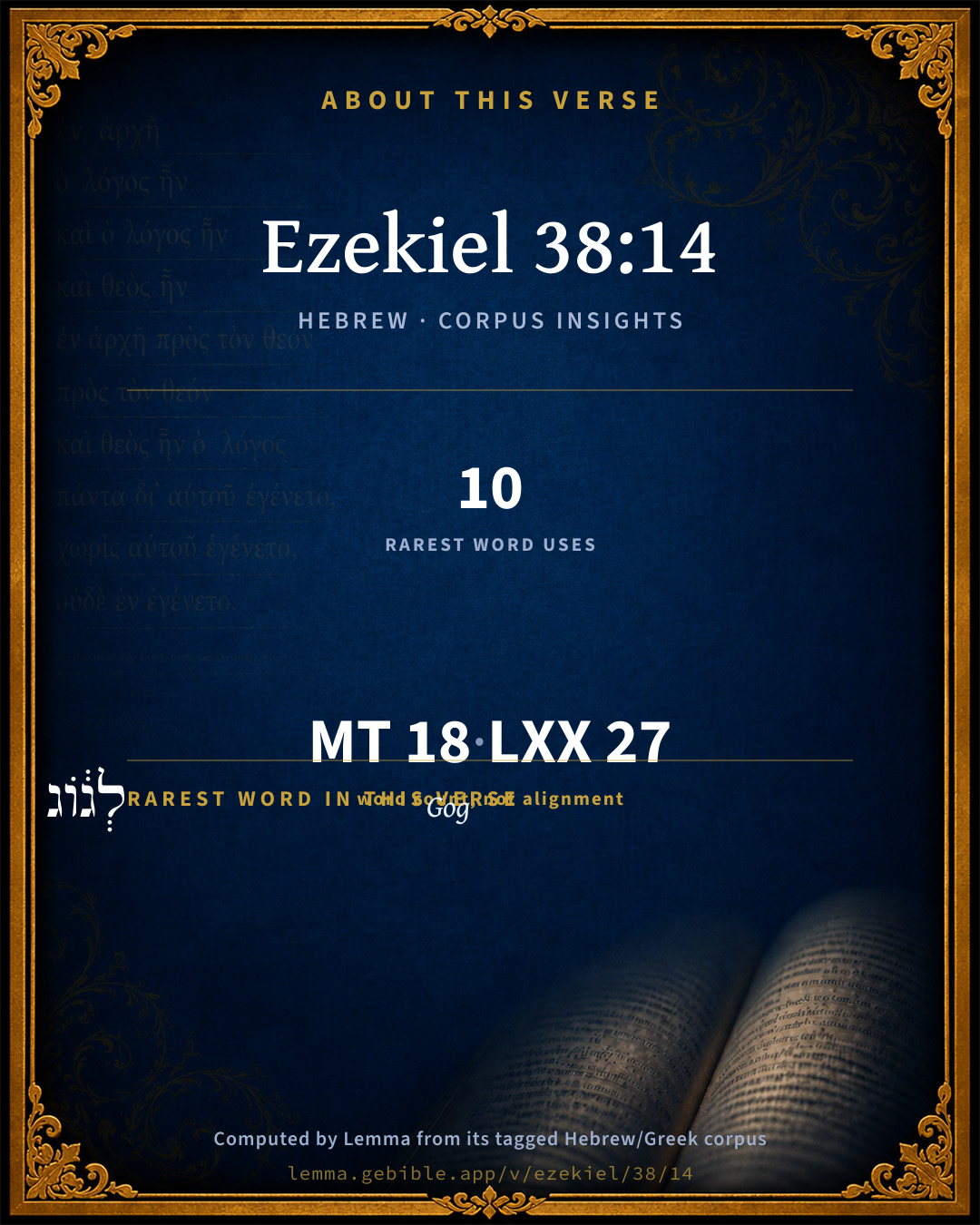
These counts appear in no published source. They are computed here, from the morphology-tagged text and Lemma’s own curated glosses. What Lemma adds →

18
words
17
distinct lemmas
Prophets
section

Notable vocabulary

The rarest word here is לְג֔וֹג Gog H1463 — appearing just 10 times in the whole Hebrew Bible.

Shared distinctive vocabulary

לְג֔וֹג Gog H1463 occurs in 8 verses of the Hebrew Bible. Also found in:

Grammatical profile

  • 5 verbs
  • 9 nouns
  • 1 pronoun
  • 2 adverbs
  • 1 particle

Verb forms

  • הִנָּבֵ֣א Niphal · Imperative
  • וְאָמַרְתָּ֣ Qal · Sequential Perfect
  • אָמַ֖ר Qal · Perfect
  • בְּשֶׁ֨בֶת Qal · Infinitive Construct
  • תֵּדָֽע Qal · Imperfect

Repetition

A word recurs within this verse — often emphatic in Hebrew:

  • וְאָמַרְתָּ֣ to say H559 ×2

Hebrew & Septuagint length

In English translation the verse runs 27 words from the Hebrew and 27 from the Septuagint (LXX English) — the same length.

A rough comparison of the two English renderings, which tokenize alike — not a word-level alignment.

Word counts can differ between the Hebrew and the Greek without any difference in meaning — e.g. the Hebrew direct-object marker אֵת has no separate Greek word, and Greek often adds the article ὁ.

In the original languages it is 18 Hebrew tokens and 27 Greek tokens — but the two are counted differently (Hebrew bundles its prefixes and suffixes into one token; the Greek is in lemma form), so that isn’t a like-for-like length.

Cross-references

7

Topical passages linked to Ezekiel 38:14 in the Treasury of Scripture Knowledge — connected by theme and wording, ordered by reader-vote popularity; previews shown in the World English Bible.

  • Ezekiel 38:8 After many days you shall be visited: in the latter years you shall come into the land that is brought back from the sword, that is gathered out of many peoples, on the mountains of Israel, which have been a continual waste; but it is brought forth out of the peoples, and they shall dwell securely, all of them.
  • Zechariah 2:5 For I,' says Yahweh, 'will be to her a wall of fire around it, and I will be the glory in the midst of her.
  • Jeremiah 23:6 In his days Judah shall be saved, and Israel shall dwell safely; and this is his name by which he shall be called: Yahweh our righteousness.
  • Ezekiel 38:11 and you shall say, I will go up to the land of unwalled villages; I will go to those who are at rest, who dwell securely, all of them dwelling without walls, and having neither bars nor gates;
  • Zechariah 2:8 For thus says Yahweh of hosts: 'For honor he has sent me to the nations which plundered you; for he who touches you touches the apple of his eye.
  • Isaiah 4:1–2 Seven women shall take hold of one man in that day, saying, "We will eat our own bread, and wear our own clothing: only let us be called by your name. Take away our reproach."
  • Ezekiel 37:28 The nations shall know that I am Yahweh who sanctifies Israel, when my sanctuary shall be in the midst of them forevermore.

Cross-references courtesy of OpenBible.info (CC BY 4.0).

Hebrew and Greek witnesses Masoretic Hebrew ↔ Greek Septuagint

The same verse in the two great witnesses to the Old Testament, shown verse-for-verse.

These are two independent witnesses, not word-aligned to each other, and the Septuagint is shown in lemma (dictionary) form.

Hebrew Ezekiel 38:14 Masoretic · Westminster Leningrad Codex

לָכֵן֙ הִנָּבֵ֣א בֶן אָדָ֔ם וְאָמַרְתָּ֣ לְג֔וֹג כֹּ֥ה אָמַ֖ר אֲדֹנָ֣י יְהוִ֑ה הֲל֣וֹא בַּיּ֣וֹם הַה֗וּא בְּשֶׁ֨בֶת עַמִּ֧י יִשְׂרָאֵ֛ל לָבֶ֖טַח תֵּדָֽע

Therefore, son of man, prophesy, and tell Gog, Thus says the Lord Yahweh: In that day when my people Israel dwells securely, shall you not know it?

World English Bible · Public Domain

Greek LXX Ezekiel 38:14 Septuagint · lemma form

διά οὗτος προφητεύω υἱός ἄνθρωπος καί εἶπον ὁ γωγ ὅδε λέγω κύριος οὐ ἐν ὁ ἡμέρα ἐκεῖνος ἐν ὁ καταοἰκίζω ὁ λαός ἐγώ ἰσραήλ ἐπί εἰρήνη ἐγείρω

Therefore prophesy, son of man, and say to Gog, Thus says the Lord; Will you not arise in that day, when my people Israel are dwelling securely,

LXX2012 (modern English Septuagint) · Public Domain

On this verse, The Cambridge Bible for Schools and Colleges discusses the Septuagint’s reading. Read the note in Commentary ↓

Hebrew: Westminster Leningrad Codex (CC BY 4.0). Greek: Septuagint (public domain); English from LXX2012 (modern English Septuagint) (Public Domain). How the Septuagint differs from the Hebrew →

Targum (Aramaic paraphrase)

1

The Targum is the ancient Jewish Aramaic paraphrase of the Hebrew Scriptures — an interpretive translation, not the Hebrew text itself. Onkelos (literal) and Pseudo-Jonathan (expansive) render the Torah, and Jonathan the Prophets. Coverage is partial: where no permissively-licensed English translation exists for a verse, only the Aramaic is shown. This is verse-level text, not a word-by-word alignment to the Hebrew.

  1. Targum Jonathan Prophets (Joshua–Malachi)
    בְּכֵן אִתְנַבֵי בַּר אָדָם וְתֵימַר לְגוֹג כִּדְנַן אֲמַר יְיָ אֱלֹהִים הֲלָא בְּעִדָנָא הַהִיא כַּד יַתְבוּן עַמִי יִשְׂרָאֵל לְרוֹחֲצָן תֵּידַע פוּרְעֲנוּת גְבוּרְתִּי:

    (no public-domain English translation for this verse)

    Targum Jonathan — Aramaic: “Mikraot Gedolot” (public domain). English: “Sefaria Community Translation” (CC0 1.0 (public-domain dedication)); “London "Chaldee Paraphrase," 1871” (public domain). Text via Sefaria.

Commentary

Notes on Ezekiel 38:14 from classic Christian and Jewish commentators (each source and its license shown beneath its notes). The classic Christian expositions comment on the surrounding passage and are grouped to its opening verse, so a note may address several verses; the Jewish commentaries on the Tanakh (Rashi and others) are per-verse, so they appear only where the commentator wrote on this verse.

Lemma curates 59 commentaries, every one of them public domain or Creative Commons licensed, each selected and text-cleaned for this edition rather than reprinted as found. About our sources →

Matthew Henry's Commentary

This latter part of the chapter is a repetition of the former; the dream is doubled, for the thing is certain and to be very carefully regarded.

I. It is here again foretold that this spiteful enemy should make a formidable descent upon the land of Israel (Eze 38:15): "Thou shalt come out of the north parts (Syria lay on the north of Canaan) with a mighty army, shalt come like a cloud, and cover the land of my people Israel," Eze 38:16. These words (Eze 38:14), When my people Israel dwell safely, shalt thou not know it? may be taken two ways: - 1. As intimating his inducements to this attempt. "Thou shalt have intelligence brought thee how securely, and therefore how carelessly, the people of Israel dwell, which shall give rise to thy project against them; for when thou knowest not only what a rich, but what an easy prey they are likely to be, thou wilt soon determine to fall upon them" Note, God's providence is to be acknowledged in the occasion, the small occasion perhaps, that is given, and that not designedly neither, to those first thoughts from which great enterprises take their original. God, to bring about his own purposes, lets men know that which yet he knows they will make a bad use of, as here. Or, 2. As intimating his disappointment in this attempt, which here, as before, the prophecy begins with: "When my people Israel dwell safely, not in their own apprehension only, but in reality, forasmuch as they dwell safely under the divine protection, shalt not thou be made to know it by the fruitlessness of thy endeavours to destroy them?" Thou shalt soon find that there is no enchantment against Jacob, that no weapon formed against them shall prosper; thou shalt know to thy cost, shalt know to thy shame, that though they have no walls, nor bars, nor gates, they have God himself, a wall of fire, round about them, and that he who touches them touches the apple of his eye; whosoever meddles with them meddles to his own hurt. And it is for the demonstrating of this to all the world that God will bring this mighty enemy against his people. Those that gathered themselves against Israel said, Let us take the spoil and take they prey, but they knew not the thoughts of the Lord, Mic 4:11, Mic 4:12. I will bring thee against my land. This is strange news, that God will not only permit his enemies to come against his own children, but will himself bring them; but, if we understand what he aims at, we shall be well reconciled even to this: it is "that the heathen may know me to be the only living and true God when I shall be sanctified in thee, O Gog! that is, in thy defeat and destruction before their eyes, that all the nations may see, and say, There is none like unto the God of Jeshurun, that rides on the heavens for the help of his people." Note, God brings his people into danger and distress that he may have the honour of bringing about their deliverance, and suffers the enemies of his church to prevail awhile, though they profane his name by their sin, that he may have the honour of prevailing at last and sanctifying his own name in their ruin. Now it is said, This shall be in the latter days, namely, in the latter days of the Old Testament church; so the mischief that Antiochus did to Israel was; but in the latter days of the New Testament church another like enemy should arise, that should in like manner be defeated. Note, Effectual securities are treasured up in the word of God against the troubles and dangers the church may be brought into a great while hence, even in the latter days.

II. Reference is herein had to the predictions of the former prophets (Eze 38:17): Art thou he of whom I have spoken in old time, of whom Moses spoke in his prophecy of the latter days (Deu 32:43, He will render vengeance to his adversaries), and David, Psa 9:15 (The heathen are sunk down into the pit that they made) and often elsewhere in the Psalms? This is the leviathan of whom Isaiah spoke (Isa 27:1), that congress of the nations of which Joel spoke, Joe 3:1. Many of the prophets had perhaps spoken particularly of this event, though it be not written, as they all had spoken and written too that which is applicable to it. Note, There is an amiable admirable harmony and agreement between the Lord's prophets, though they lived in several ages, for they were all guided by one and the same Spirit.

III. It is here foretold that this furious formidable enemy should be utterly cut off in this attempt upon Israel, and that it should issue in his own ruin. This is supposed by many to have its accomplishment in the many defeats given by the Maccabees to the forces of Antiochus and the remarkable judgments of God executed upon his own person, for he died of sore diseases. But these things are here foretold, as usual, in figurative expressions, which we are not to look for the literal accomplishment of, and yet they might be fulfilled nearer the letter than we know of. 1. God will be highly displeased with this bold invader: When he comes up in pride and anger against the land of Israel, and thinks to carry all before him with a high hand, then God's fury shall come up in his face, which is an allusion to the manner of men, whose colour rises in their faces when some high affront is offered them and they are resolved to show their resentment of it, Eze 38:18. God will speak against them in his jealousy for his people and in the fire of his wrath against his and their enemies, Eze 38:19. See how God's permitting sin, his laying occasions of sin before men, and his making use of it to serve his own purposes, consist with his hatred of sin and his displeasure against it. God brings this enemy against his land, letting him know what an easy prey it might be and determining thereby to glorify himself; and yet, when he comes against the land, God's fury comes up, and he speaks to him in the fire of his wrath. If any ask, Why does he thus find fault? for who has resisted his will? It is easy to answer, Nay, but, O man! who art thou that repliest against God? 2. His forces shall be put into the greatest confusion and consternation imaginable (Eze 38:19): There shall be a great shaking of them in the land of Israel, a universal concussion (Eze 38:20), such as shall affect the fishes and fowls, the beasts and creeping things, and much more the men that are upon the face of the earth, who sooner receive impressions of fear. There shall be such an earthquake as shall throw down the mountains, those natural heights, and the steep places, towers and walls, those artificial heights; they shall all fall to the ground. Some understand this of the fright which the land of Israel should be put into by the fury of the enemy. But it is rather to be understood of the fright which the enemy should be put into by the wrath of God; all those things which they both raise themselves and stay themselves upon shall be shaken down, and their hearts shall fail them. 3. He shall be routed and utterly ruined; both earth and heaven shall be armed against him (1.) The earth shall muster up its forces to destroy him. If the people of Israel have not strength and courage to resist him, God will call for a sword against him, Eze 38:21. And he has swords always at command, that are bathed in heaven, Isa 35:5. Throughout all the mountains of Israel, where he hoped to meet with spoil to enrich him, he shall meet with swords to destroy him, and, rather than fail, every man's sword shall be against his brother, as in the day of Midian, Psa 83:9. The great men of Syria shall undermine and overthrow one another, shall accuse one another, shall fight duels with one another. Note, God can, and often does, make the destroyers of his people to be their own destroyers and the destroyers of one another. However, he will himself be their destroyer, will take the work into his own hand, that it may be done thoroughly (Eze 38:22): I will plead against him with pestilence and blood. Note, Whom God acts against he pleads against; he shows them the ground of his controversy with them, that their mouths may be stopped, and he may be clear when he judges. (2.) The artillery of heaven shall also be drawn out against them: I will rain upon him an overflowing rain, Eze 38:22. He comes like a storm upon Israel, Eze 38:9. But God will come like a storm upon him, will rain upon him great hailstones as upon the Canaanites (Jos 10:11), fire and brimstone as upon Sodom, and a horrible tempest, Psa 11:6. Thus the Gog and Magog in the New Testament shall be devoured with fire from heaven, and cast into the lake of brimstone, Rev 20:9, Rev 20:10. That will be the everlasting portion of all the impenitent implacable enemies of God's church and people. 4. God, in all this, will be glorified. The end he aimed at (Eze 38:16) shall be accomplished (Eze 38:23): Thus will I magnify myself and sanctify myself. Note, In the destruction of sinners God makes it to appear that he is a great and holy God, and he will do so to eternity. And, if men do not magnify and sanctify him as they ought, he will magnify himself, and sanctify himself; and this we should desire and pray for daily, Father, glorify thy own name.

Matthew Henry's Commentary on the Whole Bible (1708–1710) — public domain (CC PDM 1.0). Text via the HelloAO Bible API.

Ellicott's Commentary for English Readers

(14) Shalt thou not know it?—The second part of this prophecy (Eze_38:14-23), describing the doom of Gog, is introduced (Eze_38:14-16) with a repetition of the peaceful security of Israel, and of God’s leading against her this great foe in whose destruction He shall be magnified before all people. The whole passage becomes clearer by omitting the question and reading simply, “When Israel dwells securely thou wilt observe it and come,” &c.

A Bible Commentary for English Readers, edited by Charles John Ellicott (1878–1897) — public domain. Text from a community e-Sword module.

Trapp's Complete Commentary

John Trapp

Eze 38:14 Therefore, son of man, prophesy and say unto Gog, Thus saith the Lord GOD; In that day when my people of Israel dwelleth safely, shalt thou not know [it]?

Ver. 14. Prophesy and say unto Gog.] Say it over again, that it may be the better considered, for the strengthening of the hands and hearts of my people.

Shalt thou not know it?] sc., By thine intelligencers; and wilt thou not think to make thine advantage of it? The Pope hath his Coricaei in every corner of Christendom; the Jesuits’ colleges, placed upon the walls of cities, afford them passage into the city, or abroad into the world, at pleasure, to give or receive intelligence as occasion serveth.

John Trapp, A Commentary or Exposition upon All the Books of the Old and New Testament (1647–1656) — public domain. Text from a community e-Sword module.

Joseph Benson's Commentary

Eze 38:14-16. In that day, &c. — At that remarkable time, when I shall gather my people from their dispersions and bring them again to their own land, and they shall be established therein and dwell safely, without apprehension of danger from any enemy, and without any defence to prevent their being attacked; shalt thou not know it? — Will they not be pointed out to thee as a people thou mayest easily conquer, and with whose spoils thou mayest without difficulty enrich thyself? And thou shalt come from thy place out of the north parts — See on Eze 38:6; thou and many people with thee, all of them riding upon horses, &c. — The character here given of this people may properly be applied to the Turks or Tartars, the strength of whose armies consists principally in their cavalry. As a cloud to cover the land — See on Eze 38:9. It shall be in the latter days — This is repeated to prevent the application of the prophecy to any event that should take place before the days of the Messiah: see on Eze 38:8. And I will bring thee against my land — I will permit thee to come; that the heathen may know me, when I shall be sanctified in thee — Shall be confessed to be a great God over all, a gracious and faithful God to my people, and a dreadful enemy and avenger against the wicked. Before their eyes — In the sight of all the heathen that are with Gog, and much more in the sight of God’s own people. This signal victory over Gog and his associates shall be a means of bringing infidels to give glory to God.

Joseph Benson's Commentary on the Old and New Testaments (1811–1818) — public domain. Text from a community e-Sword module.

Whedon's Commentary on the Bible

Daniel D. Whedon

14-16. Knowing that Israel “dwelleth securely” (Eze_38:14, R.V.), Gog comes against her (Eze_38:15), but knows not that he is really being brought thither by Jehovah himself, who rules and overrules all (Eze_25:4; Eze_25:7; Eze_26:3; Eze_30:25), in order that through his destruction the God of Israel may be sanctified, or “set apart” from all other deities in the eyes of the heathen, because of his holiness and power (Eze_38:16; Eze_28:22; Eze_28:25; Eze_36:23).

Daniel D. Whedon (gen. ed.), Commentary on the Old and New Testaments (1874–1909) — public domain. Text from a community e-Sword module.

F. W. Grant's Numerical Bible

Section 3 (Eze 38:14-23).

The revelation of Jehovah to the nations in the judgment of Gog.

The interrogation of the merchant princes represents them as expressing surprise at Gog’s multitude. Can it be simply for the taking of spoil? The greatness of the attack appears out of proportion to the smallness of the object. Thus might it appear to human eyes, but the deep underlying reason is given in Jehovah’s answer. He draws forth all this army, that, as He says, "The nations may know Me when I shall be hallowed in thee, O Gog, before their eyes." The magnitude of Gog’s undertaking would seem to the observant eyes of all the "young lions" of Sheba, Dedan, and Tarshish without any prospect of adequate compensation, but all is clear when God’s purpose is known. In this we get an example of how the wheels of divine government go round, carrying forward the throne and its glorious Occupant.

We have now a reference to former prophecies relating to these events. This at first may present a difficulty, for we do not find any previous prophetic announcement under the nation’s names here given. The interrogative form rather excludes the thought of Gog being mentioned before. It is rather that the prophets for many years announced a great consummation in judgment, executed upon the nations having special relations with Israel, while also her pronounced enemies. The question is then, "Art thou he" in connection with whom this will find its full accomplishment? The answer is given affirmatively in the next verse, coupled with the declaration of Jehovah’s wrath, and the terrible shaking which will be caused by His stroke of judgment.

It may be well to mention here several of the prophecies which point to this consummation. The name "Assyrian" is given to the last great enemy of Israel. He is associated with the north in Zep 2:13; and Assyria is the land of the north from which Israel will be gathered (Isa 27:12-13; Hos 11:11; Zec 10:10; Jer 16:15; Jer 23:8). Though "Assyria" and "Gog" seem names so very different, there is a similarity in their meaning which suggests moral identification, as well as that of locality, while the prophecies we shall refer to establish identity as to time, scene, and the character of judgment. Gog means either "extension" or "the topmost," both suggesting the ambition, pride and avarice which mark his conduct as given in our chapters. Assyria, from Asshur, means "a footstep," as going forward successfully, and this in boasted self-sufficiency, as Isaiah says (Isa 10:8-11; Isa 10:13-14). In this very chapter Isaiah makes plain that the invasion and the consummation in judgment of which it speaks is not only future, but after the restoration and when Messiah is present (vers. 12, 17, 20, 21, 27). Thus he stands up against the Prince of princes as Dan 8:1-27 states, and this is more emphatically affirmed by Micah (Mic 5:1-9). We know how direct the reference here is to Christ (vers. 1, 2), and then "He shall stand and shall feed His flock in the strength of the Lord," this being in beautiful accord with what Ezekiel has told us (Eze 36:24-26). Following this we have the remarkable statement, "And this Man shall be the Peace when the Assyrian shall come into our land. . .and He shall deliver us from the Assyrian when he cometh into our land" (vers. 5, 6). And Jehovah says in reference to this time, "I will execute vengeance in anger and in fury upon the nations, such as they have not heard." This agrees with what we have considered to be the time of Gog’s invasion, giving us good reason to link the prophecies regarding the Assyrian of the last days with those of Gog in Ezekiel. This we will find further strengthened by such passages as Isa 17:12-14; Isa 25:1-12; Isa 26:21; Isa 30:18-33; Joe 2:15-27; Nah 1:1-15; Nah 2:1-13; Nah 3:1-19, especially Nah 1:11-15 and Nah 3:9; and Zec 12:1-14. A careful consideration of these scriptures will lead us to see that, no matter what application they may have to the days which close the seventieth week of Daniel, they look on for full accomplishment in Gog’s great gathering, though his name does not appear. Similarity of moral character and purpose, coincidence in time and characteristics of judgment, prevail throughout. They are in that way of the same generation as the Assyrian of Sennacherib’s day, whose coming and defeat gave the text for many prophecies, while undoubtedly it was the foreshadow of the final consummation.

From these considerations we may conclude that Jehovah’s words (ver. 17) indicate the wide scope to be attributed to the prophecies. They not only have an application to the action of Assyria at the time when that ancient empire flourished, but also to the King of the North, or Assyrian of the future, who shall be the desolator, or overflowing scourge, in the closing scenes of the seventieth week, God’s battle-axe then as before upon a rebellious and idolatrous people; and finally the day when he shall come again as Gog from the north, to be utterly broken upon the mountains of Israel (Isa 10:26-27; Isa 14:24-27 with our present chapters. Compare also Isa 10:26; Jdg 7:22 with ver. 11).

There follows a most graphic description of Jehovah revealed in judgment. It is a manifestation which while centering in the land of Israel reaches throughout the earth and affects all mankind. The overthrow is accomplished by internal strife, every man’s sword against his brother; by pestilence and blood, that is, violent death, and by the downpour of destruction from heaven. Thus man in proud self-will and vaunted sufficiency has his own weapons turned against him, corruption and violence assail, while heaven’s displeasure is revealed. Those who are against God must find that the forces of earth and heaven, combined with their own devices, carry them down to destruction. Self-will and pride must ever reap according to the sowing. It is an unvarying principle of the divine government. God has written this largely on the pages of history, but men in their folly will not learn, seemingly blinded by thinking that each successive effort will be the exception to the rule which prevails in all affairs physical, moral and spiritual.

Grace known by us in Christ does not deliver from this holy government of God. Rather, since it gives to us a higher place of favor than ever known to faith before, we have greater responsibility, and we become more directly subject to the action of such divine principles. The whole history of Israel enforces this lesson. It is the moral underlying the ministry of the prophets. It is pressed home upon the people by repeated strokes of judgment. David used the sword to accomplish his own sinful will, and the sword never departed from his house. Solomon consorted with strangers, his heart was led astray, and enemies arise in the very quarters from which he drew the means of pleasing himself (1Ki 11:1-43). Man’s. self-devised plans and wilful choice ever come back upon him with. a harvest of results, which if he would only hear the Voice speaking in them, would bring him down before God in confessed impotency and sinfulness to receive the uplifting that is always given to those who humble themselves under God’s mighty hand.

The divine purpose is clearly stated (vers. 16, 23). It is that Jehovah may be known, that "the earth shall be filled with the glory of Jehovah as the waters cover the sea" (Isa 11:9; Hab 3:14). "Who shall not fear Thee, O Lord, and glorify Thy name? for Thou only art holy; for all the nations shall come and worship Thee; for Thy righteous acts have been made manifest" (Rev 15:4). This alone can establish things in proper order, as the lack of it, or its refusal, only produces confusion and evil. It is to this end that judgment is brought in. Indeed, since sin came in it is alone through God’s strange work that men can be brought to know Him. From the very beginning this has been so. Through the woman’s sorrow and subjection, and the man’s toil striving against the curse and blight of sin, God becomes known in mercy, grace and deliverance. He might have been known to His creatures through the Garden of Delights, earthly abundance, and ever-extending dominion, but this avenue was closed forever as far as the old creation is concerned, because of man’s sin. It will be realized by the new creation on a higher plane and in intimate heavenly associations through the redemption that is in Christ Jesus. Thus does God triumph over evil, but by way of judgment, in which He is magnified, sanctified, and made known. And where more fully so than in the greatest of all judgments? -that of the Cross, at once the answer to every question raised by sin, the fullest manifestation of God in holiness, righteousness, and love, when indeed a greater than Gog is met and judged, even Satan, the prince and god of this world. In our individual experience it is still often through the Lord’s judgments that we come to know Him in growing measure. Judgments which are either chastening for our waywardness, the discipline of love, or the disposing contrary to our proposing, or even allowing our will to have its demands granted that the bitter fruit of our way may be tasted, and so the sweetness of subjection to His way be realized. But ever it is the same love that gave Christ, working with and for us, love nevertheless which must prove itself holy to the objects of its richest blessing -to us. Our failure may not bring open discipline, He by the Holy Spirit may produce exercise and distress of heart which leads to self-judgment before Him, yet the salutary lesson will be kept before the soul by results reaped from our sowing which cannot be avoided. God graciously makes all contribute to a better knowledge of Himself. He is magnified and sanctified in these ways of judgment.

It is not that the believer has sin imputed to him, for to such pertains the blessedness of Rom 4:1-25, that of non-imputation, so that he does not come into judgment (Joh 5:24). This has to do with eternal issues, it is put in relation to our possession of eternal life, so that from this viewpoint we have passed out of the region of judgment. It remains true, however, that as in this blessed position we call on God "as Father, who without respect of persons judgeth according to each man’s work," and are to pass the time of our sojourn in fear, conscious of the redemption we have through the precious blood of Christ, and responsible as obedient children to be holy in all our behavior, "Because it is written, Be ye holy, for I am holy" (1Pe 1:14-18). Thus we are under the Father’s government. Its principles find illustration all through Scripture, and that quite fully in the Old Testament, where we get the record of the various dealings of God with those who are given places of privilege and responsibility. Hence the value and importance of all Scripture, and its use for teaching, conviction, correction, and instruction (2Ti 3:16-17). Its essential unity is known by the exhibition of the same divine principles in the greatest possible variety of circumstance and instrumentality. This Word "endureth forever" -"Forever, O Lord, Thy word is settled in the heavens." It is the heavens that shall rule for blessing to all creation. This will surely be exercised according to that Word which is now to rule us as born from above, born by that Word and the Spirit. The position of this verse in the psalm (Psa 119:89) offers an interesting numerical study. That psalm is an alphabetic acrostic "of the most regular and perfect kind," and this verse opens its twelfth section -Lamed

being the twelfth letter of the Hebrew alphabet. It is the number of divine government, heavenly in character and manifestly exercised over all creation (3x4), as the psalm expresses. But to this we may add that the letters of the Hebrew alphabet (as also the Greek) have a definite numerical value. In this case it is thirty (3x10), divine and heavenly manifestation in that completeness of divine order, both Godward and manward, which ten suggests. All of this is found in and through the Word, and the exercise of that holy government which is according to it and revealed in it.

F. W. Grant, The Numerical Bible (4th ed., 1903) — public domain. Text from a community e-Sword module.

Tyndale Open Study Notes

Tyndale Open Resources

38:14-16 Israel would be rich, living in peace and experiencing the fruit of obedient trust in the Lord. However, such obedience does not eliminate the possibility of threatening circumstances (cp. John 16:33). The odds might have seemed stacked against Israel, but Gog had failed to reckon with the Lord. The Lord would use Gog and his allies as a tool for displaying his holiness in the sight of all the nations.

Tyndale Open Study Notes — © Tyndale Open Resources, licensed CC BY-SA 4.0. Text via the HelloAO Bible API.

Geneva Bible (1599)

Geneva Bible translators

Shalt not thou spy thine occasions to come against my Church when they suspect nothing?

Geneva Bible (1599) marginal notes — public domain. Text via Bolls.life.

Jamieson, Fausset & Brown

Robert Jamieson, A. R. Fausset & David Brown

shalt thou not know it?--to thy cost, being visited with punishment, while Israel dwells safely.

Jamieson, Fausset & Brown — Commentary Critical and Explanatory on the Whole Bible (1871) — public domain (CC PDM 1.0). Text via the HelloAO Bible API.

The Cambridge Bible for Schools and Colleges

gen. ed. J. J. S. Perowne

14–16. The purpose and issue of Gog’s invasion: that the nations may know Jehovah, when he is sanctified in Gog

14. shalt thou not know it] It is the peaceful and unprotected condition of the people, along with their wealth, that tempts Gog to invade them. LXX., however, reads: shalt thou not stir thyself up, or, arise, which gives a more vigorous sense (Isa_41:25; Jer_6:22), though the Heb. is quite good. “Safely,” in confidence.

The Cambridge Bible for Schools and Colleges (gen. ed. J. J. S. Perowne; Cambridge University Press, 1878–1918) — public domain. Text from a community e-Sword module.

John Gill's Exposition

And thou shalt come from thy place out of the north parts,.... Whose original was from Scythia, or Cathaia in Tartary, that lies to the north of China; and who will bring with him many people from the Euxine and Caspian seas, and from the northern parts of lesser Asia; and the Turk is, by many interpreters, thought to be the king of the north, in Dan 11:44 as before observed:

thou, and many people with thee, all of them riding upon horses; the Turkish armies consisting chiefly of horse, as has been observed on Eze 38:4,

a great company, and a mighty army; for quantity many, for quality strong and mighty. The Targum is,

"many armies, and much people;''

the Turks usually have large armies; See Gill on Eze 38:4.

John Gill's Exposition of the Whole Bible (1746–1763) — public domain (CC PDM 1.0). Text via the HelloAO Bible API.

Albert Barnes' Notes on the Bible

God will mark the prosperous security of the people, and rise up against them as an easy prey.

Albert Barnes' Notes on the Bible (1834–1885) — public domain. Text from a community e-Sword/MySword module.

Matthew Poole's English Annotations

In that day: see Eze 38:8.

Dwelleth safely: see Eze 38:11; 34:25.

Shalt thou not know it? thou wilt be informed how weak, yet how rich, how easy it is to make them a prey, and thou wilt believe and try it.

Matthew Poole's English Annotations on the Holy Bible (1683–1685) — public domain. Text from a community e-Sword/MySword module.

The Pulpit Commentary

Vers. 14-23. The prophet is next directed to assure Gog of four things,

(1) that in the latter days he should come up against Israel as predicted (vers. 14-16);

(2) that he should not do so without Divine observation, permission, and direction (vers. 16,; 17);

(3) that nevertheless Jehovah"s indignation should flame forth against him (ver. 18); and

(4) that Jehovah would magnify himself in his destruction.

Shalt thou not know it? viz. that Israel is dwelling safely and unsuspectingly? Assuredly; because the barbarian chieftain will then be on the watch, as it were, to spy out Israel"s defenseless condition, and to fix upon the most opportune moment for an assault. The LXX read, "Shalt thou not arise?" Oujk... ejgerqhsh; and following it, both Hitzig and Ewald, without other justification, change d; Te into rOTe, "Wilt thou bestir thyself?

The day of security.

I THERE IS A DAY OF SECURITY. Then God"s people dwell safely. We talk of the warfare of the Christian life. There is a lifelong war. But this is not a perpetual battle. There are lulls in the storm, and quiet seasons in the Christian contest. At such times there is a temptation to unreasonable ease and confidence, just as in times of trouble people are ready to despair and imagine that "all these things are against" them. Still, the day of security has its blessing, and if this is not abused it may be welcomed as helpful.

1. It affords an opportunity for recovering strength. The soldier cannot be always fighting. Repose is essential as a pro-legation for future exertion.

2. It enables us to perform quiet work. The whole of Christian experience is not covered by the idea of warfare. There are such things as working in the vineyard, fruit-bearing, building up the house of God, etc., which his servants have to attend to, and which can be best accomplished without distracting thoughts, in times of security.

3. It offers us a foretaste of heavenly blessedness. Heaven is a safe place, and its Messed inhabitants dwell there securely. Their security, indeed, is sound and enduring; while ours on earth may be but brief and treacherous, like the calm on a mountain lake, which may be broken at any moment by a sudden squall. Still, while we enjoy the peace we may be thankful for it, and gratefully accept it as an earnest of that in the eternal home, "where the wicked cease from troubling, and the weary are at rest.

II THE SECURITY OF GOD"S PEOPLE IS OBSERVED BY THEIR FOES. Gog and Magog take note of the security of Israel and bestir themselves. Satan watches his opportunity, and often finds it best when the servants of God are quite confident in the sense of safety. The city gates are left open and the walls unmanned because no enemy is expected. The doors are unbolted at night because the householder never imagines that any burglar will visit his home. But these very signs of security tempt an attack, and, when it comes, give fatal facility to the enemy"s projects. The Eurydice suddenly went down with all on beard, when struck by a squall off the Isle of Wight, just because the fine weather had tempted the crew to leave all the port-holes open. It must have been observed by every one who has watched his own experience that seasons of spiritual peace and joy are commonly followed by times of severe temptation. Immediately after the Holy Spirit descended on Jesus he was led into the wilderness to be tempted. Peter"s boast was swiftly followed by his denial of his Master. "Let him that thinketh he standeth take heed lest he fall". (1Co_10:12)

III THE SECURITY OF GOD"S PEOPLE REVEALS THE ATTRACTIVENESS OF HIS SERVICE. Gog and Magog seem to take note of the security of Israel as beasts of prey observe the unsuspecting confidence of the game they are scenting; out they might also observe it with admiration, as Balaam did that of the tents of Israel, (Num_24:5) as Milton"s Satan observed the peace and joy of the happy pair in Eden. If so, however, the prospect need not inspire despairing, regrets as it did in Balaam, (Num_24:17) nor malignant envy as Milton represents it doing in Satan. The peace of God"s people may be shared by all, for all may become God"s people. Even Gog and Magog may enjoy the same security. Russia, the land of the ancient Scythians, became a Christian nation, we may see the calmness of Christian experience, and take it as a witness to the blessedness of the Christian privileges. Thus the gospel is preached by the very countenances of God"s people.

Vers. 14-22The invader discomfited.

Although it would be presumptuous to apply the language of this prophetic passage to any particular political event in the history of Israel, there were many occasions upon which invasion was permitted and the soil of Palestine was trodden by hostile armies; many occasions upon which the invader retreated, overwhelmed with disaster and ignominy. It is therefore allowable to interpret great political incidences and occurrences in the light of the principles here propounded upon the highest authority. At the same time, it is just to observe that there is truth here which has a wider range, and that the final confusion and destruction of the enemies of the Lord and of his Church are intimated in terms which cannot be mistaken.

I INVASION WAS PERMITTED BY THE GOD OF NATIONS. The language which Jehovah is here represented as using, "I will bring thee against my land," is very remarkable, and must be interpreted, in conformity with the common usage of Hebrew literature, as implying that all events happened by Divine permission, and may in a sense in this universe, which is under Divine control, be attributed to the Supreme. But this not in such a sense as to charge God with men"s iniquity, or to relieve men of their proper responsibility.

II THE INVADER WAS YET THE OBJECT OF DIVINE DISPLEASURE. The lust of aggrandizement and of political power was the usual motive of the invader; and a knowledge of the Divine character assures us that action prompted by such motives cannot be other than disapproved and condemned.

III THE INTERPOSITION OF THE MIGHTIEST CONFOUNDED THE MIGHTY. The terms employed to give expression to the judicial and retributive action of the Lord of all are most emphatic and unqualified: "My fury shall come up in my nostrils; for in my jealousy and in the fire of my wrath have I spoken I will call for a sword against him," etc. The means by which the invader is put to flight, and the people whom he has attacked are delivered, are described: "Every man"s sword shall be against his brother; and I will plead against him with pestilence and with blood," etc.

IV GREAT AS WAS THE CONFIDENCE OF THE AGGRESSOR, GREATER STILL WAS HIS HUMILIATION. The defeat and consternation of the invader are forcibly depicted. He came in pride; he departed in dishonor and disgrace. He came in numbers; he departed a mere remnant. He came amidst the terror of all beholders; he departed amidst hatred and contempt.

V GOD GLORIFIED HIMSELF IN THE DESTRUCTION OF HIS FOES AND IN THE DELIVERANCE OF HIS FRIENDS. God magnified and sanctified himself before many nations; and this he did by openly fulfilling his own predictions, by saving his own people, and by confounding all the selfish and rapacious plans of his enemies.

APPLICATION. The principle contained in the prediction is one which is always applicable to all God"s people, and which has an especial reference to those awful crises through which, it may be, the Church of Christ has yet to pass. Mysterious as it seems to us, it is yet a fact that the Omnipotent suffers the powers of error and of sin to gather themselves together against his people. But this should not strike dismay into the breasts of Christians, however they may feel themselves powerless and defense less. When they gaze upon the hosts of their adversaries, let them remember that "he that sitteth in the heavens shall laugh; the Lord shall have them in derision. T.

Vers. 14-23Human malice a contribution to God"s glory.

God has a variety of methods for dealing with rebellious men. Sometimes he allows them to have their willful way up to the margin of success, when suddenly the tables are turned, and apparent success becomes conspicuous defeat. With vain confidence they press on their daring measures, and are led, as it were, into an ambush and completely destroyed. Thus God dealt with Pharaoh at the Red Sea, and thus he purposes to deal with the unscrupulous monarch of the north. Their disastrous fortunes should leave on air surviving minds the vital lesson that Jehovah is the Supreme King, and that he is worthy of universal homage.

I WICKED MEN ARE THE DUPES OF SLENDEREST TEMPTATION. This ideal monarch-type of worldly kings-was seduced into battle by the appearance of Israel"s conscious security. Here was a nation without an army, without fortresses, without military generals; a nation having no visible means of protection. To evil men this was an irresistible bait. Now men with better dispositions would have argued, "Here is a peaceful nation, bent on the innocent arts of industry, devoid of ambitious aims. They deserve our respect, and (if needful) our protection." But impiety is as injurious to society as it is offensive to God. The slenderest hope of plunder and of territorial aggrandizement incites them to sharpen their weapons for human destruction. To get an empty bubble of fame, or gain rule over a few square miles, ten thousand precious lives will be sacrificed. Worse still, God"s favor will be forfeited. In this respect man has sunk to a lower level than the beasts of the forest.

II SEEMING SUCCESS OFTEN A SNARE TO COMPLETE OVERTHROW. "Thou shalt come up against my people Israel, as a cloud to cover the land." It seemed as if success were certain. What other result was possible? Their multitudinous horde seemed omnipotent by reason of its very numbers. They could compass every town and village so as to prevent a single escape. This over-confidence was weakness; it seemed to underrate the opposing force; it served to relax discipline; it blinded them to the fact that invisible forces might be silently at work against them. Thus it happened to the first Napoleon- His brilliant successes flushed him with vain confidence, led him on to destruction. "Cursed is the man who trusteth in man; He that trusteth his own heart is a fool.

III HOSTILE INVASION AGAINST ISRAEL IS CLEARLY FORESEEN BY GOD. The knowledge of an enemy"s designs and tactics is half-way towards defeating him. Many military commanders succeed by the secrecy of their projects. If one knows where and when the foe will strike, one can be well prepared. To be forewarned is to be forearmed. In this respect, the servants of God enjoy a great advantage. No design nor project of our foes can escape the eye of our God. The first formation of the evil thought is clearly detected by him, and he keeps us well informed of our adversaries" schemes. In the case of Gog, the prophets of Jehovah had repeatedly foretold the formidable invasion; and, although Israel seemed unprepared for the assault, Israel"s Defender was well equipped for the occasion. The issue was secured for Israel"s glory.

IV GOD"S ENEMIES ARE OFTEN DEFEATED BY INTERNECINE STRIFE. A confederacy cemented by wickedness is never durable. It will not bear any strain of trial Men who fight for spoil soon discover that their interests and their leaders" interests are distinct and separate things. Sin has no principle of cohesion. In many cases an army has defeated itself by internal discord. Each man"s sword has been turned upon his comrade. So God here announces that he will dissolve their base alliance. "Every man"s sword shall be against his brother.

V GOD"S ARMY IS COMPOSED OF UNEXPECTED FORCES. In ancient times God has employed winds, storms, hail, fire, to defeat the enemies of Israel. The sea was God"s triumphant army against Pharaoh. He sent the hornet to drive out the Canaanite. Locusts have been once and again employed as his invading regiment. Flakes of snow have done his destructive work. Pestilence has often served as his light brigade. Hailstones have been his irresistible artillery. He has turned back an army by the specter of its own superstitious fears. Fire overthrew the cities of the plain. The eruption of Vesuvius did a deadly work. Every force in nature is a servant of the living God, and in a moment can be made a soldier, armed to the teeth. Men am slowly discovering that God"s forces stored in nature are mightier than the brawn of the human arm, and are depending more upon dynamite and gun-cotton than upon human strength and courage. So says God, "I will rain upon him, and upon his bands an overflowing rain, and great hailstones, fire, and brimstone.

VI THE TRIUMPH IS WITH GOD, Mere overthrow of the enemy is not the triumph that satisfies God. His aim is to bring light and conviction to men"s minds to renew and elevate men"s best nature. "I will plead against him." By means of this defensive contest God will address himself to the minds and hearts of the people. "I will magnify myself." Impossible! God cannot, magnify himself. He cannot be greater than he is. But he will make his greatness known. By such mighty deeds he will reveal to men his invisible power, his matchless skill, his various excellences, his ineffable goodness. Men shall discover more of his compassion, his patience, his fatherly desire for men"s good; and, instead of hating him, they shall admire and honor him. To a large extent men fight against God because they do not know him. They misconceive his government and his dispositions. Real knowledge of God is the road to life and bliss. As the outcome of the final struggle, even the "heathen shall know" and serve the righteous King. "I will sanctify myself. D.

The Pulpit Commentary (1880–1919), ed. H.D.M. Spence-Jones & Joseph S. Exell — public domain. Text from a community e-Sword module.

John Wesley's Explanatory Notes

Know it - Thou wilt be informed of it.

John Wesley, Explanatory Notes Upon the Whole Bible (1754–1765) — public domain. Text via the GEBible commentary corpus.

unfoldingWord translationNotes

Door43 World Missions Community

Connecting Statement:

Yahweh tells Ezekiel what he is to say to Gog.

son of man

"son of a human being" or "son of humanity." God calls Ezekiel this to emphasize that Ezekiel is only a human being. God is eternal and powerful, but humans are not. See how you translated this in Ezekiel 2:1. AT: "mortal person" or "human"

On that day ... learn about them?

Yahweh uses this question to emphasize that Gog will indeed hear about the people living in Israel. AT: "On that day, when my people Israel are living securely, you will hear about them." (See: Rhetorical Question)

like a cloud that covers the land

This simile means the army will be so large that it will cover the entire land. See how you translated a similar phrase in Ezekiel 38:9. (See: Simile)

In the latter days

This refers to the distant future before the world ends. AT: "In the last days" or "At the end of time" or "In the distant future"

In the latter days ... to be holy before their eyes

All the nations will understand that Yahweh is holy when they see what he does to Gog.

might know me

"might know who I am"

translationWords

Lord Yahweh

nation

holy

unfoldingWord translationNotes — © Distant Shores Media and the Door43 World Missions Community, licensed CC BY-SA 4.0. Source: git.door43.org/Door43/en_tn.

Rashi

Rabbi Shlomo Yitzchaki (Rashi)

you will know Jonathan renders: you will know the retribution of My might, i.e., you will know and recognize Who is their might and their stronghold.

Rashi on the Tanakh — English translations: “The Judaica Press complete Tanach with Rashi, translated by A. J. Rosenberg” (CC BY 4.0); “Pentateuch with Rashi's commentary by M. Rosenbaum and A.M. Silbermann, 1929-1934” (public domain); “The Metsudah Tanach series, Lakewood, N.J” (CC BY 4.0); and “The Book of Joshua, Metsudah Publications, 1997” (CC BY 4.0). Text via Sefaria.

Lesson kit

Teaching starters — assembled from the data on this page, not authored interpretation. Every prompt links to the verse data it draws on. Edit before teaching.

Ezekiel, in the Prophets, opens this verse with 18 words (17 distinct Hebrew lemmas). Its most distinctive word is Gôwg (“Gog”). A historical commentator’s framing appears above. Read the whole chapter for the surrounding context.

Discussion questions

  1. How does “Gog” (Gôwg) shape what this verse is saying?
  2. How does 1 Chronicles 5:4, which shares the word «Gog», read alongside this verse?
  3. What does the repetition of “to say” (2× in this one verse) do in this verse?
  4. These translations render this verse differently. What is at stake in choosing one wording over another?
  5. «הִנָּבֵ֣א» is a Niphal Imperative verb. How does that grammatical form shape the action described?
  6. Compare how Matthew Henry's Commentary and Ellicott's Commentary for English Readers read this verse. Where do they agree or differ?

Things to notice

Reading settings

Reading text

Shown beneath each verse's original-language words.

Old Testament
Old Testament edition

Read the OT as the Masoretic Hebrew (MT) or the Greek Septuagint (LXX).

English shown for the Greek Septuagint (in the Hebrew ↔ Greek comparison).

Comparing translations? Open the Compare panel on any verse page to stack up to four side by side.