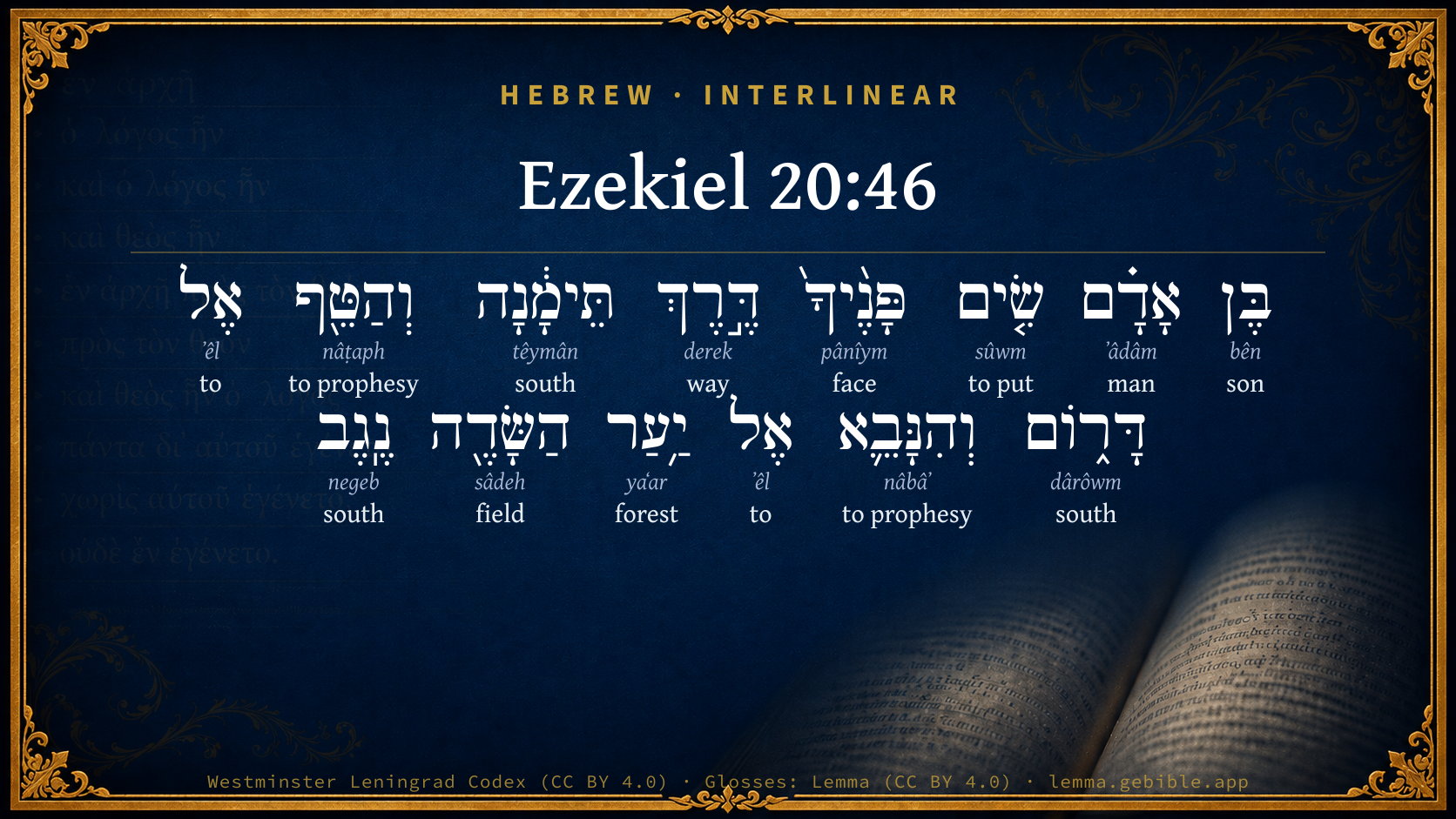
Ezekiel 20:46

Hebrew (Westminster Leningrad Codex) Ezekiel 20:46 appears in the Hebrew Old Testament. The text above is from the Westminster Leningrad Codex. Each word links to its Strong’s number, a concise gloss, and parsing drawn from the Open Scriptures Hebrew Bible morphology. Click any word for its full Brown-Driver-Briggs (BDB) entry.
Download image
Cite this verse

Ezekiel 20:46 (World English Bible). Public Domain. Lemma interlinear Bible study tool, https://lemma.gebible.app/v/ezekiel/20/46.

Show BibTeX & RIS
BibTeX
RIS
English Translation
Son of man, set your face toward the south, and drop [your word] toward the south, and prophesy against the forest of the field in the South;
World English Bible · Public Domain
Download a study sheet

One document with this verse’s original text, its word-by-word gloss line, the meaning frame, cross-references with their text, attributed commentary, and full source and license credits — printable, and it pastes into notes with its structure intact.

This verse Autodidact and up

Study sheet (.html) Plain text (.txt)

A passage Seminary Student

Up to 50 verses in one chapter. A passage sheet keeps up to 6 commentary sources and 12 cross-references per verse, in the order this page ranks them, and says so on the sheet whenever that leaves anything out. Ask for a single verse and you get the Autodidact verse sheet above.

Everything on this page stays free to read, with no account — the sheet is a download of what is already on screen, not access to it.

Want to remove ads? Support Godless Engineer
Compare translations 3

The same verse in 3 English versions, stacked beneath the original-language interlinear above. Click any original word for its lexicon entry.

Each is an independent rendering of the whole verse — the interlinear is not word-aligned to these translations.

Highlighted words mark where these versions differ — a whole-verse word diff, not a word-by-word alignment.

  • World English Bible Public Domain
    Son of man, set your face toward the south, and drop [your word] toward the south, and prophesy against the forest of the field in the South;
  • King James Version Public Domain
    Son of man, set thy face toward the south, and drop thy word toward the south, and prophesy against the forest of the south field;
  • unfoldingWord Literal Text CC BY-SA 4.0
    “Son of man, set your face toward the southern lands, and speak against the south; prophesy against the forest of the Negev.

unfoldingWord Literal Text — © unfoldingWord, licensed CC BY-SA 4.0. Word-aligned USFM3 via Door43 (git.door43.org/unfoldingWord/en_ult).

Versions to compare (up to 4)

3 of 4 selected

Show all 18 translations

Every available English version of this verse, each an independent rendering of the whole verse.

  • World English Bible Public Domain
    Son of man, set your face toward the south, and drop [your word] toward the south, and prophesy against the forest of the field in the South;
  • Berean Standard Bible Public Domain
    “Son of man, set your face toward the south, preach against it, and prophesy against the forest of the Negev.
  • Majority Standard Bible Public Domain
    “Son of man, set your face toward the south, preach against it, and prophesy against the forest of the Negev.
  • King James Version Public Domain
    Son of man, set thy face toward the south, and drop thy word toward the south, and prophesy against the forest of the south field;
  • American Standard Version (1901) Public Domain
    Son of man, set thy face toward the south, and drop `thy word' toward the south, and prophesy against the forest of the field in the South;
  • Revised Version (1885) Public Domain
    Son of man, set thy face toward the south, and drop thy word toward the south, and prophesy against the forest of the field in the South;
  • Geneva Bible (1599) Public Domain
    Sonne of man, set thy face toward the way of Teman, and drop thy word toward the South, and prophecie towarde the forest of the fielde of the South,
  • Douay-Rheims (1899) Public Domain
    Son of man, set thy face against the way of the south, and drop towards the south, and prophesy against the forest of the south field.
  • Young's Literal Translation Public Domain
    Son of man, set thy face the way of Teman, and prophesy unto the south, and prophesy unto the forest of the field -- the south;
  • Literal Standard Version CC BY-SA 4.0
    “Son of man, set your face the way of Teman, and prophesy to the south, and prophesy to the forest of the field—the south;
  • Unlocked Literal Bible CC BY-SA 4.0
    “Son of man, set your face toward the southern lands, and speak against the south; prophesy against the forest of the Negev.
  • unfoldingWord Literal Text CC BY-SA 4.0
    “Son of man, set your face toward the southern lands, and speak against the south; prophesy against the forest of the Negev.
  • Darby Bible Public Domain
    Son of man, set thy face toward the south, and drop [words] against the south, and prophesy against the forest of the south field;
  • World Messianic Bible Public Domain
    “Son of man, set your face toward the south, and proclaim toward the south, and prophesy against the forest of the field in the south.
  • Webster's Bible Public Domain
    Son of man, set thy face towards the south, and drop thy word towards the south, and prophesy against the forest of the south field;
  • Free Bible Version CC BY-SA 4.0
    “Son of man, face towards the south and preach against it. Prophesy against the forest of the Negev.
  • Bible in Basic English Public Domain
    Son of man, let your face be turned to the south, let your words be dropped to the south, and be a prophet against the woodland of the South;
  • JPS Tanakh (1917) Public Domain
    (21-2) 'Son of man, set thy face toward the South, and preach toward the South, and prophesy against the forest of the field in the South;

Literal Standard Version (2020), Covenant Press — licensed CC BY-SA 4.0. Text via the HelloAO Bible API (eBible.org). Unlocked Literal Bible (unfoldingWord) — licensed CC BY-SA 4.0. Text via the HelloAO Bible API (eBible.org). unfoldingWord Literal Text — © unfoldingWord, licensed CC BY-SA 4.0. Word-aligned USFM3 via Door43 (git.door43.org/unfoldingWord/en_ult). Free Bible Version, Dr. Jonathan Gallagher — licensed CC BY-SA 4.0. Text via the HelloAO Bible API (eBible.org).

Word by word

More ways to search: Search by grammar → Find every occurrence → Compare this word →

Practice this passage: Drill this verse → Learn its vocabulary →

דָּר֑וֹם
dârôwm
H1864
“south”
Noun, Common, Masculine, Singular, Absolute
Part of Speech
Noun
Type
Common
Gender
Masculine
Number
Singular
State
Absolute
Full BDB Definition

Origin: of uncertain derivation

TWOT: 454d

south
  1. בֶּן bên H1121 “son of” Noun, Common, Masculine, Singular, Construct
  2. אָדָ֗ם ʼâdâm H120 “man” Noun, Common, Masculine, Singular, Absolute
  3. שִׂ֤ים sûwm H7760 “put” Verb, Qal, Imperative, 2nd Person, Masculine, Singular
  4. פָּנֶ֨יךָ֙ pânîym H6440 “face(s) · your” Noun, Common, Both, Plural, Construct + Suffix, Personal, 2nd Person, Masculine, Singular
  5. דֶּ֣רֶךְ derek H1870 “way of” Noun, Common, Both, Singular, Construct
  6. תֵּימָ֔נָה têymân H8486 “south · toward” Noun, Common, Feminine, Singular, Absolute + Suffix, Demonstrative
  7. וְהַטֵּ֖ף nâṭaph H5197 “and · prophesy” Conjunction + Verb, Hiphil, Imperative, 2nd Person, Masculine, Singular
  8. אֶל ʼêl H413 “to” Preposition
  9. וְהִנָּבֵ֛א nâbâʼ H5012 “and · prophesy” Conjunction + Verb, Niphal, Imperative, 2nd Person, Masculine, Singular
  10. אֶל ʼêl H413 “to” Preposition
  11. יַ֥עַר yaʻar H3293 “forest of” Noun, Common, Masculine, Singular, Construct
  12. הַשָּׂדֶ֖ה sâdeh H7704 “the · field” Particle, Definite Article + Noun, Common, Masculine, Singular, Absolute
  13. נֶֽגֶב negeb H5045 “south” Noun, Proper

About this verse

These counts appear in no published source. They are computed here, from the morphology-tagged text and Lemma’s own curated glosses. What Lemma adds →

14
words
13
distinct lemmas
Prophets
section

Notable vocabulary

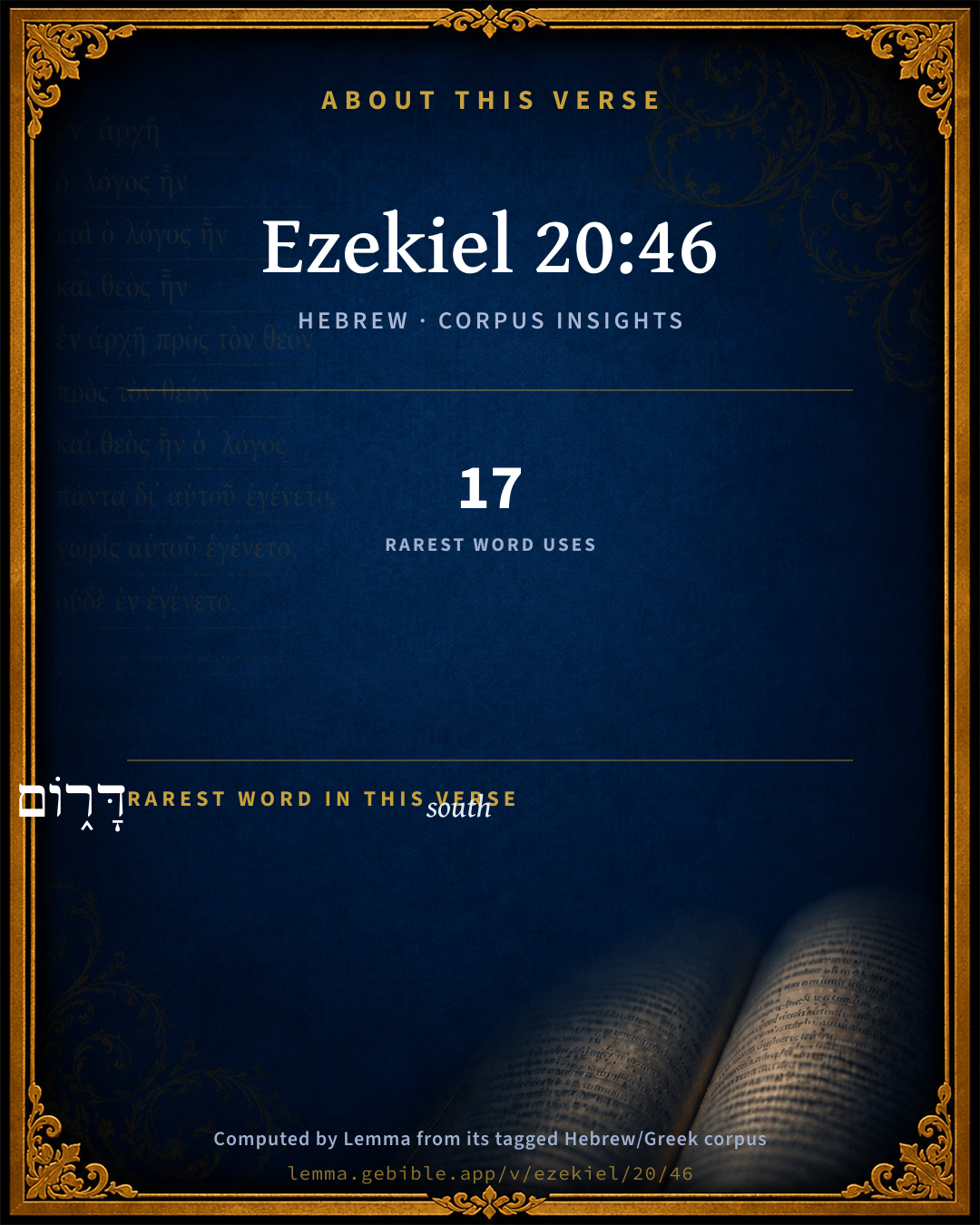
The rarest word here is דָּר֑וֹם south H1864 — appearing just 17 times in the whole Hebrew Bible.

Shared distinctive vocabulary

דָּר֑וֹם south H1864 occurs in 14 verses of the Hebrew Bible. Also found in:

Grammatical profile

  • 3 verbs
  • 9 nouns
  • 2 prepositions

Verb forms

  • שִׂ֤ים Qal · Imperative
  • וְהַטֵּ֖ף Hiphil · Imperative
  • וְהִנָּבֵ֛א Niphal · Imperative

Repetition

A word recurs within this verse — often emphatic in Hebrew:

  • אֶל to H413 ×2

Hebrew & Septuagint length

In English translation the verse runs 27 words from the Hebrew and 20 from the Septuagint (LXX English) — closely comparable.

A rough comparison of the two English renderings, which tokenize alike — not a word-level alignment.

Word counts can differ between the Hebrew and the Greek without any difference in meaning — e.g. the Hebrew direct-object marker אֵת has no separate Greek word, and Greek often adds the article ὁ.

Cross-references

11

Topical passages linked to Ezekiel 20:46 in the Treasury of Scripture Knowledge — connected by theme and wording, ordered by reader-vote popularity; previews shown in the World English Bible.

  • Ezekiel 21:2 Son of man, set your face toward Jerusalem, and drop [your word] toward the sanctuaries, and prophesy against the land of Israel;
  • Amos 7:16 Now therefore listen to the word of Yahweh: 'You say, Don't prophesy against Israel, and don't preach against the house of Isaac.'
  • Jeremiah 13:19 The cities of the South are shut up, and there is none to open them: Judah is carried away captive, all of it; it is wholly carried away captive.
  • Deuteronomy 32:2 My doctrine shall drop as the rain; My speech shall condense as the dew, As the small rain on the tender grass, As the showers on the herb.
  • Job 29:22 After my words they didn't speak again; My speech fell on them.
  • Isaiah 30:6 The burden of the animals of the South. Through the land of trouble and anguish, from whence come the lioness and the lion, the viper and fiery flying serpent, they carry their riches on the shoulders of young donkeys, and their treasures on the humps of camels, to a people that shall not profit [them].
  • Jeremiah 22:7 I will prepare destroyers against you, everyone with his weapons; and they shall cut down your choice cedars, and cast them into the fire.
  • Ezekiel 4:7 You shall set your face toward the siege of Jerusalem, with your arm uncovered; and you shall prophesy against it.
  • Ezekiel 6:2 Son of man, set your face toward the mountains of Israel, and prophesy to them,
  • Micah 2:6 "Don't you prophesy!" They prophesy. "Don't prophesy about these things. Disgrace won't overtake us."
  • Zechariah 11:1–2 Open your doors, Lebanon, That the fire may devour your cedars.

Cross-references courtesy of OpenBible.info (CC BY 4.0).

Hebrew and Greek witnesses Masoretic Hebrew ↔ Greek Septuagint

The same verse in the two great witnesses to the Old Testament, shown verse-for-verse.

These are two independent witnesses, not word-aligned to each other, and the Septuagint is shown in lemma (dictionary) form.

Hebrew Ezekiel 20:46 Masoretic · Westminster Leningrad Codex

בֶּן אָדָ֗ם שִׂ֤ים פָּנֶ֨יךָ֙ דֶּ֣רֶךְ תֵּימָ֔נָה וְהַטֵּ֖ף אֶל דָּר֑וֹם וְהִנָּבֵ֛א אֶל יַ֥עַר הַשָּׂדֶ֖ה נֶֽגֶב

Son of man, set your face toward the south, and drop [your word] toward the south, and prophesy against the forest of the field in the South;

World English Bible · Public Domain

Greek LXX Ezekiel 20:46 Septuagint · lemma form
Son of man, set your face against Thaeman, and look toward Darom, and prophesy against the chief forest of Nageb,

LXX2012 (modern English Septuagint) · Public Domain

On this verse, The Pulpit Commentary discusses the Septuagint’s reading. Read the note in Commentary ↓

Hebrew: Westminster Leningrad Codex (CC BY 4.0). Greek: Septuagint (public domain); English from LXX2012 (modern English Septuagint) (Public Domain). How the Septuagint differs from the Hebrew →

Commentary

Notes on Ezekiel 20:46 from classic Christian and Jewish commentators (each source and its license shown beneath its notes). The classic Christian expositions comment on the surrounding passage and are grouped to its opening verse, so a note may address several verses; the Jewish commentaries on the Tanakh (Rashi and others) are per-verse, so they appear only where the commentator wrote on this verse.

Lemma curates 59 commentaries, every one of them public domain or Creative Commons licensed, each selected and text-cleaned for this edition rather than reprinted as found. About our sources →

Trapp's Complete Commentary

John Trapp

Eze 20:46 Son of man, set thy face toward the south, and drop [thy word] toward the south, and prophesy against the forest of the south field;

Ver. 46. Set thy face.] Prophesy freely and boldly against Jerusalem, which is south from Chaldea.

Against the forest.] Against Judea, which is mountainous and woody, having good and bad trees in it.

John Trapp, A Commentary or Exposition upon All the Books of the Old and New Testament (1647–1656) — public domain. Text from a community e-Sword module.

Tyndale Open Study Notes

Tyndale Open Resources

20:46 turn and face the south (literally turn toward Teman): Teman was a town in Edom, southeast of Judah. • The Negev was southwest of the Dead Sea.

Tyndale Open Study Notes — © Tyndale Open Resources, licensed CC BY-SA 4.0. Text via the HelloAO Bible API.

Geneva Bible (1599)

Geneva Bible translators

For Judah stood South from Babylon.

Geneva Bible (1599) marginal notes — public domain. Text via Bolls.life.

Jamieson, Fausset & Brown

Robert Jamieson, A. R. Fausset & David Brown

south . . . south . . . south--three different Hebrew words, to express the certainty of the divine displeasure resting on the region specified. The third term is from a root meaning "dry," referring to the sun's heat in the south; representing the burning judgments of God on the southern parts of Judea, of which Jerusalem was the capital.

set thy face--determinately. The prophets used to turn themselves towards those who were to be the subjects of their prophecies.

drop--as the rain, which flows in a continuous stream, sometimes gently (Deu 32:2), sometimes violently (Amo 7:16; Mic 2:6, Margin), as here.

forest--the densely populated country of Judea; trees representing people.

Jamieson, Fausset & Brown — Commentary Critical and Explanatory on the Whole Bible (1871) — public domain (CC PDM 1.0). Text via the HelloAO Bible API.

Adam Clarke's Commentary

Verse 46. Set thy face toward the south] Towards Judea, which lay south from Babylon, or Mesopotamia, where the prophet then dwelt.

The forest of the south field] The city of Jerusalem, as full of inhabitants as the forest is of trees.

Adam Clarke's Commentary on the Bible (1810–1826) — public domain. Text from a community e-Sword/MySword module.

The Cambridge Bible for Schools and Colleges

gen. ed. J. J. S. Perowne

46. the south] Though the reference is to Judah and Jerusalem (Eze_21:1-5), the term “south” hardly means the south of Palestine; rather the whole land of Palestine from the point of view of the prophet residing in the north. The “forest of the field” hardly refers to Lebanon, but belongs to the figure, which, however, Lebanon may have suggested (Eze_17:3; Jer_22:23). The “scorching” of all faces from north to south (Eze_20:47) is also part of the figure, though powerfully expressing the effect on all who behold the great judgments on Israel. There may be, however, a certain mixture of figures, those whose faces are scorched being no other than those who, regarded as trees, are consumed—viz. all flesh from the south to the north in Israel (Eze_21:3-4).

the south field] the field in the south, the land of Israel (Eze_21:3).

The Cambridge Bible for Schools and Colleges (gen. ed. J. J. S. Perowne; Cambridge University Press, 1878–1918) — public domain. Text from a community e-Sword module.

John Gill's Exposition

And all flesh shall see that I the Lord have kindled it,.... Not only the inhabitants of Jerusalem and Judea should see the hand of the Lord in their destruction; but even all the neighbouring nations, the case was so clear and plain, the matter so visible:

it shall not be quenched; no stop put to it by all the art and power of man; so that it was a clear point that it was the Lord's doing.

John Gill's Exposition of the Whole Bible (1746–1763) — public domain (CC PDM 1.0). Text via the HelloAO Bible API.

Haydock's Catholic Bible Commentary

Of the south. Jerusalem lay towards the south of Babylon, where the prophet then was, and is here called the forest of the south field, and is threatened with utter desolation. (Challoner) See chap. xxi. (Calmet) --- In Jerusalem there were good and bad. (Worthington)

George Leo Haydock (1774–1849), Haydock's Catholic Family Bible and Commentary, 1859 edition — public domain. Excludes Psalms (Douay-Rheims chapter numbering differs from Protestant) and Deuterocanonical books (Catholic canon only).

Matthew Poole's English Annotations

He was now in Babylon, north from Jerusalem, and being commanded to look toward the south, it is toward Jerusalem, and the land of Canaan.

Thy face; thy courage and undaunted mind, manifest in prophesying as thou art commissioned.

Drop; let thy word distil, begin with softer words ere thou shower down with the vehemency of a storm; prophesy so, Amo 7:16; Mic 2:6.

The forest of the south field, i.e. Jerusalem, which was become like a forest for multitude of inhabitants, for barrenness, wildness, degeneracy, and sheltering wild beasts; murderers lodged in her.

Matthew Poole's English Annotations on the Holy Bible (1683–1685) — public domain. Text from a community e-Sword/MySword module.

Whedon's Commentary on the Bible

Daniel D. Whedon

46. The south — Or, the south country. The land of Israel.

Daniel D. Whedon (gen. ed.), Commentary on the Old and New Testaments (1874–1909) — public domain. Text from a community e-Sword module.

The Pulpit Commentary

Drop thy word. The verb is used specially of prophetic utterances (Eze_21:2; Amo_7:6; Mic_2:6, Mic_2:11) and stands, therefore, in the Hebrew without an object. Toward the south. Three distinct words are used in the Hebrew for the thrice-repeated "south" of the Authorized Version.

(1) One which primarily means "the region on the right hand," sc. as a man looks to the east which Ezekiel also uses in; (Eze_47:19 Eze_48:28)

(2) the "shining land," used repeatedly in Eze 40 Eze 42. (Deu_33:23; Job_37:17; Ecc_1:6 Ecc_11:3) and

(3) the Negeb, the "dry" or "parched" land, the South (always in Revised Version with a capital letter), of Jos_15:21, and the historical books generally, the region lying to the south of Judah. The use of the three words where one might have sacrificed is, perhaps, characteristic of Ezekiel"s affluence of diction. The LXX treats all three as proper names, and transliterates them as Thaiman, Darom, and Nageb. Against this region and its inhabitants (they, of course, are the "trees") Ezekiel is directed to utter his words of judgment. The parenthesis in the last sentence gives the key to the prophet"s cypher writing. From Ezekiel"s standpoint on the Chebar, the whole of Judah is as the forest of the south. The "green tree," as in Psa_1:1, Psa_1:2, is the man who is relatively righteous; the "dry tree" is the sinner whose true life is withered; the "fire" the devastation wrought by the Chaldean invaders, as executing the Divine judgment. In our Lord"s words in Luk_23:31 we may probably find an echo of Ezekiel"s imagery.

The Pulpit Commentary (1880–1919), ed. H.D.M. Spence-Jones & Joseph S. Exell — public domain. Text from a community e-Sword module.

John Wesley's Explanatory Notes

The south - Look toward Jerusalem, and the land of Canaan. Drop thy word - Let thy word distil, begin with softer words, before thou shower down with the vehemency of a storm. The forest - Jerusalem, which was become like a forest.

John Wesley, Explanatory Notes Upon the Whole Bible (1754–1765) — public domain. Text via the GEBible commentary corpus.

Lesson kit

Teaching starters — assembled from the data on this page, not authored interpretation. Every prompt links to the verse data it draws on. Edit before teaching.

Ezekiel, in the Prophets, opens this verse with 14 words (13 distinct Hebrew lemmas). Its most distinctive word is dârôwm (“south”). A historical commentator’s framing appears above. Read the whole chapter for the surrounding context.

Discussion questions

  1. What does “south” (dârôwm) contribute to the verse as a whole?
  2. How does Deuteronomy 33:23, which shares the word «south», read alongside this verse?
  3. What does the repetition of “to” (2× in this one verse) do in this verse?
  4. These translations render this verse differently. What is at stake in choosing one wording over another?
  5. «שִׂ֤ים» is a Qal Imperative verb. How does that grammatical form shape the action described?
  6. Compare how Trapp's Complete Commentary and Tyndale Open Study Notes read this verse. Where do they agree or differ?

Things to notice

Reading settings

Reading text

Shown beneath each verse's original-language words.

Old Testament
Old Testament edition

Read the OT as the Masoretic Hebrew (MT) or the Greek Septuagint (LXX).

English shown for the Greek Septuagint (in the Hebrew ↔ Greek comparison).

Comparing translations? Open the Compare panel on any verse page to stack up to four side by side.