
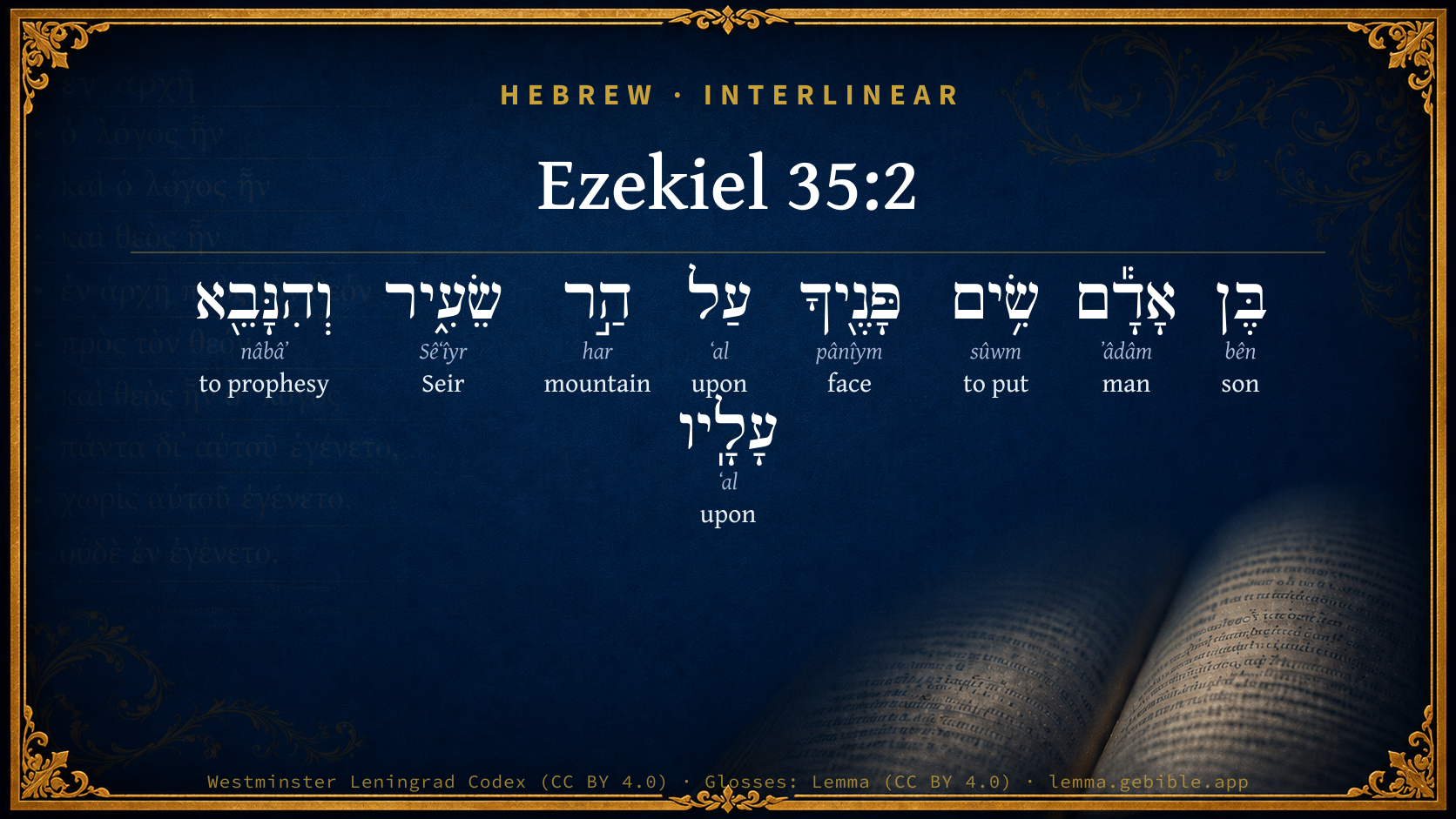
Ezekiel 35:2

Hebrew (Westminster Leningrad Codex) Ezekiel 35:2 appears in the Hebrew Old Testament. The text above is from the Westminster Leningrad Codex. Each word links to its Strong’s number, a concise gloss, and parsing drawn from the Open Scriptures Hebrew Bible morphology. Click any word for its full Brown-Driver-Briggs (BDB) entry.
Download image
Cite this verse

Ezekiel 35:2 (World English Bible). Public Domain. Lemma interlinear Bible study tool, https://lemma.gebible.app/v/ezekiel/35/2.

Show BibTeX & RIS
BibTeX
RIS
English Translation
Son of man, set your face against Mount Seir, and prophesy against it,
World English Bible · Public Domain
Download a study sheet

One document with this verse’s original text, its word-by-word gloss line, the meaning frame, cross-references with their text, attributed commentary, and full source and license credits — printable, and it pastes into notes with its structure intact.

This verse Autodidact and up

Study sheet (.html) Plain text (.txt)

A passage Seminary Student

Up to 50 verses in one chapter. A passage sheet keeps up to 6 commentary sources and 12 cross-references per verse, in the order this page ranks them, and says so on the sheet whenever that leaves anything out. Ask for a single verse and you get the Autodidact verse sheet above.

Everything on this page stays free to read, with no account — the sheet is a download of what is already on screen, not access to it.

Want to remove ads? Support Godless Engineer
Compare translations 3

The same verse in 3 English versions, stacked beneath the original-language interlinear above. Click any original word for its lexicon entry.

Each is an independent rendering of the whole verse — the interlinear is not word-aligned to these translations.

Highlighted words mark where these versions differ — a whole-verse word diff, not a word-by-word alignment.

  • World English Bible Public Domain
    Son of man, set your face against Mount Seir, and prophesy against it,
  • King James Version Public Domain
    Son of man, set thy face against mount Seir, and prophesy against it,
  • unfoldingWord Literal Text CC BY-SA 4.0
    “Son of man, set your face against Mount Seir and prophesy against it.

unfoldingWord Literal Text — © unfoldingWord, licensed CC BY-SA 4.0. Word-aligned USFM3 via Door43 (git.door43.org/unfoldingWord/en_ult).

Versions to compare (up to 4)

3 of 4 selected

Show all 18 translations

Every available English version of this verse, each an independent rendering of the whole verse.

  • World English Bible Public Domain
    Son of man, set your face against Mount Seir, and prophesy against it,
  • Berean Standard Bible Public Domain
    “Son of man, set your face against Mount Seir and prophesy against it,
  • Majority Standard Bible Public Domain
    “Son of man, set your face against Mount Seir and prophesy against it,
  • King James Version Public Domain
    Son of man, set thy face against mount Seir, and prophesy against it,
  • American Standard Version (1901) Public Domain
    Son of man, set thy face against mount Seir, and prophesy against it,
  • Revised Version (1885) Public Domain
    Son of man, set thy face against mount Seir, and prophesy against it,
  • Geneva Bible (1599) Public Domain
    Sonne of man, Set thy face against mount Seir, and prophesie against it,
  • Douay-Rheims (1899) Public Domain
    Son of man, set thy face against mount Seir, and prophesy concerning it, and say to it:
  • Young's Literal Translation Public Domain
    `Son of man, set thy face against mount Seir, and prophesy against it,
  • Literal Standard Version CC BY-SA 4.0
    “Son of man, set your face against Mount Seir, and prophesy against it,
  • Unlocked Literal Bible CC BY-SA 4.0
    “Son of man, set your face against Mount Seir and prophesy against it.
  • unfoldingWord Literal Text CC BY-SA 4.0
    “Son of man, set your face against Mount Seir and prophesy against it.
  • Darby Bible Public Domain
    Son of man, set thy face against mount Seir, and prophesy against it,
  • World Messianic Bible Public Domain
    “Son of man, set your face against Mount Seir, and prophesy against it,
  • Webster's Bible Public Domain
    Son of man, set thy face against mount Seir, and prophesy against it,
  • Free Bible Version CC BY-SA 4.0
    “Son of man, face towards Mount Seir and prophesy against it
  • Bible in Basic English Public Domain
    Son of man, let your face be turned to Mount Seir, and be a prophet against it,
  • JPS Tanakh (1917) Public Domain
    'Son of man, set thy face against mount Seir, and prophesy against it,

Literal Standard Version (2020), Covenant Press — licensed CC BY-SA 4.0. Text via the HelloAO Bible API (eBible.org). Unlocked Literal Bible (unfoldingWord) — licensed CC BY-SA 4.0. Text via the HelloAO Bible API (eBible.org). unfoldingWord Literal Text — © unfoldingWord, licensed CC BY-SA 4.0. Word-aligned USFM3 via Door43 (git.door43.org/unfoldingWord/en_ult). Free Bible Version, Dr. Jonathan Gallagher — licensed CC BY-SA 4.0. Text via the HelloAO Bible API (eBible.org).

Word by word

More ways to search: Search by grammar → Find every occurrence → Compare this word →

Practice this passage: Drill this verse → Learn its vocabulary →

שֵׂעִ֑יר
Sêʻîyr
H8165
“Seir”
Noun, Proper
Part of Speech
Noun
Type
Proper
Full BDB Definition

Origin: formed like H8163

TWOT: 2274h , 2274g

Seir = "hairy" or " shaggy" - patriarch of the Horites, the inhabitants of Edom before the descendants of Esau, the Edomites (noun proper masculine) - the land of Edom, south of the Dead Sea (noun proper territorial) - a mountain range in Edom extending from the Dead Sea to the Elanitic Gulf (noun proper mountain) - apparently also called 'Mount Seir' and extending most of the distance of the mountain range itself - a mountain in northern Judah lying westward from Kirjath-jearim (noun proper mountain)
  1. בֶּן bên H1121 “son of” Noun, Common, Masculine, Singular, Construct
  2. אָדָ֕ם ʼâdâm H120 “man” Noun, Common, Masculine, Singular, Absolute
  3. שִׂ֥ים sûwm H7760 “put” Verb, Qal, Imperative, 2nd Person, Masculine, Singular
  4. פָּנֶ֖יךָ pânîym H6440 “face(s) · your” Noun, Common, Both, Plural, Construct + Suffix, Personal, 2nd Person, Masculine, Singular
  5. עַל ʻal H5921 “upon” Preposition
  6. הַ֣ר har H2022 “mountain of” Noun, Common, Masculine, Singular, Construct
  7. וְהִנָּבֵ֖א nâbâʼ H5012 “and · prophesy” Conjunction + Verb, Niphal, Imperative, 2nd Person, Masculine, Singular
  8. עָלָֽיו ʻal H5921 “upon · him” Preposition + Suffix, Personal, 3rd Person, Masculine, Singular

About this verse

These counts appear in no published source. They are computed here, from the morphology-tagged text and Lemma’s own curated glosses. What Lemma adds →

9
words
8
distinct lemmas
Prophets
section

Shared distinctive vocabulary

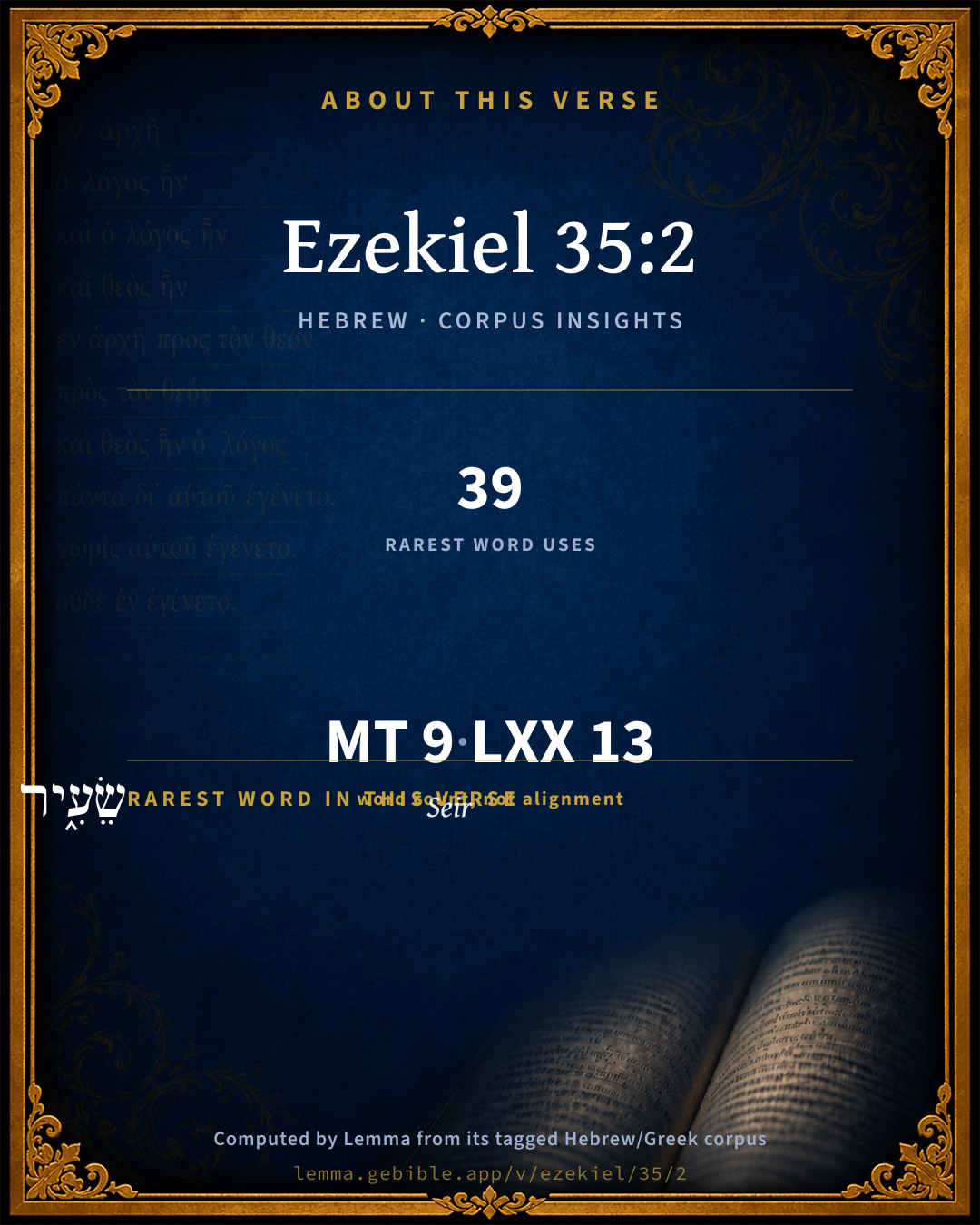
שֵׂעִ֑יר Seir H8165 occurs in 38 verses of the Hebrew Bible. Also found in:

Grammatical profile

  • 2 verbs
  • 5 nouns
  • 2 prepositions

Verb forms

  • שִׂ֥ים Qal · Imperative
  • וְהִנָּבֵ֖א Niphal · Imperative

Repetition

A word recurs within this verse — often emphatic in Hebrew:

Hebrew & Septuagint length

In English translation the verse runs 13 words from the Hebrew and 13 from the Septuagint (LXX English) — the same length.

A rough comparison of the two English renderings, which tokenize alike — not a word-level alignment.

Word counts can differ between the Hebrew and the Greek without any difference in meaning — e.g. the Hebrew direct-object marker אֵת has no separate Greek word, and Greek often adds the article ὁ.

In the original languages it is 9 Hebrew tokens and 13 Greek tokens — but the two are counted differently (Hebrew bundles its prefixes and suffixes into one token; the Greek is in lemma form), so that isn’t a like-for-like length.

Cross-references

25

Topical passages linked to Ezekiel 35:2 in the Treasury of Scripture Knowledge — connected by theme and wording, ordered by reader-vote popularity; previews shown in the World English Bible.

  • Genesis 32:3 Jacob sent messengers in front of him to Esau, his brother, to the land of Seir, the field of Edom.
  • Ezekiel 6:2 Son of man, set your face toward the mountains of Israel, and prophesy to them,
  • Ezekiel 25:8 Thus says the Lord Yahweh: Because Moab and Seir say, Behold, the house of Judah is like all the nations;
  • Genesis 36:8–9 Esau lived in the hill country of Seir. Esau is Edom.
  • Deuteronomy 2:5 don't contend with them; for I will not give you of their land, no, not so much as for the sole of the foot to tread on; because I have given Mount Seir to Esau for a possession.
  • Joshua 24:4 I gave to Isaac Jacob and Esau: and I gave to Esau Mount Seir, to possess it: and Jacob and his children went down into Egypt.
  • 2 Chronicles 20:10 Now, behold, the children of Ammon and Moab and Mount Seir, whom you would not let Israel invade, when they came out of the land of Egypt, but they turned aside from them, and didn't destroy them;
  • 2 Chronicles 20:22–23 When they began to sing and to praise, Yahweh set liers-in-wait against the children of Ammon, Moab, and Mount Seir, who had come against Judah; and they were struck.
  • 2 Chronicles 25:11–14 Amaziah took courage, and led forth his people, and went to the Valley of Salt, and struck of the children of Seir ten thousand.
  • Psalms 83:3–18 They conspire with cunning against your people. They plot against your cherished ones.
  • Isaiah 34:1–17 Come near, you nations, to hear; and listen, you peoples: let the earth hear, and the fullness of it; the world, and all things that come forth from it.
  • Isaiah 50:7 For the Lord Yahweh will help me; therefore I have not been confounded: therefore have I set my face like a flint, and I know that I shall not be disappointed.
  • Isaiah 63:1–6 Who is this who comes from Edom, with dyed garments from Bozrah? this who is glorious in his clothing, marching in the greatness of his strength? I who speak in righteousness, mighty to save.
  • Jeremiah 9:25–26 Behold, the days come, says Yahweh, that I will punish all those who are circumcised in [their] uncircumcision:
  • Jeremiah 49:7–22 Of Edom. Thus says Yahweh of Hosts: Is wisdom no more in Teman? is counsel perished from the prudent? is their wisdom vanished?
  • Lamentations 4:21–22 Rejoice and be glad, daughter of Edom, that dwell in the land of Uz: The cup shall pass through to you also; you shall be drunken, and shall make yourself naked.
  • Ezekiel 20:46 Son of man, set your face toward the south, and drop [your word] toward the south, and prophesy against the forest of the field in the South;
  • Ezekiel 21:2 Son of man, set your face toward Jerusalem, and drop [your word] toward the sanctuaries, and prophesy against the land of Israel;
  • Ezekiel 25:2 Son of man, set your face toward the children of Ammon, and prophesy against them:
  • Ezekiel 25:12–14 Thus says the Lord Yahweh: Because Edom has dealt against the house of Judah by taking vengeance, and has greatly offended, and revenged himself on them;
  • Ezekiel 32:29 There is Edom, her kings and all her princes, who in their might are laid with those who are slain by the sword: they shall lie with the uncircumcised, and with those who go down to the pit.
  • Amos 1:11–12 Thus says Yahweh: "For three transgressions of Edom, yes, for four, I will not turn away its punishment; Because he pursued his brother with the sword, And cast off all pity, And his anger raged continually, And he kept his wrath forever;
  • Obadiah 1:1 The vision of Obadiah. This is what the Lord Yahweh says about Edom. We have heard news from Yahweh, and an ambassador is sent among the nations, saying, "Arise, and let's rise up against her in battle.
  • Obadiah 1:10–14 For the violence done to your brother Jacob, shame will cover you, and you will be cut off forever.
  • Ephesians 6:19 on my behalf, that utterance may be given to me in opening my mouth, to make known with boldness the mystery of the Gospel,

Cross-references courtesy of OpenBible.info (CC BY 4.0).

Hebrew and Greek witnesses Masoretic Hebrew ↔ Greek Septuagint

The same verse in the two great witnesses to the Old Testament, shown verse-for-verse.

These are two independent witnesses, not word-aligned to each other, and the Septuagint is shown in lemma (dictionary) form.

Hebrew Ezekiel 35:2 Masoretic · Westminster Leningrad Codex

בֶּן אָדָ֕ם שִׂ֥ים פָּנֶ֖יךָ עַל הַ֣ר שֵׂעִ֑יר וְהִנָּבֵ֖א עָלָֽיו

Son of man, set your face against Mount Seir, and prophesy against it,

World English Bible · Public Domain

Greek LXX Ezekiel 35:2 Septuagint · lemma form

υἱός ἄνθρωπος ἐπιστρέφω ὁ πρόσωπον σύ ἐπί ὄρος σηιρ καί προφητεύω ἐπί αὐτός

Son of man, set your face against mount Seir, and prophesy against it,

LXX2012 (modern English Septuagint) · Public Domain

Hebrew: Westminster Leningrad Codex (CC BY 4.0). Greek: Septuagint (public domain); English from LXX2012 (modern English Septuagint) (Public Domain). How the Septuagint differs from the Hebrew →

Targum (Aramaic paraphrase)

1

The Targum is the ancient Jewish Aramaic paraphrase of the Hebrew Scriptures — an interpretive translation, not the Hebrew text itself. Onkelos (literal) and Pseudo-Jonathan (expansive) render the Torah, and Jonathan the Prophets. Coverage is partial: where no permissively-licensed English translation exists for a verse, only the Aramaic is shown. This is verse-level text, not a word-by-word alignment to the Hebrew.

  1. Targum Jonathan Prophets (Joshua–Malachi)
    בַּר אָדָם קַבֵּיל נְבוּאָה עַל טוּרָא דְשֵׂעִיר וְתִתְנַבֵּי עֲלוֹהִי:

    (no public-domain English translation for this verse)

    Targum Jonathan — Aramaic: “Mikraot Gedolot” (public domain). English: “Sefaria Community Translation” (CC0 1.0 (public-domain dedication)); “London "Chaldee Paraphrase," 1871” (public domain). Text via Sefaria.

Commentary

Notes on Ezekiel 35:2 from classic Christian and Jewish commentators (each source and its license shown beneath its notes). The classic Christian expositions comment on the surrounding passage and are grouped to its opening verse, so a note may address several verses; the Jewish commentaries on the Tanakh (Rashi and others) are per-verse, so they appear only where the commentator wrote on this verse.

Lemma curates 59 commentaries, every one of them public domain or Creative Commons licensed, each selected and text-cleaned for this edition rather than reprinted as found. About our sources →

Trapp's Complete Commentary

John Trapp

Eze 35:2 Son of man, set thy face against mount Seir, and prophesy against it,

Ver. 2. Set thy face.] Eze 6:2.

Against Mount Seir.] Inhabited by the Edomites.

And prophesy against it.] This had been done before, {Eze 25:12} but not enough. God hath a further saying to them, and that for the comfort of his poor people who might thus object. Peace and security from danger is promised us in the foregoing chapter; but we have still many deadly enemies, and none worse than our near allies and next neighbours the Edomites. Here, therefore, they are heavily threatened with utter desolation for their malignity against Israel, and their blasphemy against God.

John Trapp, A Commentary or Exposition upon All the Books of the Old and New Testament (1647–1656) — public domain. Text from a community e-Sword module.

Geneva Bible (1599)

Geneva Bible translators

Where the Edomites dwelt.

Geneva Bible (1599) marginal notes — public domain. Text via Bolls.life.

Adam Clarke's Commentary

Verse 2. Set thy face against Mount Seir] That is, against the Edomites. This prophecy was probably delivered about the time of the preceding, and before the destruction of Idumea by Nebuchadnezzar, which took place about five years after.

Calmet supposes that two destructions of Idumea are here foretold; one by Nebuchadnezzar, and the other by the Jews after their return from their captivity.

Adam Clarke's Commentary on the Bible (1810–1826) — public domain. Text from a community e-Sword/MySword module.

Ellicott's Commentary for English Readers

(2) Mount Seir.—This poetical designation of the Edomites from the land which they inhabited is common in Scripture (Gen_36:8-9; Deu_2:1; Deu_2:5; 1Ch_4:42, &c.). The land included the whole mountainous region between the Dead Sea and the Elanitic Gulf, or eastern branch of the Red Sea. The earlier denunciation of the Edomites had in view their historical relations to Israel; this, on the other hand, as already said—like Isaiah 34; Isa_63:1-6—while still keeping this historical relation in view, regards them also as representative of the world’s hostility to the covenant people of God. This appears from the fact that the desolation of Edom, itself but a small province, is put in contrast (Eze_35:14) with the rejoicing of the whole earth, and that in Eze_36:5 (and generally Eze_35:3-7) Edom is coupled with “the residue of the heathen.” For the phrase “set thy face against,” see Eze_13:17; and on Eze_35:3, comp. Eze_6:14.

A Bible Commentary for English Readers, edited by Charles John Ellicott (1878–1897) — public domain. Text from a community e-Sword module.

The Cambridge Bible for Schools and Colleges

gen. ed. J. J. S. Perowne

2. set thy face against] Cf. ch. Eze_6:2.

The Cambridge Bible for Schools and Colleges (gen. ed. J. J. S. Perowne; Cambridge University Press, 1878–1918) — public domain. Text from a community e-Sword module.

John Gill's Exposition

Son of man set thy face against Mount Seir,.... Which had its name from Seir the Horite, who first possessed it; and was succeeded in it by Esau and his posterity, the Edomites; see Gen 36:8, Deu 2:12, so that the country of Edom or Idumea is here intended, and the inhabitants of it; who are put for the enemies of the church and people of God in general, as these were the enemies of Israel and Judah; and particularly for Rome, which, as it was spiritually called Egypt and Sodom, so it may be called Edom, as it often is by the Jews: now the prophet is bid to turn his face towards this mountain or country, and look sternly at it, and severely threaten it. The Targum is,

"take up a prophecy against it;''

which is expressed in the next clause:

and prophesy against it; foretell things contrary to it, which relate to its destruction, as follows:

John Gill's Exposition of the Whole Bible (1746–1763) — public domain (CC PDM 1.0). Text via the HelloAO Bible API.

Haydock's Catholic Bible Commentary

Face. Address, or speak without fearing any man. (Worthington) --- Seir: Idumea. He speaks of its devastation, both by Nabuchodonosor on the side of Moab, and by the Machabees in what remained, Jeremias xxvii. 7., and 1 Machabees iv. 60., and xiv. 33. (Calmet)

George Leo Haydock (1774–1849), Haydock's Catholic Family Bible and Commentary, 1859 edition — public domain. Excludes Psalms (Douay-Rheims chapter numbering differs from Protestant) and Deuterocanonical books (Catholic canon only).

Matthew Poole's English Annotations

Put thyself in a posture looking towards Mount Seir, but with a stern and menacing countenance; the phrase you meet Eze 20:46; 21:2; 25:2.

Mount Seir; the country for the inhabitants of it, as is usual in Scripture. This was a mountainous country, yet fruitful. It was so called from the old lord of it, Seir the Horite, or mountaineer from Hor, whose posterity were ousted of it by Esau’s posterity, Deu 2:12.

Prophesy against it; foretell what sad things are coming on them.

Matthew Poole's English Annotations on the Holy Bible (1683–1685) — public domain. Text from a community e-Sword/MySword module.

The Pulpit Commentary

Set thy face against Mount Seir. The mountainous are in between the Dead Sea and the Elanitic Gulf, which formed the original settlement of Esau and his descendants, (Gen_36:9) is here put for the land of Edom, as the land in turn stands for its people. (Eze_25:8) Although already the prophet has pronounced a threatening doom against Edom, (Eze_25:12-14) he once more directs against, it the judgments of Heaven, on this occasion viewing it as the representative of all those hostile world-powers which from the first had been opposed to Israel as the theocratic nation, and which even then, by their antagonism, hindered her return. (cf. Isa_63:1-8)

The Pulpit Commentary (1880–1919), ed. H.D.M. Spence-Jones & Joseph S. Exell — public domain. Text from a community e-Sword module.

John Wesley's Explanatory Notes

Mount Seir - The Edomites, who inhabited it.

John Wesley, Explanatory Notes Upon the Whole Bible (1754–1765) — public domain. Text via the GEBible commentary corpus.

Lesson kit

Teaching starters — assembled from the data on this page, not authored interpretation. Every prompt links to the verse data it draws on. Edit before teaching.

Ezekiel, in the Prophets, opens this verse with 9 words (8 distinct Hebrew lemmas). Its most distinctive word is Sêʻîyr (“Seir”). A historical commentator’s framing appears above. Read the whole chapter for the surrounding context.

Discussion questions

  1. What does “Seir” (Sêʻîyr) contribute to the verse as a whole?
  2. How does Genesis 14:6, which shares the word «Seir», read alongside this verse?
  3. What does the repetition of “upon” (2× in this one verse) do in this verse?
  4. «שִׂ֥ים» is a Qal Imperative verb. How does that grammatical form shape the action described?
  5. Compare how Trapp's Complete Commentary and Geneva Bible (1599) read this verse. Where do they agree or differ?

Things to notice

Reading settings

Reading text

Shown beneath each verse's original-language words.

Old Testament
Old Testament edition

Read the OT as the Masoretic Hebrew (MT) or the Greek Septuagint (LXX).

English shown for the Greek Septuagint (in the Hebrew ↔ Greek comparison).

Comparing translations? Open the Compare panel on any verse page to stack up to four side by side.