Jeremiah 37:19

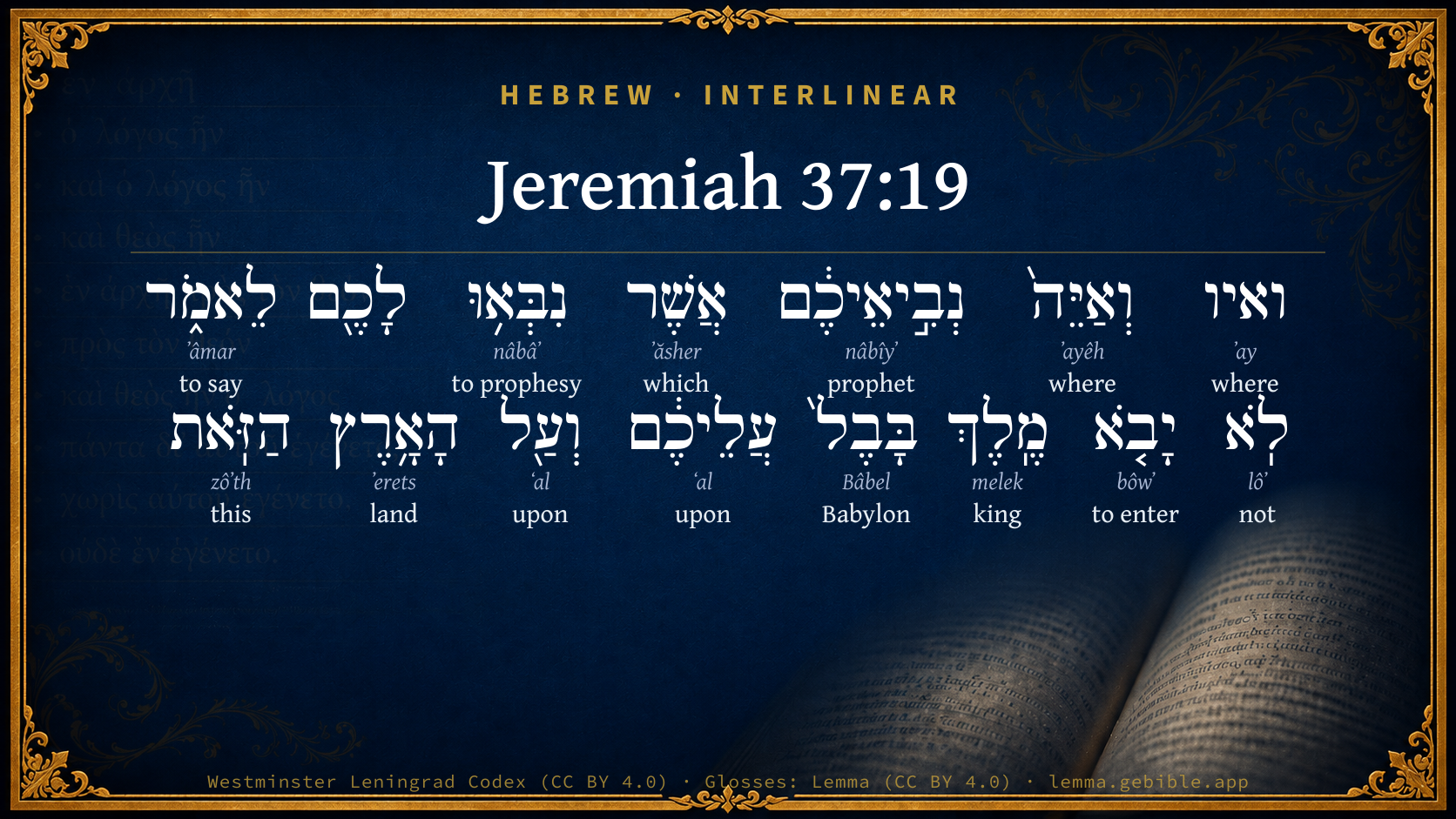
Hebrew (Westminster Leningrad Codex) Jeremiah 37:19 appears in the Hebrew Old Testament. The text above is from the Westminster Leningrad Codex. Each word links to its Strong’s number, a concise gloss, and parsing drawn from the Open Scriptures Hebrew Bible morphology. Click any word for its full Brown-Driver-Briggs (BDB) entry.
Download image
Cite this verse

Jeremiah 37:19 (World English Bible). Public Domain. Lemma interlinear Bible study tool, https://lemma.gebible.app/v/jeremiah/37/19.

Show BibTeX & RIS
BibTeX
RIS
English Translation
Where now are your prophets who prophesied to you, saying, The king of Babylon shall not come against you, nor against this land?
World English Bible · Public Domain
Download a study sheet

One document with this verse’s original text, its word-by-word gloss line, the meaning frame, cross-references with their text, attributed commentary, and full source and license credits — printable, and it pastes into notes with its structure intact.

This verse Autodidact and up

Study sheet (.html) Plain text (.txt)

A passage Seminary Student

Up to 50 verses in one chapter. A passage sheet keeps up to 6 commentary sources and 12 cross-references per verse, in the order this page ranks them, and says so on the sheet whenever that leaves anything out. Ask for a single verse and you get the Autodidact verse sheet above.

Everything on this page stays free to read, with no account — the sheet is a download of what is already on screen, not access to it.

Want to remove ads? Support Godless Engineer
Compare translations 3

The same verse in 3 English versions, stacked beneath the original-language interlinear above. Click any original word for its lexicon entry.

Each is an independent rendering of the whole verse — the interlinear is not word-aligned to these translations.

Highlighted words mark where these versions differ — a whole-verse word diff, not a word-by-word alignment.

  • World English Bible Public Domain
    Where now are your prophets who prophesied to you, saying, The king of Babylon shall not come against you, nor against this land?
  • King James Version Public Domain
    Where are now your prophets which prophesied unto you, saying, The king of Babylon shall not come against you, nor against this land?
  • unfoldingWord Literal Text CC BY-SA 4.0
    Where are your prophets, the ones who prophesied for you and said the king of Babylon will not come against you or against this land?

unfoldingWord Literal Text — © unfoldingWord, licensed CC BY-SA 4.0. Word-aligned USFM3 via Door43 (git.door43.org/unfoldingWord/en_ult).

Versions to compare (up to 4)

3 of 4 selected

Show all 18 translations

Every available English version of this verse, each an independent rendering of the whole verse.

  • World English Bible Public Domain
    Where now are your prophets who prophesied to you, saying, The king of Babylon shall not come against you, nor against this land?
  • Berean Standard Bible Public Domain
    Where are your prophets who prophesied to you, claiming, ‘The king of Babylon will not come against you or this land’?
  • Majority Standard Bible Public Domain
    Where are your prophets who prophesied to you, claiming, ‘The king of Babylon will not come against you or this land’?
  • King James Version Public Domain
    Where are now your prophets which prophesied unto you, saying, The king of Babylon shall not come against you, nor against this land?
  • American Standard Version (1901) Public Domain
    Where now are your prophets that prophesied unto you, saying, The king of Babylon shall not come against you, nor against this land?
  • Revised Version (1885) Public Domain
    Where now are your prophets which prophesied unto you, saying, The king of Babylon shall not come against you, nor against this land?
  • Geneva Bible (1599) Public Domain
    Where are nowe your prophets, which prophecied vnto you, saying, The King of Babel shall not come against you, nor against this land?
  • Douay-Rheims (1899) Public Domain
    Now therefore hear, I beseech thee, my lord the king: let my petition be accepted in thy sight: and send me not back into the house of Jonathan the scribe, lest I die there.
  • Young's Literal Translation Public Domain
    And where `are' your prophets who prophesied to you, saying, The king of Babylon doth not come in against you, and against this land?
  • Literal Standard Version CC BY-SA 4.0
    And where [are] your prophets who prophesied to you, saying, The king of Babylon does not come in against you, and against this land?
  • Unlocked Literal Bible CC BY-SA 4.0
    Where are your prophets, the ones who prophesied for you and said the king of Babylon will not come against you or against this land?
  • unfoldingWord Literal Text CC BY-SA 4.0
    Where are your prophets, the ones who prophesied for you and said the king of Babylon will not come against you or against this land?
  • Darby Bible Public Domain
    And where are your prophets that prophesied unto you, saying, The king of Babylon shall not come against you, nor against this land?
  • World Messianic Bible Public Domain
    Now where are your prophets who prophesied to you, saying, ‘The king of Babylon will not come against you, nor against this land’?
  • Webster's Bible Public Domain
    Where are now your prophets who prophesied to you, saying, The king of Babylon shall not come against you, nor against this land?
  • Free Bible Version CC BY-SA 4.0
    Where are your prophets now, the ones who prophesied to you, saying, ‘The king of Babylon won't come and attack you and this country’?
  • Bible in Basic English Public Domain
    Where now are your prophets who said to you, The king of Babylon will not come against you and against this land?
  • JPS Tanakh (1917) Public Domain
    Where now are your prophets that prophesied unto you, saying: The king of Babylon shall not come against you, nor against this land?

Literal Standard Version (2020), Covenant Press — licensed CC BY-SA 4.0. Text via the HelloAO Bible API (eBible.org). Unlocked Literal Bible (unfoldingWord) — licensed CC BY-SA 4.0. Text via the HelloAO Bible API (eBible.org). unfoldingWord Literal Text — © unfoldingWord, licensed CC BY-SA 4.0. Word-aligned USFM3 via Door43 (git.door43.org/unfoldingWord/en_ult). Free Bible Version, Dr. Jonathan Gallagher — licensed CC BY-SA 4.0. Text via the HelloAO Bible API (eBible.org).

Word by word

More ways to search: Search by grammar → Find every occurrence → Compare this word →

Practice this passage: Drill this verse → Learn its vocabulary →

ואיו
ʼay
H335
“and · where · him”
Conjunction + Particle, Interrogative + Suffix, Personal, 3rd Person, Masculine, Singular
Part of Speech
Conjunction + Particle
Type
Interrogative
Full BDB Definition

Origin: perhaps from H370

TWOT: 75

where?, whence? - which?, how? (in prefix with other adverb)
  1. וְאַיֵּה֙ ʼayêh H346 “and · where” Conjunction + Particle, Interrogative
  2. נְבִ֣יאֵיכֶ֔ם nâbîyʼ H5030 “prophets · your” Noun, Common, Masculine, Plural, Construct + Suffix, Personal, 2nd Person, Masculine, Plural
  3. אֲשֶׁר ʼăsher H834 “which” Particle, Relative
  4. נִבְּא֥וּ nâbâʼ H5012 “to prophesy” Verb, Niphal, Perfect, 3rd Person, Common, Plural
  5. לֵאמֹ֑ר ʼâmar H559 “to say” Preposition + Verb, Qal, Infinitive Construct
  6. לֹֽא lôʼ H3808 “not” Particle, Negative
  7. יָבֹ֤א bôwʼ H935 “to enter” Verb, Qal, Imperfect, 3rd Person, Masculine, Singular
  8. מֶֽלֶךְ melek H4428 “king of” Noun, Common, Masculine, Singular, Construct
  9. בָּבֶל֙ Bâbel H894 “Babylon” Noun, Proper
  10. עֲלֵיכֶ֔ם ʻal H5921 “upon · you” Preposition + Suffix, Personal, 2nd Person, Masculine, Plural
  11. וְעַ֖ל ʻal H5921 “and · upon” Conjunction + Preposition
  12. הָאָ֥רֶץ ʼerets H776 “the · land” Particle, Definite Article + Noun, Common, Both, Singular, Absolute
  13. הַזֹּֽאת zôʼth H2063 “the · this” Particle, Definite Article + Pronoun, Demonstrative, Feminine, Singular

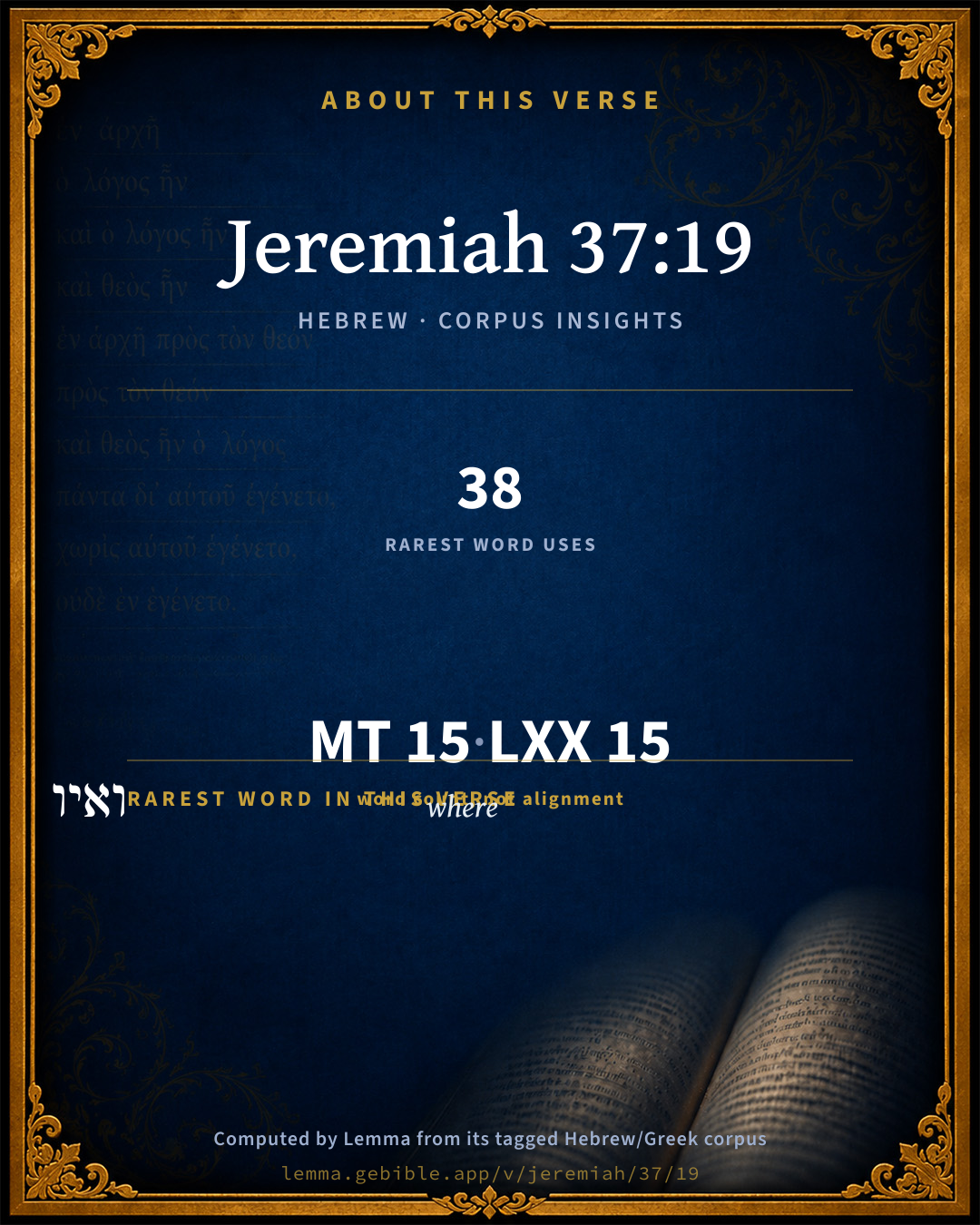
About this verse

These counts appear in no published source. They are computed here, from the morphology-tagged text and Lemma’s own curated glosses. What Lemma adds →

15
words
13
distinct lemmas
Prophets
section

Shared distinctive vocabulary

ואיו where H335 occurs in 36 verses of the Hebrew Bible. Also found in:

Grammatical profile

  • 3 verbs
  • 4 nouns
  • 1 pronoun
  • 3 prepositions
  • 4 particles

Verb forms

  • נִבְּא֥וּ Niphal · Perfect
  • לֵאמֹ֑ר Qal · Infinitive Construct
  • יָבֹ֤א Qal · Imperfect

Repetition

A word recurs within this verse — often emphatic in Hebrew:

  • עֲלֵיכֶ֔ם upon H5921 ×2

Hebrew & Septuagint length

In the original languages it is 15 Hebrew tokens and 15 Greek tokens — but the two are counted differently (Hebrew bundles its prefixes and suffixes into one token; the Greek is in lemma form), so that isn’t a like-for-like length.

Cross-references

13

Topical passages linked to Jeremiah 37:19 in the Treasury of Scripture Knowledge — connected by theme and wording, ordered by reader-vote popularity; previews shown in the World English Bible.

  • Jeremiah 2:28 But where are your gods that you have made you? let them arise, if they can save you in the time of your trouble: for according to the number of your cities are your gods, Judah.
  • Jeremiah 28:10–17 Then Hananiah the prophet took the bar from off the prophet Jeremiah's neck, and broke it.
  • 2 Kings 3:13 Elisha said to the king of Israel, What have I to do with you? get you to the prophets of your father, and to the prophets of your mother. The king of Israel said to him, No; for Yahweh has called these three kings together to deliver them into the hand of Moab.
  • Jeremiah 6:14 They have healed also the hurt of my people slightly, saying, Peace, peace; when there is no peace.
  • Jeremiah 8:11 They have healed the hurt of the daughter of my people slightly, saying, Peace, peace; when there is no peace.
  • Jeremiah 14:13–15 Then said I, Ah, Lord Yahweh! behold, the prophets tell them, You shall not see the sword, neither shall you have famine; but I will give you assured peace in this place.
  • Jeremiah 23:17 They say continually to those who despise me, Yahweh has said, You shall have peace; and to everyone who walks in the stubbornness of his own heart they say, No evil shall come on you.
  • Jeremiah 27:14–18 Don't listen to the words of the prophets who speak to you, saying, You shall not serve the king of Babylon; for they prophesy a lie to you.
  • Jeremiah 28:1–5 It happened the same year, in the beginning of the reign of Zedekiah king of Judah, in the fourth year, in the fifth month, that Hananiah the son of Azzur, the prophet, who was of Gibeon, spoke to me in the house of Yahweh, in the presence of the priests and of all the people, saying,
  • Jeremiah 29:31 Send to all them of the captivity, saying, Thus says Yahweh concerning Shemaiah the Nehelamite: Because Shemaiah has prophesied to you, and I didn't send him, and he has caused you to trust in a lie;
  • Deuteronomy 32:36–37 For Yahweh will judge his people, Repent himself for his servants; When he sees that [their] power is gone, There is none [remaining], shut up or left at large.
  • Lamentations 2:14 Your prophets have seen for you false and foolish visions; They have not uncovered your iniquity, to bring back your captivity, But have seen for you false oracles and causes of banishment.
  • Ezekiel 13:10–16 Because, even because they have seduced my people, saying, Peace; and there is no peace; and when one builds up a wall, behold, they daub it with whitewash:

Cross-references courtesy of OpenBible.info (CC BY 4.0).

Hebrew and Greek witnesses Masoretic Hebrew ↔ Greek Septuagint

The same verse in the two great witnesses to the Old Testament, shown verse-for-verse.

These are two independent witnesses, not word-aligned to each other, and the Septuagint is shown in lemma (dictionary) form.

Hebrew Jeremiah 37:19 Masoretic · Westminster Leningrad Codex

ואיו וְאַיֵּה֙ נְבִ֣יאֵיכֶ֔ם אֲשֶׁר נִבְּא֥וּ לָכֶ֖ם לֵאמֹ֑ר לֹֽא יָבֹ֤א מֶֽלֶךְ בָּבֶל֙ עֲלֵיכֶ֔ם וְעַ֖ל הָאָ֥רֶץ הַזֹּֽאת

Where now are your prophets who prophesied to you, saying, The king of Babylon shall not come against you, nor against this land?

World English Bible · Public Domain

Greek LXX Structure differs

In the Septuagint, Jeremiah is about an eighth shorter than the Hebrew and arranges its material differently — the Oracles Against the Nations (Hebrew chapters 46–51) appear in the middle of the Greek book, after 25:13. Because the chapter and verse boundaries do not line up, a verse-for-verse comparison with the Hebrew is not shown.

A verse-for-verse comparison isn’t shown here because the chapters and verses don’t line up. Switch to the LXX edition with the MT / LXX toggle above to read the Greek directly.

Hebrew: Westminster Leningrad Codex (CC BY 4.0). Greek: Septuagint (public domain); English from a public-domain English Septuagint. How the Septuagint differs from the Hebrew →

Targum (Aramaic paraphrase)

1

The Targum is the ancient Jewish Aramaic paraphrase of the Hebrew Scriptures — an interpretive translation, not the Hebrew text itself. Onkelos (literal) and Pseudo-Jonathan (expansive) render the Torah, and Jonathan the Prophets. Coverage is partial: where no permissively-licensed English translation exists for a verse, only the Aramaic is shown. This is verse-level text, not a word-by-word alignment to the Hebrew.

  1. Targum Jonathan Prophets (Joshua–Malachi)
    וְאָן נְבִיאֵיכוֹן דְשִׁקְרָא דְאִתְנַבִּיאוּ לְכוֹן לְמֵימָר לָא יֵיתֵי מַלְכָּא דְבָבֶל עֲלֵיכוֹן וְעַל אַרְעָא הָדָא:

    (no public-domain English translation for this verse)

    Targum Jonathan — Aramaic: “Mikraot Gedolot” (public domain). English: “Sefaria Community Translation” (CC0 1.0 (public-domain dedication)); “London "Chaldee Paraphrase," 1871” (public domain). Text via Sefaria.

Commentary

Notes on Jeremiah 37:19 from classic Christian and Jewish commentators (each source and its license shown beneath its notes). The classic Christian expositions comment on the surrounding passage and are grouped to its opening verse, so a note may address several verses; the Jewish commentaries on the Tanakh (Rashi and others) are per-verse, so they appear only where the commentator wrote on this verse.

Lemma curates 59 commentaries, every one of them public domain or Creative Commons licensed, each selected and text-cleaned for this edition rather than reprinted as found. About our sources →

Trapp's Complete Commentary

John Trapp

Jer 37:19 Where [are] now your prophets which prophesied unto you, saying, The king of Babylon shall not come against you, nor against this land?

Ver. 19. Where are now your prophets?] Let them appear now if you please, and upon trial made let truth take place. To this most equal motion when the king said nothing, the prophet proceedeth to move again for himself, that he might be removed at least to a more convenient place, unless they meant an end of him.

John Trapp, A Commentary or Exposition upon All the Books of the Old and New Testament (1647–1656) — public domain. Text from a community e-Sword module.

Jamieson, Fausset & Brown

Robert Jamieson, A. R. Fausset & David Brown

Where are now your prophets--The event has showed them to be liars; and, as surely as the king of Babylon has come already, notwithstanding their prophecy, so surely shall he return.

Jamieson, Fausset & Brown — Commentary Critical and Explanatory on the Whole Bible (1871) — public domain (CC PDM 1.0). Text via the HelloAO Bible API.

Adam Clarke's Commentary

Verse 19. Where are now your prophets] They told you that the Chaldeans should not come; I told you they would. According to my word the Chaldeans are come, and are departed only for a short time.

Adam Clarke's Commentary on the Bible (1810–1826) — public domain. Text from a community e-Sword/MySword module.

John Calvin's Commentaries

Here Jeremiah, taking confidence, advances to a higher ground; for he reprobates the folly of Zedekiah, because he had given ear to the false prophets and their flatteries. But this he did, that he might more fully confirm his own innocence, as though he had said, “I indeed am grievously blamed, because I threatened ruin to the city and the Temple; but what if the Lord had constrained me to do so? and it is evident that I was commissioned by God, and that I alleged nothing without authority; for I have always declared what has happened, and events have proved that I was sent from above, when I announced to you what was to be. But where are your prophets? for they have been always flattering you; and it has happened through their falsehoods, that ye have not returned to the right way. It was yet in your power to be reconciled to God, when I at first warned you; and all my labor and endeavors were for this end, that you might anticipate God’s wrath by a willing repentance. Since then your prophets have deceived you, and the event now clearly proves this, know, O king, that I have been sent from above.”

We thus see that Jeremiah was not so anxious about his life, but that he always remained stedfast to his purpose; and thus he turned not aside from making an honest profession of the truth, so as to provide for his own safety, as they do, who are fearful and think that they act prudently, when they are compliant and try to please men opposed to them at the expense of truth. This was not done by Jeremiah. He had indeed a regard for his life, as we shall now see; but he went on in the discharge of his office, and valued the truth communicated to him from above more than hundred lives. It is then with reference to this that he says, Where are your prophets? as though he had said, “You see that you have all been deceived by their false prophecies.” It follows —

John Calvin's Commentaries (1540-1563) — public domain. Text from the Calvin Translation Society English edition (1840s-50s) via the Christian Classics Ethereal Library (ccel.org). Calvin's coverage is partial (roughly two-thirds of the Bible); uncommented books and verses are honest gaps, never fabricated. The 19th-century editor's footnotes and remarks are omitted so the notes are faithfully Calvin's own voice.

Ellicott's Commentary for English Readers

(19) Where are now your prophets . . .?—The failure of the past predictions of the false prophets is urged on the king as a reason why he should not trust them in the present crisis. They had assured him (Jer_28:3) that within two years the city should be delivered, and the result had been that it had been besieged. The temporary departure of the Chaldæans had again raised their hopes, and they were now tempting the king with the assurance that the Egyptian army would make short work of them.

A Bible Commentary for English Readers, edited by Charles John Ellicott (1878–1897) — public domain. Text from a community e-Sword module.

The Cambridge Bible for Schools and Colleges

gen. ed. J. J. S. Perowne

19. Where now are your prophets which prophesied unto you] Jeremiah in this v. challenges the whole people through their king (“your … you”). For the reference to these prophets cp. Jer_28:2-11.

The Cambridge Bible for Schools and Colleges (gen. ed. J. J. S. Perowne; Cambridge University Press, 1878–1918) — public domain. Text from a community e-Sword module.

John Gill's Exposition

Where are now your prophets that prophesied unto you,.... Your false prophets, as the Targum; what is become of their prophecies? where is the truth of them, to which general credit has been given? where are they? let them appear and defend themselves, if they can, from the charge of lying, and of being false prophets? or where are they? tacitly suggesting the different circumstances of him and them; he, who was a true prophet, was laid in a prison; they, who were false prophets, were caressed in the palaces of the king and his nobles, and in favour with the people in general:

saying, the king of Babylon shall not come against you, nor against this land? gave out that the king of Babylon would never invade the land of Judea, or besiege the city of Jerusalem, which proved false; and still they had the front to say, that when the siege was raised, he would never come again; whereas he was then returned to it, and was now besieging it; so that here were notorious falsehoods delivered out by them.

John Gill's Exposition of the Whole Bible (1746–1763) — public domain (CC PDM 1.0). Text via the HelloAO Bible API.

Haydock's Catholic Bible Commentary

Be. Hebrew, "fall prostrate," chap. xxxvi. 7.

George Leo Haydock (1774–1849), Haydock's Catholic Family Bible and Commentary, 1859 edition — public domain. Excludes Psalms (Douay-Rheims chapter numbering differs from Protestant) and Deuterocanonical books (Catholic canon only).

Matthew Poole's English Annotations

You now see what kind of prophets they are, who fed you with hopes that the king of Babylon’s army should return no more to the siege of the city. I told you they would return, you had other prophets that told you they should not, judge now who were the true prophets. The devil in all ages had some that contradicted the true prophets of the Lord. Three hundred false prophets contradicted one Micaiah, as to Ahab’s going up to Ramoth-gilead, and prospering in that expedition. There were many that contradicted Isaiah and Jeremiah, and other true prophets, as to the king of Babylon’s coming to besiege Jerusalem, and his return again to the siege when he had risen up from it to meet the Egyptian army; and as to the length of time in which the Jews should be in captivity; yet, (to let us see men’s madness upon their lusts,) as there still have risen up in other generations false teachers and flatterers, so they have always found more favour than those that have dealt more faithfully in revealing God’s will.

Matthew Poole's English Annotations on the Holy Bible (1683–1685) — public domain. Text from a community e-Sword/MySword module.

Lesson kit

Teaching starters — assembled from the data on this page, not authored interpretation. Every prompt links to the verse data it draws on. Edit before teaching.

Jeremiah, in the Prophets, opens this verse with 15 words (13 distinct Hebrew lemmas). Its most distinctive word is ʼay (“where”). A historical commentator’s framing appears above. Read the whole chapter for the surrounding context.

Discussion questions

  1. What does “where” (ʼay) contribute to the verse as a whole?
  2. How does Genesis 3:9, which shares the word «where», read alongside this verse?
  3. What does the repetition of “upon” (2× in this one verse) do in this verse?
  4. These translations render this verse differently. What is at stake in choosing one wording over another?
  5. «נִבְּא֥וּ» is a Niphal Perfect verb. How does that grammatical form shape the action described?
  6. Compare how Trapp's Complete Commentary and Jamieson, Fausset & Brown read this verse. Where do they agree or differ?

Things to notice

Reading settings

Reading text

Shown beneath each verse's original-language words.

Old Testament
Old Testament edition

Read the OT as the Masoretic Hebrew (MT) or the Greek Septuagint (LXX).

English shown for the Greek Septuagint (in the Hebrew ↔ Greek comparison).

Comparing translations? Open the Compare panel on any verse page to stack up to four side by side.