
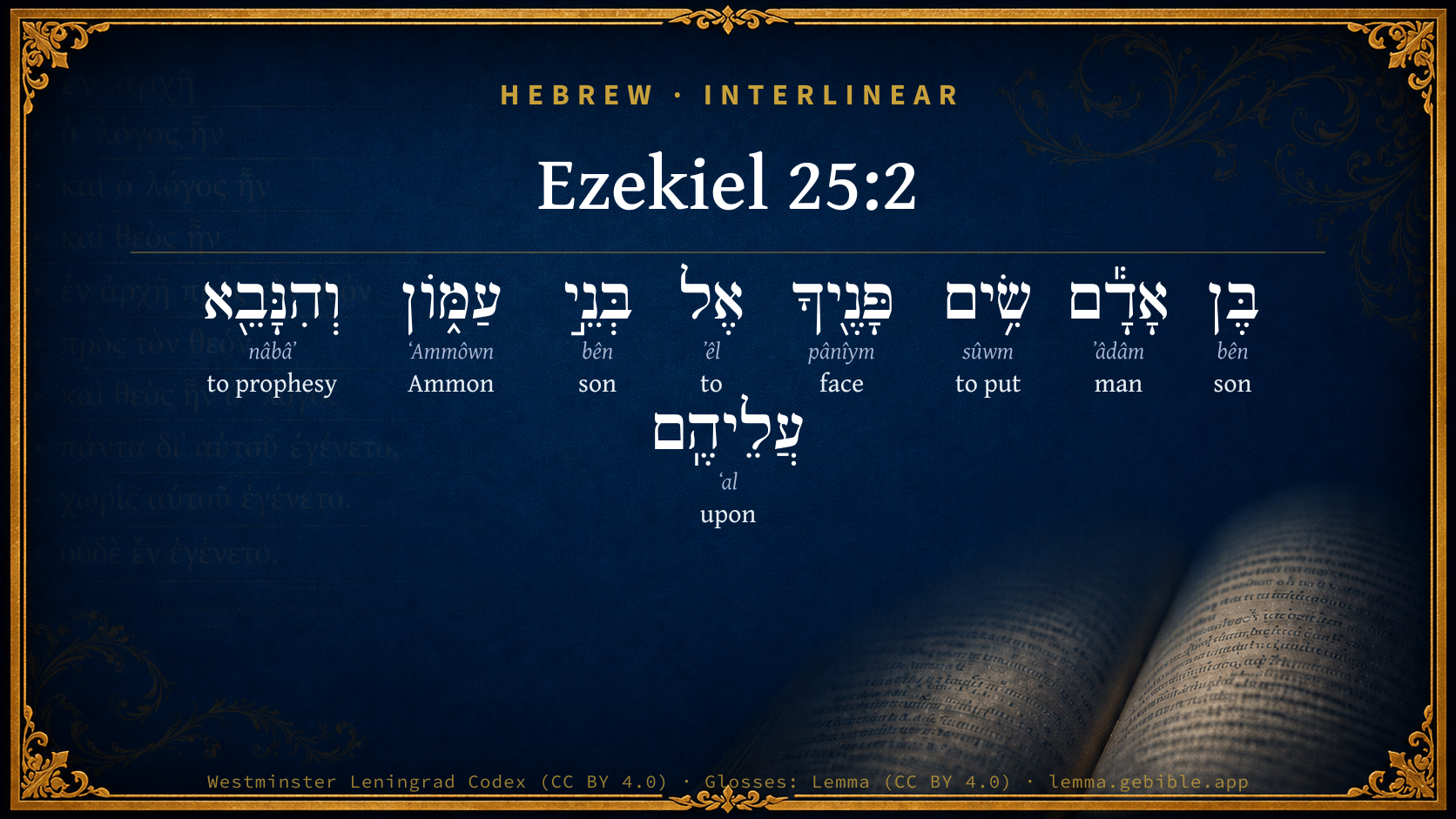
Ezekiel 25:2

Hebrew (Westminster Leningrad Codex) Ezekiel 25:2 appears in the Hebrew Old Testament. The text above is from the Westminster Leningrad Codex. Each word links to its Strong’s number, a concise gloss, and parsing drawn from the Open Scriptures Hebrew Bible morphology. Click any word for its full Brown-Driver-Briggs (BDB) entry.
Download image
Cite this verse

Ezekiel 25:2 (World English Bible). Public Domain. Lemma interlinear Bible study tool, https://lemma.gebible.app/v/ezekiel/25/2.

Show BibTeX & RIS
BibTeX
RIS
English Translation
Son of man, set your face toward the children of Ammon, and prophesy against them:
World English Bible · Public Domain
Download a study sheet

One document with this verse’s original text, its word-by-word gloss line, the meaning frame, cross-references with their text, attributed commentary, and full source and license credits — printable, and it pastes into notes with its structure intact.

This verse Autodidact and up

Study sheet (.html) Plain text (.txt)

A passage Seminary Student

Up to 50 verses in one chapter. A passage sheet keeps up to 6 commentary sources and 12 cross-references per verse, in the order this page ranks them, and says so on the sheet whenever that leaves anything out. Ask for a single verse and you get the Autodidact verse sheet above.

Everything on this page stays free to read, with no account — the sheet is a download of what is already on screen, not access to it.

Want to remove ads? Support Godless Engineer
Compare translations 3

The same verse in 3 English versions, stacked beneath the original-language interlinear above. Click any original word for its lexicon entry.

Each is an independent rendering of the whole verse — the interlinear is not word-aligned to these translations.

Highlighted words mark where these versions differ — a whole-verse word diff, not a word-by-word alignment.

  • World English Bible Public Domain
    Son of man, set your face toward the children of Ammon, and prophesy against them:
  • King James Version Public Domain
    Son of man, set thy face against the Ammonites, and prophesy against them;
  • unfoldingWord Literal Text CC BY-SA 4.0
    “Son of man, set your face against the people of Ammon and prophesy against them.

unfoldingWord Literal Text — © unfoldingWord, licensed CC BY-SA 4.0. Word-aligned USFM3 via Door43 (git.door43.org/unfoldingWord/en_ult).

Versions to compare (up to 4)

3 of 4 selected

Show all 18 translations

Every available English version of this verse, each an independent rendering of the whole verse.

  • World English Bible Public Domain
    Son of man, set your face toward the children of Ammon, and prophesy against them:
  • Berean Standard Bible Public Domain
    “Son of man, set your face against the Ammonites and prophesy against them.
  • Majority Standard Bible Public Domain
    “Son of man, set your face against the Ammonites and prophesy against them.
  • King James Version Public Domain
    Son of man, set thy face against the Ammonites, and prophesy against them;
  • American Standard Version (1901) Public Domain
    Son of man, set thy face toward the children of Ammon, and prophesy against them:
  • Revised Version (1885) Public Domain
    Son of man, set thy face toward the children of Ammon, and prophesy against them:
  • Geneva Bible (1599) Public Domain
    Sonne of man, set thy face against the Ammonites, and prophecie against them,
  • Douay-Rheims (1899) Public Domain
    Son of man, set thy face against the children of Ammon, and thou shalt prophesy of them.
  • Young's Literal Translation Public Domain
    `Son of man, set thy face unto the sons of Ammon, and prophesy against them;
  • Literal Standard Version CC BY-SA 4.0
    “Son of man, set your face toward the sons of Ammon, and prophesy against them;
  • Unlocked Literal Bible CC BY-SA 4.0
    “Son of man, set your face against the people of Ammon and prophesy against them.
  • unfoldingWord Literal Text CC BY-SA 4.0
    “Son of man, set your face against the people of Ammon and prophesy against them.
  • Darby Bible Public Domain
    Son of man, set thy face against the children of Ammon, and prophesy against them;
  • World Messianic Bible Public Domain
    “Son of man, set your face toward the children of Ammon, and prophesy against them.
  • Webster's Bible Public Domain
    Son of man, set thy face against the Ammonites, and prophesy against them;
  • Free Bible Version CC BY-SA 4.0
    “Son of man, face towards the Ammonites and prophesy against them.
  • Bible in Basic English Public Domain
    Son of man, let your face be turned to the children of Ammon, and be a prophet against them:
  • JPS Tanakh (1917) Public Domain
    'Son of man, set thy face toward the children of Ammon, and prophesy against them;

Literal Standard Version (2020), Covenant Press — licensed CC BY-SA 4.0. Text via the HelloAO Bible API (eBible.org). Unlocked Literal Bible (unfoldingWord) — licensed CC BY-SA 4.0. Text via the HelloAO Bible API (eBible.org). unfoldingWord Literal Text — © unfoldingWord, licensed CC BY-SA 4.0. Word-aligned USFM3 via Door43 (git.door43.org/unfoldingWord/en_ult). Free Bible Version, Dr. Jonathan Gallagher — licensed CC BY-SA 4.0. Text via the HelloAO Bible API (eBible.org).

Word by word

More ways to search: Search by grammar → Find every occurrence → Compare this word →

Practice this passage: Drill this verse → Learn its vocabulary →

About this verse

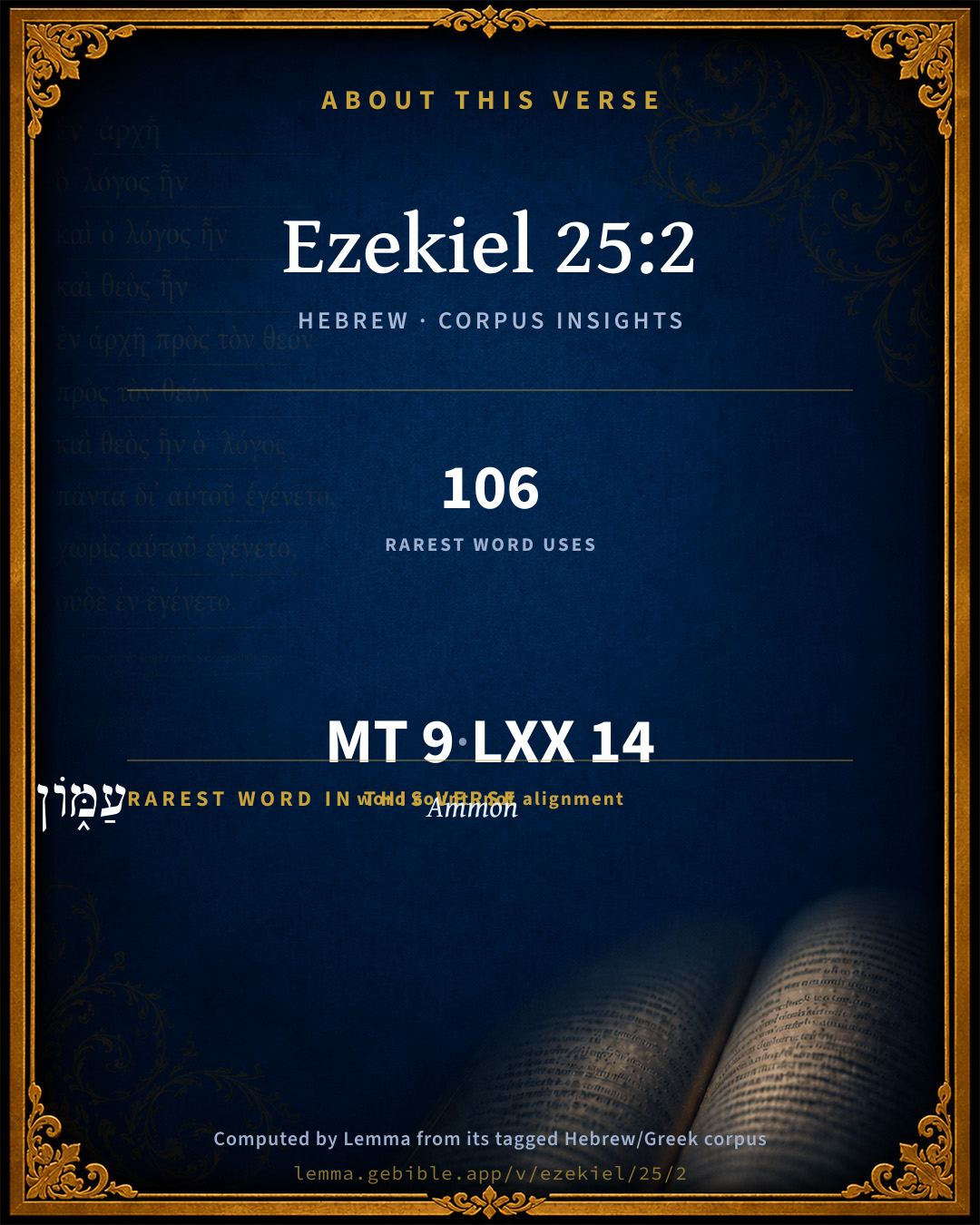
These counts appear in no published source. They are computed here, from the morphology-tagged text and Lemma’s own curated glosses. What Lemma adds →

9
words
8
distinct lemmas
Prophets
section

Grammatical profile

  • 2 verbs
  • 5 nouns
  • 2 prepositions

Verb forms

  • שִׂ֥ים Qal · Imperative
  • וְהִנָּבֵ֖א Niphal · Imperative

Repetition

A word recurs within this verse — often emphatic in Hebrew:

Hebrew & Septuagint length

In English translation the verse runs 15 words from the Hebrew and 16 from the Septuagint (LXX English) — closely comparable.

A rough comparison of the two English renderings, which tokenize alike — not a word-level alignment.

Word counts can differ between the Hebrew and the Greek without any difference in meaning — e.g. the Hebrew direct-object marker אֵת has no separate Greek word, and Greek often adds the article ὁ.

In the original languages it is 9 Hebrew tokens and 14 Greek tokens — but the two are counted differently (Hebrew bundles its prefixes and suffixes into one token; the Greek is in lemma form), so that isn’t a like-for-like length.

Cross-references

12

Topical passages linked to Ezekiel 25:2 in the Treasury of Scripture Knowledge — connected by theme and wording, ordered by reader-vote popularity; previews shown in the World English Bible.

  • Jeremiah 49:1–6 Of the children of Ammon. Thus says Yahweh: Has Israel no sons? has he no heir? why then does Malcam possess Gad, and his people well in the cities of it?
  • Ezekiel 6:2 Son of man, set your face toward the mountains of Israel, and prophesy to them,
  • Amos 1:13–15 Thus says Yahweh: "For three transgressions of the children of Ammon, yes, for four, I will not turn away its punishment; Because they have ripped open the pregnant women of Gilead, That they may enlarge their border.
  • Genesis 19:38 The younger also bore a son, and called his name Ben Ammi. The same is the father of the children of Ammon to this day.
  • Jeremiah 9:25–26 Behold, the days come, says Yahweh, that I will punish all those who are circumcised in [their] uncircumcision:
  • Jeremiah 25:21 Edom, and Moab, and the children of Ammon;
  • Jeremiah 27:3 and send them to the king of Edom, and to the king of Moab, and to the king of the children of Ammon, and to the king of Tyre, and to the king of Sidon, by the hand of the messengers who come to Jerusalem to Zedekiah king of Judah;
  • Ezekiel 20:46 Son of man, set your face toward the south, and drop [your word] toward the south, and prophesy against the forest of the field in the South;
  • Ezekiel 21:2 Son of man, set your face toward Jerusalem, and drop [your word] toward the sanctuaries, and prophesy against the land of Israel;
  • Ezekiel 21:28–32 You, son of man, prophesy, and say, Thus says the Lord Yahweh concerning the children of Ammon, and concerning their reproach; and say you, A sword, a sword is drawn, for the slaughter it is furbished, to cause it to devour, that it may be as lightning;
  • Ezekiel 35:2 Son of man, set your face against Mount Seir, and prophesy against it,
  • Zephaniah 2:8–11 I have heard the reproach of Moab, and the insults of the children of Ammon, with which they have reproached my people, and magnified themselves against their border.

Cross-references courtesy of OpenBible.info (CC BY 4.0).

Hebrew and Greek witnesses Masoretic Hebrew ↔ Greek Septuagint

The same verse in the two great witnesses to the Old Testament, shown verse-for-verse.

These are two independent witnesses, not word-aligned to each other, and the Septuagint is shown in lemma (dictionary) form.

Hebrew Ezekiel 25:2 Masoretic · Westminster Leningrad Codex

בֶּן אָדָ֕ם שִׂ֥ים פָּנֶ֖יךָ אֶל בְּנֵ֣י עַמּ֑וֹן וְהִנָּבֵ֖א עֲלֵיהֶֽם

Son of man, set your face toward the children of Ammon, and prophesy against them:

World English Bible · Public Domain

Greek LXX Ezekiel 25:2 Septuagint · lemma form

υἱός ἄνθρωπος στηρίζω ὁ πρόσωπον σύ ἐπί ὁ υἱός αμμων καί προφητεύω ἐπί αὐτός

Son of man, set your face steadfastly against the children of Ammon, and prophesy against them;

LXX2012 (modern English Septuagint) · Public Domain

On this verse, John Gill's Exposition discusses the Septuagint’s reading. Read the note in Commentary ↓

Hebrew: Westminster Leningrad Codex (CC BY 4.0). Greek: Septuagint (public domain); English from LXX2012 (modern English Septuagint) (Public Domain). How the Septuagint differs from the Hebrew →

Targum (Aramaic paraphrase)

1

The Targum is the ancient Jewish Aramaic paraphrase of the Hebrew Scriptures — an interpretive translation, not the Hebrew text itself. Onkelos (literal) and Pseudo-Jonathan (expansive) render the Torah, and Jonathan the Prophets. Coverage is partial: where no permissively-licensed English translation exists for a verse, only the Aramaic is shown. This is verse-level text, not a word-by-word alignment to the Hebrew.

  1. Targum Jonathan Prophets (Joshua–Malachi)
    בַּר אָדָם קַבֵּיל נְבוּאָה עַל בְּנֵי עַמוֹן וְתִתְנַבֵּי עֲלֵיהוֹן:

    (no public-domain English translation for this verse)

    Targum Jonathan — Aramaic: “Mikraot Gedolot” (public domain). English: “Sefaria Community Translation” (CC0 1.0 (public-domain dedication)); “London "Chaldee Paraphrase," 1871” (public domain). Text via Sefaria.

Commentary

Notes on Ezekiel 25:2 from classic Christian and Jewish commentators (each source and its license shown beneath its notes). The classic Christian expositions comment on the surrounding passage and are grouped to its opening verse, so a note may address several verses; the Jewish commentaries on the Tanakh (Rashi and others) are per-verse, so they appear only where the commentator wrote on this verse.

Lemma curates 59 commentaries, every one of them public domain or Creative Commons licensed, each selected and text-cleaned for this edition rather than reprinted as found. About our sources →

Trapp's Complete Commentary

John Trapp

Eze 25:2 Son of man, set thy face against the Ammonites, and prophesy against them;

Ver. 2. Set thy face against the Ammonites.] Look upon them firmo, torvo, et minaci vultu, as if thou wouldst look through them; and having so lightened, thunder accordingly.

Against the Ammonites.] Who have had their part already of threatenings, {Eze 21:28} but not their full due.

John Trapp, A Commentary or Exposition upon All the Books of the Old and New Testament (1647–1656) — public domain. Text from a community e-Sword module.

The Biblical Illustrator

Joseph S. Exell

Eze_25:2

I shall be replenished, now she is laid waste.

Designs of avarice defeated

All their (the Tyrians) care was to get estates and enlarge their trade, and they looked upon Jerusalem not as an enemy, but as a rival. Tyre promised herself that the fall of Jerusalem would be an advantage to her in respect of trade and commerce, that now she shall have Jerusalems customers. To be secretly pleased with the death or decay of others, when we are likely to get by it, with their fall when we may thrive upon it, is a sin that does most easily beset us. This comes from a want of that love to our neighbour as to ourselves which the law of God so expressly requires, and from that inordinate love of the world as our happiness which the love of God so expressly forbids. And it is just with God to blast the designs and projects of those who thus contrive to raise themselves upon the ruins of others; and we see they are often disappointed (M. Henry.)

.

The Biblical Illustrator, edited by Joseph S. Exell (c. 1880s–1900s) — public domain. Text from a community e-Sword module.

Adam Clarke's Commentary

Verse 2. Set thy face against the Ammonites] We have already seen, Eze 21:19, c., that when Nebuchadnezzar left Babylon he was in doubt whether he should besiege Riblath, the capital of the Ammonites, or Jerusalem, the capital of the Jews, first: and having used his divination. he was determined, by the result, to attack Jerusalem the first. He did so and the Ammonites, seeing the success of his arms, made friends with him, and exulted in the ruin of the Jews. God resents this, and predicts their downfall with that of Edom, Moab, and the Philistines. The fulfilment of this prediction is not noted in Scripture: but Josephus tells us, that about five years after the taking of Jerusalem, Nebuchadnezzar turned his arms against the Ammonites and Moabites, and afterwards against Egypt; and having subdued those nations, he returned to Babylon. Joseph. Antiq., l. x., c. ii. Berosus states, as quoted by Josephus, contra App., that Nebuchadnezzar subdued Syria, Arabia, Phoenicia, and Egypt: and consequently, that he had brought under his dominion the Ammonites, Moabites, and Idumeans, who were included among the Philistines. See Calmet.

Adam Clarke's Commentary on the Bible (1810–1826) — public domain. Text from a community e-Sword/MySword module.

Ellicott's Commentary for English Readers

(2) Set thy face against the Ammonites.—It has already been mentioned that the utterances against the four contiguous nations of Ammon, Moab, Edom, and Philistia are all contained in one prophecy, and that this prophecy was evidently spoken after the fall of Jerusalem, and, consequently, after the date of Eze_26:1. The Ammonites, descended from Lot’s incest with his younger daughter, had been for centuries persistent enemies of Israel. They had joined the Moabites in their oppression of Israel under Eglon (Jdg_3:13), and in a later attack had been subdued by Jephthah (Jdg_11:32-33); they fought with extreme cruelty and insolence against Saul (1Sa_11:2-11); they insulted and warred against David (2Sa_10:1-6), and were utterly crushed by him (2Sa_12:31); their idolatries were favoured by Solomon (1Ki_11:7); uniting with Moab and Edom, they attacked Judah under Jehoshaphat (2Ch_20:1-25), but utterly failed, and were tributary to his descendant, Uzziah (2Ch_26:8); again they fought with Jotham, and were reduced by him to heavy tribute (2Ch_27:5); and not long before this time they had occupied the vacant cities of Gad (Jer_49:1). Now they had joined Nebuchadnezzar’s army against Judah (2Ki_24:2). From Eze_25:3 it appears that their hostility arose not only from national jealousy, but from an especial hatred against the Jewish religion (comp. also Psa_83:7). They are the frequent subject of prophetic denunciation (Isa_11:14; Jer_49:1-6; Amo_1:13-15; Zep_2:8-11).

A Bible Commentary for English Readers, edited by Charles John Ellicott (1878–1897) — public domain. Text from a community e-Sword module.

John Gill's Exposition

Son of man, set thy face against the Ammonites,.... Who were of the posterity of Lot, implacable enemies of the Jews; who hated their religion, and envied their wealth and happiness; against these the prophet is bid to "set his face"; to look that way where they lived, and to put on a frowning countenance, and a menacing aspect: "strengthen thy face", as the Septuagint and Arabic versions render it; look boldly at them:

and prophesy against them; deliver out the following prophecy concerning them.

John Gill's Exposition of the Whole Bible (1746–1763) — public domain (CC PDM 1.0). Text via the HelloAO Bible API.

Haydock's Catholic Bible Commentary

Ammon. These nations were punished five years after the Jews, chap. xxi. 19., and Jeremias xxvii. 3. (Calmet) --- "Egypt, Syria, Phœnicia, and Arabia," were conquered. (Berosus) --- Hast. God saw their dispositions, which they manifested afterwards. (Calmet) --- They rejoiced most, and were therefore punished with other nations. (Worthington)

George Leo Haydock (1774–1849), Haydock's Catholic Family Bible and Commentary, 1859 edition — public domain. Excludes Psalms (Douay-Rheims chapter numbering differs from Protestant) and Deuterocanonical books (Catholic canon only).

Matthew Poole's English Annotations

Set thy face against: the phrase you have Eze 20:46. It includeth anger, menaces, and intention of mind.

The Ammonites; the posterity of Lot by the younger daughter, near neighbours, but bitter enemies to the Jews. Prophesy against them; leave recorded what heavy things shall befall them in after-days.

Matthew Poole's English Annotations on the Holy Bible (1683–1685) — public domain. Text from a community e-Sword/MySword module.

Whedon's Commentary on the Bible

Daniel D. Whedon

2. Prophesy against them — Or, upon, that is, concerning them. The same Hebrew particle is used when no threat is being pronounced.

The Ammonites — These were the hereditary enemies of Israel, and very cruel in war. (See Eze_21:28-32; 1 Samuel 11; 2Sa_10:1; 2Sa_10:11; 2Sa_10:14; 2Ki_24:2; Psa_83:7; Jer_27:3; Jer_40:14; Jer_49:1; Lam_2:15-16; Zep_2:5; Zep_2:11; Neh_4:13.) These Beni Ammon, “sons of Ammon” (Eze_25:5), were quite probably the descendants of the Katabani of South Arabia, who call themselves in a very ancient inscription walad Amm, “children of Amm.” They are closely connected with the Moabites, not only in many biblical passages, but in a very old Minaean text (South Arabia) in which the female slaves of a temple are said to have been brought from Egypt, Moab, Ammon, etc. (Glaser). In biblical times they seem to have possessed a settled residence east of the Jordan, from which they declared the Israelites had driven them (Jdg_11:13); but their ancestors were doubtless of a wandering disposition, probably being included with the Edomites and Moabites in the general term Menti, or “shepherds,” who appear on the Egyptian monuments as inhabitants of the Sinaitic peninsula fifteen hundred years or more before Abraham’s time. “They are strange looking men, with hooked noses, rounded at the point, wide nostrils, and full lips. The beard is long and the whiskers cover all the lower part of the cheek. The type is Jewish rather than Bedouin, and recalls the profiles of the tribute bearers of Jehu on the Assyrian black obelisk.” — Sayce, Races of the Old Testament.

Daniel D. Whedon (gen. ed.), Commentary on the Old and New Testaments (1874–1909) — public domain. Text from a community e-Sword module.

The Pulpit Commentary

Set thy face against the Ammonites. The main facts that are essential to a right understanding of the message to this people, not to speak of their long-standing enmity against Israel for many centuries, are

(1) that they formed part of Nebuchadnezzar"s army, as allies or tributaries, against Jehoiakim; (2Ki_24:2)

(2) that afterwards they, with other neighboring nations, intrigued with Zedekiah against the Chaldean king, (Jer_27:3) so that it was an open question whether his first act of vengeance should fall on Rabbath-Ammon or Jerusalem. (Eze_21:20) in Eze_21:28-32, written not long before, Ezekiel had uttered his prediction of the coming judgment. Here we read that when they saw that Jerusalem had been laid waste, they, like Edom, (Psa_137:7) exulted in her downfall. Earlier traces of cruelty and outrage are found in Psa_83:7; Amo_1:13-15; Zep_2:8-11. We learn from Jer_40:14 that the name ofthe Ammonite king at this time was Baalis.

Vers. 2-7. The scoffing nation.

The first nation selected for denunciation is the Ammonite, situated on the east of the Jordan and to the north of Moab, with its further border towards the Syrian desert. Its scoffing at the sacred things of the Jews, and its cruel mockery of their calamities, are to be followed by a dreadful destruction. Scoffing and mockery are dangerous practices for those who indulge in them.

I THE CRUEL SCOFFING.

1. An insult to religion. "Thou saidst, Aha! against my sanctuary when it was profaned" (Ver. 3). No doubt the sanctuary was regarded as a mystical center of the power of the Jews. When the sacred edifice was overthrown, the talisman was destroyed, the spell was broken. This was a matter of delight to an enemy. Thus scoffing is itself a testimony to the power of religion, though that power may be apprehended in a very ignorant and superstitious way. But to rejoice in the downfall of religious influence is to proclaim one"s self an enemy of God. It is fair, however, to see that scoffing at religion may be provoked by the misconduct of its champions. Much of the scoffing of unbelievers at Christianity is not inspired by hatred to the gospel, but by disgust at the unworthy conduct of Christians. The sins of the Jews led to dishonor to their temple. The sins of Christians invite insults against Christ.

2. The love of destruction. The Ammonites scoffed "against the land of Israel when it was desolate." The northern nation had been already destroyed and scattered, but the waste and ruined condition of the deserted land was a delight to the jealous neighbors on the eastern border. There is a fierce joy in the idea delenda est Carthago. But this is heathenish and wicked. Sin that works for death creates a delight in destruction. The Christian idea is the opposite to this not breaking a bruised reed, but helping on the time when "the wilderness and the solitary place shall be glad; and the desert shall rejoice and blossom as the rose". (Isa_35:1)

3. A pleasure in cruelty. The Ammonites scoffed at the contemporary calamity of the southern kingdom house of Judah, when they went into captivity." The earlier destruction of Israel is a source of wild, fiendish joy. "Thou hast clapped thine hands, and stamped with the feet, and rejoiced in heart with all thy despite against the land of Israel" (Ver. 6). There is no more Satanic wickedness than joy springing from the contemplation of the misery of others.

II THE NATIONAL DOOM. This is to be very similar to that of Israel and Judah, so that what the Ammonites rejoiced to see in their neighbors shall come on their own heads, but still with certain variations determined by their situation and character.

1. Subjection to others. Ammon had rejoiced over the downfall of her western neighbors. She in turn shall be overrun by people from the cast. The destruction was to come from Babylon, but "the men of the east," i.e. the Arabs, would follow it, and like vultures pounce on the prey left by the advancing Chaldean army. Cruelty makes many enemies and no friends. The scoffer must expect to be scoffed at.

2. Reduced civilization. Rabbah, the proud capital, will become a pasture for camels, and the once populous land of Ammon a sheep run. National punishment lowers a people in the scale of social life.

3. National destruction. The Ammonites are to "perish out of the countries." This old-world nation did cease to exist. Though individuals may remain, the corporate life of the nation is destroyed. As the wages of individual sin is individual death, so a nation"s sin is punished by national destruction. The wicked Roman Empire was destroyed. It depends on our national conduct whether the same fate will come on the British Empire.

The Pulpit Commentary (1880–1919), ed. H.D.M. Spence-Jones & Joseph S. Exell — public domain. Text from a community e-Sword module.

Lesson kit

Teaching starters — assembled from the data on this page, not authored interpretation. Every prompt links to the verse data it draws on. Edit before teaching.

Ezekiel, in the Prophets, opens this verse with 9 words (8 distinct Hebrew lemmas). Its most distinctive word is ʻAmmôwn (“Ammon”). A historical commentator’s framing appears above. Read the whole chapter for the surrounding context.

Discussion questions

  1. What does “Ammon” (ʻAmmôwn) contribute to the verse as a whole?
  2. Jeremiah 49:1–6 shares this passage’s theme. How do the two illuminate each other?
  3. “son” occurs 2× in this one verse. What is the effect of the repetition?
  4. The translations on this page render this verse differently — a whole-verse word diff, not a word-by-word alignment. What might account for the different wordings?
  5. The verb «שִׂ֥ים» is Qal Imperative. How does its form color the action?
  6. Reading how Trapp's Complete Commentary and The Biblical Illustrator read this verse, where do the two commentators agree and where do they part?

Things to notice

Reading settings

Reading text

Shown beneath each verse's original-language words.

Old Testament
Old Testament edition

Read the OT as the Masoretic Hebrew (MT) or the Greek Septuagint (LXX).

English shown for the Greek Septuagint (in the Hebrew ↔ Greek comparison).

Comparing translations? Open the Compare panel on any verse page to stack up to four side by side.