
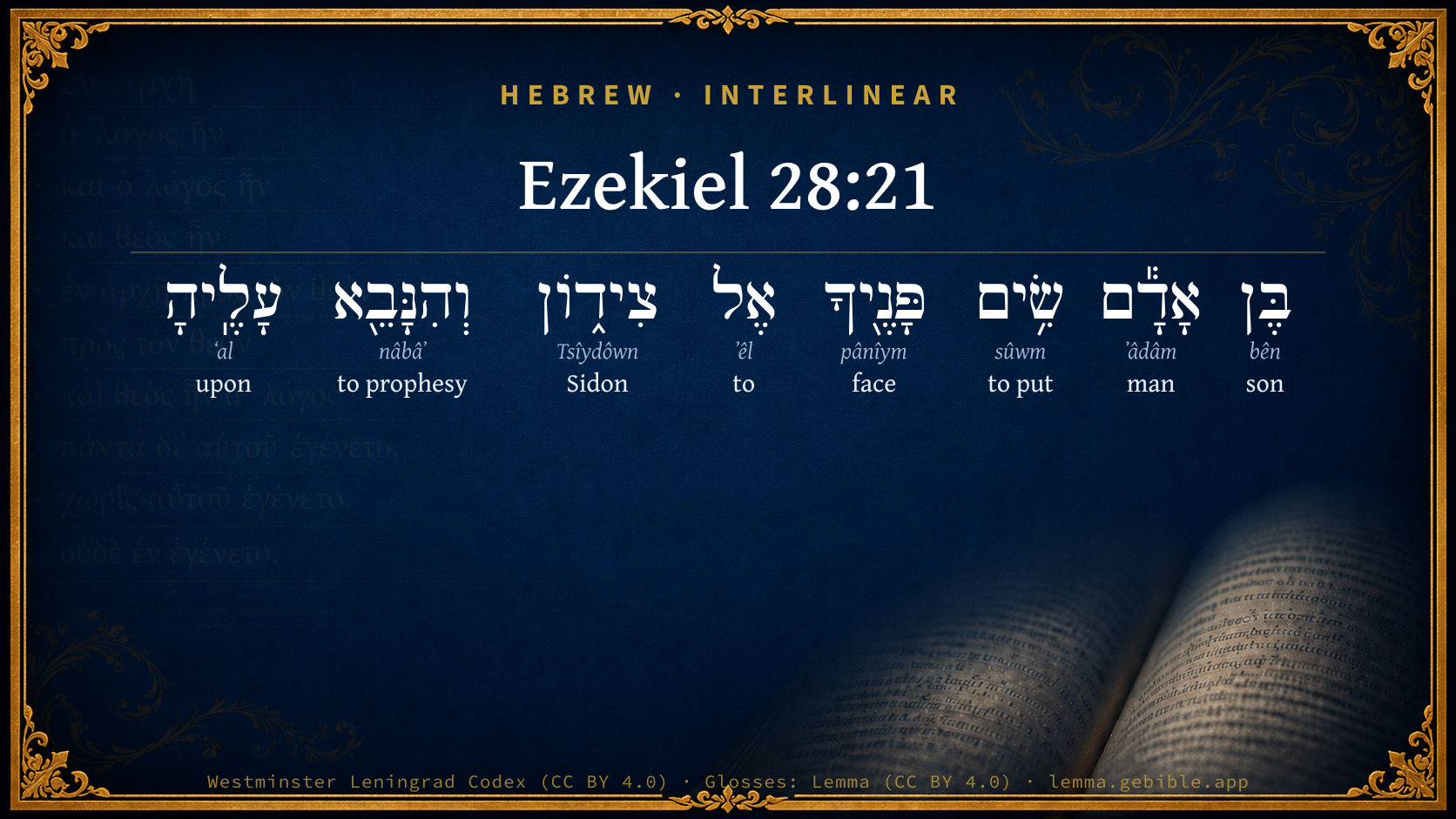
Ezekiel 28:21

Hebrew (Westminster Leningrad Codex) Ezekiel 28:21 appears in the Hebrew Old Testament. The text above is from the Westminster Leningrad Codex. Each word links to its Strong’s number, a concise gloss, and parsing drawn from the Open Scriptures Hebrew Bible morphology. Click any word for its full Brown-Driver-Briggs (BDB) entry.
Download image
Cite this verse

Ezekiel 28:21 (World English Bible). Public Domain. Lemma interlinear Bible study tool, https://lemma.gebible.app/v/ezekiel/28/21.

Show BibTeX & RIS
BibTeX
RIS
English Translation
Son of man, set your face toward Sidon, and prophesy against it,
World English Bible · Public Domain
Download a study sheet

One document with this verse’s original text, its word-by-word gloss line, the meaning frame, cross-references with their text, attributed commentary, and full source and license credits — printable, and it pastes into notes with its structure intact.

This verse Autodidact and up

Study sheet (.html) Plain text (.txt)

A passage Seminary Student

Up to 50 verses in one chapter. A passage sheet keeps up to 6 commentary sources and 12 cross-references per verse, in the order this page ranks them, and says so on the sheet whenever that leaves anything out. Ask for a single verse and you get the Autodidact verse sheet above.

Everything on this page stays free to read, with no account — the sheet is a download of what is already on screen, not access to it.

Want to remove ads? Support Godless Engineer
Compare translations 3

The same verse in 3 English versions, stacked beneath the original-language interlinear above. Click any original word for its lexicon entry.

Each is an independent rendering of the whole verse — the interlinear is not word-aligned to these translations.

Highlighted words mark where these versions differ — a whole-verse word diff, not a word-by-word alignment.

  • World English Bible Public Domain
    Son of man, set your face toward Sidon, and prophesy against it,
  • King James Version Public Domain
    Son of man, set thy face against Zidon, and prophesy against it,
  • unfoldingWord Literal Text CC BY-SA 4.0
    “Son of man, set your face against Sidon and prophesy against her.

unfoldingWord Literal Text — © unfoldingWord, licensed CC BY-SA 4.0. Word-aligned USFM3 via Door43 (git.door43.org/unfoldingWord/en_ult).

Versions to compare (up to 4)

3 of 4 selected

Show all 18 translations

Every available English version of this verse, each an independent rendering of the whole verse.

  • World English Bible Public Domain
    Son of man, set your face toward Sidon, and prophesy against it,
  • Berean Standard Bible Public Domain
    “Son of man, set your face against Sidon and prophesy against her.
  • Majority Standard Bible Public Domain
    “Son of man, set your face against Sidon and prophesy against her.
  • King James Version Public Domain
    Son of man, set thy face against Zidon, and prophesy against it,
  • American Standard Version (1901) Public Domain
    Son of man, set thy face toward Sidon, and prophesy against it,
  • Revised Version (1885) Public Domain
    Son of man, set thy face toward Zidon, and prophesy against it,
  • Geneva Bible (1599) Public Domain
    Sonne of man, set thy face against Zidon, and prophesie against it,
  • Douay-Rheims (1899) Public Domain
    Son of man, set thy face against Sidon: and thou shalt prophesy of it,
  • Young's Literal Translation Public Domain
    `Son of man, set thy face unto Zidon, and prophesy concerning it;
  • Literal Standard Version CC BY-SA 4.0
    “Son of man, set your face toward Sidon, and prophesy concerning it;
  • Unlocked Literal Bible CC BY-SA 4.0
    “Son of man, set your face against Sidon and prophesy against her.
  • unfoldingWord Literal Text CC BY-SA 4.0
    “Son of man, set your face against Sidon and prophesy against her.
  • Darby Bible Public Domain
    Son of man, set thy face towards Zidon, and prophesy against it,
  • World Messianic Bible Public Domain
    “Son of man, set your face toward Sidon, and prophesy against it,
  • Webster's Bible Public Domain
    Son of man, set thy face against Zidon, and prophesy against it,
  • Free Bible Version CC BY-SA 4.0
    “Son of man, face towards Sidon and prophesy against her.
  • Bible in Basic English Public Domain
    Son of man, let your face be turned to Zidon, and be a prophet against it, and say,
  • JPS Tanakh (1917) Public Domain
    'Son of man, set thy face toward Zidon, and prophesy against it,

Literal Standard Version (2020), Covenant Press — licensed CC BY-SA 4.0. Text via the HelloAO Bible API (eBible.org). Unlocked Literal Bible (unfoldingWord) — licensed CC BY-SA 4.0. Text via the HelloAO Bible API (eBible.org). unfoldingWord Literal Text — © unfoldingWord, licensed CC BY-SA 4.0. Word-aligned USFM3 via Door43 (git.door43.org/unfoldingWord/en_ult). Free Bible Version, Dr. Jonathan Gallagher — licensed CC BY-SA 4.0. Text via the HelloAO Bible API (eBible.org).

Word by word

More ways to search: Search by grammar → Find every occurrence → Compare this word →

Practice this passage: Drill this verse → Learn its vocabulary →

About this verse

These counts appear in no published source. They are computed here, from the morphology-tagged text and Lemma’s own curated glosses. What Lemma adds →

8
words
8
distinct lemmas
Prophets
section

Notable vocabulary

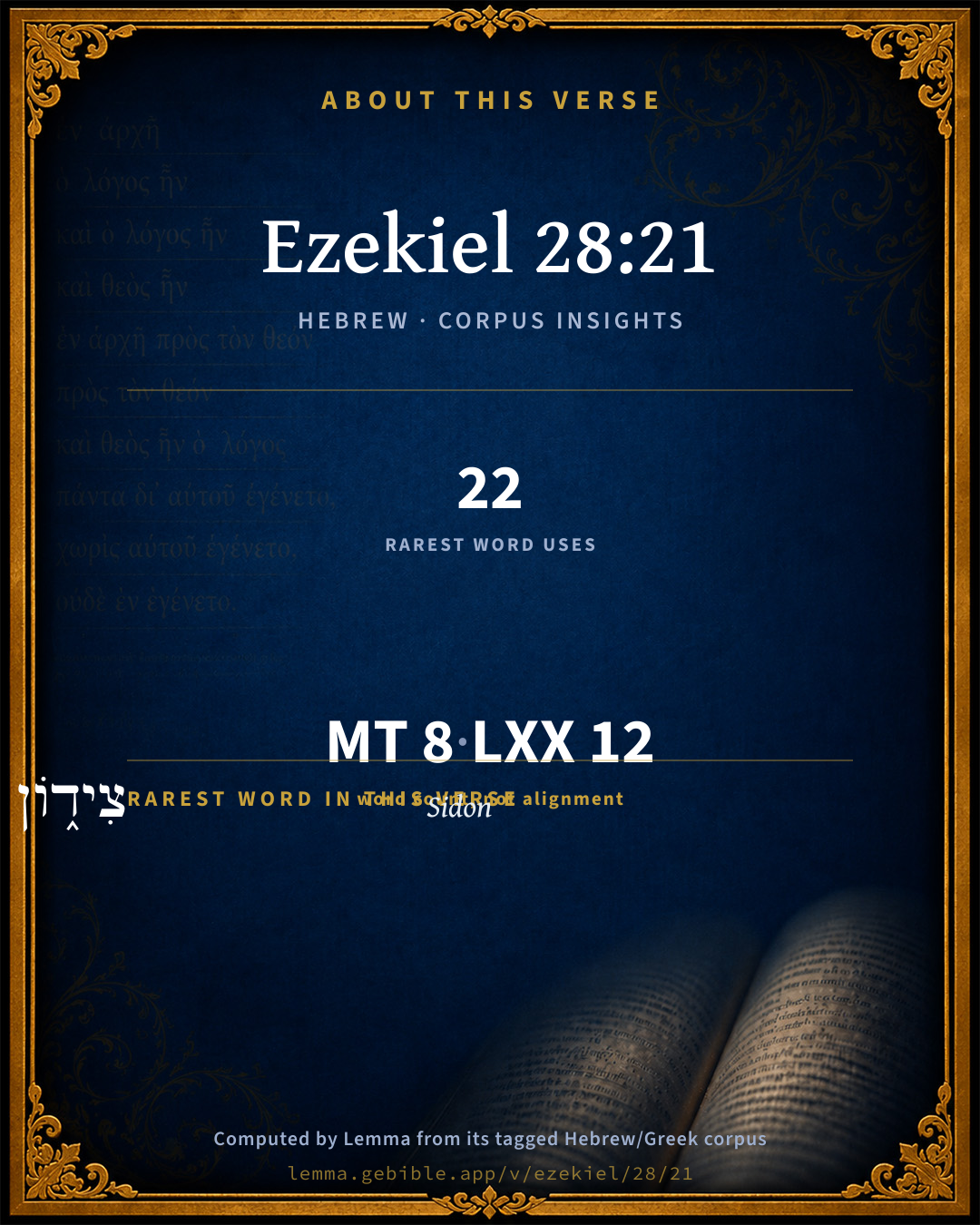
The rarest word here is צִיד֑וֹן Sidon H6721 — appearing just 22 times in the whole Hebrew Bible.

Shared distinctive vocabulary

צִיד֑וֹן Sidon H6721 occurs in 22 verses of the Hebrew Bible. Also found in:

Grammatical profile

  • 2 verbs
  • 4 nouns
  • 2 prepositions

Verb forms

  • שִׂ֥ים Qal · Imperative
  • וְהִנָּבֵ֖א Niphal · Imperative

Hebrew & Septuagint length

In English translation the verse runs 12 words from the Hebrew and 12 from the Septuagint (LXX English) — the same length.

A rough comparison of the two English renderings, which tokenize alike — not a word-level alignment.

Word counts can differ between the Hebrew and the Greek without any difference in meaning — e.g. the Hebrew direct-object marker אֵת has no separate Greek word, and Greek often adds the article ὁ.

In the original languages it is 8 Hebrew tokens and 12 Greek tokens — but the two are counted differently (Hebrew bundles its prefixes and suffixes into one token; the Greek is in lemma form), so that isn’t a like-for-like length.

Cross-references

13

Topical passages linked to Ezekiel 28:21 in the Treasury of Scripture Knowledge — connected by theme and wording, ordered by reader-vote popularity; previews shown in the World English Bible.

  • Ezekiel 6:2 Son of man, set your face toward the mountains of Israel, and prophesy to them,
  • Genesis 10:15 Canaan became the father of Sidon (his firstborn), Heth,
  • Jeremiah 25:22 and all the kings of Tyre, and all the kings of Sidon, and the kings of the isle which is beyond the sea;
  • Ezekiel 25:2 Son of man, set your face toward the children of Ammon, and prophesy against them:
  • Ezekiel 27:8 The inhabitants of Sidon and Arvad were your rowers: your wise men, Tyre, were in you, they were your pilots.
  • Isaiah 23:2–4 Be still, you inhabitants of the coast, you whom the merchants of Sidon, that pass over the sea, have replenished.
  • Isaiah 23:12 He said, You shall no more rejoice, you oppressed virgin daughter of Sidon: arise, pass over to Kittim; even there shall you have no rest.
  • Jeremiah 27:3 and send them to the king of Edom, and to the king of Moab, and to the king of the children of Ammon, and to the king of Tyre, and to the king of Sidon, by the hand of the messengers who come to Jerusalem to Zedekiah king of Judah;
  • Jeremiah 47:4 because of the day that comes to destroy all the Philistines, to cut off from Tyre and Sidon every helper who remains: for Yahweh will destroy the Philistines, the remnant of the isle of Caphtor.
  • Ezekiel 29:2 Son of man, set your face against Pharaoh king of Egypt, and prophesy against him, and against all Egypt;
  • Ezekiel 32:30 There are the princes of the north, all of them, and all the Sidonians, who are gone down with the slain; in the terror which they caused by their might they are put to shame; and they lie uncircumcised with those who are slain by the sword, and bear their shame with those who go down to the pit.
  • Joel 3:4–8 "Yes, and what are you to me, Tyre, and Sidon, And all the regions of Philistia? Will you repay me? And if you repay me, I will swiftly and speedily return your repayment on your own head.
  • Zechariah 9:2 And Hamath, also, which borders on it; Tyre and Sidon, because they are very wise.

Cross-references courtesy of OpenBible.info (CC BY 4.0).

Hebrew and Greek witnesses Masoretic Hebrew ↔ Greek Septuagint

The same verse in the two great witnesses to the Old Testament, shown verse-for-verse.

These are two independent witnesses, not word-aligned to each other, and the Septuagint is shown in lemma (dictionary) form.

Hebrew Ezekiel 28:21 Masoretic · Westminster Leningrad Codex

בֶּן אָדָ֕ם שִׂ֥ים פָּנֶ֖יךָ אֶל צִיד֑וֹן וְהִנָּבֵ֖א עָלֶֽיהָ

Son of man, set your face toward Sidon, and prophesy against it,

World English Bible · Public Domain

Greek LXX Ezekiel 28:21 Septuagint · lemma form

υἱός ἄνθρωπος στηρίζω ὁ πρόσωπον σύ ἐπί σιδών καί προφητεύω ἐπί αὐτός

Son of man, set your face against Sidon, and prophesy against it,

LXX2012 (modern English Septuagint) · Public Domain

Hebrew: Westminster Leningrad Codex (CC BY 4.0). Greek: Septuagint (public domain); English from LXX2012 (modern English Septuagint) (Public Domain). How the Septuagint differs from the Hebrew →

Targum (Aramaic paraphrase)

1

The Targum is the ancient Jewish Aramaic paraphrase of the Hebrew Scriptures — an interpretive translation, not the Hebrew text itself. Onkelos (literal) and Pseudo-Jonathan (expansive) render the Torah, and Jonathan the Prophets. Coverage is partial: where no permissively-licensed English translation exists for a verse, only the Aramaic is shown. This is verse-level text, not a word-by-word alignment to the Hebrew.

  1. Targum Jonathan Prophets (Joshua–Malachi)
    בַּר אָדָם קַבֵּיל נְבוּאָה עַל צִידוֹן וְאִתְנַבֵּי עֲלָה:

    (no public-domain English translation for this verse)

    Targum Jonathan — Aramaic: “Mikraot Gedolot” (public domain). English: “Sefaria Community Translation” (CC0 1.0 (public-domain dedication)); “London "Chaldee Paraphrase," 1871” (public domain). Text via Sefaria.

Commentary

Notes on Ezekiel 28:21 from classic Christian and Jewish commentators (each source and its license shown beneath its notes). The classic Christian expositions comment on the surrounding passage and are grouped to its opening verse, so a note may address several verses; the Jewish commentaries on the Tanakh (Rashi and others) are per-verse, so they appear only where the commentator wrote on this verse.

Lemma curates 59 commentaries, every one of them public domain or Creative Commons licensed, each selected and text-cleaned for this edition rather than reprinted as found. About our sources →

Trapp's Complete Commentary

John Trapp

Eze 28:21 Son of man, set thy face against Zidon, and prophesy against it,

Ver. 21. Set thy face against Zidon.] An ancient and eminent city of Phoenicia, little inferior to Tyre: in Joshua it is called "Zidon the great." {Jos 11:8} A very superstitious place, and a great enemy to God’s people.

John Trapp, A Commentary or Exposition upon All the Books of the Old and New Testament (1647–1656) — public domain. Text from a community e-Sword module.

Joseph Benson's Commentary

Eze 28:21-23. Set thy face against Zidon — Direct thy face and thy speech toward Zidon, and fore-tel its destruction by the king of Babylon. Tyre and Zidon were neighbouring cities, and generally partakers of the same prosperity or adversity. We have, indeed, no history that informs us of the particulars of what befell Zidon; but it is likely that it sent help to the Tyrians, and so (Nebuchadnezzar proving victorious) suffered with them, and was reduced first under the power of the Chaldeans, and afterward of the Persians. Say, Behold, I am against thee, O Zidon — Provoked by thy sins, I am an adversary to thee, and am determined to punish thee. I will be glorified in the midst of thee — I will make my power and justice known by the judgments I will execute upon thee. In the same sense God saith, Exo 14:17, I will get me honour upon Pharaoh. And will be sanctified in her — And will get myself reverence, fear, and praise, by the punishment I will bring upon her. God is said to be sanctified in those for whose preservation or destruction he exerts his power in a remarkable manner, so as to get glory to himself. For I will send her pestilence and blood — The pestilence, which often accompanies long sieges, shall destroy her inhabitants. And the wounded shall be judged, &c., by the sword — That is, the wounded shall fall in the midst of her by the sword, and meet with their deserved punishment from it.

Joseph Benson's Commentary on the Old and New Testaments (1811–1818) — public domain. Text from a community e-Sword module.

Jamieson, Fausset & Brown

Robert Jamieson, A. R. Fausset & David Brown

Zidon--famous for its fishery (from a root, Zud, "to fish"); and afterwards for its wide extended commerce; its artistic elegance was proverbial. Founded by Canaan's first-born (Gen 10:15). Tyre was an offshoot from it, so that it was involved in the same overthrow by the Chaldeans as Tyre. It is mentioned separately, because its idolatry (Ashtaroth, Tammuz, or Adonis) infected Israel more than that of Tyre did (Eze 8:14; Jdg 10:6; Kg1 11:33). The notorious Jezebel was a daughter of the Zidonian king.

Jamieson, Fausset & Brown — Commentary Critical and Explanatory on the Whole Bible (1871) — public domain (CC PDM 1.0). Text via the HelloAO Bible API.

The Cambridge Bible for Schools and Colleges

gen. ed. J. J. S. Perowne

21. In Gen_10:15 Zidon is the firstborn of Canaan, and it was probably the parent city of Tyre, which lies twenty miles further south. The modern town bears the name Saida. See chart of Sidon in Rawl. Phenic. p. 66.

The Cambridge Bible for Schools and Colleges (gen. ed. J. J. S. Perowne; Cambridge University Press, 1878–1918) — public domain. Text from a community e-Sword module.

John Gill's Exposition

Son of man, set thy face against Zidon,.... An ancient city, near to Tyre, and in confederacy with it, greatly given to idolatry and superstition; and may design all the antichristian states in the communion of the church of Rome:

and prophesy against it; the prophet is bid to look towards this place with a stern countenance, as before against Tyre; threatening it with ruin, and prophesying of it, in the following manner.

John Gill's Exposition of the Whole Bible (1746–1763) — public domain (CC PDM 1.0). Text via the HelloAO Bible API.

Albert Barnes' Notes on the Bible

Prophecy against Zidon. Zidon (mod. Saida) was more ancient than Tyre and was the original metropolis of Phoenicia Gen 10:19, but in the times of Phoenician greatness it ever played a subordinate part. Only once Jdg 10:12 do we find the “Zidonians” in conflict with Israel. The evil which they did was the seducing them to idolatry (compare Eze 28:24), as in the case of Jezebel, daughter of Ethbaal, king of the Zidonians 1Ki 16:31. The capture of Tyre by Nebuchadnezzar increased the importance of Zidon, which was a wealthy and flourishing town when Artaxerxes Ochus destroyed it. It has rallied from time to time, but has never attained to any great consequence, though not in such complete ruin as Tyre.

Albert Barnes' Notes on the Bible (1834–1885) — public domain. Text from a community e-Sword/MySword module.

Matthew Poole's English Annotations

Set thy face: see Eze 20:46; 21:2.

Against Zidon; neighbour and confederate of Tyre.

Prophesy against it; declare her sins, approaching sorrows, and my judgments against her.

Matthew Poole's English Annotations on the Holy Bible (1683–1685) — public domain. Text from a community e-Sword/MySword module.

Whedon's Commentary on the Bible

Daniel D. Whedon

21. Zidon — Or, Sidon. The oldest, and for many millenniums the leading Phoenician city. A document written cir. 1400 B.C. proves, however, that even at that early date Tyre had dared to lift her hand, though as yet ineffectually, even with Egypt’s assistance, against the mother city. So high did Zidon stand above all the other cities of the coast that Sidonian is the general name for Phoenician in the early Old Testament history (Jdg_18:7; Jdg_18:28; Deu_3:9; 1Ki_16:31). In David and Solomon’s day, and even earlier (from 1100 B.C.), Tyre appears as the greater city, and although Sennacherib sought in every way to strengthen Sidon as a rival to Tyre, which he wished to subjugate (701 B.C.), it was so completely destroyed by Esarhaddon (678 B.C.) that it disappears entirely even from the list of towns tributary to Assyria, giving place to the new city of Esarhaddonburg, erected on or near its site (McCurdy, 2:341). At the time this prophecy was written it had evidently recovered sufficiently to deserve a passing notice (Eze_27:8; Joe_3:4; Jer_25:22; Jer_27:3; Zec_9:2).

Daniel D. Whedon (gen. ed.), Commentary on the Old and New Testaments (1874–1909) — public domain. Text from a community e-Sword module.

The Pulpit Commentary

Set thy face against Zidon. The relation of this city to Tyre was one of sufficient independence to justify a separate oracle for the completeness of the prophet"s arrangement of his messages. (Joe_3:4; Jer_25:22; Zec_9:2) It was sufficiently identified with it not to call for any long description. It is assumed that her sins were of the same kind and required a like punishment.

The Pulpit Commentary (1880–1919), ed. H.D.M. Spence-Jones & Joseph S. Exell — public domain. Text from a community e-Sword module.

Lesson kit

Teaching starters — assembled from the data on this page, not authored interpretation. Every prompt links to the verse data it draws on. Edit before teaching.

Ezekiel, in the Prophets, opens this verse with 8 words (8 distinct Hebrew lemmas). Its most distinctive word is Tsîydôwn (“Sidon”). A historical commentator’s framing appears above. Read the whole chapter for the surrounding context.

Discussion questions

  1. How does “Sidon” (Tsîydôwn) shape what this verse is saying?
  2. Genesis 10:15 shares the word «Sidon» with this verse. How do the two illuminate each other?
  3. The translations on this page render this verse differently — a whole-verse word diff, not a word-by-word alignment. What might account for the different wordings?
  4. The verb «שִׂ֥ים» is Qal Imperative. How does its form color the action?
  5. Reading how Trapp's Complete Commentary and Joseph Benson's Commentary read this verse, where do the two commentators agree and where do they part?

Things to notice

Reading settings

Reading text

Shown beneath each verse's original-language words.

Old Testament
Old Testament edition

Read the OT as the Masoretic Hebrew (MT) or the Greek Septuagint (LXX).

English shown for the Greek Septuagint (in the Hebrew ↔ Greek comparison).

Comparing translations? Open the Compare panel on any verse page to stack up to four side by side.