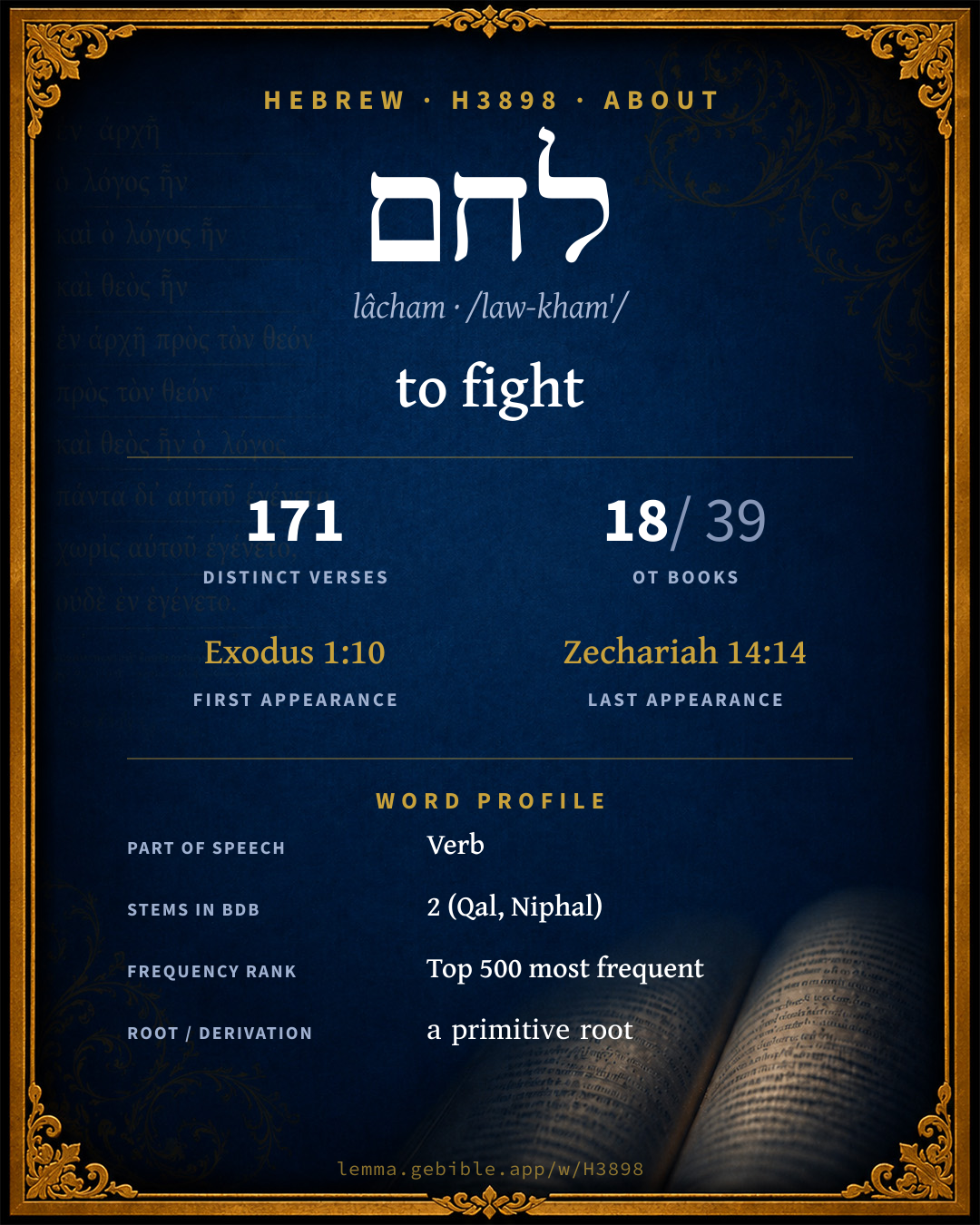
לָחַם
to fight
also: do battle, make war fuller range ↓
Full lexicon entry — Brown-Driver-Briggs (BDB)
From Brown-Driver-Briggs (BDB)
Where this word appears
Grammar key — what these labels mean
Part of speech
- Verb
- An action or state-of-being word.
Stem
- Niphal
- Usually the simple passive or reflexive of the Qal (“he was written”).
- Qal
- The basic, simple active stem — the plain form of the verb (“he wrote”).
Form
- Infinitive Construct
- A bound verbal noun, frequently with prepositions (“to write / in writing”).
- Sequential Imperfect
- An imperfect with prefixed waw — the standard past-narrative form (waw-consecutive imperfect).
- Perfect
- A completed action or state — Hebrew marks aspect (completeness) more than strict tense (“he wrote”).
- Participle Active
- A verbal adjective expressing ongoing or characteristic action (“writing / one who writes”).
- Sequential Perfect
- A perfect with prefixed waw continuing a preceding imperfect or command (waw-consecutive perfect).
- Imperfect
- An incomplete, ongoing, or future action (“he will / would write”).
- Cohortative
- A first-person volitional form expressing wish or resolve (“let me / let us write”).
- Imperative
- A direct command (“write!”).
- Participle Passive
- A verbal adjective expressing action received (“written”).
- Infinitive Absolute
- An unbound verbal noun, often intensifying or standing in for a finite verb.
- Jussive
- A third- or second-person volitional form expressing wish or command (“let him write”).
State
- Absolute
- The independent form of a noun, not bound to a following word.
- Construct
- A noun bound to a following noun in a possessive / “of” relationship (the construct chain).
Person
- 3rd Person
- The one spoken about (“he / she / it / they”).
- 2nd Person
- The one addressed (“you”).
- 1st Person
- The speaker (“I / we”).
Gender
- Masculine
- Grammatically masculine.
- Common
- Either gender — not distinguished for this form.
- Feminine
- Grammatically feminine.
Number
- Singular
- One.
- Plural
- More than one (in Hebrew, generally three or more).
Every verse where H3898 appears in the Book of Numbers — 4 distinct verses. Click any verse to open its interlinear word-by-word view. Verse text shown in the World English Bible for context — . Each verse’s Hebrew form is shown with its reference; the English is not keyword-highlighted, since the data carries no word-level English alignment. Use “Compare translations” on any verse to read it across multiple English versions. This concordance covers the Hebrew Bible; Septuagint (Greek Old Testament) occurrences are not indexed here.
Numbers
- Numbers 21:1 וַ/יִּלָּ֨חֶם֙ conj + Niphal wimpf 3ms The Canaanite, the king of Arad, who lived in the South, heard tell that Israel came by the way of Atharim; and he fought against Israel, and took some of them captive.
- Numbers 21:23 וַ/יִּלָּ֖חֶם conj + Niphal wimpf 3ms Sihon would not allow Israel to pass through his border: but Sihon gathered all his people together, and went out against Israel into the wilderness, and came to Jahaz; and he fought against Israel.
- Numbers 21:26 נִלְחַ֗ם Niphal pf 3ms For Heshbon was the city of Sihon the king of the Amorites, who had fought against the former king of Moab, and taken all his land out of his hand, even to the Arnon.
- Numbers 22:11 לְ/הִלָּ֥חֶם prep + Niphal inf.cs Behold, the people that is come out of Egypt, it covers the surface of the earth: now, come curse me them; peradventure I shall be able to fight against them, and shall drive them out.
About this entry
At a glance — auto-summarized from this page’s data, not written by a person. Every figure links to its source below. This summary describes the numbers; it doesn’t interpret them.
The Hebrew verb לחם centers on the idea of “to fight.” First canonically at Exodus 1:10, it enters the text early. It turns up in 171 verses across 18 books, a common footprint. The verb spans 2 stems, from Qal to Niphal. It clusters with לחום, לחם and לחם under a shared root. Each statement above links to its evidence; the full detail follows below.
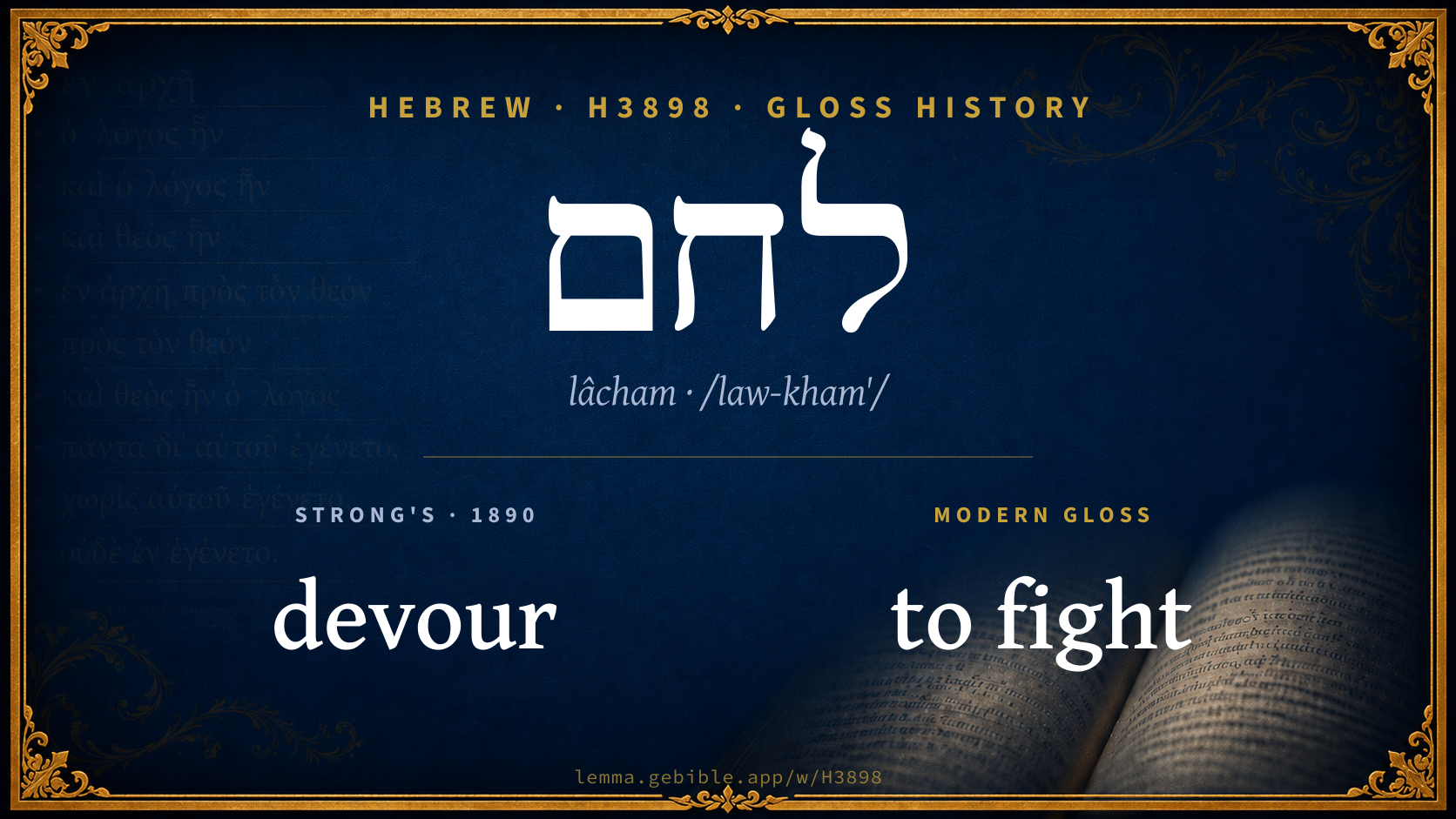
Gloss history
Strong's 1890 vs modern scholarship
About this word
Strong's H3898 catalogs a Hebrew word from the Hebrew Old Testament.
These counts are not copied from any lexicon or concordance. They are computed here, from the morphology-tagged Hebrew Old Testament. What Lemma adds →
- 171
- distinct verses
- The word appears in 171 distinct verses.
- 18 / 39
- OT books
- The word appears in 18 of 39 Old Testament books.
- #262
- by frequency
- Top 500 most frequent Hebrew words (rank 262 of 8,640 Hebrew words by occurrence).
View all 171 occurrences in the concordance →
By section of the Old Testament
By traditional corpus
Conventional, traditional groupings — biblical authorship is debated, so this is a traditional corpus grouping, not an authorship claim. Each share is this word’s portion of its verses in that division of the Hebrew canon. Each figure is a share of the word’s 171 distinct verses.
- Prophets (Nevi'im) 122 verses · 71%
- Writings (Ketuvim) 31 verses · 18%
- Torah (Pentateuch) 18 verses · 11%
How translations render this word
Counts come from each version’s own published word-to-Strong’s tagging or interlinear alignment — an approximate guide to how each version renders this word, not a word-level alignment the data otherwise carries. Because each total is that version’s own tagged count, the per-version totals vary from one another and need not match the appearance or distinct-verse counts above. These counts may also differ from a printed concordance because Lemma counts each distinctly tagged rendering and does not collapse phrase taggings into a single head-word total. This is a fixed set of word-tagged versions (KJV, ASV, BSB, ULT) and does not change with the reading translation you choose elsewhere. Each version’s license is shown beside its name below (and on Sources).
BDB lists this Strong’s number as 2 distinct words (homographs). Each count above pools all of them and is not split by sense — see the Senses section below. A low-frequency rendering may belong to a different one of those words, not the primary meaning.
- King James Version†: Fight 60×, Fought 34×, He fought 7×
- American Standard Version†: Fight 45×, Fought 27×, He fought 7×
- Berean Standard Bible†: Fight 58×, Fought 34×, Fighting 7×
- unfoldingWord Literal Text†: Fight 53×, Fought 25×, He fought 19×
King James Version Public Domain
Renders H3898 across 177† tagged occurrences — most commonly:
Plus other, less common renderings. Plus 32 renderings that appear only once — usually multi-word phrases or single function words the recovered tagging swept in, not distinct renderings.
American Standard Version Public Domain
Renders H3898 across 176† tagged occurrences — most commonly:
Plus other, less common renderings. Plus 59 renderings that appear only once — usually multi-word phrases or single function words the recovered tagging swept in, not distinct renderings.
Berean Standard Bible Public Domain
Renders H3898 across 175† tagged occurrences — most commonly:
Plus other, less common renderings. Plus 26 renderings that appear only once — usually multi-word phrases or single function words the recovered tagging swept in, not distinct renderings. Not rendered by a distinct English word in 2 further occurrences.
unfoldingWord Literal Text CC BY-SA 4.0
Renders H3898 across 185† tagged occurrences — most commonly:
Plus other, less common renderings. Plus 33 renderings that appear only once — usually multi-word phrases or single function words the recovered tagging swept in, not distinct renderings.
Senses in the full BDB
Hebrew verbs can shift meaning by stem (binyan): Qal is the basic action, Niphal is often passive or reflexive, Piel often intensifies or makes it factitive, and Hiphil is typically causative. The senses below are grouped under the stem BDB assigns to each.
What do BDB’s symbols mean?
BDB uses these scholarly abbreviations:
| Symbol | Meaning |
|---|---|
| 𝔊 | the Septuagint (the ancient Greek translation, LXX) |
| 𝔙 | the Vulgate (the Latin translation) |
| 𝔖 | the Syriac version (the Peshitta) |
| 𝔗 | the Targum (the Aramaic translation) |
| ψ | the Psalms |
| √ | root (the underlying root or stem) |
| ‖ | parallel passage (a synonymous or contrasted parallel) |
| † | the dagger: every passage where the word occurs is cited |
The 3 senses and sub-senses the full Brown-Driver-Briggs lexicon distinguishes for this word, in lexicon order (not ranked by frequency), with BDB’s own verbatim wording and sub-sense lettering. Shown in Hebrew script with BDB’s own scholarly abbreviations. The condensed entry is in the Lexicon Entry tab. See also the Forms in the corpus table below.
לחם I fight, do battle (NH Hithp.
Qal
- (poet.) only Imv. ms. and Pt. act.—fight, do battle with, rare, only ψψ, appar. later usage:—לְחַם אֶת־לֹחֲמָ֑י ψ 35:1 do battle with those battling with me (dub. whether את is acc. sign or prep. with, cf. Ol; ‖ רִיבָה אֶת־יְרִיבַי); לֹחֲמִים לִי 56:3 doing battle against me; לֹחֵם v 2 as subst. fighter. e.g. Psalms 35:1
Niphal
- Pf. נִלְחַם Ju 9:17 +, וְנִלְחַמְתָּ֫ 11:8 1 S 15:18, וְנִלְחַמְנוּ Dt 1:41 consec., etc.; Impf. יִלָּהֵם Ex 14:14 Dt 1:30; יִ֫לָּחֶם לָ֑נוּ Ne 4:14, וַיִּ֫לָּחֶם Ex 17:8 + 19 times; 3 fs. תִּלָּחֵם Zc 14:14; 3 mpl. וַיִּלָּֽחֲמוּ Ju 1:5 + 13 times; sf. וַיִּלָּֽחֲמוּנִי ψ 109:3; 2 mpl. תִּלָּֽחֲמוּ 1 K 22:31 + 4 times; תִּלָּֽחֲמוּן 1 K 12:24, etc.; Imv. הִלָּחֵם Ex 17:9 1 S 18:17; הִלָּ֫חֶם בּוֹ Ju 9:38; pl. הִלָּֽחֲמוּ 2 K 10:3 Ne 4:8; Inf. abs. נִלְחֹם Ju 11:26; cstr. הִלָּחֵם 1:9 + 35 times; הִלָּ֫חֶם בּוֹ etc., Nu 22:11 + 6 times; sf. הִלָּחֲמוֹ 2 K 8:29 + 3 times; Pt. נִלְחָם Ex 14:25 + 10 times; pl. נִלְחָמִים Jos 10:25 + 10 times (but 1 S 31:1 read rather נִלְחֲמוּ, so ‖ 1 Ch 10:1 We Klo Bu, cf. Dr);—engage in battle (recipr.), sometimes wage war (Jos 10:5; Ju 11:5; 1 K 14:19; 22:46; 2 K 6:8; 14:28 etc.), often c. בְּ of enemy (60 times) Ex 1:10; 17:9, 10; Nu 21:23, 26; 22:11 (all E), Ju 11:8, 25; 1 S 15:18; 2 S 8:10 + (49 times); less often c. בְּ of city attacked, besieged †Ju 9:45; 1 S 23:1; 2 S 12:26, 27, 29 Is 20:1; Jos 10:31 (D), 1 K 20:1 2 Ch 35:20 Ne 4:2; of tower Ju 9:52; sq. בְּאַרְצִי 11:12†; c. עִם of enemy (26 times): Ju 5:20; 11:4, 5, 20 Jos 11:5 (JE), 1 S 13:5; 17:19, also 1 S 17:32, 33 (of single combat), Dt 20:4; Jos 9:2 (both D), 2 K 13:12; 14:15; 2 Ch 11:1; 17:10; 27:5; Dn 10:20; 11:11 +; c. עִם of city †Jos 10:29 (D), 19:47 (JE)†; c. אֶת־ = with, of enemy, †Jos 24:8 (E), 1 S 17:9 (single combat), Je 21:5; 1 K 20:23; 2 K 19:9 = Is 37:9, Je 37:10; also Ju 12:4; 2 S 11:17; 21:15; 1 K 22:31;2 K 8:2; 9:15; Je 21:4; 32:5; 33:5; 2 Ch 18:30; 22:6, and c. אוֹתָם (= אִתָּם) Jos 10:25 (D), 1 K 20:25 (KöLgb. ii. 296)†; c. עַל, against, of enemy only Je 21:2; elsewhere (16 times) of city: †Jos 10:5 (JE), Is 7:1; 2 K 12:18; 19:8 = Is 37:8; especially D and Je: Dt 20:10, 19 Jos 10:34, 36, 38 (all D), Je 32:24, 29; 34:1, 7, 8, 22†; c. אֶל־ of enemy †Je 1:19; 15:20†; c. sf. וַיִּלָּֽחֲמוּנִי †ψ 109:3 and they have fought against me†; c. יָ֑חַד i.e. fight together = with (against) one another †1 S 17:10; abs. c. acc. cogn. מִלְחָמוֹת fight battles †1 S 8:20; 18:17; 25:28; 2 Ch 32:8†; abs. elsewhere Ju 5:19(×2), 20 Dt 1:41; Zc 10:5 + 26 times + וַוָּסֻרוּ עָלָיו לְהִלָּחֵ֑ם 1 K 22:32; †c. עַל for, in behalf of, Ju 9:17; 2 K 10:3; Ne 4:8; c. לְ = id., Ex 14:14 (J), v 25 (J; + בְּ of enemy), Dt 1:30; 3:22; 20:4 (+ עִם of enemy, vid. supra), Jos 10:14, 42; 23:3, 10 (all D), Ne 4:14†; יָכֹל לְהִלּ׳ be able to fight, c. את of enemy 1 S 17:9, c. בְּ of enemy Nu 22:11, = be successful in fighting, prevail against; so c. עַל of city Is 7:1, and abs. 2 K 16:5 (after וַיָּצֻרוּ עָל besiege). e.g. Judges 9:17
לחם II use as food, eat, poet. (so Thes Buhl, cf. Frä30 GuidiDella Sede 33
Qal
- Pf. 3 pl. לָֽחֲמוּ Pr 4:17; Impf. 2 ms. תִּלְחַם Pr 23:6, 1 s. אֶלְחַם ψ 141:4; Imv. mpl. לַחֲמוּ Pr 9:5; Inf. cstr. לְחוֹם Pr 23:1; Pt. pass. pl. cstr. לְחֻמֵי Dt 32:24; eat (mostly Pr), abs. Pr 23:1; sq. acc. cogn. לֶחֶם 4:17; 23:6; sq. בְּלַחְמִי 9:5; sq. בְּמַנְעַמֵּיהֶם ψ 141:4 eat of their dainties; לְחֻמֵי רֶשֶׁף Dt 32:24 (poem) eaten up with the Fire-bolt, fig. of pestilence (Dr). e.g. Proverbs 4:17
Senses from the full Brown-Driver-Briggs lexicon (Brown, Driver, Briggs; Oxford 1906 — public domain), digitized via Sefaria, supplemented by the OpenScriptures HebrewLexicon (CC BY 4.0). Full attribution on Sources.
Word origin
I. vb. fight, do battle (NH Hithp.; ואלתחם MI11.15.19; perhaps = order the battle, cf. NöZMG xl. 1886, 721; Arabic لَحَمَ fit close together, so NH לחם Pi., Syriac ܠܚܡ Pa. unite, ܠܳܚܶܡ fit; also threaten; GerberVerb. Denom. 59 thinks vb. in Heb. denom. from מִלְחָמָה battle-line, but dub.);—
II. vb. use as food, eat, poet. (so Thes Buhl, cf. Frä30 GuidiDella Sede 33; this would explain diff. between לֶחֶם and لَحْمٌ; yet verb rare and chiefly late);—
— Brown-Driver-Briggs (Oxford 1906, public domain), digitized via Sefaria, supplemented by the OpenScriptures HebrewLexicon (CC BY 4.0). See Sources.
Origin: a primitive root
Jastrow Dictionary
A second Hebrew/Aramaic lexicon for comparison, covering Aramaic and post-biblical (Talmudic, Targumic, Midrashic) usage that the biblical-Hebrew BDB does not. Matched by lemma rather than by Strong’s number, so a lemma may carry more than one Jastrow headword (shown separately below), and the entries cover usage well beyond the Bible.
לָחַם I
- (cmp. לוּחַ), to join, or to be joined, be inserted.
- to fit, insert; to tenon. Y. Sabb. XII, 13ᶜ המַלְחִים את וכ׳ he who inserts the shutters (of a shop); Y. Bets. I, 60ᶜ המלחם (corr. acc.). Cant. R. to V, 12; ib. to IV, 15, v. לְחִי. Lev. R. s. 3 (ref. to the harmonious parallelism of Is. LV, 7) כאדם שהוא מלחים שני נסרים ומדביקן זה לזה as one fits (with tenon and mortise) two boards and glues them to one another; כאדם שהוא מ׳ שתי כרעי המטה (leave out ומדביקן זה לזה, v. Ar. s. v. מלח) as one inserts two legs of a bedstead. e.g. Isaiah 55:7
לָחַם II
- v. preced.) to join.
- (cmp. use of זָוַג Nithpa.) to come in (hostile) contact, to battle; with ל of person, to assist, battle for. Mekh. B’shall. 2 (ref. to Ex. XIV, 14) לא … יִלָּחֵם לכם אלא לעולם ילחם כנגדן וכ׳ not only this time will he assist you, but he will always battle against your enemies. Tanḥ. Masé 6 כשהלך להִלָּחֵם בישראל when he (Sisera) went to war against &c. Ib. Vayera 7 (ref. בלחומו, Job XX, 23) על המלחמות שהיו נִלְחָמִים עם וכ׳ for the battles which they fought against the Lord; a. fr. e.g. Exodus 14:14
- to contest, dispute. Y. M. Kat. III, 81ᵈ top אם חברים מִתְלַחֲמִים וכ׳ if scholars are at variance with one another, what concern is it to you? (B. Mets. 59ᵇ מנצחים זה את זה וכ׳).
לֶחֶם
- fr. לחח to chew, v. Ges. H. Dict.10 s. v. לוע) food, bread; [Arab. meat]. Ber. V, 1 the benediction over bread (פת) reads: המוציא ל׳ וכ׳ who makest food grow out of the earth; ib. 37ᵇ. Men. XI, 1 שתי הל׳ (sub. ככרות) the two loaves of bread (Lev. XXIII, 17). Ib. ל׳ הפנים the show-bread (on the table of the Sanctuary); a. fr.—Trnsf. tribute, tax, salary (cmp. annona). Ruth R. to II, 14 זו לַחְמָהּ של מלכות that is (thou shalt partake of) the royal maintenance. Zeb. 85ᵃ; Meïl. 7ᵇ לַחְמוֹ של מזבח the tribute belonging to the altar (cmp. Lev. XXI, 6; 8; Neh. V, 14).—Pl. לְחָמִים. Y. Ḥag. III, end, 79ᵈ שני ל׳ two sets of show-bread, opp. to לחם אחד. e.g. Leviticus 23:17
לְחֵם
- 1. same. Targ. Gen. XIV, 18. Ib. XLIII, 31; a. fr.—Snh. 100ᵇ (from Ben Sira) אמר במאי איכול ל׳ ל׳ סב מיניה if a man says, ‘wherewith shall I eat bread (to season it)?’, take the bread from him. Ab. Zar. 35ᵇ ל׳ דארמאי (Ms. M. נהמא) bread baked by gentiles, v. פַּת. Ber. 42ᵇ ניזיל וניכול ל׳ וכ׳ (Ms. M. נהמא) let us go and dine at a certain place; a. fr.
- 2. meat, flesh. Ex. R. s. 42 (ref. to לחמם, Zeph. I, 17) בערביא קורין לבשרא ל׳ in Arabia they call meat laḥma e.g. Zephaniah 1:17
A Dictionary of the Targumim, the Talmud Babli and Yerushalmi, and the Midrashic Literature (Marcus Jastrow; London, Luzac, 1903) — Public Domain. Digitized via Sefaria. Digitized via Sefaria. Full attribution on Sources.
Forms in the corpus
The 97 distinct written forms H3898 takes in the Hebrew Bible, most frequent first — each parse links to that stem’s occurrences in the concordance. Hebrew forms include their vowel points and cantillation, so a single lemma takes many written forms.
The 60 most common forms are shown; 37 rarer forms follow in the full concordance.
Same root — word family
Other BDB entries built from the same root as H3898, grouped by Strong’s listed origin. These share a root / origin per the lexicon — not necessarily a shared meaning. Each links to that word’s own entry.
Derived from this word
Compare all same-root words → Showing 4 of 5 — not the complete family. They share a root, not necessarily a meaning.
Septuagint verse parallels
This word appears in 162 verses that also exist in the Greek Old Testament (Septuagint), out of the 171 Hebrew verses it occurs in. You can read those verses in Greek by switching the Old Testament edition to the Septuagint.
Read these verses in the Septuagint
- Exodus 1:10
- Numbers 21:1
- Deuteronomy 1:30
- Joshua 9:2
- Judges 1:1
- 1 Samuel 4:9
- 2 Samuel 2:28
- 1 Kings 12:21
- 2 Kings 3:21
- 1 Chronicles 10:1
- 2 Chronicles 11:1
- Psalms 35:1
This is a verse-level parallel only — the same verses exist in both the Hebrew and Greek Old Testaments. No word-level Hebrew↔Greek correspondence is claimed: the data carries no such alignment, so no Greek word is shown as this Hebrew word’s translation. Coverage is not total — the Septuagint omits the deuterocanon and renumbers the Psalms, so some Hebrew verses have no direct Greek parallel.