
Jeremiah 21:2

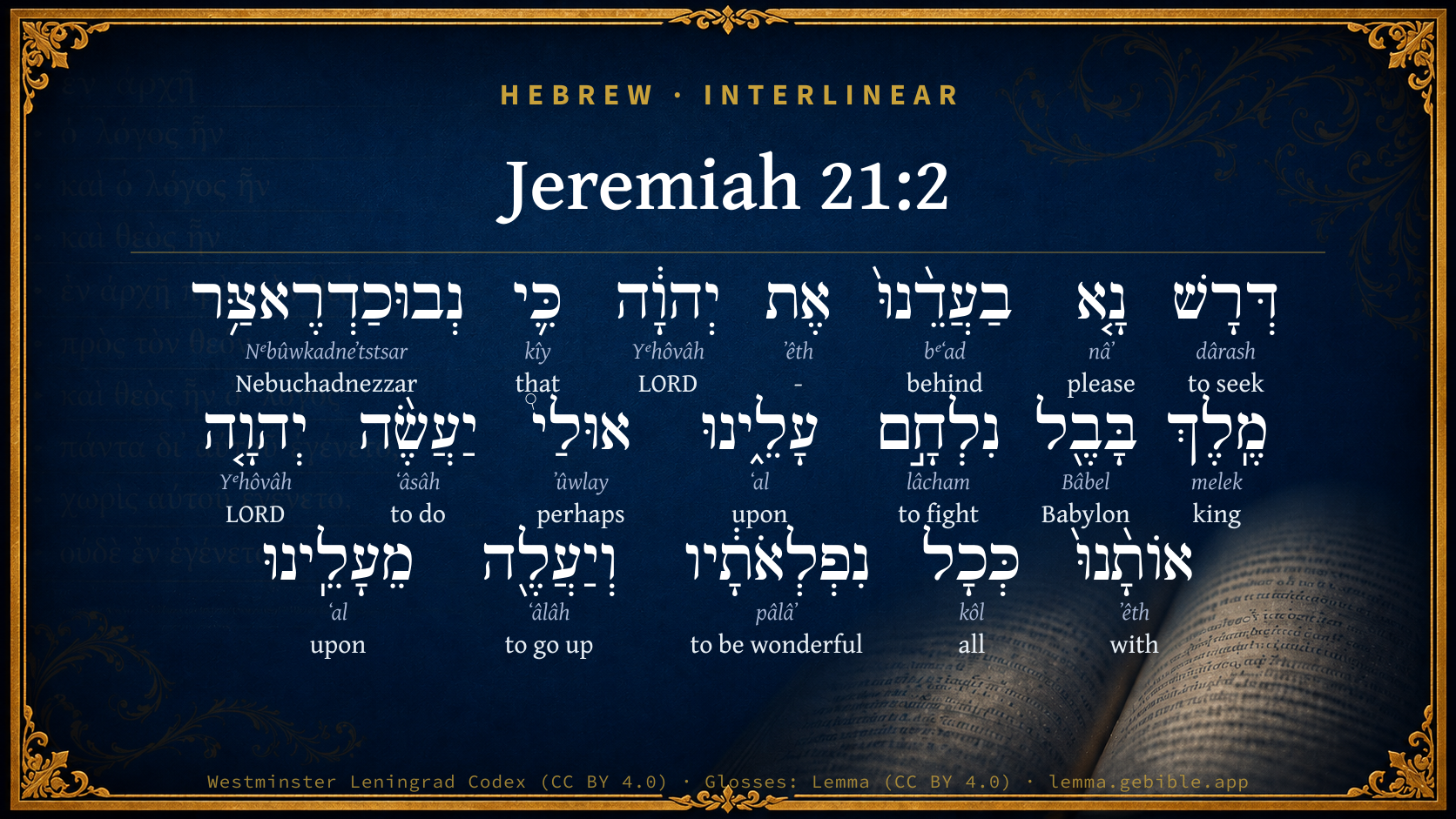
Hebrew (Westminster Leningrad Codex) Jeremiah 21:2 appears in the Hebrew Old Testament. The text above is from the Westminster Leningrad Codex. Each word links to its Strong’s number, a concise gloss, and parsing drawn from the Open Scriptures Hebrew Bible morphology. Click any word for its full Brown-Driver-Briggs (BDB) entry.
Download image
Cite this verse

Jeremiah 21:2 (World English Bible). Public Domain. Lemma interlinear Bible study tool, https://lemma.gebible.app/v/jeremiah/21/2.

Show BibTeX & RIS
BibTeX
RIS
English Translation
Please inquire of Yahweh for us; for Nebuchadrezzar king of Babylon makes war against us: peradventure Yahweh will deal with us according to all his wondrous works, that he may go up from us.
World English Bible · Public Domain
Download a study sheet

One document with this verse’s original text, its word-by-word gloss line, the meaning frame, cross-references with their text, attributed commentary, and full source and license credits — printable, and it pastes into notes with its structure intact.

This verse Autodidact and up

Study sheet (.html) Plain text (.txt)

A passage Seminary Student

Up to 50 verses in one chapter. A passage sheet keeps up to 6 commentary sources and 12 cross-references per verse, in the order this page ranks them, and says so on the sheet whenever that leaves anything out. Ask for a single verse and you get the Autodidact verse sheet above.

Everything on this page stays free to read, with no account — the sheet is a download of what is already on screen, not access to it.

Want to remove ads? Support Godless Engineer
Compare translations 3

The same verse in 3 English versions, stacked beneath the original-language interlinear above. Click any original word for its lexicon entry.

Each is an independent rendering of the whole verse — the interlinear is not word-aligned to these translations.

Highlighted words mark where these versions differ — a whole-verse word diff, not a word-by-word alignment.

  • World English Bible Public Domain
    Please inquire of Yahweh for us; for Nebuchadrezzar king of Babylon makes war against us: peradventure Yahweh will deal with us according to all his wondrous works, that he may go up from us.
  • King James Version Public Domain
    Enquire, I pray thee, of the LORD for us; for Nebuchadrezzar king of Babylon maketh war against us; if so be that the LORD will deal with us according to all his wondrous works, that he may go up from us.
  • unfoldingWord Literal Text CC BY-SA 4.0
    “Please inquire of Yahweh on our behalf, for Nebuchadnezzar king of Babylon is fighting against us. Perhaps Yahweh will do with us according to all his wonders, and he will withdraw from upon us.”

unfoldingWord Literal Text — © unfoldingWord, licensed CC BY-SA 4.0. Word-aligned USFM3 via Door43 (git.door43.org/unfoldingWord/en_ult).

Versions to compare (up to 4)

3 of 4 selected

Show all 18 translations

Every available English version of this verse, each an independent rendering of the whole verse.

  • World English Bible Public Domain
    Please inquire of Yahweh for us; for Nebuchadrezzar king of Babylon makes war against us: peradventure Yahweh will deal with us according to all his wondrous works, that he may go up from us.
  • Berean Standard Bible Public Domain
    “Please inquire of the LORD on our behalf, since Nebuchadnezzar king of Babylon is waging war against us. Perhaps the LORD will perform for us something like all His past wonders, so that Nebuchadnezzar will withdraw from us.”
  • Majority Standard Bible Public Domain
    “Please inquire of the LORD on our behalf, since Nebuchadnezzar king of Babylon is waging war against us. Perhaps the LORD will perform for us something like all His past wonders, so that Nebuchadnezzar will withdraw from us.”
  • King James Version Public Domain
    Enquire, I pray thee, of the LORD for us; for Nebuchadrezzar king of Babylon maketh war against us; if so be that the LORD will deal with us according to all his wondrous works, that he may go up from us.
  • American Standard Version (1901) Public Domain
    Inquire, I pray thee, of Jehovah for us; for Nebuchadrezzar king of Babylon maketh war against us: peradventure Jehovah will deal with us according to all his wondrous works, that he may go up from us.
  • Revised Version (1885) Public Domain
    Inquire, I pray thee, of the LORD for us; for Nebuchadrezzar king of Babylon maketh war against us: peradventure the LORD will deal with us according to all his wondrous works, that he may go up from us.
  • Geneva Bible (1599) Public Domain
    Inquire, I pray thee, of the Lord for vs, (for Nebuchad-nezzar King of Babel maketh warre against vs) if so be that the Lord will deale with vs according to all his wonderous workes, that he may returne vp from vs.
  • Douay-Rheims (1899) Public Domain
    Inquire of the Lord for us, for Nabuchodonosor king of Babylon maketh war against us: if so be the Lord will deal with us according to all his wonderful works, that he may depart from us.
  • Young's Literal Translation Public Domain
    `Inquire, we pray thee, for us at Jehovah, for Nebuchadrezzar king of Babylon hath fought against us; perhaps Jehovah doth deal with us according to all His wonders, and doth cause him to go up from off us.'
  • Literal Standard Version CC BY-SA 4.0
    “Please inquire of YHWH for us, for Nebuchadnezzar king of Babylon has fought against us; perhaps YHWH deals with us according to all His wonders, and causes him to go up from off us.”
  • Unlocked Literal Bible CC BY-SA 4.0
    “Seek advice from Yahweh on our behalf, for Nebuchadnezzar king of Babylon is making war on us. Perhaps Yahweh will do miracles for us, as in times past, and will make him withdraw from us.”
  • unfoldingWord Literal Text CC BY-SA 4.0
    “Please inquire of Yahweh on our behalf, for Nebuchadnezzar king of Babylon is fighting against us. Perhaps Yahweh will do with us according to all his wonders, and he will withdraw from upon us.”
  • Darby Bible Public Domain
    Inquire, I pray thee, of Jehovah for us; for Nebuchadrezzar the king of Babylon maketh war against us; if so be that Jehovah will deal with us according to all his marvellous works, that he may go up from us.
  • World Messianic Bible Public Domain
    “Please inquire of the LORD for us; for Nebuchadnezzar king of Babylon makes war against us. Perhaps the LORD will deal with us according to all his wondrous works, that he may withdraw from us.”
  • Webster's Bible Public Domain
    Inquire, I pray thee, of the LORD for us; for Nebuchadnezzar king of Babylon maketh war against us; it may be that the LORD will deal with us according to all his wondrous works, that he may go up from us.
  • Free Bible Version CC BY-SA 4.0
    “Please speak with the Lord on our behalf because Nebuchadnezzar, king of Babylon, is attacking us. Perhaps the Lord will do some miracle for us like all those miracles he used to do, so that Nebuchadnezzar will retreat from us.”
  • Bible in Basic English Public Domain
    Will you get directions from the Lord for us; for Nebuchadrezzar, king of Babylon, is making war against us; it may be that the Lord will do something for us like all the wonders he has done, and make him go away from us.
  • JPS Tanakh (1917) Public Domain
    'Inquire, I pray thee, of the LORD for us; for Nebuchadrezzar king of Babylon maketh war against us; peradventure the LORD will deal with us according to all His wondrous works, that he may go up from us.'

Literal Standard Version (2020), Covenant Press — licensed CC BY-SA 4.0. Text via the HelloAO Bible API (eBible.org). Unlocked Literal Bible (unfoldingWord) — licensed CC BY-SA 4.0. Text via the HelloAO Bible API (eBible.org). unfoldingWord Literal Text — © unfoldingWord, licensed CC BY-SA 4.0. Word-aligned USFM3 via Door43 (git.door43.org/unfoldingWord/en_ult). Free Bible Version, Dr. Jonathan Gallagher — licensed CC BY-SA 4.0. Text via the HelloAO Bible API (eBible.org).

Word by word

More ways to search: Search by grammar → Find every occurrence → Compare this word →

Practice this passage: Drill this verse → Learn its vocabulary →

אוּלַי֩
ʼûwlay
H194
“perhaps”
Adverb
Part of Speech
Adverb
Full BDB Definition

Origin: from H176

TWOT: 46

perhaps, peradventure - if peradventure - unless - suppose
  1. דְּרָשׁ dârash H1875 “seek” Verb, Qal, Imperative, 2nd Person, Masculine, Singular
  2. נָ֤א nâʼ H4994 “please” Particle, Exhortation
  3. בַעֲדֵ֨נוּ֙ bᵉʻad H1157 “behind · us” Preposition + Suffix, Personal, 1st Person, Common, Plural
  4. אֶת ʼêth H853 “-” Particle, Direct Object
  5. יְהוָ֔ה Yᵉhôvâh H3068 “LORD” Noun, Proper
  6. כִּ֛י kîy H3588 “that” Conjunction
  7. נְבוּכַדְרֶאצַּ֥ר Nᵉbûwkadneʼtstsar H5019 “Nebuchadnezzar” Noun, Proper
  8. מֶֽלֶךְ melek H4428 “king of” Noun, Common, Masculine, Singular, Construct
  9. בָּבֶ֖ל Bâbel H894 “Babylon” Noun, Proper
  10. נִלְחָ֣ם lâcham H3898 “fighting” Verb, Niphal, Participle Active, Masculine, Singular, Absolute
  11. עָלֵ֑ינוּ ʻal H5921 “upon · us” Preposition + Suffix, Personal, 1st Person, Common, Plural
  12. יַעֲשֶׂ֨ה ʻâsâh H6213 “to do” Verb, Qal, Imperfect, 3rd Person, Masculine, Singular
  13. יְהוָ֤ה Yᵉhôvâh H3068 “LORD” Noun, Proper
  14. אוֹתָ֨נוּ֙ ʼêth H854 “with · us” Preposition + Suffix, Personal, 1st Person, Common, Plural
  15. כְּכָל kôl H3605 “like/as · all of” Preposition + Noun, Common, Masculine, Singular, Construct
  16. נִפְלְאֹתָ֔יו pâlâʼ H6381 “being wonderful · him” Verb, Niphal, Participle Active, Feminine, Plural, Construct + Suffix, Personal, 3rd Person, Masculine, Singular
  17. וְיַעֲלֶ֖ה ʻâlâh H5927 “and · to go up” Conjunction + Verb, Qal, Imperfect, 3rd Person, Masculine, Singular
  18. מֵעָלֵֽינוּ ʻal H5921 “from · upon · us” Preposition + Preposition + Suffix, Personal, 1st Person, Common, Plural

About this verse

These counts appear in no published source. They are computed here, from the morphology-tagged text and Lemma’s own curated glosses. What Lemma adds →

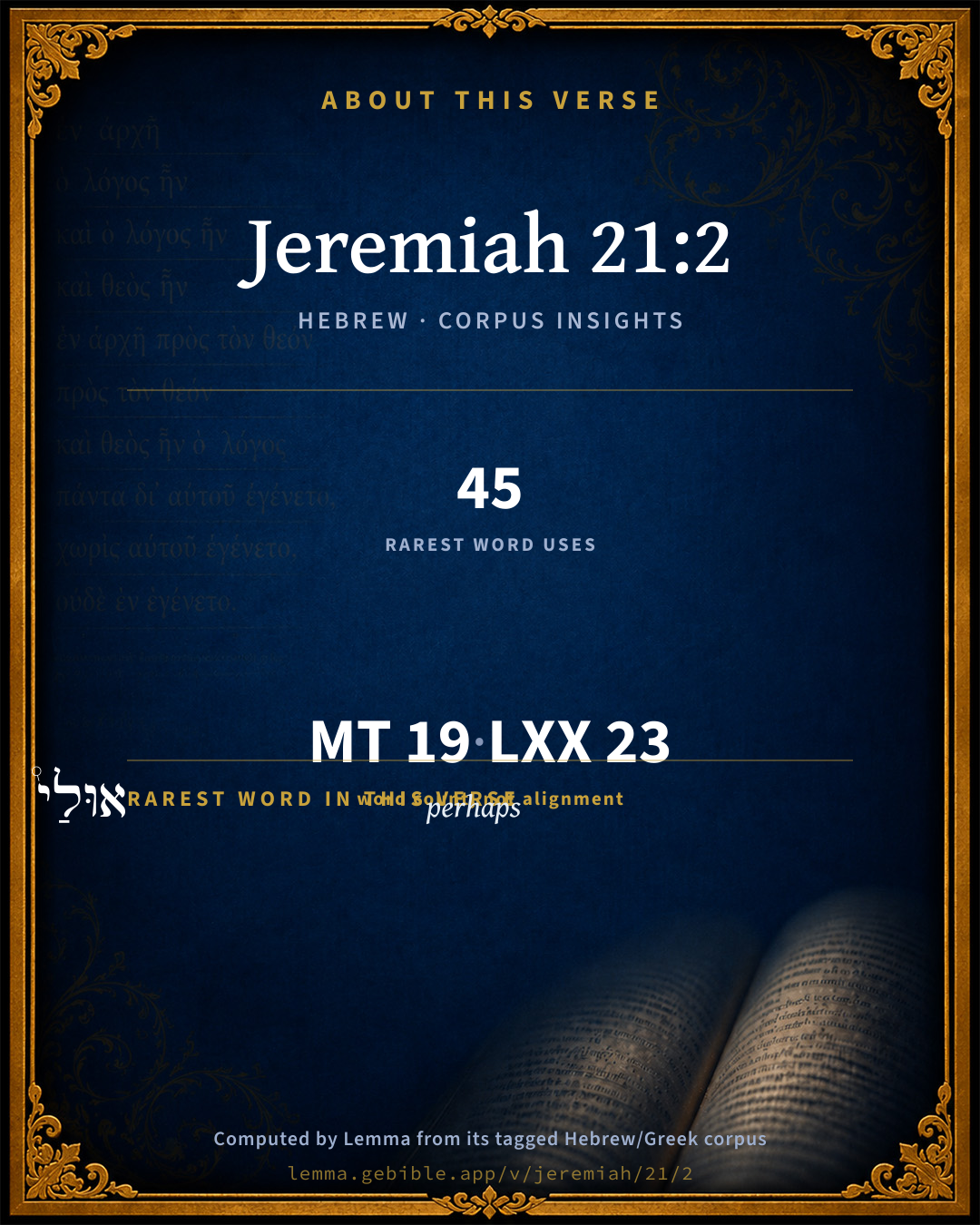
19
words
17
distinct lemmas
Prophets
section

Shared distinctive vocabulary

אוּלַי֩ perhaps H194 occurs in 44 verses of the Hebrew Bible. Also found in:

Grammatical profile

  • 5 verbs
  • 6 nouns
  • 4 prepositions
  • 1 conjunction
  • 1 adverb
  • 2 particles

Verb forms

  • דְּרָשׁ Qal · Imperative
  • נִלְחָ֣ם Niphal · Participle Active
  • יַעֲשֶׂ֨ה Qal · Imperfect
  • נִפְלְאֹתָ֔יו Niphal · Participle Active
  • וְיַעֲלֶ֖ה Qal · Imperfect

Repetition

Words recur within this verse — often emphatic in Hebrew:

  • יְהוָ֔ה LORD H3068 ×2
  • עָלֵ֑ינוּ upon H5921 ×2

Hebrew & Septuagint length

In the original languages it is 19 Hebrew tokens and 23 Greek tokens — but the two are counted differently (Hebrew bundles its prefixes and suffixes into one token; the Greek is in lemma form), so that isn’t a like-for-like length.

Cross-references

35

Topical passages linked to Jeremiah 21:2 in the Treasury of Scripture Knowledge — connected by theme and wording, ordered by reader-vote popularity; previews shown in the World English Bible.

  • Jeremiah 37:3 Zedekiah the king sent Jehucal the son of Shelemiah, and Zephaniah the son of Maaseiah, the priest, to the prophet Jeremiah, saying, Pray now to Yahweh our God for us.
  • Jeremiah 37:7 Thus says Yahweh, the God of Israel, Thus shall you tell the king of Judah, who sent you to me to inquire of me: Behold, Pharaoh's army, which is come forth to help you, shall return to Egypt into their own land.
  • Jeremiah 42:4–6 Then Jeremiah the prophet said to them, I have heard you; behold, I will pray to Yahweh your God according to your words; and it shall happen that whatever thing Yahweh shall answer you, I will declare it to you; I will keep nothing back from you.
  • Ezekiel 20:1–3 It happened in the seventh year, in the fifth [month], the tenth [day] of the month, that certain of the elders of Israel came to inquire of Yahweh, and sat before me.
  • 1 Samuel 28:6 When Saul inquired of Yahweh, Yahweh didn't answer him, neither by dreams, nor by Urim, nor by prophets.
  • 1 Samuel 28:15 Samuel said to Saul, Why have you disquieted me, to bring me up? Saul answered, I am sore distressed; for the Philistines make war against me, and God is departed from me, and answers me no more, neither by prophets, nor by dreams: therefore I have called you, that you may make known to me what I shall do.
  • 1 Kings 14:2–3 Jeroboam said to his wife, Please get up and disguise yourself, that you not be known to be the wife of Jeroboam; and get you to Shiloh: behold, there is Ahijah the prophet, who spoke concerning me that I should be king over this people.
  • Psalms 44:1–4 We have heard with our ears, God; Our fathers have told us, What work you did in their days, In the days of old.
  • Exodus 14:1–15 Yahweh spoke to Moses, saying,
  • Joshua 10:1–11 Now it happened, when Adoni-zedek king of Jerusalem heard how Joshua had taken Ai, and had utterly destroyed it; as he had done to Jericho and her king, so he had done to Ai and her king; and how the inhabitants of Gibeon had made peace with Israel, and were among them;
  • Judges 4:1–5 The children of Israel again did that which was evil in the sight of Yahweh, when Ehud was dead.
  • Judges 20:27 The children of Israel asked of Yahweh (for the ark of the covenant of God was there in those days,
  • 1 Samuel 7:10–12 As Samuel was offering up the burnt offering, the Philistines drew near to battle against Israel; but Yahweh thundered with a great thunder on that day on the Philistines, and confused them; and they were struck down before Israel.
  • 1 Samuel 10:22 Therefore they asked of Yahweh further, Is there yet a man to come here? Yahweh answered, Behold, he has hid himself among the baggage.
  • 1 Samuel 14:6–14 Jonathan said to the young man who bore his armor, Come, and let us go over to the garrison of these uncircumcised: it may be that Yahweh will work for us; for there is no restraint to Yahweh to save by many or by few.
  • 1 Samuel 17:45–50 Then said David to the Philistine, You come to me with a sword, and with a spear, and with a javelin: but I come to you in the name of Yahweh of hosts, the God of the armies of Israel, whom you have defied.
  • 1 Kings 22:3–8 The king of Israel said to his servants, "You know that Ramoth-gilead is ours, and we are still, and don't take it out of the hand of the king of Syria?"
  • 2 Kings 1:3 But the angel of Yahweh said to Elijah the Tishbite, Arise, go up to meet the messengers of the king of Samaria, and tell them, Is it because there is no God in Israel, that you go to inquire of Baal Zebub, the god of Ekron?
  • 2 Kings 3:11–14 But Jehoshaphat said, Isn't there here a prophet of Yahweh, that we may inquire of Yahweh by him? One of the king of Israel's servants answered, Elisha the son of Shaphat is here, who poured water on the hands of Elijah.
  • 2 Kings 22:13–14 Go you, inquire of Yahweh for me, and for the people, and for all Judah, concerning the words of this book that is found; for great is the wrath of Yahweh that is kindled against us, because our fathers have not listened to the words of this book, to do according to all that which is written concerning us.
  • 2 Kings 25:1–2 It happened in the ninth year of his reign, in the tenth month, in the tenth day of the month, that Nebuchadnezzar king of Babylon came, he and all his army, against Jerusalem, and encamped against it; and they built forts against it round about.
  • 2 Chronicles 14:9–13 There came out against them Zerah the Ethiopian with an army of a million troops, and three hundred chariots; and he came to Mareshah.
  • 2 Chronicles 20:1–30 It happened after this, that the children of Moab, and the children of Ammon, and with them some of the Ammonites, came against Jehoshaphat to battle.
  • 2 Chronicles 32:21 Yahweh sent an angel, who cut off all the mighty men of valor, and the leaders and captains, in the camp of the king of Assyria. So he returned with shame of face to his own land. When he was come into the house of his god, those who came forth from his own bowels killed him there with the sword.
  • Psalms 46:8–11 Come, see Yahweh's works, What desolations he has made in the earth.
  • Psalms 48:4–8 For, behold, the kings assembled themselves, They passed by together.
  • Psalms 105:5–45 Remember his marvelous works that he has done; His wonders, and the judgments of his mouth,
  • Psalms 136:1–26 Give thanks to Yahweh, for he is good; For his loving kindness endures forever.
  • Isaiah 59:1–2 Behold, Yahweh's hand is not shortened, that it can't save; neither his ear heavy, that it can't hear:
  • Jeremiah 32:17 Ah Lord Yahweh! behold, you have made the heavens and the earth by your great power and by your outstretched arm; there is nothing too hard for you,
  • Jeremiah 32:24 Behold, the mounds, they are come to the city to take it; and the city is given into the hand of the Chaldeans who fight against it, because of the sword, and of the famine, and of the pestilence; and what you have spoken has happened; and, behold, you see it.
  • Jeremiah 38:14–27 Then Zedekiah the king sent, and took Jeremiah the prophet to him into the third entry that is in the house of Yahweh: and the king said to Jeremiah, I will ask you a thing; hide nothing from me.
  • Jeremiah 39:1–2 It happened when Jerusalem was taken, (in the ninth year of Zedekiah king of Judah, in the tenth month, came Nebuchadrezzar king of Babylon and all his army against Jerusalem, and besieged it;
  • Jeremiah 52:3–6 For through the anger of Yahweh did it happen in Jerusalem and Judah, until he had cast them out from his presence. Zedekiah rebelled against the king of Babylon.
  • Ezekiel 14:3–7 Son of man, these men have taken their idols into their heart, and put the stumbling block of their iniquity before their face: should I be inquired of at all by them?

Cross-references courtesy of OpenBible.info (CC BY 4.0).

Hebrew and Greek witnesses Masoretic Hebrew ↔ Greek Septuagint

The same verse in the two great witnesses to the Old Testament, shown verse-for-verse.

These are two independent witnesses, not word-aligned to each other, and the Septuagint is shown in lemma (dictionary) form.

Hebrew Jeremiah 21:2 Masoretic · Westminster Leningrad Codex

דְּרָשׁ נָ֤א בַעֲדֵ֨נוּ֙ אֶת יְהוָ֔ה כִּ֛י נְבוּכַדְרֶאצַּ֥ר מֶֽלֶךְ בָּבֶ֖ל נִלְחָ֣ם עָלֵ֑ינוּ אוּלַי֩ יַעֲשֶׂ֨ה יְהוָ֤ה אוֹתָ֨נוּ֙ כְּכָל נִפְלְאֹתָ֔יו וְיַעֲלֶ֖ה מֵעָלֵֽינוּ

Please inquire of Yahweh for us; for Nebuchadrezzar king of Babylon makes war against us: peradventure Yahweh will deal with us according to all his wondrous works, that he may go up from us.

World English Bible · Public Domain

Greek LXX Structure differs

In the Septuagint, Jeremiah is about an eighth shorter than the Hebrew and arranges its material differently — the Oracles Against the Nations (Hebrew chapters 46–51) appear in the middle of the Greek book, after 25:13. Because the chapter and verse boundaries do not line up, a verse-for-verse comparison with the Hebrew is not shown.

A verse-for-verse comparison isn’t shown here because the chapters and verses don’t line up. Switch to the LXX edition with the MT / LXX toggle above to read the Greek directly.

Hebrew: Westminster Leningrad Codex (CC BY 4.0). Greek: Septuagint (public domain); English from a public-domain English Septuagint. How the Septuagint differs from the Hebrew →

Targum (Aramaic paraphrase)

1

The Targum is the ancient Jewish Aramaic paraphrase of the Hebrew Scriptures — an interpretive translation, not the Hebrew text itself. Onkelos (literal) and Pseudo-Jonathan (expansive) render the Torah, and Jonathan the Prophets. Coverage is partial: where no permissively-licensed English translation exists for a verse, only the Aramaic is shown. This is verse-level text, not a word-by-word alignment to the Hebrew.

  1. Targum Jonathan Prophets (Joshua–Malachi)
    צַלֵי כְעַן עֲלָנָא קֳדָם יְיָ אֲרֵי נְבוּכַדְרֶצַר מַלְכָּא דְבָבֶל מֵגִיחַ קְרָבָא בָנָא מָאִים יַעֲבֵּד יְיָ עִמָנָא כְּכָל פְּרִישָׁתֵיהּ וְיִסְתַּלֵק מִנָנָא:

    (no public-domain English translation for this verse)

    Targum Jonathan — Aramaic: “Mikraot Gedolot” (public domain). English: “Sefaria Community Translation” (CC0 1.0 (public-domain dedication)); “London "Chaldee Paraphrase," 1871” (public domain). Text via Sefaria.

Commentary

Notes on Jeremiah 21:2 from classic Christian and Jewish commentators (each source and its license shown beneath its notes). The classic Christian expositions comment on the surrounding passage and are grouped to its opening verse, so a note may address several verses; the Jewish commentaries on the Tanakh (Rashi and others) are per-verse, so they appear only where the commentator wrote on this verse.

Lemma curates 59 commentaries, every one of them public domain or Creative Commons licensed, each selected and text-cleaned for this edition rather than reprinted as found. About our sources →

Trapp's Complete Commentary

John Trapp

Jer 21:2 Enquire, I pray thee, of the LORD for us; for Nebuchadrezzar king of Babylon maketh war against us; if so be that the LORD will deal with us according to all his wondrous works, that he may go up from us.

Ver. 2. Inquire, I pray thee, of the Lord for us.] He seeketh now to the Lord, whom in his prosperity he regarded not; so doth a drowning man catch at the tree or twig, which before he made no reckoning of. Rarae fumant felicibus arae. "In their affliction they will seek me early." {Hos 5:15} "When he slew them, then they sought him, and inquired early after God." {Psa 78:34} Pharaoh, when plagued, calleth earnestly for Moses to pray for him; and Joab, when in danger of his life, runneth to the horns of the altar.

If so be the Lord will deal with us according to his wondrous works.] Or, It may be the Lord will deal with us, &c. - scil., As he did not long since with Hezekiah, when invaded by Sennacherib. Thus wicked wretches are willing to presume, and promise themselves impunity. See Deu 29:19. {See Trapp on "Deu 29:19"}

John Trapp, A Commentary or Exposition upon All the Books of the Old and New Testament (1647–1656) — public domain. Text from a community e-Sword module.

Joseph Benson's Commentary

Jer 21:2. Inquire, I pray thee, of the Lord for us — As Zedekiah was not one of the best, so he was not one of the worst of the kings of Judah. Having some reverence for God, he sends the prophet to inquire of him. Or, as the word דרשׁ, signifies, to seek or apply to God by prayer and supplication: see Isa 55:6. If so be the Lord will deal with us, &c. —

If he will show his wonderful power, in giving us a total deliverance from the hands of our enemies, the Chaldeans. If they had attended to the predictions of the prophets they would not have made this inquiry of Jeremiah; for all the things which had happened to them already, had been predicted by the prophets. But perhaps they flattered themselves that all God’s threatenings would not be executed; or that they had been executed already, in great numbers of them being carried into captivity, first in the reign of Jehoiakim, and afterward in that of Jehoiachin.

Joseph Benson's Commentary on the Old and New Testaments (1811–1818) — public domain. Text from a community e-Sword module.

Tyndale Open Study Notes

Tyndale Open Resources

21:2 Nebuchadnezzar . . . is attacking Judah: This event probably occurred around the beginning of the siege of Jerusalem in 588 BC (2 Kgs 25:1). • Zedekiah did not pray to the Lord as his ancestor Hezekiah had done (2 Kgs 19:14-20, 29-37; 2 Chr 32:20-22; Isa 37:1-7, 14-20). However, the king expected Jeremiah to perform the miracle of turning away the Lord’s anger.

Tyndale Open Study Notes — © Tyndale Open Resources, licensed CC BY-SA 4.0. Text via the HelloAO Bible API.

Geneva Bible (1599)

Geneva Bible translators

Not that the King was touched with repentance of his sins, and so sought to God, as did Hezekiah, when he sent to Isaiah, 2 Kings 19:1; Isa. 37:2, but because the Prophet might pray unto God to take this present plague away, as Pharaoh sought unto Moses, Exod. 9:28.

Geneva Bible (1599) marginal notes — public domain. Text via Bolls.life.

Jamieson, Fausset & Brown

Robert Jamieson, A. R. Fausset & David Brown

Nebuchadrezzar--the more usual way of spelling the name in Jeremiah than Nebuchadnezzar. From Persiac roots, meaning either "Nebo, the chief of the gods," or, "Nebo, the god of fire." He was son of Nabopolassar, who committed the command of the army against Egypt, at Carchemish, and against Judea, to the Brown prince.

according to all his wondrous works--Zedekiah hopes for God's special interposition, such as was vouchsafed to Hezekiah against Sennacherib (Kg2 19:35-36).

he--Nebuchadnezzar.

go up from us--rise up from the siege which he sat down to lay (Jer 37:5, Jer 37:11, Margin; Num 16:24, Num 16:27; Kg1 15:19, Margin).

Jamieson, Fausset & Brown — Commentary Critical and Explanatory on the Whole Bible (1871) — public domain (CC PDM 1.0). Text via the HelloAO Bible API.

Adam Clarke's Commentary

Verse 2. Inquire, I pray thee] See whether God intends to deliver us into or out of the hand of the Chaldeans.

Adam Clarke's Commentary on the Bible (1810–1826) — public domain. Text from a community e-Sword/MySword module.

John Calvin's Commentaries

He then adds, If Jehovah will deal with us according to all his wondrous works We again see that Zedekiah had some sense of religion; but it was very evanescent; for he was not influenced by any real impression, being like hypocrites who wish, as it has been said, to have peace with God, provided it be on their own terms. But as they are unwilling wholly to surrender themselves to God, they take a circuituous course, and seek to allure God to themselves, at least they come not to him except through various windings, and not in a direct way. Hence Zedekiah refers here to God’s miraculous works which had been wrought in behalf of the Israelites in all ages; as though he had said, “God has hitherto dealt; in a wonderful manner with his chosen people, and whenever he brought help to our fathers, he manifested wonderful proofs of his power; will he not deal with us at this day in the same manner?” He assumes the principle, that God’s covenant remained inviolable; and this was quite true, but the application was false; for Zedekiah and the whole people ought to have kept faith with God. For if they wished God to be propitious to them, why did they not in return worship and serve him as their God? But as they were covenant-breakers, how foolishly and vainly did they allege God’s covenant, which they themselves had rendered void? But it is usual with hypocrites to apply to themselves every favor which God shews to his own children; for they falsely assume the name as a covering, and say, that they are members of the Church because God had adopted them. This was the reason why Zedekiah asked whether God would do according to his wonderful works, as though he had said, “Surely God is ever like himself, and we are his people; and as he has so often delivered his Church, and in such various ways, his power has always been wonderfully displayed; why, then, will he not deal with us in the same manner?”

He at last, adds, that he may ascend from us, that is, that the King Nebuchadnezzar may raise the siege and leave us free.

John Calvin's Commentaries (1540-1563) — public domain. Text from the Calvin Translation Society English edition (1840s-50s) via the Christian Classics Ethereal Library (ccel.org). Calvin's coverage is partial (roughly two-thirds of the Bible); uncommented books and verses are honest gaps, never fabricated. The 19th-century editor's footnotes and remarks are omitted so the notes are faithfully Calvin's own voice.

Ellicott's Commentary for English Readers

(2) Nebuchadrezzar.—This form of the name, as might be expected in the writings of one who was personally brought into contact with the king and his officers, is more correct than that of Nebuchadnezzar, which we find elsewhere, and even in Jeremiah’s own writings (Jer_34:1; Jer_39:5).

The name has been variously interpreted by scholars as “Nebo protects against misfortune,” “Nebo protects the land-marks,” “Nebo protects the crown,” or “Fire, the shining God.”

If so be that the Lord will deal with us . . .—The messengers come to inquire of the prophet, and yet suggest the answer which he is expected to give. Jehovah is to show His wondrous works in the deliverance of the city. The history of Sennacherib’s army (2 Kings 19; Isaiah 37) was probably present to their minds. It was apparently an attempt on the part of the king and his counsellors, under the show of a devout reverence, to entice Jeremiah to change his tone and side with the policy of resistance to the Chaldæans. In Jer_37:3 we have another like mission, coming apparently at a somewhat later date in the reign of Zedekiah

That he may go up from us.—i.e., in modern phraseology, that he may “raise the siege.”

A Bible Commentary for English Readers, edited by Charles John Ellicott (1878–1897) — public domain. Text from a community e-Sword module.

The Cambridge Bible for Schools and Colleges

gen. ed. J. J. S. Perowne

2. Nebuchadrezzar] This is a nearer approach than Nebuchadnezzar to the correct spelling of the word and is always found in the MT. of this Book except in chs. 27–29 (where see introd. note). Nabukudurri-uzur (“O Nebo, defend the landmark”) presents perhaps the nearest sound in English writing.

his wondrous works] perhaps referring to the event recorded in 2Ki_19:35.

go up] raise the siege. Cp. Jer_34:21.

The Cambridge Bible for Schools and Colleges (gen. ed. J. J. S. Perowne; Cambridge University Press, 1878–1918) — public domain. Text from a community e-Sword module.

John Gill's Exposition

Inquire, I pray thee, of the Lord for us,.... Or, "seek the Lord now for us" (n); seek the Lord by prayer and supplication for me and my people, for this city and the inhabitants of it; entreat him that he would appear for us, and deliver us out of the hands of the enemy; for this they said in the name of the king that sent them, who knew that the prophet had an interest at the throne of grace, and was a favourite of heaven; and therefore desired him to be an intercessor for them:

for Nebuchadnezzar king of Babylon maketh war against us; the same that is elsewhere called Nebuchadnezzar, commonly called by the Greeks Nebuchodonosor; he was now come up to Jerusalem, and was besieging it, as had been predicted:

if so be the Lord will deal with us according to all his wondrous works; which he had done in times past for that nation; as by bringing them out of Egypt; driving out the Canaanites before them; delivering them out of the hands of their neighbours, time after time, when oppressed by them; and particularly by destroying the Assyrian army in Hezekiah's time, which was besieging the city of Jerusalem, and causing their king to depart and flee in haste; and their present case being similar to that, it is very likely that that was more especially in view:

that he may go up from us; namely, the king of Babylon; that he may rise up, and raise the siege, and depart into his own country, as Sennacherib did.

(n) "interroga nunc pro nobis", Vatablus: Pagninus; "inquire nunc", Montanus.

John Gill's Exposition of the Whole Bible (1746–1763) — public domain (CC PDM 1.0). Text via the HelloAO Bible API.

Albert Barnes' Notes on the Bible

Nebuchadrezzar - A more correct way of spelling the name than Nebuchadnezzar.

According to all his wondrous works - The king and his envoys expected some such answer as Isaiah had given on a former occasion Isa 37:6.

Albert Barnes' Notes on the Bible (1834–1885) — public domain. Text from a community e-Sword/MySword module.

Matthew Poole's English Annotations

Zedekiah, as he was none of the best, so he was none of the worst, of the kings of Judah; be had some convictions and impressions (possibly from his education) not worn off; and having some reverence of God, he sends to the prophet to inquire of the Lord, because the

king of Babylon was come up to make war against them. It is true, the greatest contemners of God and his faithful ministers will sometimes, in great straits, choose to send for them rather than those who in their prosperity pleased them. Hence we read of Saul, when he went to the witch at Endor, desiring that Samuel might be raised up. But in Zedekiah’s whole story we read no such eminent contempt of God, but a disobedience to the commands of God, proceeding rather from his easiness to be ruled by his corrupt court, than from a stubbornness in himself. By mentioning God’s former

wondrous works, possibly he may have a respect to God’s raising Sennacherib’s siege in the time of his grandfather Hezekiah. The remembering of God’s former wondrous works is of use to raise in us a hope and confidence in God for further deliverances, supposing ourselves under the same circumstances of obedience to God’s will; otherwise not, as we shall see in the case of Judah and its king at this time; therefore Zedekiah saith,

if so be. Guilt of sin hinders confidence and holy boldness in the best: but as the guilt is greater, so the hope or confidence of any is justly less.

Matthew Poole's English Annotations on the Holy Bible (1683–1685) — public domain. Text from a community e-Sword/MySword module.

Whedon's Commentary on the Bible

Daniel D. Whedon

2. Inquire — Not pray for deliverance, but ask for a revelation. Perhaps the memory of Sennacherib’s miraculous discomfiture inspired the hope of a similar interference.

Nebuchadrezzar — This is the common orthography of this name in Jeremiah and Ezekiel, and is closer to the original than our Nebuchadnezzar.

According to all his wondrous works — This expression confirms the intimation given above, that they may have had hope of miraculous help.

Daniel D. Whedon (gen. ed.), Commentary on the Old and New Testaments (1874–1909) — public domain. Text from a community e-Sword module.

The Pulpit Commentary

Nebuchadrezzar. This form predominates in Jeremiah and Daniel, and is the only form found in Ezekiel. It is, in fact, the correct way of spelling the name, which is in Babylonian Nabu-kudura-ucur, i.e. "Nebo, protect or perhaps, "has made the crown." According to all his wondrous works; e.g. the destruction of Sennacherib, which must have occurred in the first instance to the minds of devout Jews.

The Pulpit Commentary (1880–1919), ed. H.D.M. Spence-Jones & Joseph S. Exell — public domain. Text from a community e-Sword module.

John Wesley's Explanatory Notes

Inquire - Zedekiah, as he was none of the best, so he was none of the worst of the kings of Judah. Having some reverence of God, he sends the prophet to inquire of the Lord.

John Wesley, Explanatory Notes Upon the Whole Bible (1754–1765) — public domain. Text via the GEBible commentary corpus.

Lesson kit

Teaching starters — assembled from the data on this page, not authored interpretation. Every prompt links to the verse data it draws on. Edit before teaching.

Jeremiah, in the Prophets, opens this verse with 19 words (17 distinct Hebrew lemmas). Its most distinctive word is ʼûwlay (“perhaps”). A historical commentator’s framing appears above. Read the whole chapter for the surrounding context.

Discussion questions

  1. How does “perhaps” (ʼûwlay) shape what this verse is saying?
  2. Genesis 16:2 shares the word «perhaps» with this verse. How do the two illuminate each other?
  3. “LORD” occurs 2× in this one verse. What is the effect of the repetition?
  4. These translations render this verse differently. What is at stake in choosing one wording over another?
  5. The verb «דְּרָשׁ» is Qal Imperative. How does its form color the action?
  6. Reading how Trapp's Complete Commentary and Joseph Benson's Commentary read this verse, where do the two commentators agree and where do they part?

Things to notice

Reading settings

Reading text

Shown beneath each verse's original-language words.

Old Testament
Old Testament edition

Read the OT as the Masoretic Hebrew (MT) or the Greek Septuagint (LXX).

English shown for the Greek Septuagint (in the Hebrew ↔ Greek comparison).

Comparing translations? Open the Compare panel on any verse page to stack up to four side by side.