
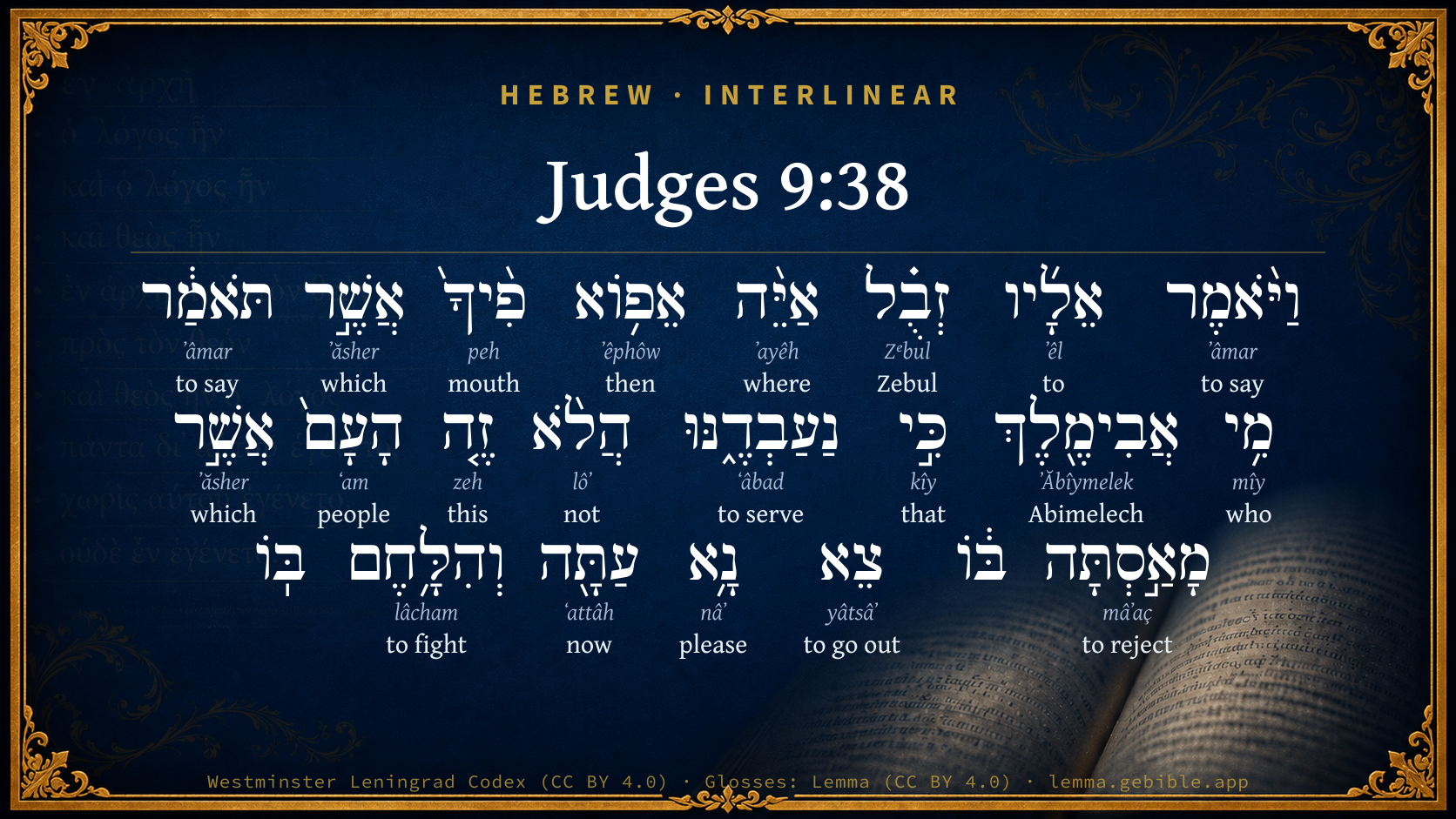
Judges 9:38

Hebrew (Westminster Leningrad Codex) Judges 9:38 appears in the Hebrew Old Testament. The text above is from the Westminster Leningrad Codex. Each word links to its Strong’s number, a concise gloss, and parsing drawn from the Open Scriptures Hebrew Bible morphology. Click any word for its full Brown-Driver-Briggs (BDB) entry.
Download image
Cite this verse

Judges 9:38 (World English Bible). Public Domain. Lemma interlinear Bible study tool, https://lemma.gebible.app/v/judges/9/38.

Show BibTeX & RIS
BibTeX
RIS
English Translation
Then said Zebul to him, Where is now your mouth, that you said, Who is Abimelech, that we should serve him? is not this the people that you have despised? go out now, I pray, and fight with them.
World English Bible · Public Domain
Download a study sheet

One document with this verse’s original text, its word-by-word gloss line, the meaning frame, cross-references with their text, attributed commentary, and full source and license credits — printable, and it pastes into notes with its structure intact.

This verse Autodidact and up

Study sheet (.html) Plain text (.txt)

A passage Seminary Student

Up to 50 verses in one chapter. A passage sheet keeps up to 6 commentary sources and 12 cross-references per verse, in the order this page ranks them, and says so on the sheet whenever that leaves anything out. Ask for a single verse and you get the Autodidact verse sheet above.

Everything on this page stays free to read, with no account — the sheet is a download of what is already on screen, not access to it.

Want to remove ads? Support Godless Engineer
Compare translations 3

The same verse in 3 English versions, stacked beneath the original-language interlinear above. Click any original word for its lexicon entry.

Each is an independent rendering of the whole verse — the interlinear is not word-aligned to these translations.

Highlighted words mark where these versions differ — a whole-verse word diff, not a word-by-word alignment.

  • World English Bible Public Domain
    Then said Zebul to him, Where is now your mouth, that you said, Who is Abimelech, that we should serve him? is not this the people that you have despised? go out now, I pray, and fight with them.
  • King James Version Public Domain
    Then said Zebul unto him, Where is now thy mouth, wherewith thou saidst, Who is Abimelech, that we should serve him? is not this the people that thou hast despised? go out, I pray now, and fight with them.
  • unfoldingWord Literal Text CC BY-SA 4.0
    Then Zebul said to him, “Where now your mouth, which you said, ‘Who Abimelech, that we should serve him?’ this not the people that you despised? Indeed, go out now and fight with it.”

unfoldingWord Literal Text — © unfoldingWord, licensed CC BY-SA 4.0. Word-aligned USFM3 via Door43 (git.door43.org/unfoldingWord/en_ult).

Versions to compare (up to 4)

3 of 4 selected

Show all 18 translations

Every available English version of this verse, each an independent rendering of the whole verse.

  • World English Bible Public Domain
    Then said Zebul to him, Where is now your mouth, that you said, Who is Abimelech, that we should serve him? is not this the people that you have despised? go out now, I pray, and fight with them.
  • Berean Standard Bible Public Domain
    “Where is your gloating now?” Zebul replied. “You said, ‘Who is Abimelech that we should serve him?’ Are these not the people you ridiculed? Go out now and fight them!”
  • Majority Standard Bible Public Domain
    “Where is your gloating now?” Zebul replied. “You said, ‘Who is Abimelech that we should serve him?’ Are these not the people you ridiculed? Go out now and fight them!”
  • King James Version Public Domain
    Then said Zebul unto him, Where is now thy mouth, wherewith thou saidst, Who is Abimelech, that we should serve him? is not this the people that thou hast despised? go out, I pray now, and fight with them.
  • American Standard Version (1901) Public Domain
    Then said Zebul unto him, Where is now thy mouth, that thou saidst, Who is Abimelech, that we should serve him? is not this the people that thou hast despised? go out now, I pray, and fight with them.
  • Revised Version (1885) Public Domain
    Then said Zebul unto him, Where is now thy mouth, that thou saidst, Who is Abimelech, that we should serve him? is not this the people that thou hast despised? go out now, I pray, and fight with them.
  • Geneva Bible (1599) Public Domain
    Then sayd Zebul vnto him, Where is now thy mouth, that said, Who is Abimelech, that we should serue him? Is not this the people that thou hast despised? Go out now, I pray thee, and fight with them.
  • Douay-Rheims (1899) Public Domain
    And Zebul said to him: Where is now thy mouth wherewith thou saidst? Who is Abimelech that we should serve him? Is not this the people which thou didst despise? Go out, and fight against him.
  • Young's Literal Translation Public Domain
    And Zebul saith unto him, `Where `is' now thy mouth, in that thou sayest, Who `is' Abimelech that we serve him? is not this the people against which thou hast kicked? go out, I pray thee now, and fight against it.'
  • Literal Standard Version CC BY-SA 4.0
    And Zebul says to him, “Where [is] your mouth now, in that you say, Who [is] Abimelech that we serve him? Is this not the people against which you have kicked? Please go out now and fight against it.”
  • Unlocked Literal Bible CC BY-SA 4.0
    Then Zebul said to him, “Where are your proud words now, you who said, 'Who is Abimelech that we should serve him?' Are these not the men you despised? Go out now and fight against them.”
  • unfoldingWord Literal Text CC BY-SA 4.0
    Then Zebul said to him, “Where now your mouth, which you said, ‘Who Abimelech, that we should serve him?’ this not the people that you despised? Indeed, go out now and fight with it.”
  • Darby Bible Public Domain
    Then Zebul said to him, "Where is your mouth now, you who said, 'Who is Abim'elech, that we should serve him?' Are not these the men whom you despised? Go out now and fight with them."
  • World Messianic Bible Public Domain
    Then Zebul said to him, “Now where is your mouth, that you said, ‘Who is Abimelech, that we should serve him?’ Isn’t this the people that you have despised? Please go out now and fight with them.”
  • Webster's Bible Public Domain
    Then said Zebul to him, Where is now thy mouth, with which thou saidst, Who is Abimelech, that we should serve him? are not these the people that thou hast despised? go out, I pray now, and fight with them.
  • Free Bible Version CC BY-SA 4.0
    “Where's your big mouth now? You're the one who said, ‘Who is this Abimelech, that we should have to serve him?’” Zebul told him. “Aren't these the people you detested? Go on then—go and fight with them!”
  • Bible in Basic English Public Domain
    Then Zebul said to him, Now where is your loud talk when you said, Who is Abimelech that we are to be his servants? Is this not the people whom you were rating so low? Go out now, and make war on them.
  • JPS Tanakh (1917) Public Domain
    Then said Zebul unto him: 'Where is now thy mouth, that thou saidst: Who is Abimelech, that we should serve him? is not this the people that thou hast despised? go out now, I pray, and fight with them.'

Literal Standard Version (2020), Covenant Press — licensed CC BY-SA 4.0. Text via the HelloAO Bible API (eBible.org). Unlocked Literal Bible (unfoldingWord) — licensed CC BY-SA 4.0. Text via the HelloAO Bible API (eBible.org). unfoldingWord Literal Text — © unfoldingWord, licensed CC BY-SA 4.0. Word-aligned USFM3 via Door43 (git.door43.org/unfoldingWord/en_ult). Free Bible Version, Dr. Jonathan Gallagher — licensed CC BY-SA 4.0. Text via the HelloAO Bible API (eBible.org).

Word by word

More ways to search: Search by grammar → Find every occurrence → Compare this word →

Practice this passage: Drill this verse → Learn its vocabulary →

זְבֻ֗ל
Zᵉbul
H2083
“Zebul”
Noun, Proper
Part of Speech
Noun
Type
Proper
Full BDB Definition

Origin: the same as H2073

TWOT: None

Zebul = "exalted" - chief man of the city of Shechem at the time of the contest between Abimelech and the native Canaanites
  1. וַיֹּ֨אמֶר ʼâmar H559 “and · to say” Conjunction + Verb, Qal, Sequential Imperfect, 3rd Person, Masculine, Singular
  2. אֵלָ֜יו ʼêl H413 “to · him” Preposition + Suffix, Personal, 3rd Person, Masculine, Singular
  3. אַיֵּ֨ה ʼayêh H346 “where” Particle, Interrogative
  4. אֵפ֥וֹא ʼêphôw H645 “then” Adverb
  5. פִ֨יךָ֙ peh H6310 “mouth · your” Noun, Common, Masculine, Singular, Construct + Suffix, Personal, 2nd Person, Masculine, Singular
  6. אֲשֶׁ֣ר ʼăsher H834 “which” Particle, Relative
  7. תֹּאמַ֔ר ʼâmar H559 “to say” Verb, Qal, Imperfect, 2nd Person, Masculine, Singular
  8. מִ֥י mîy H4310 “who” Particle, Interrogative
  9. אֲבִימֶ֖לֶךְ ʼĂbîymelek H40 “Abimelech” Noun, Proper
  10. כִּ֣י kîy H3588 “that” Conjunction
  11. נַעַבְדֶ֑נּוּ ʻâbad H5647 “to serve · us” Verb, Qal, Imperfect, 1st Person, Common, Plural + Suffix, Personal, 1st Person, Common, Plural
  12. הֲלֹ֨א lôʼ H3808 “not” Particle, Interrogative + Particle, Negative
  13. זֶ֤ה zeh H2088 “this” Pronoun, Demonstrative, Masculine, Singular
  14. הָעָם֙ ʻam H5971 “the · people” Particle, Definite Article + Noun, Common, Masculine, Singular, Absolute
  15. אֲשֶׁ֣ר ʼăsher H834 “which” Particle, Relative
  16. מָאַ֣סְתָּה mâʼaç H3988 “to reject” Verb, Qal, Perfect, 2nd Person, Masculine, Singular
  17. צֵא yâtsâʼ H3318 “go out” Verb, Qal, Imperative, 2nd Person, Masculine, Singular
  18. נָ֥א nâʼ H4994 “please” Particle, Exhortation
  19. עַתָּ֖ה ʻattâh H6258 “now” Adverb
  20. וְהִלָּ֥חֶם lâcham H3898 “and · fight” Conjunction + Verb, Niphal, Imperative, 2nd Person, Masculine, Singular

About this verse

These counts appear in no published source. They are computed here, from the morphology-tagged text and Lemma’s own curated glosses. What Lemma adds →

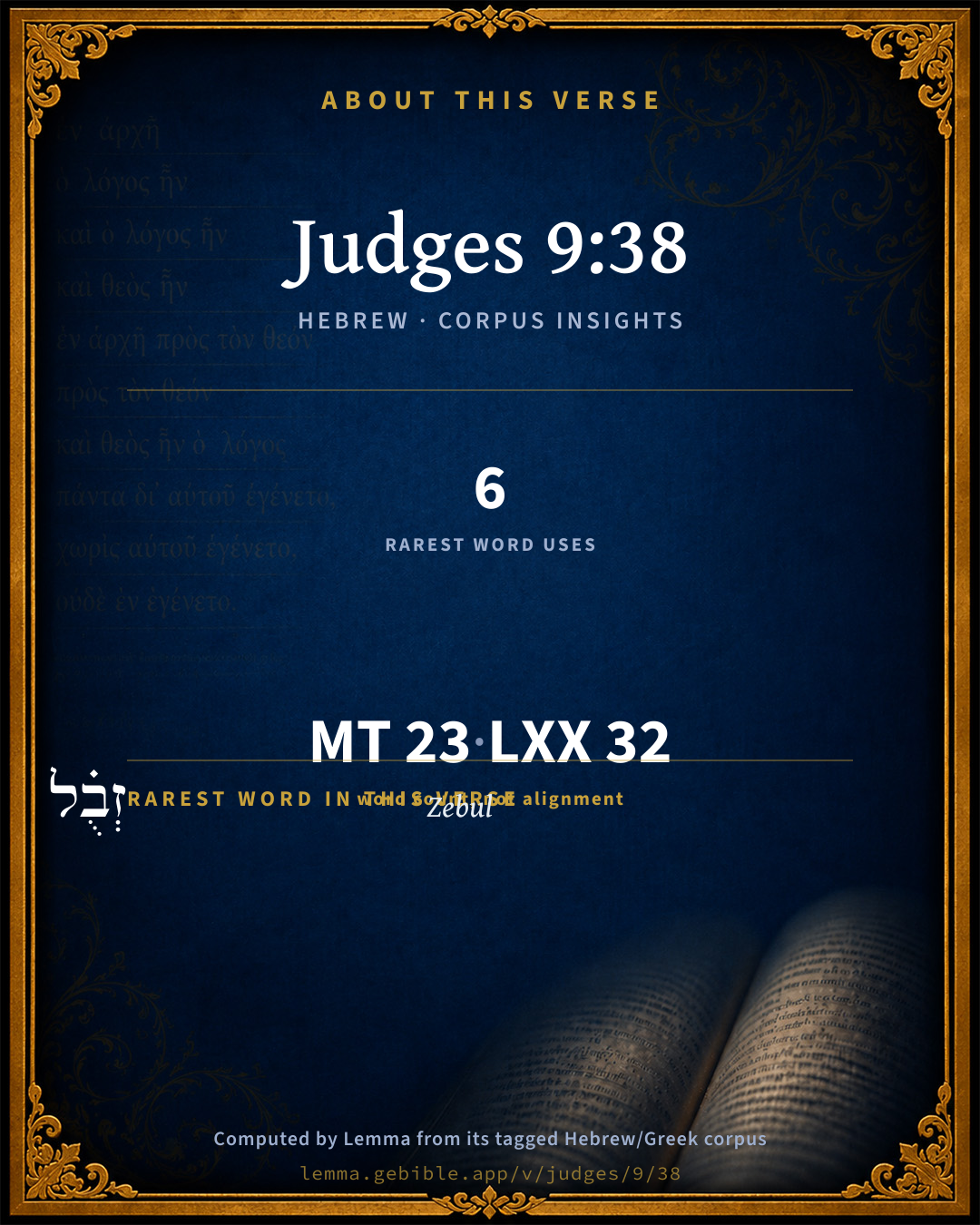
23
words
19
distinct lemmas
Historical
section

Notable vocabulary

The rarest word here is זְבֻ֗ל Zebul H2083 — appearing just 6 times in the whole Hebrew Bible.

Shared distinctive vocabulary

זְבֻ֗ל Zebul H2083 occurs in 5 verses of the Hebrew Bible. Also found in:

Grammatical profile

  • 6 verbs
  • 4 nouns
  • 1 pronoun
  • 3 prepositions
  • 1 conjunction
  • 2 adverbs
  • 6 particles

Verb forms

  • וַיֹּ֨אמֶר Qal · Sequential Imperfect
  • תֹּאמַ֔ר Qal · Imperfect
  • נַעַבְדֶ֑נּוּ Qal · Imperfect
  • מָאַ֣סְתָּה Qal · Perfect
  • צֵא Qal · Imperative
  • וְהִלָּ֥חֶם Niphal · Imperative

Repetition

Words recur within this verse — often emphatic in Hebrew:

  • וַיֹּ֨אמֶר to say H559 ×2
  • אֲשֶׁ֣ר which H834 ×2

Hebrew & Septuagint length

In English translation the verse runs 39 words from the Hebrew and 40 from the Septuagint (LXX English) — closely comparable.

A rough comparison of the two English renderings, which tokenize alike — not a word-level alignment.

Word counts can differ between the Hebrew and the Greek without any difference in meaning — e.g. the Hebrew direct-object marker אֵת has no separate Greek word, and Greek often adds the article ὁ.

In the original languages it is 23 Hebrew tokens and 32 Greek tokens — but the two are counted differently (Hebrew bundles its prefixes and suffixes into one token; the Greek is in lemma form), so that isn’t a like-for-like length.

Cross-references

4

Topical passages linked to Judges 9:38 in the Treasury of Scripture Knowledge — connected by theme and wording, ordered by reader-vote popularity; previews shown in the World English Bible.

  • Judges 9:28–29 Gaal the son of Ebed said, Who is Abimelech, and who is Shechem, that we should serve him? Isn't he the son of Jerubbaal? and Zebul his officer? serve you the men of Hamor the father of Shechem: but why should we serve him?
  • 2 Samuel 2:26–27 Then Abner called to Joab, and said, "Shall the sword devour forever? Don't you know that it will be bitterness in the latter end? How long shall it be then, before you bid the people return from following their brothers?"
  • 2 Kings 14:8–14 Then Amaziah sent messengers to Jehoash, the son of Jehoahaz son of Jehu, king of Israel, saying, Come, let us look one another in the face.
  • Jeremiah 2:28 But where are your gods that you have made you? let them arise, if they can save you in the time of your trouble: for according to the number of your cities are your gods, Judah.

Cross-references courtesy of OpenBible.info (CC BY 4.0).

Hebrew and Greek witnesses Masoretic Hebrew ↔ Greek Septuagint

The same verse in the two great witnesses to the Old Testament, shown verse-for-verse.

These are two independent witnesses, not word-aligned to each other, and the Septuagint is shown in lemma (dictionary) form.

Hebrew Judges 9:38 Masoretic · Westminster Leningrad Codex

וַיֹּ֨אמֶר אֵלָ֜יו זְבֻ֗ל אַיֵּ֨ה אֵפ֥וֹא פִ֨יךָ֙ אֲשֶׁ֣ר תֹּאמַ֔ר מִ֥י אֲבִימֶ֖לֶךְ כִּ֣י נַעַבְדֶ֑נּוּ הֲלֹ֨א זֶ֤ה הָעָם֙ אֲשֶׁ֣ר מָאַ֣סְתָּה בּ֔וֹ צֵא נָ֥א עַתָּ֖ה וְהִלָּ֥חֶם בּֽוֹ

Then said Zebul to him, Where is now your mouth, that you said, Who is Abimelech, that we should serve him? is not this the people that you have despised? go out now, I pray, and fight with them.

World English Bible · Public Domain

Greek LXX Judges 9:38 Septuagint · lemma form

καί εἶπον πρός αὐτός ζεβουλ καί ποῦ εἰμί ὁ στόμα σύ ὡς λαλέω τίς εἰμί αβιμελεχ ὅτι δουλεύω αὐτός μή οὐ οὗτος ὁ λαός ὅς ἐκοὐδενόω ἐκἔρχομαι δή νῦν καί παρατάσσω αὐτός

And Zebul said to him, And where is your mouth as you spoke, Who is Abimelech that we should serve him? Is not this the people whom you despised? go forth now, and set the battle in array against him.

LXX2012 (modern English Septuagint) · Public Domain

Hebrew: Westminster Leningrad Codex (CC BY 4.0). Greek: Septuagint (public domain); English from LXX2012 (modern English Septuagint) (Public Domain). How the Septuagint differs from the Hebrew →

Targum (Aramaic paraphrase)

1

The Targum is the ancient Jewish Aramaic paraphrase of the Hebrew Scriptures — an interpretive translation, not the Hebrew text itself. Onkelos (literal) and Pseudo-Jonathan (expansive) render the Torah, and Jonathan the Prophets. Coverage is partial: where no permissively-licensed English translation exists for a verse, only the Aramaic is shown. This is verse-level text, not a word-by-word alignment to the Hebrew.

  1. Targum Jonathan Prophets (Joshua–Malachi)
    וַאֲמַר לֵיהּ זְבוּל אָן אִנוּן פִּתְגָמָךְ דִי אַתְּ אֲמַר מַן אֲבִימֶלֶךְ אֲרֵי נִפְלְחִינֵיהּ הֲלָא דֵין עַמָא דְקַצְתָּא בֵּיהּ פּוּק כְעַן וַאֲגַח קְרָבָא בֵּיהּ:

    (no public-domain English translation for this verse)

    Targum Jonathan — Aramaic: “Mikraot Gedolot” (public domain). English: “Sefaria Community Translation” (CC0 1.0 (public-domain dedication)); “London "Chaldee Paraphrase," 1871” (public domain). Text via Sefaria.

Commentary

Notes on Judges 9:38 from classic Christian and Jewish commentators (each source and its license shown beneath its notes). The classic Christian expositions comment on the surrounding passage and are grouped to its opening verse, so a note may address several verses; the Jewish commentaries on the Tanakh (Rashi and others) are per-verse, so they appear only where the commentator wrote on this verse.

Lemma curates 59 commentaries, every one of them public domain or Creative Commons licensed, each selected and text-cleaned for this edition rather than reprinted as found. About our sources →

Trapp's Complete Commentary

John Trapp

Jdg 9:38 Then said Zebul unto him, Where [is] now thy mouth, wherewith thou saidst, Who [is] Abimelech, that we should serve him? [is] not this the people that thou hast despised? go out, I pray now, and fight with them.

Ver. 38. Where is now thy mouth?] Thy bubbles of words, thy thrasonical boastings? Now play the man, and fight the approaching enemy, or thou art shamed for ever.

John Trapp, A Commentary or Exposition upon All the Books of the Old and New Testament (1647–1656) — public domain. Text from a community e-Sword module.

Joseph Benson's Commentary

Jdg 9:38-40. Then said Zebul, Where is now thy mouth, &c. — Now show thyself a man, and fight valiantly for thyself and the people. And he fled — Being surprised by the unexpected coming of Abimelech, and probably not fully prepared for the encounter.

Joseph Benson's Commentary on the Old and New Testaments (1811–1818) — public domain. Text from a community e-Sword module.

Ellicott's Commentary for English Readers

(38) Where is now thy mouth . . .?—“Mouth” here means boastfulness. This is usually taken as a bitter taunt, as though Zebul could now safely throw off his deceitful acquiescence in Gaal’s plans. It may be so, for the narrative gives us no further details; but unless Zebul was in some way secured by his own adherents from Gaal’s immediate vengeance, it seems better to take it as a sort of expostulation against Gaal’s past rashness.

A Bible Commentary for English Readers, edited by Charles John Ellicott (1878–1897) — public domain. Text from a community e-Sword module.

The Cambridge Bible for Schools and Colleges

gen. ed. J. J. S. Perowne

38. thy mouth] i.e. thy boastful mockery; cf. Isa_57:4, Psa_35:21, Job_16:10.

The Cambridge Bible for Schools and Colleges (gen. ed. J. J. S. Perowne; Cambridge University Press, 1878–1918) — public domain. Text from a community e-Sword module.

John Gill's Exposition

And Gaal went out before the men of Shechem,.... At the head of them, to meet Abimelech, having gathered together as many, and put them in as good order, as he could, and the time would admit of:

and fought with Abimelech; without the city.

John Gill's Exposition of the Whole Bible (1746–1763) — public domain (CC PDM 1.0). Text via the HelloAO Bible API.

Matthew Poole's English Annotations

Thy mouth, i.e. thy brags. Now thou betrayest thy fears; and therefore now show thyself a man, and fight valiantly for thyself and people.

Matthew Poole's English Annotations on the Holy Bible (1683–1685) — public domain. Text from a community e-Sword/MySword module.

Whedon's Commentary on the Bible

Daniel D. Whedon

38. Thy mouth — Zebul now suddenly flings off the mask, and upbraids Gaal for his recent swaggering and his present apparent cowardice, and provokes him to go forth to the battle, in which he is miserably defeated.

Daniel D. Whedon (gen. ed.), Commentary on the Old and New Testaments (1874–1909) — public domain. Text from a community e-Sword module.

The Pulpit Commentary

Then said Zebul, etc. Zebul now throws off the mask, and dares Gaal to carry out his boast in ver. 28.

The Pulpit Commentary (1880–1919), ed. H.D.M. Spence-Jones & Joseph S. Exell — public domain. Text from a community e-Sword module.

John Wesley's Explanatory Notes

Where is now, &c. - Now shew thyself a man, and fight valiantly for thyself and people.

John Wesley, Explanatory Notes Upon the Whole Bible (1754–1765) — public domain. Text via the GEBible commentary corpus.

Keil & Delitzsch

C. F. Keil & F. Delitzsch

Then Zebul declared openly against Gaal, and reproached him with his foolhardy speech, whilst Abimelech was drawing nearer with his troops: "Where is thy mouth now with which thou saidst, Who is Abimelech? Is not this the people that thou hast despised? Go out now and fight with him!"

Keil & Delitzsch — Biblical Commentary on the Old Testament (1861–1891) — public domain (CC PDM 1.0). Text via the HelloAO Bible API. (Old Testament only.)

unfoldingWord translationNotes

Door43 World Missions Community

Zebul

See how you translated this name in Judges 9:28.

Where are your proud words now, you

Zebul is scolding Gaal with this rhetorical question. AT: "You are not speaking proudly now, you" or "You are not proud now, you" (See: Rhetorical Question)

you who said, 'Who is Abimelech that we should serve him?'

Zebul is quoting Gaal's boast back to Gaal. This can be translated as a statement and as an indirect quote. AT: "you who said that we should not serve Abimelech." (See: Rhetorical Question and Direct and Indirect Quotations)

Are these not the men you despised?

Zebul is challenging Gaal with this rhetorical question. This question can be translated as a statement. AT: "Here are the men that you despised." (See: Rhetorical Question)

despised

strongly disliked or hated

Gaal

See how you translated this name in Judges 9:26.

Many fell with deadly wounds

This is an idiom. AT: "And many men died of wounds" (See: Idiom)

translationWords

proud

Abimelech

servant

Shechem

gate

unfoldingWord translationNotes — © Distant Shores Media and the Door43 World Missions Community, licensed CC BY-SA 4.0. Source: git.door43.org/Door43/en_tn.

Lesson kit

Teaching starters — assembled from the data on this page, not authored interpretation. Every prompt links to the verse data it draws on. Edit before teaching.

Judges, in the Historical, opens this verse with 23 words (19 distinct Hebrew lemmas). Its most distinctive word is Zᵉbul (“Zebul”). A historical commentator’s framing appears above. Read the whole chapter for the surrounding context.

Discussion questions

  1. What does “Zebul” (Zᵉbul) contribute to the verse as a whole?
  2. Judges 9:28 shares the word «Zebul» with this verse. How do the two illuminate each other?
  3. “to say” occurs 2× in this one verse. What is the effect of the repetition?
  4. These translations render this verse differently. What is at stake in choosing one wording over another?
  5. The verb «וַיֹּ֨אמֶר» is Qal Sequential Imperfect. How does its form color the action?
  6. Reading how Trapp's Complete Commentary and Joseph Benson's Commentary read this verse, where do the two commentators agree and where do they part?

Things to notice

Reading settings

Reading text

Shown beneath each verse's original-language words.

Old Testament
Old Testament edition

Read the OT as the Masoretic Hebrew (MT) or the Greek Septuagint (LXX).

English shown for the Greek Septuagint (in the Hebrew ↔ Greek comparison).

Comparing translations? Open the Compare panel on any verse page to stack up to four side by side.