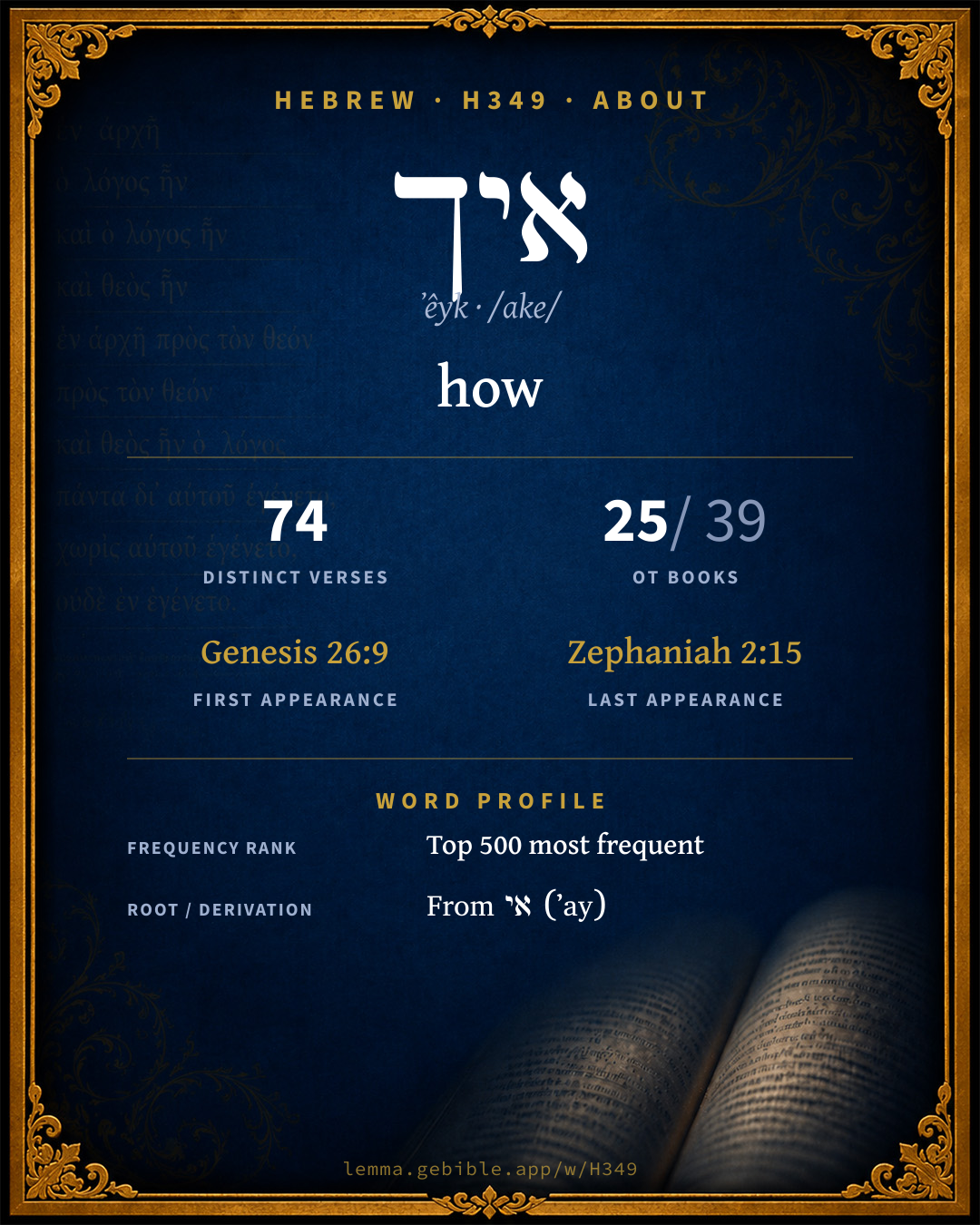
אֵיךְ
how
‘how’ is one of 3 main senses fuller range ↓
Full lexicon entry — Brown-Driver-Briggs (BDB)
From Brown-Driver-Briggs (BDB)
Where this word appears
Grammar key — what these labels mean
Part of speech
- Particle
- A short function word — article, negation, interrogative, the sign of the direct object, and the like.
Every verse where H349 appears — 74 distinct verses across 25 books. Click any verse to open its interlinear word-by-word view. Verse text shown in the World English Bible for context — . Each verse’s Hebrew form is shown with its reference; the English is not keyword-highlighted, since the data carries no word-level English alignment. Use “Compare translations” on any verse to read it across multiple English versions. This concordance covers the Hebrew Bible; Septuagint (Greek Old Testament) occurrences are not indexed here.
Genesis 4 verses
- Genesis 26:9 וְ/אֵ֥יךְ conj + ptcl inter Abimelech called Isaac, and said, "Behold, surely she is your wife. Why did you say, 'She is my sister?'" Isaac said to him, "Because I said, 'Lest I die because of her.'"
- Genesis 39:9 וְ/אֵ֨יךְ conj + ptcl inter He isn't greater in this house than I, neither has he kept back anything from me but you, because you are his wife. How then can I do this great wickedness, and sin against God?"
- Genesis 44:8 וְ/אֵ֗יךְ conj + ptcl inter Behold, the money, which we found in our sacks' mouths, we brought again to you out of the land of Canaan. How then should we steal silver or gold out of your lord's house?
- Genesis 44:34 אֵיךְ֙ ptcl inter For how will I go up to my father, if the boy isn't with me? Lest I see the evil that will come on my father."
Exodus 2 verses
- Exodus 6:12 וְ/אֵיךְ֙ conj + ptcl inter Moses spoke before Yahweh, saying, "Behold, the children of Israel haven't listened to me. How then shall Pharaoh listen to me, who am of uncircumcised lips?"
- Exodus 6:30 וְ/אֵ֕יךְ conj + ptcl inter Moses said before Yahweh, "Behold, I am of uncircumcised lips, and how shall Pharaoh listen to me?"
Deuteronomy 5 verses
- Deuteronomy 1:12 אֵיכָ֥ה ptcl inter How can I myself alone bear your encumbrance, and your burden, and your strife?
- Deuteronomy 7:17 אֵיכָ֥ה ptcl inter If you shall say in your heart, These nations are more than I; how can I dispossess them?
- Deuteronomy 12:30 אֵיכָ֨ה ptcl inter take heed to yourself that you not be ensnared to follow them, after that they are destroyed from before you; and that you not inquire after their gods, saying, How do these nations serve their gods? even so will I do likewise.
- Deuteronomy 18:21 אֵיכָה֙ ptcl inter If you say in your heart, How shall we know the word which Yahweh has not spoken?
- Deuteronomy 32:30 אֵיכָ֞ה ptcl inter How should one chase a thousand, Two put ten thousand to flight, Except their Rock had sold them, Yahweh had delivered them up?
Joshua 1 verse
Judges 2 verses
- Judges 16:15 אֵ֚יךְ ptcl inter She said to him, How can you say, I love you, when your heart is not with me? you have mocked me these three times, and have not told me in which your great strength lies.
- Judges 20:3 אֵיכָ֥ה ptcl inter (Now the children of Benjamin heard that the children of Israel had gone up to Mizpah.) The children of Israel said, Tell us, how was this wickedness brought to pass?
Ruth 1 verse
1 Samuel 1 verse
2 Samuel 8 verses
- 2 Samuel 1:5 אֵ֣יךְ ptcl inter David said to the young man who told him, How know you that Saul and Jonathan his son are dead?
- 2 Samuel 1:14 אֵ֚יךְ ptcl inter David said to him, How were you not afraid to put forth your hand to destroy Yahweh's anointed?
- 2 Samuel 1:19 אֵ֖יךְ ptcl inter Your glory, Israel, is slain on your high places! How are the mighty fallen!
- 2 Samuel 1:25 אֵ֚יךְ ptcl inter How are the mighty fallen in the midst of the battle! Jonathan is slain on your high places.
- 2 Samuel 1:27 אֵ֚יךְ ptcl inter How are the mighty fallen, The weapons of war perished!
- 2 Samuel 2:22 וְ/אֵיךְ֙ conj + ptcl inter Abner said again to Asahel, Turn you aside from following me: why should I strike you to the ground? how then should I hold up my face to Joab your brother?
- 2 Samuel 6:9 אֵ֛יךְ ptcl inter David was afraid of Yahweh that day; and he said, How shall the ark of Yahweh come to me?
- 2 Samuel 12:18 וְ/אֵ֨יךְ conj + ptcl inter It happened on the seventh day, that the child died. The servants of David feared to tell him that the child was dead; for they said, Behold, while the child was yet alive, we spoke to him, and he didn't listen to our voice: how will he then vex himself, if we tell him that the child is dead!
1 Kings 1 verse
2 Kings 4 verses
- 2 Kings 6:15 אֵיכָ֥ה ptcl inter When the servant of the man of God was risen early, and gone forth, behold, a host with horses and chariots was round about the city. His servant said to him, Alas, my master! how shall we do?
- 2 Kings 10:4 וְ/אֵ֖יךְ conj + ptcl inter But they were exceedingly afraid, and said, Behold, the two kings didn't stand before him: how then shall we stand?
- 2 Kings 17:28 אֵ֖יךְ ptcl inter So one of the priests whom they had carried away from Samaria came and lived in Bethel, and taught them how they should fear Yahweh.
- 2 Kings 18:24 וְ/אֵ֣יךְ conj + ptcl inter How then can you turn away the face of one captain of the least of my master's servants, and put your trust on Egypt for chariots and for horsemen?
2 Chronicles 1 verse
Esther 1 verse
Job 1 verse
Psalms 4 verses
- Psalms 11:1 אֵ֭יךְ ptcl inter In Yahweh, I take refuge. How can you say to my soul, "Flee as a bird to your mountain!"
- Psalms 73:11 אֵיכָ֥ה ptcl inter They say, "How does God know? Is there knowledge in the Most High?"
- Psalms 73:19 אֵ֤יךְ ptcl inter How they are suddenly destroyed! They are completely swept away with terrors.
- Psalms 137:4 אֵ֗יךְ ptcl inter How can we sing Yahweh's song in a foreign land?
Proverbs 1 verse
Ecclesiastes 2 verses
- Ecclesiastes 2:16 וְ/אֵ֛יךְ conj + ptcl inter For of the wise man, even as of the fool, there is no memory for ever, seeing that in the days to come all will have been long forgotten. Indeed, the wise man must die just like the fool!
- Ecclesiastes 4:11 אֵ֥יךְ ptcl inter Again, if two lie together, then they have warmth; but how can one keep warm alone?
Song of Solomon 2 verses
- Song of Solomon 1:7 אֵיכָ֣ה אֵיכָ֖ה ptcl inter ptcl inter Tell me, you whom my soul loves, Where you graze your flock, Where you rest them at noon; For why should I be as one who is veiled Beside the flocks of your companions? Lover
- Song of Solomon 5:3 אֵיכָ֖כָה אֵיכָ֥כָה ptcl inter ptcl inter I have taken off my robe. Indeed, must I put it on? I have washed my feet. Indeed, must I soil them?
Isaiah 7 verses
- Isaiah 1:21 אֵיכָה֙ ptcl inter How the faithful city has become a prostitute! She was full of justice; righteousness lodged in her, But now murderers.
- Isaiah 14:4 אֵ֚יךְ ptcl inter that you shall take up this parable against the king of Babylon, and say, How has the oppressor ceased! the golden city ceased!
- Isaiah 14:12 אֵ֛יךְ ptcl inter How you are fallen from heaven, day-star, son of the morning! How you are cut down to the ground, who laid the nations low!
- Isaiah 19:11 אֵ֚יךְ ptcl inter The princes of Zoan are utterly foolish; the counsel of the wisest counselors of Pharaoh is become brutish: how do you say to Pharaoh, I am the son of the wise, the son of ancient kings?
- Isaiah 20:6 וְ/אֵ֖יךְ conj + ptcl inter The inhabitant of this coast-land shall say in that day, Behold, such is our expectation, where we fled for help to be delivered from the king of Assyria: and we, how shall we escape?
- Isaiah 36:9 וְ/אֵ֣יךְ conj + ptcl inter How then can you turn away the face of one captain of the least of my master's servants, and put your trust on Egypt for chariots and for horsemen?
- Isaiah 48:11 אֵ֣יךְ ptcl inter For my own sake, for my own sake, will I do it; for how should [my name] be profaned? and my glory I will not give to another.
Jeremiah 15 verses
- Jeremiah 2:21 וְ/אֵיךְ֙ conj + ptcl inter Yet I had planted you a noble vine, wholly a right seed: how then are you turned into the degenerate branches of a foreign vine to me?
- Jeremiah 2:23 אֵ֣יךְ ptcl inter How can you say, I am not defiled, I have not gone after the Baals? see your way in the valley, know what you have done: [you are] a swift dromedary traversing her ways;
- Jeremiah 3:19 אֵ֚יךְ ptcl inter But I said, How I will put you among the children, and give you a pleasant land, a goodly heritage of the hosts of the nations! and I said, You shall call me My Father, and shall not turn away from following me.
- Jeremiah 8:8 אֵיכָ֤ה ptcl inter How do you say, We are wise, and the law of Yahweh is with us? But, behold, the false pen of the scribes has worked falsely.
- Jeremiah 9:7 אֵ֣יךְ ptcl inter Therefore thus says Yahweh of Hosts, Behold, I will melt them, and try them; for how [else] should I do, because of the daughter of my people?
- Jeremiah 9:19 אֵ֣יךְ ptcl inter For a voice of wailing is heard out of Zion, How are we ruined! we are greatly confounded, because we have forsaken the land, because they have cast down our dwellings.
- Jeremiah 12:5 וְ/אֵ֥יךְ וְ/אֵ֥יךְ conj + ptcl inter conj + ptcl inter If you have run with the footmen, and they have wearied you, then how can you contend with horses? and though in a land of peace you are secure, yet how will you do in the pride of the Jordan?
- Jeremiah 36:17 אֵ֗יךְ ptcl inter They asked Baruch, saying, Tell us now, How did you write all these words at his mouth?
- Jeremiah 47:7 אֵ֣יךְ ptcl inter How can you be quiet, seeing Yahweh has given you a charge? Against Ashkelon, and against the sea-shore, there has he appointed it.
- Jeremiah 48:14 אֵ֚יךְ ptcl inter How say you, We are mighty men, and valiant men for the war?
- Jeremiah 48:17 אֵיכָ֤ה ptcl inter All you who are round about him, bemoan him, and all you who know his name; say, How is the strong staff broken, the beautiful rod!
- Jeremiah 48:39 אֵ֥יךְ אֵ֛יךְ ptcl inter ptcl inter How is it broken down! [how] do they wail! how has Moab turned the back with shame! so shall Moab become a derision and a terror to all who are round about him.
- Jeremiah 49:25 אֵ֥יךְ ptcl inter How is the city of praise not forsaken, the city of my joy?
- Jeremiah 50:23 אֵ֤יךְ אֵ֣יךְ ptcl inter ptcl inter How is the hammer of the whole earth cut apart and broken! how is Babylon become a desolation among the nations!
- Jeremiah 51:41 אֵ֚יךְ אֵ֣יךְ ptcl inter ptcl inter How is Sheshach taken! and the praise of the whole earth seized! how is Babylon become a desolation among the nations!
Lamentations 4 verses
- Lamentations 1:1 אֵיכָ֣ה ptcl inter How does the city sit solitary, that was full of people! She has become as a widow, who was great among the nations! She who was a princess among the provinces is become tributary!
- Lamentations 2:1 אֵיכָה֩ ptcl inter How has the Lord covered the daughter of Zion with a cloud in his anger! He has cast down from heaven to the earth the beauty of Israel, And hasn't remembered his footstool in the day of his anger.
- Lamentations 4:1 אֵיכָה֙ ptcl inter How is the gold become dim! [how] is the most pure gold changed! The stones of the sanctuary are poured out at the head of every street.
- Lamentations 4:2 אֵיכָ֤ה ptcl inter The precious sons of Zion, comparable to fine gold, How are they esteemed as earthen pitchers, the work of the hands of the potter!
Ezekiel 2 verses
- Ezekiel 26:17 אֵ֣יךְ ptcl inter They shall take up a lamentation over you, and tell you, How are you destroyed, who were inhabited by seafaring men, the renowned city, who was strong in the sea, she and her inhabitants, who caused their terror to be on all who lived there!
- Ezekiel 33:10 וְ/אֵ֥יךְ conj + ptcl inter You, son of man, tell the house of Israel: Thus you speak, saying, Our transgressions and our sins are on us, and we pine away in them; how then can we live?
Hosea 1 verse
Obadiah 2 verses
- Obadiah 1:5 אֵ֣יךְ ptcl inter If thieves came to you, if robbers by night-- oh, what disaster awaits you--wouldn't they only steal until they had enough? If grape pickers came to you, wouldn't they leave some gleaning grapes?
- Obadiah 1:6 אֵ֚יךְ ptcl inter How Esau will be ransacked! How his hidden treasures are sought out!
Micah 1 verse
Zephaniah 1 verse
About this entry
At a glance — auto-summarized from this page’s data, not written by a person. Every figure links to its source below. This summary describes the numbers; it doesn’t interpret them.
The Hebrew word איך centers on the idea of “how.” Its earliest occurrence is Genesis 26:9. The Hebrew Bible uses it across 74 verses — moderately common. The lexicon spreads it across several senses; see its full sense range. Sharing its root, it stands alongside אי, אי and איה. Dig into 74-verse concordance and the renderings breakdown below.
Gloss history
Strong's 1890 vs modern scholarship
About this word
Strong's H349 catalogs a Hebrew word from the Hebrew Old Testament.
These counts are not copied from any lexicon or concordance. They are computed here, from the morphology-tagged Hebrew Old Testament. What Lemma adds →
- 74
- distinct verses
- The word appears in 74 distinct verses.
- 25 / 39
- OT books
- The word appears in 25 of 39 Old Testament books.
- #487
- by frequency
- Top 500 most frequent Hebrew words (rank 487 of 8,640 Hebrew words by occurrence).
View all 74 occurrences in the concordance →
By section of the Old Testament
By traditional corpus
Conventional, traditional groupings — biblical authorship is debated, so this is a traditional corpus grouping, not an authorship claim. Each share is this word’s portion of its verses in that division of the Hebrew canon. Each figure is a share of the word’s 74 distinct verses.
- Prophets (Nevi'im) 46 verses · 62%
- Writings (Ketuvim) 17 verses · 23%
- Torah (Pentateuch) 11 verses · 15%
How translations render this word
Counts come from each version’s own published word-to-Strong’s tagging or interlinear alignment — an approximate guide to how each version renders this word, not a word-level alignment the data otherwise carries. Because each total is that version’s own tagged count, the per-version totals vary from one another and need not match the appearance or distinct-verse counts above. These counts may also differ from a printed concordance because Lemma counts each distinctly tagged rendering and does not collapse phrase taggings into a single head-word total. This is a fixed set of word-tagged versions (KJV, ASV, BSB, ULT) and does not change with the reading translation you choose elsewhere. Each version’s license is shown beside its name below (and on Sources).
BDB lists this Strong’s number as 4 distinct words (homographs). Each count above pools all of them and is not split by sense — see the Senses section below. A low-frequency rendering may belong to a different one of those words, not the primary meaning.
- King James Version†: How 6×
- American Standard Version†: How 5×
- Berean Standard Bible†: How 65×, What 5×, Why 4×
- unfoldingWord Literal Text†: How 66×, Where 2×
King James Version Public Domain
Renders H349 across 10† tagged occurrences — most commonly:
Plus 4 renderings that appear only once — usually multi-word phrases or single function words the recovered tagging swept in, not distinct renderings.
American Standard Version Public Domain
Renders H349 across 11† tagged occurrences — most commonly:
Plus 6 renderings that appear only once — usually multi-word phrases or single function words the recovered tagging swept in, not distinct renderings.
Berean Standard Bible Public Domain
Renders H349 across 82† tagged occurrences — most commonly:
Plus 2 renderings that appear only once — usually multi-word phrases or single function words the recovered tagging swept in, not distinct renderings.
unfoldingWord Literal Text CC BY-SA 4.0
Renders H349 across 73† tagged occurrences — most commonly:
Plus 5 renderings that appear only once — usually multi-word phrases or single function words the recovered tagging swept in, not distinct renderings.
Senses in the full BDB
What do BDB’s symbols mean?
BDB uses these scholarly abbreviations:
| Symbol | Meaning |
|---|---|
| 𝔊 | the Septuagint (the ancient Greek translation, LXX) |
| 𝔙 | the Vulgate (the Latin translation) |
| 𝔖 | the Syriac version (the Peshitta) |
| 𝔗 | the Targum (the Aramaic translation) |
| ψ | the Psalms |
| √ | root (the underlying root or stem) |
| ‖ | parallel passage (a synonymous or contrasted parallel) |
| † | the dagger: every passage where the word occurs is cited |
The 5 senses and sub-senses the full Brown-Driver-Briggs lexicon distinguishes for this word, in lexicon order (not ranked by frequency), with BDB’s own verbatim wording and sub-sense lettering. Shown in Hebrew script with BDB’s own scholarly abbreviations. The condensed entry is in the Lexicon Entry tab. See also the Forms in the corpus table below.
איך I (Aramaic אֵיךְ, ܐܰܝܟ [pron. âch]) adv.
- 1. interrog. How? Gn 26:9 2 S 1:5, 14 1 K 12:6 Is 20:6 al.; of. with impf. (esp. in 1 ps.) in an expostulation Gn 39:9; 44:8, 34 Jos 9:7 2 S 2:22; 12:18 ψ 137:4, Is 48:11 for how should it be profaned? איך תאמר(ו) how canst or dost thou (do you) say …? Ju 16:15 Is 19:11 Je 2:23 (cf. 8:8 אֵיכָה) 48:14 ψ 11:1; in an indirect sentence 2 K 17:28 Je 36:17 Ru 3:18. e.g. Genesis 26:9
- 2. as an exclam. How! whether of lamentation 2 S 1:19 Je 2:21; 9:18 Mi 2:4 Ec 2:16; or of satisfaction Is 14:4, 12 Je 48:39; 51:41 Ob 5 al.; with intensive force = how gladly! Je 3:19, how terribly! 9:6 (but others render here ‘for how [else] should I do’? etc.), Ho 11:8 acc. to Hi. e.g. 2 Samuel 1:19
איך II (from אַי and כָּה = כֹּה
- 1. interrog. In what manner? τίνι τρόπῳ; (rather more definite than אֵיךְ = πῶς;) Dt 1:12; 7:17; 12:30; 18:21; 32:30 Ju 20:3 (indirect sentence) 2 K 6:15 Je 8:8 ψ 73:11. e.g. Deuteronomy 1:12
- 2. exclam. How! (slightly more emph. than אֵיךְ) Is 1:21 Je 48:17 La 1:1; 2:1; 4:1, 2. e.g. Isaiah 1:21
- 3. Where? (prob. north-Isr.; cf. Aramaic אֵיכָא, ܐܰܝܟܳܐ where? Cf. DrIntr. 178, 421) only 2 K 6:13 (K3 אֵיכֹה) Kt Ct 1:7(×2),—each time in an indirect sentence. e.g. 2 Kings 6:13
איך III (Ct) אֵֽיכָכָ֫ה (Est) (from אַי & כָּ֫כָה thus) How? only Ct 5
Senses from the full Brown-Driver-Briggs lexicon (Brown, Driver, Briggs; Oxford 1906 — public domain), digitized via Sefaria, supplemented by the OpenScriptures HebrewLexicon (CC BY 4.0). Full attribution on Sources.
Word origin
I. (Aramaic אֵיךְ, ܐܰܝܟ [pron. âch]) adv.
I. (from אַי and כָּה = כֹּה; cf. As. ekiam) adv.
I. (Ct) אֵֽיכָכָ֫ה (Est) (from אַי & כָּ֫כָה thus) How? only Ct 5:3(×2) Est 8:6(×2).
— Brown-Driver-Briggs (Oxford 1906, public domain), digitized via Sefaria, supplemented by the OpenScriptures HebrewLexicon (CC BY 4.0). See Sources.
Derived from אי (ʼay) (H335) — where.
Jastrow Dictionary
A second Hebrew/Aramaic lexicon for comparison, covering Aramaic and post-biblical (Talmudic, Targumic, Midrashic) usage that the biblical-Hebrew BDB does not. Matched by lemma rather than by Strong’s number, so a lemma may carry more than one Jastrow headword (shown separately below), and the entries cover usage well beyond the Bible.
אֵיךְ
- as, how. Targ. Prov. XX, 20; a. fr.
A Dictionary of the Targumim, the Talmud Babli and Yerushalmi, and the Midrashic Literature (Marcus Jastrow; London, Luzac, 1903) — Public Domain. Digitized via Sefaria. Digitized via Sefaria. Full attribution on Sources.
Forms in the corpus
The 31 distinct written forms H349 takes in the Hebrew Bible, most frequent first — each parse links to that state’s occurrences in the concordance. Hebrew forms include their vowel points and cantillation, so a single lemma takes many written forms.
| Form | Parsing | Example | Uses |
|---|---|---|---|
| אֵ֚יךְ | Particle, Interrogative | Hosea 11:8 | 14 |
| אֵ֣יךְ | Particle, Interrogative | Ezekiel 26:17 | 12 |
| אֵיכָ֥ה | Particle, Interrogative | Deuteronomy 1:12 | 5 |
| וְ/אֵ֥יךְ | Particle, Interrogative | Ezekiel 33:10 | 4 |
| אֵ֖יךְ | Particle, Interrogative | 2 Kings 17:28 | 3 |
| אֵ֛יךְ | Particle, Interrogative | 2 Samuel 6:9 | 3 |
| אֵ֥יךְ | Particle, Interrogative | Ecclesiastes 4:11 | 3 |
| אֵיכָ֤ה | Particle, Interrogative | Jeremiah 8:8 | 3 |
| אֵיכָה֙ | Particle, Interrogative | Deuteronomy 18:21 | 3 |
| וְ/אֵ֖יךְ | Particle, Interrogative | 2 Kings 10:4 | 3 |
| וְ/אֵיךְ֙ | Particle, Interrogative | Exodus 6:12 | 3 |
| אֵ֗יךְ | Particle, Interrogative | Jeremiah 36:17 | 2 |
| אֵ֤יךְ | Particle, Interrogative | Jeremiah 50:23 | 2 |
| אֵ֭יךְ | Particle, Interrogative | Proverbs 5:12 | 2 |
| אֵיכָ֣ה | Particle, Interrogative | Lamentations 1:1 | 2 |
| וְ/אֵ֣יךְ | Particle, Interrogative | 2 Kings 18:24 | 2 |
| וְ/אֵ֨יךְ | Particle, Interrogative | Genesis 39:9 | 2 |
| אֵ֞יךְ | Particle, Interrogative | Hosea 11:8 | 1 |
| אֵיךְ֙ | Particle, Interrogative | Genesis 44:34 | 1 |
| אֵיכָ֖ה | Particle, Interrogative | Song of Solomon 1:7 | 1 |
| אֵיכָ֖כָה | Particle, Interrogative | Song of Solomon 5:3 | 1 |
| אֵיכָ֞ה | Particle, Interrogative | Deuteronomy 32:30 | 1 |
| אֵיכָ֥כָה | Particle, Interrogative | Song of Solomon 5:3 | 1 |
| אֵיכָ֨ה | Particle, Interrogative | Deuteronomy 12:30 | 1 |
| אֵיכָה֩ | Particle, Interrogative | Lamentations 2:1 | 1 |
| אֵיכָכָ֤ה | Particle, Interrogative | Esther 8:6 | 1 |
| וְ/אֵ֕יךְ | Particle, Interrogative | Exodus 6:30 | 1 |
| וְ/אֵ֗יךְ | Particle, Interrogative | Genesis 44:8 | 1 |
| וְ/אֵ֛יךְ | Particle, Interrogative | Ecclesiastes 2:16 | 1 |
| וְ/אֵֽיכָכָ֤ה | Particle, Interrogative | Esther 8:6 | 1 |
| וְ֭/אֵיךְ | Particle, Interrogative | Job 21:34 | 1 |
Same root — word family
Other BDB entries built from the same root as H349, grouped by Strong’s listed origin. These share a root / origin per the lexicon — not necessarily a shared meaning. Each links to that word’s own entry.
Derives from
Shares the same root
Derived from this word
Compare all same-root words → Showing 4 of 7 — not the complete family. They share a root, not necessarily a meaning.
Septuagint verse parallels
This word appears in 70 verses that also exist in the Greek Old Testament (Septuagint), out of the 74 Hebrew verses it occurs in. You can read those verses in Greek by switching the Old Testament edition to the Septuagint.
Read these verses in the Septuagint
- Genesis 26:9
- Exodus 6:12
- Deuteronomy 1:12
- Joshua 9:7
- Judges 16:15
- Ruth 3:18
- 1 Samuel 16:2
- 2 Samuel 1:5
- 1 Kings 12:6
- 2 Kings 6:15
- 2 Chronicles 10:6
- Esther 8:6
This is a verse-level parallel only — the same verses exist in both the Hebrew and Greek Old Testaments. No word-level Hebrew↔Greek correspondence is claimed: the data carries no such alignment, so no Greek word is shown as this Hebrew word’s translation. Coverage is not total — the Septuagint omits the deuterocanon and renumbers the Psalms, so some Hebrew verses have no direct Greek parallel.