
Judges 20:3

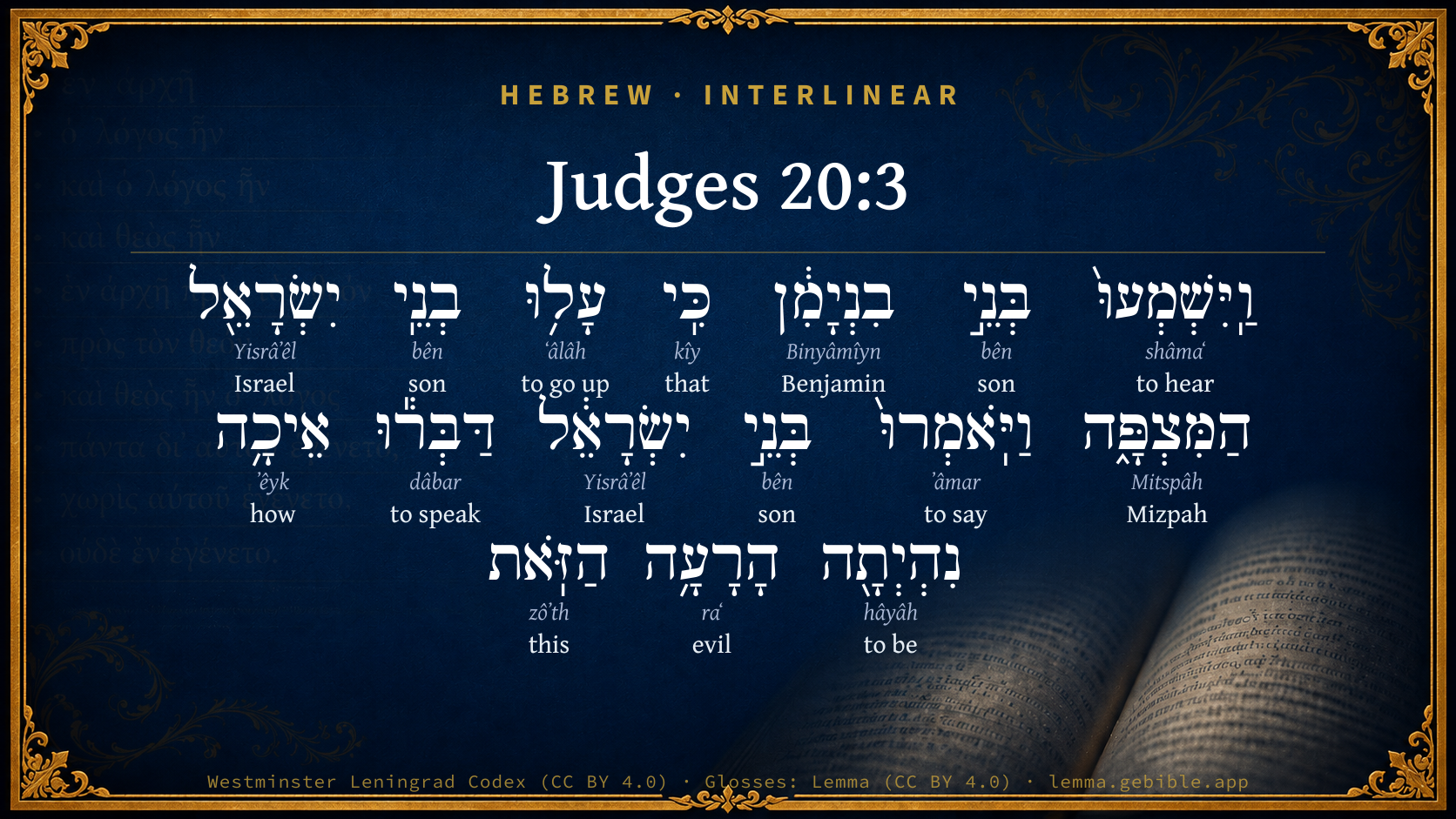
Hebrew (Westminster Leningrad Codex) Judges 20:3 appears in the Hebrew Old Testament. The text above is from the Westminster Leningrad Codex. Each word links to its Strong’s number, a concise gloss, and parsing drawn from the Open Scriptures Hebrew Bible morphology. Click any word for its full Brown-Driver-Briggs (BDB) entry.
Download image
Cite this verse

Judges 20:3 (World English Bible). Public Domain. Lemma interlinear Bible study tool, https://lemma.gebible.app/v/judges/20/3.

Show BibTeX & RIS
BibTeX
RIS
English Translation
(Now the children of Benjamin heard that the children of Israel had gone up to Mizpah.) The children of Israel said, Tell us, how was this wickedness brought to pass?
World English Bible · Public Domain
Download a study sheet

One document with this verse’s original text, its word-by-word gloss line, the meaning frame, cross-references with their text, attributed commentary, and full source and license credits — printable, and it pastes into notes with its structure intact.

This verse Autodidact and up

Study sheet (.html) Plain text (.txt)

A passage Seminary Student

Up to 50 verses in one chapter. A passage sheet keeps up to 6 commentary sources and 12 cross-references per verse, in the order this page ranks them, and says so on the sheet whenever that leaves anything out. Ask for a single verse and you get the Autodidact verse sheet above.

Everything on this page stays free to read, with no account — the sheet is a download of what is already on screen, not access to it.

Want to remove ads? Support Godless Engineer
Compare translations 3

The same verse in 3 English versions, stacked beneath the original-language interlinear above. Click any original word for its lexicon entry.

Each is an independent rendering of the whole verse — the interlinear is not word-aligned to these translations.

Highlighted words mark where these versions differ — a whole-verse word diff, not a word-by-word alignment.

  • World English Bible Public Domain
    (Now the children of Benjamin heard that the children of Israel had gone up to Mizpah.) The children of Israel said, Tell us, how was this wickedness brought to pass?
  • King James Version Public Domain
    (Now the children of Benjamin heard that the children of Israel were gone up to Mizpeh.) Then said the children of Israel, Tell us, how was this wickedness?
  • unfoldingWord Literal Text CC BY-SA 4.0
    Now the sons of Benjamin heard that the sons of Israel had gone up Mizpah. And the sons of Israel said, “Say how this evil has been done.”

unfoldingWord Literal Text — © unfoldingWord, licensed CC BY-SA 4.0. Word-aligned USFM3 via Door43 (git.door43.org/unfoldingWord/en_ult).

Versions to compare (up to 4)

3 of 4 selected

Show all 18 translations

Every available English version of this verse, each an independent rendering of the whole verse.

  • World English Bible Public Domain
    (Now the children of Benjamin heard that the children of Israel had gone up to Mizpah.) The children of Israel said, Tell us, how was this wickedness brought to pass?
  • Berean Standard Bible Public Domain
    (Meanwhile the Benjamites heard that the Israelites had gone up to Mizpah.) And the Israelites asked, “Tell us, how did this wicked thing happen?”
  • Majority Standard Bible Public Domain
    (Meanwhile the Benjamites heard that the Israelites had gone up to Mizpah.) And the Israelites asked, “Tell us, how did this wicked thing happen?”
  • King James Version Public Domain
    (Now the children of Benjamin heard that the children of Israel were gone up to Mizpeh.) Then said the children of Israel, Tell us, how was this wickedness?
  • American Standard Version (1901) Public Domain
    (Now the children of Benjamin heard that the children of Israel were gone up to Mizpah.) And the children of Israel said, Tell us, how was this wickedness brought to pass?
  • Revised Version (1885) Public Domain
    (Now the children of Benjamin heard that the children of Israel were gone up to Mizpah.) And the children of Israel said, Tell us, how was this wickedness brought to pass?
  • Geneva Bible (1599) Public Domain
    (Now the children of Beniamin heard that the children of Israel were gone vp to Mizpeh) Then the children of Israel saide, Howe is this wickednesse committed?
  • Douay-Rheims (1899) Public Domain
    (Nor were the children of Benjamin ignorant that the children of Israel were come up to Maspha.) And the Levite the husband of the woman that was killed, being asked, how so great a wickedness had been committed,
  • Young's Literal Translation Public Domain
    And the sons of Benjamin hear that the sons of Israel have gone up to Mizpeh. And the sons of Israel say, `Speak ye, how hath this evil been?'
  • Literal Standard Version CC BY-SA 4.0
    And the sons of Benjamin hear that the sons of Israel have gone up to Mizpeh. And the sons of Israel say, “Speak! How has this evil been?”
  • Unlocked Literal Bible CC BY-SA 4.0
    Now the people of Benjamin heard that the people of Israel had gone up to Mizpah. The people of Israel said, “Tell us how this wicked thing happened.”
  • unfoldingWord Literal Text CC BY-SA 4.0
    Now the sons of Benjamin heard that the sons of Israel had gone up Mizpah. And the sons of Israel said, “Say how this evil has been done.”
  • Darby Bible Public Domain
    (Now the Benjaminites heard that the people of Israel had gone up to Mizpah.) And the people of Israel said, "Tell us, how was this wickedness brought to pass?"
  • World Messianic Bible Public Domain
    (Now the children of Benjamin heard that the children of Israel had gone up to Mizpah.) The children of Israel said, “Tell us, how did this wickedness happen?”
  • Webster's Bible Public Domain
    (Now the children of Benjamin heard that the children of Israel were gone up to Mizpeh.) Then said the children of Israel, Tell us, how was this wickedness?
  • Free Bible Version CC BY-SA 4.0
    The tribe of Benjamin found out that the Israelites had assembled at Mizpah. The Israelites asked, “Tell us, how could such an evil act have happened?”
  • Bible in Basic English Public Domain
    (Now the children of Benjamin had word that the children of Israel had gone up to Mizpah.) And the children of Israel said, Make clear how this evil thing took place.
  • JPS Tanakh (1917) Public Domain
    Now the children of Benjamin heard that the children of Israel were gone up to Mizpah. — And the children of Israel said: 'Tell us, how was this wickedness brought to pass?'

Literal Standard Version (2020), Covenant Press — licensed CC BY-SA 4.0. Text via the HelloAO Bible API (eBible.org). Unlocked Literal Bible (unfoldingWord) — licensed CC BY-SA 4.0. Text via the HelloAO Bible API (eBible.org). unfoldingWord Literal Text — © unfoldingWord, licensed CC BY-SA 4.0. Word-aligned USFM3 via Door43 (git.door43.org/unfoldingWord/en_ult). Free Bible Version, Dr. Jonathan Gallagher — licensed CC BY-SA 4.0. Text via the HelloAO Bible API (eBible.org).

Word by word

More ways to search: Search by grammar → Find every occurrence → Compare this word →

Practice this passage: Drill this verse → Learn its vocabulary →

הַמִּצְפָּ֑ה
Mitspâh
H4709
“the · Mizpah”
Particle, Definite Article + Noun, Proper
Part of Speech
Particle + Noun
Type
Proper
Full BDB Definition

Origin: from H4708

TWOT: None

Mizpah = "watchtower" - a place in Gilead north of Jabbok and location of Laban's cairn - a place in Gilead south of Jabbok; site unknown - a place near Mount Hermon - an old sacred place in Benjamin
  1. וַֽיִּשְׁמְעוּ֙ shâmaʻ H8085 “and · to hear” Conjunction + Verb, Qal, Sequential Imperfect, 3rd Person, Masculine, Plural
  2. בְּנֵ֣י bên H1121 “sons of” Noun, Common, Masculine, Plural, Construct
  3. בִנְיָמִ֔ן Binyâmîyn H1144 “Benjamin” Noun, Proper
  4. כִּֽי kîy H3588 “that” Conjunction
  5. עָל֥וּ ʻâlâh H5927 “to go up” Verb, Qal, Perfect, 3rd Person, Common, Plural
  6. בְנֵֽי bên H1121 “sons of” Noun, Common, Masculine, Plural, Construct
  7. יִשְׂרָאֵ֖ל Yisrâʼêl H3478 “Israel” Noun, Proper
  8. וַיֹּֽאמְרוּ֙ ʼâmar H559 “and · to say” Conjunction + Verb, Qal, Sequential Imperfect, 3rd Person, Masculine, Plural
  9. בְּנֵ֣י bên H1121 “sons of” Noun, Common, Masculine, Plural, Construct
  10. יִשְׂרָאֵ֔ל Yisrâʼêl H3478 “Israel” Noun, Proper
  11. דַּבְּר֕וּ dâbar H1696 “speak” Verb, Piel, Imperative, 2nd Person, Masculine, Plural
  12. אֵיכָ֥ה ʼêyk H349 “how” Particle, Interrogative
  13. נִהְיְתָ֖ה hâyâh H1961 “to be” Verb, Niphal, Perfect, 3rd Person, Feminine, Singular
  14. הָרָעָ֥ה raʻ H7451 “the · evil” Particle, Definite Article + Noun, Common, Feminine, Singular, Absolute
  15. הַזֹּֽאת zôʼth H2063 “the · this” Particle, Definite Article + Pronoun, Demonstrative, Feminine, Singular

About this verse

These counts appear in no published source. They are computed here, from the morphology-tagged text and Lemma’s own curated glosses. What Lemma adds →

16
words
13
distinct lemmas
Historical
section

Shared distinctive vocabulary

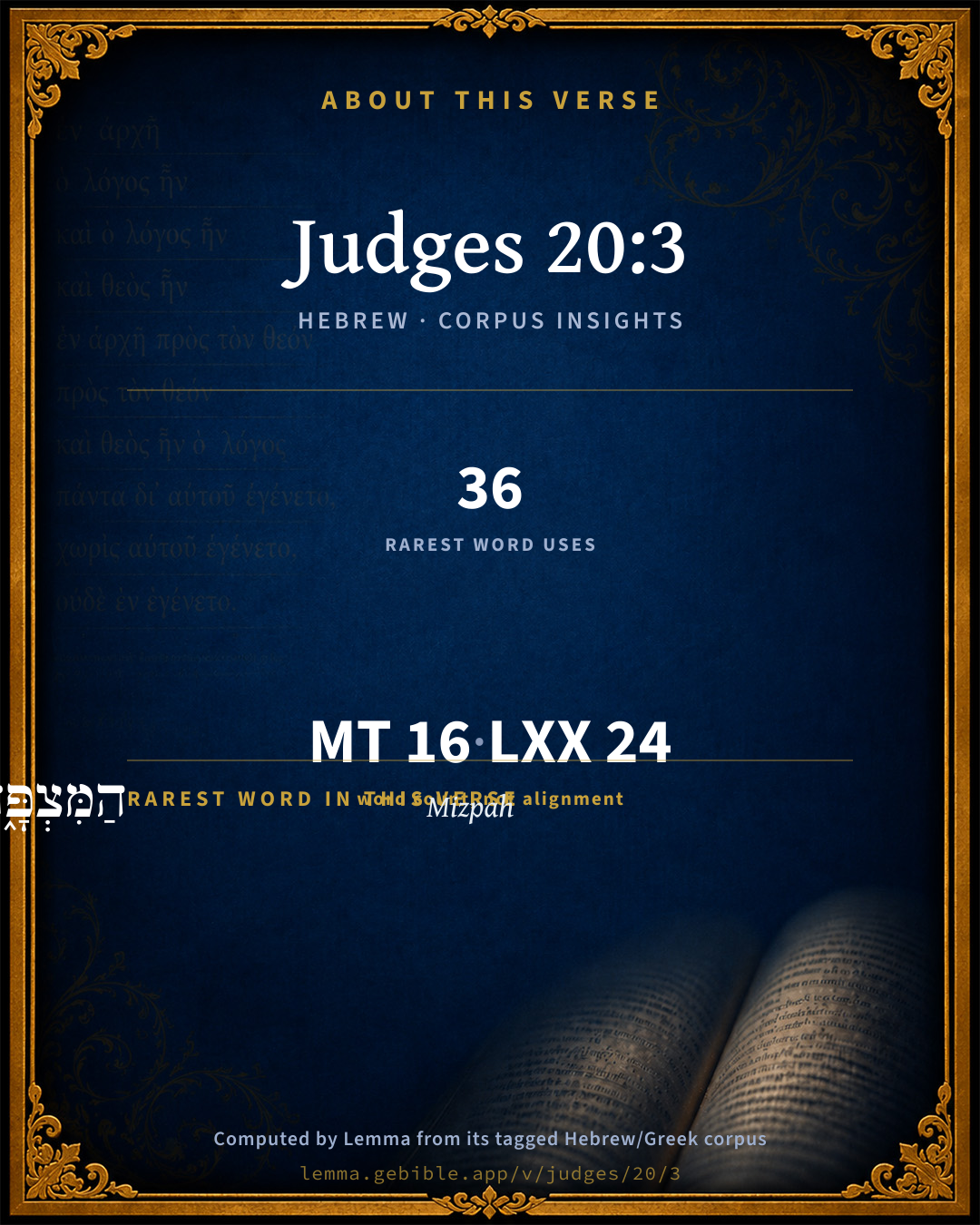
הַמִּצְפָּ֑ה Mizpah H4709 occurs in 33 verses of the Hebrew Bible. Also found in:

Grammatical profile

  • 5 verbs
  • 8 nouns
  • 1 pronoun
  • 1 conjunction
  • 1 particle

Verb forms

  • וַֽיִּשְׁמְעוּ֙ Qal · Sequential Imperfect
  • עָל֥וּ Qal · Perfect
  • וַיֹּֽאמְרוּ֙ Qal · Sequential Imperfect
  • דַּבְּר֕וּ Piel · Imperative
  • נִהְיְתָ֖ה Niphal · Perfect

Repetition

Words recur within this verse — often emphatic in Hebrew:

  • בְּנֵ֣י son H1121 ×3
  • יִשְׂרָאֵ֖ל Israel H3478 ×2

Hebrew & Septuagint length

In English translation the verse runs 30 words from the Hebrew and 32 from the Septuagint (LXX English) — closely comparable.

A rough comparison of the two English renderings, which tokenize alike — not a word-level alignment.

Word counts can differ between the Hebrew and the Greek without any difference in meaning — e.g. the Hebrew direct-object marker אֵת has no separate Greek word, and Greek often adds the article ὁ.

In the original languages it is 16 Hebrew tokens and 24 Greek tokens — but the two are counted differently (Hebrew bundles its prefixes and suffixes into one token; the Greek is in lemma form), so that isn’t a like-for-like length.

Cross-references

5

Topical passages linked to Judges 20:3 in the Treasury of Scripture Knowledge — connected by theme and wording, ordered by reader-vote popularity; previews shown in the World English Bible.

  • Judges 19:22–27 As they were making their hearts merry, behold, the men of the city, certain base fellows, beset the house round about, beating at the door; and they spoke to the master of the house, the old man, saying, Bring forth the man who came into your house, that we may know him.
  • Luke 12:58–59 For when you are going with your adversary before the magistrate, try diligently on the way to be released from him, lest perhaps he drag you to the judge, and the judge deliver you to the officer, and the officer throw you into prison.
  • Proverbs 22:3 A prudent man sees danger, and hides himself; But the simple pass on, and suffer for it.
  • Matthew 5:25 Agree with your adversary quickly, while you are with him in the way; lest perhaps the prosecutor deliver you to the judge, and the judge deliver you to the officer, and you be cast into prison.
  • Luke 14:31–32 Or what king, as he goes to encounter another king in war, will not sit down first and consider whether he is able with ten thousand to meet him who comes against him with twenty thousand?

Cross-references courtesy of OpenBible.info (CC BY 4.0).

Hebrew and Greek witnesses Masoretic Hebrew ↔ Greek Septuagint

The same verse in the two great witnesses to the Old Testament, shown verse-for-verse.

These are two independent witnesses, not word-aligned to each other, and the Septuagint is shown in lemma (dictionary) form.

Hebrew Judges 20:3 Masoretic · Westminster Leningrad Codex

וַֽיִּשְׁמְעוּ֙ בְּנֵ֣י בִנְיָמִ֔ן כִּֽי עָל֥וּ בְנֵֽי יִשְׂרָאֵ֖ל הַמִּצְפָּ֑ה וַיֹּֽאמְרוּ֙ בְּנֵ֣י יִשְׂרָאֵ֔ל דַּבְּר֕וּ אֵיכָ֥ה נִהְיְתָ֖ה הָרָעָ֥ה הַזֹּֽאת

(Now the children of Benjamin heard that the children of Israel had gone up to Mizpah.) The children of Israel said, Tell us, how was this wickedness brought to pass?

World English Bible · Public Domain

Greek LXX Judges 20:3 Septuagint · lemma form

καί ἀκούω ὁ υἱός βενιαμίν ὅτι ἀναβαίνω ὁ υἱός ἰσραήλ εἰς μασσηφα καί ἔρχομαι εἶπον ὁ υἱός ἰσραήλ λαλέω ποῦ γίγνομαι ὁ πονηρία οὗτος

And the children of Benjamin heard that the children of Israel were gone up to Massepha: and the children of Israel came and said, Tell us, where did this wickedness take place?

LXX2012 (modern English Septuagint) · Public Domain

On this verse, Haydock's Catholic Bible Commentary discusses the Septuagint’s reading. Read the note in Commentary ↓

Hebrew: Westminster Leningrad Codex (CC BY 4.0). Greek: Septuagint (public domain); English from LXX2012 (modern English Septuagint) (Public Domain). How the Septuagint differs from the Hebrew →

Targum (Aramaic paraphrase)

1

The Targum is the ancient Jewish Aramaic paraphrase of the Hebrew Scriptures — an interpretive translation, not the Hebrew text itself. Onkelos (literal) and Pseudo-Jonathan (expansive) render the Torah, and Jonathan the Prophets. Coverage is partial: where no permissively-licensed English translation exists for a verse, only the Aramaic is shown. This is verse-level text, not a word-by-word alignment to the Hebrew.

  1. Targum Jonathan Prophets (Joshua–Malachi)
    וּשְׁמָעוּ בְּנֵי בִנְיָמִין אֲרֵי סַלִיקוּ בְנֵי יִשְׂרָאֵל לְמִצְפַּיָא וַאֲמַרוּ בְּנֵי יִשְׂרָאֵל מַלִילוּ אֵיכְדֵין הֲוַת בִּישָׁתָא הָדָא:

    (no public-domain English translation for this verse)

    Targum Jonathan — Aramaic: “Mikraot Gedolot” (public domain). English: “Sefaria Community Translation” (CC0 1.0 (public-domain dedication)); “London "Chaldee Paraphrase," 1871” (public domain). Text via Sefaria.

Commentary

Notes on Judges 20:3 from classic Christian and Jewish commentators (each source and its license shown beneath its notes). The classic Christian expositions comment on the surrounding passage and are grouped to its opening verse, so a note may address several verses; the Jewish commentaries on the Tanakh (Rashi and others) are per-verse, so they appear only where the commentator wrote on this verse.

Lemma curates 59 commentaries, every one of them public domain or Creative Commons licensed, each selected and text-cleaned for this edition rather than reprinted as found. About our sources →

Trapp's Complete Commentary

John Trapp

Jdg 20:3 (Now the children of Benjamin heard that the children of Israel were gone up to Mizpeh.) Then said the children of Israel, Tell [us], how was this wickedness?

Ver. 3. Then said the children of Israel, Tell us.] This they said to the Levite, to his servant, and to the old man his host. Janius will have it spoken to the Benjamites, who should have answered by their agents at this meeting: who because they appeared not, the Levite remonstrateth the whole business briefly and plainly, without preface or passions. {a}

{a} ανευ προοιμιων και παθων.

John Trapp, A Commentary or Exposition upon All the Books of the Old and New Testament (1647–1656) — public domain. Text from a community e-Sword module.

Joseph Benson's Commentary

Jdg 20:3. The children of Benjamin heard — Like persons unconcerned and resolved, they neither went nor sent thither: partly through their own pride and stubbornness; partly because, as they were loath to give up any of their brethren to justice, so they presumed the other tribes would never proceed to war against them; and partly from a divine infatuation, hardening that wicked tribe to their own destruction. Tell us — They speak to the Levite, and his servant, and his host, who doubtless were present upon this occasion.

Joseph Benson's Commentary on the Old and New Testaments (1811–1818) — public domain. Text from a community e-Sword module.

Geneva Bible (1599)

Geneva Bible translators

To the Levite.

Geneva Bible (1599) marginal notes — public domain. Text via Bolls.life.

Jamieson, Fausset & Brown

Robert Jamieson, A. R. Fausset & David Brown

Now the children of Benjamin heard that the children of Israel were gone up to Mizpeh--Some suppose that Benjamin had been passed over, the crime having been perpetrated within the territory of that tribe [Jdg 19:16]; and that, as the concubine's corpse had been divided into twelve pieces [Jdg 19:29] --two had been sent to Manasseh, one respectively to the western and eastern divisions. It is more probable that Benjamin had received a formal summons like the other tribes, but chose to treat it with indifference, or haughty disdain.

Jamieson, Fausset & Brown — Commentary Critical and Explanatory on the Whole Bible (1871) — public domain (CC PDM 1.0). Text via the HelloAO Bible API.

Adam Clarke's Commentary

Verse 3. Tell us, how was this wickedness?] They had heard before, by the messengers he sent with the fragments of his wife's body; but they wish to hear it, in full council, from himself.

Adam Clarke's Commentary on the Bible (1810–1826) — public domain. Text from a community e-Sword/MySword module.

Ellicott's Commentary for English Readers

(3) Heard.—Probably the Benjamites had received the same summons as the other tribes (see Jdg_19:29), but insolently refused to notice the summons.

Tell us.—Literally, Tell ye us. The request is addressed to any who could give the necessary information.

A Bible Commentary for English Readers, edited by Charles John Ellicott (1878–1897) — public domain. Text from a community e-Sword module.

The Cambridge Bible for Schools and Colleges

gen. ed. J. J. S. Perowne

3. The first half of the verse interrupts the connexion with Jdg_20:1 d; it would be in place before Jdg_20:14. The displacement was no doubt caused by the insertion of Jdg_20:2; Jdg_20:9-13 into the older narrative.

And the children of Israel etc.] Here follows A’s report of what happened at the meeting: the evidence of the Levite is heard. In B the assembly does not ask for evidence; their righteous indignation has been roused, and they proceed to act at once, Jdg_20:9 ff.

The Cambridge Bible for Schools and Colleges (gen. ed. J. J. S. Perowne; Cambridge University Press, 1878–1918) — public domain. Text from a community e-Sword module.

John Gill's Exposition

Now the children of Benjamin heard that the children of Israel were gone up to Mizpeh,.... Having no doubt the same notice the rest of the tribes had; but the thing complained of being done in their tribe, and by some of it, they might be willing to screen the delinquents, or were careless about and indifferent to the case, and secure and easy, as imagining their brethren would never go to war with them about it; or were proud and haughty, and would pay no regard to the summons given them:

then said the children of Israel, tell us, how was this wickedness? proclamation was made in the assembly, that if any person there knew anything of this shocking affair, and horrid iniquity, which was the occasion of their meeting together, that they would rise up and declare what was the cause of it, how it came about, and by whom it was done; or they addressed themselves particularly to the Levite, and his host, and his servant, who might all be upon the spot to bear witness in this case, as it is certain the former of them was, who upon this stood up, and spoke as follows.

John Gill's Exposition of the Whole Bible (1746–1763) — public domain (CC PDM 1.0). Text via the HelloAO Bible API.

Haydock's Catholic Bible Commentary

Levite. Hebrew and Septuagint do not say that the discourse was addressed to him; but he was the most interested, and capable of giving a true account. Hebrew, "The said the children of Israel, Relate (Septuagint, ye) how this wickedness happened, (4) And the Levite," &c., answered.

George Leo Haydock (1774–1849), Haydock's Catholic Family Bible and Commentary, 1859 edition — public domain. Excludes Psalms (Douay-Rheims chapter numbering differs from Protestant) and Deuterocanonical books (Catholic canon only).

Matthew Poole's English Annotations

The children of Benjamin heard; like persons unconcerned and resolved, they neither went nor sent thither; partly, from their own pride, and stubbornness, and self-confidence; partly, because as they were loth to give up any of their brethren to justice, so they presumed the other tribes would never proceed to a war against them; and partly, from a Divine infatuation hardening that wicked tribe to their own destruction.

Tell us; the verb is of the plural number, because they speak to the Levite, and his servant, and his host, who doubtless were present upon this occasion.

Matthew Poole's English Annotations on the Holy Bible (1683–1685) — public domain. Text from a community e-Sword/MySword module.

Whedon's Commentary on the Bible

Daniel D. Whedon

3. How was this wickedness — The members of the assembly had heard the substance of the horrid tale before, but the purpose of the council required that the particulars be now publicly related in the hearing of all.

Daniel D. Whedon (gen. ed.), Commentary on the Old and New Testaments (1874–1909) — public domain. Text from a community e-Sword module.

The Pulpit Commentary

The children of Benjamin heard, etc. This seems to be mentioned to show that the absence of the Benjamites from the national council was not from ignorance, but from contumacy. Tell as, etc. This was addressed to all whom it might concern. The Levite answered.

The Pulpit Commentary (1880–1919), ed. H.D.M. Spence-Jones & Joseph S. Exell — public domain. Text from a community e-Sword module.

John Wesley's Explanatory Notes

Heard - Like persons unconcerned and resolved, they neither went nor sent thither: partly for their own pride, and stubbornness; partly because as they were loth to give up any of their brethren to justice, so they presumed the other tribes would never proceed to war against them; and partly, from a Divine infatuation hardening that wicked tribe to their own destruction. Tell us - They speak to the Levite, and his servant, and his host, who doubtless were present upon this occasion.

John Wesley, Explanatory Notes Upon the Whole Bible (1754–1765) — public domain. Text via the GEBible commentary corpus.

unfoldingWord translationNotes

Door43 World Missions Community

Now

This word is used here to mark a break in the main story line. Here the author of the book tells background information about what the people of Benjamin knew.

had gone up to Mizpah

Mizpah was located high in the mountains.

to spend the night

"for the night" or "to stay for a night"

translationWords

Benjamin

evil

Levi

Gibeah

concubine

unfoldingWord translationNotes — © Distant Shores Media and the Door43 World Missions Community, licensed CC BY-SA 4.0. Source: git.door43.org/Door43/en_tn.

Lesson kit

Teaching starters — assembled from the data on this page, not authored interpretation. Every prompt links to the verse data it draws on. Edit before teaching.

Judges, in the Historical, opens this verse with 16 words (13 distinct Hebrew lemmas). Its most distinctive word is Mitspâh (“Mizpah”). A historical commentator’s framing appears above. Read the whole chapter for the surrounding context.

Discussion questions

  1. The word Mitspâh carries the sense “Mizpah.” How does it shape the verse?
  2. How does Genesis 31:49, which shares the word «Mizpah», read alongside this verse?
  3. What does the repetition of “son” (3× in this one verse) do in this verse?
  4. These translations render this verse differently. What is at stake in choosing one wording over another?
  5. «וַֽיִּשְׁמְעוּ֙» is a Qal Sequential Imperfect verb. How does that grammatical form shape the action described?
  6. Compare how Trapp's Complete Commentary and Joseph Benson's Commentary read this verse. Where do they agree or differ?

Things to notice

Reading settings

Reading text

Shown beneath each verse's original-language words.

Old Testament
Old Testament edition

Read the OT as the Masoretic Hebrew (MT) or the Greek Septuagint (LXX).

English shown for the Greek Septuagint (in the Hebrew ↔ Greek comparison).

Comparing translations? Open the Compare panel on any verse page to stack up to four side by side.