
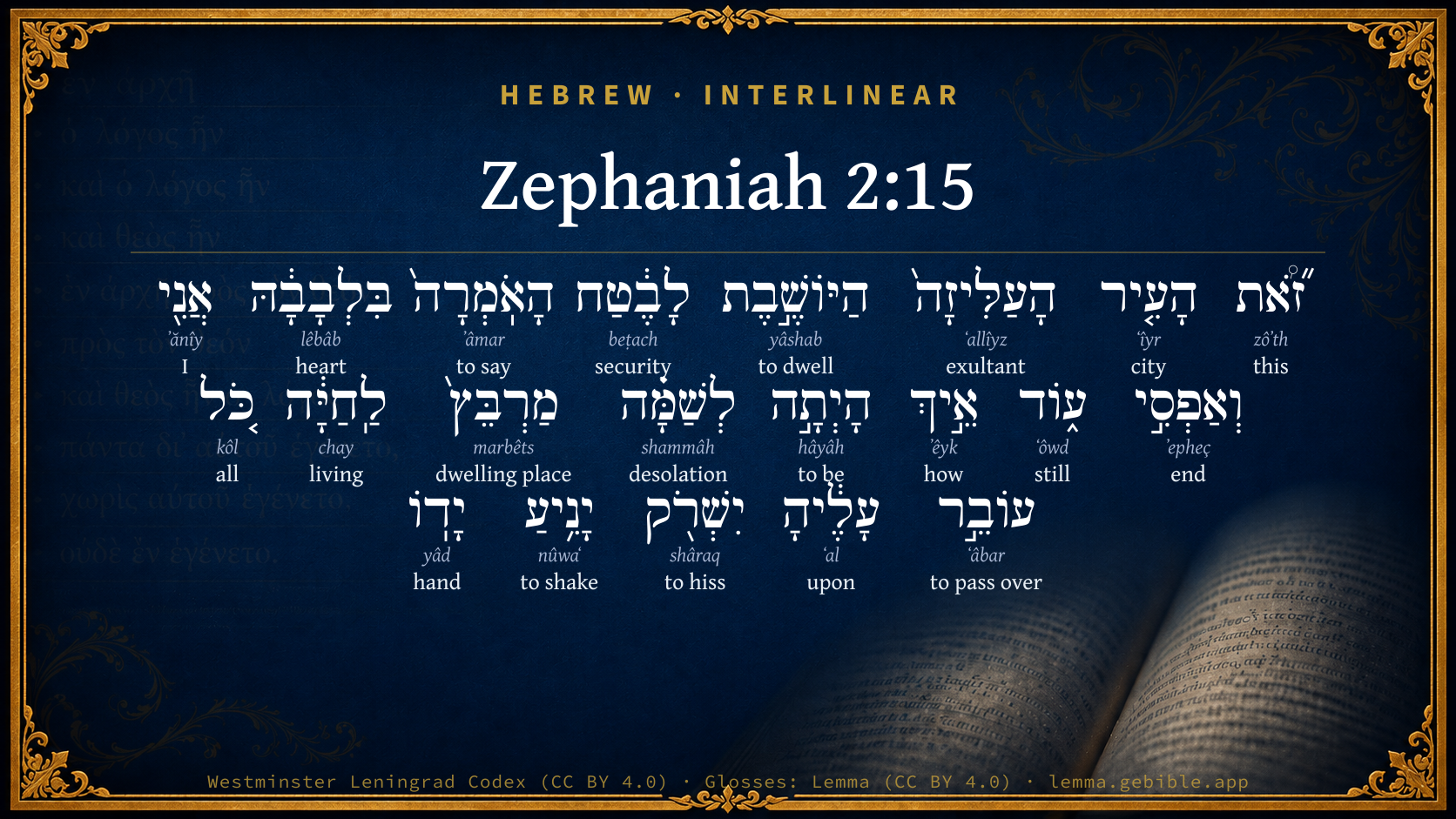
Zephaniah 2:15

Hebrew (Westminster Leningrad Codex) Zephaniah 2:15 appears in the Hebrew Old Testament. The text above is from the Westminster Leningrad Codex. Each word links to its Strong’s number, a concise gloss, and parsing drawn from the Open Scriptures Hebrew Bible morphology. Click any word for its full Brown-Driver-Briggs (BDB) entry.
Download image
Cite this verse

Zephaniah 2:15 (World English Bible). Public Domain. Lemma interlinear Bible study tool, https://lemma.gebible.app/v/zephaniah/2/15.

Show BibTeX & RIS
BibTeX
RIS
English Translation
This is the joyous city that lived carelessly, that said in her heart, "I am, and there is none besides me." How she has become a desolation, a place for animals to lie down in! Everyone who passes by her will hiss, and shake their fists.
World English Bible · Public Domain
Download a study sheet

One document with this verse’s original text, its word-by-word gloss line, the meaning frame, cross-references with their text, attributed commentary, and full source and license credits — printable, and it pastes into notes with its structure intact.

This verse Autodidact and up

Study sheet (.html) Plain text (.txt)

A passage Seminary Student

Up to 50 verses in one chapter. A passage sheet keeps up to 6 commentary sources and 12 cross-references per verse, in the order this page ranks them, and says so on the sheet whenever that leaves anything out. Ask for a single verse and you get the Autodidact verse sheet above.

Everything on this page stays free to read, with no account — the sheet is a download of what is already on screen, not access to it.

Want to remove ads? Support Godless Engineer
Compare translations 3

The same verse in 3 English versions, stacked beneath the original-language interlinear above. Click any original word for its lexicon entry.

Each is an independent rendering of the whole verse — the interlinear is not word-aligned to these translations.

Highlighted words mark where these versions differ — a whole-verse word diff, not a word-by-word alignment.

  • World English Bible Public Domain
    This is the joyous city that lived carelessly, that said in her heart, "I am, and there is none besides me." How she has become a desolation, a place for animals to lie down in! Everyone who passes by her will hiss, and shake their fists.
  • King James Version Public Domain
    This is the rejoicing city that dwelt carelessly, that said in her heart, I am, and there is none beside me: how is she become a desolation, a place for beasts to lie down in! every one that passeth by her shall hiss, and wag his hand.
  • unfoldingWord Literal Text CC BY-SA 4.0
    This the exultant city, the one dwelling in security, the one saying in its heart, “I, and besides me not another.” How it has become a ruin, a lair for the beast! Every one passing by will hiss at it; he will shake his fist.

unfoldingWord Literal Text — © unfoldingWord, licensed CC BY-SA 4.0. Word-aligned USFM3 via Door43 (git.door43.org/unfoldingWord/en_ult).

Versions to compare (up to 4)

3 of 4 selected

Show all 18 translations

Every available English version of this verse, each an independent rendering of the whole verse.

  • World English Bible Public Domain
    This is the joyous city that lived carelessly, that said in her heart, "I am, and there is none besides me." How she has become a desolation, a place for animals to lie down in! Everyone who passes by her will hiss, and shake their fists.
  • Berean Standard Bible Public Domain
    This carefree city that dwells securely, that thinks to herself: “I am it, and there is none besides me,” what a ruin she has become, a resting place for beasts. Everyone who passes by her hisses and shakes his fist.
  • Majority Standard Bible Public Domain
    This carefree city that dwells securely, that thinks to herself: “I am it, and there is none besides me,” what a ruin she has become, a resting place for beasts. Everyone who passes by her hisses and shakes his fist.
  • King James Version Public Domain
    This is the rejoicing city that dwelt carelessly, that said in her heart, I am, and there is none beside me: how is she become a desolation, a place for beasts to lie down in! every one that passeth by her shall hiss, and wag his hand.
  • American Standard Version (1901) Public Domain
    This is the joyous city that dwelt carelessly, that said in her heart, I am, and there is none besides me: how is she become a desolation, a place for beasts to lie down in! every one that passeth by her shall hiss, and wag his hand.
  • Revised Version (1885) Public Domain
    This is the joyous city that dwelt carelessly, that said in her heart, I am, and there is none else beside me: how is she become a desolation, a place for beasts to lie down in! every one that passeth by her shall hiss, and wag his hand.
  • Geneva Bible (1599) Public Domain
    This is the reioycing citie that dwelt carelesse, that said in her heart, I am, and there is none besides me: how is she made waste, and the lodging of the beastes! euery one that passeth by her, shall hisse and wagge his hand.
  • Douay-Rheims (1899) Public Domain
    This is the glorious city that dwelt in security: that said in her heart: I am, and there is none beside me: how is she become a desert, a place for beasts to lie down in? every one that passeth by her, shall hiss, and wag his hand.
  • Young's Literal Translation Public Domain
    This `is' the exulting city that is dwelling confidently, That is saying in her heart, `I `am', and beside me there is none,' How hath she been for a desolation, A crouching-place for beasts, Every one passing by her doth hiss, He doth shake his hand!
  • Literal Standard Version CC BY-SA 4.0
    This [is] the exulting city that is dwelling confidently, || That is saying in her heart, || “I [am], and there is none beside me,” || How she has been for a desolation, || A crouching-place for beasts, || Everyone passing by her hisses, || He shakes his hand!
  • Unlocked Literal Bible CC BY-SA 4.0
    This is the exultant city that lived without fear, that said in her heart, “I am, and nothing is my equal.” How she has become a horror, a place for beasts to lie down in. Everyone that passes by her will hiss and shake his fist at her.
  • unfoldingWord Literal Text CC BY-SA 4.0
    This the exultant city, the one dwelling in security, the one saying in its heart, “I, and besides me not another.” How it has become a ruin, a lair for the beast! Every one passing by will hiss at it; he will shake his fist.
  • Darby Bible Public Domain
    This is the rejoicing city that dwelt in security, that said in her heart, I am, and there is none else beside me: how is she become a desolation, a couching-place for beasts! Every one that passeth by her shall hiss, shall wave his hand.
  • World Messianic Bible Public Domain
    This is the joyous city that lived carelessly, that said in her heart, “I am, and there is no one besides me.” How she has become a desolation, a place for animals to lie down in! Everyone who passes by her will hiss and shake their fists.
  • Webster's Bible Public Domain
    This is the rejoicing city that dwelt in security, that said in her heart, I am, and there is none besides me: how is she become a desolation, a place for beasts to lie down in! every one that passeth by her shall hiss, and wag his hand.
  • Free Bible Version CC BY-SA 4.0
    This is what will happen to this triumphant city that thought it was so secure. “Look at me!” it said proudly to itself. “There is no city as great as me!” But it has become a desolate place—just a home for wild animals. Everyone who passes by will point their finger and laugh in derision.
  • Bible in Basic English Public Domain
    This is the town which was full of joy, living without fear of danger, saying in her heart, I am, and there is no other: how has she been made waste, a place for beasts to take their rest in! everyone who goes by her will make hisses, waving his hand.
  • JPS Tanakh (1917) Public Domain
    This is the joyous city that dwelt without care, that said in her heart: 'I am, and there is none else beside me'; how is she become a desolation, a place for beasts to lie down in! Every one that passeth by her shall hiss, and wag his hand.

Literal Standard Version (2020), Covenant Press — licensed CC BY-SA 4.0. Text via the HelloAO Bible API (eBible.org). Unlocked Literal Bible (unfoldingWord) — licensed CC BY-SA 4.0. Text via the HelloAO Bible API (eBible.org). unfoldingWord Literal Text — © unfoldingWord, licensed CC BY-SA 4.0. Word-aligned USFM3 via Door43 (git.door43.org/unfoldingWord/en_ult). Free Bible Version, Dr. Jonathan Gallagher — licensed CC BY-SA 4.0. Text via the HelloAO Bible API (eBible.org).

Word by word

More ways to search: Search by grammar → Find every occurrence → Compare this word →

Practice this passage: Drill this verse → Learn its vocabulary →

מַרְבֵּץ֙
marbêts
H4769
“dwelling place”
Noun, Common, Masculine, Singular, Absolute
Part of Speech
Noun
Type
Common
Gender
Masculine
Number
Singular
State
Absolute
Full BDB Definition

Origin: from H7257

TWOT: 2109b

place of lying down, resting or dwelling place - of wild beasts
  1. זֹ֞֠את zôʼth H2063 “this” Pronoun, Demonstrative, Feminine, Singular
  2. הָעִ֤יר ʻîyr H5892 “the · city” Particle, Definite Article + Noun, Common, Feminine, Singular, Absolute
  3. הָעַלִּיזָה֙ ʻallîyz H5947 “the · exultant” Particle, Definite Article + Adjective, Adjective, Feminine, Singular, Absolute
  4. הַיּוֹשֶׁ֣בֶת yâshab H3427 “the · dwelling” Particle, Definite Article + Verb, Qal, Participle Active, Feminine, Singular, Absolute
  5. לָבֶ֔טַח beṭach H983 “to/for · security” Preposition + Noun, Common, Masculine, Singular, Absolute
  6. הָאֹֽמְרָה֙ ʼâmar H559 “the · saying” Particle, Definite Article + Verb, Qal, Participle Active, Feminine, Singular, Absolute
  7. בִּלְבָבָ֔הּ lêbâb H3824 “in/at · heart · her” Preposition + Noun, Common, Masculine, Singular, Construct + Suffix, Personal, 3rd Person, Feminine, Singular
  8. אֲנִ֖י ʼănîy H589 “I” Pronoun, Personal, 1st Person, Common, Singular
  9. וְאַפְסִ֣י ʼepheç H657 “and · end · my” Conjunction + Noun, Common, Masculine, Singular, Construct + Suffix, Personal, 1st Person, Common, Singular
  10. ע֑וֹד ʻôwd H5750 “still” Adverb
  11. אֵ֣יךְ ʼêyk H349 “how” Particle, Interrogative
  12. הָיְתָ֣ה hâyâh H1961 “to be” Verb, Qal, Perfect, 3rd Person, Feminine, Singular
  13. לְשַׁמָּ֗ה shammâh H8047 “to/for · desolation” Preposition + Noun, Common, Feminine, Singular, Absolute
  14. לַֽחַיָּ֔ה chay H2416 “to/for the · living” Preposition, Determined + Noun, Common, Feminine, Singular, Absolute
  15. כֹּ֚ל kôl H3605 “all” Noun, Common, Masculine, Singular, Absolute
  16. עוֹבֵ֣ר ʻâbar H5674 “passing over” Verb, Qal, Participle Active, Masculine, Singular, Absolute
  17. עָלֶ֔יהָ ʻal H5921 “upon · her” Preposition + Suffix, Personal, 3rd Person, Feminine, Singular
  18. יִשְׁרֹ֖ק shâraq H8319 “to hiss” Verb, Qal, Imperfect, 3rd Person, Masculine, Singular
  19. יָנִ֥יעַ nûwaʻ H5128 “to shake” Verb, Hiphil, Imperfect, 3rd Person, Masculine, Singular
  20. יָדֽוֹ yâd H3027 “hand · his” Noun, Common, Both, Singular, Construct + Suffix, Personal, 3rd Person, Masculine, Singular

About this verse

These counts appear in no published source. They are computed here, from the morphology-tagged text and Lemma’s own curated glosses. What Lemma adds →

21
words
21
distinct lemmas
Prophets
section

Notable vocabulary

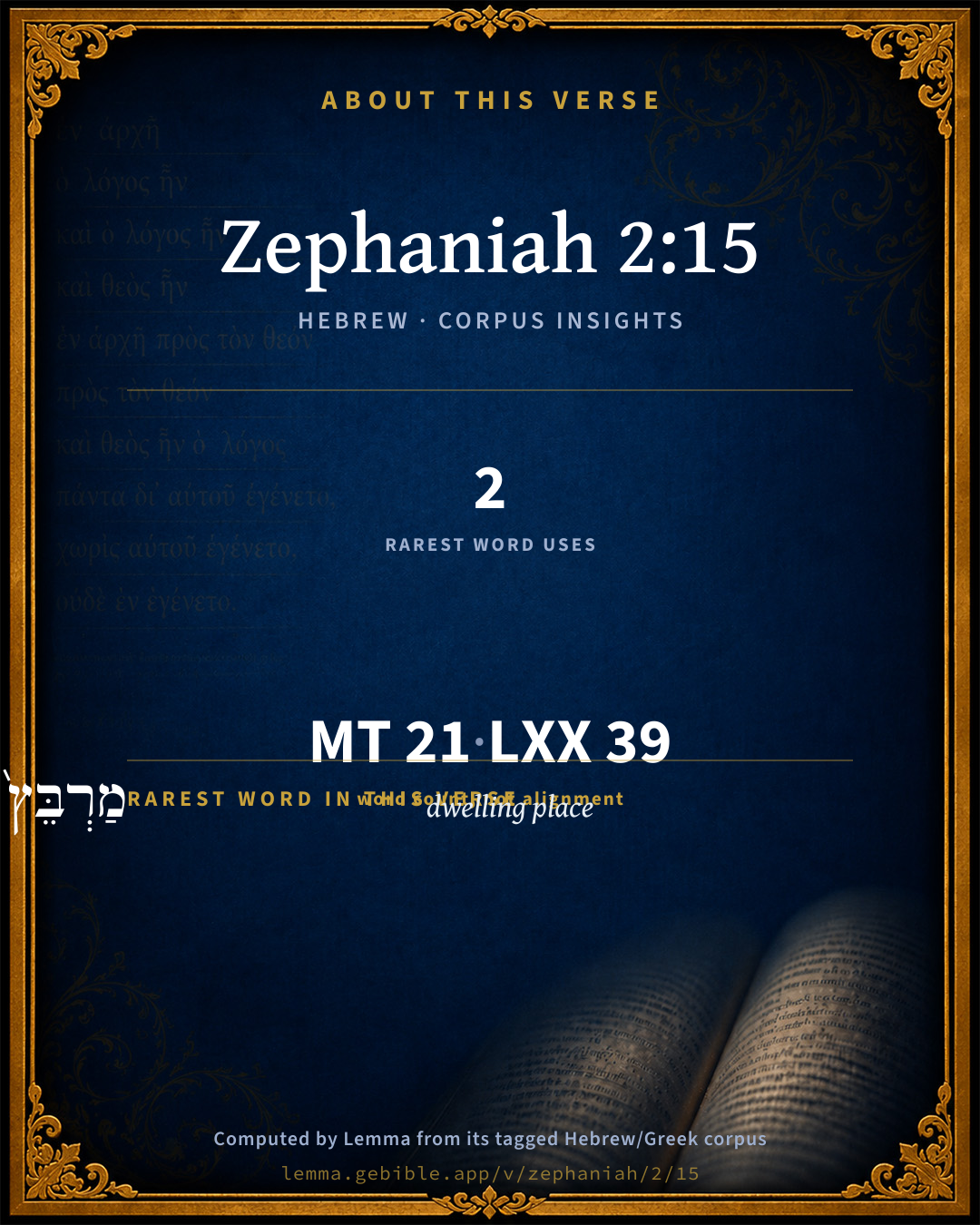
The rarest word here is מַרְבֵּץ֙ dwelling place H4769 — appearing just 2 times in the whole Hebrew Bible.

Shared distinctive vocabulary

מַרְבֵּץ֙ dwelling place H4769 occurs in 2 verses of the Hebrew Bible. Also found in:

Grammatical profile

  • 6 verbs
  • 9 nouns
  • 1 adjective
  • 2 pronouns
  • 1 preposition
  • 1 adverb
  • 1 particle

Verb forms

  • הַיּוֹשֶׁ֣בֶת Qal · Participle Active
  • הָאֹֽמְרָה֙ Qal · Participle Active
  • הָיְתָ֣ה Qal · Perfect
  • עוֹבֵ֣ר Qal · Participle Active
  • יִשְׁרֹ֖ק Qal · Imperfect
  • יָנִ֥יעַ Hiphil · Imperfect

Hebrew & Septuagint length

In the original languages it is 21 Hebrew tokens and 39 Greek tokens — but the two are counted differently (Hebrew bundles its prefixes and suffixes into one token; the Greek is in lemma form), so that isn’t a like-for-like length.

Cross-references

19

Topical passages linked to Zephaniah 2:15 in the Treasury of Scripture Knowledge — connected by theme and wording, ordered by reader-vote popularity; previews shown in the World English Bible.

  • Ezekiel 28:2 Son of man, tell the prince of Tyre, Thus says the Lord Yahweh: Because your heart is lifted up, and you have said, I am a god, I sit in the seat of God, in the midst of the seas; yet you are man, and not God, though you did set your heart as the heart of God;-
  • Isaiah 22:2 You that are full of shouting, a tumultuous city, a joyous town; your slain are not slain with the sword, neither are they dead in battle.
  • Isaiah 47:7–8 You said, I shall be mistress forever; so that you did not lay these things to your heart, neither did remember the latter end of it.
  • Ezekiel 28:9 Will you yet say before him who kills you, I am God? but you are man, and not God, in the hand of him who wounds you.
  • Nahum 3:19 There is no healing your wound, for your injury is fatal. All who hear the report of you clap their hands over you; for who hasn't felt your endless cruelty?
  • 1 Kings 9:7–8 then will I cut off Israel out of the land which I have given them; and this house, which I have made holy for my name, will I cast out of my sight; and Israel shall be a proverb and a byword among all peoples.
  • Psalms 52:6–7 The righteous also will see it, and fear, And laugh at him, saying,
  • Jeremiah 19:8 I will make this city an astonishment, and a hissing; everyone who passes thereby shall be astonished and hiss because of all the plagues of it.
  • Lamentations 1:1 How does the city sit solitary, that was full of people! She has become as a widow, who was great among the nations! She who was a princess among the provinces is become tributary!
  • Lamentations 2:15 All that pass by clap their hands at you; They hiss and wag their head at the daughter of Jerusalem, [saying], Is this the city that men called The perfection of beauty, The joy of the whole earth?
  • Job 27:23 Men shall clap their hands at him, And shall hiss him out of his place.
  • Isaiah 10:12–14 Therefore it shall happen that, when the Lord has performed his whole work on Mount Zion and on Jerusalem, I will punish the fruit of the stout heart of the king of Assyria, and the glory of his high looks.
  • Isaiah 14:4–5 that you shall take up this parable against the king of Babylon, and say, How has the oppressor ceased! the golden city ceased!
  • Isaiah 32:9 Rise up, you women who are at ease, [and] hear my voice; you careless daughters, give ear to my speech.
  • Lamentations 2:1 How has the Lord covered the daughter of Zion with a cloud in his anger! He has cast down from heaven to the earth the beauty of Israel, And hasn't remembered his footstool in the day of his anger.
  • Ezekiel 27:36 The merchants among the peoples hiss at you; you are become a terror, and you shall nevermore have any being.
  • Ezekiel 29:3 speak, and say, Thus says the Lord Yahweh: Behold, I am against you, Pharaoh king of Egypt, the great monster that lies in the midst of his rivers, that has said, My river is my own, and I have made it for myself.
  • Matthew 27:39 Those who passed by blasphemed him, wagging their heads,
  • Revelation 18:7–19 However much she glorified herself, and grew wanton, so much give her of torment and mourning. For she says in her heart, 'I sit a queen, and am no widow, and will in no way see mourning.'

Cross-references courtesy of OpenBible.info (CC BY 4.0).

Hebrew and Greek witnesses Masoretic Hebrew ↔ Greek Septuagint

The same verse in the two great witnesses to the Old Testament, shown verse-for-verse.

These are two independent witnesses, not word-aligned to each other, and the Septuagint is shown in lemma (dictionary) form.

Hebrew Zephaniah 2:15 Masoretic · Westminster Leningrad Codex

זֹ֞֠את הָעִ֤יר הָעַלִּיזָה֙ הַיּוֹשֶׁ֣בֶת לָבֶ֔טַח הָאֹֽמְרָה֙ בִּלְבָבָ֔הּ אֲנִ֖י וְאַפְסִ֣י ע֑וֹד אֵ֣יךְ הָיְתָ֣ה לְשַׁמָּ֗ה מַרְבֵּץ֙ לַֽחַיָּ֔ה כֹּ֚ל עוֹבֵ֣ר עָלֶ֔יהָ יִשְׁרֹ֖ק יָנִ֥יעַ יָדֽוֹ

This is the joyous city that lived carelessly, that said in her heart, "I am, and there is none besides me." How she has become a desolation, a place for animals to lie down in! Everyone who passes by her will hiss, and shake their fists.

World English Bible · Public Domain

Greek LXX Zephaniah 2:15 Septuagint · lemma form

οὗτος ὁ πόλις ὁ φαυλίστρια ὁ καταοἰκέω ἐπί ἐλπίς ὁ λέγω ἐν καρδία αὐτός ἐγώ εἰμί καί οὐ εἰμί μετά ἐγώ ἔτι πῶς γίγνομαι εἰς ἀφανισμός νομή θηρίον πᾶς ὁ διαπορεύομαι διά αὐτός συρίζω καί κινέω ὁ χείρ αὐτός

No English rendering of this Greek verse — the small residue in the structurally divergent books.

On this verse, The Pulpit Commentary discusses the Septuagint’s reading. Read the note in Commentary ↓

Hebrew: Westminster Leningrad Codex (CC BY 4.0). Greek: Septuagint (public domain); English from a public-domain English Septuagint. How the Septuagint differs from the Hebrew →

Targum (Aramaic paraphrase)

1

The Targum is the ancient Jewish Aramaic paraphrase of the Hebrew Scriptures — an interpretive translation, not the Hebrew text itself. Onkelos (literal) and Pseudo-Jonathan (expansive) render the Torah, and Jonathan the Prophets. Coverage is partial: where no permissively-licensed English translation exists for a verse, only the Aramaic is shown. This is verse-level text, not a word-by-word alignment to the Hebrew.

  1. Targum Jonathan Prophets (Joshua–Malachi)
    דָא קַרְתָּא תַקִפְתָּא דְיָתְבָא לְרוֹחֲצָן דְאָמְרָה בְּלִבָּהּ אֲנָא וְלֵית בַּר מִנִי עוֹד אֵיכְדֵין הֲוַת לְצָדוּ בֵּית מֵישְׁרֵי חַיְתָא כָּל דִי עֲבַר עֲלָהּ יִכְלֵי וְיָנִיד יְדֵיהּ:

    (no public-domain English translation for this verse)

    Targum Jonathan — Aramaic: “Mikraot Gedolot” (public domain). English: “Sefaria Community Translation” (CC0 1.0 (public-domain dedication)); “London "Chaldee Paraphrase," 1871” (public domain). Text via Sefaria.

Commentary

Notes on Zephaniah 2:15 from classic Christian and Jewish commentators (each source and its license shown beneath its notes). The classic Christian expositions comment on the surrounding passage and are grouped to its opening verse, so a note may address several verses; the Jewish commentaries on the Tanakh (Rashi and others) are per-verse, so they appear only where the commentator wrote on this verse.

Lemma curates 59 commentaries, every one of them public domain or Creative Commons licensed, each selected and text-cleaned for this edition rather than reprinted as found. About our sources →

Jamieson, Fausset & Brown

Robert Jamieson, A. R. Fausset & David Brown

Nothing then seemed more improbable than that the capital of so vast an empire, a city sixty miles in compass, with walls one hundred feet high, and so thick that three chariots could go abreast on them, and with fifteen hundred towers, should be so totally destroyed that its site is with difficulty discovered. Yet so it is, as the prophet foretold.

there is none beside me--This peculiar phrase, expressing self-gratulation as if peerless, is plainly adopted from Isa 47:8. The later prophets, when the spirit of prophecy was on the verge of departing, leaned more on the predictions of their predecessors.

hiss--in astonishment at a desolation so great and sudden (Kg1 9:8); also in derision (Job 27:23; Lam 2:15; Eze 27:36).

Next: Zephaniah Chapter 3

Jamieson, Fausset & Brown — Commentary Critical and Explanatory on the Whole Bible (1871) — public domain (CC PDM 1.0). Text via the HelloAO Bible API.

The Cambridge Bible for Schools and Colleges

gen. ed. J. J. S. Perowne

15. A ḳinah or elegy on Nineveh.

the rejoicing city] R.V. the joyous city.

there is none beside me] there is none else. She felt unique in her power and splendour. The same words are used of herself by Babylon, Isa_47:8.

shall hiss, and wag his hand] Expressions of scorn and hatred. Eze_27:36; Lam_2:15-16; Job_27:23; Nah_3:19.

The Cambridge Bible for Schools and Colleges (gen. ed. J. J. S. Perowne; Cambridge University Press, 1878–1918) — public domain. Text from a community e-Sword module.

Trapp's Complete Commentary

John Trapp

Zep 2:15 This [is] the rejoicing city that dwelt carelessly, that said in her heart, I [am], and [there is] none beside me: how is she become a desolation, a place for beasts to lie down in! every one that passeth by her shall hiss, [and] wag his hand.

Ver. 15. This is the rejoicing city] Exultabunda, that could stand on no ground, but was ready to leap out of her skin as it were; her inhabitants were mere mirthmongers altogether set upon the merry pin; like the people of Tombutum in Africa, who spend their whole time in singing and dancing. Now the case is altered, and the Church, out of zeal for God’s glory, thus insulteth over them.

That dwelt carelessly] As if situated in the clouds, above all fear; and altogether insuperable. Security ushereth in destruction. See Jer 49:31-32.

That said in her heart, I am, and there is none besides me] This was a proud word indeed. I am is one of God Almighty’s names, Exo 3:14, and there is none besides me is one of his titles, Isa 45:5; Isa 45:21; Isa 48:12. Thus empty man would be something (the toad would swell to the size of an ox), though man be born like a wild ass’s colt, Job 11:12, and man being in honour, understandeth not that he is, or shortly shall be, like the beasts that perish: that die of the murrain, and so become carrion, good for nothing. {Psa 49:20, pecoribus morticinis. Tremel.}

“ Unde superbit homo cuius conceptio turpis,

Nasci poena, labor vita, necesse mori? ”

“Whence will man show his pride, whose conception is shameful,

to be born a penalty, life of work, and needs die”

How is she become a desolation] Here the prophet, Nineven in Theatre statuit, et traducit apud Iudaeos (saith Calvin), setteth Nineveh upon the stage, and showeth his Jews the tragic end of her; how she should wonderfully be brought down beyond all expectation. God delighteth to make himself marvellous; he is the only true Thaumaturgus.

Every one that passeth by her shall hiss, and wag his hand] In scorn, horror, and disdain; and why, see Nah 3:19 Lam 2:15; Lam 2:17 1Ki 9:8 Eze 27:36 Mic 6:16. {See Trapp on "Nah 3:19"} Surely God scorneth the scorners, Pro 3:34, and maketh that the merciless find no mercy, Jas 2:13.

John Trapp, A Commentary or Exposition upon All the Books of the Old and New Testament (1647–1656) — public domain. Text from a community e-Sword module.

Joseph Benson's Commentary

Zep 2:15. This is the rejoicing city — This is supposed to be said by those who should pass by it after its desolation; that said in her heart, I am, and there is none besides me — Its inhabitants indulged themselves in their ease and pleasures; and they arrived at that degree of presumption, as to fancy that no strength or power could bring them down from the height of grandeur at which they were arrived. Babylon is charged with the same degree of pride and carnal security, Isa 47:8. Every one that passeth by her shall hiss, &c. — In astonishment at the condition to which she is reduced: see a like topic, of a great city laid waste, pursued in a train of images full of sublimity and terror, Isa 34:11-17.

Joseph Benson's Commentary on the Old and New Testaments (1811–1818) — public domain. Text from a community e-Sword module.

Tyndale Open Study Notes

Tyndale Open Resources

2:15 utter ruin: The doom was so certain and irreversible (see Nah 1:14; 2:13; 3:19) that Zephaniah saw no future for Assyria or its capital. So complete was Nineveh’s devastation that the Greek historian Xenophon once passed by its ruins unaware that it was there. • laugh . . . shake a defiant fist: Those who suffered under Assyria’s cruel empire would be glad seeing its demise.

Tyndale Open Study Notes — © Tyndale Open Resources, licensed CC BY-SA 4.0. Text via the HelloAO Bible API.

Geneva Bible (1599)

Geneva Bible translators

Meaning, Nineveh, which rejoicing so much of her strength and prosperity, should be thus made waste, and God’s people delivered.

Geneva Bible (1599) marginal notes — public domain. Text via Bolls.life.

Adam Clarke's Commentary

Verse 15. This is the rejoicing city] The city in which mirth, jocularity, and pleasure, reigned without interruption.

And wag his hand] Will point her out as a mark and monument of Divine displeasure.

Adam Clarke's Commentary on the Bible (1810–1826) — public domain. Text from a community e-Sword/MySword module.

John Calvin's Commentaries

He seems to have added this by way of anticipation, lest the magnificent splendor of the city Nineveh should frighten the Jews, as though it were exempt from all danger. The Prophet therefore reminds them here, that though Nineveh was thus proud of its wealth, it could not yet escape the hand of God; nay, he shows that the greatness, on account of which Nineveh extolled itself, would be the cause of its ruin; for it would cast itself down by its own pride: as a wall, when it swells, will not long stand; so also men, when they inwardly swell, and vent their own boastings, burst; and though no one pushes them down, they fall of themselves. Such a destruction the Prophet denounces on the Ninevites and the Assyrians.

This, he says, is the exulting city, which sat in confidence. Isaiah reprobates in nearly the same words the pride of Babylon: but what Isaiah said of Babylon our Prophet justly transfers here to Nineveh. But he no doubt had respect to the Jews, and exhibits Nineveh in its state of ruin, lest the power of that city should dazzle their eyes; for we are seized with wonder, when anything grand and splendid presents itself to us. Here then Zephaniah makes a representation of Nineveh and sets it before the Jews: Behold, he says, ye see this city full of exultation; ye also see that it rests as in a state of safety; for it is conscious of no fear; it regards itself exempt from the common lot of men, as though it was built in the clouds. This city, he says, is above all others celebrated; but let not frail and evanescent splendor terrify you; for God will doubtless in his own time overthrow it and reduce it to nothing.

Let us also in the meantime observe what I have lately referred to,—that the cause of the ruin of Nineveh is described, which was, that it had promised to itself a perpetuity in the world. But let us remember, that in this city is presented to us an example, which belongs in common to all nations,—that God cannot endure the presumption of men, when inflated by their own greatness and power, they do not think themselves to be men, nor humble themselves in a way suitable to the condition of men, but forget themselves, as though they could exalt themselves above the heavens.

But it is necessary to examine the words: Nineveh said in her heart, I, and besides me no other. By these words the Prophet means, that Nineveh was so blinded by its splendor that it now defied every change of fortune. Had Babylon spoken thus, it would have been no wonder, for it had taken from Nineveh its sovereignty. But we see that the same pride infatuates people as well as superior kings; for each thinks himself to be great alone, and when he compares himself with others, he looks on them as far below him, as though they were placed beneath his feet. Thus then the Prophet shows in few words what was the cause of the ruin of Nineveh: it thought that its condition on the earth was fixed and perpetual. If then we desire to be protected by God’s hand, let us bear in mind what our condition is, and daily, yea, hourly prepare ourselves for a change, except God be pleased to sustain us. Our stability is to depend only on the aid of God, and from consciousness of our infirmity, to tremble in ourselves, lest a forgetfulness of our state should creep in.

He afterwards adds, How has it become a desolation? The Prophet accommodates his words to the capacities of men: for the ruin of Nineveh might have appeared incredible. Hence the Prophet by a question rouses the minds of the faithful, that they might not doubt the truth of what God declared, for he would work in an extraordinary manner. This how then intimates, that the Jews ought not to be incredulous, while thinking that Nineveh was on all sides fortified, so as to prevent the occurrence of anything disastrous: for God would, in a wonderful manner and beyond what is usual, overthrow it. How, then, has it become a desolation, a resting-place for beasts?

He then subjoins, Every one who passes by will hiss and shake his hand. The Prophet seems to point out the future reproach of Nineveh, and to confirm also by a different mode of speaking what he had before said, that its ruin would be wonderful; for the shaking of the hand and hissing are marks of reproach: Behold Nineveh, which so much flattered itself! we now see only its sad ruins. The Prophet, I have no doubt, means here by hissing and the shaking of the hind, that Nineveh would become an ignominious spectacle to all people: and the same mode of speaking often occurs in the Prophets. All shall hiss at thee; that is, I will make thee a reproach and a disgrace. Then the Prophet, as I have already said, still declares the same truths that the ruin of Nineveh would be like a miracle; for all those who pass by would be amazed; as though he had said, Behold, they will hiss—What is this? and then they will shake the hand—What can be firm in this world? We see the principal seat of empire demolished, and differing nothing from a desert. We now perceive the meaning of the Prophet.

As this doctrine is also necessary for us at this day, we must notice the circumstances to which we have referred. If, then, our enemies triumph now, and their haughtiness is intolerable, let us know, that the sooner the vengeance of God will overtake them; if they are become insensible in their prosperity, and secure, and despise all dangers, they thus provoke God’s wrath, and especially if to their pride and hardness they add cruelty, so as basely to persecute the Church of God, to spoil, to plunder, and to slay his people, as we see them doing. Since then our enemies are so wanton, we may see as in a mirror their near destruction, such as is foretold by the Prophet: for he spoke not only of his own age, but designed to teach us, by the prophetic spirit, how dear to God is the safety of his Church; and the future lot of the ungodly till the end of the world will no doubt be such as Nineveh is described here to have been that though they swell with pride for a time, and promise themselves every success against the innocent, God will yet put a stop to their insolence and check their cruelty, when the proper time shall come. I shall not today begin the third chapter, for it contains a new subject.

John Calvin's Commentaries (1540-1563) — public domain. Text from the Calvin Translation Society English edition (1840s-50s) via the Christian Classics Ethereal Library (ccel.org). Calvin's coverage is partial (roughly two-thirds of the Bible); uncommented books and verses are honest gaps, never fabricated. The 19th-century editor's footnotes and remarks are omitted so the notes are faithfully Calvin's own voice.

Ellicott's Commentary for English Readers

(15) The earlier part of this verse is doubtless based on Isa_47:8, “Hear now this, thou that art given to pleasures, that dwellest carelessly, that sayest in thine heart, I am and none else beside me.” (See also Isa_23:7, and compare the language in Rev_18:7.) The remainder of the verse reminds us of Jer_50:23; Nah_3:19.

A Bible Commentary for English Readers, edited by Charles John Ellicott (1878–1897) — public domain. Text from a community e-Sword module.

John Gill's Exposition

This is the rejoicing city that dwelt carelessly Once exceeding populous, and the inhabitants full of mirth and gaiety, abounding with wealth and riches, and indulging themselves in all carnal delights and pleasures; and, being well fortified, thought themselves out of all danger, and were careless and unconcerned, not fearing any enemy that should attack them; imagining their city was impregnable and invincible: these are the words of the prophet, concluding his prophecy concerning the destruction of this city, and having, by a spirit of prophecy, a foresight of its ruin and desolation; or of passengers, and what they should say when they saw it lie in its ruins: that said in her heart, I [am], and [there is] none besides me; or, "is there any besides me?" F20 there is none, no city in the world to be compared to it for the largeness of the place, the strength of its walls, the number of its inhabitants, its wealth and riches: at least so she thought within herself, and was elated with these things; and concluded it would never be otherwise with her; "I am", and shall always continue so: how is she become a desolation! what a desolate place is this! its walls broken down, its houses demolished, its wealth and riches plundered, its inhabitants destroyed; and now the hold and habitation of beasts of prey, and hateful birds: a place for beasts to lie down in! and not for men to dwell in: this is said, either as wondering, or as rejoicing at it, as follows: everyone that passeth by her; and sees her in this ruinous condition: shall hiss, [and] wag his hand; in scorn and derision, as pleased with the sight, and having no pity and compassion for her, remembering her cruelty to and oppression of others, when in her prosperity; see ( Nahum 3:19 ) . FOOTNOTES: F20 (rze yopaw yna) "et praeter me adhuc quiequam est?" Cocceius.

John Gill's Exposition of the Whole Bible (1746–1763) — public domain (CC PDM 1.0). Text via the HelloAO Bible API.

Albert Barnes' Notes on the Bible

This utter desolation is “the rejoicing city” (so unlike is it, that there is need to point out that it is the same); this is she, who was full of joy, exulting exceedingly, but in herself, not in God; “that dwelt carelessly,” literally, “securely,” and so carelessly; saying “Peace and safety” 1Th 5:3, as though no evil would come upon her, and so perishing more certainly and miserably (see Jdg 18:27) “That said in her heart,” this was her inmost feeling, the moving cause of all her deeds; “I am and there is none beside me;” literally , “and there is no I beside,” claiming the very attribute of God (as the world does) of self-existence, as if it alone were “I,” and others, in respect of her, were as nothing. Pantheism, which denies the being of God, as Author of the world, and claims the life in the material world to be God, and each living being to be a part of God, is only this self-idolatry, reflected upon and carried out in words. All the pride of the world, all self-indulgence which says, “Let us eat and drink, for tomorrow we die,” all covetousness which ends in this world, speaks this by its acts, “I and no I beside.”

How is she become a desolation - Has passed wholly into it, exists only as a desolation, “a place for beasts to lie down in,” a mere den for “the wild beasts. Every one that passeth by her shall hiss” in derision, “and wag” (or wave) “his hand” in detestation, as though putting the hand between them and it, so as not to look at it, or, as it were, motioning it away. The action is different from that of “clapping the hands in exultation” Nah 3:19.

“It is not difficult,” Jerome says, “to explain this of the world, that when the Lord hath stretched forth His Hand over the north and destroyed the Assyrian, the Prince of this world, the world also perishes together with its Princes, and is brought to utter desolation, and is pitied by none, but all hiss and shake their hands at its ruin. But of the Church it seems, at first sight, blasphemous to say that it shall be a pathless desert, and wild beasts shall dwell in her, and that afterward it shall be said insultingly over her; ‘This is the city given up to ill, which “dwelt carelessly and said in her heart, I and none beside.”’ But whoso should consider that of the Apostle, wherein he says, “in the last days perilous times shall come” 2Ti 3:1-5, and what is written in the Gospel, that “because iniquity shall abound, the love of many shall wax cold” Mat 24:12, so that then shall that be fulfilled, “When the Son of Man cometh, shall He find the faith on the earth?” he will not marvel at the extreme desolation of the Church, that, in the reign of antichrist, it shall be reduced to a desolation and given over to beasts, and shall suffer whatever the prophet now describes.

For if for unbelief “God spared not the natural branches,” but “brake them off,” and “turned rivers into a wilderness and the water-springs into a dry ground,” and “a fruitful land into barrenness, for the iniquity of them that dwell therein,” why not as to those of whom He had said, “He turneth the wilderness into a standing water, and dry ground into water-springs, and there He maketh the hungry to dwell” Psa 107:33-36; and as to those whom “out of the wild olive He hath grafted into the good olive tree,” why, if forgetful of this benefit, they depart from their Maker and worship the Assyrian, should He not undo them and bring them to the same thirst wherein they were before? Which, whereas it may be understood generally of the coming of antichrist or of the end of the world, yet it may, day by day, be understood of those who feign to be of the Church of God, and “in works deny it, are hearers of the word not doers,” who in vain boast in an outward show, whereas herds that is, troops of vices dwell in them, and brute animals serving the body, and all the beasts of the field which devour their hearts (and pelicans, that is, gluttons , whose ‘god is their belly’) and hedgehogs, a prickly animal full of spikes which pricketh whatever it toucheth.

After which it is subjoined, that the Church shall therefore suffer this, or hath suffered it, because it lifted itself up proudly and raised its head like a cedar, given up to evil works, and yet promising itself future blessedness, and despising others in its heart, nor thinking that there is any other beside itself, and saying, “I am, and there is no other beside me,” how is it become a solitude, a lair of beasts! For where before, dwelt the Father, and the Son, and the Holy Spirit, and Angels presided over its ministries, there shall beasts dwell. And if we understand that, every one that passeth by shall hiss, we shall explain it thus; when Angels shall pass through her, and not remain in her, as was their wont, they shall be amazed and marvel, and shall not support and bear her up with their hand, when falling, but shall lift up the hands and shall pass by. Or they shall make a sound as those who mourn. But if we understand this of the devil and his angels, who destroyed the vine also that was brought out of Egypt, we shall say, that through the soul, which before was the temple of God and hath ceased so to be, the serpent passeth, and hisseth and spitteth forth the venom of his malice in her, and not this only, but setteth in motion his works which figuratively are called hands.”

Rup.: “The earlier and partial fulfillment of prophecy does not destroy, it rather confirms, the entire fulfillment to come. For whoso heareth of the destruction of mighty cities, is constrained to believe the truth of the Gospel, that the fashion of this world passeth away, and that, after the likeness of Nineveh and Babylon, the Lord will in the end judge the whole world also.”

Albert Barnes' Notes on the Bible (1834–1885) — public domain. Text from a community e-Sword/MySword module.

Haydock's Catholic Bible Commentary

Beside, or equal. This was true, Jonas i. 2. (Calmet) --- The founder intended that no city should ever equal it. (Diodorus ii.) St. Jerome applies what is here said of Ninive to the Church in the times of antichrist, (Rondet.) or to a fallen soul. Any nation may abandon the faith: but the whole Church cannot fail. [Matthew 16:18] (Haydock)

George Leo Haydock (1774–1849), Haydock's Catholic Family Bible and Commentary, 1859 edition — public domain. Excludes Psalms (Douay-Rheims chapter numbering differs from Protestant) and Deuterocanonical books (Catholic canon only).

Matthew Poole's English Annotations

This is the rejoicing city: we may suppose the prophet, or the Jews, or all passengers, standing still and wondering, nay, upbraiding Nineveh, all mirth and jollity once, but now all sorrow and grief.

That dwelt carelessly; in so great confidence and security, as if it had been impossible she should ever have fallen from her glory.

That said in her heart; persuaded herself into an opinion very ill becoming any but God himself.

There is none beside me; none that can contend with me, that will be so hardy as to attempt against me, none able to overthrow me. Somewhat like Tyre, Eze 28:12, &o.

How is she become a desolation! she thought none was like her in glory, power, and wealth. now there is none like her indeed, but it is for misery and desolations. It may be either the speech of one that laments and wonders at it, or of one that rejoiceth at it.

A place for beasts to lie down in: where palaces for princes stood, now are places for beasts; where nobles dwelt, now do ignoble cattle couch.

Shall hiss and wag his hand; deride their arrogancy, and condemn their ungodly pride and security, yet with some pity toward this desolate city.

Matthew Poole's English Annotations on the Holy Bible (1683–1685) — public domain. Text from a community e-Sword/MySword module.

The Pulpit Commentary

This is the rejoicing city. Such is the fate of this once exulting city, that dwelt carelessly, secure, with no fear of danger at hand. (Isa_47:8, on which this passage is founded) I am, and there is none beside me. Thus, in effect, Nineveh claimed for himself the attributes of Almighty God. She stands alone, mistress of nations, a type of the powers of this world, which deify themselves and defy the Lord. Septuagint, Ouk esti met eme eti , "There is no more any after me." Shall hiss. In scorn. (Job_27:23 Jer_19:8 Mic_6:16) Wag his hand. He shall shake or wave his hand with the gesture of dismissal, as if saying, "Away with thee! get thee gone! a rehearsal of the awful "Depart ye!" in the final judgment. (comp. Nah_3:19)

The Pulpit Commentary (1880–1919), ed. H.D.M. Spence-Jones & Joseph S. Exell — public domain. Text from a community e-Sword module.

John Wesley's Explanatory Notes

This - So the prophet triumphs over her. There is none - None like me, or that can contend with me.

John Wesley, Explanatory Notes Upon the Whole Bible (1754–1765) — public domain. Text via the GEBible commentary corpus.

unfoldingWord translationNotes

Door43 World Missions Community

General Information:

In Zep 2:4-15, Yahweh announces his judgment on the nations that surround Judah.

the exultant city

"the city that is proud of itself." This refers to the city of Nineveh, about whom Yahweh began to speak in Zephaniah 2:13.

said in her heart

This idiom means "said to herself" or "she thought." The city is spoken of as if it were a person that could speak. It represents the people who live in that city. (See: Idiom and Personification and Metonymy)

I am, and nothing is my equal

It may be necessary to supply an object for "I am." AT: "I am the greatest city, and no other city is equal to me" (See: Assumed Knowledge and Implicit Information)

a horror

"a horrible place to see"

hiss and shake his fist

A hiss is an angry sound. This phrase indicates extreme anger of the people toward Nineveh.

translationWords

exult

life

heart

unfoldingWord translationNotes — © Distant Shores Media and the Door43 World Missions Community, licensed CC BY-SA 4.0. Source: git.door43.org/Door43/en_tn.

Rashi

Rabbi Shlomo Yitzchaki (Rashi)

and there is none besides me וְאַפְסִי

Rashi on the Tanakh — English translations: “The Judaica Press complete Tanach with Rashi, translated by A. J. Rosenberg” (CC BY 4.0); “Pentateuch with Rashi's commentary by M. Rosenbaum and A.M. Silbermann, 1929-1934” (public domain); “The Metsudah Tanach series, Lakewood, N.J” (CC BY 4.0); and “The Book of Joshua, Metsudah Publications, 1997” (CC BY 4.0). Text via Sefaria.

Lesson kit

Teaching starters — assembled from the data on this page, not authored interpretation. Every prompt links to the verse data it draws on. Edit before teaching.

Zephaniah, in the Prophets, opens this verse with 21 words (21 distinct Hebrew lemmas). Its most distinctive word is marbêts (“dwelling place”). A historical commentator’s framing appears above. Read the whole chapter for the surrounding context.

Discussion questions

  1. How does “dwelling place” (marbêts) shape what this verse is saying?
  2. Ezekiel 25:5 shares the word «dwelling place» with this verse. How do the two illuminate each other?
  3. The translations on this page render this verse differently — a whole-verse word diff, not a word-by-word alignment. What might account for the different wordings?
  4. The verb «הַיּוֹשֶׁ֣בֶת» is Qal Participle Active. How does its form color the action?
  5. Reading how Jamieson, Fausset & Brown and The Cambridge Bible for Schools and Colleges read this verse, where do the two commentators agree and where do they part?

Things to notice

Reading settings

Reading text

Shown beneath each verse's original-language words.

Old Testament
Old Testament edition

Read the OT as the Masoretic Hebrew (MT) or the Greek Septuagint (LXX).

English shown for the Greek Septuagint (in the Hebrew ↔ Greek comparison).

Comparing translations? Open the Compare panel on any verse page to stack up to four side by side.