Jeremiah 47:7

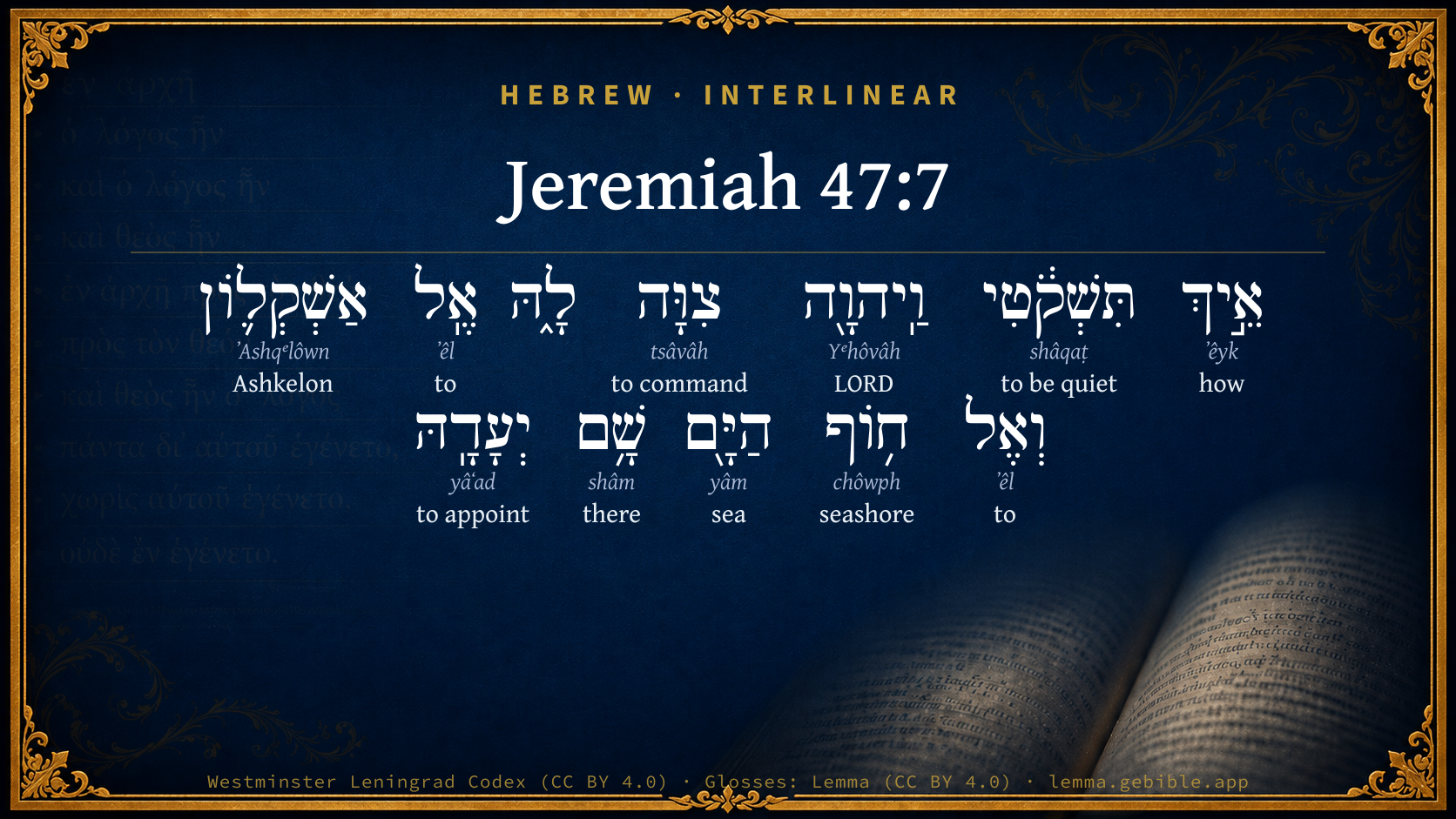
Hebrew (Westminster Leningrad Codex) Jeremiah 47:7 appears in the Hebrew Old Testament. The text above is from the Westminster Leningrad Codex. Each word links to its Strong’s number, a concise gloss, and parsing drawn from the Open Scriptures Hebrew Bible morphology. Click any word for its full Brown-Driver-Briggs (BDB) entry.
Download image
Cite this verse

Jeremiah 47:7 (World English Bible). Public Domain. Lemma interlinear Bible study tool, https://lemma.gebible.app/v/jeremiah/47/7.

Show BibTeX & RIS
BibTeX
RIS
English Translation
How can you be quiet, seeing Yahweh has given you a charge? Against Ashkelon, and against the sea-shore, there has he appointed it.
World English Bible · Public Domain
Download a study sheet

One document with this verse’s original text, its word-by-word gloss line, the meaning frame, cross-references with their text, attributed commentary, and full source and license credits — printable, and it pastes into notes with its structure intact.

This verse Autodidact and up

Study sheet (.html) Plain text (.txt)

A passage Seminary Student

Up to 50 verses in one chapter. A passage sheet keeps up to 6 commentary sources and 12 cross-references per verse, in the order this page ranks them, and says so on the sheet whenever that leaves anything out. Ask for a single verse and you get the Autodidact verse sheet above.

Everything on this page stays free to read, with no account — the sheet is a download of what is already on screen, not access to it.

Want to remove ads? Support Godless Engineer
Compare translations 3

The same verse in 3 English versions, stacked beneath the original-language interlinear above. Click any original word for its lexicon entry.

Each is an independent rendering of the whole verse — the interlinear is not word-aligned to these translations.

Highlighted words mark where these versions differ — a whole-verse word diff, not a word-by-word alignment.

  • World English Bible Public Domain
    How can you be quiet, seeing Yahweh has given you a charge? Against Ashkelon, and against the sea-shore, there has he appointed it.
  • King James Version Public Domain
    How can it be quiet, seeing the LORD hath given it a charge against Ashkelon, and against the sea shore? there hath he appointed it.
  • unfoldingWord Literal Text CC BY-SA 4.0
    How can it rest when Yahweh has commanded it, when he has ordered it to attack Ashkelon and the coastlands along the sea?”

unfoldingWord Literal Text — © unfoldingWord, licensed CC BY-SA 4.0. Word-aligned USFM3 via Door43 (git.door43.org/unfoldingWord/en_ult).

Versions to compare (up to 4)

3 of 4 selected

Show all 18 translations

Every available English version of this verse, each an independent rendering of the whole verse.

  • World English Bible Public Domain
    How can you be quiet, seeing Yahweh has given you a charge? Against Ashkelon, and against the sea-shore, there has he appointed it.
  • Berean Standard Bible Public Domain
    How can it rest when the LORD has commanded it? He has appointed it against Ashkelon and the shore of its coastland.”
  • Majority Standard Bible Public Domain
    How can it rest when the LORD has commanded it? He has appointed it against Ashkelon and the shore of its coastland.”
  • King James Version Public Domain
    How can it be quiet, seeing the LORD hath given it a charge against Ashkelon, and against the sea shore? there hath he appointed it.
  • American Standard Version (1901) Public Domain
    How canst thou be quiet, seeing Jehovah hath given thee a charge? Against Ashkelon, and against the sea-shore, there hath he appointed it.
  • Revised Version (1885) Public Domain
    How canst thou be quiet, seeing the LORD hath given thee a charge? against Ashkelon, and against the sea shore, there hath he appointed it.
  • Geneva Bible (1599) Public Domain
    Howe can it cease, seeing the Lord hath giuen it a charge against Ashkelon, and against the sea banke? euen there hath he appointed it.
  • Douay-Rheims (1899) Public Domain
    How shall it be quiet, when the Lord hath given it a charge against Ascalon, and against the countries thereof by the sea side, and there hath made an appointment for it?
  • Young's Literal Translation Public Domain
    How shall it be quiet, And Jehovah hath given a charge to it, Against Ashkelon, and against the sea shore? There hath He appointed it!'
  • Literal Standard Version CC BY-SA 4.0
    How will it be quiet, || And YHWH has given a charge to it, || Against Ashkelon and against the seashore? He has appointed it there!”
  • Unlocked Literal Bible CC BY-SA 4.0
    How can it rest when Yahweh has commanded it, when he has ordered it to attack Ashkelon and the coastlands along the sea?”
  • unfoldingWord Literal Text CC BY-SA 4.0
    How can it rest when Yahweh has commanded it, when he has ordered it to attack Ashkelon and the coastlands along the sea?”
  • Darby Bible Public Domain
    How shouldest thou be quiet? -- For Jehovah hath given it a charge: against Ashkelon, and against the sea shore, there hath he appointed it.
  • World Messianic Bible Public Domain
    “How can you be quiet, since the LORD has given you a command? Against Ashkelon, and against the seashore, there he has appointed it.”
  • Webster's Bible Public Domain
    How can it be quiet, seeing the LORD hath given it a charge against Ashkelon, and against the sea shore? there hath he appointed it.
  • Free Bible Version CC BY-SA 4.0
    But how can the sword stop killing when the Lord has given it orders to attack Ashkelon and its coastlands?
  • Bible in Basic English Public Domain
    How is it possible for it to be quiet, seeing that the Lord has given it orders? against Ashkelon and against the sea-land he has given it directions.
  • JPS Tanakh (1917) Public Domain
    How canst thou be quiet? for the LORD hath given it a charge; against Ashkelon, and against the sea-shore, there hath He appointed it.

Literal Standard Version (2020), Covenant Press — licensed CC BY-SA 4.0. Text via the HelloAO Bible API (eBible.org). Unlocked Literal Bible (unfoldingWord) — licensed CC BY-SA 4.0. Text via the HelloAO Bible API (eBible.org). unfoldingWord Literal Text — © unfoldingWord, licensed CC BY-SA 4.0. Word-aligned USFM3 via Door43 (git.door43.org/unfoldingWord/en_ult). Free Bible Version, Dr. Jonathan Gallagher — licensed CC BY-SA 4.0. Text via the HelloAO Bible API (eBible.org).

Word by word

More ways to search: Search by grammar → Find every occurrence → Compare this word →

Practice this passage: Drill this verse → Learn its vocabulary →

ח֥וֹף
chôwph
H2348
“seashore of”
Noun, Common, Masculine, Singular, Construct
Part of Speech
Noun
Type
Common
Gender
Masculine
Number
Singular
State
Construct
Full BDB Definition

Origin: from an unused root meaning to cover

TWOT: 710a

seashore, coast, shore
  1. אֵ֣יךְ ʼêyk H349 “how” Particle, Interrogative
  2. תִּשְׁקֹ֔טִי shâqaṭ H8252 “to be quiet” Verb, Qal, Imperfect, 2nd Person, Feminine, Singular
  3. וַֽיהוָ֖ה Yᵉhôvâh H3068 “and · LORD” Conjunction + Noun, Proper
  4. צִוָּה tsâvâh H6680 “to command” Verb, Piel, Perfect, 3rd Person, Masculine, Singular
  5. אֶֽל ʼêl H413 “to” Preposition
  6. אַשְׁקְל֛וֹן ʼAshqᵉlôwn H831 “Ashkelon” Noun, Proper
  7. וְאֶל ʼêl H413 “and · to” Conjunction + Preposition
  8. הַיָּ֖ם yâm H3220 “the · sea” Particle, Definite Article + Noun, Common, Masculine, Singular, Absolute
  9. שָׁ֥ם shâm H8033 “there” Adverb
  10. יְעָדָֽהּ yâʻad H3259 “to appoint · her” Verb, Qal, Perfect, 3rd Person, Masculine, Singular + Suffix, Personal, 3rd Person, Feminine, Singular

About this verse

These counts appear in no published source. They are computed here, from the morphology-tagged text and Lemma’s own curated glosses. What Lemma adds →

12
words
10
distinct lemmas
Prophets
section

Notable vocabulary

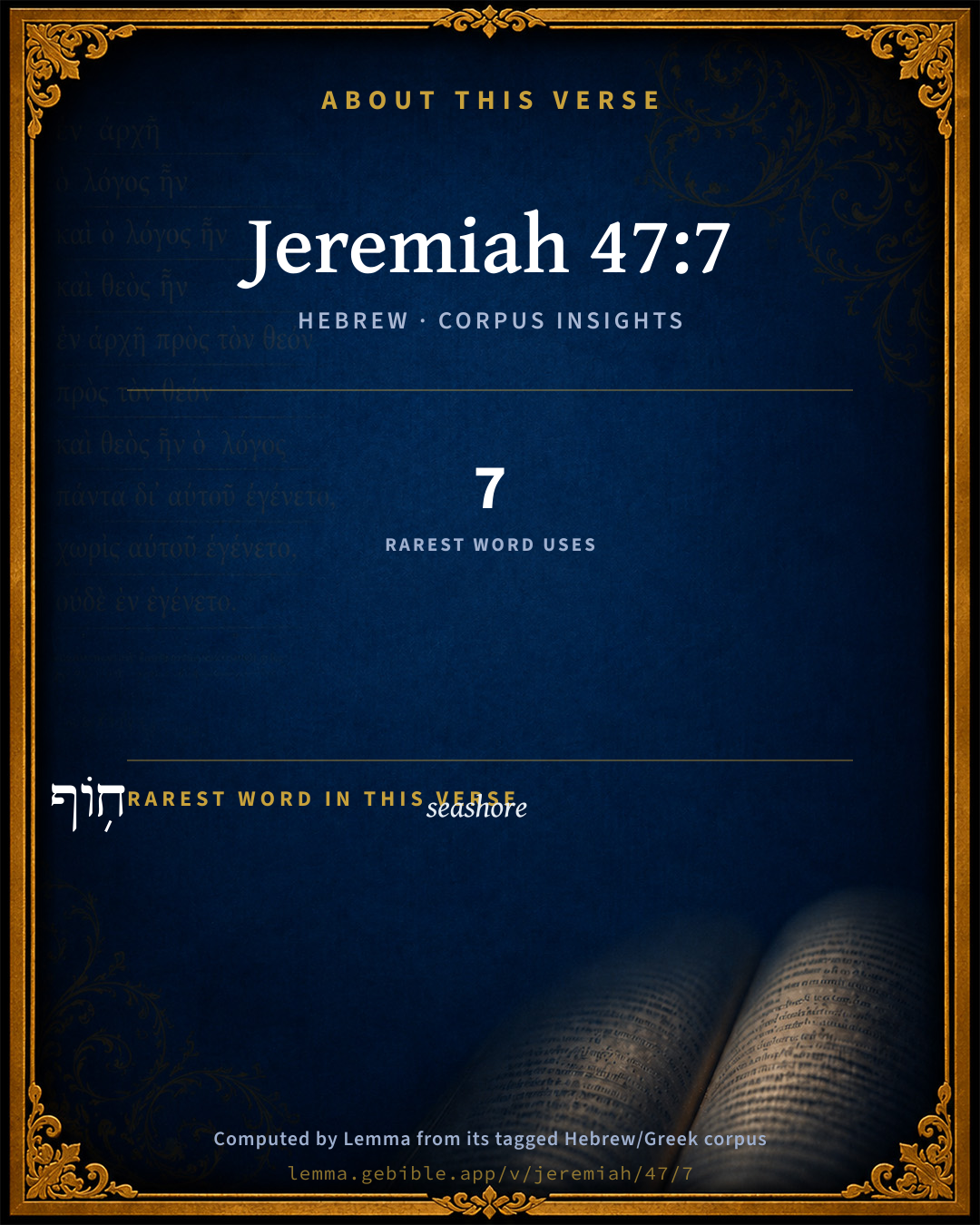
The rarest word here is ח֥וֹף seashore H2348 — appearing just 7 times in the whole Hebrew Bible.

Shared distinctive vocabulary

ח֥וֹף seashore H2348 occurs in 6 verses of the Hebrew Bible. Also found in:

Grammatical profile

  • 3 verbs
  • 4 nouns
  • 3 prepositions
  • 1 adverb
  • 1 particle

Verb forms

  • תִּשְׁקֹ֔טִי Qal · Imperfect
  • צִוָּה Piel · Perfect
  • יְעָדָֽהּ Qal · Perfect

Repetition

A word recurs within this verse — often emphatic in Hebrew:

  • אֶֽל to H413 ×2

Cross-references

11

Topical passages linked to Jeremiah 47:7 in the Treasury of Scripture Knowledge — connected by theme and wording, ordered by reader-vote popularity; previews shown in the World English Bible.

  • Ezekiel 14:17 Or if I bring a sword on that land, and say, Sword, go through the land; so that I cut off from it man and animal;
  • Micah 6:9 Yahweh's voice calls to the city, And wisdom sees your name: "Listen to the rod, And he who appointed it.
  • Isaiah 10:6 I will send him against a profane nation, and against the people of my wrath will I give him a charge, to take the spoil, and to take the prey, and to tread them down like the mire of the streets.
  • 1 Samuel 15:3 Now go and strike Amalek, and utterly destroy all that they have, and don't spare them; but kill both man and woman, infant and suckling, ox and sheep, camel and donkey.
  • Isaiah 13:3 I have commanded my consecrated ones, yes, I have called my mighty men for my anger, even my proudly exulting ones.
  • Isaiah 37:26 Have you not heard how I have done it long ago, and formed it of ancient times? now have I brought it to pass, that it should be your to lay waste fortified cities into ruinous heaps.
  • Isaiah 45:1–3 Thus says Yahweh to his anointed, to Cyrus, whose right hand I have held, to subdue nations before him, and I will loose the loins of kings; to open the doors before him, and the gates shall not be shut:
  • Isaiah 46:10–11 declaring the end from the beginning, and from ancient times things that are not [yet] done; saying, My counsel shall stand, and I will do all my pleasure;
  • Ezekiel 25:16 therefore thus says the Lord Yahweh, Behold, I will stretch out my hand on the Philistines, and I will cut off the Cherethites, and destroy the remnant of the sea coast.
  • Amos 3:6 Does the trumpet alarm sound in a city, Without the people being afraid? Does evil happen to a city, And Yahweh hasn't done it?
  • Zephaniah 2:6–7 The sea coast will be pastures, with cottages for shepherds and folds for flocks.

Cross-references courtesy of OpenBible.info (CC BY 4.0).

Hebrew and Greek witnesses Masoretic Hebrew ↔ Greek Septuagint

The same verse in the two great witnesses to the Old Testament, shown verse-for-verse.

These are two independent witnesses, not word-aligned to each other, and the Septuagint is shown in lemma (dictionary) form.

Hebrew Jeremiah 47:7 Masoretic · Westminster Leningrad Codex

אֵ֣יךְ תִּשְׁקֹ֔טִי וַֽיהוָ֖ה צִוָּה לָ֑הּ אֶֽל אַשְׁקְל֛וֹן וְאֶל ח֥וֹף הַיָּ֖ם שָׁ֥ם יְעָדָֽהּ

How can you be quiet, seeing Yahweh has given you a charge? Against Ashkelon, and against the sea-shore, there has he appointed it.

World English Bible · Public Domain

Greek LXX Structure differs

In the Septuagint, Jeremiah is about an eighth shorter than the Hebrew and arranges its material differently — the Oracles Against the Nations (Hebrew chapters 46–51) appear in the middle of the Greek book, after 25:13. Because the chapter and verse boundaries do not line up, a verse-for-verse comparison with the Hebrew is not shown.

A verse-for-verse comparison isn’t shown here because the chapters and verses don’t line up. Switch to the LXX edition with the MT / LXX toggle above to read the Greek directly.

On this verse, The Cambridge Bible for Schools and Colleges discusses the Septuagint’s reading. Read the note in Commentary ↓

Hebrew: Westminster Leningrad Codex (CC BY 4.0). Greek: Septuagint (public domain); English from a public-domain English Septuagint. How the Septuagint differs from the Hebrew →

Targum (Aramaic paraphrase)

1

The Targum is the ancient Jewish Aramaic paraphrase of the Hebrew Scriptures — an interpretive translation, not the Hebrew text itself. Onkelos (literal) and Pseudo-Jonathan (expansive) render the Torah, and Jonathan the Prophets. Coverage is partial: where no permissively-licensed English translation exists for a verse, only the Aramaic is shown. This is verse-level text, not a word-by-word alignment to the Hebrew.

  1. Targum Jonathan Prophets (Joshua–Malachi)
    אֵיכְדֵין תְנוּחִין וַיָי פַּרֵיד עֲלָהּ עַל אַשְׁקְלוֹן וְעַל סְפַר יַמָא לְתַמָן מְזַמְנָהּ:

    (no public-domain English translation for this verse)

    Targum Jonathan — Aramaic: “Mikraot Gedolot” (public domain). English: “Sefaria Community Translation” (CC0 1.0 (public-domain dedication)); “London "Chaldee Paraphrase," 1871” (public domain). Text via Sefaria.

Commentary

Notes on Jeremiah 47:7 from classic Christian and Jewish commentators (each source and its license shown beneath its notes). The classic Christian expositions comment on the surrounding passage and are grouped to its opening verse, so a note may address several verses; the Jewish commentaries on the Tanakh (Rashi and others) are per-verse, so they appear only where the commentator wrote on this verse.

Lemma curates 59 commentaries, every one of them public domain or Creative Commons licensed, each selected and text-cleaned for this edition rather than reprinted as found. About our sources →

Trapp's Complete Commentary

John Trapp

Jer 47:7 How can it be quiet, seeing the LORD hath given it a charge against Ashkelon, and against the sea shore? there hath he appointed it.

Ver. 7. How can it be quiet?] Heb., How shalt thou be quiet? Here the prophet quieteth himself howsoever by a humble submission to his holy will, who had put the sword in commission. God’s will is the rule of right, neither can force or entreaty prevail aught against it in this world, much less in the world to come, where each one must hold him to his doom, which is irreversible.

John Trapp, A Commentary or Exposition upon All the Books of the Old and New Testament (1647–1656) — public domain. Text from a community e-Sword module.

Tyndale Open Study Notes

Tyndale Open Resources

47:7 The punishment would not end soon, because the judge had declared his judgment and his mission had to be accomplished: Ashkelon . . . must be destroyed.

Tyndale Open Study Notes — © Tyndale Open Resources, licensed CC BY-SA 4.0. Text via the HelloAO Bible API.

Geneva Bible (1599)

Geneva Bible translators

Meaning, that it is not possible that the wicked should by any means escape or stay the Lord, when he will take vengeance.

Geneva Bible (1599) marginal notes — public domain. Text via Bolls.life.

Jamieson, Fausset & Brown

Robert Jamieson, A. R. Fausset & David Brown

Jeremiah, from addressing the sword in the second person, turns to his hearers and speaks of it in the third person.

Lord . . . given it a charge-- (Eze 14:17).

the sea-shore--the strip of land between the mountains and Mediterranean, held by the Philistines: "their valley" (see on Jer 47:5).

there hath he appointed it-- (Mic 6:9). There hath He ordered it to rage.

It had taken part with the Chaldeans against Judea (Kg2 24:2). Fulfilled by Nebuchadnezzar five years after the destruction of Jerusalem, when also he attacked Egypt (Jer 43:8-13) and Ammon (Jer 49:1-6). [JOSEPHUS, Antiquities, 10:9,7]. Jeremiah in this prophecy uses that of Isa. 15:1-16:14, amplifying and adapting it to his purpose under inspiration, at the same time confirming its divine authority. Isaiah, however, in his prophecy refers to the devastation of Moab by the Assyrian king, Shalmaneser; Jeremiah refers to that by Nebuchadnezzar.

Next: Jeremiah Chapter 48

Jamieson, Fausset & Brown — Commentary Critical and Explanatory on the Whole Bible (1871) — public domain (CC PDM 1.0). Text via the HelloAO Bible API.

Adam Clarke's Commentary

Verse 7. How can it be quiet] This is the answer of the Sword. I am the officer of God's judgments, and he has given me a commission against Ashkelon, and against the sea shore; all the coast where the Philistines have their territories. The measure of their iniquities is full; and these God hath appointed this sword to ravage. The Philistines were ever the implacable enemies of the Jews, and the basest and worst of all idolaters. On these accounts the sword of the Lord had its commission against them; and it did its office most fearfully and effectually by the hand of the Chaldeans.

Adam Clarke's Commentary on the Bible (1810–1826) — public domain. Text from a community e-Sword/MySword module.

John Calvin's Commentaries

Some take it, ה, he, as meaning the land itself; but as it immediately follows, against Ashkelon and against the seashore, it is better to explain it as above.

By the sea-shore some understand Joppa; but it is probable that the Prophet includes the whole coast, and that he thus still speaks of Tyre, and Sidon, and Gaza, though he names Ashkelon, which was a little distant from the sea. When, therefor, God commanded his sword against Ashkelon and all the cities which were by the sea-shore, the execution of his judgement could not be prevented in that region. He further adds, he hath commanded it; but it is in a solemn manner, and hence I have rendered the words, he hath called it to witness, or protested it. He then intimates that God had not simply given his sword a command to commit slaughters through the whole land, but bound his sword, as it were, by solemn protest; as though he had said, that this decree could not be revoked, because Godwill not only command his sword to execute his vengeance, but will also give it a solemn command, and bind it, as it were, by an oath, never to cease from its work until the whole people, and all the cities, and the whole land, should be destroyed together.

John Calvin's Commentaries (1540-1563) — public domain. Text from the Calvin Translation Society English edition (1840s-50s) via the Christian Classics Ethereal Library (ccel.org). Calvin's coverage is partial (roughly two-thirds of the Bible); uncommented books and verses are honest gaps, never fabricated. The 19th-century editor's footnotes and remarks are omitted so the notes are faithfully Calvin's own voice.

Ellicott's Commentary for English Readers

(7) Against the sea shore.—In the “sea shore,” as in Eze_25:16, we have the term specially appropriate to the territory of the Philistines.

A Bible Commentary for English Readers, edited by Charles John Ellicott (1878–1897) — public domain. Text from a community e-Sword module.

The Cambridge Bible for Schools and Colleges

gen. ed. J. J. S. Perowne

7. How canst thou] rather, with LXX, Syr., Vulg. How can it.… So correct “thee” by mg. it, the sea shore, the Philistine and Phoenician coast.

The Cambridge Bible for Schools and Colleges (gen. ed. J. J. S. Perowne; Cambridge University Press, 1878–1918) — public domain. Text from a community e-Sword module.

John Gill's Exposition

How can it be quiet,.... There is no reason to believe it will, nor can it be expected that it should; to stop it is impossible, and to request that it might be stopped is in vain:

seeing the Lord hath given it a charge against Ashkelon, and against the seashore? for it had a commission from the Lord to destroy the inhabitants of Ashkelon, and other places, which lay still more towards the sea, as Joppa and Jamne; and indeed all Palestine lay on the coast of the Mediterranean sea:

there hath he appointed it; by an irreversible decree of his, in righteousness to punish the inhabitants of these places for their sins.

Next: Jeremiah Chapter 48

John Gill's Exposition of the Whole Bible (1746–1763) — public domain (CC PDM 1.0). Text via the HelloAO Bible API.

Matthew Poole's English Annotations

Some make the words of the 6th verse to be the words of the Philistines in their mourning and cutting themselves, crying to God to stop the sword drawn against them, and to return it again into its scabbard: others make them the words of the prophet, lamenting the havoc which he by the eye of the prophecy saw was like to be made amongst the Philistines by the Chaldeans (for good men are affected with the miseries even of the worst of men).

The latter verse must be expounded according to the former; for if the words of the former verse be understood as the words of the Philistines, those of this verse must be understood as the words of the prophet putting them out of hopes of the sword’s stopping, because what it did was by commission from God, which it must execute. If the words of the former verse be to be understood as the prophet’s words, the words of this verse are either the prophet’s words correcting himself, and concluding that this sword could not be quiet, because it was edged by God himself, who had given it his commission, which it must execute; or the words of God, letting the prophet know that he had given this sword its commission, and therefore it could not stop till Ashkelon and the people on the sea-shore were destroyed by it.

Matthew Poole's English Annotations on the Holy Bible (1683–1685) — public domain. Text from a community e-Sword/MySword module.

Whedon's Commentary on the Bible

Daniel D. Whedon

7. How can it, etc. — A reply to the question asked in Jer_47:6. Jehovah hath given “the sword” a commission, and it cannot be quiet until the commission be fulfilled.

Sea shore — A suitable designation of Philistia.

Daniel D. Whedon (gen. ed.), Commentary on the Old and New Testaments (1874–1909) — public domain. Text from a community e-Sword module.

The Pulpit Commentary

The seashore. So Ezekiel speaks of "the remnant of the seashore", (Eze_25:16) referring to Philistia.

HOMILIES BY S. CONWAY Ver. 7. The sword that cannot be quiet.

This chapter tells of another of the Gentile nations on whom the judgment of God was to come. These nations all lay in the march of the Babylonian armies, and were one after another overthrown. Philistia is represented as asking of the sword of the Lord, when it will be quiet, and the answer is, "How can it be quiet, when," etc.? (ver. 7). It reminds

I OF THE SWORD OF CONSCIENCE. The Lord hath given it a charge, and, though we may blunt it, we cannot perfectly quiet it (cf. Macbeth, Judas, and other conscience-haunted men).

II OF THE SWORD OF SCRIPTURE. "The Word of the Lord is not bound. How men have sought to sheathe it in the scabbard, to hide and hold it there, so that they may go on unchecked in their own ways! But it has leapt forth in spite of them; and, in spite of pagan, Roman, and other persecutions, has asserted its supreme might.

III OF THE SWORD OF THE DIVINE JUDGMENT AGAINST SIN. Sin and sorrow are eternally married, and can never be put asunder. Where one is the other is never far off, and never will be in this world or the next. But for every believer Christ has offered his own heart as a sheath for it. For such that sword is sheathed therein, and will be quiet there forever. C. "When Christ gave up the ghost The Law was satisfied; And now to its most rigorous claims I answer, "Jesus died.

The Pulpit Commentary (1880–1919), ed. H.D.M. Spence-Jones & Joseph S. Exell — public domain. Text from a community e-Sword module.

John Wesley's Explanatory Notes

How - God lets the prophet know that he had given this sword its commission, and therefore it could not stop 'till Ashkelon and the people on the sea-shore were destroyed by it.

John Wesley, Explanatory Notes Upon the Whole Bible (1754–1765) — public domain. Text via the GEBible commentary corpus.

Lesson kit

Teaching starters — assembled from the data on this page, not authored interpretation. Every prompt links to the verse data it draws on. Edit before teaching.

Jeremiah, in the Prophets, opens this verse with 12 words (10 distinct Hebrew lemmas). Its most distinctive word is chôwph (“seashore”). A historical commentator’s framing appears above. Read the whole chapter for the surrounding context.

Discussion questions

  1. What does “seashore” (chôwph) contribute to the verse as a whole?
  2. How does Genesis 49:13, which shares the word «seashore», read alongside this verse?
  3. What does the repetition of “to” (2× in this one verse) do in this verse?
  4. These translations render this verse differently; the difference is in the English rendering, not the original. What questions does that raise?
  5. «תִּשְׁקֹ֔טִי» is a Qal Imperfect verb. How does that grammatical form shape the action described?
  6. Compare how Trapp's Complete Commentary and Tyndale Open Study Notes read this verse. Where do they agree or differ?

Things to notice

Reading settings

Reading text

Shown beneath each verse's original-language words.

Old Testament
Old Testament edition

Read the OT as the Masoretic Hebrew (MT) or the Greek Septuagint (LXX).

English shown for the Greek Septuagint (in the Hebrew ↔ Greek comparison).

Comparing translations? Open the Compare panel on any verse page to stack up to four side by side.