Isaiah 14:12

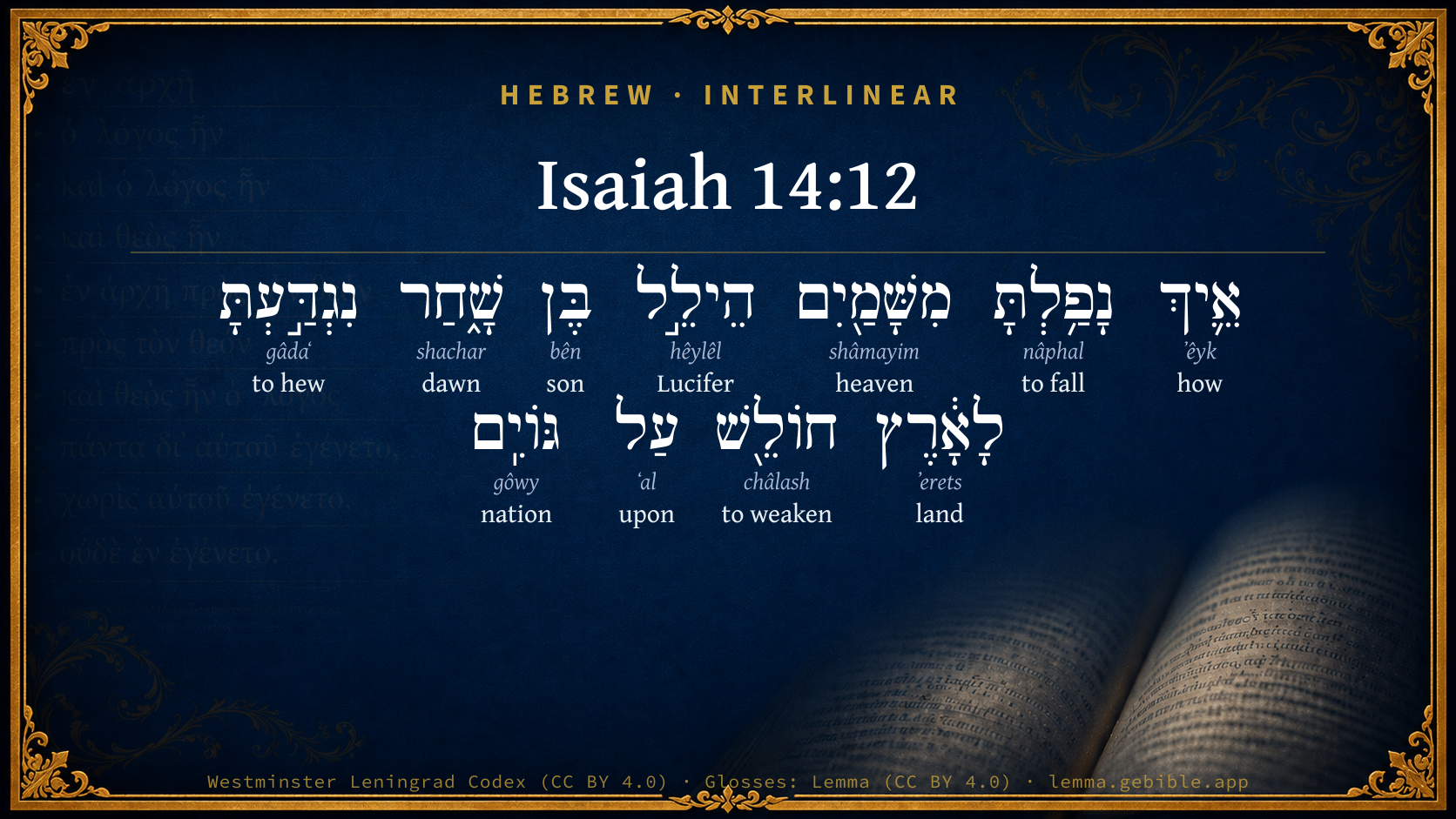
Hebrew (Westminster Leningrad Codex) Isaiah 14:12 appears in the Hebrew Old Testament. The text above is from the Westminster Leningrad Codex. Each word links to its Strong’s number, a concise gloss, and parsing drawn from the Open Scriptures Hebrew Bible morphology. Click any word for its full Brown-Driver-Briggs (BDB) entry.
Download image
Cite this verse

Isaiah 14:12 (World English Bible). Public Domain. Lemma interlinear Bible study tool, https://lemma.gebible.app/v/isaiah/14/12.

Show BibTeX & RIS
BibTeX
RIS
English Translation
How you are fallen from heaven, day-star, son of the morning! How you are cut down to the ground, who laid the nations low!
World English Bible · Public Domain
Highlights
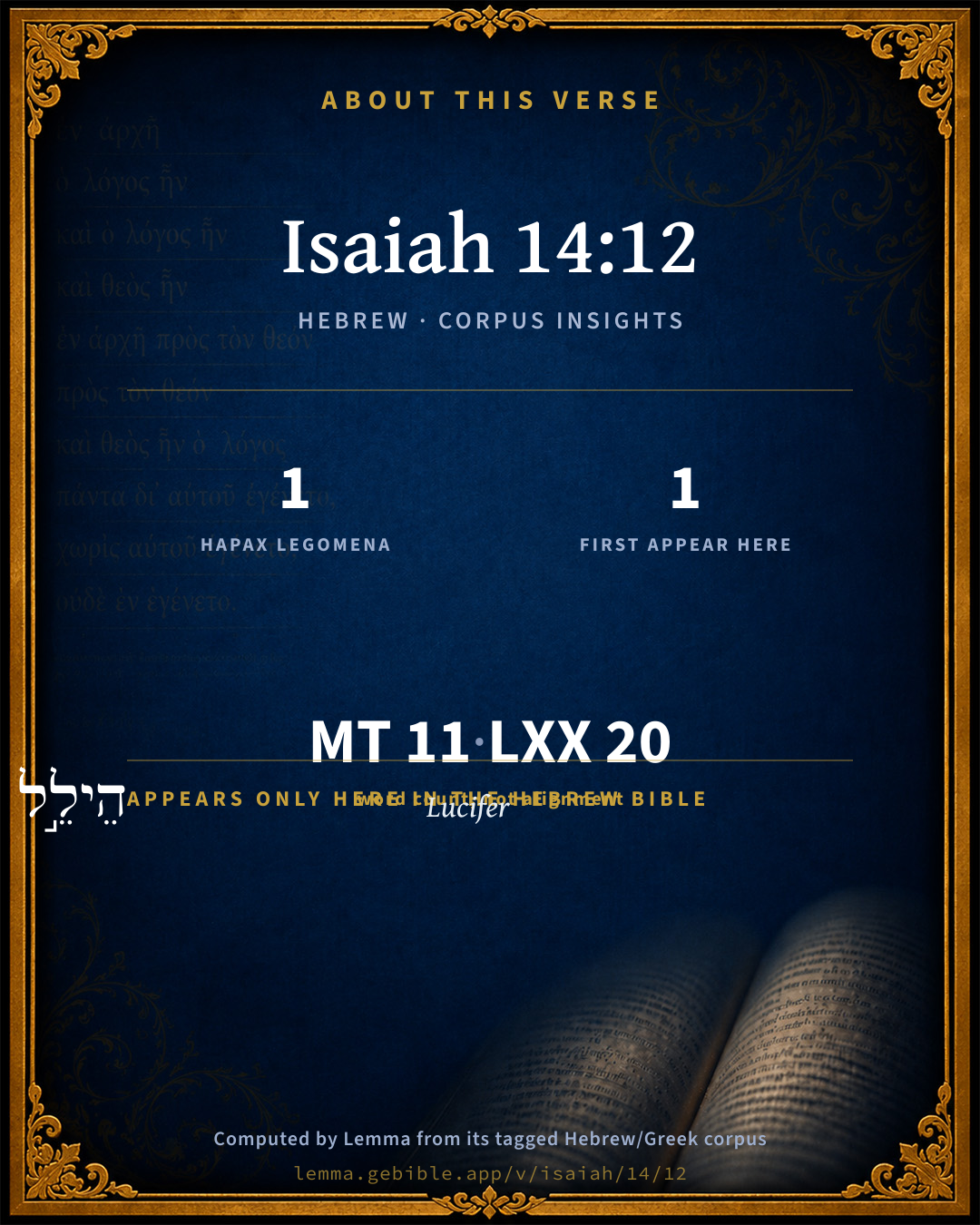
  • 1 hapax legomenon — only here in the Hebrew Bible
  • 1 first appearance in the Hebrew Bible
Full analysis ↓
Download a study sheet

One document with this verse’s original text, its word-by-word gloss line, the meaning frame, cross-references with their text, attributed commentary, and full source and license credits — printable, and it pastes into notes with its structure intact.

This verse Autodidact and up

Study sheet (.html) Plain text (.txt)

A passage Seminary Student

Up to 50 verses in one chapter. A passage sheet keeps up to 6 commentary sources and 12 cross-references per verse, in the order this page ranks them, and says so on the sheet whenever that leaves anything out. Ask for a single verse and you get the Autodidact verse sheet above.

Everything on this page stays free to read, with no account — the sheet is a download of what is already on screen, not access to it.

Want to remove ads? Support Godless Engineer
Compare translations 3

The same verse in 3 English versions, stacked beneath the original-language interlinear above. Click any original word for its lexicon entry.

Each is an independent rendering of the whole verse — the interlinear is not word-aligned to these translations.

Highlighted words mark where these versions differ — a whole-verse word diff, not a word-by-word alignment.

  • World English Bible Public Domain
    How you are fallen from heaven, day-star, son of the morning! How you are cut down to the ground, who laid the nations low!
  • King James Version Public Domain
    How art thou fallen from heaven, O Lucifer, son of the morning! how art thou cut down to the ground, which didst weaken the nations!
  • unfoldingWord Literal Text CC BY-SA 4.0
    How you have fallen from the heavens, morning star, son of the dawn! You have been cut down to the ground, the one subduing nations!

unfoldingWord Literal Text — © unfoldingWord, licensed CC BY-SA 4.0. Word-aligned USFM3 via Door43 (git.door43.org/unfoldingWord/en_ult).

Versions to compare (up to 4)

3 of 4 selected

Show all 18 translations

Every available English version of this verse, each an independent rendering of the whole verse.

  • World English Bible Public Domain
    How you are fallen from heaven, day-star, son of the morning! How you are cut down to the ground, who laid the nations low!
  • Berean Standard Bible Public Domain
    How you have fallen from heaven, O day star, son of the dawn! You have been cut down to the ground, O destroyer of nations.
  • Majority Standard Bible Public Domain
    How you have fallen from heaven, O day star, son of the dawn! You have been cut down to the ground, O destroyer of nations.
  • King James Version Public Domain
    How art thou fallen from heaven, O Lucifer, son of the morning! how art thou cut down to the ground, which didst weaken the nations!
  • American Standard Version (1901) Public Domain
    How art thou fallen from heaven, O day-star, son of the morning! how art thou cut down to the ground, that didst lay low the nations!
  • Revised Version (1885) Public Domain
    How art thou fallen from heaven, O day star, son of the morning! how art thou cut down to the ground, which didst lay low the nations!
  • Geneva Bible (1599) Public Domain
    How art thou fallen from heauen, O Lucifer, sonne of the morning? and cutte downe to the grounde, which didest cast lottes vpon the nations?
  • Douay-Rheims (1899) Public Domain
    How art thou fallen from heaven, O Lucifer, who didst rise in the morning? how art thou fallen to the earth, that didst wound the nations?
  • Young's Literal Translation Public Domain
    How hast thou fallen from the heavens, O shining one, son of the dawn! Thou hast been cut down to earth, O weakener of nations.
  • Literal Standard Version CC BY-SA 4.0
    How you have fallen from the heavens, || O shining one, son of the dawn! You have been cut down to earth, || O weakener of nations.
  • Unlocked Literal Bible CC BY-SA 4.0
    How you are fallen from heaven, daystar, son of the morning! How you are cut down to the ground, you who conquered the nations!
  • unfoldingWord Literal Text CC BY-SA 4.0
    How you have fallen from the heavens, morning star, son of the dawn! You have been cut down to the ground, the one subduing nations!
  • Darby Bible Public Domain
    How art thou fallen from heaven, Lucifer, son of the morning! Thou art cut down to the ground, that didst prostrate the nations!
  • World Messianic Bible Public Domain
    How you have fallen from heaven, shining one, son of the dawn! How you are cut down to the ground, who laid the nations low!
  • Webster's Bible Public Domain
    How art thou fallen from heaven, O Lucifer, son of the morning! how art thou cut down to the ground, which didst weaken the nations!
  • Free Bible Version CC BY-SA 4.0
    Morning star, son of the dawn, how you have fallen from heaven! Destroyer of nations, you have been cut down to the ground!
  • Bible in Basic English Public Domain
    How great is your fall from heaven, O shining one, son of the morning! How are you cut down to the earth, low among the dead bodies!
  • JPS Tanakh (1917) Public Domain
    How art thou fallen from heaven, O day-star, son of the morning! How art thou cut down to the ground, that didst cast lots over the nations!

Literal Standard Version (2020), Covenant Press — licensed CC BY-SA 4.0. Text via the HelloAO Bible API (eBible.org). Unlocked Literal Bible (unfoldingWord) — licensed CC BY-SA 4.0. Text via the HelloAO Bible API (eBible.org). unfoldingWord Literal Text — © unfoldingWord, licensed CC BY-SA 4.0. Word-aligned USFM3 via Door43 (git.door43.org/unfoldingWord/en_ult). Free Bible Version, Dr. Jonathan Gallagher — licensed CC BY-SA 4.0. Text via the HelloAO Bible API (eBible.org).

Word by word

More ways to search: Search by grammar → Find every occurrence → Compare this word →

Practice this passage: Drill this verse → Learn its vocabulary →

הֵילֵ֣ל
hêylêl
H1966
“Lucifer”
Noun, Common, Masculine, Singular, Absolute
Part of Speech
Noun
Type
Common
Gender
Masculine
Number
Singular
State
Absolute
Full BDB Definition

Origin: from H1984 (in the sense of brightness)

TWOT: 499a

Lucifer = "light-bearer" - shining one, morning star, Lucifer - of the king of Babylon and Satan (figuratively) - (TWOT) 'Helel' describing the king of Babylon
  1. אֵ֛יךְ ʼêyk H349 “how” Particle, Interrogative
  2. נָפַ֥לְתָּ nâphal H5307 “to fall” Verb, Qal, Perfect, 2nd Person, Masculine, Singular
  3. מִשָּׁמַ֖יִם shâmayim H8064 “from · heaven(s)” Preposition + Noun, Common, Masculine, Plural, Absolute
  4. בֶּן bên H1121 “son of” Noun, Common, Masculine, Singular, Construct
  5. שָׁ֑חַר shachar H7837 “dawn” Noun, Common, Masculine, Singular, Absolute
  6. נִגְדַּ֣עְתָּ gâdaʻ H1438 “to hew” Verb, Niphal, Perfect, 2nd Person, Masculine, Singular
  7. לָאָ֔רֶץ ʼerets H776 “to/for the · land” Preposition, Determined + Noun, Common, Both, Singular, Absolute
  8. חוֹלֵ֖שׁ châlash H2522 “weakening” Verb, Qal, Participle Active, Masculine, Singular, Absolute
  9. עַל ʻal H5921 “upon” Preposition
  10. גּוֹיִֽם gôwy H1471 “nations” Noun, Common, Masculine, Plural, Absolute

About this verse

These counts appear in no published source. They are computed here, from the morphology-tagged text and Lemma’s own curated glosses. What Lemma adds →

11
words
11
distinct lemmas
Prophets
section

Notable vocabulary

1 hapax legomenon — a word that appears only here in the entire Hebrew Bible:

  • הֵילֵ֣ל Lucifer H1966

First appearance in Scripture

This word makes its first canonical appearance in the Hebrew Bible here:

  • הֵילֵ֣ל Lucifer H1966

Shared distinctive vocabulary

חוֹלֵ֖שׁ to weaken H2522 occurs in 3 verses of the Hebrew Bible. Also found in:

Grammatical profile

  • 3 verbs
  • 6 nouns
  • 1 preposition
  • 1 particle

Verb forms

  • נָפַ֥לְתָּ Qal · Perfect
  • נִגְדַּ֣עְתָּ Niphal · Perfect
  • חוֹלֵ֖שׁ Qal · Participle Active

Hebrew & Septuagint length

In English translation the verse runs 24 words from the Hebrew and 24 from the Septuagint (LXX English) — the same length.

A rough comparison of the two English renderings, which tokenize alike — not a word-level alignment.

Word counts can differ between the Hebrew and the Greek without any difference in meaning — e.g. the Hebrew direct-object marker אֵת has no separate Greek word, and Greek often adds the article ὁ.

In the original languages it is 11 Hebrew tokens and 20 Greek tokens — but the two are counted differently (Hebrew bundles its prefixes and suffixes into one token; the Greek is in lemma form), so that isn’t a like-for-like length.

Cross-references

14

Topical passages linked to Isaiah 14:12 in the Treasury of Scripture Knowledge — connected by theme and wording, ordered by reader-vote popularity; previews shown in the World English Bible.

  • Ezekiel 28:13–17 You were in Eden, the garden of God; every precious stone adorned you: ruby, topaz, emerald, chrysolite, onx, jasper, sapphire, turquoise, and beryl. Gold work of tambourines and of pipes was in you. In the day that you were created they were prepared.
  • Luke 10:18 He said to them, "I saw Satan having fallen like lightning from heaven.
  • Revelation 12:7–10 There was war in the sky. Michael and his angels made war on the dragon. The dragon and his angels made war.
  • Revelation 8:10 The third angel sounded, and a great star fell from the sky, burning like a torch, and it fell on one third of the rivers, and on the springs of the waters.
  • Isaiah 34:4 All the host of the sky shall be dissolved, and the heavens shall be rolled together as a scroll; and all their host shall fade away, as the leaf fades from off the vine, and as a fading [leaf] from the fig tree.
  • 2 Peter 1:19 We have the more sure word of prophecy; whereunto you do well that you take heed, as to a lamp shining in a dark place, until the day dawns, and the day star arises in your hearts:
  • Revelation 22:16 I, Jesus, have sent my angel to testify these things to you for the assemblies. I am the root and the offspring of David; the Bright and Morning Star."
  • Revelation 2:28 and I will give him the morning star.
  • Isaiah 14:4–6 that you shall take up this parable against the king of Babylon, and say, How has the oppressor ceased! the golden city ceased!
  • 2 Peter 2:4 For if God didn't spare angels when they sinned, but cast them down to Tartarus, and committed them to pits of darkness, to be reserved to judgment;
  • Jeremiah 50:23 How is the hammer of the whole earth cut apart and broken! how is Babylon become a desolation among the nations!
  • Jeremiah 51:20–24 You are my battle-axe and weapons of war: and with you will I break in pieces the nations; and with you will I destroy kingdoms;
  • Revelation 9:1 The fifth angel sounded, and I saw a star from the sky which had fallen to the earth. The key to the pit of the abyss was given to him.
  • Isaiah 13:10 For the stars of the sky and the constellations of it shall not give their light; the sun shall be darkened in its going forth, and the moon shall not cause its light to shine.

Cross-references courtesy of OpenBible.info (CC BY 4.0).

Hebrew and Greek witnesses Masoretic Hebrew ↔ Greek Septuagint

The same verse in the two great witnesses to the Old Testament, shown verse-for-verse.

These are two independent witnesses, not word-aligned to each other, and the Septuagint is shown in lemma (dictionary) form.

Hebrew Isaiah 14:12 Masoretic · Westminster Leningrad Codex

אֵ֛יךְ נָפַ֥לְתָּ מִשָּׁמַ֖יִם הֵילֵ֣ל בֶּן שָׁ֑חַר נִגְדַּ֣עְתָּ לָאָ֔רֶץ חוֹלֵ֖שׁ עַל גּוֹיִֽם

How you are fallen from heaven, day-star, son of the morning! How you are cut down to the ground, who laid the nations low!

World English Bible · Public Domain

Greek LXX Isaiah 14:12 Septuagint · lemma form

πῶς ἐκπίπτω ἐκ ὁ οὐρανός ὁ ἑωσφόρος ὁ πρωί ἀνατέλλω συντρίβω εἰς ὁ γῆ ὁ ἀποστέλλω πρός πᾶς ὁ ἔθνος

How has Lucifer, that rose in the morning, fallen from heaven! He that sent orders to all the nations is crushed to the earth.

LXX2012 (modern English Septuagint) · Public Domain

On this verse, Albert Barnes' Notes on the Bible discusses the Septuagint’s reading. Read the note in Commentary ↓

Hebrew: Westminster Leningrad Codex (CC BY 4.0). Greek: Septuagint (public domain); English from LXX2012 (modern English Septuagint) (Public Domain). How the Septuagint differs from the Hebrew →

Targum (Aramaic paraphrase)

1

The Targum is the ancient Jewish Aramaic paraphrase of the Hebrew Scriptures — an interpretive translation, not the Hebrew text itself. Onkelos (literal) and Pseudo-Jonathan (expansive) render the Torah, and Jonathan the Prophets. Coverage is partial: where no permissively-licensed English translation exists for a verse, only the Aramaic is shown. This is verse-level text, not a word-by-word alignment to the Hebrew.

  1. Targum Jonathan Prophets (Joshua–Malachi)
    אֵיכְדֵין אִתְרְכִינְתָּא מִן רוּמָא דַהֲוֵיתָא זִיוְתָן בְּגוֹ בְְנֵי אֱנָשָׁא כְּכוֹכָב נוֹגְהָא בֵּין כּוֹכְבַיָא אִתְרַטֵישְׁתָּא לְאַרְעָא דַהֲוֵיתָא קְטוֹל בְּעַמְמַיָא:

    How art thou cast down from on high, who wast shining among the sons of men as the star Venus among the stars: thou art dashed down to the earth, who wast a slaughterer among the nations.

    Targum Jonathan — Aramaic: “Mikraot Gedolot” (public domain). English: “Sefaria Community Translation” (CC0 1.0 (public-domain dedication)); “London "Chaldee Paraphrase," 1871” (public domain). Text via Sefaria.

Commentary

Notes on Isaiah 14:12 from classic Christian and Jewish commentators (each source and its license shown beneath its notes). The classic Christian expositions comment on the surrounding passage and are grouped to its opening verse, so a note may address several verses; the Jewish commentaries on the Tanakh (Rashi and others) are per-verse, so they appear only where the commentator wrote on this verse.

Lemma curates 59 commentaries, every one of them public domain or Creative Commons licensed, each selected and text-cleaned for this edition rather than reprinted as found. About our sources →

Jamieson, Fausset & Brown

Robert Jamieson, A. R. Fausset & David Brown

THE JEWS ADDRESS HIM AGAIN AS A FALLEN ONCE-BRIGHT STAR. (Isa 14:12-15)

Lucifer--"day star." A title truly belonging to Christ (Rev 22:16), "the bright and morning star," and therefore hereafter to be assumed by Antichrist. GESENIUS, however, renders the Hebrew here as in Eze 21:12; Zac 11:2, "howl."

weaken--"prostrate"; as in Exo 17:13, "discomfit."

Jamieson, Fausset & Brown — Commentary Critical and Explanatory on the Whole Bible (1871) — public domain (CC PDM 1.0). Text via the HelloAO Bible API.

Trapp's Complete Commentary

John Trapp

Isa 14:12 How art thou fallen from heaven, O Lucifer, son of the morning! [how] art thou cut down to the ground, which didst weaken the nations!

Ver. 12. How art thou fallen from heaven, O Lucifer!] That is, not O Belzeebub, as some ancients, but, O Belshazzar rather, called Lucifer here, or the morning star, for his beauty and brightness; and as much wonder it was to see the Chaldean monarch at such an under, as to have seen Lucifer, the sun’s constant companion, fallen from heaven. He was the terror of the world, and, as he thought, superior to fortune; yet a sudden and dismal change befell him. In the chariot of the Roman triumpher, there hung up a little bell and a whip, to put him in mind he might one day be whipped as a slave, or as an offender lose his head. Nemo confidat mimium secundis. Let no one rely on the least favours.

John Trapp, A Commentary or Exposition upon All the Books of the Old and New Testament (1647–1656) — public domain. Text from a community e-Sword module.

Joseph Benson's Commentary

Isa 14:12-14. How art thou fallen from heaven — From the height of thy glory; O Lucifer — Lucifer is properly a bright star, that ushers in the morning; but is here metaphorically taken for the mighty king of Babylon, who outshone all the kings of the earth by his great splendour. Son of the morning — The title of son is given in Scripture, not only to a person or thing begotten or produced by another, but also to any thing which is related to it, in which sense we read of the son of a night, Jon 4:10, a son of perdition, Joh 17:12, and, which is more agreeable to the present case, the sons of Arcturus, Job 38:32. How art thou cut down to the ground — Thou, whose power raised thee, in the estimation of men, even to heaven itself? Thou, who didst trample on, and destroy all the nations! For thou hast said in thy heart — Which lay open to God’s inspection; I will ascend into heaven — I will advance myself above the state of weak and mortal men. I will exalt my throne above the stars of God — Above all other kings and potentates; or, above the most eminent persons of God’s church. I will sit upon the mount of the congregation — I will establish my royal throne upon mount Zion, where the Jews meet together to worship God: in the sides of the north — This is added as a more exact description of the place of the temple; it stood upon mount Moriah, which was northward from the hill of Zion, strictly so called. I will be like the Most High — In the uncontrollableness of my power, and the universal extent of my dominion. By putting these and such like words into the mouths of the kings of Babylon, the prophet means to show their excessive pride, and the confidence which they entertained, that they should perpetually reign over the Jews.

Joseph Benson's Commentary on the Old and New Testaments (1811–1818) — public domain. Text from a community e-Sword module.

Scofield Reference Notes

C. I. Scofield

son of the morning

Isa 14:12-14 evidently refer to Satan, who, as prince of this world-system (see "World," Joh 7:7 (See Scofield "Rev 13:8") is the real unseen ruler of the successive world- powers. Tyre, Babylon, Medo-Persia, Greece, Rome, etc. (see Eze 28:12-14 Lucifer, "day-star," can be none other that Satan. This tremendous passage marks the beginning of sin in the universe. When Lucifer said, "I will," sin began. See Scofield "Rev 20:10".

See other instances of addressing Satan through another, Gen 3:15; Mat 16:22; Mat 16:23.

The Scofield Reference Bible (1917 edition), notes by C. I. Scofield — public domain. Text from a community e-Sword module.

Tyndale Open Study Notes

Tyndale Open Resources

14:12 fallen from heaven, O shining star: These words allude to the Canaanite story of the god Helel’s rebellion against the god El (chief deity of the Canaanite pantheon) and his fall from heaven. Some see the fall of the king of Babylon here as symbolizing the fall of Satan (see Ezek 28; Luke 10:18; Rev 12:9). However, there is little to suggest that Isaiah understood it in that way. He was thinking of the historical king of Babylon. • son of the morning: The battle took place under the early morning sun. The Latin Vulgate translates the term as Lucifer (morning star), a name for Satan in Christian tradition, but the Hebrew text makes no apparent reference here to Satan.

Tyndale Open Study Notes — © Tyndale Open Resources, licensed CC BY-SA 4.0. Text via the HelloAO Bible API.

Geneva Bible (1599)

Geneva Bible translators

Thou that thoughtest thyself most glorious, and as it were placed in the heaven: for the morning star that goeth before the sun, is called Lucifer, to whom Nebuchadnezzar is compared.

Geneva Bible (1599) marginal notes — public domain. Text via Bolls.life.

Adam Clarke's Commentary

Verse 12. O Lucifer, son of the morning] The Versions in general agree in this translation, and render הילל heilel as signifying Lucifer, Φωσφωρος, the morning star, whether Jupiter or Venus; as these are both bringers of the morning light, or morning stars, annually in their turn. And although the context speaks explicitly concerning Nebuchadnezzar, yet this has been, I know not why, applied to the chief of the fallen angels, who is most incongruously denominated Lucifer, (the bringer of light!) an epithet as common to him as those of Satan and Devil. That the Holy Spirit by his prophets should call this arch-enemy of God and man the light-bringer, would be strange indeed. But the truth is, the text speaks nothing at all concerning Satan nor his fall, nor the occasion of that fall, which many divines have with great confidence deduced from this text. O how necessary it is to understand the literal meaning of Scripture, that preposterous comments may be prevented! Besides, I doubt much whether our translation be correct. הילל heilel, which we translate Lucifer, comes from ילל yalal, yell, howl, or shriek, and should be translated, "Howl, son of the morning;" and so the Syriac has understood it; and for this meaning Michaelis contends: see his reasons in Parkhurst, under הלל halal.

Adam Clarke's Commentary on the Bible (1810–1826) — public domain. Text from a community e-Sword/MySword module.

Ellicott's Commentary for English Readers

(12) How art thou fallen from heaven, O Lucifer, son of the morning!—The word for Lucifer is, literally, the shining one, the planet Venus, the morning star, the son of the dawn, as the symbol of the Babylonian power, which was so closely identified with astrolatry. “Lucifer” etymologically gives the same meaning, and is used by Latin poets (Tibull. i., 10, 62) for Venus, as an equivalent for the phôsphoros of the Greeks. The use of the word, however, in mediæval Latin as a name of Satan, whose fall was supposed to be shadowed forth in this and the following verse, makes its selection here singularly unfortunate. Few English readers realise the fact that it is the king of Babylon, and not the devil, who is addressed as Lucifer. While this has been the history of the Latin word, its Greek and English equivalents have risen to a higher place, and the “morning star” has become a name of the Christ (Rev_22:16).

A Bible Commentary for English Readers, edited by Charles John Ellicott (1878–1897) — public domain. Text from a community e-Sword module.

The Cambridge Bible for Schools and Colleges

gen. ed. J. J. S. Perowne

12. O Lucifer; son of the morning] In his splendour he is likened to the morning star; which was worshipped by the Babylonians under the name of Istar, and is described in Assyrian by an epithet, mustilil (shining star), which seems to correspond to the word here used (Schrader, Cuneiform Inscriptions, on this verse). The translation “Lucifer” (light-bearer) is quite correct, and is needlessly abandoned by the R.V. By some of the fathers the passage was applied to the fall of Satan (cf. Luk_10:18); hence the current use of Lucifer as a name of the devil.

For weaken, read lay prostrate.

12–15. The third strophe contains the prophet’s reflection on the sudden fall of the king of Babylon. That he should go to Sheol at all was a fate never contemplated by his soaring and self-deifying pride.

The Cambridge Bible for Schools and Colleges (gen. ed. J. J. S. Perowne; Cambridge University Press, 1878–1918) — public domain. Text from a community e-Sword module.

John Gill's Exposition

How art thou fallen from heaven,.... This is not to be understood of the fall of Satan, and the apostate angels, from their first estate, when they were cast down from heaven to hell, though there may be an allusion to it; see Luk 10:18 but the words are a continuation of the speech of the dead to the king of Babylon, wondering at it, as a thing almost incredible, that he who seemed to be so established on the throne of his kingdom, which was his heaven, that he should be deposed or fall from it. So the destruction of the Roman Pagan emperors is signified by the casting out of the dragon and his angels from heaven, Rev 12:7 and in like manner Rome Papal, or the Romish antichrist, will fall from his heaven of outward splendour and happiness, of honour and authority, now, possessed by him:

O Lucifer, son of the morning! alluding to the star Venus, which is the phosphorus or morning star, which ushers in the light of the morning, and shows that day is at hand; by which is meant, not Satan, who is never in Scripture called Lucifer, though he was once an angel of light, and sometimes transforms himself into one, and the good angels are called morning stars, Job 38:7 and such he and his angels once were; but the king of Babylon is intended, whose royal glory and majesty, as outshining all the rest of the kings of the earth, is expressed by those names; and which perhaps were such as he took himself, or were given him by his courtiers. The Targum is,

"how art thou fallen from on high, who was shining among the sons of men, as the star Venus among the stars.''

Jarchi, as the Talmud (c), applies it to Nebuchadnezzar; though, if any particular person is pointed at, Belshazzar is rather designed, the last of the kings of Babylon. The church of Rome, in the times of the apostles, was famous for its light and knowledge; its faith was spoken of throughout all the earth; and its bishops or pastors were bright stars, in the morning of the Gospel dispensation:

how art thou cut down to the ground; like a tall tree that is cut down, and laid along the ground, and can never rise and flourish more, to which sometimes great monarchs and monarchies are compared; see Isa 10:18 and this denotes that the king of Babylon should die, not a natural, but a violent death, as Belshazzar did, with whom the Babylonish monarchy fell, and never rose more; and this is a representation of the sudden, violent, and irrecoverable ruin of the Romish antichrist, Rev 18:21,

which didst weaken the nations! by subduing them, taking cities and towns, plundering the inhabitants of their substance, carrying them captive, or obliging them to a yearly tribute, by which means he weakened them, and kept them under. So the Romish antichrist has got the power over many nations of the earth, and has reigned over the kings of it, and by various methods has drained them of their wealth and riches, and so greatly enfeebled them; nay, they have of themselves given their power and strength unto the beast, Rev 17:12. Several of the Jewish writers observe, that the word here used signifies to cast lots; and so it is used in the Misna (d), and explained in the Talmud (e); and is applied to the king of Babylon casting lots upon the nations and kingdoms whom he should go to war with, and subdue first; see Eze 21:19. The Targum is,

"thou art cast down to the earth, who killedst the people:''

a fit description of antichrist, Rev 11:7.

(c) T. Bab. Cholin, fol. 89. 1. Gloss. in Pesachim, fol. 94. 1. & Chagiga, fol. 13. 1. (d) Misn. Sabbat, c. 23. 2. & Maimon. & Bartenora in ib. (e) T. Bab. Sabbat, fol. 149. 2.

John Gill's Exposition of the Whole Bible (1746–1763) — public domain (CC PDM 1.0). Text via the HelloAO Bible API.

Albert Barnes' Notes on the Bible

How art thou fallen from heaven - A new image is presented here. It is that of the bright morning star; and a comparison of the once magnificent monarch with that beautiful star. He is now exhibited as having fallen from his place in the east to the earth. His glory is dimmed; his brightness quenched. Nothing can be more poetic and beautiful than a comparison of a magnificent monarch with the bright morning star! Nothing more striking in representing his death, than the idea of that star falling to the earth!

Lucifer - Margin, ‘Day-star’ (הילל hēylēl, from הלל hâlal, “to shine”). The word in Hebrew occurs as a noun nowhere else. In two other places Eze 21:12; Zec 11:2, it is used as a verb in the imperative mood of Hiphil, and is translated ‘howl’ from the verb ילל yālal, “to howl” or “cry.” Gesenius and Rosenmuller suppose that it should be so rendered here. So Noyes renders it, ‘Howl, son of the morning!’ But the common translation seems to be preferable. The Septuagint renders it, Ἑωσφόρος Heōsphoros, and the Vulgate, ‘Lucifer, the morning star.’ The Chaldee, ‘How art thou fallen from high, who wert splendid among the sons of men.’ There can be no doubt that the object in the eve of the prophet was the bright morning star; and his design was to compare this magnificent oriental monarch with that. The comparison of a monarch with the sun, or the other heavenly bodies, is common in the Scriptures.

Son of the morning - This is a Hebraism (see the note at Mat 1:1), and signifies that that bright star is, as it were, the production, or the offspring of morning; or that it belongs to the morning. The word ‘son’ often thus denotes possession, or that one thing belongs to another. The same star in one place represents the Son of God himself; Rev 21:16 : ‘I am - the bright and morning star.’

Which didst weaken the nations - By thy oppressions and exactions, rendering once mighty nations feeble.

Albert Barnes' Notes on the Bible (1834–1885) — public domain. Text from a community e-Sword/MySword module.

Haydock's Catholic Bible Commentary

O Lucifer. O day-star. All this, according to the letter, is spoken of the king of Babylon. It may also be applied, in a spiritual sense, to Lucifer, the prince of devils, who was created a bright angel, but fell by pride and rebellion against God. (Challoner) (Luke x. 18.) (Calmet) --- He fell by pride, as Nabuchodonosor did. (Worthington) --- Homer (Iliad xix.) represents the demon of discord hurled down by Jupiter to the miserable region of mortals.

George Leo Haydock (1774–1849), Haydock's Catholic Family Bible and Commentary, 1859 edition — public domain. Excludes Psalms (Douay-Rheims chapter numbering differs from Protestant) and Deuterocanonical books (Catholic canon only).

Matthew Poole's English Annotations

From heaven; from the height of thy glory and royal majesty. As kings are sometimes called gods in Scripture, so their palaces and thrones may be fitly called their heavens.

O Lucifer; which properly is a bright and eminent star, which ushers in the sun and the morning; but is here metaphorically taken for the high and mighty king of Babylon. And it is a very usual thing, both in prophetical and in profane writers, to describe the princes and potentates of the world under the title of the sun or stars of heaven. Some understand this place of the devil; to whom indeed it may be mystically applied; but as he is never called by this name in Scripture, so it cannot be literally meant of him, but of the king of Babylon, as is undeniably evident from the whole context, which certainly speaks of one and the same person, and describes him as plainly as words can do it.

Son of the morning: the title of son is given in Scripture not only to a person or thing begotten or produced by another, but also in general to any thing which is any way related to another; in which sense we read of a son of stripes, Deu 25:2, the son of a night, Jon 4:10, a son of perdition, Joh 17:12, and, which is more agreeable to the present case, the sons of Arcturus, Job 38:32.

Matthew Poole's English Annotations on the Holy Bible (1683–1685) — public domain. Text from a community e-Sword/MySword module.

Whedon's Commentary on the Bible

Daniel D. Whedon

12. Fallen from heaven — A new image is now introduced, but felicitously appropriate, on account of the early date of Babylonian culture, reaching into far primeval times, and of a predominant astrological character.

From heaven — That is, from the sky.

Lucifer, son of the morning — The epithet “Lucifer,” coupled with a phrase which defines it, is from a verb which means to shine, to give forth, to radiate; hence its proper meaning is light-bearer, radiant one, son of the morning dawn, so called, probably, in virtue of Babylon’s having, from ages immemorial, shone forth in the dawn of the world’s history with surprising lustre, first in culture as the world’s teacher, then in perverted power.

Cut down to the ground — Literally, hewn down. As if this Babel-power were the impersonation of the impurest idolatry, whose asherah, or groves, need an utter cutting up.

Daniel D. Whedon (gen. ed.), Commentary on the Old and New Testaments (1874–1909) — public domain. Text from a community e-Sword module.

The Pulpit Commentary

How art thou fallen from heaven, O Lucifer! Babylon"s sudden fall is compared, with great force and beauty, to the (seeming) fall of a star from heaven. The word translated "Lucifer" means properly "shining one," and no doubt here designates a star; but whether any particular star or no is uncertain. The LXX translated by ewsforov , whence our "Lucifer." The subjoined epithet, "son of the morning" or "of the dawn," accords well with this rendering. How art thou cut down to the ground! One of Isaiah"s favorite changes of metaphor. It is a favorite metaphor also to which he reverts that of representing the destruction of a nation by the felling of a tree or of a forest. (comp. Isa_2:12, 13 10:33, 34, etc.) Which didst weaken the nations; rather, which didst prostrate the nations. The word used is one of great force. (comp. Exo_17:13Jo Exo_14:10)

The ambitious spirit in man.

The word "Lucifer" means the "light-bringer," and so has been in modern times associated with our matches. As standing in this text, it has often been taken as a synonym for Satan; but it really is a highly poetical description of the King of Babylon, and the Babylonian empire is in Scripture represented as the type of the ambitions, aspiring, tyrannical, and self-idolizing power. Ver. 13 gives the supreme boasting of this king: "I will ascend into heaven, I will exalt my throne above the stars of God." "Babylon had shone forth in the dawn of. the world"s history with surprising luster, but was perverted by self-admiration." It should be remembered that the ancient Oriental notion was that kings were incarnations of the Divine, and everything was done to sustain this sentiment. We have evidence of this as regards Egypt, Assyria, and Babylonia, Such a sentiment must have fostered national ambition to an extravagant height. Treating the King of Babylon as a type, we consider the general subject of the ambitious spirit in man," observing

I THAT IT IS THE SPRING- OF ENTERPRISE. The true spring of human enterprise should be loyalty and devotion to God. Next to that we place supreme desire for the well-being of others, the "enthusiasm of humanity." But these have been made to give place, and self-interests have fashioned the ambitions which have inspired men to heroic and persevering deeds, in all the various spheres of life. Illustrate, from commerce, science, travel, literature, and extension of kingdoms. Ambition has been the source of achievement and the spirit of progress. It may be shown how far it has thus proved an element in the well-being of the race. Without ambition the world could never have been won for man.

II IT IS ALSO A CONDITION OF INDIVIDUAL GROWTH. Without it a man remains in the educational anti intellectual range of his class, and the social sphere in which he was born. Illustrate from the farm-laborer, who, through a long life, plods on his simple way, attaining nothing, because utterly lacking the inspiration of ambition. The spread of education is chiefly important for this it shows higher levels, and starts ambition. A man ceases to grow when he ceases to aspire. And the infinite perfection of God is the sublime height set before us. We may all grow on until we have become like him.

III IT IS THE SPIRIT IN MAN TO WHICH RELIGION APPEALS. Religion finds it crushed down into hopelessness, and it touches it, quickening it into new vigor and hope. Religion finds it diverted to base and merely self-seeking ends, and it brings it back to the right lines, and makes it noble and self-denying. Man, made in the image of God, and made for God, must want to reach God. Religion sets God before him so attractively in the person of the Lord Jesus that the ambitions are drawn in, and become one supreme ambition to be worthy sons and devoted servants of the Lord God Almighty. The Christian ought to be the most ambitious of all men. A Christian without his sacred ambitious does no honor to his name.

IV IT IS THE SPIRIT IN MAN WHICH MUST BE KEPT UNDER STRICT LIMITATIONS. Because ambition so soon and so easily gets beyond self-control the control of the sanctified self and becomes self-willed, self-seeking; a mere striving to attain, whether God will have us attain or not. Then ambition is like that of the King of Babylon, and it must bring us under Divine arrestings, checkings, and judgments. The law of limitation is, "Seek ye first the kingdom of God, and his righteousness." There is no fear for the influence of any ambitions that come after, this first and supreme one. The sin and folly of men"s usual ambitions lie in their putting God last. It is with them "all of self, and none of thee. R.T.

The Pulpit Commentary (1880–1919), ed. H.D.M. Spence-Jones & Joseph S. Exell — public domain. Text from a community e-Sword module.

John Wesley's Explanatory Notes

Fallen - From the height of thy glory. Lucifer - Which properly is a bright star, that ushers in the morning; but is here metaphorically taken for the mighty king of Babylon. Son - The title of son is given in scripture not only to a person or thing begotten or produced by another, but also to any thing which is related, to it, in which sense we read of the son of a night, Jonah iv, 10, a son of perdition, John xvii, 12, and, which is more agreeable, to the present case, the sons of Arcturus, Job xxxviii, 32.

John Wesley, Explanatory Notes Upon the Whole Bible (1754–1765) — public domain. Text via the GEBible commentary corpus.

Keil & Delitzsch

C. F. Keil & F. Delitzsch

"How art thou fallen from the sky, thou star of light, sun of the dawn, hurled down to the earth, thou that didst throw down nations from above?" הילל is here the morning star (from hâlal, to shine, resolved from hillel, after the form מאן, Jer 13:10, סעף, Psa 119:113, or rather attaching itself as a third class to the forms היכל, עירם: compare the Arabic sairaf, exchanger; saikal, sword-cleaner). It derives its name in other ancient languages also from its striking brilliancy, and is here called ben-shachar (sun of the dawn), just as in the classical mythology it is called son of Eos, from the fact that it rises before the sun, and swims in the morning light as if that were the source of its birth.

(Note: It is singular, however, that among the Semitic nations the morning star is not personified as a male (Heōsphoros or Phōsphoros), but as a female (Astarte, see at Isa 17:8), and that it is called Nâghâh, Ashtoreth, Zuhara, but never by a name derived from hâlal; whilst the moon is regarded as a male deity (Sin), and in Arabic hilâl signifies the new moon, which might be called ben- shacar (son of the dawn), from the fact that, from the time when it passes out of the invisibility of its first phase, it is seen at sunrise, and is as it were born out of the dawn.)

Lucifer, as a name given to the devil, was derived from this passage, which the fathers (and lately Stier) interpreted, without any warrant whatever, as relating to the apostasy and punishment of the angelic leaders. The appellation is a perfectly appropriate one for the king of Babel, on account of the early date of the Babylonian culture, which reached back as far as the grey twilight of primeval times, and also because of its predominant astrological character. The additional epithet chōlēsh ‛al-gōyim is founded upon the idea of the influxus siderum:

(Note: In a similar manner, the sun-god (San) is called the "conqueror of the king's enemies," "breaker of opposition," etc., on the early Babylonian monuments (see G. Rawlinson, The Five Great Monarchies, i. 160).)

cholesh signifies "overthrowing" or laying down (Exo 17:13), and with ‛al, "bringing defeat upon;" whilst the Talmud (b. Sabbath 149b) uses it in the sense of projiciens sortem, and thus throws light upon the cholesh (= purah, lot) of the Mishnah. A retrospective glance is now cast at the self-deification of the king of Babylon, in which he was the antitype of the devil and the type of antichrist (Dan 11:36; Th2 2:4), and which had met with its reward.

Keil & Delitzsch — Biblical Commentary on the Old Testament (1861–1891) — public domain (CC PDM 1.0). Text via the HelloAO Bible API. (Old Testament only.)

J. A. Alexander on Isaiah

Joseph Addison Alexander

“How art thou fallen from heaven, Lucifer, son of the morning, felled to the ground, thou that didst lord it over the nations.” In the two other places where the word translated Lucifer occurs, it is an imperative signifying ‘howl’. This sense is also put upon it here by the Peshito, but all the other ancient versions and all the leading Rabbins make the word a noun denoting bright one, or more specifically, bright star, or according to the ancients more specifically still, the morning star or harbinger of daylight, called in Latin ‘lucifer’. The same derivation and interpretation is adopted by the latest writers. Some of the Fathers, regarding Luk 10:18 as an explanation of this verse, apply it to the fall of Satan, from which has arisen the popular perversion of the beautiful name Lucifer to signify the Devil. In the last clause the figure of a fallen star is exchanged for that of a prostrate tree. The last clause is a description of the Babylonian tyranny.

Joseph Addison Alexander, The Prophecies of Isaiah (1846–1847; New York: Scribner, 1870–1878) — public domain. Text from a community e-Sword module.

unfoldingWord translationNotes

Door43 World Missions Community

Connecting Statement:

This is part of the taunt song that the Israelites will sing to the king of Babylon.

How you are fallen from heaven, daystar, son of the morning

The daystar is a bright star that rises just before morning. The people of Israel will refer to the king of Babylon in terms of this star in order to imply that he once was great, but now he was not. AT: "You were like the bright morning star, but you have fallen from the sky" (See: Metaphor)

How you are cut down to the ground

The people of Israel will speak of the king of Babylon as if he were a tree that was cut down. AT: "You are defeated like a tree that someone has cut down to the ground" (See: Metaphor)

I will sit on the mount of assembly

This alludes to the myth that many people in the Ancient Near East knew, that the Canaanite gods met in council on the top of a mountain in the northern part of Syria. Sitting on the mountain represents ruling with the gods. AT: "I will rule on the mountain where the gods assemble" (See: Assumed Knowledge and Implicit Information)

in the far reaches of the north

"in the most northern places." The mountain in the north was apparently called Zaphon. Some modern versions say "far away on the sides of Zaphon."

translationWords

heaven

nation

heart

exalt

throne

assembly

Most High

unfoldingWord translationNotes — © Distant Shores Media and the Door43 World Missions Community, licensed CC BY-SA 4.0. Source: git.door43.org/Door43/en_tn.

Rashi

Rabbi Shlomo Yitzchaki (Rashi)

Lucifer, the morning star This is Venus, which gives light as the morning star, הֵילֵל being derived from יהל, to shed light. This is the lamentation over the heavenly prince of Babylon, who will fall from heaven.

You have been cut down to earth You, Nebuchadnezzar, who would cast lots on nations. You would cast lots on them, on the kings, who of them would serve you on such and such a day, and who on such and such a day. Our Rabbis, however, expounded this to mean that he would cast lots on the kings for purposes of pederasty.

Rashi on the Tanakh — English translations: “The Judaica Press complete Tanach with Rashi, translated by A. J. Rosenberg” (CC BY 4.0); “Pentateuch with Rashi's commentary by M. Rosenbaum and A.M. Silbermann, 1929-1934” (public domain); “The Metsudah Tanach series, Lakewood, N.J” (CC BY 4.0); and “The Book of Joshua, Metsudah Publications, 1997” (CC BY 4.0). Text via Sefaria.

Ibn Ezra

Rabbi Abraham ibn Ezra

הילל Very probably Lucifer, as בן שחר morning star proves. It is seen on certain days a little before dawn, and of all the host of heaven there is no star that shines with such brilliancy as this; its name is therefore הילל (lit., splendour); comp. יחלו They shall cause to shine (13:11).

חולש Who didst weaken. Comp. ויחלוש And he defeated (Exod. 17:13). According to others: Who didst cast lots; comp. קלקל בחצים He divined by arrows (Ez. 21:26).

Ibn Ezra on the Tanakh — English translations: “Sefaria Community Translation” (CC0 1.0 (public-domain dedication)); “Yalkut, Sifsei Chachomim Chumash, Metsudah Publications, 2009” (CC BY 4.0); and “Commentary of Ibn Ezra on Isaiah - trans. by M. Friedlander, 1873” (public domain). Text via Sefaria.

Lesson kit

Teaching starters — assembled from the data on this page, not authored interpretation. Every prompt links to the verse data it draws on. Edit before teaching.

Isaiah, in the Prophets, opens this verse with 11 words (11 distinct Hebrew lemmas). Its most distinctive word is hêylêl (“Lucifer”). A historical commentator’s framing appears above. Read the whole chapter for the surrounding context.

Discussion questions

  1. The word hêylêl carries the sense “Lucifer.” How does it shape the verse?
  2. 1 word here appears nowhere else in the Hebrew Bible. Why might the author reach for such rare wording?
  3. This is the first place “Lucifer” appears in Scripture (first appears here). What does its debut here establish?
  4. How does Exodus 17:13, which shares the word «to weaken», read alongside this verse?
  5. The translations on this page render this verse differently — a whole-verse word diff, not a word-by-word alignment. What might account for the different wordings?
  6. «נָפַ֥לְתָּ» is a Qal Perfect verb. How does that grammatical form shape the action described?
  7. Compare how Jamieson, Fausset & Brown and Trapp's Complete Commentary read this verse. Where do they agree or differ?

Things to notice

Reading settings

Reading text

Shown beneath each verse's original-language words.

Old Testament
Old Testament edition

Read the OT as the Masoretic Hebrew (MT) or the Greek Septuagint (LXX).

English shown for the Greek Septuagint (in the Hebrew ↔ Greek comparison).

Comparing translations? Open the Compare panel on any verse page to stack up to four side by side.