Jeremiah 2:21

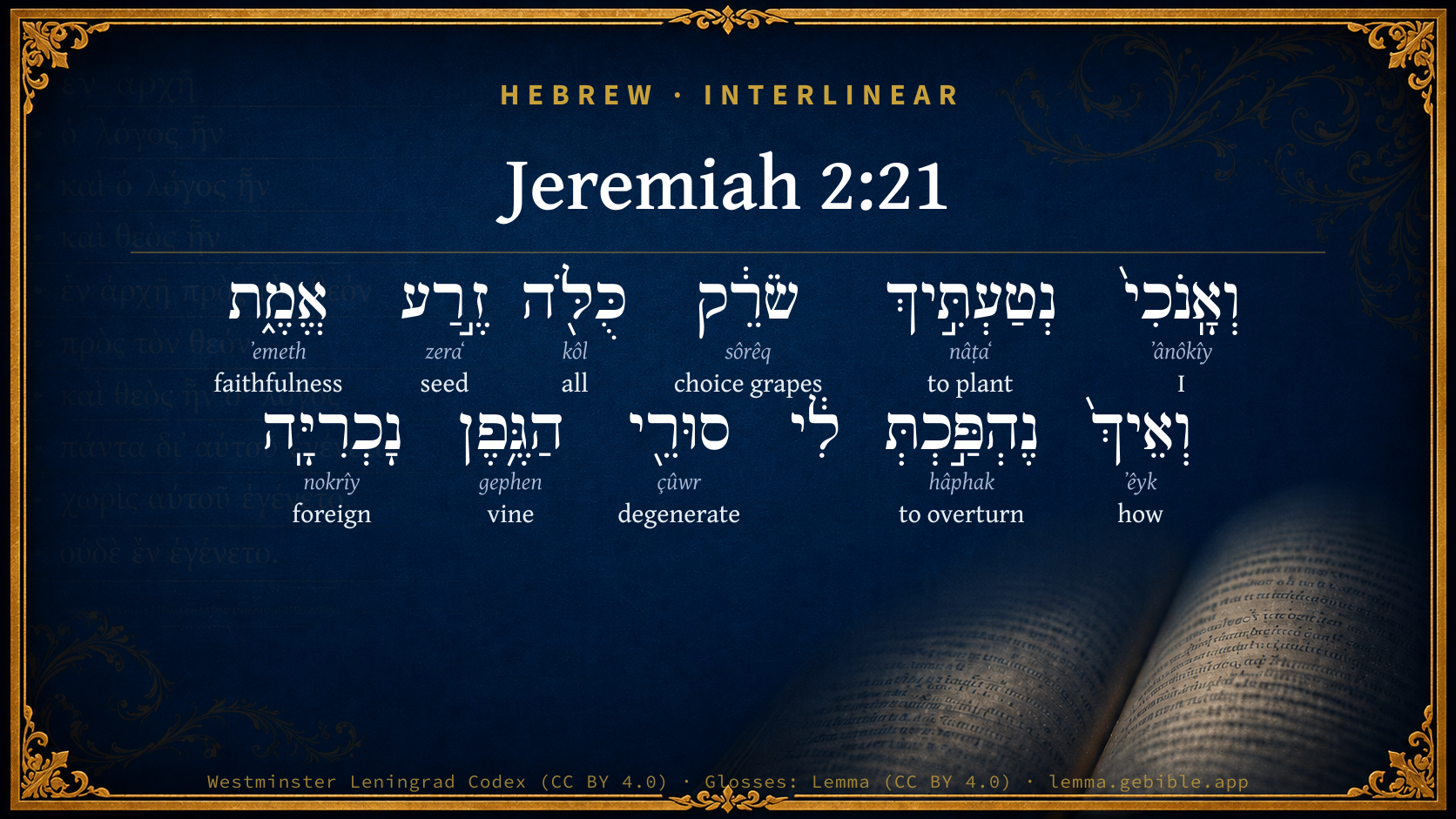
Hebrew (Westminster Leningrad Codex) Jeremiah 2:21 appears in the Hebrew Old Testament. The text above is from the Westminster Leningrad Codex. Each word links to its Strong’s number, a concise gloss, and parsing drawn from the Open Scriptures Hebrew Bible morphology. Click any word for its full Brown-Driver-Briggs (BDB) entry.
Download image
Cite this verse

Jeremiah 2:21 (World English Bible). Public Domain. Lemma interlinear Bible study tool, https://lemma.gebible.app/v/jeremiah/2/21.

Show BibTeX & RIS
BibTeX
RIS
English Translation
Yet I had planted you a noble vine, wholly a right seed: how then are you turned into the degenerate branches of a foreign vine to me?
World English Bible · Public Domain
Highlights
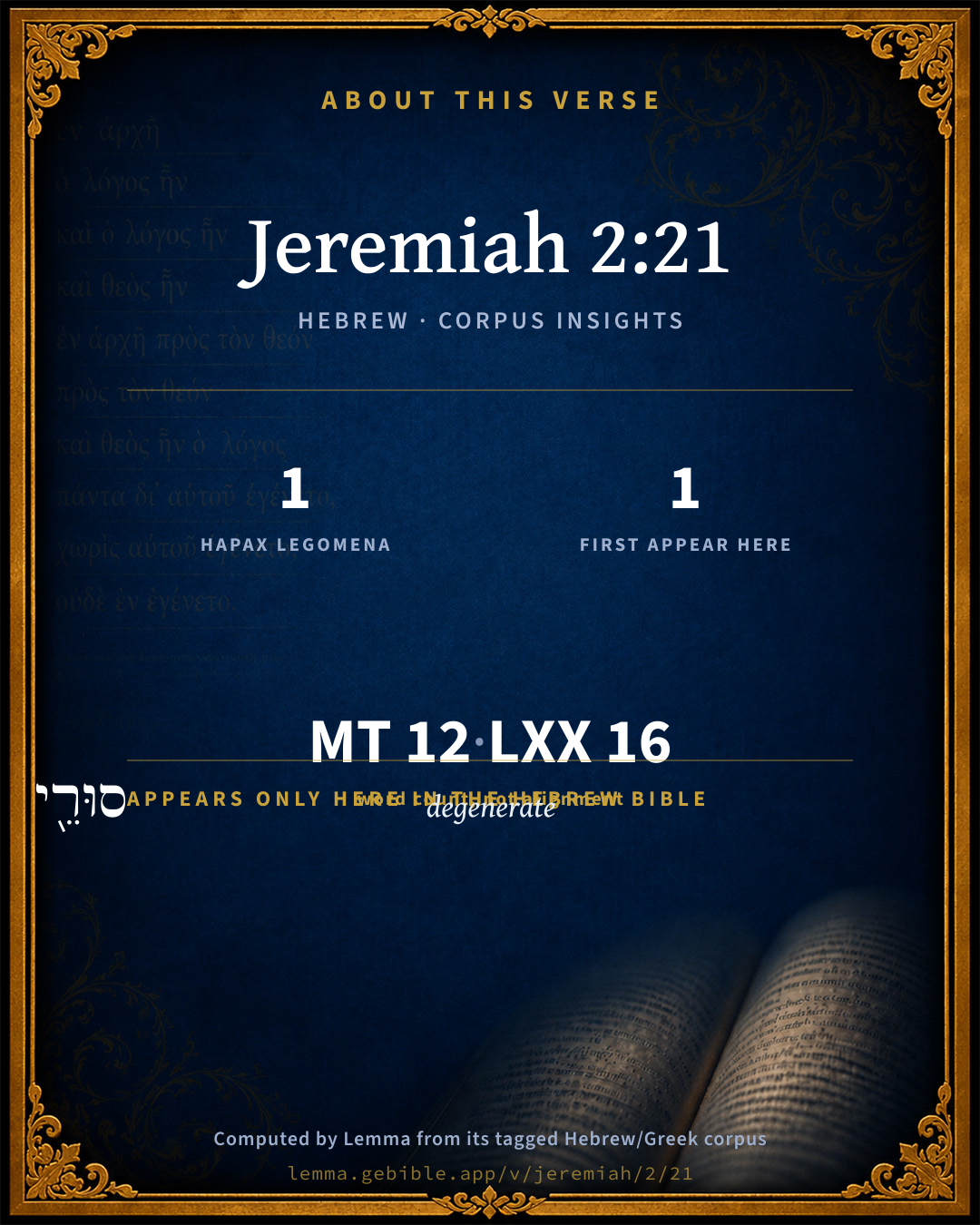
  • 1 hapax legomenon — only here in the Hebrew Bible
  • 1 first appearance in the Hebrew Bible
Full analysis ↓
Download a study sheet

One document with this verse’s original text, its word-by-word gloss line, the meaning frame, cross-references with their text, attributed commentary, and full source and license credits — printable, and it pastes into notes with its structure intact.

This verse Autodidact and up

Study sheet (.html) Plain text (.txt)

A passage Seminary Student

Up to 50 verses in one chapter. A passage sheet keeps up to 6 commentary sources and 12 cross-references per verse, in the order this page ranks them, and says so on the sheet whenever that leaves anything out. Ask for a single verse and you get the Autodidact verse sheet above.

Everything on this page stays free to read, with no account — the sheet is a download of what is already on screen, not access to it.

Want to remove ads? Support Godless Engineer
Compare translations 3

The same verse in 3 English versions, stacked beneath the original-language interlinear above. Click any original word for its lexicon entry.

Each is an independent rendering of the whole verse — the interlinear is not word-aligned to these translations.

Highlighted words mark where these versions differ — a whole-verse word diff, not a word-by-word alignment.

  • World English Bible Public Domain
    Yet I had planted you a noble vine, wholly a right seed: how then are you turned into the degenerate branches of a foreign vine to me?
  • King James Version Public Domain
    Yet I had planted thee a noble vine, wholly a right seed: how then art thou turned into the degenerate plant of a strange vine unto me?
  • unfoldingWord Literal Text CC BY-SA 4.0
    And I myself planted you a choice vine, all of it of genuine seed. And how have you changed towards me degenerates of the strange vine?

unfoldingWord Literal Text — © unfoldingWord, licensed CC BY-SA 4.0. Word-aligned USFM3 via Door43 (git.door43.org/unfoldingWord/en_ult).

Versions to compare (up to 4)

3 of 4 selected

Show all 18 translations

Every available English version of this verse, each an independent rendering of the whole verse.

  • World English Bible Public Domain
    Yet I had planted you a noble vine, wholly a right seed: how then are you turned into the degenerate branches of a foreign vine to me?
  • Berean Standard Bible Public Domain
    I had planted you like a choice vine from the very best seed. How could you turn yourself before Me into a rotten, wild vine?
  • Majority Standard Bible Public Domain
    I had planted you like a choice vine from the very best seed. How could you turn yourself before Me into a rotten, wild vine?
  • King James Version Public Domain
    Yet I had planted thee a noble vine, wholly a right seed: how then art thou turned into the degenerate plant of a strange vine unto me?
  • American Standard Version (1901) Public Domain
    Yet I had planted thee a noble vine, wholly a right seed: how then art thou turned into the degenerate branches of a foreign vine unto me?
  • Revised Version (1885) Public Domain
    Yet I had planted thee a noble vine, wholly a right seed: how then art thou turned into the degenerate plant of a strange vine unto me?
  • Geneva Bible (1599) Public Domain
    Yet I had planted thee, a noble vine, whose plants were all natural: howe then art thou turned vnto me into the plants of a strange vine?
  • Douay-Rheims (1899) Public Domain
    Yet I planted thee a chosen vineyard, all true seed: how then art thou turned unto me into that which is good for nothing, O strange vineyard?
  • Young's Literal Translation Public Domain
    And I planted thee a choice vine, wholly a true seed, And how hast thou been turned to Me, To the degenerate shoots of a strange vine?
  • Literal Standard Version CC BY-SA 4.0
    And I planted you [as] a choice vine, wholly of true seed, || And how have you been turned || Into the degenerate shoots of a strange vine to Me?
  • Unlocked Literal Bible CC BY-SA 4.0
    I planted you as a choice vine, completely from pure seed. How then have you have changed yourself into a corrupt, worthless vine?
  • unfoldingWord Literal Text CC BY-SA 4.0
    And I myself planted you a choice vine, all of it of genuine seed. And how have you changed towards me degenerates of the strange vine?
  • Darby Bible Public Domain
    And I, -- I had planted thee a noble vine, wholly a right seed; how then art thou turned into the degenerate shoots of a strange vine unto me?
  • World Messianic Bible Public Domain
    Yet I had planted you a noble vine, a pure and faithful seed. How then have you turned into the degenerate branches of a foreign vine to me?
  • Webster's Bible Public Domain
    Yet I had planted thee a noble vine, wholly a right seed: how then art thou turned into the degenerate plant of a strange vine to me?
  • Free Bible Version CC BY-SA 4.0
    I was the one who planted you like the finest vine, grown from the very best seed. How could you degenerate into a useless wild vine?
  • Bible in Basic English Public Domain
    But when you were planted by me, you were a noble vine, in every way a true seed: how then have you been changed into the branching plant of a strange vine?
  • JPS Tanakh (1917) Public Domain
    Yet I had planted thee a noble vine, wholly a right seed; how then art thou turned into the degenerate plant of a strange vine unto Me?

Literal Standard Version (2020), Covenant Press — licensed CC BY-SA 4.0. Text via the HelloAO Bible API (eBible.org). Unlocked Literal Bible (unfoldingWord) — licensed CC BY-SA 4.0. Text via the HelloAO Bible API (eBible.org). unfoldingWord Literal Text — © unfoldingWord, licensed CC BY-SA 4.0. Word-aligned USFM3 via Door43 (git.door43.org/unfoldingWord/en_ult). Free Bible Version, Dr. Jonathan Gallagher — licensed CC BY-SA 4.0. Text via the HelloAO Bible API (eBible.org).

Word by word

More ways to search: Search by grammar → Find every occurrence → Compare this word →

Practice this passage: Drill this verse → Learn its vocabulary →

סוּרֵ֖י
çûwr
H5494
“degenerate of”
Adjective, Adjective, Masculine, Plural, Construct
Part of Speech
Adjective
Type
Adjective
Gender
Masculine
Number
Plural
State
Construct
Full BDB Definition

Origin: from H5493

TWOT: 1480

degenerate
  1. וְאָֽנֹכִי֙ ʼânôkîy H595 “and · I” Conjunction + Pronoun, Personal, 1st Person, Common, Singular
  2. נְטַעְתִּ֣יךְ nâṭaʻ H5193 “to plant · you” Verb, Qal, Perfect, 1st Person, Common, Singular + Suffix, Personal, 2nd Person, Feminine, Singular
  3. שֹׂרֵ֔ק sôrêq H8321 “choice grapes” Noun, Common, Masculine, Singular, Absolute
  4. כֻּלֹּ֖ה kôl H3605 “all · her” Noun, Common, Masculine, Singular, Construct + Suffix, Personal, 3rd Person, Feminine, Singular
  5. זֶ֣רַע zeraʻ H2233 “seed of” Noun, Common, Masculine, Singular, Construct
  6. אֱמֶ֑ת ʼemeth H571 “faithfulness” Noun, Common, Feminine, Singular, Absolute
  7. וְאֵיךְ֙ ʼêyk H349 “and · how” Conjunction + Particle, Interrogative
  8. נֶהְפַּ֣כְתְּ hâphak H2015 “to overturn” Verb, Niphal, Perfect, 2nd Person, Feminine, Singular
  9. הַגֶּ֥פֶן gephen H1612 “the · vine” Particle, Definite Article + Noun, Common, Both, Singular, Absolute
  10. נָכְרִיָּֽה nokrîy H5237 “foreign” Adjective, Adjective, Feminine, Singular, Absolute

About this verse

These counts appear in no published source. They are computed here, from the morphology-tagged text and Lemma’s own curated glosses. What Lemma adds →

12
words
11
distinct lemmas
Prophets
section

Notable vocabulary

1 hapax legomenon — a word that appears only here in the entire Hebrew Bible:

  • סוּרֵ֖י degenerate H5494

First appearance in Scripture

This word makes its first canonical appearance in the Hebrew Bible here:

  • סוּרֵ֖י degenerate H5494

Shared distinctive vocabulary

שֹׂרֵ֔ק choice grapes H8321 occurs in 3 verses of the Hebrew Bible. Also found in:

Grammatical profile

  • 2 verbs
  • 5 nouns
  • 2 adjectives
  • 1 pronoun
  • 1 preposition
  • 1 particle

Verb forms

  • נְטַעְתִּ֣יךְ Qal · Perfect
  • נֶהְפַּ֣כְתְּ Niphal · Perfect

Hebrew & Septuagint length

In the original languages it is 12 Hebrew tokens and 16 Greek tokens — but the two are counted differently (Hebrew bundles its prefixes and suffixes into one token; the Greek is in lemma form), so that isn’t a like-for-like length.

Cross-references

21

Topical passages linked to Jeremiah 2:21 in the Treasury of Scripture Knowledge — connected by theme and wording, ordered by reader-vote popularity; previews shown in the World English Bible.

  • Isaiah 5:4 What could have been done more to my vineyard, that I have not done in it? Why, when I looked for it to yield grapes, did it yield wild grapes?
  • Exodus 15:17 You shall bring them in, and plant them in the mountain of your inheritance, The place, Yahweh, which you have made for yourself to dwell in; The sanctuary, Lord, which your hands have established.
  • John 15:1 "I am the true vine, and my Father is the farmer.
  • Psalms 44:2 You drove out the nations with your hand, But you planted them. You afflicted the peoples, But you spread them abroad.
  • Psalms 80:8 You brought a vine out of Egypt. You drove out the nations, and planted it.
  • Deuteronomy 4:37 Because he loved your fathers, therefore he chose their seed after them, and brought you out with his presence, with his great power, out of Egypt;
  • Genesis 26:3–5 Sojourn in this land, and I will be with you, and will bless you. For to you, and to your seed, I will give all these lands, and I will establish the oath which I swore to Abraham your father.
  • Deuteronomy 32:32 For their vine is of the vine of Sodom, Of the fields of Gomorrah: Their grapes are grapes of gall, Their clusters are bitter:
  • Mark 12:1 He began to speak to them in parables. "A man planted a vineyard, put a hedge around it, dug a pit for the winepress, built a tower, rented it out to a farmer, and went into another country.
  • Luke 20:9 He began to tell the people this parable. "A man planted a vineyard, and rented it out to some farmers, and went into another country for a long time.
  • Isaiah 61:3 to appoint to those who mourn in Zion, to give to them a garland for ashes, the oil of joy for mourning, the garment of praise for the spirit of heaviness; that they may be called trees of righteousness, the planting of Yahweh, that he may be glorified.
  • Matthew 21:33 "Hear another parable. There was a man who was a master of a household, who planted a vineyard, set a hedge about it, dug a winepress in it, built a tower, leased it out to farmers, and went into another country.
  • Joshua 24:31 Israel served Yahweh all the days of Joshua, and all the days of the elders who outlived Joshua, and had known all the work of Yahweh, that he had worked for Israel.
  • Isaiah 1:21 How the faithful city has become a prostitute! She was full of justice; righteousness lodged in her, But now murderers.
  • Isaiah 5:1–2 Let me sing for my well beloved a song of my beloved about his vineyard. My beloved had a vineyard on a very fruitful hill.
  • Isaiah 41:8 But you, Israel, my servant, Jacob whom I have chosen, the seed of Abraham my friend,
  • Isaiah 60:21 Your people also shall be all righteous; they shall inherit the land forever, the branch of my planting, the work of my hands, that I may be glorified.
  • Genesis 18:19 For I have known him, to the end that he may command his children and his household after him, that they may keep the way of Yahweh, to do righteousness and justice; to the end that Yahweh may bring on Abraham that which he has spoken of him."
  • Genesis 32:28 He said, "Your name will no longer be called 'Jacob,' but, 'Israel,' for you have fought with God and with men, and have prevailed."
  • Psalms 105:6 You seed of Abraham, his servant, You children of Jacob, his chosen ones.
  • Lamentations 4:1 How is the gold become dim! [how] is the most pure gold changed! The stones of the sanctuary are poured out at the head of every street.

Cross-references courtesy of OpenBible.info (CC BY 4.0).

Hebrew and Greek witnesses Masoretic Hebrew ↔ Greek Septuagint

The same verse in the two great witnesses to the Old Testament, shown verse-for-verse.

These are two independent witnesses, not word-aligned to each other, and the Septuagint is shown in lemma (dictionary) form.

Hebrew Jeremiah 2:21 Masoretic · Westminster Leningrad Codex

וְאָֽנֹכִי֙ נְטַעְתִּ֣יךְ שֹׂרֵ֔ק כֻּלֹּ֖ה זֶ֣רַע אֱמֶ֑ת וְאֵיךְ֙ נֶהְפַּ֣כְתְּ לִ֔י סוּרֵ֖י הַגֶּ֥פֶן נָכְרִיָּֽה

Yet I had planted you a noble vine, wholly a right seed: how then are you turned into the degenerate branches of a foreign vine to me?

World English Bible · Public Domain

Greek LXX Structure differs

In the Septuagint, Jeremiah is about an eighth shorter than the Hebrew and arranges its material differently — the Oracles Against the Nations (Hebrew chapters 46–51) appear in the middle of the Greek book, after 25:13. Because the chapter and verse boundaries do not line up, a verse-for-verse comparison with the Hebrew is not shown.

A verse-for-verse comparison isn’t shown here because the chapters and verses don’t line up. Switch to the LXX edition with the MT / LXX toggle above to read the Greek directly.

On this verse, The Cambridge Bible for Schools and Colleges discusses the Septuagint’s reading. Read the note in Commentary ↓

Hebrew: Westminster Leningrad Codex (CC BY 4.0). Greek: Septuagint (public domain); English from a public-domain English Septuagint. How the Septuagint differs from the Hebrew →

Targum (Aramaic paraphrase)

1

The Targum is the ancient Jewish Aramaic paraphrase of the Hebrew Scriptures — an interpretive translation, not the Hebrew text itself. Onkelos (literal) and Pseudo-Jonathan (expansive) render the Torah, and Jonathan the Prophets. Coverage is partial: where no permissively-licensed English translation exists for a verse, only the Aramaic is shown. This is verse-level text, not a word-by-word alignment to the Hebrew.

  1. Targum Jonathan Prophets (Joshua–Malachi)
    וַאֲנָא קַיֵמְתְּכוֹן קָדָמַי כְּמִנְצַב גַפְנָא בְּחִירָא כּוּלְכוֹן עָבְדֵי קְשׁוֹט וְאֵיכְדִין אִשְׁתַּנֵתוּן קֳדָמַי בְּעוֹבָדֵיכוֹן מְקַלְקְלַיָא סְטֵיתוּן מִבָּתַר פּוּלְחָנִי הֲוֵיתוּן כְּגֶפֶן דְלֵית בֵּיהּ הֲנָאָה:

    (no public-domain English translation for this verse)

    Targum Jonathan — Aramaic: “Mikraot Gedolot” (public domain). English: “Sefaria Community Translation” (CC0 1.0 (public-domain dedication)); “London "Chaldee Paraphrase," 1871” (public domain). Text via Sefaria.

Commentary

Notes on Jeremiah 2:21 from classic Christian and Jewish commentators (each source and its license shown beneath its notes). The classic Christian expositions comment on the surrounding passage and are grouped to its opening verse, so a note may address several verses; the Jewish commentaries on the Tanakh (Rashi and others) are per-verse, so they appear only where the commentator wrote on this verse.

Lemma curates 59 commentaries, every one of them public domain or Creative Commons licensed, each selected and text-cleaned for this edition rather than reprinted as found. About our sources →

Trapp's Complete Commentary

John Trapp

Jer 2:21 Yet I had planted thee a noble vine, wholly a right seed: how then art thou turned into the degenerate plant of a strange vine unto me?

Ver 21. Yet I had planted thee a noble vine.] Heb., A sorek, or with slips of sorek. {Jdg 16:4} See Isa 5:3, a parallel text; Exo 15:17 Psa 44:3; Psa 80:9.

Wholly a right seed.] That should have yielded a right crop, but it proveth otherwise. Nec votis respondet avari agricolae.

How then art thou turned into the degenerate plant?] How is it that slips of sorek prove slips of Sodom? {Deu 32:32} See on Isa 5:4; Isa 5:7.

John Trapp, A Commentary or Exposition upon All the Books of the Old and New Testament (1647–1656) — public domain. Text from a community e-Sword module.

The Biblical Illustrator

Joseph S. Exell

Jer_2:21

How then art thou turned into the degenerate plant.

Spiritual deterioration

A mysterious action is this of spiritual deterioration. It does not set in with obvious energy all at once, so that in one short week a man ceases to be a healthy and fruit-bearing vine; but little by little he goes down, his tone changes, his prayers are depleted of elements that once made them rich with spiritual significance; a carelessness comes upon all his personal discipline; we say, he is no longer the man he once was; then he falls again, and still further he goes down, until at last we begin to be ashamed of his society, or to say that we never come near him without being chilled: once he was so warm, so cordial, so affectionate, so spiritually-minded, that to touch him was to receive virtue; but now all is changed,--his talk has fallen to a lower level, and there comes now and then a look into his face which means that the better self is being displaced by another identity. What I say unto one, said Christ, I say unto all, Watch. Let us be careful lest whilst we slumber the enemy take an advantage over us. (J. Parker, D. D.)

The Biblical Illustrator, edited by Joseph S. Exell (c. 1880s–1900s) — public domain. Text from a community e-Sword module.

Geneva Bible (1599)

Geneva Bible translators

Hebrew, seed was all true.

Geneva Bible (1599) marginal notes — public domain. Text via Bolls.life.

Jamieson, Fausset & Brown

Robert Jamieson, A. R. Fausset & David Brown

The same image as in Deu 32:32; Psa 80:8-9; Isa 5:1, &c.

unto me--with respect to Me.

Jamieson, Fausset & Brown — Commentary Critical and Explanatory on the Whole Bible (1871) — public domain (CC PDM 1.0). Text via the HelloAO Bible API.

Adam Clarke's Commentary

Verse 21. I had planted thee a noble vine] I gave thee the fullest instruction, the purest ordinances, the highest privileges; and reason would that I should expect thee to live suitably to such advantages; but instead of this thou art become degenerate; the tree is deteriorated, and the fruit is bad. Instead of being true worshippers, and of a holy life and conversation, ye are become idolaters of the most corrupt and profligate kind. See Isa 5:1, &c., where the same image is used.

Adam Clarke's Commentary on the Bible (1810–1826) — public domain. Text from a community e-Sword/MySword module.

John Calvin's Commentaries

God here confirms what is said in the last verse; for he condemned the Israelites for having perversely run here and there after their superstitions, when yet they had been redeemed for this end, — that they might be ruled by the hand of God. Hence he says, I planted thee as a choice vine; that is, “When I redeemed thee from thine enemies, I did not give thee permission thus to prostitute thyself without any restraint, without any shame; for I planted thee as a choice vine.”

The metaphor is well known, and often occurs; for God frequently compares his Church to a vine. He calls it generally his heritage, or his land; but as vines excel other possessions, (for they are usually preferred to pasture lands, or to cultivated fields,) as then vines are the most valuable property, God hereby testifies how highly he values his Church; for he calls it his vine rather than his pasture or his field, when he speaks of it. So he does in this place, “I did not deliver thee from Egypt, that I might afterwards throw aside every care of thee; but my purpose was, that thou shouldest strike roots, and become an heritage precious to me, as an exquisite and a noble vine. I, therefore, planted thee a generous vine, שורק shurek, that thou mightest bring me forth fruit.”

Then he says, a wholly right seed; that is, “I planted thee for this end, — that thou mightest produce fruit acceptable and pleasant to me.” God regards here his own grace, and not the character of the people; for that people, as it is well known, was never a true seed: but God here shews the purpose for which he had redeemed the people, which was, that they might be like a choice vine. How then? he adds. God speaks here of their corruptions with wonder, for the indignity was such as was enough to astonish all men: how then art thou turned to me into degenerations! So I render סורום surim, though the word is not in common use in Latin: but it is enough for me if we understand the meaning of the Prophet. The word is derived from סור sur, to turn aside, or back. We ought to say then correctly, “into turnings aside.” But as this would be obscure, when the vine is spoken of, I have not hesitated to fix on another word: How then art thou turned to me into the degenerations of a strange vine! Some give this version, “into useless branches of grapes:” but I know not whence they have taken the words. I wish to keep to what is more genuine, — that the vine, which ought to have been fruitful, had so degenerated that it produced nothing, as we shall find in another place, but wild grapes. And he calls them the turnings aside of a strange vine, which ceases to be the choice vine, שורק, shurek, and is turned to a wild vine, which produces nothing but sour or bitter fruit: and in the last place, as it brought forth nothing useful, God justly calls it a strange vine. It follows —

John Calvin's Commentaries (1540-1563) — public domain. Text from the Calvin Translation Society English edition (1840s-50s) via the Christian Classics Ethereal Library (ccel.org). Calvin's coverage is partial (roughly two-thirds of the Bible); uncommented books and verses are honest gaps, never fabricated. The 19th-century editor's footnotes and remarks are omitted so the notes are faithfully Calvin's own voice.

Ellicott's Commentary for English Readers

(21) A noble vine.—Literally, a Sorek vine. Elsewhere rendered choice or choicest (Gen_49:11; Isa_5:2). The word “Sorek” points primarily to the dark purple of the grape, and then to the valley of Sorek, between Ascalon and Gaza (Jdg_16:4).

Wholly a right seed.—Literally, a seed of truth, parallel with the “good seed” in the Parable of the Tares. Here, however, as in Isa_5:1-7, which Jeremiah seems to have in his mind, stress is laid not on the mingling of the evil with the good, but on the degeneration which had changed the character of that which God had planted.

Art thou turned . . .?—Better, hast thou changed thyself . . .?

Plant.—Better, branches.

A Bible Commentary for English Readers, edited by Charles John Ellicott (1878–1897) — public domain. Text from a community e-Sword module.

The Cambridge Bible for Schools and Colleges

gen. ed. J. J. S. Perowne

21. The fault did not lie in Jehovah’s planting, but in Israel’s perversity. Hos_10:1 has the same illustration. Jeremiah has probably a reminiscence also of Isa_5:1 ff., where, however, Israel is not as here the vine, but the vineyard in which it is planted.

a noble vine] a Sorek vine, the word Sorek probably referring to the colour of the fruit, a vine bearing dark-purple grapes. It is the “choice vine” of Gen_49:11.

how then art thou turned] That which had been sown, in other words the people, when first chosen to be God’s, was uncorrupt. How is it then, He asks, that such “right seed” can have produced such degenerate shoots?

degenerate plant] The Hebrew is harsh, and suggested emendations are rendered either (with LXX) bitterness, or (with Dr.) evil smell.

strange] foreign. For the word in this sense cp. Gen_42:7; Exo_21:8; Psa_114:1 and so

And palmers for to seeken straunge strondes.

Chaucer, Cant. Tales, prol.

unto me] to my grief—a frequent use of the dative case.

The Cambridge Bible for Schools and Colleges (gen. ed. J. J. S. Perowne; Cambridge University Press, 1878–1918) — public domain. Text from a community e-Sword module.

John Gill's Exposition

For though thou wash thee with nitre,.... The word "nitre", is only used in this place and in Pro 25:20 and it is hard to say what it is. Kimchi and Ben Melech observe, that some say it is what is called "alum"; and others that it is a dust with which they wash the head, and cleanse everything; and so Jarchi says it is a kind of earth used in cleaning garments; and "nitre" is mentioned by the Misnic doctors (s) among those things which are used for the washing of garments, and taking spots out of them; though about what it is they are not agreed; and it seems the nitre of the ancients is unknown to us (t); and saltpetre is put in the room of it; and some render the word here "saltpetre"; and Pliny (u) observes, that nitre does not much differ from salt, and ascribes to it a virtue of eating out filth, and removing it; so Aristotle (w) reports of the lake Ascania; that its water is of such a nitrous quality, that garments, being put into it, need no other washing. Nitre has its name from "to loose", because it looses the filth, and cleanses from it:

and take thee much soap. The Septuagint render it, "herb"; and the Vulgate Latin version, "the herb borith"; which is the Hebrew word here used; and about the sense of which there is some difficulty. Kimchi and Ben Melech say some take it to be the same with what is called "soap"; so Jarchi; and others, that it is an herb with which they wash, the same that is called fullers' herb; but whether it is soap, or fullers' herb, or fullers' earth, as others, it is certain it is something fullers used in cleaning garments, as appear from Mal 3:2, where the same word is used, and fullers made mention of as using what is signified by it. It has its name from which signifies to "cleanse" and "purify". The sense is, let this backsliding and degenerate people take what methods they will to cleanse themselves from their sins, as by their ceremonial ablutions and sacrifices, which was the usual method they had recourse to, to purify themselves, and in which they rested:

yet thine iniquity is marked before me, saith the Lord God; or, "will retain its spots" (x) these remain; the filth is not washed away; the iniquity is not hid and covered; it appears very plain and manifest;

yea, shines like gold; or, "is gilded" (y); as the word used signifies. It is of too deep a die to be removed by such external things; nothing but the blood of Christ can cleanse from sin, take away its filth, removes its guilt, and cover it out of the sight of God, so that it can be seen no more. The Targum is,

"for if you think to be cleansed from your sins, as they cleanse with nitre, or make white with "borith", or soap; lo, as the mark of a spot which is not clean, so are your sins multiplied before me, saith the Lord God.''

(s) Misn. Sabbat, c. 9. sect. 5. & Nidda, c. 9. sect. 6. & Maimon & Bartenora in ib. & in Misn. Celim, c. 10. sect. 1. (t) Schroder. Pharmacopoeia, l. 3. c. 23. p. 140. (u) Nat. Hist. l. 31. c. 10. (w) Opera, vol. 1, de Mirabil. p. 705. (x) "Maculas tamen retinebit iniquitas tua", Schmidt. (y) "nitet, vel splendet, instar anri", Piscator; "obducat se auro insigni", Junius & Tremellius; so Gussetius renders the word, "inaurari, auro ebduci"; and who rightly observes, that whatever is glided, or covered with gold, the more it is washed with nitre, or soap, the brighter it will appear; and so, whatever other methods are taken to wash away sin, but seeking for justification by the grace of God in Christ, it will be but the more manifest, Ebr. Comment. p. 410.

John Gill's Exposition of the Whole Bible (1746–1763) — public domain (CC PDM 1.0). Text via the HelloAO Bible API.

Albert Barnes' Notes on the Bible

A noble vine - Properly, a Sorek vine (see Isa 5:2), which produced a red wine Pro 23:31, and had a lasting reputation Gen 49:11.

A right seed - literally, “a seed of truth,” i. e., true, genuine seed, not mixed with weeds, nor with seed of an inferior quality. Compare Mat 13:24.

How then art thou turned - Or, “How then” hast thou changed thyself “unto me” (i. e., to my hurt or vexation) “into the degenerate” branches “of a strange vine?” The stock, which was God’s planting, was genuine, and of the noblest sort: the wonder was how such a stock could produce shoots of a totally different kind Deu 32:32.

Albert Barnes' Notes on the Bible (1834–1885) — public domain. Text from a community e-Sword/MySword module.

Haydock's Catholic Bible Commentary

Chosen. Hebrew, Sorek, Judges xvi. 4., and Isaias v. 2., and xvi. 8. (Calmet) --- God created all things good, planted his Church in justice, and no evil proceeds from Him. (Worthington)

George Leo Haydock (1774–1849), Haydock's Catholic Family Bible and Commentary, 1859 edition — public domain. Excludes Psalms (Douay-Rheims chapter numbering differs from Protestant) and Deuterocanonical books (Catholic canon only).

Matthew Poole's English Annotations

A noble vine; a usual metaphor for the church, Psa 80:8,9, &c. See Poole "Isa 5:1". The Hebrew is Sorek, and may refer to the place or to the plant. With reference to the place, it may be taken either for a proper name, as Carmel for any fruitful place; so here noting either the place whence, viz. a vine of the same kind with those that come from Sorek; possibly that country where Samson saw Delilah, Jdg 16:4; or, the place where planted, viz. in a fruitful land, Exo 15:17. See Poole "Isa 1:2". If it be referred to the plant, then it points at the excellency of its kind; and this the next clause seems to favour: and thus it notes both God’s care; he had as great a care of it as of the choicest plant; see on Isa 27:2,3; and also his expectation, that it should prove so, Isa 5:4. And the sense is, I planted thee, that thou shouldst bring forth choice fruit to me.

A right seed; a right seed of true believers, as ill the days of the patriarchs Abraham, Isaac, and Jacob. Or supposing with to be understood before right seed, (as it often is in the Hebrew,) we may understand it of the ordinances of his church, which are said to be the plants or seed that God furnisheth it withal, Mat 13:24; and these are called right, Neh 9:13, not false or counterfeit.

The degenerate plant: though there be only degenerate or declining in the Hebrew text, yet the supplement is necessary in regard of the metaphor.

Strange: this must here be taken in a bad sense, as the word

degenerate going before intimates, though it be sometimes for what is rare and excellent: here it notes their apostacy and infidelity, and other wickednesses, where God speaks after the manner of man, both in a way of wonder and reproof.

Matthew Poole's English Annotations on the Holy Bible (1683–1685) — public domain. Text from a community e-Sword/MySword module.

Whedon's Commentary on the Bible

Daniel D. Whedon

21. In the original, two different words in the first member of this verse are emphasized, which fact of emphasis escapes our attention in the English Version.

I had planted — The Hebrew places emphasis on the pronoun I, as if God would disclaim all responsibility for the monstrous product. The second emphatic word is wholly, which has a special force from its connexion with sorek, noble vine, preceding. God had planted Israel a “noble vine,” “wholly” a right seed, but they had changed themselves into the degenerate plant (bastards) of a strange vine.

Daniel D. Whedon (gen. ed.), Commentary on the Old and New Testaments (1874–1909) — public domain. Text from a community e-Sword module.

The Pulpit Commentary

A noble vine. Jeremiah means the choicest kind of Oriental vine, called sorek (from the dark-red color of its grapes), and mentioned again in Isa_5:2. The figure of the vine is one endeared to us by its association especially with our Lord; it was endeared to the Jews by the annual festivities of the vintage. The sacred writers are never afraid of its palling on the ear by repetition. (comp. Jer_5:10 Jer_6:9 Jer_12:10 Isa_5:1-7 Isa_27:2, 3 Eze_17:6 Psa_80:8-16) A right seed; i.e. a vine-shoot of the genuine sort. "Seed" for "shoot," as in Isa_17:11 (scrap. ver. 10). The degenerate plant; rather, degenerate shoots (if at least the text is right).

The Pulpit Commentary (1880–1919), ed. H.D.M. Spence-Jones & Joseph S. Exell — public domain. Text from a community e-Sword module.

John Wesley's Explanatory Notes

A right seed - A right seed of true believers.

John Wesley, Explanatory Notes Upon the Whole Bible (1754–1765) — public domain. Text via the GEBible commentary corpus.

Rashi

Rabbi Shlomo Yitzchaki (Rashi)

I planted you a noble vine stock Heb. שורק is the branches of a good vine, that is to say the children of pious and righteous fathers. Its midrashic interpretation is: I planted you שורק. I added for you to the seven commandments of the children of Noah, six hundred and six, as is the numerical value of שורק.

degenerate Heb. סוּרי (Destoultours in O.F).

wild vine that grows in the forests.

Rashi on the Tanakh — English translations: “The Judaica Press complete Tanach with Rashi, translated by A. J. Rosenberg” (CC BY 4.0); “Pentateuch with Rashi's commentary by M. Rosenbaum and A.M. Silbermann, 1929-1934” (public domain); “The Metsudah Tanach series, Lakewood, N.J” (CC BY 4.0); and “The Book of Joshua, Metsudah Publications, 1997” (CC BY 4.0). Text via Sefaria.

Lesson kit

Teaching starters — assembled from the data on this page, not authored interpretation. Every prompt links to the verse data it draws on. Edit before teaching.

Jeremiah, in the Prophets, opens this verse with 12 words (11 distinct Hebrew lemmas). Its most distinctive word is çûwr (“degenerate”). A historical commentator’s framing appears above. Read the whole chapter for the surrounding context.

Discussion questions

  1. What does “degenerate” (çûwr) contribute to the verse as a whole?
  2. This verse holds 1 word here found nowhere else in the Hebrew Bible. What might the rare word draw attention to?
  3. The word “degenerate” first appears here in Scripture. What is being introduced at this debut?
  4. Genesis 49:11 shares the word «choice grapes» with this verse. How do the two illuminate each other?
  5. The translations on this page render this verse differently — a whole-verse word diff, not a word-by-word alignment. What might account for the different wordings?
  6. The verb «נְטַעְתִּ֣יךְ» is Qal Perfect. How does its form color the action?
  7. Reading how Trapp's Complete Commentary and The Biblical Illustrator read this verse, where do the two commentators agree and where do they part?

Things to notice

Reading settings

Reading text

Shown beneath each verse's original-language words.

Old Testament
Old Testament edition

Read the OT as the Masoretic Hebrew (MT) or the Greek Septuagint (LXX).

English shown for the Greek Septuagint (in the Hebrew ↔ Greek comparison).

Comparing translations? Open the Compare panel on any verse page to stack up to four side by side.