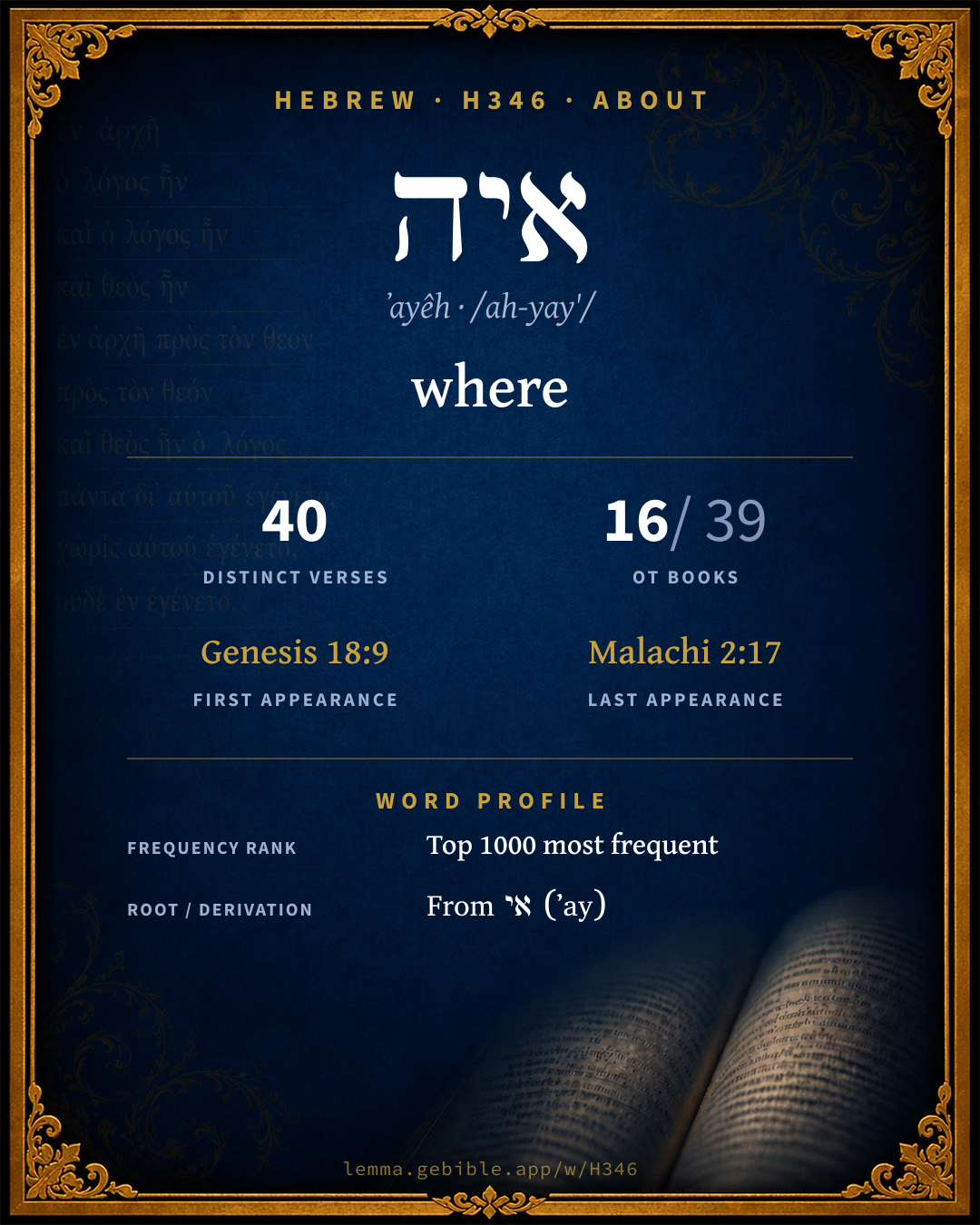
אַיֵּה
where
‘where’ is one of 3 main senses fuller range ↓
Full lexicon entry — Brown-Driver-Briggs (BDB)
From Brown-Driver-Briggs (BDB)
Where this word appears
Grammar key — what these labels mean
Part of speech
- Particle
- A short function word — article, negation, interrogative, the sign of the direct object, and the like.
Every verse where H346 appears — 40 distinct verses across 16 books. Click any verse to open its interlinear word-by-word view. Verse text shown in the World English Bible for context — . Each verse’s Hebrew form is shown with its reference; the English is not keyword-highlighted, since the data carries no word-level English alignment. Use “Compare translations” on any verse to read it across multiple English versions. This concordance covers the Hebrew Bible; Septuagint (Greek Old Testament) occurrences are not indexed here.
Genesis 4 verses
- Genesis 18:9 אַיֵּ֖ה ptcl inter They said to him, "Where is Sarah, your wife? He said, "See, in the tent."
- Genesis 19:5 אַיֵּ֧ה ptcl inter They called to Lot, and said to him, "Where are the men who came in to you this night? Bring them out to us, that we may have sex with them."
- Genesis 22:7 וְ/אַיֵּ֥ה conj + ptcl inter Isaac spoke to Abraham his father, and said, "My father?" He said, "Here I am, my son." He said, "Here is the fire and the wood, but where is the lamb for a burnt offering?"
- Genesis 38:21 אַיֵּ֧ה ptcl inter Then he asked the men of her place, saying, "Where is the prostitute, that was at Enaim by the road?" They said, "There has been no prostitute here."
Exodus 1 verse
Judges 2 verses
- Judges 6:13 וְ/אַיֵּ֣ה conj + ptcl inter Gideon said to him, Oh, my lord, if Yahweh is with us, why then has all this happened to us? and where are all his wondrous works which our fathers told us of, saying, Did not Yahweh bring us up from Egypt? but now Yahweh has cast us off, and delivered us into the hand of Midian.
- Judges 9:38 אַיֵּ֨ה ptcl inter Then said Zebul to him, Where is now your mouth, that you said, Who is Abimelech, that we should serve him? is not this the people that you have despised? go out now, I pray, and fight with them.
2 Samuel 2 verses
- 2 Samuel 16:3 וְ/אַיֵּ֖ה conj + ptcl inter The king said, Where is your master's son? Ziba said to the king, Behold, he abides at Jerusalem; for he said, Today will the house of Israel restore me the kingdom of my father.
- 2 Samuel 17:20 אַיֵּ֗ה ptcl inter Absalom's servants came to the woman to the house; and they said, Where are Ahimaaz and Jonathan? The woman said to them, They have gone over the brook of water. When they had sought and could not find them, they returned to Jerusalem.
2 Kings 2 verses
- 2 Kings 2:14 אַיֵּ֕ה ptcl inter He took the mantle of Elijah that fell from him, and struck the waters, and said, Where is Yahweh, the God of Elijah? and when he also had struck the waters, they were divided here and there; and Elisha went over.
- 2 Kings 18:34 אַיֵּה֩ אַיֵּ֛ה ptcl inter ptcl inter Where are the gods of Hamath, and of Arpad? where are the gods of Sepharvaim, of Hena, and Ivvah? have they delivered Samaria out of my hand?
Job 4 verses
- Job 14:10 וְ/אַיּֽ/וֹ conj + ptcl inter + sfx pers 3ms But man dies, and is laid low. Yes, man gives up the spirit, and where is he?
- Job 15:23 אַיֵּ֑ה ptcl inter He wanders abroad for bread, saying, 'Where is it?' He knows that the day of darkness is ready at his hand.
- Job 17:15 וְ֭/אַיֵּה conj + ptcl inter Where then is my hope? As for my hope, who shall see it?
- Job 21:28 אַיֵּ֥ה וְ֝/אַיֵּ֗ה ptcl inter conj + ptcl inter For you say, 'Where is the house of the prince? Where is the tent in which the wicked lived?'
Psalms 5 verses
- Psalms 42:3 אַיֵּ֥ה ptcl inter My tears have been my food day and night, While they continually ask me, "Where is your God?"
- Psalms 42:10 אַיֵּ֥ה ptcl inter As with a sword in my bones, my adversaries reproach me, While they continually ask me, "Where is your God?"
- Psalms 79:10 אַיֵּ֪ה ptcl inter Why should the nations say, "Where is their God?" Let it be known among the nations, before our eyes, That vengeance for your servants' blood is being poured out.
- Psalms 89:49 אַיֵּ֤ה ptcl inter Lord, where are your former loving kindnesses, Which you swore to David in your faithfulness?
- Psalms 115:2 אַיֵּה ptcl inter Why should the nations say, "Where is their God, now?"
Isaiah 6 verses
- Isaiah 33:18 אַיֵּ֤ה אַיֵּ֣ה אַיֵּ֖ה ptcl inter ptcl inter ptcl inter Your heart shall muse on the terror: Where is he who counted, where is he who weighed [the tribute]? where is he who counted the towers?
- Isaiah 36:19 אַיֵּ֞ה אַיֵּ֖ה ptcl inter ptcl inter Where are the gods of Hamath and Arpad? where are the gods of Sepharvaim? and have they delivered Samaria out of my hand?
- Isaiah 37:13 אַיֵּ֤ה ptcl inter Where is the king of Hamath, and the king of Arpad, and the king of the city of Sepharvaim, of Hena, and Ivvah?
- Isaiah 51:13 וְ/אַיֵּ֖ה conj + ptcl inter and have forgotten Yahweh your Maker, who stretched forth the heavens, and laid the foundations of the earth; and fear continually all the day because of the fury of the oppressor, when he makes ready to destroy? and where is the fury of the oppressor?
- Isaiah 63:11 אַיֵּ֣ה אַיֵּ֛ה ptcl inter ptcl inter Then he remembered the days of old, Moses [and] his people, [saying], Where is he who brought them up out of the sea with the shepherds of his flock? where is he who put his holy Spirit in the midst of them?
- Isaiah 63:15 אַיֵּ֤ה ptcl inter Look down from heaven, and see from the habitation of your holiness and of your glory: where are your zeal and your mighty acts? the yearning of your heart and your compassion is restrained toward me.
Jeremiah 6 verses
- Jeremiah 2:6 אַיֵּ֣ה ptcl inter Neither said they, Where is Yahweh who brought us up out of the land of Egypt, who led us through the wilderness, through a land of deserts and of pits, through a land of drought and of the shadow of death, through a land that none passed through, and where no man lived?
- Jeremiah 2:8 אַיֵּ֣ה ptcl inter The priests didn't say, Where is Yahweh? and those who handle the law didn't know me: the rulers also transgressed against me, and the prophets prophesied by Baal, and walked after things that do not profit.
- Jeremiah 2:28 וְ/אַיֵּ֤ה conj + ptcl inter But where are your gods that you have made you? let them arise, if they can save you in the time of your trouble: for according to the number of your cities are your gods, Judah.
- Jeremiah 13:20 אַיֵּ֗ה ptcl inter Lift up your eyes, and see those who come from the north: where is the flock that was given you, your beautiful flock?
- Jeremiah 17:15 אַיֵּ֥ה ptcl inter Behold, they tell me, Where is the word of Yahweh? let it come now.
- Jeremiah 37:19 וְ/אַיֵּה֙ conj + ptcl inter Where now are your prophets who prophesied to you, saying, The king of Babylon shall not come against you, nor against this land?
Lamentations 1 verse
Ezekiel 1 verse
Joel 1 verse
Micah 1 verse
Nahum 1 verse
Zechariah 1 verse
Malachi 2 verses
- Malachi 1:6 אַיֵּ֣ה אַיֵּ֨ה ptcl inter ptcl inter "A son honors his father, and a servant his master. If I am a father, then where is my honor? And if I am a master, where is the respect due me? Says Yahweh of Hosts to you, priests, who despise my name. You say, 'How have we despised your name?'
- Malachi 2:17 אַיֵּ֖ה ptcl inter You have wearied Yahweh with your words. Yet you say, 'How have we wearied him?' In that you say, 'Everyone who does evil is good in the sight of Yahweh, and he delights in them;' or 'Where is the God of justice?'
About this entry
At a glance — auto-summarized from this page’s data, not written by a person. Every figure links to its source below. This summary describes the numbers; it doesn’t interpret them.
איה — transliterated ʼayêh — is a Hebrew word carrying the sense “where.” It first appears in Genesis 18:9. The Hebrew Bible uses it across 40 verses — moderately common. Its lexical range runs to 3 senses. Related forms include אי, אי and איך. Each statement above links to its evidence; the full detail follows below.
Gloss history
Strong's 1890 vs modern scholarship
About this word
Strong's H346 catalogs a Hebrew word from the Hebrew Old Testament.
These counts are not copied from any lexicon or concordance. They are computed here, from the morphology-tagged Hebrew Old Testament. What Lemma adds →
- 40
- distinct verses
- The word appears in 40 distinct verses.
- 16 / 39
- OT books
- The word appears in 16 of 39 Old Testament books.
- #783
- by frequency
- Top 1000 most frequent Hebrew words (rank 783 of 8,640 Hebrew words by occurrence).
View all 40 occurrences in the concordance →
By section of the Old Testament
By traditional corpus
Conventional, traditional groupings — biblical authorship is debated, so this is a traditional corpus grouping, not an authorship claim. Each share is this word’s portion of its verses in that division of the Hebrew canon. Each figure is a share of the word’s 40 distinct verses.
- Prophets (Nevi'im) 25 verses · 63%
- Writings (Ketuvim) 10 verses · 25%
- Torah (Pentateuch) 5 verses · 13%
How translations render this word
Counts come from each version’s own published word-to-Strong’s tagging or interlinear alignment — an approximate guide to how each version renders this word, not a word-level alignment the data otherwise carries. Because each total is that version’s own tagged count, the per-version totals vary from one another and need not match the appearance or distinct-verse counts above. These counts may also differ from a printed concordance because Lemma counts each distinctly tagged rendering and does not collapse phrase taggings into a single head-word total. This is a fixed set of word-tagged versions (KJV, ASV, BSB, ULT) and does not change with the reading translation you choose elsewhere. Each version’s license is shown beside its name below (and on Sources).
- King James Version: Are now 1×, Where 1×
- American Standard Version: Him 1×, Now 1×
- Berean Standard Bible: Where 42×
- unfoldingWord Literal Text: Where 42×, Is 8×, Is he 2×
King James Version Public Domain
Renders H346 across 2 tagged occurrences — most commonly:
American Standard Version Public Domain
Renders H346 across 2 tagged occurrences — most commonly:
Berean Standard Bible Public Domain
Renders H346 across 44 tagged occurrences — most commonly:
Plus 2 renderings that appear only once — usually multi-word phrases or single function words the recovered tagging swept in, not distinct renderings.
unfoldingWord Literal Text CC BY-SA 4.0
Renders H346 across 56 tagged occurrences — most commonly:
Plus 4 renderings that appear only once — usually multi-word phrases or single function words the recovered tagging swept in, not distinct renderings.
Senses in BDB
The 3 senses BDB distinguishes for this word, in lexicon order (not ranked by frequency or importance). The full entry — with sub-senses — is in the Lexicon Entry tab.
- where?
- of persons, things
- rhetorical
Word origin
(lengthened from אַי, cf. הֵן & הִנֵּה) interr.adv. Where? Gn 18:9; 19:5; 22:7; the most gen. term expressing this idea, used of both persons & things (but never with a verb [contrast אֵיפֹה]); often in poet. or elevated style, where the answer nowhere is expected, Is 33:18; 36:19; 51:13 Je 2:28 (cf. Dt 32:37 אֵי) 17:15; 37:19, Jb 15:23 he wandereth abroad for bread אַיֵּה (saying Where is it? 21:28 Zc 1:5 (אַיֵּה־הֵם); in the (iron.) phrase where is thy (their) God? †ψ 42:4, 11; 79:10; 115:2 (אַיֵּה־נָא) Jo 2:17; rhetorically, of an earnest inquiry Je 2:6, 8 Job 35:10, or longing Is 63:11, 15 Ju 6:13.
— Brown-Driver-Briggs (Oxford 1906, public domain), digitized via Sefaria, supplemented by the OpenScriptures HebrewLexicon (CC BY 4.0). See Sources.
Derived from אי (ʼay) (H335) — where.
Jastrow Dictionary
A second Hebrew/Aramaic lexicon for comparison, covering Aramaic and post-biblical (Talmudic, Targumic, Midrashic) usage that the biblical-Hebrew BDB does not. Matched by lemma rather than by Strong’s number, so a lemma may carry more than one Jastrow headword (shown separately below), and the entries cover usage well beyond the Bible.
אַיָּה
- Ayah. Git. 35ᵃ א׳ מרי A. Mari, surname of one Aḥa b. Hidya.
A Dictionary of the Targumim, the Talmud Babli and Yerushalmi, and the Midrashic Literature (Marcus Jastrow; London, Luzac, 1903) — Public Domain. Digitized via Sefaria. Digitized via Sefaria. Full attribution on Sources.
Forms in the corpus
The 25 distinct written forms H346 takes in the Hebrew Bible, most frequent first — each parse links to that state’s occurrences in the concordance. Hebrew forms include their vowel points and cantillation, so a single lemma takes many written forms.
| Form | Parsing | Example | Uses |
|---|---|---|---|
| אַיֵּ֖ה | Particle, Interrogative | Genesis 18:9 | 6 |
| אַיֵּ֣ה | Particle, Interrogative | Isaiah 33:18 | 5 |
| אַיֵּ֥ה | Particle, Interrogative | Ezekiel 13:12 | 5 |
| אַיֵּ֤ה | Particle, Interrogative | Isaiah 33:18 | 4 |
| אַיֵּ֗ה | Particle, Interrogative | 2 Samuel 17:20 | 2 |
| אַיֵּ֛ה | Particle, Interrogative | 2 Kings 18:34 | 2 |
| אַיֵּ֧ה | Particle, Interrogative | Genesis 19:5 | 2 |
| אַיֵּ֨ה | Particle, Interrogative | Judges 9:38 | 2 |
| אַיֵּה | Particle, Interrogative | Psalms 115:2 | 2 |
| וְ/אַיֵּ֖ה | Particle, Interrogative | 2 Samuel 16:3 | 2 |
| אַיּ֖/וֹ | Particle, Interrogative | Micah 7:10 | 1 |
| אַיֵּ֑ה | Particle, Interrogative | Job 15:23 | 1 |
| אַיֵּ֕ה | Particle, Interrogative | 2 Kings 2:14 | 1 |
| אַיֵּ֞ה | Particle, Interrogative | Isaiah 36:19 | 1 |
| אַיֵּ֪ה | Particle, Interrogative | Psalms 79:10 | 1 |
| אַיֵּה֙ | Particle, Interrogative | Nahum 2:11 | 1 |
| אַיֵּה֩ | Particle, Interrogative | 2 Kings 18:34 | 1 |
| וְ/אַיּ֑/וֹ | Particle, Interrogative | Exodus 2:20 | 1 |
| וְ/אַיֵּ֣ה | Particle, Interrogative | Judges 6:13 | 1 |
| וְ/אַיֵּ֤ה | Particle, Interrogative | Jeremiah 2:28 | 1 |
| וְ/אַיֵּ֥ה | Particle, Interrogative | Genesis 22:7 | 1 |
| וְ/אַיֵּה֙ | Particle, Interrogative | Jeremiah 37:19 | 1 |
| וְ/אַיּֽ/וֹ | Particle, Interrogative | Job 14:10 | 1 |
| וְ֝/אַיֵּ֗ה | Particle, Interrogative | Job 21:28 | 1 |
| וְ֭/אַיֵּה | Particle, Interrogative | Job 17:15 | 1 |
Same root — word family
Other BDB entries built from the same root as H346, grouped by Strong’s listed origin. These share a root / origin per the lexicon — not necessarily a shared meaning. Each links to that word’s own entry.
Derives from
Shares the same root
Derived from this word
Compare all same-root words → Showing 4 of 6 — not the complete family. They share a root, not necessarily a meaning.
Septuagint verse parallels
This word appears in 38 verses that also exist in the Greek Old Testament (Septuagint), out of the 40 Hebrew verses it occurs in. You can read those verses in Greek by switching the Old Testament edition to the Septuagint.
Read these verses in the Septuagint
- Genesis 18:9
- Exodus 2:20
- Judges 6:13
- 2 Samuel 16:3
- 2 Kings 2:14
- Job 14:10
- Psalms 42:3
- Isaiah 33:18
- Jeremiah 2:6
- Lamentations 2:12
- Ezekiel 13:12
- Joel 2:17
This is a verse-level parallel only — the same verses exist in both the Hebrew and Greek Old Testaments. No word-level Hebrew↔Greek correspondence is claimed: the data carries no such alignment, so no Greek word is shown as this Hebrew word’s translation. Coverage is not total — the Septuagint omits the deuterocanon and renumbers the Psalms, so some Hebrew verses have no direct Greek parallel.