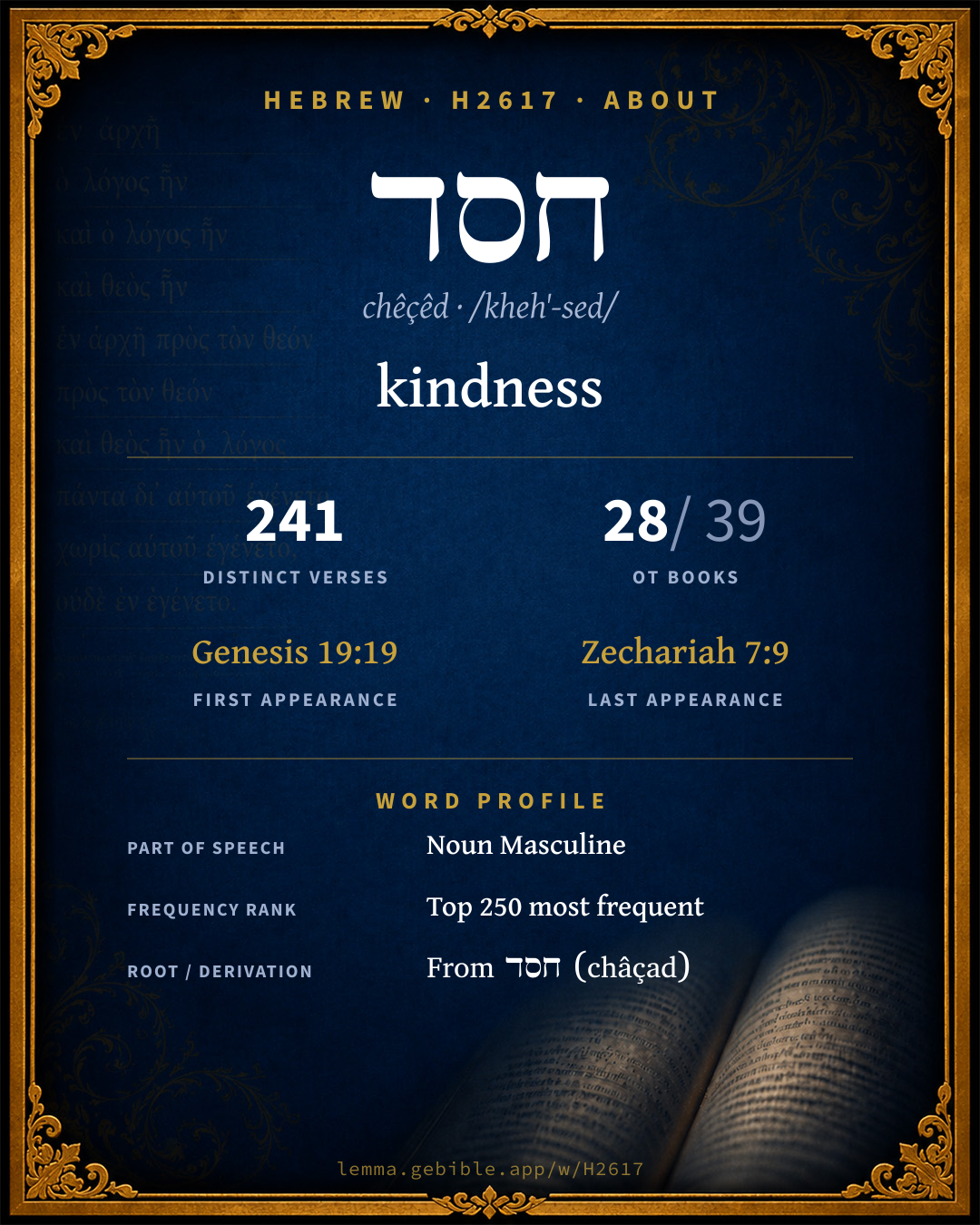
חֶ֫סֶד
kindness
also: goodness, faithfulness fuller range ↓
Full lexicon entry — Brown-Driver-Briggs (BDB)
From Brown-Driver-Briggs (BDB)
Where this word appears
See every Absolute-state word in the Hebrew Bible →
Grammar key — what these labels mean
Part of speech
- Noun
- A naming word — a person, place, thing, or idea.
Noun type
- Common
- A common noun — a general class of person, place, or thing (“king,” “city,” “water”), not a specific name.
State
- Absolute
- The independent form of a noun, not bound to a following word.
- Construct
- A noun bound to a following noun in a possessive / “of” relationship (the construct chain).
Gender
- Masculine
- Grammatically masculine.
Number
- Singular
- One.
- Plural
- More than one (in Hebrew, generally three or more).
2 verses where H2617 appears in the Construct state in the Book of 1 Samuel. Filtered view — show all forms. Click any verse to open its interlinear word-by-word view. Verse text shown in the World English Bible for context — . Each verse’s Hebrew form is shown with its reference; the English is not keyword-highlighted, since the data carries no word-level English alignment. Use “Compare translations” on any verse to read it across multiple English versions. This concordance covers the Hebrew Bible; Septuagint (Greek Old Testament) occurrences are not indexed here.
1 Samuel
- 1 Samuel 20:14 חֶ֥סֶד n c ms cs You shall not only while yet I live show me the loving kindness of Yahweh, that I not die;
- 1 Samuel 20:15 חַסְדְּ/ךָ֛ n c ms cs + sfx pers 2ms but also you shall not cut off your kindness from my house forever; no, not when Yahweh has cut off the enemies of David everyone from the surface of the earth.
About this entry
At a glance — auto-summarized from this page’s data, not written by a person. Every figure links to its source below. This summary describes the numbers; it doesn’t interpret them.
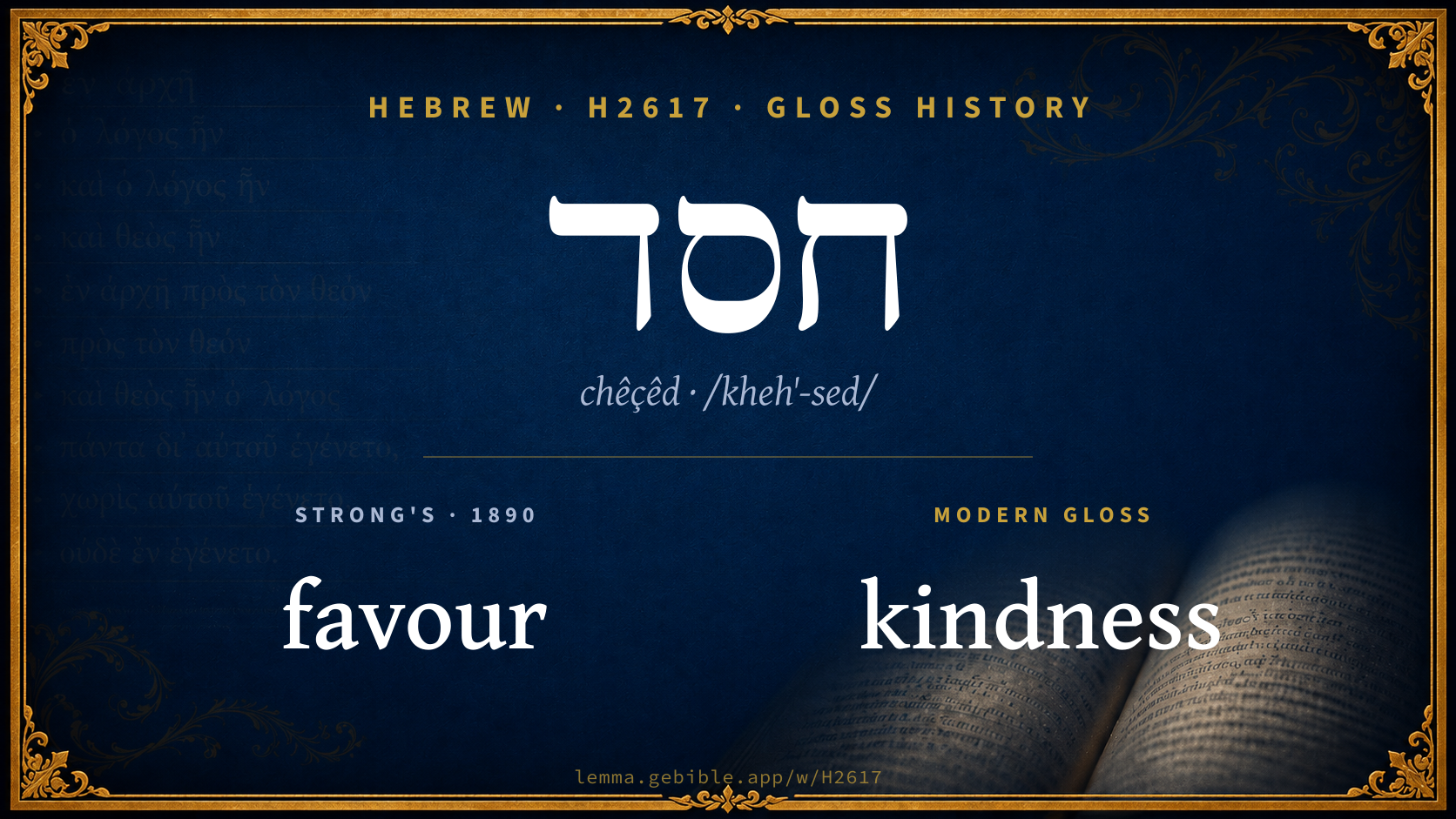
At its core, חסד (chêçêd) means “kindness.” The word gravitates to Psalms (53%), then Genesis and 2 Samuel. It turns up in 241 verses across 28 books, a common footprint. Not a single-sense word: its full sense range also takes in “goodness” and “faithfulness”. Older and newer Bibles part ways — “mercy” in the King James Version, “loving devotion” (Berean Standard Bible) and “covenant faithfulness” (unfoldingWord Literal Text) in modern versions. See the renderings breakdown. Dig into 241-verse concordance and the renderings breakdown below.
Gloss history
Strong's 1890 vs modern scholarship
About this word
Strong's H2617 catalogs a Hebrew word from the Hebrew Old Testament.
These counts are not copied from any lexicon or concordance. They are computed here, from the morphology-tagged Hebrew Old Testament. What Lemma adds →
- 241
- distinct verses
- The word appears in 241 distinct verses.
- 28 / 39
- OT books
- The word appears in 28 of 39 Old Testament books.
- #191
- by frequency
- Top 250 most frequent Hebrew words (rank 191 of 8,640 Hebrew words by occurrence).
View all 241 occurrences in the concordance →
By section of the Old Testament
By traditional corpus
Conventional, traditional groupings — biblical authorship is debated, so this is a traditional corpus grouping, not an authorship claim. Each share is this word’s portion of its verses in that division of the Hebrew canon. Each figure is a share of the word’s 241 distinct verses.
- Writings (Ketuvim) 171 verses · 71%
- Prophets (Nevi'im) 49 verses · 20%
- Torah (Pentateuch) 21 verses · 9%
How translations render this word
Counts come from each version’s own published word-to-Strong’s tagging or interlinear alignment — an approximate guide to how each version renders this word, not a word-level alignment the data otherwise carries. Because each total is that version’s own tagged count, the per-version totals vary from one another and need not match the appearance or distinct-verse counts above. These counts may also differ from a printed concordance because Lemma counts each distinctly tagged rendering and does not collapse phrase taggings into a single head-word total. This is a fixed set of word-tagged versions (KJV, ASV, BSB, ULT) and does not change with the reading translation you choose elsewhere. Each version’s license is shown beside its name below (and on Sources).
BDB lists this Strong’s number as 2 distinct words (homographs). Each count above pools all of them and is not split by sense — see the Senses section below. A low-frequency rendering may belong to a different one of those words, not the primary meaning.
- King James Version†: Mercy 118×, Kindness 29×, Lovingkindness 16×
- American Standard Version†: Lovingkindness 127×, Kindness 24×, Lovingkindnesses 7×
- Berean Standard Bible†: Loving devotion 163×, Kindness 30×, According to your loving devotion 6×
- unfoldingWord Literal Text†: Covenant faithfulness 170×, Kindness 25×, Covenant faithfulness of 11×
King James Version Public Domain
Renders H2617 across 248† tagged occurrences — most commonly:
Plus other, less common renderings. Plus 45 renderings that appear only once — usually multi-word phrases or single function words the recovered tagging swept in, not distinct renderings.
American Standard Version Public Domain
Renders H2617 across 245† tagged occurrences — most commonly:
Plus other, less common renderings. Plus 56 renderings that appear only once — usually multi-word phrases or single function words the recovered tagging swept in, not distinct renderings.
Berean Standard Bible Public Domain
Renders H2617 across 247† tagged occurrences — most commonly:
Plus other, less common renderings. Plus 23 renderings that appear only once — usually multi-word phrases or single function words the recovered tagging swept in, not distinct renderings.
unfoldingWord Literal Text CC BY-SA 4.0
Renders H2617 across 247† tagged occurrences — most commonly:
Plus 22 renderings that appear only once — usually multi-word phrases or single function words the recovered tagging swept in, not distinct renderings.
19 senses and sub-senses in the full BDB
What do BDB’s symbols mean?
BDB uses these scholarly abbreviations:
| Symbol | Meaning |
|---|---|
| 𝔊 | the Septuagint (the ancient Greek translation, LXX) |
| 𝔙 | the Vulgate (the Latin translation) |
| 𝔖 | the Syriac version (the Peshitta) |
| 𝔗 | the Targum (the Aramaic translation) |
| ψ | the Psalms |
| √ | root (the underlying root or stem) |
| ‖ | parallel passage (a synonymous or contrasted parallel) |
| † | the dagger: every passage where the word occurs is cited |
The 19 senses and sub-senses the full Brown-Driver-Briggs lexicon distinguishes for this word, in lexicon order (not ranked by frequency), with BDB’s own verbatim wording and sub-sense lettering. Shown in Hebrew script with BDB’s own scholarly abbreviations. The condensed entry is in the Lexicon Entry tab. See also the Forms in the corpus table below.
חסד I
- I. of man:
- 1. kindness of men towards men, in doing favours and benefits 1 S 20:15; 2 S 16:17 ψ 141:5 Pr 19:22; 20:6; ח׳ יהוה 1 S 20:14 the kindness of י׳ (such as he shews, Thes MV; that sworn to by oath to Yahweh Mich Dathe; shewn out of reverence to Yahweh Th Ke), cf. ח׳ אלהים 2 S 9:3; תּוֹרַת־ח׳ Pr 31:26 instruction in kindness, kindly instruction עָשָׂה חֶסֶד עִמָּדִי do or shew kindness (in dealing) with me Gn 20:13; 40:14 (E), 1 S 20:14; 2 S 10:2 (עִמִּי in ‖ 1 Ch 19:2); c. עִם Gn 21:23 (E), 24:12, 14; Jos 2:12(×2) Ju 1:24 (J), 8:35; 1 S 15:6; 2 S 2:5; 3:8; 9:1, 3, 7, 10:2a = 1 Ch 19:2a, 1 Ch 19:2b; 2 Ch 24:22; c. עַל 1 S 20:8; c. לְ 1 K 2:7; נשׂא ח׳ לפני obtain kindness before Est 2:9, 17; היטיב ח׳ Ru 3:10. e.g. 1 Samuel 20:15
- 2. kindness (especially as extended to the lowly, needy and miserable), mercy Pr 20:28; Jb 6:14; אישׁ חסד merciful man Pr 11:17 (opp. אַכְזָרִי); מַלְכֵי ח׳ merciful kings 1 K 20:31; עשׂה ח׳ ψ 109:16; in this sense usually with other attributes (v. also infr. II. 2); ‖ אמת Ho 4:1; Is 16:5; ח׳ ואמת Pr 3:3; 14:22; 16:6; 20:28; עשׂה ח׳ ואמת Gn 24:49; 47:29; Jos 2:14 (J; RV gives these under 1); ‖ צדקה Ho 10:12; צדקה וח׳ Pr 21:21; ‖ משׁפט Mi 6:8; ח׳ ומשׁפט Ho 12:7; ‖ חוֹנֵן ψ 109:12; ח׳ ורחמים Zc 7:9 Dn 1:9.—(On Ho 6:4, 6 v. 3 infr.) e.g. Proverbs 20:28
- 3. (rarely) affection of Isr. to י׳, love to God, piety: ח׳ נְעוּרַיִךְ Je 2:2 piety of thy youth (‖ love of thine espousals to Yahweh); poss. also חַסְדְּכֶם כַּעֲנַן־בֹּקֶר Ho 6:4 your piety is like a morning cloud (fleeting), and כִּי חֶסֶד חָפַצְתִּי וְלאֹ־זָ֑בַח Ho 6:6 for piety I delight in and not in peace-offering (‖ דעת אלהים, cf. 1 S 15:22);—so Wü Now Hi (v 4) Che; Ke Hi (v 6) al. sub 2 (or 1);—אַנְשֵׁי חֶסֶד men of piety Is 57:1 (‖ צַדִּיק); pl. pious acts 2 Ch 32:32; 35:26; Ne 13:14. e.g. Jeremiah 2:2
- 4. lovely appearance: כָּל־חַסְדּוֹ כְּצִיץ הַשָּׂדֶה Is 40:6 all its loveliness as the flower of the field (so Thes Hi De Che Di al.; but δόξα 𝔊 1 Pet 1:24 & gloria 𝔙 favour an original reading הוֹדוֹ Lo or כְּבֹדוֹ Ew, see BrMP 375; Du הֲדָרוֹ). e.g. Isaiah 40:6
- II. of God: kindness, lovingkindness in condescending to the needs of his creatures. He is חַסְדָּם their goodness, favour Jon 2:9; חַסְדִּי ψ 144:2; אֱלֹהֵי חַסְדִּי God of my kindness ψ 59:18; in v 11 read אֱלֹהַי חַסְדּוֹ my God with his kindness 𝔖 𝔙 Ew Hup De Pe Che Bae; his is the kindness ψ 62:13; it is with him ψ 130:7; he delights in it Mi 7:18. e.g. Jonah 2:9
- 1. specif. lovingkindness:
- a. in redemption from enemies and troubles Gn 19:19; 39:21 (J), Ex 15:13 (song), Je 31:3; Ezr 7:28; 9:9 ψ 21:8; 31:17, 22; 32:10; 33:22; 36:8, 11; 42:9; 44:27; 48:10; 59:17; 66:20; 85:8; 90:14; 94:18; 107:8, 15, 21, 31; 143:8, 12; Jb 37:13; Ru 1:8; 2:20; men should trust in it ψ 13:6; 52:10; rejoice in it ψ 31:8; hope in it ψ 33:18; 147:11. e.g. Genesis 19:19
- b. in preservation of life from death ψ 6:5; 86:13 Jb 10:12. e.g. Psalms 6:5
- c. in quickening of spiritual life ψ 109:26; 119:41, 76, 88, 124, 149, 159. e.g. Psalms 109:26
- d. in redemption from sin ψ 25:7; 51:3. e.g. Psalms 25:7
- e. in keeping the covenants, with Abraham Mi 7:20; with Moses and Israel שׁמר הַבְּרִית וְ(הַ)חֶסֶד keepeth the covenant and the lovingkindness Dt 7:9, 12; 1 K 8:23 = 2 Ch 6:14, Ne 1:5; 9:32; Dn 9:4; with David and his dynasty 2 S 7:15 = 1 Ch 17:13, 2 S 22:51 = ψ 18:51, 1 K 3:6(×2) = 2 Ch 1:8, ψ 89:29, 34; with the wife Zion Is 54:10. e.g. Micah 7:20
- 2. חֶסֶד is grouped with other divine attributes: חסד ואמת kindness (lovingkindness) and fidelity Gn 24:27 (J), ψ 25:10; 40:11, 12; 57:4; 61:8; 85:11; 89:15; 115:1; 138:2; עשׂה ח׳ ואמת עם 2 S 2:6; 15:20 (𝔊, v. Dr); c. אֶת־ Gn 24:49; רַב ח׳ ואמת Ex 34:6 (JE), ψ 86:15; also ‖ אמת Mi 7:20 ψ 26:3; 117:2; ‖ אֱמוּנָה ψ 88:12; 89:3; 92:3; אמונה וח׳ ψ 89:25; ח׳ ואמונה ψ 98:3; ‖ רחמים ψ 77:9; ח׳ ורחמים Je 16:5; Ho 2:21 ψ 103:4; ח׳ ומשׁפט Je 9:23 ψ 101:1; ‖ צדקה ψ 36:11; טוב וח׳ ψ 23:6. e.g. Genesis 24:27
- 3. the kindness of God is
- a. abundant: רַב־חֶסֶד abundant, plenteous in kindness (goodness) Nu 14:18 (J), Ne 9:17 (Qr), Jo 2:13; Jon 4:2 ψ 86:5; 103:8 (cf. Ex 34:6 JE; ψ 86:15); רֹב חַסְדְּךָ Ne 13:22 ψ 5:8; 69:14; 106:7 (𝔊 𝔙 Aq 𝔗, to be preferred to MT חֲסָדֶיךָ); רֹב חֲסָדָו֯ La 3:32 ψ 106:45 (Kt 𝔊 in both to be preferred). e.g. Numbers 14:18
- b. great in extent: גֹּדֶל ח׳ greatness of thy mercy Nu 14:19 (J); גְּדָו֯ל־ח׳ ψ 145:8; it is kept for thousands Ex 34:7 (JE), Je 32:18, especially of those connected with lovers of י׳, Ex 20:6 = Dt 5:10; for 1000 generations Dt 7:9; it is great as the heavens ψ 57:11; 103:11, cf. 36:6; 108:5; the earth is full of it ψ 33:5; 119:64. e.g. Numbers 14:19
- c. everlasting: לעולם חסדוֹ Je 33:11; 1 Ch 16:34, 41; 2 Ch 5:13; 7:3, 6; 20:21; Ezr 3:11 ψ 100:5; 106:1; 107:1; 118:1, 2, 3, 4, 29; 136:1–26 (26 times); חסדךָ לעולם ψ 138:8; ח׳ מעולם ועד עולם ψ 103:17; ח׳ עולם Is 54:8; ח׳ אל כל היום ψ 52:3. e.g. Jeremiah 33:11
- d. good: כִּי־טוֹב חַסְדְּךָ ψ 69:17; 109:21; כי טוב חסדךָ מחיים ψ 63:4. e.g. Psalms 69:17
- 4. pl. mercies, deeds of kindness, the historic displays of lovingkindness to Israel: shewn to Jacob Gn 32:11 (R); but mostly late Is 63:7 ψ 25:6; 89:2; כְּרֹב חסדיו Is 63:7, see 3 a; promised in the Davidic covenant ψ 89:50; חַסְדֵי דָוִיד mercies to David Is 55:3; 2 Ch 6:42; mercies in general La 3:22 ψ 17:7; 107:43 f.—חֶסֶד in n.pr.m. בן־ח׳ v. sub בֵּן. On Lv 20:17; Pr 14:34 v. ii. חֶסֶד sub II. חסד. e.g. Genesis 32:11
- 1. specif. lovingkindness:
חסד II shame, reproach, only abs.
Senses from the full Brown-Driver-Briggs lexicon (Brown, Driver, Briggs; Oxford 1906 — public domain), digitized via Sefaria, supplemented by the OpenScriptures HebrewLexicon (CC BY 4.0). Full attribution on Sources.
Word origin
I. n.m. 2 S 16:17 goodness, kindness;—abs. ח׳ Gn 24:12 + 85 times; חָ֑סֶד Gn 39:21 + 12 times; cstr. חֶסֶד 1 S 20:14 + 8 times; sf. חַסְדִּי ψ 59:18 + 120 times sfs.; pl. חֲסָדִים Gn 32:11; cstr. חַסְדֵי Is 55:3 + 5 times (BaerJes p. 79 Ges§ 93, R. 1 F.); sf. חֲסָדַי Ne 13:14 + 10 times sfs.; (not in H or P).
II. n.m. shame, reproach, only abs.:—ח׳ הוּא Lv 20:17 (H) it is a shame (shameful thing); ח׳ לְאֻמִּים חַטָּאת Pr 14:34 sin is a reproach to peoples.
— Brown-Driver-Briggs (Oxford 1906, public domain), digitized via Sefaria, supplemented by the OpenScriptures HebrewLexicon (CC BY 4.0). See Sources.
Derived from חסד (châçad) (H2616) — to be kind.
Jastrow Dictionary
A second Hebrew/Aramaic lexicon for comparison, covering Aramaic and post-biblical (Talmudic, Targumic, Midrashic) usage that the biblical-Hebrew BDB does not. Matched by lemma rather than by Strong’s number, so a lemma may carry more than one Jastrow headword (shown separately below), and the entries cover usage well beyond the Bible.
חָסַד I
- (v. next w.) to be white, pure, charitable, graceful.—Part. pass. חָסוּד, fem. חֲסוּדָה, endowed with חֶסֶד, graceful. Keth. 17ᵃ (in a bridal song) כלה נאה וח׳ handsome and graceful bride. Num. R. s. 12; Cant. R. to III, 10 (not חסידה).
חָסַד II
- ; Pi. חִסֵּד, חִשֵּׂד [to scrape off,] (cmp. גדף, גרף) to jeer, scoff at, to shame. Ruth R. to IV, 8 שחִסְּדָן ברבים (or שחֲסָדָן; ed. Wil. שחשדן) he scoffed at them publicly (speaking ironically, with ref. to II Chr. XIII, 8); Y. Yeb. XVII, beg. 15ᶜ שחִישֵּׂד וכ׳ he jeered at Jeroboam; Gen. R. s. 65; ib. s. 73 שחסדם ed. Wil. (oth. שחש׳); Lev. R. s. 33; Midr. Sam. ch. XVIII שחִיסְּדָן; Yalk. Kings 205 ומְחַשֵּׂד.—Ex. R. s. 30 (ref. to Ex. II, 14) שחִיסְּדוּ וכ׳ when Dathan and Abiram sneered at him. Ib. בזה שחִיסַּדְתֶּם אותו וכ׳ with the very word (שופט) with which you sneered at him, I shall give him the rulership (משפטים). Pesik. R. s. 42 מְחַסְּדִים את שרה (not מחסרו׳) jeered at Sarah; a. e.—V. חִיסּוּד. e.g. 2 Chronicles 13:8
חֲסַד
- 1. to be put to shame (be whitened). Targ. Ps. XXXIV, 6 Ms. (ed. עצבו). Ib. XL, 15 (ed. Lag. a. oth. Ithpa.; some ed. ר for ד).
- 2. to shame &c.; v. infra.
- to jeer, blaspheme, disgrace (in ed. frequ. Pe.). Targ. I Sam. XVII, 36. Targ. Prov. XXV, 10 נַחְסִידָךְ Lev. (ed. נֶחְסְדָךְ); a. fr. [Some ed. ר for ד.]
- to be reviled, put to shame. Targ. Ps. LXXI, 24; a. e.; v. supra. Targ. Prov. XX, 4 (v. LXX).
חֶסֶד
- grace, kindness, love, charity. Sifra K’dosh., Par. 4, ch. X (ref. to חסד, Lev. XX, 17) שמא תאמר … ח׳ הוא if you will object, why did Cain marry his sister? (Answ.) It was an act of kindness (to secure the propagation of the race); Y. Yeb. XI, 11ᵈ top ח׳ עשיתי וכ׳ I (the Lord) dealt kindly with &c.—חוט של ח׳, v. חוּט. Succ. 49ᵇ אין צדקה … לפי ח׳ שבה charity is rewarded only in proportion to the benevolence in it. Ib. תורה של ח׳ a study of love (for its own sake); a. fr.—Ruth R. Par. 3, beg., v. חִסְדָּאָה.—Gen. R. s. 8 ח׳ אומר Charity said &c.—Pl. חֲסָדִים acts of kindness. Succ. l. c.; a. fr.; v. גָּמַל a. גְּמִילוּת. e.g. Leviticus 20:17
חֶסֶד ²
- Targ. Y. Lev. XX, 17 (v. Y. Yeb. Xl, 11ᵈ top, quot. in preced). Targ. Gen. XXXIX, 21; a. fr.—Y. Ab. Zar. III, 42ᶜ top; Y. Ḥag. II, 77ᵈ bot., v. גְּמַל; a. e.—Pl. חִסְדַּיָּא, חַסְ׳; חִסְדִּין, חַסְ׳, חִיסְ׳. Targ. O. Gen. XXXII, 11. Targ. Ps. CVII, 43; a. e.
A Dictionary of the Targumim, the Talmud Babli and Yerushalmi, and the Midrashic Literature (Marcus Jastrow; London, Luzac, 1903) — Public Domain. Digitized via Sefaria. Digitized via Sefaria. Full attribution on Sources.
Forms in the corpus
The 108 distinct written forms H2617 takes in the Hebrew Bible, most frequent first — each parse links to that state’s occurrences in the concordance. Hebrew forms include their vowel points and cantillation, so a single lemma takes many written forms.
The 60 most common forms are shown; 48 rarer forms follow in the full concordance.
Same root — word family
Other BDB entries built from the same root as H2617, grouped by Strong’s listed origin. These share a root / origin per the lexicon — not necessarily a shared meaning. Each links to that word’s own entry.
Derives from
Shares the same root
Proper names from this root
People and places named from this root — a name, not an additional meaning of the word.
Compare all same-root words → Showing 4 of 5 — not the complete family. 2 of the same-root words are proper names (people or places). They share a root, not necessarily a meaning.
Septuagint verse parallels
This word appears in 179 verses that also exist in the Greek Old Testament (Septuagint), out of the 241 Hebrew verses it occurs in. You can read those verses in Greek by switching the Old Testament edition to the Septuagint.
Read these verses in the Septuagint
- Genesis 19:19
- Exodus 15:13
- Leviticus 20:17
- Numbers 14:18
- Deuteronomy 5:10
- Joshua 2:12
- Judges 1:24
- Ruth 1:8
- 1 Samuel 15:6
- 2 Samuel 2:5
- 1 Kings 2:7
- 1 Chronicles 16:34
This is a verse-level parallel only — the same verses exist in both the Hebrew and Greek Old Testaments. No word-level Hebrew↔Greek correspondence is claimed: the data carries no such alignment, so no Greek word is shown as this Hebrew word’s translation. Coverage is not total — the Septuagint omits the deuterocanon and renumbers the Psalms, so some Hebrew verses have no direct Greek parallel.