Isaiah 54:8

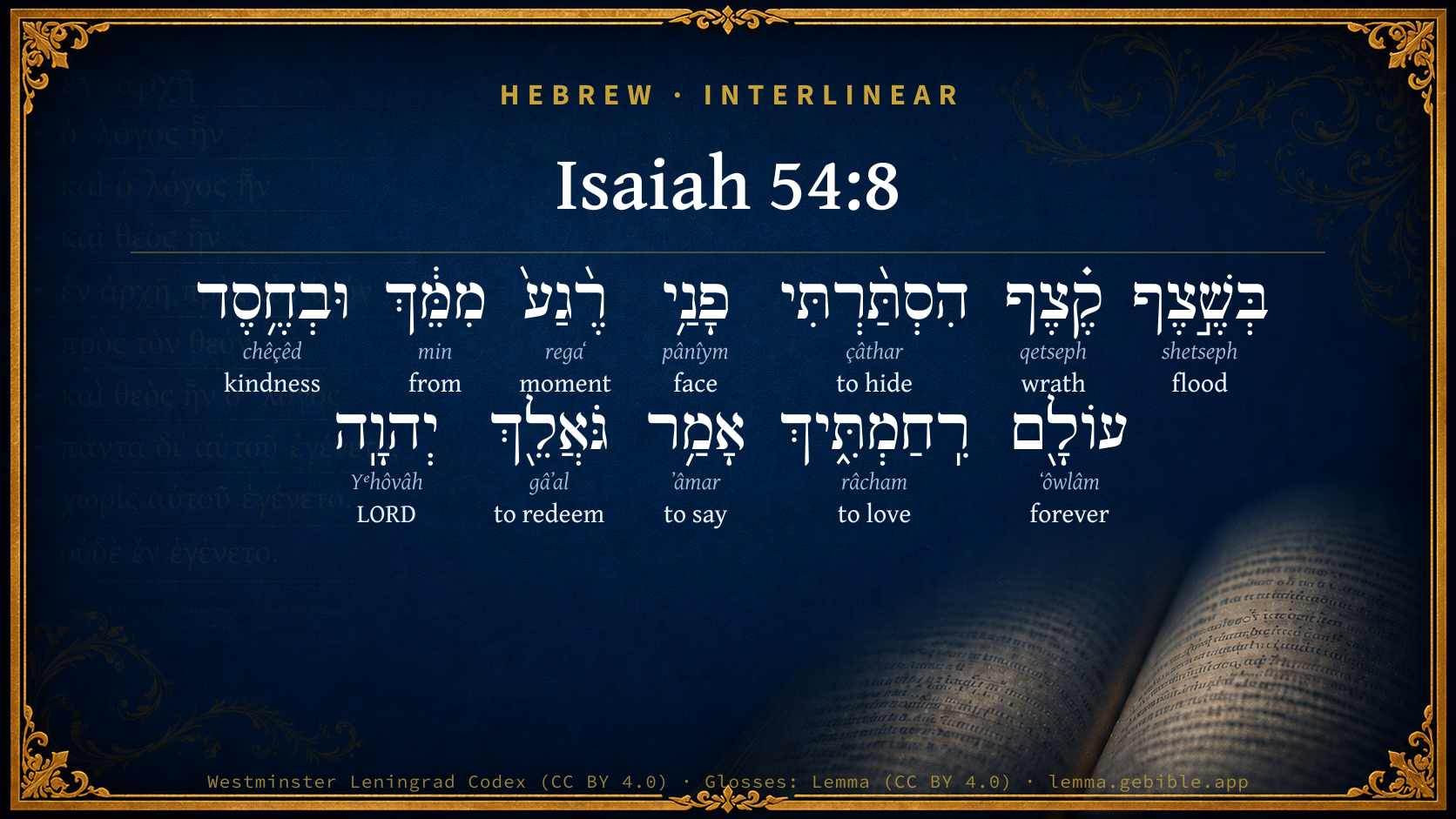
Hebrew (Westminster Leningrad Codex) Isaiah 54:8 appears in the Hebrew Old Testament. The text above is from the Westminster Leningrad Codex. Each word links to its Strong’s number, a concise gloss, and parsing drawn from the Open Scriptures Hebrew Bible morphology. Click any word for its full Brown-Driver-Briggs (BDB) entry.
Download image
Cite this verse

Isaiah 54:8 (World English Bible). Public Domain. Lemma interlinear Bible study tool, https://lemma.gebible.app/v/isaiah/54/8.

Show BibTeX & RIS
BibTeX
RIS
English Translation
In overflowing wrath I hid my face from you for a moment; but with everlasting loving kindness will I have mercy on you, says Yahweh your Redeemer.
World English Bible · Public Domain
Highlights
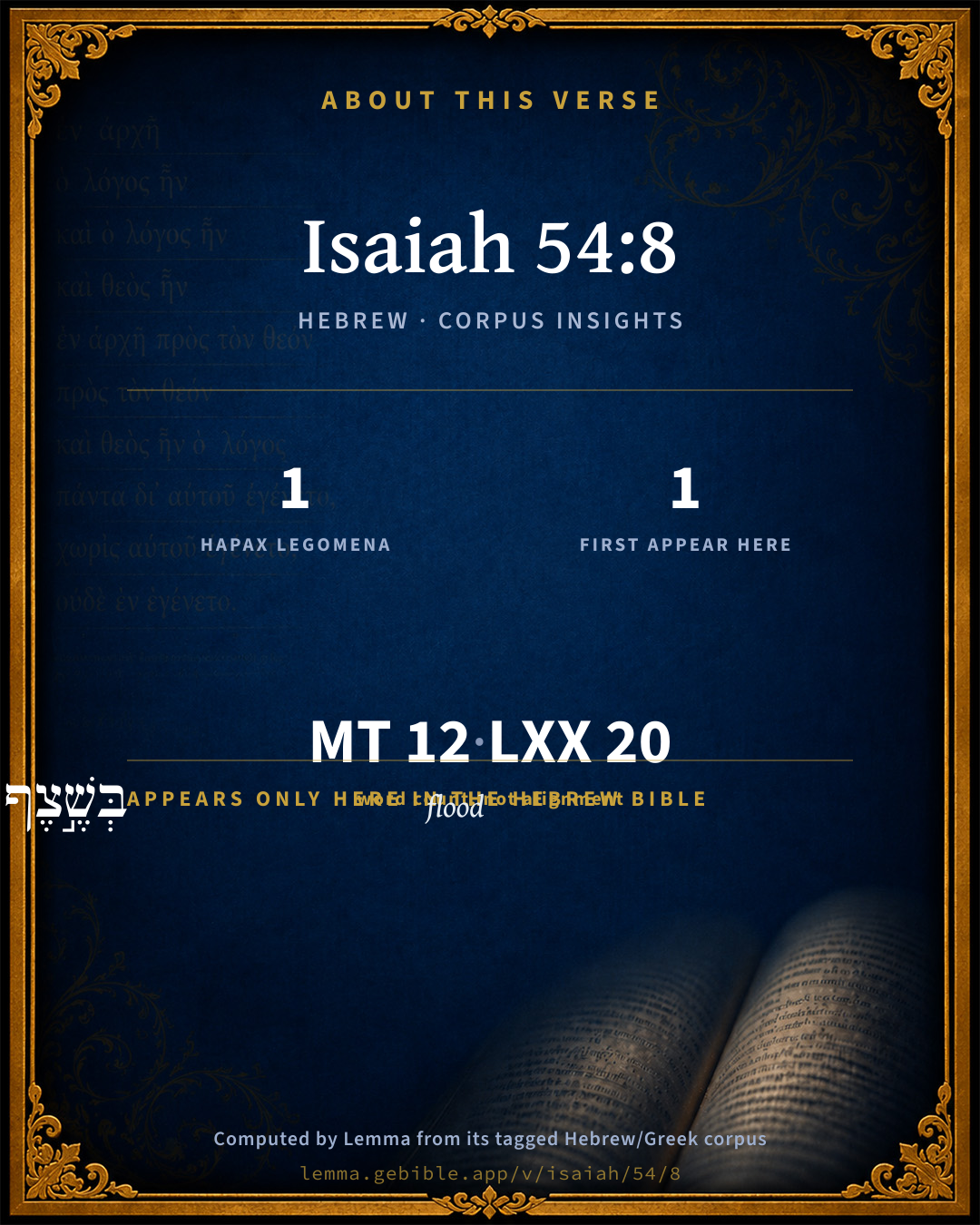
  • 1 hapax legomenon — only here in the Hebrew Bible
  • 1 first appearance in the Hebrew Bible
Full analysis ↓
Download a study sheet

One document with this verse’s original text, its word-by-word gloss line, the meaning frame, cross-references with their text, attributed commentary, and full source and license credits — printable, and it pastes into notes with its structure intact.

This verse Autodidact and up

Study sheet (.html) Plain text (.txt)

A passage Seminary Student

Up to 50 verses in one chapter. A passage sheet keeps up to 6 commentary sources and 12 cross-references per verse, in the order this page ranks them, and says so on the sheet whenever that leaves anything out. Ask for a single verse and you get the Autodidact verse sheet above.

Everything on this page stays free to read, with no account — the sheet is a download of what is already on screen, not access to it.

Want to remove ads? Support Godless Engineer
Compare translations 3

The same verse in 3 English versions, stacked beneath the original-language interlinear above. Click any original word for its lexicon entry.

Each is an independent rendering of the whole verse — the interlinear is not word-aligned to these translations.

Highlighted words mark where these versions differ — a whole-verse word diff, not a word-by-word alignment.

  • World English Bible Public Domain
    In overflowing wrath I hid my face from you for a moment; but with everlasting loving kindness will I have mercy on you, says Yahweh your Redeemer.
  • King James Version Public Domain
    In a little wrath I hid my face from thee for a moment; but with everlasting kindness will I have mercy on thee, saith the LORD thy Redeemer.
  • unfoldingWord Literal Text CC BY-SA 4.0
    In a flood of anger I hid my face a moment from you, but with covenant faithfulness of eternity I will have compassion on you,” says Yahweh your redeemer. q1

unfoldingWord Literal Text — © unfoldingWord, licensed CC BY-SA 4.0. Word-aligned USFM3 via Door43 (git.door43.org/unfoldingWord/en_ult).

Versions to compare (up to 4)

3 of 4 selected

Show all 18 translations

Every available English version of this verse, each an independent rendering of the whole verse.

  • World English Bible Public Domain
    In overflowing wrath I hid my face from you for a moment; but with everlasting loving kindness will I have mercy on you, says Yahweh your Redeemer.
  • Berean Standard Bible Public Domain
    In a surge of anger I hid My face from you for a moment, but with everlasting kindness I will have compassion on you,” says the LORD your Redeemer.
  • Majority Standard Bible Public Domain
    In a surge of anger I hid My face from you for a moment, but with everlasting kindness I will have compassion on you,” says the LORD your Redeemer.
  • King James Version Public Domain
    In a little wrath I hid my face from thee for a moment; but with everlasting kindness will I have mercy on thee, saith the LORD thy Redeemer.
  • American Standard Version (1901) Public Domain
    In overflowing wrath I hid my face from thee for a moment; but with everlasting lovingkindness will I have mercy on thee, saith Jehovah thy Redeemer.
  • Revised Version (1885) Public Domain
    In overflowing wrath I hid my face from thee for a moment; but with everlasting kindness will I have mercy on thee, saith the LORD thy redeemer.
  • Geneva Bible (1599) Public Domain
    For a moment, in mine anger, I hid my face from thee for a litle season, but with euerlasting mercy haue I had compassion on thee, sayth the Lord thy redeemer.
  • Douay-Rheims (1899) Public Domain
    In a moment of indignation have I hid my face a little while from thee, but with everlasting kindness have I had mercy on thee, said the Lord thy Redeemer.
  • Young's Literal Translation Public Domain
    In overflowing wrath I hid my face `for' a moment from thee, And in kindness age-during I have loved thee, Said thy Redeemer -- Jehovah!
  • Literal Standard Version CC BY-SA 4.0
    In overflowing wrath I hid My face [for] a moment from you, || And in perpetual kindness I have loved you, || Said your Redeemer—YHWH!
  • Unlocked Literal Bible CC BY-SA 4.0
    In a flood of anger I hid my face from you momentarily; but with everlasting covenant faithfulness I will have mercy on you— says Yahweh, the one who rescues you.
  • unfoldingWord Literal Text CC BY-SA 4.0
    In a flood of anger I hid my face a moment from you, but with covenant faithfulness of eternity I will have compassion on you,” says Yahweh your redeemer. q1
  • Darby Bible Public Domain
    In the outpouring of wrath have I hid my face from thee for a moment; but with everlasting loving-kindness will I have mercy on thee, saith Jehovah, thy Redeemer.
  • World Messianic Bible Public Domain
    In overflowing wrath I hid my face from you for a moment, but with everlasting loving kindness I will have mercy on you,” says the LORD your Redeemer.
  • Webster's Bible Public Domain
    In a little wrath I hid my face from thee for a moment; but with everlasting kindness will I have mercy on thee, saith the LORD thy Redeemer.
  • Free Bible Version CC BY-SA 4.0
    In a moment of anger I turned my face away from you, but now with trustworthy love I will always be kind to you, says the Lord, your Redeemer.
  • Bible in Basic English Public Domain
    In overflowing wrath my face was veiled from you for a minute, but I will have pity on you for ever, says the Lord who takes up your cause.
  • JPS Tanakh (1917) Public Domain
    In a little wrath I hid My face from thee for a moment; but with everlasting kindness will I have compassion on thee, saith the LORD thy Redeemer.

Literal Standard Version (2020), Covenant Press — licensed CC BY-SA 4.0. Text via the HelloAO Bible API (eBible.org). Unlocked Literal Bible (unfoldingWord) — licensed CC BY-SA 4.0. Text via the HelloAO Bible API (eBible.org). unfoldingWord Literal Text — © unfoldingWord, licensed CC BY-SA 4.0. Word-aligned USFM3 via Door43 (git.door43.org/unfoldingWord/en_ult). Free Bible Version, Dr. Jonathan Gallagher — licensed CC BY-SA 4.0. Text via the HelloAO Bible API (eBible.org).

Word by word

More ways to search: Search by grammar → Find every occurrence → Compare this word →

Practice this passage: Drill this verse → Learn its vocabulary →

בְּשֶׁ֣צֶף
shetseph
H8241
“in/at · flood of”
Preposition + Noun, Common, Masculine, Singular, Construct
Part of Speech
Preposition + Noun
Type
Common
Gender
Masculine
Number
Singular
State
Construct
Full BDB Definition

Origin: from H7857 (for alliteration with H7110 )

TWOT: 2373a

flood, downpour, overflowing
  1. קֶ֗צֶף qetseph H7110 “wrath” Noun, Common, Masculine, Singular, Absolute
  2. הִסְתַּ֨רְתִּי çâthar H5641 “to hide” Verb, Hiphil, Perfect, 1st Person, Common, Singular
  3. פָנַ֥י pânîym H6440 “face(s) · my” Noun, Common, Both, Plural, Construct + Suffix, Personal, 1st Person, Common, Singular
  4. רֶ֨גַע֙ regaʻ H7281 “moment” Noun, Common, Masculine, Singular, Absolute
  5. מִמֵּ֔ךְ min H4480 “from · you” Preposition + Suffix, Personal, 2nd Person, Feminine, Singular
  6. וּבְחֶ֥סֶד chêçêd H2617 “and · in/at · kindness of” Conjunction + Preposition + Noun, Common, Masculine, Singular, Construct
  7. עוֹלָ֖ם ʻôwlâm H5769 “forever” Noun, Common, Masculine, Singular, Absolute
  8. רִֽחַמְתִּ֑יךְ râcham H7355 “to love · you” Verb, Piel, Perfect, 1st Person, Common, Singular + Suffix, Personal, 2nd Person, Feminine, Singular
  9. אָמַ֥ר ʼâmar H559 “to say” Verb, Qal, Perfect, 3rd Person, Masculine, Singular
  10. גֹּאֲלֵ֖ךְ gâʼal H1350 “redeeming · you” Verb, Qal, Participle Active, Masculine, Singular, Construct + Suffix, Personal, 2nd Person, Feminine, Singular
  11. יְהוָֽה Yᵉhôvâh H3068 “LORD” Noun, Proper

About this verse

These counts appear in no published source. They are computed here, from the morphology-tagged text and Lemma’s own curated glosses. What Lemma adds →

12
words
12
distinct lemmas
Prophets
section

Notable vocabulary

1 hapax legomenon — a word that appears only here in the entire Hebrew Bible:

  • בְּשֶׁ֣צֶף flood H8241

First appearance in Scripture

This word makes its first canonical appearance in the Hebrew Bible here:

  • בְּשֶׁ֣צֶף flood H8241

Shared distinctive vocabulary

רֶ֨גַע֙ moment H7281 occurs in 22 verses of the Hebrew Bible. Also found in:

Grammatical profile

  • 4 verbs
  • 7 nouns
  • 1 preposition

Verb forms

  • הִסְתַּ֨רְתִּי Hiphil · Perfect
  • רִֽחַמְתִּ֑יךְ Piel · Perfect
  • אָמַ֥ר Qal · Perfect
  • גֹּאֲלֵ֖ךְ Qal · Participle Active

Hebrew & Septuagint length

In English translation the verse runs 27 words from the Hebrew and 27 from the Septuagint (LXX English) — the same length.

A rough comparison of the two English renderings, which tokenize alike — not a word-level alignment.

Word counts can differ between the Hebrew and the Greek without any difference in meaning — e.g. the Hebrew direct-object marker אֵת has no separate Greek word, and Greek often adds the article ὁ.

In the original languages it is 12 Hebrew tokens and 20 Greek tokens — but the two are counted differently (Hebrew bundles its prefixes and suffixes into one token; the Greek is in lemma form), so that isn’t a like-for-like length.

Cross-references

18

Topical passages linked to Isaiah 54:8 in the Treasury of Scripture Knowledge — connected by theme and wording, ordered by reader-vote popularity; previews shown in the World English Bible.

  • Jeremiah 31:3 Yahweh appeared of old to me, [saying], Yes, I have loved you with an everlasting love: therefore with loving kindness have I drawn you.
  • Isaiah 60:10 Foreigners shall build up your walls, and their kings shall minister to you: for in my wrath I struck you, but in my favor have I had mercy on you.
  • 1 Timothy 1:16 However, for this cause I obtained mercy, that in me first, Jesus Christ might display all his patience, for an example of those who were going to believe in him for eternal life.
  • Ezekiel 39:23–24 The nations shall know that the house of Israel went into captivity for their iniquity; because they trespassed against me, and I hid my face from them: so I gave them into the hand of their adversaries, and they fell all of them by the sword.
  • Isaiah 54:10 For the mountains may depart, and the hills be removed; but my loving kindness shall not depart from you, neither shall my covenant of peace be removed, says Yahweh who has mercy on you.
  • Isaiah 57:16–17 For I will not contend forever, neither will I be always angry; for the spirit would faint before me, and the souls who I have made.
  • Zechariah 1:15 I am very angry with the nations that are at ease; for I was but a little displeased, but they added to the calamity."
  • Isaiah 8:17 I will wait for Yahweh, who hides his face from the house of Jacob, and I will look for him.
  • Isaiah 55:3 Turn your ear, and come to me; hear, and your soul shall live: and I will make an everlasting covenant with you, even the sure mercies of David.
  • Isaiah 47:6 I was angry with my people, I profaned my inheritance, and gave them into your hand: you did show them no mercy; on the aged have you very heavily laid your yoke.
  • Isaiah 48:17 Thus says Yahweh, your Redeemer, the Holy One of Israel: I am Yahweh your God, who teaches you to profit, who leads you by the way that you should go.
  • Isaiah 54:5 For your Maker is your husband; Yahweh of Hosts is his name: and the Holy One of Israel is your Redeemer; the God of the whole earth shall he be called.
  • Psalms 13:1 How long, Yahweh? Will you forget me forever? How long will you hide your face from me?
  • Psalms 103:17 But Yahweh's loving kindness is from everlasting to everlasting with those who fear him, His righteousness to children's children;
  • Isaiah 45:15 Most assuredly you are a God who hid yourself, God of Israel, the Savior.'
  • Isaiah 49:26 I will feed those who oppress you with their own flesh; and they shall be drunken with their own blood, as with sweet wine: and all flesh shall know that I, Yahweh, am your Savior, and your Redeemer, the Mighty One of Jacob.
  • 2 Thessalonians 2:16 Now our Lord Jesus Christ himself, and God our Father, who loved us and gave us eternal comfort and good hope through grace,
  • Psalms 27:9 Don't hide your face from me. Don't put your servant away in anger. You have been my help. Don't abandon me, Neither forsake me, God of my salvation.

Cross-references courtesy of OpenBible.info (CC BY 4.0).

Hebrew and Greek witnesses Masoretic Hebrew ↔ Greek Septuagint

The same verse in the two great witnesses to the Old Testament, shown verse-for-verse.

These are two independent witnesses, not word-aligned to each other, and the Septuagint is shown in lemma (dictionary) form.

Hebrew Isaiah 54:8 Masoretic · Westminster Leningrad Codex

בְּשֶׁ֣צֶף קֶ֗צֶף הִסְתַּ֨רְתִּי פָנַ֥י רֶ֨גַע֙ מִמֵּ֔ךְ וּבְחֶ֥סֶד עוֹלָ֖ם רִֽחַמְתִּ֑יךְ אָמַ֥ר גֹּאֲלֵ֖ךְ יְהוָֽה

In overflowing wrath I hid my face from you for a moment; but with everlasting loving kindness will I have mercy on you, says Yahweh your Redeemer.

World English Bible · Public Domain

Greek LXX Isaiah 54:8 Septuagint · lemma form

ἐν θυμός μικρός ἀποστρέφω ὁ πρόσωπον ἐγώ ἀπό σύ καί ἐν ἔλεος αἰώνιος ἐλεέω σύ εἶπον ὁ ῥύομαι σύ κύριος

In a little wrath I turned away my face from you; but with everlasting mercy will I have compassion upon you, says the Lord that delivers you.

LXX2012 (modern English Septuagint) · Public Domain

On this verse, Adam Clarke's Commentary discusses the Septuagint’s reading. Read the note in Commentary ↓

Hebrew: Westminster Leningrad Codex (CC BY 4.0). Greek: Septuagint (public domain); English from LXX2012 (modern English Septuagint) (Public Domain). How the Septuagint differs from the Hebrew →

Targum (Aramaic paraphrase)

1

The Targum is the ancient Jewish Aramaic paraphrase of the Hebrew Scriptures — an interpretive translation, not the Hebrew text itself. Onkelos (literal) and Pseudo-Jonathan (expansive) render the Torah, and Jonathan the Prophets. Coverage is partial: where no permissively-licensed English translation exists for a verse, only the Aramaic is shown. This is verse-level text, not a word-by-word alignment to the Hebrew.

  1. Targum Jonathan Prophets (Joshua–Malachi)
    בִּרְגַז זְעֵיר סַלְקִית אַפֵי שְׁכִנְתִּי זְמַן זְעֵירָא מִנִיךְ וּבְטַבְוַת עֲלָם דְלָא פְסָקָן אֲרַחֵם עֲלָךְ אֲמַר פָּרְקִיךְ יְיָ:

    For a little moment I removed the presence of my Shekinah, yea, for a short time from thee, but with everlasting kindness, which shall not cease, will I have mercy on thee, saith the Lord thy Redeemer.

    Targum Jonathan — Aramaic: “Mikraot Gedolot” (public domain). English: “Sefaria Community Translation” (CC0 1.0 (public-domain dedication)); “London "Chaldee Paraphrase," 1871” (public domain). Text via Sefaria.

Commentary

Notes on Isaiah 54:8 from classic Christian and Jewish commentators (each source and its license shown beneath its notes). The classic Christian expositions comment on the surrounding passage and are grouped to its opening verse, so a note may address several verses; the Jewish commentaries on the Tanakh (Rashi and others) are per-verse, so they appear only where the commentator wrote on this verse.

Lemma curates 59 commentaries, every one of them public domain or Creative Commons licensed, each selected and text-cleaned for this edition rather than reprinted as found. About our sources →

Trapp's Complete Commentary

John Trapp

Isa 54:8 In a little wrath I hid my face from thee for a moment; but with everlasting kindness will I have mercy on thee, saith the LORD thy Redeemer.

Ver. 8. In a little wrath.] God can let forth his wrath in minnums, in little bubbles, as the word here rendered "wrath" properly signifieth. This wrath to the saints is but love displeased, and soon pacified again.

I hid my face from thee.] God sometimes concealeth his love out of increasement of love; he departeth from us, but then turneth again and looketh through the chinkers, as that martyr phraseth it, to see how we take it. Fathers leave their children, saith one, the other side the stile, and help them over when they cry; they seem to leave them sometimes in a throng, and then reach them the hand again upon their complaint. So is it here. To say God hath cast me off because he hath hid his face, is a fallacy fetched out of the devil’s topics. When the sun is eclipsed, foolish people may think it will never recover light; but wise men know it will. As, during the eclipse, though the earth wanteth the light of the sun for a time, yet not the influence thereof; for the metals that are engendered in the heart of the earth are concocted by the sun at the same time; so doth God’s favour visit men’s hearts in the power, heat, and vigorous influence of his grace, when the light and comfort of it is intercluded. {a}

But with everlasting kindness.] See a like elegant antithesis, with a double hyperbole to boot in 2Co 4:17.

{a} Dr Goodwin.

John Trapp, A Commentary or Exposition upon All the Books of the Old and New Testament (1647–1656) — public domain. Text from a community e-Sword module.

The Biblical Illustrator

Joseph S. Exell

Isa_54:8

In a little wrath I hid My face from thee

Gods face hidden

To say God hath cast me off because He hath hid His face is a fallacy fetched out of the devils topics.

When the sun is eclipsed, foolish people may think it will never recover light, but wise men know it will. During the eclipse, though the earth wanteth the light of the sun for a time, yet not the influence thereof. (J. Trapp.)

Gods little wrath and Gods great wrath

This precious passage is the property of all true believers in the Lord Jesus Christ. We might not have ventured to say this if it were not for the last verse of the chapter, which assures us that it is so. This is the heritage.

I. What the Lord calls His LITTLE WRATH. Let us speak of it and its modifications.

1. Our view of that wrath, and Gods view of it may very greatly differ. To a child of God in a right state even the most modified form of Divine anger is very painful. This pain of heart is a very proper feeling, but it may be perverted by unbelief into the occasion of sin. We may conclude from the chastening rod that the Lord is about to destroy us, though he has plainly said, Fury is not in Me. This dark estimate of our affairs is not Gods view of them. It is but a partial departure under which the saint is suffering; the small moment will soon be over. I will now call your attention to two or three things which should greatly modify the view we take of the hidings of Gods face.

(1) As to time; the time during which our God withdraws Himself is very short: for a moment, He says; but He puts it less than that, For a small moment. Think of how long He has loved us, even from before the foundation of the world! The time in which He hides His face is very short compared with that. Think of how long He will love us: when all this universe shall have subsided into its native nothingness, He will love us for ever! The time during which He chastens us is, compared with that, a very small moment. Think of how long we deserved to have been in hell, to lie for ever beneath His indignation: the little moment in which His heavy hand is upon us is indeed as nothing compared with the eternal misery which our sins have merited. When you come forth from the hiding of His face into the light again, this gloom will seem to have been but a small moment.

(2) The recompense which is promised. With great mercies will I gather thee. The Lord will make up to you all your losses, your crosses, and your chastisements. Gods dealings with us never seem to be so merciful as after a time of trial. The bitterness makes the sweet the sweeter, and the sorrow makes the joy more abounding. The text does not say that God will give us mercy after He has for awhile left us; the word is in the plural, mercies, multitudes of mercies. Nay, it does not merely say mercies, but great mercies, for they are all the greater because we so greatly need them, are plunged in such great distress for want of them, and filled with so many great fears as to our future estate. The Lord not only promises us these great favours, but promises that He Himself will bring them. They are not to be sent to us by angels or by external providences. With great mercies will I gather thee.

(3) The wrath is in itself little.

2. The expression of His little, anger is not after all so extremely severe, for what does it say? I hid My face. The face of the Lord is against them that do evil, to cut off the remembrance of, them from the earth, but our text does not say, I turned My face against thee, but only, I hid My face from thee. This is painful, but still there is this sweet reflection--why does He hide His face? It is because the sight of it would be pleasant to us. It is a face of love; for if it were a face of anger He would not need to hide it from His erring child. If it were an angry face, and He wished to chasten us, He would unveil it; therefore, we may be sure that He covers it because it is so bright with everlasting love that if it could be seen no chastisement would be felt by us.

3. Observe, too, for we must not leave out a word here, that this little wrath is perfectly consistent with everlasting love. In a little wrath I hid My face from thee for a moment, but with everlasting kindness will I have mercy on thee. The Lord is filled with everlasting kindness at the very time when He is making the promise, for if you promise a person that you will love him you do love him already; love alone could prompt a promise such as that which I have read. You have no right to infer from the greatness of your griefs that God is ceasing to love you, or that He loves you less.

II. THE GREAT WRATH OF GOD AND OUR SECURITY AGAINST IT. Our security against it is this: This is as the waters of Noah unto Me: for as I have sworn, etc. Until God drowns the whole world again, He can never let out His great wrath against His people.

1. My text suggests that we have ample security that the wrath of God will never break out against us, for it has broken out against us once. The waters of Noah did go over the earth once, but never twice, Now, the wrath of God can never break forth against His redeemed, because it has already broken forth against them. Who shall lay anything to the charge of Gods elect,? It is God that justifieth. Who is he that condemneth? It is Christ that died. Is not that answer enough for all the charges of hell?

2. The text gives us next the oath of God as our security. As I have sworn that the waters of Noah should no more go over the earth, etc. It is always a solemn occasion when Jehovah lifts His hand to heaven and swears. Then is a matter confirmed indeed when it is secured by the oath of God.

3. Next, we have before us the fact that the Lord has guaranteed our security by a covenant. Neither shall the covenant of My peace be removed.

4. What blessed illustrations of our security are added in the further declaration of the Lords mind and will The Lord looks on the mountains and the hills, and declares that these and all things visible will pass away, for times grandest birth shall perish when eternity resumes its sway. The mountains and the hills may represent the most stable of earthly hopes and confidences: these all must fail us when most we need them. The Lord Himself assures us of this, and therefore does not at all guarantee to us any security in the things which are seen, nor any peace that can be drawn from the creature; our consolation lies elsewhere. The mountains shall depart, and the hills be removed, but My kindness shall not depart from thee, neither shall the covenant of My peace be removed, saith Jehovah, the Pitier. Under no conceivable circumstances shall the covenant fail; the Lord who made it cannot change, Jesus who sealed it cannot die, the love which dictated it cannot cease, the power which executes it cannot decay, and the truth which guarantees it cannot be questioned. As for you who have no portion in Divine realities, what do you possess that is worth having? (C. H.Spurgeon)

The Biblical Illustrator, edited by Joseph S. Exell (c. 1880s–1900s) — public domain. Text from a community e-Sword module.

Jamieson, Fausset & Brown

Robert Jamieson, A. R. Fausset & David Brown

In a little wrath--rather, "In the overflowing of wrath"; as Pro 27:4, Margin, [GESENIUS]. The wrath, though but "for a moment," was overflowing while it lasted.

hid . . . face-- (Isa 8:17; Psa 30:7).

everlasting--in contrast to "for a moment."

Jamieson, Fausset & Brown — Commentary Critical and Explanatory on the Whole Bible (1871) — public domain (CC PDM 1.0). Text via the HelloAO Bible API.

Adam Clarke's Commentary

Verse 8. I hid my face from thee for a moment] The word רגע rega is omitted by the Septuagint, Syriac, and two MSS. of Kennicott's, and two of De Rossi's. It seems to embarrass rather than to help the sentence. Forte reponi debet pro שצף shetseph, quod potest a קצף ketseph errore scribae originem duxisse. "Perhaps it ought to be substituted for שצף shetseph, an error probably made by some scribe from its similarity to קצף ketseph." - Secker.

Thy Redeemer] גאלך goalech: but for this word three of De Rossi's MSS. have מרחמך merachamech, thy commiserator.

Adam Clarke's Commentary on the Bible (1810–1826) — public domain. Text from a community e-Sword/MySword module.

Ellicott's Commentary for English Readers

(8) In a little wrath.—The Hebrew has the rhetorical emphasis of rhyme, bĕshetsheph, guetseph, literally, in a gush or burst, of wrath, which, however terrible at the time, endured but for a moment.

A Bible Commentary for English Readers, edited by Charles John Ellicott (1878–1897) — public domain. Text from a community e-Sword module.

The Cambridge Bible for Schools and Colleges

gen. ed. J. J. S. Perowne

8. In a little wrath] In an outbreak of wrath (Heb. shéçeph qéçeph). The word shéçeph is probably another form (chosen for the sake of assonance) of shéṭeph which occurs in Pro_27:4.

The Cambridge Bible for Schools and Colleges (gen. ed. J. J. S. Perowne; Cambridge University Press, 1878–1918) — public domain. Text from a community e-Sword module.

John Gill's Exposition

In a little wrath I hid my face from thee for a moment,.... This signifies much the same as before, when God hides his face from his people, withdraws his gracious presence, and does not grant the discoveries of his love; or they are under the frowns of his providence, and have not the smiles of his face and the light of his countenance as formerly, then they think they are forsaken by him; though all this is but for a moment, a small period of time; and though it seems to be in "wrath", it is but "little wrath"; and this wrath is no other than the displeasure of a loving and tender hearted father. The Syriac version renders it, "great wrath"; and so Schultens (o) thinks the word signifies "overflowing wrath" (p), and the vehemency of it; to which agrees R. Menachem (q), who interprets it, "the heat of wrath"; so the Lord's suffering such a scene of bloody persecutions to attend his church in the first ages of Christianity might seem to be:

but with everlasting kindness will I have mercy on thee, saith the Lord thy Redeemer; all the dealings of God with his people, however dark and dismal they be, whatever appearances there are in them of wrath and displeasure, they are all agreeable to, and do not contradict, his everlasting love; and sooner or later he will make it manifest, he has mercy in store for his people, which he does and will exercise towards them; this mercy flows from his love and kindness to them, which kindness is everlasting, and continues in and through all states and conditions into which they come; the consideration of which is very comfortable and encouraging, and of which they may be assured from the relation the Lord stands in to them as their Redeemer; for, having redeemed them at the expense of his blood, he will effectually gather them by grace in calling, and will never lose them, or suffer them to perish here or hereafter.

(o) Animadv. in Job, p. 145, 146. (p) "pauxillo irae exundantis, vel exiguo irae ebullientis", Vitringa. (q) Apud Jarchi, Kimchi, & Ben Melech, in loc.

John Gill's Exposition of the Whole Bible (1746–1763) — public domain (CC PDM 1.0). Text via the HelloAO Bible API.

Albert Barnes' Notes on the Bible

In a little wrath - The Syriac renders this, ‘In great wrath.’ The Vulgate, ‘In a moment of indignation.’ The Septuagint, ‘In a little wrath.’ (Noyes renders it in accordance with the view of Rosenmuller, ‘In overflowing wrath.’ This variety of interpretation has arisen from the various meanings affixed to the unusual word שׁצף shetsep. This word occurs nowhere else in the Bible. Gesenius supposes that it is used for the sake of paronomasia with קצף qetsep, ‘wrath,’ instead of שׁטף sheṭep. This word frequently occurs, and means a gushing out, an overflowing, an inundation, a flood Neh 1:8; Job 38:25; Psa 32:6; Pro 27:4. According to this it would mean, ‘in my overflowing anger,’ in accordance with the expression in Pro 27:4, ‘anger is outrageous,’ more correctly in the margin, ‘An overflowing.’ The parallelism, however, seems to demand the sense of short or momentary, as it stands opposed to ‘everlasting.’ But it is not possible to demonstrate that the Hebrew word has this signification. Rosenmuller agrees with Gesenius in the opinion that it should be rendered ‘In overflowing wrath;’ and perhaps as the parallelism of the word ‘everlasting’ will be sufficiently secured by the phrase ‘for a moment,’ the probability is in favor of this interpretation. Then it will mean that the wrath, though it was but for a moment, was overflowing. It was like a deluge; and all their institutions, their city, their temple, their valued possessions, were swept away.

I hid my face from thee - This is expressive of displeasure (see the note at Isa 53:3; compare Job 13:24; Job 34:29; Psa 30:7; Psa 44:24; Isa 8:17). Here it refers to the displeasure which he had manifested in the punishment which he brought on them in Babylon.

For a moment - (See the note at Isa 54:7). This stands opposed to the ‘everlasting kindness’ which he would show to them.

But with everlasting kindness - This is true:

1. Of the church at large under the Messiah. It is the object of the unchanging affection and favor of God.

2. Of each individual Christian. He will make him blessed in an eternal heaven.

Albert Barnes' Notes on the Bible (1834–1885) — public domain. Text from a community e-Sword/MySword module.

Matthew Poole's English Annotations

I hid my face; I removed the means and pledges of my presence and kindness.

With everlasting kindness; with kindness to thee and thy seed through all succeeding generations, here and unto all eternity.

Matthew Poole's English Annotations on the Holy Bible (1683–1685) — public domain. Text from a community e-Sword/MySword module.

John Wesley's Explanatory Notes

With everlasting kindness - With kindness to thee and thy seed through all succeeding generations.

John Wesley, Explanatory Notes Upon the Whole Bible (1754–1765) — public domain. Text via the GEBible commentary corpus.

J. A. Alexander on Isaiah

Joseph Addison Alexander

“In a gush of wrath I hid my face a moment from thee, and in everlasting kindness I have had mercy on thee, saith thy Redeemer, Jehovah.” The idea of the preceding verse is again expressed more fully. The first noun occurs only here, but a cognate form means a flood or inundation, and is elsewhere used in reference to anger. So in Isa 42:25, the wrath of God is said to have been poured out upon Israel. This verse, like the one before it, is a general description of the everlasting favor which shall drown the very memory of former alienations between God and His people. The only specific application which is equally consistent with the form of the expression and the context is the one suggested in the note upon the foregoing verse.

Joseph Addison Alexander, The Prophecies of Isaiah (1846–1847; New York: Scribner, 1870–1878) — public domain. Text from a community e-Sword module.

Rashi

Rabbi Shlomo Yitzchaki (Rashi)

With a little wrath Heb. שֶׁצֶף. Menahem (Machbereth p. 179) interprets this as, “with kindling of wrath,” and Dunash (Teshuvoth p. 20) states, “with a little wrath,” paralleling “For a small moment have I forsaken you,” and so did Jonathan render.

and with everlasting kindness that will exist forever.

Rashi on the Tanakh — English translations: “The Judaica Press complete Tanach with Rashi, translated by A. J. Rosenberg” (CC BY 4.0); “Pentateuch with Rashi's commentary by M. Rosenbaum and A.M. Silbermann, 1929-1934” (public domain); “The Metsudah Tanach series, Lakewood, N.J” (CC BY 4.0); and “The Book of Joshua, Metsudah Publications, 1997” (CC BY 4.0). Text via Sefaria.

Ibn Ezra

Rabbi Abraham ibn Ezra

בשצף In a little. It is hap. leg.

With everlasting kindness, etc. This is the opposite of the idea expressed in, I hid my face for a moment. The kingdom of Israel will remain for ever (comp. Dan. 7:27); and the days of the exile, though many, will be like a moment in comparison with the everlasting days of the future happiness.

Ibn Ezra on the Tanakh — English translations: “Sefaria Community Translation” (CC0 1.0 (public-domain dedication)); “Yalkut, Sifsei Chachomim Chumash, Metsudah Publications, 2009” (CC BY 4.0); and “Commentary of Ibn Ezra on Isaiah - trans. by M. Friedlander, 1873” (public domain). Text via Sefaria.

Lesson kit

Teaching starters — assembled from the data on this page, not authored interpretation. Every prompt links to the verse data it draws on. Edit before teaching.

Isaiah, in the Prophets, opens this verse with 12 words (12 distinct Hebrew lemmas). Its most distinctive word is shetseph (“flood”). A historical commentator’s framing appears above. Read the whole chapter for the surrounding context.

Discussion questions

  1. How does “flood” (shetseph) shape what this verse is saying?
  2. This verse holds 1 word here found nowhere else in the Hebrew Bible. What might the rare word draw attention to?
  3. The word “flood” first appears here in Scripture. What is being introduced at this debut?
  4. Exodus 33:5 shares the word «moment» with this verse. How do the two illuminate each other?
  5. These translations render this verse differently. What is at stake in choosing one wording over another?
  6. The verb «הִסְתַּ֨רְתִּי» is Hiphil Perfect. How does its form color the action?
  7. Reading how Trapp's Complete Commentary and The Biblical Illustrator read this verse, where do the two commentators agree and where do they part?

Things to notice

Reading settings

Reading text

Shown beneath each verse's original-language words.

Old Testament
Old Testament edition

Read the OT as the Masoretic Hebrew (MT) or the Greek Septuagint (LXX).

English shown for the Greek Septuagint (in the Hebrew ↔ Greek comparison).

Comparing translations? Open the Compare panel on any verse page to stack up to four side by side.