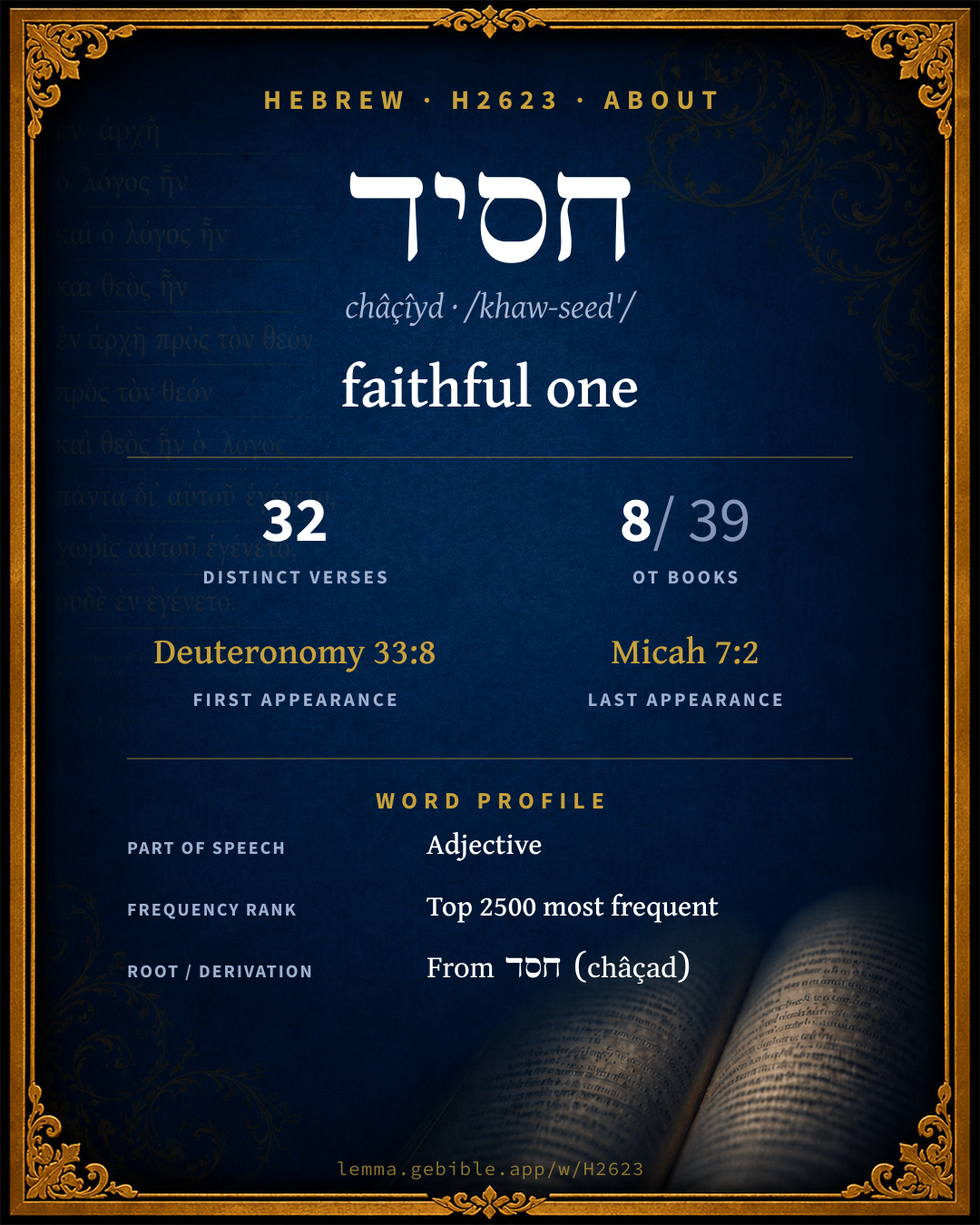
חָסִיד
faithful one
‘faithful one’ is one of 4 main senses fuller range ↓
Full lexicon entry — Brown-Driver-Briggs (BDB)
From Brown-Driver-Briggs (BDB)
Where this word appears
See every Construct-state word in the Hebrew Bible →
Grammar key — what these labels mean
Part of speech
- Adjective
- A word that describes or qualifies a noun.
State
- Construct
- A noun bound to a following noun in a possessive / “of” relationship (the construct chain).
- Absolute
- The independent form of a noun, not bound to a following word.
Gender
- Masculine
- Grammatically masculine.
Number
- Plural
- More than one (in Hebrew, generally three or more).
- Singular
- One.
Grammatical forms
- Adjective, Adjective, Masculine, Plural, Construct 18 times (53%)
- Adjective, Adjective, Masculine, Singular, Absolute 10 times (29%)
- Adjective, Adjective, Masculine, Singular, Construct 4 times (12%)
- Adjective, Adjective, Masculine, Plural, Absolute 2 times (6%)
Parsed forms decoded from the imported morphology (morphhb / Westminster Leningrad Codex — WLC text public domain, morphhb tagging CC BY 4.0), counted across 34 parsed occurrences — not distinct verses.
Every verse where H2623 appears — 32 distinct verses across 8 books. Click any verse to open its interlinear word-by-word view. Verse text shown in the World English Bible for context — . Each verse’s Hebrew form is shown with its reference; the English is not keyword-highlighted, since the data carries no word-level English alignment. Use “Compare translations” on any verse to read it across multiple English versions. This concordance covers the Hebrew Bible; Septuagint (Greek Old Testament) occurrences are not indexed here.
Deuteronomy 1 verse
1 Samuel 1 verse
2 Samuel 1 verse
2 Chronicles 1 verse
Psalms 25 verses
- Psalms 4:3 חָסִ֣יד adj Adjective ms But know that Yahweh has set apart for himself him who is godly: Yahweh will hear when I call to him.
- Psalms 12:1 חָסִ֑יד adj Adjective ms Help, Yahweh; for the godly man ceases. For the faithful fail from among the children of men.
- Psalms 16:10 חֲ֝סִידְ/ךָ֗ adj Adjective ms cs + sfx pers 2ms For you will not leave my soul in Sheol, Neither will you allow your holy one to see corruption.
- Psalms 18:25 חָסִ֥יד adj Adjective ms With the merciful you will show yourself merciful. With the perfect man, you will show yourself perfect.
- Psalms 30:4 חֲסִידָ֑י/ו adj Adjective mp cs + sfx pers 3ms Sing praise to Yahweh, you saints of his. Give thanks to his holy name.
- Psalms 31:23 חֲסִ֫ידָ֥י/ו adj Adjective mp cs + sfx pers 3ms Oh love Yahweh, all you his saints! Yahweh preserves the faithful, And pays back him who deals proudly in full.
- Psalms 32:6 חָסִ֨יד adj Adjective ms For this, let everyone who is godly pray to you in a time when you may be found. Surely when the great waters overflow, they shall not reach to him.
- Psalms 37:28 חֲ֭סִידָי/ו adj Adjective mp cs + sfx pers 3ms For Yahweh loves justice, And doesn't forsake his saints. They are preserved forever, But the children of the wicked shall be cut off.
- Psalms 43:1 חָסִ֑יד adj Adjective ms Vindicate me, God, and plead my cause against an ungodly nation. Oh, deliver me from deceitful and wicked men.
- Psalms 50:5 חֲסִידָ֑/י adj Adjective mp cs + sfx pers 1cs "Gather my saints together to me, Those who have made a covenant with me by sacrifice."
- Psalms 52:9 חֲסִידֶֽי/ךָ adj Adjective mp cs + sfx pers 2ms I will give you thanks forever, because you have done it. I will hope in your name, for it is good, In the presence of your saints.
- Psalms 79:2 חֲ֝סִידֶ֗י/ךָ adj Adjective mp cs + sfx pers 2ms They have given the dead bodies of your servants to be food for the birds of the sky, The flesh of your saints to the animals of the earth.
- Psalms 85:8 חֲסִידָ֑י/ו adj Adjective mp cs + sfx pers 3ms I will hear what God, Yahweh, will speak, For he will speak peace to his people, his saints; But let them not turn again to folly.
- Psalms 86:2 חָסִ֪יד adj Adjective ms Preserve my soul, for I am godly. You, my God, save your servant who trusts in you.
- Psalms 89:19 לַֽ/חֲסִידֶ֗י/ךָ prep + Adjective Adjective mp cs + sfx pers 2ms Then you spoke in vision to your saints, And said, "I have bestowed strength on the warrior. I have exalted a young man from the people.
- Psalms 97:10 חֲסִידָ֑י/ו adj Adjective mp cs + sfx pers 3ms You who love Yahweh, hate evil. He preserves the souls of his saints. He delivers them out of the hand of the wicked.
- Psalms 116:15 לַ/חֲסִידָֽי/ו prep + Adjective Adjective mp cs + sfx pers 3ms Precious in the sight of Yahweh is the death of his saints.
- Psalms 132:9 וַ/חֲסִידֶ֥י/ךָ conj + Adjective Adjective mp cs + sfx pers 2ms Let your priest be clothed with righteousness. Let your saints shout for joy!"
- Psalms 132:16 וַ֝/חֲסִידֶ֗י/הָ conj + Adjective Adjective mp cs + sfx pers 3fs Her priests I will also clothe with salvation. Her saints will shout aloud for joy.
- Psalms 145:10 וַ֝/חֲסִידֶ֗י/ךָ conj + Adjective Adjective mp cs + sfx pers 2ms All your works will give thanks to you, Yahweh. Your saints will extol you.
- Psalms 145:17 וְ֝/חָסִ֗יד conj + Adjective Adjective ms Yahweh is righteous in all his ways, And gracious in all his works.
- Psalms 148:14 חֲסִידָ֗י/ו adj Adjective mp cs + sfx pers 3ms He has lifted up the horn of his people, The praise of all his saints; Even of the children of Israel, a people near to him. Praise Yah!
- Psalms 149:1 חֲסִידִֽים adj Adjective mp Praise Yahweh! Sing to Yahweh a new song, His praise in the assembly of the saints.
- Psalms 149:5 חֲסִידִ֣ים adj Adjective mp Let the saints rejoice in honor. Let them sing for joy on their beds.
- Psalms 149:9 חֲסִידָ֗י/ו adj Adjective mp cs + sfx pers 3ms To execute on them the written judgment. All his saints have this honor. Praise Yah!
Proverbs 1 verse
Jeremiah 1 verse
Micah 1 verse
About this entry
At a glance — auto-summarized from this page’s data, not written by a person. Every figure links to its source below. This summary describes the numbers; it doesn’t interpret them.
חסיד — transliterated châçîyd — is a Hebrew adjective carrying the sense “faithful one.” Its uses cluster heavily in Psalms (78% of all occurrences). With 32 verses in 8 books, it is a moderately common word in the Hebrew Bible. The lexicon spreads it across several senses; see its full sense range. The King James Version usually renders it “saints,” while modern versions prefer “faithful” (unfoldingWord Literal Text) — see the renderings breakdown. Each statement above links to its evidence; the full detail follows below.
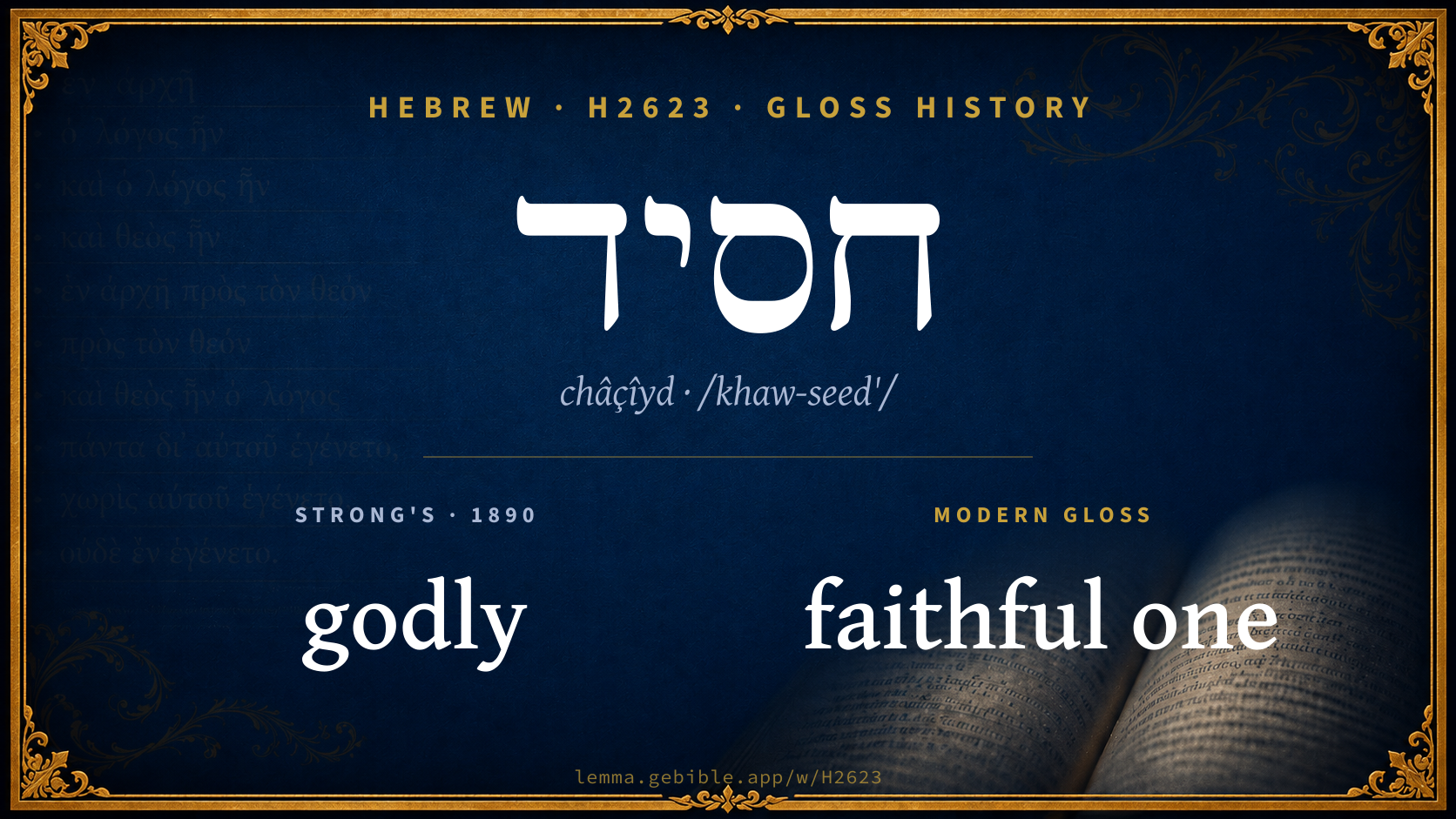
Gloss history
Strong's 1890 vs modern scholarship
About this word
Strong's H2623 catalogs a Hebrew word from the Hebrew Old Testament.
These counts are not copied from any lexicon or concordance. They are computed here, from the morphology-tagged Hebrew Old Testament. What Lemma adds →
- 32
- distinct verses
- The word appears in 32 distinct verses.
- 8 / 39
- OT books
- The word appears in 8 of 39 Old Testament books.
- #1,041
- by frequency
- Top 2500 most frequent Hebrew words (rank 1,041 of 8,640 Hebrew words by occurrence).
View all 32 occurrences in the concordance →
Most concentrated in
- Psalms 25 verses 78%
- Deuteronomy 1 verse 3%
- 1 Samuel 1 verse 3%
By section of the Old Testament
By traditional corpus
Conventional, traditional groupings — biblical authorship is debated, so this is a traditional corpus grouping, not an authorship claim. Each share is this word’s portion of its verses in that division of the Hebrew canon. Each figure is a share of the word’s 32 distinct verses.
- Writings (Ketuvim) 27 verses · 84%
- Prophets (Nevi'im) 4 verses · 13%
- Torah (Pentateuch) 1 verse · 3%
How translations render this word
Counts come from each version’s own published word-to-Strong’s tagging or interlinear alignment — an approximate guide to how each version renders this word, not a word-level alignment the data otherwise carries. Because each total is that version’s own tagged count, the per-version totals vary from one another and need not match the appearance or distinct-verse counts above. These counts may also differ from a printed concordance because Lemma counts each distinctly tagged rendering and does not collapse phrase taggings into a single head-word total. This is a fixed set of word-tagged versions (KJV, ASV, BSB, ULT) and does not change with the reading translation you choose elsewhere. Each version’s license is shown beside its name below (and on Sources).
- King James Version: Saints 11×, Holy one 2×, Let thy saints 2×
- American Standard Version: Saints 10×, Let thy saints 2×, Merciful 2×
- Berean Standard Bible: Saints 14×, Godly 7×, Faithful 2×
- unfoldingWord Literal Text: Faithful 20×, Faithful ones 5×, Am faithful 2×
King James Version Public Domain
Renders H2623 across 31 tagged occurrences — most commonly:
Plus 14 renderings that appear only once — usually multi-word phrases or single function words the recovered tagging swept in, not distinct renderings. Not rendered by a distinct English word in 1 further occurrence.
American Standard Version Public Domain
Renders H2623 across 30 tagged occurrences — most commonly:
Plus 16 renderings that appear only once — usually multi-word phrases or single function words the recovered tagging swept in, not distinct renderings.
Berean Standard Bible Public Domain
Renders H2623 across 31 tagged occurrences — most commonly:
Plus 8 renderings that appear only once — usually multi-word phrases or single function words the recovered tagging swept in, not distinct renderings. Not rendered by a distinct English word in 1 further occurrence.
unfoldingWord Literal Text CC BY-SA 4.0
Renders H2623 across 34 tagged occurrences — most commonly:
Plus 5 renderings that appear only once — usually multi-word phrases or single function words the recovered tagging swept in, not distinct renderings.
7 senses and sub-senses in the full BDB
What do BDB’s symbols mean?
BDB uses these scholarly abbreviations:
| Symbol | Meaning |
|---|---|
| 𝔊 | the Septuagint (the ancient Greek translation, LXX) |
| 𝔙 | the Vulgate (the Latin translation) |
| 𝔖 | the Syriac version (the Peshitta) |
| 𝔗 | the Targum (the Aramaic translation) |
| ψ | the Psalms |
| √ | root (the underlying root or stem) |
| ‖ | parallel passage (a synonymous or contrasted parallel) |
| † | the dagger: every passage where the word occurs is cited |
The 7 senses and sub-senses the full Brown-Driver-Briggs lexicon distinguishes for this word, in lexicon order (not ranked by frequency), with BDB’s own verbatim wording and sub-sense lettering. Shown in Hebrew script with BDB’s own scholarly abbreviations. The condensed entry is in the Lexicon Entry tab. See also the Forms in the corpus table below.
- 1. kind:
- a. of man עם ח׳ תתחסד with the kind thou shewest thyself kind 2 S 22:26 = ψ 18:26. e.g. 2 Samuel 22:26
- b. of wing of ostrich אִם אֶבְרָה חֲסִידָה Jb 39:13 is it a kindly pinion? poss. with play on חֲסִידָה n.f. stork (is the ostrich kind like the stork?). e.g. Job 39:13
- c. of God, only Je 3:12 ψ 145:17. e.g. Jeremiah 3:12
- 2. pious, godly, either as exhibition of ‘duteous love’ toward God (CheOP 378), or (in view of rarity of such passages as Ho 6:4, 6; Je 2:2, and their possible ambiguity) because kindness, as prominent in the godly, comes to imply other attributes, and to be a designation of the godly character, piety: e.g. Hosea 6:4
- a. as adj.—גּוֹי לא חסיד a nation, not pious, = ungodly ψ 43:1. e.g. Psalms 43:1
- b. elsewhere as subst.: sing., a pious man, the godly ψ 4:4; 12:2; 32:6; 86:2, ‖ יָשָׁר Mi 7:2; (thy) pious one(s) ψ 16:10 (Kt pl.), 1 S 2:9 (Qr pl.) Pr 2:8, אִישׁ חֲסִידֶ֑ךָ men of thy pious one Dt 33:8 (Moses, v. Di; others, the man, thy godly one, i.e. Levi); pl. the pious, godly, those of the people who were faithful, devoted to God’s service, only in Psalter and chiefly, if not entirely, in late Psalms ψ 149:1, 5; his pious ones ψ 30:5; 31:24; 37:28; 85:9; 97:10; 116:15; 148:14; 149:9; thy pious ones ψ 52:11; 79:2; 89:20; 132:9 = 2 Ch 6:41, ψ 145:10; my pious ones ψ 50:5, her (Zion’s) pious ψ 132:16.—(In Maccab. age, συναγωγὴ Ἀσιδαίων denoted, technically, the party of the pious, who opposed the Hellenization of Judaea, v. 1 Macc 2:42; cf. 7:13 2 Macc 14:6 and CheOP 48, 56; so perhaps ψ 116:15; 149:1, 5, 9.) e.g. Psalms 4:4
Senses from the full Brown-Driver-Briggs lexicon (Brown, Driver, Briggs; Oxford 1906 — public domain), digitized via Sefaria, supplemented by the OpenScriptures HebrewLexicon (CC BY 4.0). Full attribution on Sources.
Word origin
adj.m. kind, pious (so, as denoting active practice of חֶסֶד, kindness, Thes MV De and most, cf. קָצִיר, פָּקִיד etc.; > Hup on ψ 4:4 RVm who expl. as passive reception of י׳’s חֶסֶד, cf. שָׂכִיר, אָסִיר etc.; its use as attribute of God Je 3:12 ψ 145:17, and the context ψ 12:1 Mi 7:2 etc., favour active sense)—ח׳ ψ 4:4 + 9 times; חֲסִידֶ֑ךָ Dt 33:8 ψ 89:20; חֲסִידְיךָ֯ ψ 16:10; pl. חֲסִידִים ψ 149:1, 5; sf. חֲסִידָ֑י ψ 50:5; חֲסִידָו֯ 1 S 2:9 + 15 times sfs.;—
— Brown-Driver-Briggs (Oxford 1906, public domain), digitized via Sefaria, supplemented by the OpenScriptures HebrewLexicon (CC BY 4.0). See Sources.
Derived from חסד (châçad) (H2616) — to be kind.
Jastrow Dictionary
A second Hebrew/Aramaic lexicon for comparison, covering Aramaic and post-biblical (Talmudic, Targumic, Midrashic) usage that the biblical-Hebrew BDB does not. Matched by lemma rather than by Strong’s number, so a lemma may carry more than one Jastrow headword (shown separately below), and the entries cover usage well beyond the Bible.
חָסִיד
- kind, God-fearing, submissive, pious, abstemious. Tem. 15ᵇ כל היכא דאמר מעשה בח׳ אחד וכ׳ wherever we read (in Talmudic writings), ‘It is reported of a pious man’, either R. Juda b. Baba it meant or &c. Sot. III, 4 ח׳ שוטה a foolish saint. Ab. V, 10 שלי … ח׳ he who says, Mine is thine and thine is thine, is a ḥasid. Ib. 11; a. v. fr.—Pl. חֲסִידִים. Ber. V, 1 ח׳ הראשונים the pious men of olden days; a. v. fr.
חֲסִיד
- 1. same. Targ. Ps. XVIII, 26; a. fr.—B. Kam. 30ᵃ האי … למיהוי ח׳ he who desires to be a conscientious man (in business) let him live up to the laws laid down in N’zikin (v. נֶזֶק). B. Bath. 7ᵇ; a. fr.—Frequ. as a distinguishing surname. M. Kat. 17ᵃ. Ber. 29ᵇ; a. fr.—Pl. חֲסִידַיָּא, חֲסִידֵי. Targ. Ps. CXLV, 10; a. e.—Ḥull. 122ᵃ, a. e. ח׳ דבבל the meek men of Babylonia, opp. תקיפי. M. Kat. 17ᵃ למערתא דח׳ to the cave where the pious were buried; a. fr.—Fem. חֲסִידָא, חֲסִידְתָּא. Sabb. 77ᵇ, v. אֲסִיתָא.
- 2. graceful. Targ. Prov. XI, 16. Ib. XVII, 8.
A Dictionary of the Targumim, the Talmud Babli and Yerushalmi, and the Midrashic Literature (Marcus Jastrow; London, Luzac, 1903) — Public Domain. Digitized via Sefaria. Digitized via Sefaria. Full attribution on Sources.
Forms in the corpus
The 29 distinct written forms H2623 takes in the Hebrew Bible, most frequent first — each parse links to that state’s occurrences in the concordance. Hebrew forms include their vowel points and cantillation, so a single lemma takes many written forms.
Same root — word family
Other BDB entries built from the same root as H2623, grouped by Strong’s listed origin. These share a root / origin per the lexicon — not necessarily a shared meaning. Each links to that word’s own entry.
Derives from
Shares the same root
Derived from this word
Compare all same-root words → They share a root, not necessarily a meaning.
Septuagint verse parallels
This word appears in 22 verses that also exist in the Greek Old Testament (Septuagint), out of the 32 Hebrew verses it occurs in. You can read those verses in Greek by switching the Old Testament edition to the Septuagint.
Read these verses in the Septuagint
- Deuteronomy 33:8
- 1 Samuel 2:9
- 2 Samuel 22:26
- 2 Chronicles 6:41
- Psalms 4:3
- Proverbs 2:8
- Jeremiah 3:12
- Micah 7:2
This is a verse-level parallel only — the same verses exist in both the Hebrew and Greek Old Testaments. No word-level Hebrew↔Greek correspondence is claimed: the data carries no such alignment, so no Greek word is shown as this Hebrew word’s translation. Coverage is not total — the Septuagint omits the deuterocanon and renumbers the Psalms, so some Hebrew verses have no direct Greek parallel.