
Proverbs 20:28

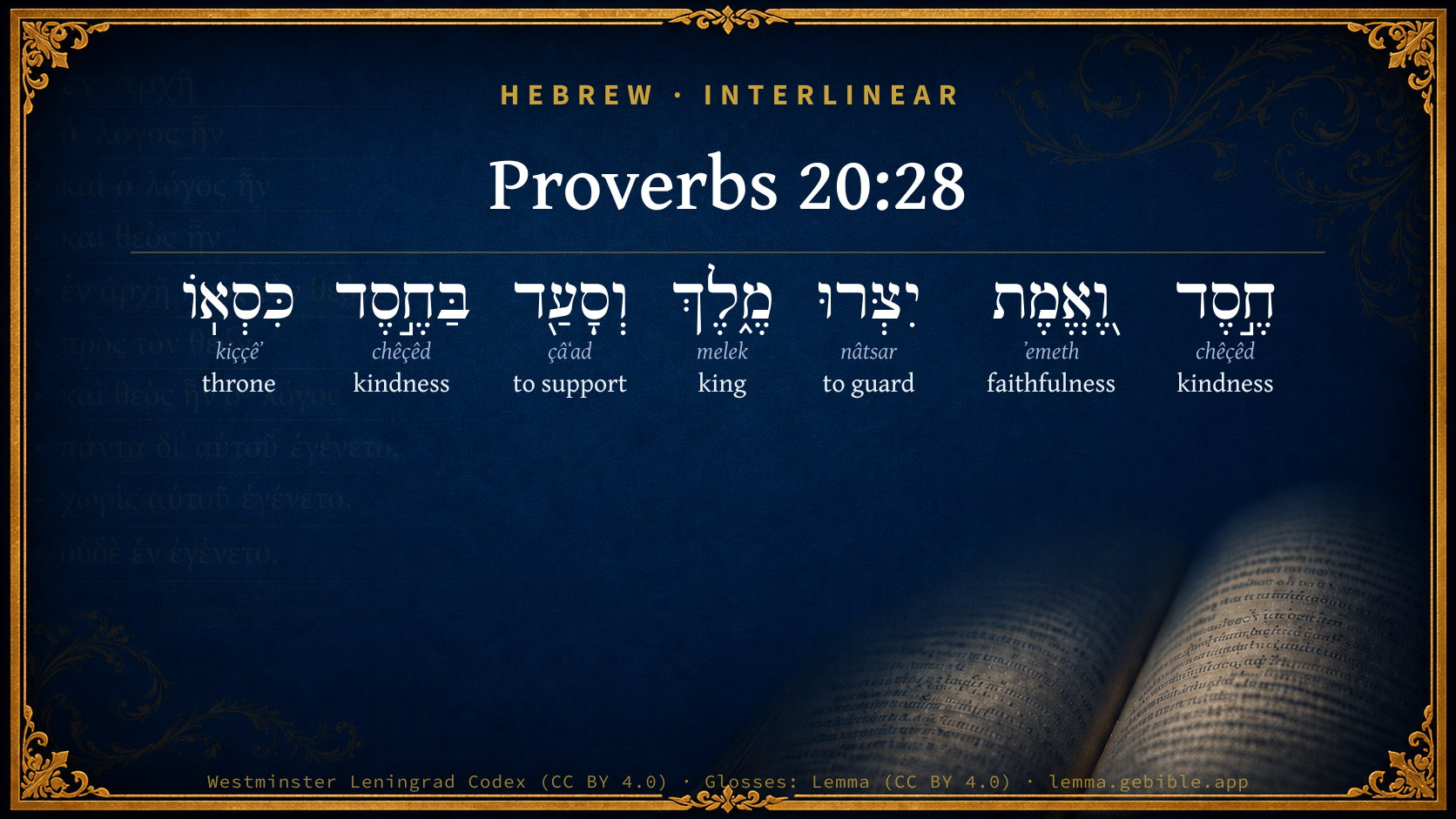
Hebrew (Westminster Leningrad Codex) Proverbs 20:28 appears in the Hebrew Old Testament. The text above is from the Westminster Leningrad Codex. Each word links to its Strong’s number, a concise gloss, and parsing drawn from the Open Scriptures Hebrew Bible morphology. Click any word for its full Brown-Driver-Briggs (BDB) entry.
Download image
Cite this verse

Proverbs 20:28 (World English Bible). Public Domain. Lemma interlinear Bible study tool, https://lemma.gebible.app/v/proverbs/20/28.

Show BibTeX & RIS
BibTeX
RIS
English Translation
Love and faithfulness keep the king safe. His throne is sustained by love.
World English Bible · Public Domain
Download a study sheet

One document with this verse’s original text, its word-by-word gloss line, the meaning frame, cross-references with their text, attributed commentary, and full source and license credits — printable, and it pastes into notes with its structure intact.

This verse Autodidact and up

Study sheet (.html) Plain text (.txt)

A passage Seminary Student

Up to 50 verses in one chapter. A passage sheet keeps up to 6 commentary sources and 12 cross-references per verse, in the order this page ranks them, and says so on the sheet whenever that leaves anything out. Ask for a single verse and you get the Autodidact verse sheet above.

Everything on this page stays free to read, with no account — the sheet is a download of what is already on screen, not access to it.

Want to remove ads? Support Godless Engineer
Compare translations 3

The same verse in 3 English versions, stacked beneath the original-language interlinear above. Click any original word for its lexicon entry.

Each is an independent rendering of the whole verse — the interlinear is not word-aligned to these translations.

Highlighted words mark where these versions differ — a whole-verse word diff, not a word-by-word alignment.

  • World English Bible Public Domain
    Love and faithfulness keep the king safe. His throne is sustained by love.
  • King James Version Public Domain
    Mercy and truth preserve the king: and his throne is upholden by mercy.
  • unfoldingWord Literal Text CC BY-SA 4.0
    Covenant faithfulness and trustworthiness guard a king, and his throne is sustained by covenant faithfulness.

unfoldingWord Literal Text — © unfoldingWord, licensed CC BY-SA 4.0. Word-aligned USFM3 via Door43 (git.door43.org/unfoldingWord/en_ult).

Versions to compare (up to 4)

3 of 4 selected

Show all 18 translations

Every available English version of this verse, each an independent rendering of the whole verse.

  • World English Bible Public Domain
    Love and faithfulness keep the king safe. His throne is sustained by love.
  • Berean Standard Bible Public Domain
    Loving devotion and faithfulness preserve a king; by these he maintains his throne.
  • Majority Standard Bible Public Domain
    Loving devotion and faithfulness preserve a king; by these he maintains his throne.
  • King James Version Public Domain
    Mercy and truth preserve the king: and his throne is upholden by mercy.
  • American Standard Version (1901) Public Domain
    Kindness and truth preserve the king; And his throne is upholden by kindness.
  • Revised Version (1885) Public Domain
    Mercy and truth preserve the king: and his throne is upholden by mercy.
  • Geneva Bible (1599) Public Domain
    Mercie and trueth preserue the King: for his throne shall be established with mercie.
  • Douay-Rheims (1899) Public Domain
    Mercy and truth preserve the king, and his throne is strengthened by clemency.
  • Young's Literal Translation Public Domain
    Kindness and truth keep a king, And he hath supported by kindness his throne.
  • Literal Standard Version CC BY-SA 4.0
    Kindness and truth keep a king, || And he has supported his throne by kindness.
  • Unlocked Literal Bible CC BY-SA 4.0
    Covenant faithfulness and trustworthiness preserve the king; his throne is made secure by love.
  • unfoldingWord Literal Text CC BY-SA 4.0
    Covenant faithfulness and trustworthiness guard a king, and his throne is sustained by covenant faithfulness.
  • Darby Bible Public Domain
    Mercy and truth preserve the king; and he upholdeth his throne by mercy.
  • World Messianic Bible Public Domain
    Love and faithfulness keep the king safe. His throne is sustained by love.
  • Webster's Bible Public Domain
    Mercy and truth preserve the king: and his throne is upheld by mercy.
  • Free Bible Version CC BY-SA 4.0
    Trustworthy love and faithfulness keep a king safe; trustworthy love supports his rule.
  • Bible in Basic English Public Domain
    Mercy and good faith keep the king safe, and the seat of his power is based on upright acts.
  • JPS Tanakh (1917) Public Domain
    Mercy and truth preserve the king; and his throne is upheld by mercy.

Literal Standard Version (2020), Covenant Press — licensed CC BY-SA 4.0. Text via the HelloAO Bible API (eBible.org). Unlocked Literal Bible (unfoldingWord) — licensed CC BY-SA 4.0. Text via the HelloAO Bible API (eBible.org). unfoldingWord Literal Text — © unfoldingWord, licensed CC BY-SA 4.0. Word-aligned USFM3 via Door43 (git.door43.org/unfoldingWord/en_ult). Free Bible Version, Dr. Jonathan Gallagher — licensed CC BY-SA 4.0. Text via the HelloAO Bible API (eBible.org).

Word by word

More ways to search: Search by grammar → Find every occurrence → Compare this word →

Practice this passage: Drill this verse → Learn its vocabulary →

וְסָעַ֖ד
çâʻad
H5582
“and · to support”
Conjunction + Verb, Qal, Sequential Perfect, 3rd Person, Masculine, Singular
Part of Speech
Conjunction + Verb
Stem
Qal
Form
Sequential Perfect
Person
3rd Person
Gender
Masculine
Number
Singular
Full BDB Definition

Origin: a primitive root

TWOT: 1525

to support, sustain, stay, establish, strengthen, comfort - (Qal) to support, sustain - to sustain, stay (of heart) - to support, uphold (of throne)
  1. חֶ֣סֶד chêçêd H2617 “kindness” Noun, Common, Masculine, Singular, Absolute
  2. וֶ֭אֱמֶת ʼemeth H571 “and · faithfulness” Conjunction + Noun, Common, Feminine, Singular, Absolute
  3. יִצְּרוּ nâtsar H5341 “to guard” Verb, Qal, Imperfect, 3rd Person, Masculine, Plural
  4. מֶ֑לֶךְ melek H4428 “king” Noun, Common, Masculine, Singular, Absolute
  5. בַּחֶ֣סֶד chêçêd H2617 “in/at the · kindness” Preposition, Determined + Noun, Common, Masculine, Singular, Absolute
  6. כִּסְאֽוֹ kiççêʼ H3678 “throne · his” Noun, Common, Masculine, Singular, Construct + Suffix, Personal, 3rd Person, Masculine, Singular

About this verse

These counts appear in no published source. They are computed here, from the morphology-tagged text and Lemma’s own curated glosses. What Lemma adds →

7
words
6
distinct lemmas
Wisdom
section

Notable vocabulary

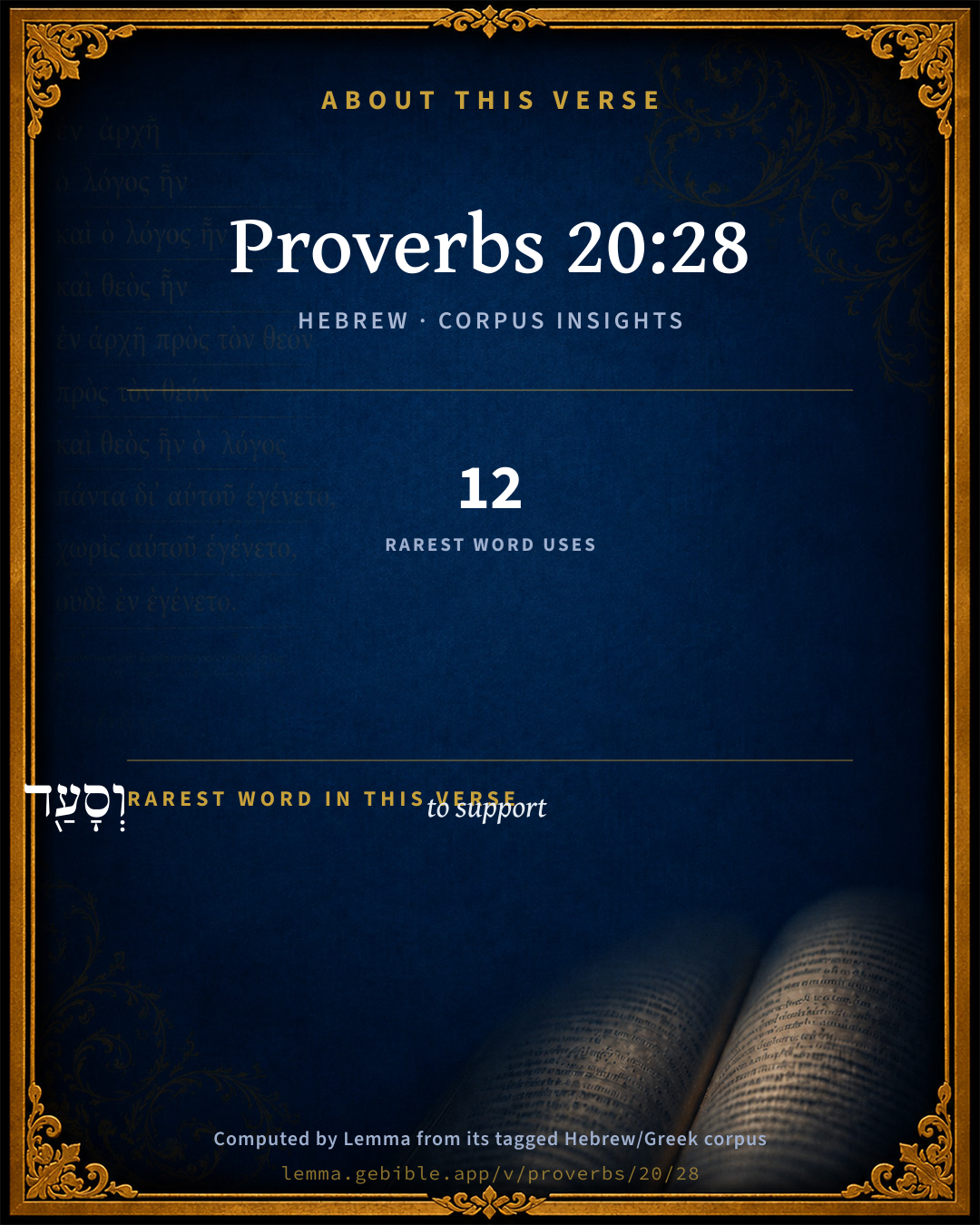
The rarest word here is וְסָעַ֖ד to support H5582 — appearing just 12 times in the whole Hebrew Bible.

Shared distinctive vocabulary

וְסָעַ֖ד to support H5582 occurs in 12 verses of the Hebrew Bible. Also found in:

Grammatical profile

  • 2 verbs
  • 5 nouns

Verb forms

  • יִצְּרוּ Qal · Imperfect
  • וְסָעַ֖ד Qal · Sequential Perfect

Repetition

A word recurs within this verse — often emphatic in Hebrew:

  • חֶ֣סֶד kindness H2617 ×2

Hebrew & Septuagint length

In English translation the verse runs 13 words from the Hebrew and 16 from the Septuagint (LXX English) — closely comparable.

A rough comparison of the two English renderings, which tokenize alike — not a word-level alignment.

Word counts can differ between the Hebrew and the Greek without any difference in meaning — e.g. the Hebrew direct-object marker אֵת has no separate Greek word, and Greek often adds the article ὁ.

Cross-references

8

Topical passages linked to Proverbs 20:28 in the Treasury of Scripture Knowledge — connected by theme and wording, ordered by reader-vote popularity; previews shown in the World English Bible.

  • Proverbs 16:12 It is an abomination for kings to do wrong, For the throne is established by righteousness.
  • Psalms 26:1 Judge me, Yahweh, for I have walked in my integrity. I have trusted also in Yahweh without wavering.
  • Psalms 101:1 I will sing of loving kindness and justice. To you, Yahweh, I will sing praises.
  • Proverbs 29:14 The king who fairly judges the poor, His throne shall be established forever.
  • Psalms 21:7 For the king trusts in Yahweh. Through the loving kindness of the Most High, he shall not be moved.
  • Psalms 61:7 He shall be enthroned in God's presence forever. Appoint your loving kindness and truth, that they may preserve him.
  • Proverbs 16:6 By mercy and truth iniquity is atoned for. By the fear of Yahweh men depart from evil.
  • Isaiah 16:5 A throne shall be established in loving kindness; and one shall sit thereon in truth, in the tent of David, judging, and seeking justice, and swift to do righteousness.

Cross-references courtesy of OpenBible.info (CC BY 4.0).

Hebrew and Greek witnesses Masoretic Hebrew ↔ Greek Septuagint

The same verse in the two great witnesses to the Old Testament, shown verse-for-verse.

These are two independent witnesses, not word-aligned to each other, and the Septuagint is shown in lemma (dictionary) form.

Hebrew Proverbs 20:28 Masoretic · Westminster Leningrad Codex

חֶ֣סֶד וֶ֭אֱמֶת יִצְּרוּ מֶ֑לֶךְ וְסָעַ֖ד בַּחֶ֣סֶד כִּסְאֽוֹ

Love and faithfulness keep the king safe. His throne is sustained by love.

World English Bible · Public Domain

Greek LXX Proverbs 20:28 Septuagint · lemma form
Mercy and truth are a guard to a king, and will surround his throne with righteousness.

LXX2012 (modern English Septuagint) · Public Domain

On this verse, The Pulpit Commentary discusses the Septuagint’s reading. Read the note in Commentary ↓

Hebrew: Westminster Leningrad Codex (CC BY 4.0). Greek: Septuagint (public domain); English from LXX2012 (modern English Septuagint) (Public Domain). How the Septuagint differs from the Hebrew →

Commentary

Notes on Proverbs 20:28 from classic Christian and Jewish commentators (each source and its license shown beneath its notes). The classic Christian expositions comment on the surrounding passage and are grouped to its opening verse, so a note may address several verses; the Jewish commentaries on the Tanakh (Rashi and others) are per-verse, so they appear only where the commentator wrote on this verse.

Lemma curates 59 commentaries, every one of them public domain or Creative Commons licensed, each selected and text-cleaned for this edition rather than reprinted as found. About our sources →

Trapp's Complete Commentary

John Trapp

Pro 20:28 Mercy and truth preserve the king: and his throne is upholden by mercy.

Ver. 28. Mercy and truth preserve the king.] These are the best guard of his body, and supporters of his throne. Mildness and righteousness, lenity and fidelity, do more safe guard a prince than munitions of rocks, or any warlike preparations, amidst which Henry IV of France perished, when Queen Elizabeth of England lived and died with glory. That French king, being persuaded by the Duke of Sully not to readmit the Jesuits, answered, Give me then security for my life. But he was shortly after stabbed to death by their instigation. When our queen, that stuck fast to her principles, was not more loved of her friends than feared of foes, being protected by God beyond expectation. Our King John thought to strengthen himself by gathering money, the sinews of war; but meanwhile he lost his people’s affections, those joints of peace, and came, after endless turmoils, to an unhappy end. So did our late sovereign of bleeding memory.

John Trapp, A Commentary or Exposition upon All the Books of the Old and New Testament (1647–1656) — public domain. Text from a community e-Sword module.

Joseph Benson's Commentary

Pro 20:28. Mercy — Clemency to offenders, and bounty to worthy indigent persons; and truth — Faithfulness in keeping his word and promises inviolably; preserve the king — Because they engage God to guard him, and gain him the reverence and affections of his people, which is, under God, a king’s greatest safety and happiness. And his throne is upheld by mercy — Which is again mentioned, to show that although to exercise mercy be an act of grace, and therefore, in some sort, free, yet princes are obliged to it both by their duty and by their interest, because it is a singular means of their preservation.

Joseph Benson's Commentary on the Old and New Testaments (1811–1818) — public domain. Text from a community e-Sword module.

The Preacher's Complete Homiletical Commentary

Joseph S. Exell (gen. ed.)

CRITICAL NOTES.—

Pro_20:26. The wheel, i.e., the wheel of the threshing, instrument which blows away the chaff.

MAIN HOMILETICS OF Pro_20:26; Pro_20:28

PILLARS OF GOVERNMENT

I. A human ruler will have rebellious subjects in his kingdom. This will be the case however wise the laws, and with whatever care and discrimination they are administered. In the most cultivated and carefully kept ground some weeds are always found among the flowers—some tares among the wheat; and since the King who can do no wrong numbers among his subjects those who are lawless and disobedient, the best and wisest of human rulers must expect to do the same.

II. It is the duty and wisdom of a human ruler to make a distinction between his good and bad subjects, and to punish the latter. Even if the wheel mentioned in the proverb be regarded as simply an instrument of separation, as the threshing instrument separates the chaff from the wheat, the idea of punishment is retained. In a well-governed kingdom the laws which govern it are such a separating power between the evil and the good, so far as external conduct is concerned, and it is indispensable for the stability of peace and order that they should be strictly enforced. It would be most unjust, as well as unwise—it would be tempting men to transgression—if the lawless citizens in a community were allowed to go unpunished; and it is contrary to our innate sense of justice that in any kingdom “the righteous should be as the wicked” (Gen_18:25)—that the thief should have all the privileges of an honest man, and the murderer the liberty of an innocent person. The punishment of transgressors not only defends the good man, but it may prevent the bad man from increasing his guilt by adding crime to crime. The king of Solomon’s proverbs is a typical word for all who are called upon to rule, whether in the family or the State, and the very word ruler, or governor, implies a discrimination between the evil and the good and a difference in their treatment.

III. The preservation of the throne depends more upon moral than upon physical power. We take the word throne in its widest sense as signifying any place or position which raises one man to be in any sense the ruler of another, from the throne of the father in his family and the master among his servants to that of the king amidst his subjects. In each and every one of these kingdoms, although external and physical coercion and punishment are sometimes indispensable, yet there is no permanent stability unless there is mercy and truth in the ruler, and unless it is manifest in his government. Many a throne has been erected on other foundations,—physical strength has established many kingdoms, and material wealth has set many men upon thrones. But if they have raised a superstructure its foundation has been in the sand, and when the rain and wind of adversity have descended upon it it has fallen, and great has been the fall of it. There must be some truth and mercy—some righteousness and justice, and withal some exercise of grace towards the wrongdoer—if the throne or the kingdom is to be upholden, and the wisdom of the ruler will be shown in his so mingling sternness with severity as to make both contribute to the one end. Truth must here be taken as synonymous with righteousness—as that observance of the just claims of every man which he has a right to expect and demand from those who rule him. This will include that punishment of the lawless which is the subject of Pro_20:26, but it is here implied that even punishment is to be tempered with mercy. Pity for the offender ought always to be mingled with indignation at the offence, and if any ruler desires to sit firmly upon his seat of justice he must consider not only the greatness of the crime but the strength of the temptation—not how severely he can punish the criminal but whether he can reform him. And this is rarely if ever done by the exercise of justice merely. The frost and cold are necessary to kill the weeds and vermin and to break up the soil, but there will never be flowers or fruit without summer rain and sunshine. And mercy is that “gentle rain from heaven” without which no sinful creature will ever bring forth fruits of righteousness.

ILLUSTRATION

The necessity of mingling mercy with justice is strikingly exemplified in the great success which attended the efforts of the late Captain Maconochie to benefit the convicts in our penal settlement in Norfolk Island. Having, in his capacity as Secretary to the Governor of Tasmania, seen most terrible and hardening effects from unmixed severity, he desired earnestly to try what could be done by combining mercy with discipline and punishment. For this purpose he was placed in command of Norfolk Island, and remained there four years, having under his care from 1500 to 2000 doubly-convicted prisoners, i.e., convicts who, after being transported from England to New South Wales, had been for other crimes again transported to Norfolk Island. Previous to his arrival they worked in chains, and it was considered dangerous for even armed officers to approach within three yards of them. It was considered unsafe to trust them with knives, and they therefore tore their food with their hands and teeth. They were accustomed to inflict dreadful injuries upon themselves in order to evade labour, and were described at the time as a demoniacal assemblage. But under more humane treatment the entire colony became changed, and one of his colleagues testifies that he and another superintendent “resided at one of the settlements in a cottage without lock and key, with simply a latch to the door, and close to the convict barracks, where over 2000 were lodged every night, also without locks.” “Not a single serious offence,” says he, “was ever committed in that time by any of those men, and the only bodyguard was another free superintendent and myself, together with a few trustworthy men selected from among themselves.” This gentleman (Mr. J. Simms, since Governor of Plymouth Prison) goes on to say, “I shall ever remember this year as the most remarkable of all my prison experience, because it.… was a fair result of what might be realised from any body of men generally, thus treated, not by force, iron force, but by moral means.” One remarkable example is given. At Sydney there had been a most desperate and unmanageable convict, named Anderson. He was flogged time after time for various offences, but to no good effect. He became more outrageous than ever. At last, the authorities, in despair, put him on a little island in Sydney Harbour, where he was kept chained to a rock, and in the hollow of which rock he slept. After some weeks the Governor went to see him, and urged him to submit to authority, but he refused. He was then sent for life to Port Macquarie Convict Station, where he was again and again flogged. He made his escape, and lived among the natives for some time, but, ultimately, being recaptured, he was sent to Norfolk Island for the crime of murder. Under Maconochie’s humane treatment he became a changed man, and when the Governor of New South Wales visited the settlement he particularly noticed Anderson, and inquired, “What smart fellow may that be?” (See Leisure Hour for October, 1878.)

OUTLINES AND SUGGESTIVE COMMENTS

All dynasties have been kind. If they are cruel now, it must be like the weight of a clock, running down. There was kindness. “Mercy and truth” must at some time or other have builded the “throne.”—Miller.

Godly Asa removed wickedness from the high place nearest his own throne and heart. Amaziah justly punished it with death. Nehemiah—that true reformer—rebuked it even in the family of the high priest. Our own Alfred appeared to maintain this standard as a witness for God in an age of darkness. But it is the King of kings alone that can make this separation complete. Often does He sift His Church by trial, for her greater purity and complete preservation (Amo_9:9). But what will it be, when He shall come “with His fan in His hand, and shall thoroughly purge His floor?” (Mat_3:12). What a scattering of chaff will there be! Not an atom will go into the garner. Not a grain of wheat will be cast away. O my soul! what wilt thou be found at this great sifting day! “Who may abide the day of His coming? And who shall stand when He appeareth?” (Mal_3:2).—Bridges.

There goes more to preserve a king than to preserve a kingdom; and though the preservation of a kingdom be a weighty matter, yet the preservation of a king is much more weighty—though much care and pains be required for the one, much more is required for the other. Half of that will serve for the one which is needful for the other. Mercy will support the throne, but mercy and truth must preserve the king.—Jermin.

The Preacher's Complete Homiletical Commentary (gen. ed. Joseph S. Exell; Funk & Wagnalls, c. 1892) — public domain (pre-1929). A full-Bible homiletical/sermon-outline anthology covering 65 of 66 books (2 John is absent from the source module). Text from a community e-Sword module.

Tyndale Open Study Notes

Tyndale Open Resources

20:28 God’s unfailing love and faithfulness are closely connected to his covenant with his people (see Exod 34:5-7; Deut 7:7-9). The king represents God on earth, so God will protect him (see 2 Sam 7).

Tyndale Open Study Notes — © Tyndale Open Resources, licensed CC BY-SA 4.0. Text via the HelloAO Bible API.

Matthew Henry's Commentary

Here we have, 1. The virtues of a good king. Those are mercy and truth, especially mercy, for that is mentioned twice here. He must be strictly faithful to his word, must be sincere, and abhor all dissimulation, must religiously discharge all the trusts reposed in him, must support and countenance truth. He must likewise rule with clemency, and by all acts of compassion gain the affections of his people. Mercy and truth are the glories of God's throne, and kings are called gods. 2. The advantages he gains thereby. These virtues will preserve his person and support his government, will make him easy and safe, beloved by his own people and feared by his enemies, if it be possible that he should have any.

Matthew Henry's Commentary on the Whole Bible (1708–1710) — public domain (CC PDM 1.0). Text via the HelloAO Bible API.

Jamieson, Fausset & Brown

Robert Jamieson, A. R. Fausset & David Brown

(Compare Pro 3:3; Pro 16:6, Pro 16:12).

Jamieson, Fausset & Brown — Commentary Critical and Explanatory on the Whole Bible (1871) — public domain (CC PDM 1.0). Text via the HelloAO Bible API.

Adam Clarke's Commentary

Verse 28. Mercy and truth preserve the king] These are the brightest jewels in the royal crown; and those kings who are most governed by them have the stablest government.

Adam Clarke's Commentary on the Bible (1810–1826) — public domain. Text from a community e-Sword/MySword module.

Ellicott's Commentary for English Readers

(28) Mercy and truth preserve the king.—See above on Pro_3:3. The love and faithfulness he shows to his subjects draw out the same qualities in them, and these are the safeguard of his throne. So (Psa_130:4) the mercy shown by God inspires man with a reverent fear of Him, while harshness might have made him a slave, or driven him through despair into rebellion. (Comp. Jer_33:9.)

A Bible Commentary for English Readers, edited by Charles John Ellicott (1878–1897) — public domain. Text from a community e-Sword module.

John Gill's Exposition

Mercy and truth preserve the king,.... Which are two good qualifications in a prince; not ruling his subjects with rigour and cruelty, but with tenderness and clemency; easing them as much as he can of burdens and pressures; showing compassion to the distressed, and pardoning delinquents when the case will admit of it; as also being faithful to his word, promises, and engagements; inviolably adhering to the laws and constitution of the nation, and steady in his administrations of justice; these preserve him in the affections of his people, and make him safe and secure on his throne; and because of these the Lord preserves him from his enemies. It maybe rendered, "grace and truth" (l); and applied to Christ, who is full of both, and which are said to preserve him, Psa 40:11;

and his throne is upholden by mercy; this explains what is meant by the preservation of him, and what is the security of his throne and kingdom, which is clemency and goodness to his subjects.

(l) "gratis et veritas", Cocceius.

John Gill's Exposition of the Whole Bible (1746–1763) — public domain (CC PDM 1.0). Text via the HelloAO Bible API.

Haydock's Catholic Bible Commentary

Clemency. Such a king need not fear rebellion. (Calmet)

George Leo Haydock (1774–1849), Haydock's Catholic Family Bible and Commentary, 1859 edition — public domain. Excludes Psalms (Douay-Rheims chapter numbering differs from Protestant) and Deuterocanonical books (Catholic canon only).

Matthew Poole's English Annotations

Mercy; clemency to offenders, and bounty to worthy and to indigent persons; and truth; faithfulness in keeping his word and promises inviolably; preserve the king, because they engage God to guard him, and gain him the reverence and affections of his people, which is a king’s greatest safety and happiness.

Mercy is again mentioned, to show that although it be an act of grace, and therefore in some sort free, yet princes are obliged to it, both by their duty and by their interest, because it is a singular means of their preservation.

Matthew Poole's English Annotations on the Holy Bible (1683–1685) — public domain. Text from a community e-Sword/MySword module.

Whedon's Commentary on the Bible

Daniel D. Whedon

28. Mercy and truth — Or, goodwill and truth: truth, goodwill, and kindness towards his subjects — truth and faithfulness in all his dealings with them — will secure the approbation and admiration of the people, and make the throne secure. Compare Psa_25:21; Psa_101:1; Pro_29:14.

Daniel D. Whedon (gen. ed.), Commentary on the Old and New Testaments (1874–1909) — public domain. Text from a community e-Sword module.

The Pulpit Commentary

Mercy and truth preserve the king. (For "mercy and truth," see note on Pro_3:3) The love and faithfulness which the king displays in dealing with his subjects elicits the like virtues in them, and these are the safeguard of his throne. His throne is upholden by mercy; or, love. So the king is well called the father of his people, and in modern times the epithet "gracious" is applied to the sovereign as being the fountain of mercy and condescension. Sallust, "Jugurtha," 10, "Non exercitus neque thesauri praesidia regni sunt, verum amici, quos neque armis cogere neque auro parare queas; officio et fide pariuntur." Septuagint, "Mercy (elehmosunh ) and truth are a guard to a king, and will surround his throne with righteousness." "The subject"s love," says our English maxim, "is the king"s lifeguard."

The Pulpit Commentary (1880–1919), ed. H.D.M. Spence-Jones & Joseph S. Exell — public domain. Text from a community e-Sword module.

Keil & Delitzsch

C. F. Keil & F. Delitzsch

28 Love and truth guard the king;

And he supports his throne by love.

We have not in the German [nor in the Eng.] language a couple of words that completely cover חסד ואמת; when they are used of God, we translate them by grace and truth [Gnade u. Wahrheit], Psa 40:12 (יצּרוּני); when of men, by love and truth [Liebe u. Treue], Pro 16:6; and when of the two-sided divine forces, by kindness and truth, Pro 3:3. Love and truth are the two good spirits that guard the king. If it is elsewhere said that the king's throne is supported "with judgment and with justice," Isa 9:6 [7]; here, on the other side, we see that the exercise of government must have love as its centre; he has not only to act on the line of right, שׁוּרת הדּין; but, as the later proverb says, in such a way, that within this circle his conduct is determined by the central motive of love. In this sense we give the king not only the title of Grossmchtigster [most high and mighty], but also that of "Allergndigster" most gracious, for the king can and ought to exercise grace before other men; the virtue of condescension establishes his throne more than the might of greatness.

Keil & Delitzsch — Biblical Commentary on the Old Testament (1861–1891) — public domain (CC PDM 1.0). Text via the HelloAO Bible API. (Old Testament only.)

Bridges on Proverbs

Charles Bridges

Punishment is indeed a necessary security against the infringement of the law. (Pro 20:26 .) Yet a wise King will follow the example of the Great Sovereign, and "make judgment his strange work," and mercy his "delight."†1 And so long as truth inviolable is his guiding principle, the abuse of mercy need be little feared. Nay, mercy is the upholding pillar of his throne. (Isa 16:5 .) But who does not know, that, while truth commands reverence, it is mercy that wins the heart? Solomon himself had a strong body-guard around him, for the safety of his person. (Song of Son 3:7 .) Yet were the mercy and truth of his government not only the most splendid jewels of his crown, but ’the best guard of his body, and supporters of his throne.’†2

How lovely is this combination in the administration of the Great King! "Justice and judgment are the habitation of thy throne; mercy and truth shall go before thy face." (Psa 89:14 .) Much more bright is the manifestation of these glorious perfections in that great work, by which he sacrificed even his Beloved Son, that man might be saved without the tarnish of one spot upon his infinitely adorable name. (Psa 85:10 .)

Footnotes:

†1 Compare Isa 28:21 . Mic 7:18 .

†2 Trapp in loco.

Charles Bridges, An Exposition of the Book of Proverbs (1846) — public domain. Text from a community e-Sword module.

Kretzmann's Popular Commentary

Paul E. Kretzmann

v. 28. Mercy and truth preserve the king, they are the attributes or virtues which make his reign successful, and his throne is upholden by mercy, by gracious kindness and favor.

Paul E. Kretzmann, Popular Commentary of the Bible (1921–1924) — public domain. Text from a community e-Sword module.

Lesson kit

Teaching starters — assembled from the data on this page, not authored interpretation. Every prompt links to the verse data it draws on. Edit before teaching.

Proverbs, in the Wisdom, opens this verse with 7 words (6 distinct Hebrew lemmas). Its most distinctive word is çâʻad (“to support”). A historical commentator’s framing appears above. Read the whole chapter for the surrounding context.

Discussion questions

  1. The word çâʻad carries the sense “to support.” How does it shape the verse?
  2. How does Genesis 18:5, which shares the word «to support», read alongside this verse?
  3. What does the repetition of “kindness” (2× in this one verse) do in this verse?
  4. These translations render this verse differently. What is at stake in choosing one wording over another?
  5. «יִצְּרוּ» is a Qal Imperfect verb. How does that grammatical form shape the action described?
  6. Compare how Trapp's Complete Commentary and Joseph Benson's Commentary read this verse. Where do they agree or differ?

Things to notice

Reading settings

Reading text

Shown beneath each verse's original-language words.

Old Testament
Old Testament edition

Read the OT as the Masoretic Hebrew (MT) or the Greek Septuagint (LXX).

English shown for the Greek Septuagint (in the Hebrew ↔ Greek comparison).

Comparing translations? Open the Compare panel on any verse page to stack up to four side by side.