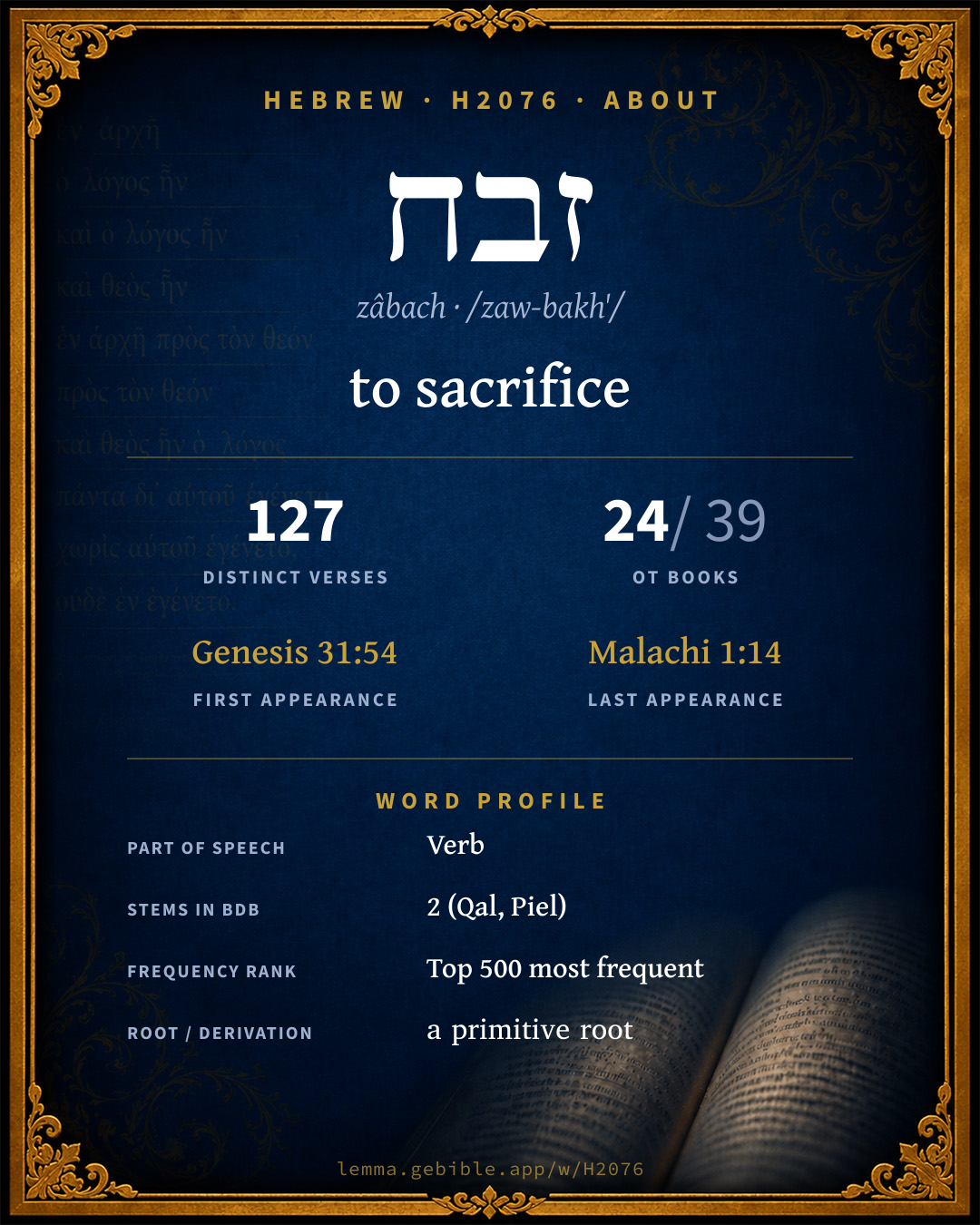
זָבַח
to sacrifice
‘to sacrifice’ is one of 2 main senses fuller range ↓
Full lexicon entry — Brown-Driver-Briggs (BDB)
From Brown-Driver-Briggs (BDB)
Where this word appears
See every Piel verb in the Hebrew Bible →
Grammar key — what these labels mean
Part of speech
- Verb
- An action or state-of-being word.
Stem
- Qal
- The basic, simple active stem — the plain form of the verb (“he wrote”). Here: ‘slaughter for sacrifice’
- Piel
- An intensive or resultative active stem. Here: ‘of the abundant sacrifices made to Yahweh by Solomon 1 K 8’
Form
- Sequential Imperfect
- An imperfect with prefixed waw — the standard past-narrative form (waw-consecutive imperfect).
- Infinitive Construct
- A bound verbal noun, frequently with prepositions (“to write / in writing”).
- Participle Active
- A verbal adjective expressing ongoing or characteristic action (“writing / one who writes”).
- Imperfect
- An incomplete, ongoing, or future action (“he will / would write”).
- Sequential Perfect
- A perfect with prefixed waw continuing a preceding imperfect or command (waw-consecutive perfect).
- Cohortative
- A first-person volitional form expressing wish or resolve (“let me / let us write”).
- Perfect
- A completed action or state — Hebrew marks aspect (completeness) more than strict tense (“he wrote”).
- Imperative
- A direct command (“write!”).
- Jussive
- A third- or second-person volitional form expressing wish or command (“let him write”).
State
- Absolute
- The independent form of a noun, not bound to a following word.
- Construct
- A noun bound to a following noun in a possessive / “of” relationship (the construct chain).
Person
- 3rd Person
- The one spoken about (“he / she / it / they”).
- 2nd Person
- The one addressed (“you”).
- 1st Person
- The speaker (“I / we”).
Gender
- Masculine
- Grammatically masculine.
- Common
- Either gender — not distinguished for this form.
- Feminine
- Grammatically feminine.
Number
- Singular
- One.
- Plural
- More than one (in Hebrew, generally three or more).
4 verses where H2076 appears in the Piel stem in the Book of Hosea. Filtered view — show all forms. Click any verse to open its interlinear word-by-word view. Verse text shown in the World English Bible for context — . Each verse’s Hebrew form is shown with its reference; the English is not keyword-highlighted, since the data carries no word-level English alignment. Use “Compare translations” on any verse to read it across multiple English versions. This concordance covers the Hebrew Bible; Septuagint (Greek Old Testament) occurrences are not indexed here.
Hosea
- Hosea 4:13 יְזַבֵּ֗חוּ Piel impf 3mp They sacrifice on the tops of the mountains, And burn incense on the hills, under oaks and poplars and terebinths, Because its shade is good. Therefore your daughters play the prostitute, And your brides commit adultery.
- Hosea 4:14 יְזַבֵּ֑חוּ Piel impf 3mp I will not punish your daughters when they play the prostitute, Nor your brides when they commit adultery; Because the men consort with prostitutes, And they sacrifice with the shrine prostitutes; And the people that does not understand will come to ruin.
- Hosea 11:2 יְזַבֵּ֔חוּ Piel impf 3mp They called to them, so they went from them. They sacrificed to the Baals, And burned incense to engraved images.
- Hosea 12:11 זִבֵּ֑חוּ Piel pf 3cp If Gilead is wicked, Surely they are worthless. In Gilgal they sacrifice bulls. Indeed, their altars are like heaps in the furrows of the field.
About this entry
At a glance — auto-summarized from this page’s data, not written by a person. Every figure links to its source below. This summary describes the numbers; it doesn’t interpret them.
זבח — transliterated zâbach — is a Hebrew verb carrying the sense “to sacrifice.” Debuting at Genesis 31:54, it then recurs through the corpus. With 127 verses in 24 books, it is a common word in the Hebrew Bible. Read the stem: it spans 2 stems, including Qal and Piel. Sharing its root, it stands alongside דבח, זבח and מזבח. Each statement above links to its evidence; the full detail follows below.
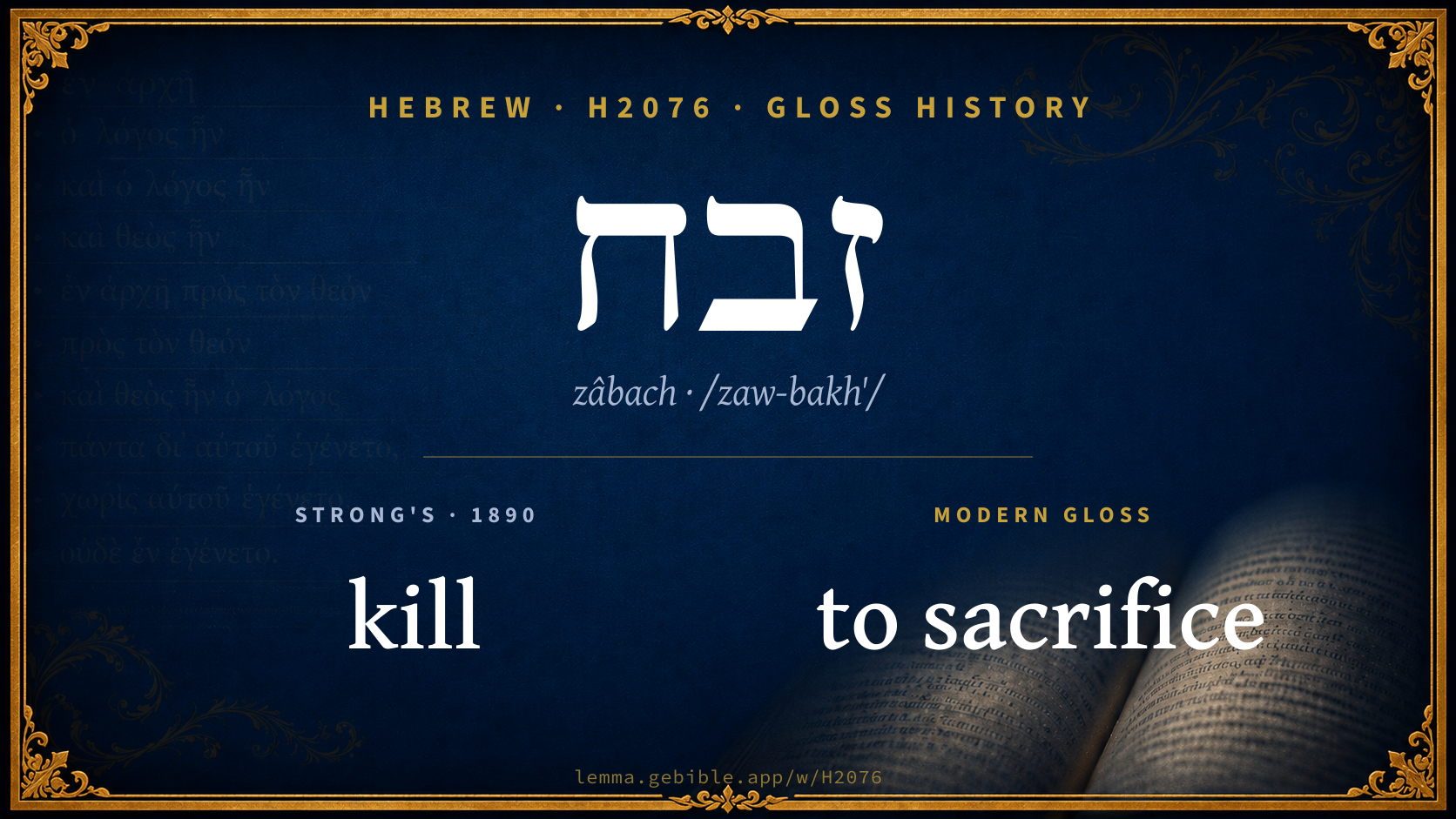
Gloss history
Strong's 1890 vs modern scholarship
About this word
Strong's H2076 catalogs a Hebrew word from the Hebrew Old Testament.
These counts are not copied from any lexicon or concordance. They are computed here, from the morphology-tagged Hebrew Old Testament. What Lemma adds →
- 127
- distinct verses
- The word appears in 127 distinct verses.
- 24 / 39
- OT books
- The word appears in 24 of 39 Old Testament books.
- #332
- by frequency
- Top 500 most frequent Hebrew words (rank 332 of 8,640 Hebrew words by occurrence).
View all 127 occurrences in the concordance →
By section of the Old Testament
By traditional corpus
Conventional, traditional groupings — biblical authorship is debated, so this is a traditional corpus grouping, not an authorship claim. Each share is this word’s portion of its verses in that division of the Hebrew canon. Each figure is a share of the word’s 127 distinct verses.
- Prophets (Nevi'im) 61 verses · 48%
- Torah (Pentateuch) 37 verses · 29%
- Writings (Ketuvim) 29 verses · 23%
How translations render this word
Counts come from each version’s own published word-to-Strong’s tagging or interlinear alignment — an approximate guide to how each version renders this word, not a word-level alignment the data otherwise carries. Because each total is that version’s own tagged count, the per-version totals vary from one another and need not match the appearance or distinct-verse counts above. These counts may also differ from a printed concordance because Lemma counts each distinctly tagged rendering and does not collapse phrase taggings into a single head-word total. This is a fixed set of word-tagged versions (KJV, ASV, BSB, ULT) and does not change with the reading translation you choose elsewhere. Each version’s license is shown beside its name below (and on Sources).
- King James Version: Sacrifice 18×, Offered 11×, Sacrificed 11×
- American Standard Version: Sacrifice 18×, Sacrificed 10×, Offer 7×
- Berean Standard Bible: Sacrifice 26×, Sacrificed 14×, Offer 9×
- unfoldingWord Literal Text: Sacrifice 31×, Sacrificed 12×, They sacrificed 11×
King James Version Public Domain
Renders H2076 across 134 tagged occurrences — most commonly:
Plus other, less common renderings. Plus 46 renderings that appear only once — usually multi-word phrases or single function words the recovered tagging swept in, not distinct renderings.
American Standard Version Public Domain
Renders H2076 across 134 tagged occurrences — most commonly:
Plus other, less common renderings. Plus 48 renderings that appear only once — usually multi-word phrases or single function words the recovered tagging swept in, not distinct renderings.
Berean Standard Bible Public Domain
Renders H2076 across 132 tagged occurrences — most commonly:
Plus 47 renderings that appear only once — usually multi-word phrases or single function words the recovered tagging swept in, not distinct renderings. Not rendered by a distinct English word in 2 further occurrences.
unfoldingWord Literal Text CC BY-SA 4.0
Renders H2076 across 154 tagged occurrences — most commonly:
Plus other, less common renderings. Plus 28 renderings that appear only once — usually multi-word phrases or single function words the recovered tagging swept in, not distinct renderings.
14 senses and sub-senses in the full BDB
Hebrew verbs can shift meaning by stem (binyan): Qal is the basic action, Niphal is often passive or reflexive, Piel often intensifies or makes it factitive, and Hiphil is typically causative. The senses below are grouped under the stem BDB assigns to each.
What do BDB’s symbols mean?
BDB uses these scholarly abbreviations:
| Symbol | Meaning |
|---|---|
| 𝔊 | the Septuagint (the ancient Greek translation, LXX) |
| 𝔙 | the Vulgate (the Latin translation) |
| 𝔖 | the Syriac version (the Peshitta) |
| 𝔗 | the Targum (the Aramaic translation) |
| ψ | the Psalms |
| √ | root (the underlying root or stem) |
| ‖ | parallel passage (a synonymous or contrasted parallel) |
| † | the dagger: every passage where the word occurs is cited |
The 14 senses and sub-senses the full Brown-Driver-Briggs lexicon distinguishes for this word, in lexicon order (not ranked by frequency), with BDB’s own verbatim wording and sub-sense lettering. Shown in Hebrew script with BDB’s own scholarly abbreviations. The condensed entry is in the Lexicon Entry tab. See also the Forms in the corpus table below.
Qal
- Pf. ז׳ 1 K 8:63; 13:2, זָבַחְתָּ Ex 20:24 + 3 times, זָבַחְתִּי Ez 39:19, זָֽבְחוּ Ex 34:15 Lv 17:5, זְבַחְתֶּם Ex 8:24, זָבַחְנוּ Ex 8:23; Impf. וַיִזְבַּח Gn 31:54 + 14 times; 2 ms. sf. תִּוְבָּחֶנּוּ Dt 15:21, 2 fs. sf. וַתִּזְבָּחִים Ez 16:20, 1 s. אֶזְבַּח ψ 116:17, אֶזְבְּחָה ψ 27:6; 54:8 Jon 2:10; 2 mpl. תִּזְבְּחוּ Lv 19:5 + 2 times, תִּזְבָּ֑חוּ Lv 22:29 + 2 times; 1 pl. נִוְבְּחָה Ex 3:18 +, etc. (61 times Impf.); Imv. זְבַח ψ 50:14, זִבְחוּ Ex 8:21 ψ 4:6; Inf. cstr. זְבֹחַ 1 S 15:15 + 14 times, לִזְבּוֹחַ 2 Ch 11:16, בְּזָבְחוֹ 2 S 15:12; Pt. act. זֹבֵחַ Ex 13:15 + 8 times, זוֹבֵחַ Is 66:3, pl. זֹבְחִים Lv 17:5 + (20 times Pt.)— e.g. 1 Kings 8:63
- I. slaughter for sacrifice
- 1. c. acc. of
- a. kind of sacrifice ז׳ זֶבַח Gn 31:54 +, †פֶּסַח Dt 16:2, 5, 6, †שְׁלָמְים Dt 27:7 Jos 8:31, †תּוֹדָה ψ 50:14, 23, †עֹלוֹת ושׁלמים Ex 20:24 (E); cf. 23:18. e.g. Genesis 31:54
- b. victims, (α) animals †בָּקָר וָצֹאן 1 K 8:63 Nu 22:40, †צאן ובקר 2 Ch 18:2, †הַבְּרִיאָה Ez 34:3, †כָּל־פֶּטֶר רֶחֶם Ex 13:15 (J); †פָּרִים וְאֵילִים 1 Ch 15:26, שׁוֹר וָשֶׂה Dt 17:1; (β) mankind †בָּנִים וּבָנוֹת ψ 106:37 Ez 16:20, †זֹבְחֵי אָדָם sacrificers of mankind Ho 13:2 (so Ra AE Hi Wü MV men that sacrifice AV RV after Ki, so Pu Ew Ke Now Che SS). e.g. 1 Kings 8:63
- c. †תּוֹעֲבַת מִצְרַיִם Ex 8:22(×2) (E), †מָשְׁחָת Mal 1:14. e.g. Exodus 8:22
- 2. absolute 1 S 1:3 + often e.g. 1 Samuel 1:3
- 3. c. לְ of deity, †לְדָגוֹן Ju 16:23, †לַשְּׂעִירִם Lv 17:7 (H), †לַשֵּׁדִים Dt 32:17 ψ 106:37; other gods Ex 34:15 (JE) +; but usually ליהוה Ex 3:18 + 9 times JE, Lv 17:5; 19:5; 22:5 (all H, not elsewhere in P), Dt 15:21; 16:2; 17:1; 1 S 1:3 +; †לֵאלֹהֵי אָבִיו Gn 46:1 (E), לאלהים ψ 50:14, †לאדני Mal 1:14. e.g. Judges 16:23
- 4. with local prep. בְּ Gn 31:54 (E) +, עַל Ex 20:24 (E) +; לפני Lv 9:4 (P) +, על פני השׂדה Lv 17:5 (H). e.g. Genesis 31:54
- 1. c. acc. of
- II. slaughter for eating (connected also with sacrifice, as all eating of flesh among ancient Hebrews was sacrificial, RSSem 219) 1 S 28:24 (fat calf for Saul), Ez 34:3 (fat sheep for shepherds), 2 Ch 18:2 (sheep and oxen for Jehoshaphat, c. לְ of person); cf. Dt 12:15; v 21 (abs.), 1 K 19:21. e.g. 1 Samuel 28:24
- III. slaughter in divine judgment Ez 39:17–19 c. acc. זִבְחִי (Gog and Magog as feast for vultures), 1 K 13:2 2 K 23:20 (priests of high-places on their own altars). e.g. Ezekiel 39:17
Piel
- Pf. זִבַּח 2 Ch 33:22, זִבְּחוּ ψ 106:38, זִבֵּ֑חוּ Ho 12:12; Impf. יְזַבֵּחַ Hb 1:16, יְזַבֵּ֑חוּ Ho 4:13, 14; 11:2 (7 times Impf.) Inf. cstr. לְזַבֵּחַ 1 K 12:32; Pt. מְזַבֵּחַ 1 K 3:3, pl. מְזַבְּחִים 2 Ch 5:6 + 8 times, מְזַבְּחוֹת 1 K 11:8;—sacrifice, e.g. 2 Chronicles 33:22
- 1. of the abundant sacrifices made to Yahweh by Solomon 1 K 8:5 = 2 Ch 5:6, and Hezekiah 2 Ch 30:22, and prob. intensive; but e.g. 1 Kings 8:5
- 2. elsewhere of sacrifice to other deities, possibly iterative in some cases, but certainly not in all: לַבְּעָלִים Ho 11:2, לֵאלֹהֵיהֶן 1 K 11:8, לַעֲגָלִים 12:32, לְחֶרְמוֹ Hb 1:16, לַעֲצַבֵּי כְנָ֑עַן ψ 106:38, לֵאלֹהֵי דַּרְמֶשֶׂק 2 Ch 28:23, לְכָל־הַפְּסִילִים 33:22; or in unlawful places עַל־רָאשֵׁי הֶהָרִים Ho 4:13 cf. v 14, בַּגִּלְגָּל 12:12, בַּבָּמוֹת 1 K 3:2, 3; 22:44 2 K 12:4; 14:4; 15:4, 35, 16:4 = 2 Ch 28:4. It is used without direct obj. Ho 4:14 and often; also c. acc. of victim שְׁוָרִים Ho 12:12 צֹאן וּבָקָר 1 K 8:5 = 2 Ch 5:6; sons and daughters ψ 106:38, זִבְחֵי שְׁלָמִים 2 Ch 30:22. e.g. Hosea 11:2
Senses from the full Brown-Driver-Briggs lexicon (Brown, Driver, Briggs; Oxford 1906 — public domain), digitized via Sefaria, supplemented by the OpenScriptures HebrewLexicon (CC BY 4.0). Full attribution on Sources.
Word origin
vb. slaughter for sacrifice (NH id., Ph. זבח; Assyrian zibû DlPr 174 cf. LotzTP 174; Arabic ذَبَحَ, Sab. דֿבח CIS iv. 1, 2, No.; 74 l. 11, 12; Aramaic דְּבַח, ܕܒܰܚ, Ethiopic ዘብሐ )
— Brown-Driver-Briggs (Oxford 1906, public domain), digitized via Sefaria, supplemented by the OpenScriptures HebrewLexicon (CC BY 4.0). See Sources.
Origin: a primitive root
Jastrow Dictionary
A second Hebrew/Aramaic lexicon for comparison, covering Aramaic and post-biblical (Talmudic, Targumic, Midrashic) usage that the biblical-Hebrew BDB does not. Matched by lemma rather than by Strong’s number, so a lemma may carry more than one Jastrow headword (shown separately below), and the entries cover usage well beyond the Bible.
זָבַח
- [to give a feast,] to slaughter, sacrifice. Ḥull. II, 3 (ref. to Deut. XXVII, 7) מה שאתה זוֹבֵחַ וכ׳ thou mayest eat what thou (a human hand) cuttest. Snh. 60ᵇ בזובח לעכו"ם of one sacrificing to an idol; a. fr.—Part. pass. זָבוּחַ. Lev. R. s. 10 (play on מזבח, Ex. XXXII, 5) מֵהַזָּ׳ לפניו וכ׳ he was afraid on account of him who lay killed before him (Hur); a. fr. e.g. Deuteronomy 27:7
- same. Snh. 62ᵃ ז׳ וקיטר וכ׳ if he slaughtered a sacrifice, and burnt &c. (to an idol). Ib. VII, 6 (60ᵇ) המְזַבֵּחַ Talm. ed. (Mish. הזובח) he who offers an animal (to an idol), a. fr.—V. זָבַל
- to be sacrificed, to be slaughtered; to die as a martyr. Zeb. I, 1 שנִזְבְּחוּ שלא לשמן which were offered not for the purpose for which they were dedicated. Y. Snh. X, 29ᶜ top (play on עלי זבח, Ps. L, 5) שעילו אותי ונזבחו על שמי who raised me and sacrificed themselves for my name’s sake; a. fr. e.g. Psalms 50:5
זֶבַח
- preced.) a slaughtering, sacrifice, esp. (festive) peace-offering (חֲגִיגָה). Pes. X, 9. Tosef. ib. X, 14. Tosef. Ber. V, 22; a. fr.—Pl. זְבָחִים, constr. זִבְחֵי. Ib. Zeb. I, 1 כל הז׳ all animalic offerings; a. fr.—Z’baḥim, name of a treatise of the Mishnah, Tosefta and Talmud Babli (also called שְׁחִיטַת קָדֳשִׁים).
A Dictionary of the Targumim, the Talmud Babli and Yerushalmi, and the Midrashic Literature (Marcus Jastrow; London, Luzac, 1903) — Public Domain. Digitized via Sefaria. Digitized via Sefaria. Full attribution on Sources.
Forms in the corpus
The 103 distinct written forms H2076 takes in the Hebrew Bible, most frequent first — each parse links to that stem’s occurrences in the concordance. Hebrew forms include their vowel points and cantillation, so a single lemma takes many written forms.
The 60 most common forms are shown; 43 rarer forms follow in the full concordance.
Same root — word family
Other BDB entries built from the same root as H2076, grouped by Strong’s listed origin. These share a root / origin per the lexicon — not necessarily a shared meaning. Each links to that word’s own entry.
Derived from this word
Compare all same-root words → They share a root, not necessarily a meaning.
Septuagint verse parallels
This word appears in 120 verses that also exist in the Greek Old Testament (Septuagint), out of the 127 Hebrew verses it occurs in. You can read those verses in Greek by switching the Old Testament edition to the Septuagint.
Read these verses in the Septuagint
- Genesis 31:54
- Exodus 3:18
- Leviticus 9:4
- Numbers 22:40
- Deuteronomy 12:15
- Judges 2:5
- 1 Samuel 1:3
- 2 Samuel 6:13
- 1 Kings 1:9
- 2 Kings 12:3
- 1 Chronicles 15:26
- 2 Chronicles 5:6
This is a verse-level parallel only — the same verses exist in both the Hebrew and Greek Old Testaments. No word-level Hebrew↔Greek correspondence is claimed: the data carries no such alignment, so no Greek word is shown as this Hebrew word’s translation. Coverage is not total — the Septuagint omits the deuterocanon and renumbers the Psalms, so some Hebrew verses have no direct Greek parallel.