
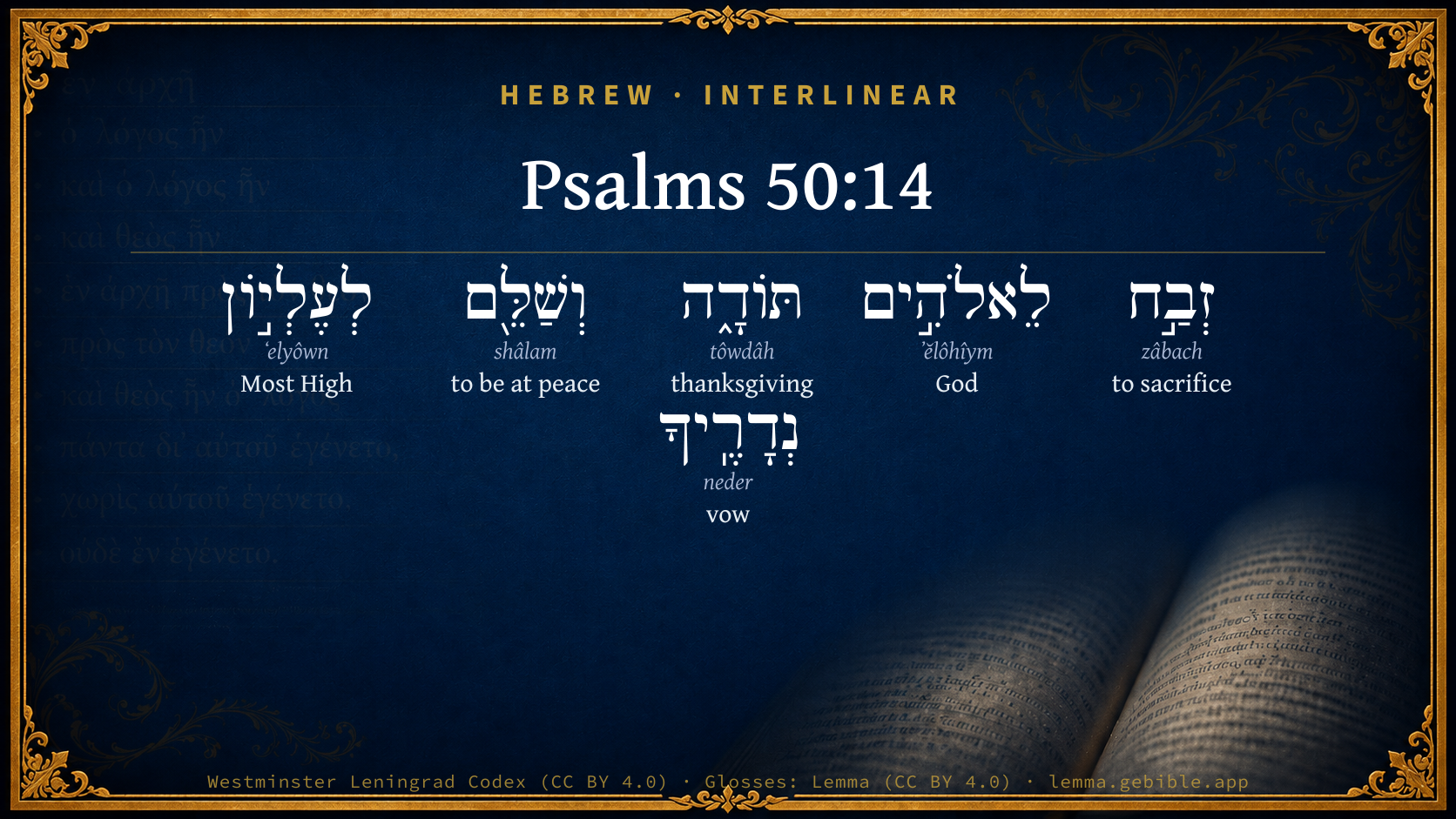
Psalms 50:14

Hebrew (Westminster Leningrad Codex) Psalms 50:14 appears in the Hebrew Old Testament. The text above is from the Westminster Leningrad Codex. Each word links to its Strong’s number, a concise gloss, and parsing drawn from the Open Scriptures Hebrew Bible morphology. Click any word for its full Brown-Driver-Briggs (BDB) entry.
Download image
Cite this verse

Psalms 50:14 (World English Bible). Public Domain. Lemma interlinear Bible study tool, https://lemma.gebible.app/v/psalms/50/14.

Show BibTeX & RIS
BibTeX
RIS
English Translation
Offer to God the sacrifice of thanksgiving. Pay your vows to the Most High.
World English Bible · Public Domain
Download a study sheet

One document with this verse’s original text, its word-by-word gloss line, the meaning frame, cross-references with their text, attributed commentary, and full source and license credits — printable, and it pastes into notes with its structure intact.

This verse Autodidact and up

Study sheet (.html) Plain text (.txt)

A passage Seminary Student

Up to 50 verses in one chapter. A passage sheet keeps up to 6 commentary sources and 12 cross-references per verse, in the order this page ranks them, and says so on the sheet whenever that leaves anything out. Ask for a single verse and you get the Autodidact verse sheet above.

Everything on this page stays free to read, with no account — the sheet is a download of what is already on screen, not access to it.

Want to remove ads? Support Godless Engineer
Compare translations 3

The same verse in 3 English versions, stacked beneath the original-language interlinear above. Click any original word for its lexicon entry.

Each is an independent rendering of the whole verse — the interlinear is not word-aligned to these translations.

Highlighted words mark where these versions differ — a whole-verse word diff, not a word-by-word alignment.

  • World English Bible Public Domain
    Offer to God the sacrifice of thanksgiving. Pay your vows to the Most High.
  • King James Version Public Domain
    Offer unto God thanksgiving; and pay thy vows unto the most High:
  • unfoldingWord Literal Text CC BY-SA 4.0
    Sacrifice a thank offering to God, and pay your vows to the Most High.

unfoldingWord Literal Text — © unfoldingWord, licensed CC BY-SA 4.0. Word-aligned USFM3 via Door43 (git.door43.org/unfoldingWord/en_ult).

Versions to compare (up to 4)

3 of 4 selected

Show all 18 translations

Every available English version of this verse, each an independent rendering of the whole verse.

  • World English Bible Public Domain
    Offer to God the sacrifice of thanksgiving. Pay your vows to the Most High.
  • Berean Standard Bible Public Domain
    Sacrifice a thank offering to God, and fulfill your vows to the Most High.
  • Majority Standard Bible Public Domain
    Sacrifice a thank offering to God, and fulfill your vows to the Most High.
  • King James Version Public Domain
    Offer unto God thanksgiving; and pay thy vows unto the most High:
  • American Standard Version (1901) Public Domain
    Offer unto God the sacrifice of thanksgiving; And pay thy vows unto the Most High:
  • Revised Version (1885) Public Domain
    Offer unto God the sacrifice of thanksgiving; and pay thy vows unto the Most High:
  • Geneva Bible (1599) Public Domain
    Offer vnto God praise, and pay thy vowes vnto the most High,
  • Douay-Rheims (1899) Public Domain
    Offer to God the sacrifice of praise: and pay thy vows to the most High.
  • Young's Literal Translation Public Domain
    Sacrifice to God confession, And complete to the Most High thy vows.
  • Literal Standard Version CC BY-SA 4.0
    Sacrifice to God confession, || And complete your vows to the Most High.
  • Unlocked Literal Bible CC BY-SA 4.0
    Offer to God the sacrifice of thanksgiving, and pay your vows to the Most High.
  • unfoldingWord Literal Text CC BY-SA 4.0
    Sacrifice a thank offering to God, and pay your vows to the Most High.
  • Darby Bible Public Domain
    Offer unto God thanksgiving, and perform thy vows unto the Most High;
  • World Messianic Bible Public Domain
    Offer to God the sacrifice of thanksgiving. Pay your vows to the Most High.
  • Webster's Bible Public Domain
    Offer to God thanksgiving; and pay thy vows to the Most High:
  • Free Bible Version CC BY-SA 4.0
    Give an offering of thanks to God; keep the promises you made to the Most High,
  • Bible in Basic English Public Domain
    Make an offering of praise to God; keep the agreements which you have made with the Most High;
  • JPS Tanakh (1917) Public Domain
    Offer unto God the sacrifice of thanksgiving; and pay thy vows unto the Most High;

Literal Standard Version (2020), Covenant Press — licensed CC BY-SA 4.0. Text via the HelloAO Bible API (eBible.org). Unlocked Literal Bible (unfoldingWord) — licensed CC BY-SA 4.0. Text via the HelloAO Bible API (eBible.org). unfoldingWord Literal Text — © unfoldingWord, licensed CC BY-SA 4.0. Word-aligned USFM3 via Door43 (git.door43.org/unfoldingWord/en_ult). Free Bible Version, Dr. Jonathan Gallagher — licensed CC BY-SA 4.0. Text via the HelloAO Bible API (eBible.org).

Word by word

More ways to search: Search by grammar → Find every occurrence → Compare this word →

Practice this passage: Drill this verse → Learn its vocabulary →

About this verse

These counts appear in no published source. They are computed here, from the morphology-tagged text and Lemma’s own curated glosses. What Lemma adds →

6
words
6
distinct lemmas
Wisdom
section

Shared distinctive vocabulary

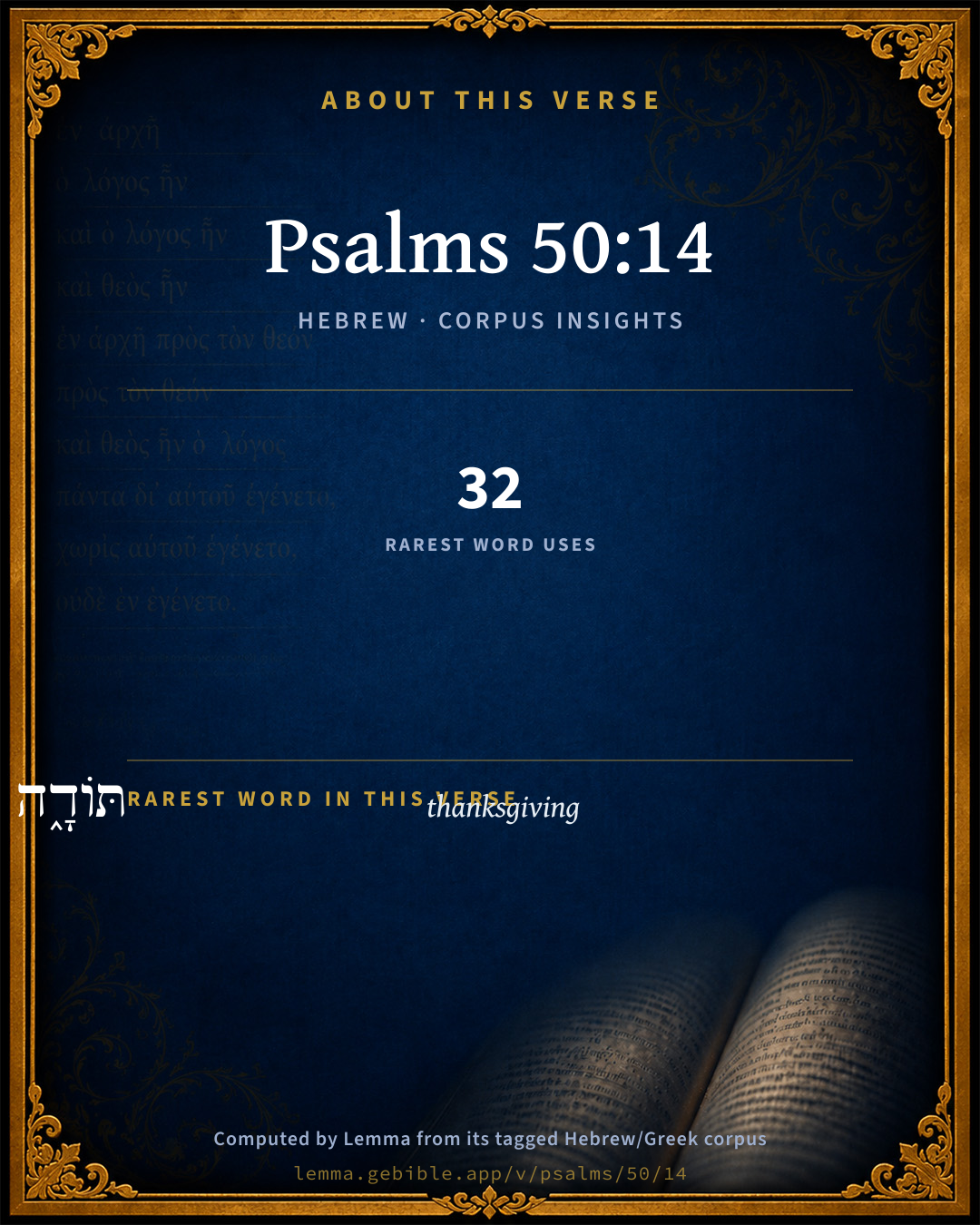
תּוֹדָ֑ה thanksgiving H8426 occurs in 30 verses of the Hebrew Bible. Also found in:

Grammatical profile

  • 2 verbs
  • 3 nouns
  • 1 adjective

Verb forms

  • זְבַ֣ח Qal · Imperative
  • וְשַׁלֵּ֖ם Piel · Imperative

Hebrew & Septuagint length

In English translation the verse runs 14 words from the Hebrew and 15 from the Septuagint (LXX English) — closely comparable.

A rough comparison of the two English renderings, which tokenize alike — not a word-level alignment.

Word counts can differ between the Hebrew and the Greek without any difference in meaning — e.g. the Hebrew direct-object marker אֵת has no separate Greek word, and Greek often adds the article ὁ.

Cross-references

23

Topical passages linked to Psalms 50:14 in the Treasury of Scripture Knowledge — connected by theme and wording, ordered by reader-vote popularity; previews shown in the World English Bible.

  • Hebrews 13:15 Through him, then, let us offer up a sacrifice of praise to God continually, that is, the fruit of lips which make confession to his name.
  • Psalms 56:12 Your vows are on me, God. I will give thank offerings to you.
  • Deuteronomy 23:21 When you shall vow a vow to Yahweh your God, you shall not be slack to pay it: for Yahweh your God will surely require it of you; and it would be sin in you.
  • Psalms 107:21–22 Let them praise Yahweh for his loving kindness, For his wonderful works to the children of men!
  • Psalms 116:12–14 What will I give to Yahweh for all his benefits toward me?
  • 1 Peter 2:5 You also, as living stones, are built up as a spiritual house, to be a holy priesthood, to offer up spiritual sacrifices, acceptable to God through Jesus Christ.
  • Psalms 76:11 Make vows to Yahweh your God, and fulfill them! Let all of his neighbors bring presents to him who is to be feared.
  • Hosea 14:2 Take words with you, and return to Yahweh. Tell him, "Forgive all our sins, And accept that which is good: So we offer like bulls our lips.
  • Romans 12:1 Therefore I urge you, brothers, by the mercies of God, to present your bodies a living sacrifice, holy, acceptable to God, which is your spiritual service.
  • 1 Thessalonians 5:18 In everything give thanks, for this is the will of God in Christ Jesus toward you.
  • Psalms 50:23 Whoever offers the sacrifice of thanksgiving glorifies me, And prepares his way so that I will show God's salvation to him."
  • Psalms 69:30–31 I will praise the name of God with a song, And will magnify him with thanksgiving.
  • Psalms 147:1 Praise Yah, For it is good to sing praises to our God; For it is pleasant and fitting to praise him.
  • Ecclesiastes 5:4–5 When you vow a vow to God, don't defer to pay it; for he has no pleasure in fools. Pay that which you vow.
  • 1 Peter 2:9 But you are a chosen race, a royal priesthood, a holy nation, a people for God's own possession, that you may show forth the excellencies of him who called you out of darkness into his marvelous light:
  • Psalms 116:17–18 I will offer to you the sacrifice of thanksgiving, And will call on the name of Yahweh.
  • Nahum 1:15 Behold, on the mountains the feet of him who brings good news, who publishes peace! Keep your feasts, Judah! Perform your vows, for the wicked one will no more pass through you. He is utterly cut off.
  • Numbers 30:2–16 When a man vows a vow to Yahweh, or swears an oath to bind his soul with a bond, he shall not break his word; he shall do according to all that proceeds out of his mouth.
  • Leviticus 27:2–34 "Speak to the children of Israel, and say to them, 'When a man makes a vow, the persons shall be for Yahweh by your valuation.
  • Psalms 22:25 Of you comes my praise in the great assembly. I will pay my vows before those who fear him.
  • Psalms 27:6 Now my head will be lifted up above my enemies around me. I will offer sacrifices of joy in his tent. I will sing, yes, I will sing praises to Yahweh.
  • Psalms 65:1 Praise waits for you, God, in Zion. To you shall vows be performed.
  • Psalms 61:8 So I will sing praise to your name forever, That I may fulfill my vows daily.

Cross-references courtesy of OpenBible.info (CC BY 4.0).

Hebrew and Greek witnesses Masoretic Hebrew ↔ Greek Septuagint

The same verse in the two great witnesses to the Old Testament, shown verse-for-verse.

You’re reading Greek Psalm 49 (Hebrew Psalm 50). The Septuagint counts the superscription, so verse numbers can differ from the Hebrew — chapter-level alignment, not verse-by-verse. Numbering follows Rahlfs.

These are two independent witnesses, not word-aligned to each other, and the Septuagint is shown in lemma (dictionary) form.

Hebrew Psalms 50:14 Masoretic · Westminster Leningrad Codex

זְבַ֣ח לֵאלֹהִ֣ים תּוֹדָ֑ה וְשַׁלֵּ֖ם לְעֶלְי֣וֹן נְדָרֶֽיךָ

Offer to God the sacrifice of thanksgiving. Pay your vows to the Most High.

World English Bible · Public Domain

Greek LXX Greek Psalm 49:14 Septuagint · lemma form

θύω ὁ θεός θυσία αἴνεσις καί ἀποδίδωμι ὁ ὕψιστος ὁ εὐχή σύ

Offer to God the sacrifice of praise; and pay your vows to the Most High.

LXX2012 (modern English Septuagint) · Public Domain

On this verse, Albert Barnes' Notes on the Bible discusses the Septuagint’s reading. Read the note in Commentary ↓

Hebrew: Westminster Leningrad Codex (CC BY 4.0). Greek: Septuagint (public domain); English from LXX2012 (modern English Septuagint) (Public Domain). How the Septuagint differs from the Hebrew →

Commentary

Notes on Psalms 50:14 from classic Christian and Jewish commentators (each source and its license shown beneath its notes). The classic Christian expositions comment on the surrounding passage and are grouped to its opening verse, so a note may address several verses; the Jewish commentaries on the Tanakh (Rashi and others) are per-verse, so they appear only where the commentator wrote on this verse.

Lemma curates 59 commentaries, every one of them public domain or Creative Commons licensed, each selected and text-cleaned for this edition rather than reprinted as found. About our sources →

Trapp's Complete Commentary

John Trapp

Psa 50:14 Offer unto God thanksgiving; and pay thy vows unto the most High:

Ver. 14. Offer unto God thanksgiving] That pith of your peace offerings, that sacrifice more acceptable to God than an ox that hath horns and hoofs, Psa 69:31. Oh cover God’s altar with the calves of your lips, giving thanks to his name, Heb 13:15.

And pay thy vows unto the Most High] Say not God a thank only, but do him thanks; the life of thanksgiving is the good life of the thanksgiver. Our praises should be real and substantial: vow and perform to the Lord your God, Psa 76:11.

John Trapp, A Commentary or Exposition upon All the Books of the Old and New Testament (1647–1656) — public domain. Text from a community e-Sword module.

The Biblical Illustrator

Joseph S. Exell

Psa_50:14

Offer unto God thanksgiving and pay thy vows.

A thanksgiving mode of glorifying God

1. Offer unto God thanksgiving. For what? In everything give thanks. The propriety of this is seen at once when we consider that we owe everything to God. It is impossible, without a due acknowledgment of this, to appreciate our dependence upon and obligation to Him, in whom we live, and move, and have our being.

2. But our text enjoins us to pay our vows unto the Most High.

3. And call upon God in the day of trouble. Our fathers had their troubles, and we shall have ours. They may arise from sources anticipated or unanticipated; for the former we may to some degree prepare, or even, perhaps, by prudent forethought and action in some cases prevent; for the latter, we can only patiently wait upon God who sees and knows all things, and with whom is all wisdom and power. No intelligent observer can be unaware of serious dangers that threaten our God-given heritage. The price of liberty is eternal vigilance. We think our cherished institutions well guarded in citadels of truth and righteousness, and if all who man the citadels are reliable and faithful, it is certain that no foes without can harm, for the God in whom we trust will never suffer the righteous to be confounded or finally overcome. And we must trust in Him for the protection and defence of all that is right; and we must, if we would be safe and secure, look to Him for wisdom to devise and strength to execute all our purposes in His fear.

4. And thou shalt glorify Me. Not make Him glorious, as if to imply that we can add anything to His glory that ever was, is, and ever shall be complete in itself beyond any comparison; but show forth His glory, by acknowledging it in our hearts, pro claiming it with our lips, exhibiting our regard for it in our lives, and diffusing it all abroad by the exertion of all our ransomed powers and possible energies in His service for the good of all within the range of our influence. For this we were created, for this we are preserved, and when we are told that we are redeemed by the precious blood of Christ, we are exhorted therefore to glorify God in our bodies and our spirits, which are His. (J. T. Ward, D. D.)

On thanksgiving

Gratitude is a natural principle of the human heart. In every age thanksgiving has been offered. The songs of Zion have been often sung; the altar has blazed before the Creator of the universe, and the temple been filled with the odours of incense.

I. Creation is a proper subject of thanksgiving. With the beauties of nature you are surrounded on every side. The morning sun and the melody of the groves; the beautiful landscape and the blue sky; the roaring cataract and the spacious ocean; these are free. Untouched with gratitude can mortals behold them?

II. The benefits of providence demand your thanksgiving. Often has health been restored after sickness, and the mind solaced after the depression of sorrow. In some eases, misfortunes have been removed. Yes, calamities have been alleviated. Now, the return of tranquillity to the troubled mind is a blessing unspeakable; and the wounded spirit, which God hath healed, ought surely to praise Him.

III. The blessings of his grace claim your warmest gratitude. And, wherever such gratitude exists, it becomes a powerful principle of obedience, leading a pious man to combat every species of corruption, to cultivate every virtue, to maintain rectitude of conduct in every case, and preserve, in short, on all occasions, a careful and conscientious adherence to the commandments of his God. (T. Laurie.)

The duty of praise and thanksgiving

Offer unto God thanksgiving. Which that we may do, let us inquire first how we are to understand this command of offering praise and thanksgiving unto God; and then how reasonable it is that we should comply with it. Our inquiry into what is meant here will be very short: for who is there that understands anything of religion hut knows that the offering praise and thanks to God implies our having a lively and devout sense of His excellencies and of His benefits; our recollecting them with humility and thankfulness of heart; and our expressing these inward affections by suitable outward signs; by reverent and lowly postures of body, by songs, and hymns, and spiritual ejaculations; either privately or publicly. Our praise properly terminates in God, on the account of His natural excellencies and perfections; and is that act of devotion by which we confess and admire His several attributes: but thanksgiving is a narrower duty, and imports only a grateful sense and acknowledgment of past mercies. Now, the great reasonableness and obligation of this duty of praise or thanksgiving will appear if we consider it absolutely in itself as the debt of our natures: or compare it with other duties, and then the rank it bears among them; or set out, in the last place, some of its peculiar properties and advantages, which recommend it to the devout performer.

1. It is the most pleasing part of our devotions. It proceeds always from a lively, cheerful temper of mind; and it cherishes and improves what it proceeds from.

2. It is another distinguishing property of Divine praise, that it enlargeth the powers and capacities of our souls; turning them from little and low things, upon their greatest and noblest objects, the Divine nature; and employing them in the discovery and admiration of those several perfections that adorn it.

3. It farther promotes in us an exquisite sense of Gods honour, and an high indignation of mind at everything that openly profanes it.

4. It will work in us a deep humility and consciousness of our own imperfections.

5. A conscientious praise of God will keep us back from all false and mean praises, all fulsome and servile flatteries, such as are in use among men. (Bishop Atterbury.)

Thanksgiving due to God alone

A lady applied to an eminent philanthropist of Bristol, Richard Reynolds, on behalf of a little orphan boy. After he had given liberally, she said, When he is old enough I will teach him to name and thank his benefactor. Stop, said the good man; thou art mistaken. We do not thank the clouds for rain. Teach him to look higher, and thank Him who giveth both the clouds and the rain.

The Biblical Illustrator, edited by Joseph S. Exell (c. 1880s–1900s) — public domain. Text from a community e-Sword module.

Joseph Benson's Commentary

Psa 50:14. Offer unto God thanksgiving — If thou wouldest know what sacrifices I prize, and indispensably require, in the first place, it is that of thankfulness, proportionable to my great and numberless favours; which doth not consist barely in verbal acknowledgments, but proceeds from a heart deeply affected with God’s mercies, and is accompanied with such a course of life as is well pleasing to God. And pay thy vows unto the Most High — Not ceremonial, but moral vows seem to be evidently meant here: the things required in this Psalm being opposed to sacrifices, and all ceremonial observances and offerings, and preferred before them. He means those substantial vows, promises, and covenants, which were the very soul of their sacrifices, and to which their sacrifices were but appurtenances and seals; namely, the vows whereby they did avouch Jehovah to be their God, and engaged to walk in his ways, Deu 26:17; and to love, serve, and obey him according to that solemn covenant which they entered into at Sinai, Exo 24:3-8, and which they often renewed, and indeed did implicitly repeat in all their sacrifices, which were appointed for this very end, to confirm this covenant.

Joseph Benson's Commentary on the Old and New Testaments (1811–1818) — public domain. Text from a community e-Sword module.

J. A. Alexander on Psalms

Joseph Addison Alexander

14. (Psa 50:14) Sacrifice to God thanksgiving, and (so) pay unto the Most High thy vows. The first word means something more than offer, and contains a distinct allusion to the animal sacrifices mentioned in Psa 50:8 above. This is not an exhortaton to offer thanks or praise instead of material sacrifices, which would. be inconsistent with the express requisition of the latter, but to offer them as expressions of thanksgiving, or in other words, to offer these as they were intended to be offered, not as a meritorious operation, nor as gross attempts to feed the Deity, but as symbolical expressions of devout affection, repentance, faith, and love, all which we may suppose to be represented, or at least suggested, by the single act of praise or thanksgiving, here explicitly enjoined. The imperative in the last clause may, according to a very common Hebrew idiom, be resolved into a future, and the whole verse paraphrased as follows: "If you offer your material sacrifices, not merely as such, but as the prescribed expression of inward. spiritual exercises, you will thereby really discharge your obligations to the being whom you worship."

Joseph Addison Alexander, The Psalms Translated and Explained (1850) — public domain. Text from a community e-Sword module.

Tyndale Open Study Notes

Tyndale Open Resources

50:14 Thankfulness means looking beyond self-interest to express gratitude for God’s blessings (see 51:15-17; 54:6). • True sacrifice requires offering one’s self to the glory of God (50:23; Rom 12:1-2).

Tyndale Open Study Notes — © Tyndale Open Resources, licensed CC BY-SA 4.0. Text via the HelloAO Bible API.

Geneva Bible (1599)

Geneva Bible translators

Show thyself mindful of God’s benefits by thanksgiving.

Geneva Bible (1599) marginal notes — public domain. Text via Bolls.life.

Adam Clarke's Commentary

Verse 14. Offer unto God thanksgiving; and pay thy vows unto the Most High] זבח zebach, "sacrifice unto God, אלהים Elohim, the תודה todah, thank-offering," which was the same as the sin-offering, viz. a bullock, or a ram, without blemish; only there were, in addition, "unleavened cakes mingled with oil, and unleavened wafers anointed with oil; and cakes of fine flour mingled with oil and fried," Le 7:12.

And pay thy vows] נדריך nedareycha, "thy vow-offering, to the Most High." The neder or vow-offering was a male without blemish, taken from among the beeves, the sheep, or the goats. Compare Le 22:19 with Ps 50:22. Now these were offerings, in their spiritual and proper meaning, which God required of the people: and as the sacrificial system was established for an especial end - to show the sinfulness of sin, and the purity of Jehovah, and to show how sin could be atoned for, forgiven, and removed; this system was now to end in the thing that it signified,-the grand sacrifice of Christ, which was to make atonement, feed, nourish, and save the souls of believers unto eternal life; to excite their praise and thanksgiving; bind them to God Almighty by the most solemn vows to live to him in the spirit of gratitude and obedience all the days of their life. And, in order that they might be able to hold fast faith and a good conscience, they were to make continual prayer to God, who promised to hear and deliver them, that they might glorify him, Ps 50:15.

From the 16th to the 22nd verse Asaph appears to refer to the final rejection of the Jews from having any part in the true covenant sacrifice.

Adam Clarke's Commentary on the Bible (1810–1826) — public domain. Text from a community e-Sword/MySword module.

John Calvin's Commentaries

These verses cast light upon the preceding context. Had it been stated in unqualified terms that sacrifices were of no value, we might have been perplexed to know why in that case they were instituted by God; but the difficulty disappears when we perceive that they are spoken of only in comparison with the true worship of God. From this we infer, that when properly observed, they were far from incurring divine condemnation. There is in all men by nature a strong and ineffaceable conviction that they ought to worship God. Indisposed to worship him in a pure and spiritual manner, it becomes necessary that they should invent some specious appearance as a substitute; and however clearly they may be persuaded of the vanity of such conduct, they persist in it to the last, because they shrink from a total renunciation of the service of God. Men have always, accordingly, been found addicted to ceremonies until they have been brought to the knowledge of that which constitutes true and acceptable religion. Praise and prayer are here to be considered as representing the whole of the worship of God, according to the figure synecdoche. The Psalmist specifies only one part of divine worship, when he enjoins us to acknowledge God as the Author of all our mercies, and to ascribe to him the praise which is justly due unto his name: and adds, that we should betake ourselves to his goodness, cast all our cares into his bosom, and seek by prayer that deliverance which he alone can give, and thanks for which must afterwards be rendered to him. Faith, self-denial, a holy life, and patient endurance of the cross, are all sacrifices which please God. But as prayer is the offspring of faith, and uniformly accompanied with patience and mortification of sin, while praise, where it is genuine, indicates holiness of heart, we need not wonder that these two points of worship should here be employed to represent the whole. Praise and prayer are set in opposition to ceremonies and mere external observances of religion, to teach us, that the worship of God is spiritual. Praise is first mentioned, and this might seem an inversion of natural order. But in reality it may be ranked first without any violation of propriety. An ascription to God of the honor due unto his name lies at the foundation of all prayer, and application to him as the fountain of goodness is the most elementary exercise of faith. Testimonies of his goodness await us ere yet we are born into the world, and we may therefore be said to owe the debt of gratitude before we are called to the necessity of supplication. Could we suppose men to come into the world in the full exercise of reason and judgment, their first act of spiritual sacrifice should be that of thanksgiving. There is no necessity, however, for exercising our ingenuity in defense of the order here adopted by the Psalmist, it being quite sufficient to hold that he here, in a general and popular manner, describes the spiritual worship of God as consisting in praise, prayer, and thanksgiving. In the injunction here given, to pay our vows, there is an allusion to what was in use under the ancient dispensation,

“What shall I render unto the Lord for all his benefits towards me? I will take the cup of salvation, and call upon the name of the Lord.” Psalm 116:12, 13

What the words inculcate upon the Lord’s people is, in short, gratitude, which they were then in the habit of testifying by solemn sacrifices. But we shall now direct our attention more particularly to the important point of the doctrine which is set before us in this passage. And the first thing deserving our notice is, that the Jews, as well as ourselves, were enjoined to yield a spiritual worship to God. Our Lord, when he taught that this was the only acceptable species of worship, rested his proof upon the one argument, that “God is a spirit,” (John 4:24.) He was no less a spirit, however, under the period of the legal ceremonies than after they were abolished; and must, therefore, have demanded then the same mode of worship which he now enjoins. It is true that he subjected the Jews to the ceremonial yoke, but in this he had a respect to the age of the Church; as afterwards, in the abrogation of it, he had an eye to our advantage. In every essential respect the worship was the same. The distinction was one entirely of outward form, God accommodating himself to their weaker and unripe apprehensions by the rudiments of ceremony, while he has extended a simple form of worship to us who have attained a maturer age since the coming of Christ. In himself there is no alteration. The idea entertained by the Manicheans, that the change of dispensation necessarily inferred a change in God himself, was as absurd as it would be to arrive at a similar conclusion from the periodical alterations of the seasons. These outward rites are, therefore, in themselves of no importance, and acquire it only in so far as they are useful in confirming our faith, so that we may call upon the name of the Lord with a pure heart. The Psalmist, therefore, justly denounces the hypocrites who gloried in their ostentatious services, and declares that they observed them in vain. It may occur to some, that as sacrifices sustained a necessary place under the Law, they could not be warrantably neglected by the Jewish worshipper; but by attending to the scope of the Psalmist, we may easily discover that he does not propose to abrogate them so far as they were helps to piety, but to correct that erroneous view of them, which was fraught with the deepest injury to religion.

John Calvin's Commentaries (1540-1563) — public domain. Text from the Calvin Translation Society English edition (1840s-50s) via the Christian Classics Ethereal Library (ccel.org). Calvin's coverage is partial (roughly two-thirds of the Bible); uncommented books and verses are honest gaps, never fabricated. The 19th-century editor's footnotes and remarks are omitted so the notes are faithfully Calvin's own voice.

Ellicott's Commentary for English Readers

(14) Offer.—Gratitude, and the loyal performance of known duties, are the ritual most pleasing to God. Not that the verse implies the cessation of outward rites, but the subordination of the outward to the inward, the form to the spirit. (See Psa_51:17-19.)

A Bible Commentary for English Readers, edited by Charles John Ellicott (1878–1897) — public domain. Text from a community e-Sword module.

The Cambridge Bible for Schools and Colleges

gen. ed. J. J. S. Perowne

14. Offer &c.] Lit., sacrifice unto God thanksgiving: hence R.V., offer unto God the sacrifice of thanksgiving. The context makes it clear that spiritual sacrifices of thanksgiving are meant, not the material ‘sacrifices of thanksgiving’ (Lev_7:12) as contrasted with burnt offerings. Cp. Psa_69:30 f; Psa_51:17; Hos_14:2.

and pay &c.] i.e., by such spiritual sacrifice thou shalt discharge thy vows (Lev_7:16). Cp. Psa_61:8.

14, 15. What sacrifice then does God desire? Not the material sacrifices of the altar, but the offering of the heart.

The Cambridge Bible for Schools and Colleges (gen. ed. J. J. S. Perowne; Cambridge University Press, 1878–1918) — public domain. Text from a community e-Sword module.

John Gill's Exposition

And call upon me in the day of trouble,.... This is another part of spiritual sacrifice or worship, which is much more acceptable to God than legal sacrifices. Invocation of God includes all parts of religious worship, and particularly designs prayer, as it does here, of which God, and he only, is the object; and which should be performed in faith, in sincerity, and with fervency; and though it should be made at all times, in private and in public, yet more especially should be attended to in a time of affliction, whether of soul or body, whether of a personal, family, or public kind, Jam 5:13; and the encouragement to it is,

I will deliver thee: that is, out of trouble: as he is able, so faithful is he that hath promised, and will do it. The obligation follows,

and thou shall glorify me; by offering praise, Psa 50:23; ascribing the glory of the deliverance to God, and serving him in righteousness and true holiness continually.

John Gill's Exposition of the Whole Bible (1746–1763) — public domain (CC PDM 1.0). Text via the HelloAO Bible API.

Albert Barnes' Notes on the Bible

Offer unto God thanksgiving - The word rendered “offer” in this place - זבח zâbach - means properly “sacrifice.” So it is rendered by the Septuagint, θῦσον thuson - and by the Vulgate, “immola.” The word is used, doubtless, with design - to show what was the “kind” of sacrifice with which God would be pleased, and which he would approve. It was not the mere “sacrifice” of animals, as they commonly understood the term; it was not the mere presentation of the bodies and the blood of slain beasts; it was an offering which proceeded from the heart, and which was expressive of gratitude and praise. This is not to be understood as implying that God did not require or approve of the offering of bloody sacrifices, but as implying that a higher sacrifice was necessary; that these would be vain and worthless unless they were accompanied with the offerings of the heart; and that his worship, even amidst outward forms, was to be a spiritual worship.

And pay thy vows unto the Most High - To the true God, the most exalted Being in the universe. The word “vows” here - נדר neder - means properly a vow or promise; and then, a thing vowed; a votive offering, a sacrifice. The idea seems to be, that the true notion to be attached to the sacrifices which were prescribed and required was, that they were to be regarded as expressions of internal feelings and purposes; of penitence; of a deep sense of sin; of gratitude and love; and that the design of such sacrifices was not fulfilled unless the “vows” or pious purposes implied in the very nature of sacrifices and offerings were carried out in the life and conduct. They were not, therefore, to come merely with these offerings, and then feel that all the purpose of worship was accomplished. They were to carry out the true design of them by lives corresponding with the idea intended by such sacrifices - lives full of penitence, gratitude, love, obedience, submission, devotion. This only could be acceptable worship. Compare the notes at Isa 1:11-17. See also Psa 76:11; Ecc 5:5.

Albert Barnes' Notes on the Bible (1834–1885) — public domain. Text from a community e-Sword/MySword module.

Matthew Poole's English Annotations

If thou wouldst know what sacrifices I most prize, and indispensably require, in the first place, it is that of thankfulness and praise proportionable to my great, and glorious, and numberless favours; which doth not consist barely in verbal acknowledgments, but proceeds from a heart truly and deeply affected with God’s mercies, and is accompanied with such a course of life as is gratified or well-pleasing to God; all which is plainly comprehended in

thanksgiving, as that duty is explained in other Scriptures.

Thy vows; either,

1. Ceremonial vows, the sacrifices which thou hast vowed to God. Or rather,

2. Moral vows; for the things here mentioned are directly opposed unto sacrifices, and preferred before them; for having disparaged, and in some sort rejected,

their sacrifices and burnt-offerings, Psa 50:8, it is not likely that he should have a better opinion of, or value for, their vowed sacrifices; which were of an inferior sort. He seems therefore to understand those substantial vows, and promises, and covenants, which were the very soul of their sacrifices, and to which their sacrifices were but appurtenances and seals, as was noted above, on Psa 50:5, whereby they did avouch the Lord to be their God, and to walk in his ways, &c., as it is expressed, Deu 26:17, and engaged themselves to love, and serve, and obey the Lord according to that solemn vow and covenant which they entered into at Sinai, Exo 24:3,7,8, which they oft renewed, and indeed did implicitly repeat in all their sacrifices, which were appointed for this very end, to confirm this covenant.

Matthew Poole's English Annotations on the Holy Bible (1683–1685) — public domain. Text from a community e-Sword/MySword module.

The Treasury of David

Charles H. Spurgeon

Ver. 14. Offer unto God thanksgiving. No longer look at your sacrifices as in themselves gifts pleasing to me, but present them as the tributes of your gratitude; it is then that I will accept them, but not while your poor souls have no love and no thankfulness to offer me. The sacrifices, as considered in themselves, are contemned, but the internal emotions of love consequent upon a remembrance of divine goodness, are commended as the substance, meaning, and soul of sacrifice. Even when the legal ceremonials were not abolished, this was true, and when they came to an end, this truth was more than ever made manifest. Not for want of bullocks on the altar was Israel blamed, but for want of thankful adoration before the Lord. She excelled in the visible, but in the inward grace, which is the one thing needful, she sadly failed. Too many in these days are in the same condemnation. And pay thy vows unto the most High. Let the sacrifice be really presented to the God who seeth the heart, pay to him the love you promised, the service you covenanted to render, the loyalty of heart you have vowed to maintain. O for grace to do this! O that we may be graciously enabled to love God, and live up to our profession! To be, indeed, the servants of the Lord, the lovers of Jesus, this is our main concern. What avails our baptism, to what end our gatherings at the Lord's table, to what purpose our solemn assemblies, if we have not the fear of the Lord, and vital godliness reigning within our bosoms?

None.

Charles H. Spurgeon's The Treasury of David (1869–1885) — public domain. Psalms only. Text from a community e-Sword/MySword module.

Whedon's Commentary on the Bible

Daniel D. Whedon

14. Offer unto God thanksgiving— “The calves of the lips,” says the prophet, Hos_14:2, which the apostle calls “the sacrifice of praise to God,” Heb_13:15. The Hebrew reads: Sacrifice to God a todah. The todah was a praise offering, one of the species of “peace offerings,” described Lev_7:11-15, the fundamental idea of which was, thanksgiving to God for reconciliation, or peace, with him. So, also, the next line—pay thy vows—refers to the “freewill offering,” another species of “peace offering,” described in Lev_7:16. It was an offering which the individual had freely and voluntarily assumed. The idea of the text is, that to offer to God, from the heart, thanksgiving and praise, and to heartily fulfil their covenant vows, the things signified by the external sacrifice, is the real requirement and intent of the law, without which the form is only empty mockery. Compare 1Sa_15:22-23

Daniel D. Whedon (gen. ed.), Commentary on the Old and New Testaments (1874–1909) — public domain. Text from a community e-Sword module.

The Pulpit Commentary

Offer unto God thanksgiving. The one offering acceptable to God is praise and thanksgiving out of a pure heart. This was designed to be the accompaniment of all sacrifice, and was the ground of acceptability in every case where sacrifice was acceptable. And pay thy vows unto the Most High; i.e. "and so pay thy vows." So offer thy worship, and it will be accepted.

The Pulpit Commentary (1880–1919), ed. H.D.M. Spence-Jones & Joseph S. Exell — public domain. Text from a community e-Sword module.

John Wesley's Explanatory Notes

Offer - If thou wouldest know what sacrifices I prize, and indispensably require, in the first place, it is that of thankfulness, proportionable to my great and numberless favours; which doth not consist barely in verbal acknowledgments, but proceeds from an heart deeply affected with God's mercies, and is accompanied with such a course of life, as is well-pleasing to God. Vows - Those substantial vows and promises, which were the very soul of their sacrifices.

John Wesley, Explanatory Notes Upon the Whole Bible (1754–1765) — public domain. Text via the GEBible commentary corpus.

unfoldingWord translationNotes

Door43 World Missions Community

Offer to God

Here God refers to himself. AT: "Offer to me" (See: First, Second, or Third Person)

pay your vows to the Most High

The writer speaks of "vows" as if they are currency which a person pays to God. AT: "fulfill your vows to the Most High" or "do what you have promised the Most High to do" (See: Metaphor)

in the day of trouble

Here the word "day" refers to any period of time. AT: "whenever you have troubles" (See: Idiom)

translationWords

sacrifice

vow

Most High

call

day

trouble

glory

unfoldingWord translationNotes — © Distant Shores Media and the Door43 World Missions Community, licensed CC BY-SA 4.0. Source: git.door43.org/Door43/en_tn.

Rashi

Rabbi Shlomo Yitzchaki (Rashi)

Slaughter for God a confession Confess your deeds and return to Me. That is the sacrifice that I desire, and afterwards pay the Most High your vows, for then they will be accepted willingly.

Rashi on the Tanakh — English translations: “The Judaica Press complete Tanach with Rashi, translated by A. J. Rosenberg” (CC BY 4.0); “Pentateuch with Rashi's commentary by M. Rosenbaum and A.M. Silbermann, 1929-1934” (public domain); “The Metsudah Tanach series, Lakewood, N.J” (CC BY 4.0); and “The Book of Joshua, Metsudah Publications, 1997” (CC BY 4.0). Text via Sefaria.

Lesson kit

Teaching starters — assembled from the data on this page, not authored interpretation. Every prompt links to the verse data it draws on. Edit before teaching.

Psalms, in the Wisdom, opens this verse with 6 words (6 distinct Hebrew lemmas). Its most distinctive word is tôwdâh (“thanksgiving”). A historical commentator’s framing appears above. Read the whole chapter for the surrounding context.

Discussion questions

  1. What does “thanksgiving” (tôwdâh) contribute to the verse as a whole?
  2. Leviticus 7:12 shares the word «thanksgiving» with this verse. How do the two illuminate each other?
  3. These translations render this verse differently; the difference is in the English rendering, not the original. What questions does that raise?
  4. The verb «זְבַ֣ח» is Qal Imperative. How does its form color the action?
  5. Reading how Trapp's Complete Commentary and The Biblical Illustrator read this verse, where do the two commentators agree and where do they part?

Things to notice

Reading settings

Reading text

Shown beneath each verse's original-language words.

Old Testament
Old Testament edition

Read the OT as the Masoretic Hebrew (MT) or the Greek Septuagint (LXX).

English shown for the Greek Septuagint (in the Hebrew ↔ Greek comparison).

Comparing translations? Open the Compare panel on any verse page to stack up to four side by side.