1 Samuel 28:24

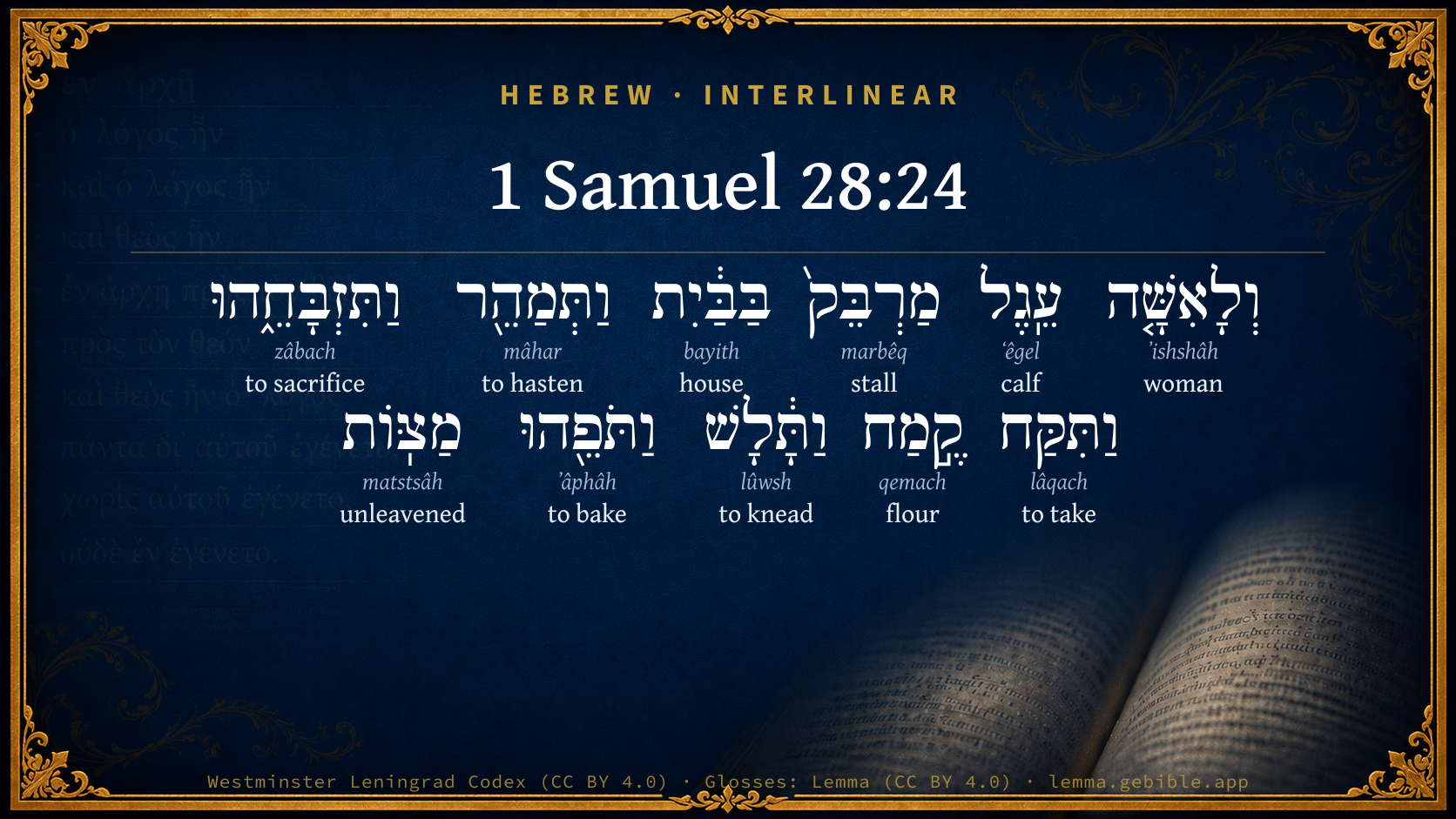
Hebrew (Westminster Leningrad Codex) 1 Samuel 28:24 appears in the Hebrew Old Testament. The text above is from the Westminster Leningrad Codex. Each word links to its Strong’s number, a concise gloss, and parsing drawn from the Open Scriptures Hebrew Bible morphology. Click any word for its full Brown-Driver-Briggs (BDB) entry.
Download image
Cite this verse

1 Samuel 28:24 (World English Bible). Public Domain. Lemma interlinear Bible study tool, https://lemma.gebible.app/v/1-samuel/28/24.

Show BibTeX & RIS
BibTeX
RIS
English Translation
The woman had a fattened calf in the house; and she hurried, and killed it; and she took flour, and kneaded it, and did bake unleavened bread of it:
World English Bible · Public Domain
Highlights
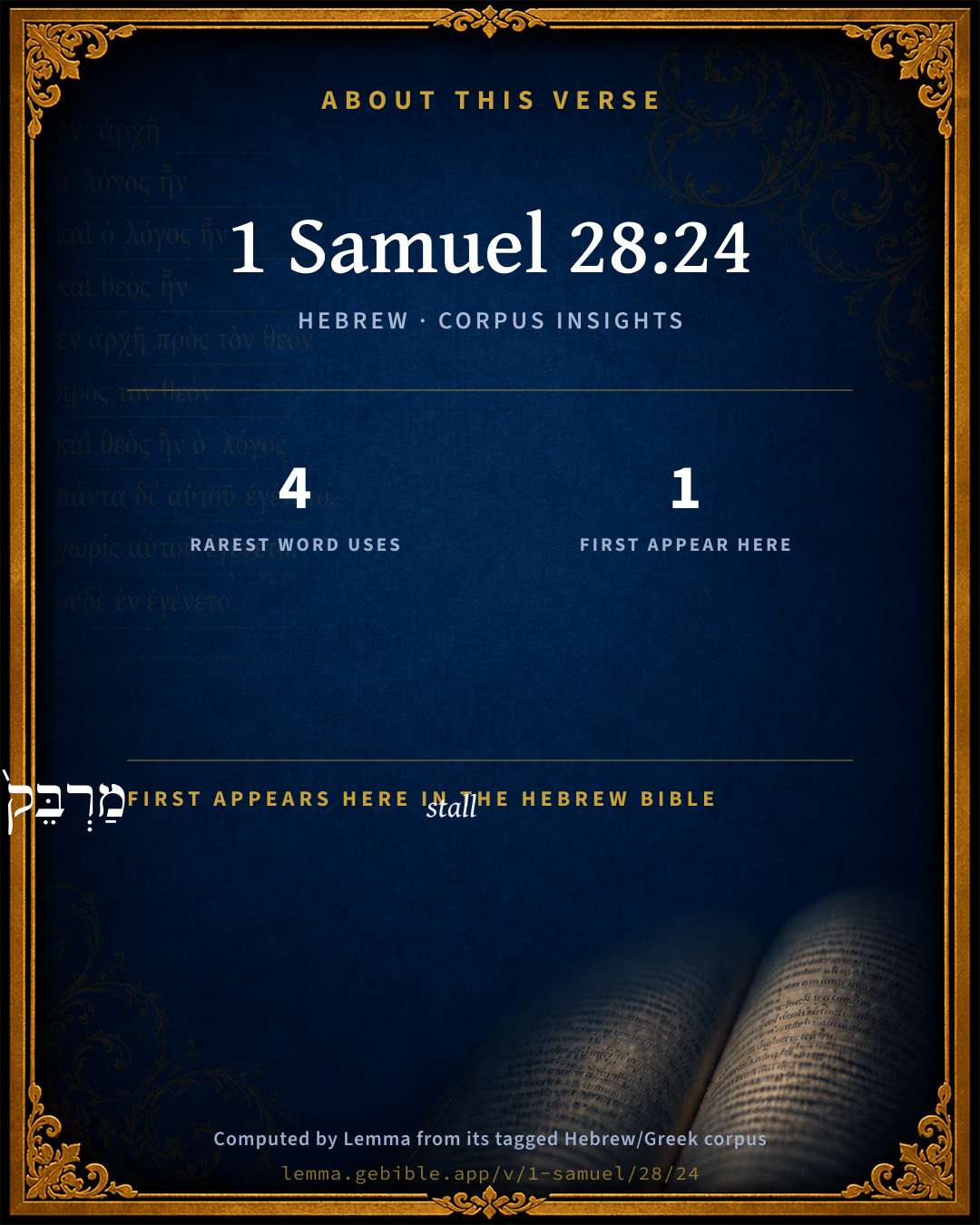
  • 1 first appearance in the Hebrew Bible
Full analysis ↓
Download a study sheet

One document with this verse’s original text, its word-by-word gloss line, the meaning frame, cross-references with their text, attributed commentary, and full source and license credits — printable, and it pastes into notes with its structure intact.

This verse Autodidact and up

Study sheet (.html) Plain text (.txt)

A passage Seminary Student

Up to 50 verses in one chapter. A passage sheet keeps up to 6 commentary sources and 12 cross-references per verse, in the order this page ranks them, and says so on the sheet whenever that leaves anything out. Ask for a single verse and you get the Autodidact verse sheet above.

Everything on this page stays free to read, with no account — the sheet is a download of what is already on screen, not access to it.

Want to remove ads? Support Godless Engineer
Compare translations 3

The same verse in 3 English versions, stacked beneath the original-language interlinear above. Click any original word for its lexicon entry.

Each is an independent rendering of the whole verse — the interlinear is not word-aligned to these translations.

Highlighted words mark where these versions differ — a whole-verse word diff, not a word-by-word alignment.

  • World English Bible Public Domain
    The woman had a fattened calf in the house; and she hurried, and killed it; and she took flour, and kneaded it, and did bake unleavened bread of it:
  • King James Version Public Domain
    And the woman had a fat calf in the house; and she hasted, and killed it, and took flour, and kneaded it, and did bake unleavened bread thereof:
  • unfoldingWord Literal Text CC BY-SA 4.0
    Now to the woman a calf of the stall in the house, and she hurried and slaughtered it. And she took flour and kneaded and baked it unleavened bread.

unfoldingWord Literal Text — © unfoldingWord, licensed CC BY-SA 4.0. Word-aligned USFM3 via Door43 (git.door43.org/unfoldingWord/en_ult).

Versions to compare (up to 4)

3 of 4 selected

Show all 18 translations

Every available English version of this verse, each an independent rendering of the whole verse.

  • World English Bible Public Domain
    The woman had a fattened calf in the house; and she hurried, and killed it; and she took flour, and kneaded it, and did bake unleavened bread of it:
  • Berean Standard Bible Public Domain
    The woman had a fattened calf at her house, and she quickly slaughtered it. She also took flour, kneaded it, and baked unleavened bread.
  • Majority Standard Bible Public Domain
    The woman had a fattened calf at her house, and she quickly slaughtered it. She also took flour, kneaded it, and baked unleavened bread.
  • King James Version Public Domain
    And the woman had a fat calf in the house; and she hasted, and killed it, and took flour, and kneaded it, and did bake unleavened bread thereof:
  • American Standard Version (1901) Public Domain
    And the woman had a fatted calf in the house; and she hasted, and killed it; and she took flour, and kneaded it, and did bake unleavened bread thereof:
  • Revised Version (1885) Public Domain
    And the woman had a fatted calf in the house; and she hasted, and killed it; and she took flour, and kneaded it, and did bake unleavened bread thereof:
  • Geneva Bible (1599) Public Domain
    Nowe the woman had a fat calfe in the house, and she hasted, and killed it, and tooke floure and kneaded it, and baked of it vnleauened bread.
  • Douay-Rheims (1899) Public Domain
    Now the woman had a fatted calf in the house, and she made haste and killed it: and taking meal kneaded it, and baked some unleavened bread,
  • Young's Literal Translation Public Domain
    And the woman hath a calf of the stall in the house, and she hasteth and slaughtereth it, and taketh flour, and kneadeth, and baketh it unleavened things,
  • Literal Standard Version CC BY-SA 4.0
    And the woman has a calf of the stall in the house, and she hurries and slaughters it, and takes flour, and kneads, and bakes it [into] unleavened things,
  • Unlocked Literal Bible CC BY-SA 4.0
    The woman had a fatted calf in the house; she hurried and killed it; she took flour, kneaded it, and baked unleavened bread with it.
  • unfoldingWord Literal Text CC BY-SA 4.0
    Now to the woman a calf of the stall in the house, and she hurried and slaughtered it. And she took flour and kneaded and baked it unleavened bread.
  • Darby Bible Public Domain
    And the woman had a fat calf in the house; and she hasted and killed it, and took flour, and kneaded it, and baked unleavened bread thereof;
  • World Messianic Bible Public Domain
    The woman had a fattened calf in the house. She hurried and killed it; and she took flour and kneaded it, and baked unleavened bread of it.
  • Webster's Bible Public Domain
    And the woman had a fat calf in the house: and she hasted and killed it, and took flour, and kneaded it, and baked unleavened bread of it.
  • Free Bible Version CC BY-SA 4.0
    The woman had a fattened calf at the house, and she quickly went and slaughtered it. She also got some flour, kneaded it, and baked some unleavened bread.
  • Bible in Basic English Public Domain
    And the woman had in the house a young cow, made fat for food; and she put it to death straight away; and she took meal and got it mixed and made unleavened bread;
  • JPS Tanakh (1917) Public Domain
    And the woman had a fatted calf in the house; and she made haste, and killed it; and she took flour, and kneaded it, and did bake unleavened bread thereof;

Literal Standard Version (2020), Covenant Press — licensed CC BY-SA 4.0. Text via the HelloAO Bible API (eBible.org). Unlocked Literal Bible (unfoldingWord) — licensed CC BY-SA 4.0. Text via the HelloAO Bible API (eBible.org). unfoldingWord Literal Text — © unfoldingWord, licensed CC BY-SA 4.0. Word-aligned USFM3 via Door43 (git.door43.org/unfoldingWord/en_ult). Free Bible Version, Dr. Jonathan Gallagher — licensed CC BY-SA 4.0. Text via the HelloAO Bible API (eBible.org).

Word by word

More ways to search: Search by grammar → Find every occurrence → Compare this word →

Practice this passage: Drill this verse → Learn its vocabulary →

מַרְבֵּק֙
marbêq
H4770
“stall”
Noun, Common, Masculine, Singular, Absolute
Part of Speech
Noun
Type
Common
Gender
Masculine
Number
Singular
State
Absolute
Full BDB Definition

Origin: from an unused root meaning to tie up

TWOT: 2110a

stall (of animals)
  1. וְלָאִשָּׁ֤ה ʼishshâh H802 “and · to/for the · woman” Conjunction + Preposition, Determined + Noun, Common, Feminine, Singular, Absolute
  2. עֵֽגֶל ʻêgel H5695 “calf of” Noun, Common, Masculine, Singular, Construct
  3. בַּבַּ֔יִת bayith H1004 “in/at the · house” Preposition, Determined + Noun, Common, Masculine, Singular, Absolute
  4. וַתְּמַהֵ֖ר mâhar H4116 “and · to hasten” Conjunction + Verb, Piel, Sequential Imperfect, 3rd Person, Feminine, Singular
  5. וַתִּזְבָּחֵ֑הוּ zâbach H2076 “and · to sacrifice · him” Conjunction + Verb, Qal, Sequential Imperfect, 3rd Person, Feminine, Singular + Suffix, Personal, 3rd Person, Masculine, Singular
  6. וַתִּקַּח lâqach H3947 “and · to take” Conjunction + Verb, Qal, Sequential Imperfect, 3rd Person, Feminine, Singular
  7. קֶ֣מַח qemach H7058 “flour” Noun, Common, Masculine, Singular, Absolute
  8. וַתָּ֔לָשׁ lûwsh H3888 “and · to knead” Conjunction + Verb, Qal, Sequential Imperfect, 3rd Person, Feminine, Singular
  9. וַתֹּפֵ֖הוּ ʼâphâh H644 “and · to bake · him” Conjunction + Verb, Qal, Sequential Imperfect, 3rd Person, Feminine, Singular + Suffix, Personal, 3rd Person, Masculine, Singular
  10. מַצּֽוֹת matstsâh H4682 “unleavened bread” Noun, Common, Feminine, Plural, Absolute

About this verse

These counts appear in no published source. They are computed here, from the morphology-tagged text and Lemma’s own curated glosses. What Lemma adds →

11
words
11
distinct lemmas
Historical
section

Notable vocabulary

The rarest word here is מַרְבֵּק֙ stall H4770 — appearing just 4 times in the whole Hebrew Bible.

First appearance in Scripture

This word makes its first canonical appearance in the Hebrew Bible here:

  • מַרְבֵּק֙ stall H4770

Shared distinctive vocabulary

מַרְבֵּק֙ stall H4770 occurs in 4 verses of the Hebrew Bible. Also found in:

Grammatical profile

  • 5 verbs
  • 6 nouns

Verb forms

  • וַתְּמַהֵ֖ר Piel · Sequential Imperfect
  • וַתִּזְבָּחֵ֑הוּ Qal · Sequential Imperfect
  • וַתִּקַּח Qal · Sequential Imperfect
  • וַתָּ֔לָשׁ Qal · Sequential Imperfect
  • וַתֹּפֵ֖הוּ Qal · Sequential Imperfect

Hebrew & Septuagint length

In English translation the verse runs 29 words from the Hebrew and 27 from the Septuagint (LXX English) — closely comparable.

A rough comparison of the two English renderings, which tokenize alike — not a word-level alignment.

Word counts can differ between the Hebrew and the Greek without any difference in meaning — e.g. the Hebrew direct-object marker אֵת has no separate Greek word, and Greek often adds the article ὁ.

Cross-references

2

Topical passages linked to 1 Samuel 28:24 in the Treasury of Scripture Knowledge — connected by theme and wording, ordered by reader-vote popularity; previews shown in the World English Bible.

  • Luke 15:23 Bring the fattened calf, kill it, and let us eat, and celebrate;
  • Genesis 18:7–8 Abraham ran to the herd, and fetched a tender and good calf, and gave it to the servant. He hurried to dress it.

Cross-references courtesy of OpenBible.info (CC BY 4.0).

Hebrew and Greek witnesses Masoretic Hebrew ↔ Greek Septuagint

The same verse in the two great witnesses to the Old Testament, shown verse-for-verse.

These are two independent witnesses, not word-aligned to each other, and the Septuagint is shown in lemma (dictionary) form.

Hebrew 1 Samuel 28:24 Masoretic · Westminster Leningrad Codex

וְלָאִשָּׁ֤ה עֵֽגֶל מַרְבֵּק֙ בַּבַּ֔יִת וַתְּמַהֵ֖ר וַתִּזְבָּחֵ֑הוּ וַתִּקַּח קֶ֣מַח וַתָּ֔לָשׁ וַתֹּפֵ֖הוּ מַצּֽוֹת

The woman had a fattened calf in the house; and she hurried, and killed it; and she took flour, and kneaded it, and did bake unleavened bread of it:

World English Bible · Public Domain

Greek LXX 1 Samuel 28:24 Septuagint · lemma form

καί ὁ γυνή εἰμί δάμαλις νομή ἐν ὁ οἰκία καί σπεύδω καί θύω αὐτός καί λαμβάνω ἄλευρον καί φυράω καί πέσσω ἄζυμος

And the woman had a fat heifer in the house; and she hasted and killed it; and she took meal and kneaded it, and baked unleavened cakes.

LXX2012 (modern English Septuagint) · Public Domain

Hebrew: Westminster Leningrad Codex (CC BY 4.0). Greek: Septuagint (public domain); English from LXX2012 (modern English Septuagint) (Public Domain). How the Septuagint differs from the Hebrew →

Targum (Aramaic paraphrase)

1

The Targum is the ancient Jewish Aramaic paraphrase of the Hebrew Scriptures — an interpretive translation, not the Hebrew text itself. Onkelos (literal) and Pseudo-Jonathan (expansive) render the Torah, and Jonathan the Prophets. Coverage is partial: where no permissively-licensed English translation exists for a verse, only the Aramaic is shown. This is verse-level text, not a word-by-word alignment to the Hebrew.

  1. Targum Jonathan Prophets (Joshua–Malachi)
    וּלְאִתְּתָא עֵגֶל פַּטִים בְּבֵיתָא וְאוֹחִיאַת וּנְכֵסְתֵּיהּ וּנְסִיבַת קִמְחָא וְלָשַׁת וַאֲפִיתֵיהּ פַּטִיר:

    (no public-domain English translation for this verse)

    Targum Jonathan — Aramaic: “Mikraot Gedolot” (public domain). English: “Sefaria Community Translation” (CC0 1.0 (public-domain dedication)); “London "Chaldee Paraphrase," 1871” (public domain). Text via Sefaria.

Commentary

Notes on 1 Samuel 28:24 from classic Christian and Jewish commentators (each source and its license shown beneath its notes). The classic Christian expositions comment on the surrounding passage and are grouped to its opening verse, so a note may address several verses; the Jewish commentaries on the Tanakh (Rashi and others) are per-verse, so they appear only where the commentator wrote on this verse.

Lemma curates 59 commentaries, every one of them public domain or Creative Commons licensed, each selected and text-cleaned for this edition rather than reprinted as found. About our sources →

Trapp's Complete Commentary

John Trapp

1Sa 28:24 And the woman had a fat calf in the house; and she hasted, and killed it, and took flour, and kneaded [it], and did bake unleavened bread thereof:

Ver. 24. And she hasted, and killed it.] That he might go safe out of her house, and she not be questioned for his death, as she might have been if he had there swooned quite away. Josephus highly commendeth her for this her courtesy to Saul: as also he doth him for his valour in dying in defence of his country. But so did the Decii, Curtii, and other Romans of old: and so do those Turkish desperadoes the Spahyes at this day.

John Trapp, A Commentary or Exposition upon All the Books of the Old and New Testament (1647–1656) — public domain. Text from a community e-Sword module.

Tyndale Open Study Notes

Tyndale Open Resources

28:24 fattening a calf . . . dough . . . bread: This meal was a major undertaking, a model of hospitality (cp. Gen 18:5-7). This meal the medium shared with Saul recalls the fine meal Samuel had shared with Saul (1 Sam 9:22-24) before he anointed Saul as king. That meal with God’s prophet marked the beginning of Saul’s kingship. This meal with a condemned spiritist came shortly before his death.

Tyndale Open Study Notes — © Tyndale Open Resources, licensed CC BY-SA 4.0. Text via the HelloAO Bible API.

Geneva Bible (1599)

Geneva Bible translators

Because it required haste.

Geneva Bible (1599) marginal notes — public domain. Text via Bolls.life.

Jamieson, Fausset & Brown

Robert Jamieson, A. R. Fausset & David Brown

the woman had a fat calf . . . and she hasted, and killed it, &c.--(See on Gen 18:1-8).

Jamieson, Fausset & Brown — Commentary Critical and Explanatory on the Whole Bible (1871) — public domain (CC PDM 1.0). Text via the HelloAO Bible API.

Adam Clarke's Commentary

Verse 24. The woman had a fat calf] The ancients used great despatch in their cookery. In hot countries they could not keep flesh meat by them any length of time; hence they generally kept young animals, such as calves, lambs, and kids, ready for slaughter; and when there was occasion, one of them was killed, and dressed immediately.

Unleavened bread] There was not time to bake leavened bread; that would have taken considerable time, in order that the leaven might leaven the whole lump.

Adam Clarke's Commentary on the Bible (1810–1826) — public domain. Text from a community e-Sword/MySword module.

Ellicott's Commentary for English Readers

(24) Unleavened bread.—There was no time to be lost; so she did not wait to leaven the dough, but at once baked it, and set it before the king.

A Bible Commentary for English Readers, edited by Charles John Ellicott (1878–1897) — public domain. Text from a community e-Sword module.

The Cambridge Bible for Schools and Colleges

gen. ed. J. J. S. Perowne

24. And the woman, &c.] Meals are rapidly prepared in the East. “With the Bedawin it is nearly universal to cook the meat immediately after it is butchered, and to bake fresh bread for every meal.” The Land and the Book, p. 446. Cp. Gen_18:6 ff.

The Cambridge Bible for Schools and Colleges (gen. ed. J. J. S. Perowne; Cambridge University Press, 1878–1918) — public domain. Text from a community e-Sword module.

John Gill's Exposition

And the woman had a fat calf in the house,.... This was reckoned a very dainty dish in those countries, and fit for any guests, see Gen 18:7; Josephus says (l), she vouchsafed to feed and take care of it in her house, and it was very familiar with her; and he highly commends the liberality of the woman, and as worthy of imitation:

and she hasted and killed it; and dressed it in some way or another, and which in those times was done speedily:

and took flour and kneaded it, and did bake unleavened bread therewith; which was soonest made, she not having time to leaven it.

(l) Antiqu. l. 6. c. 14. sect. 3. 4.

John Gill's Exposition of the Whole Bible (1746–1763) — public domain (CC PDM 1.0). Text via the HelloAO Bible API.

Haydock's Catholic Bible Commentary

Calf, destined for a victim or feast, Luke xv. 23., and Proverbs xv. 17. (Calmet) --- The generosity of this woman deserves commendation. (Josephus, [Antiquities?] vi. 15.) (Haydock)

George Leo Haydock (1774–1849), Haydock's Catholic Family Bible and Commentary, 1859 edition — public domain. Excludes Psalms (Douay-Rheims chapter numbering differs from Protestant) and Deuterocanonical books (Catholic canon only).

Matthew Poole's English Annotations

Not having time to leaven it.

Matthew Poole's English Annotations on the Holy Bible (1683–1685) — public domain. Text from a community e-Sword/MySword module.

Whedon's Commentary on the Bible

Daniel D. Whedon

24. A fat calf in the house — At this day cattle are kept stalled in the caves of Endor. Dr. Thomson saw little calves at the mouths of these caves, where they were kept while their mothers were at pasture.

She hasted, and killed it — “With the Bedouin it is nearly universal to cook the meat immediately after it is butchered, and to bake fresh bread for every meal.… A sheep or a calf will be brought and killed before you, thrust instanter into the great caldron, which stands ready on the fire to receive it, and, ere you are aware, it will reappear on the great copper tray, with a bushel of burgul, (cracked wheat,) or a hill of boiled rice and leben… It seems that this killing, cooking, and eating in rapid succession is a very old custom. Abraham, and Manoah, and many others, besides the witch of Endor, were expert in getting up such impromptu feasts; and our Saviour has given it a proverbial expression in the fatted calf of the prodigal son.” — The Land and the Book; vol. ii, p. 162.

Daniel D. Whedon (gen. ed.), Commentary on the Old and New Testaments (1874–1909) — public domain. Text from a community e-Sword module.

John Wesley's Explanatory Notes

Unleavened - Not having time to leaven it.

John Wesley, Explanatory Notes Upon the Whole Bible (1754–1765) — public domain. Text via the GEBible commentary corpus.

unfoldingWord translationNotes

Door43 World Missions Community

fatted calf

a calf that has been grown and fed to be available for a special feast

she ... kneaded it

She mixed flour and oil, working and rolling the mixture thoroughly with her hands to produce dough for baking.

translationWords

cow

unleavened bread

Saul (OT)

servant

unfoldingWord translationNotes — © Distant Shores Media and the Door43 World Missions Community, licensed CC BY-SA 4.0. Source: git.door43.org/Door43/en_tn.

Rashi

Rabbi Shlomo Yitzchaki (Rashi)

A fattened calf. A fattened calf.

Rashi on the Tanakh — English translations: “The Judaica Press complete Tanach with Rashi, translated by A. J. Rosenberg” (CC BY 4.0); “Pentateuch with Rashi's commentary by M. Rosenbaum and A.M. Silbermann, 1929-1934” (public domain); “The Metsudah Tanach series, Lakewood, N.J” (CC BY 4.0); and “The Book of Joshua, Metsudah Publications, 1997” (CC BY 4.0). Text via Sefaria.

Lesson kit

Teaching starters — assembled from the data on this page, not authored interpretation. Every prompt links to the verse data it draws on. Edit before teaching.

1 Samuel, in the Historical, opens this verse with 11 words (11 distinct Hebrew lemmas). Its most distinctive word is marbêq (“stall”). A historical commentator’s framing appears above. Read the whole chapter for the surrounding context.

Discussion questions

  1. How does “stall” (marbêq) shape what this verse is saying?
  2. The word “stall” first appears here in Scripture. What is being introduced at this debut?
  3. Jeremiah 46:21 shares the word «stall» with this verse. How do the two illuminate each other?
  4. The translations on this page render this verse differently — a whole-verse word diff, not a word-by-word alignment. What might account for the different wordings?
  5. The verb «וַתְּמַהֵ֖ר» is Piel Sequential Imperfect. How does its form color the action?
  6. Reading how Trapp's Complete Commentary and Tyndale Open Study Notes read this verse, where do the two commentators agree and where do they part?

Things to notice

Reading settings

Reading text

Shown beneath each verse's original-language words.

Old Testament
Old Testament edition

Read the OT as the Masoretic Hebrew (MT) or the Greek Septuagint (LXX).

English shown for the Greek Septuagint (in the Hebrew ↔ Greek comparison).

Comparing translations? Open the Compare panel on any verse page to stack up to four side by side.