
Psalms 116:17

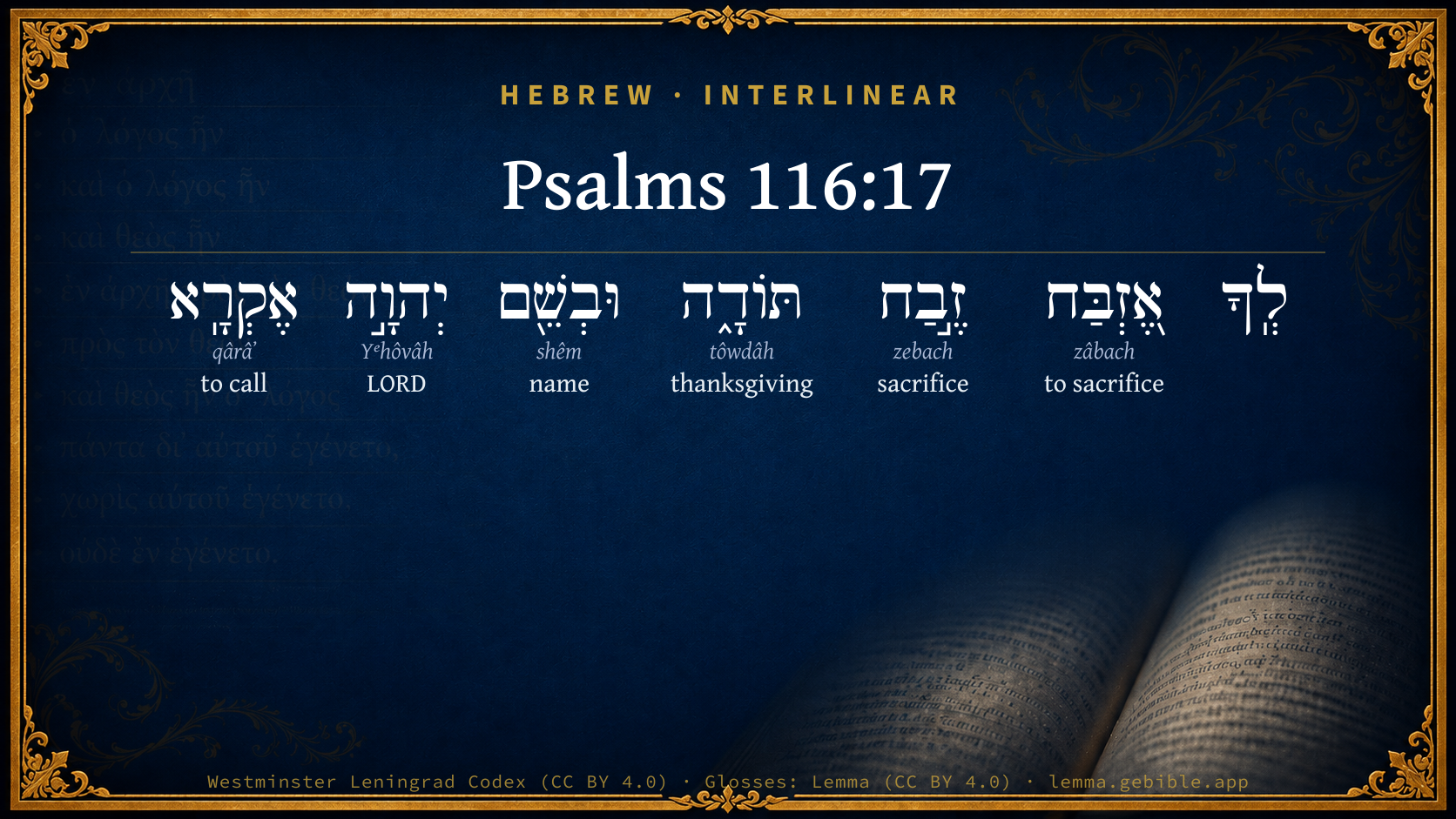
Hebrew (Westminster Leningrad Codex) Psalms 116:17 appears in the Hebrew Old Testament. The text above is from the Westminster Leningrad Codex. Each word links to its Strong’s number, a concise gloss, and parsing drawn from the Open Scriptures Hebrew Bible morphology. Click any word for its full Brown-Driver-Briggs (BDB) entry.
Download image
Cite this verse

Psalms 116:17 (World English Bible). Public Domain. Lemma interlinear Bible study tool, https://lemma.gebible.app/v/psalms/116/17.

Show BibTeX & RIS
BibTeX
RIS
English Translation
I will offer to you the sacrifice of thanksgiving, And will call on the name of Yahweh.
World English Bible · Public Domain
Download a study sheet

One document with this verse’s original text, its word-by-word gloss line, the meaning frame, cross-references with their text, attributed commentary, and full source and license credits — printable, and it pastes into notes with its structure intact.

This verse Autodidact and up

Study sheet (.html) Plain text (.txt)

A passage Seminary Student

Up to 50 verses in one chapter. A passage sheet keeps up to 6 commentary sources and 12 cross-references per verse, in the order this page ranks them, and says so on the sheet whenever that leaves anything out. Ask for a single verse and you get the Autodidact verse sheet above.

Everything on this page stays free to read, with no account — the sheet is a download of what is already on screen, not access to it.

Want to remove ads? Support Godless Engineer
Compare translations 3

The same verse in 3 English versions, stacked beneath the original-language interlinear above. Click any original word for its lexicon entry.

Each is an independent rendering of the whole verse — the interlinear is not word-aligned to these translations.

Highlighted words mark where these versions differ — a whole-verse word diff, not a word-by-word alignment.

  • World English Bible Public Domain
    I will offer to you the sacrifice of thanksgiving, And will call on the name of Yahweh.
  • King James Version Public Domain
    I will offer to thee the sacrifice of thanksgiving, and will call upon the name of the LORD.
  • unfoldingWord Literal Text CC BY-SA 4.0
    I will sacrifice to you the sacrifice of thanksgiving and I will call on the name of Yahweh.

unfoldingWord Literal Text — © unfoldingWord, licensed CC BY-SA 4.0. Word-aligned USFM3 via Door43 (git.door43.org/unfoldingWord/en_ult).

Versions to compare (up to 4)

3 of 4 selected

Show all 18 translations

Every available English version of this verse, each an independent rendering of the whole verse.

  • World English Bible Public Domain
    I will offer to you the sacrifice of thanksgiving, And will call on the name of Yahweh.
  • Berean Standard Bible Public Domain
    I will offer to You a sacrifice of thanksgiving and call on the name of the LORD.
  • Majority Standard Bible Public Domain
    I will offer to You a sacrifice of thanksgiving and call on the name of the LORD.
  • King James Version Public Domain
    I will offer to thee the sacrifice of thanksgiving, and will call upon the name of the LORD.
  • American Standard Version (1901) Public Domain
    I will offer to thee the sacrifice of thanksgiving, And will call upon the name of Jehovah.
  • Revised Version (1885) Public Domain
    I will offer to thee the sacrifice of thanksgiving, and will call upon the name of the LORD.
  • Geneva Bible (1599) Public Domain
    I will offer to thee a sacrifice of prayse, and will call vpon the Name of the Lord.
  • Douay-Rheims (1899) Public Domain
    I will sacrifice to thee the sacrifice of praise, and I will call upon the name of the Lord.
  • Young's Literal Translation Public Domain
    To Thee I sacrifice a sacrifice of thanks, And in the name of Jehovah I call.
  • Literal Standard Version CC BY-SA 4.0
    I sacrifice a sacrifice of thanks to You, || And in the Name of YHWH I call.
  • Unlocked Literal Bible CC BY-SA 4.0
    I will offer to you the sacrifice of thanksgiving and will call on the name of Yahweh.
  • unfoldingWord Literal Text CC BY-SA 4.0
    I will sacrifice to you the sacrifice of thanksgiving and I will call on the name of Yahweh.
  • Darby Bible Public Domain
    I will offer to thee the sacrifice of thanksgiving, and will call upon the name of Jehovah.
  • World Messianic Bible Public Domain
    I will offer to you the sacrifice of thanksgiving, and will call on the LORD’s name.
  • Webster's Bible Public Domain
    I will offer to thee the sacrifice of thanksgiving, and will call upon the name of the LORD.
  • Free Bible Version CC BY-SA 4.0
    I will offer a sacrifice of thanksgiving to you and I will worship you.
  • Bible in Basic English Public Domain
    I will give an offering of praise to you, and make my prayer in the name of the Lord.
  • JPS Tanakh (1917) Public Domain
    I will offer to thee the sacrifice of thanksgiving, and will call upon the name of the LORD.

Literal Standard Version (2020), Covenant Press — licensed CC BY-SA 4.0. Text via the HelloAO Bible API (eBible.org). Unlocked Literal Bible (unfoldingWord) — licensed CC BY-SA 4.0. Text via the HelloAO Bible API (eBible.org). unfoldingWord Literal Text — © unfoldingWord, licensed CC BY-SA 4.0. Word-aligned USFM3 via Door43 (git.door43.org/unfoldingWord/en_ult). Free Bible Version, Dr. Jonathan Gallagher — licensed CC BY-SA 4.0. Text via the HelloAO Bible API (eBible.org).

Word by word

More ways to search: Search by grammar → Find every occurrence → Compare this word →

Practice this passage: Drill this verse → Learn its vocabulary →

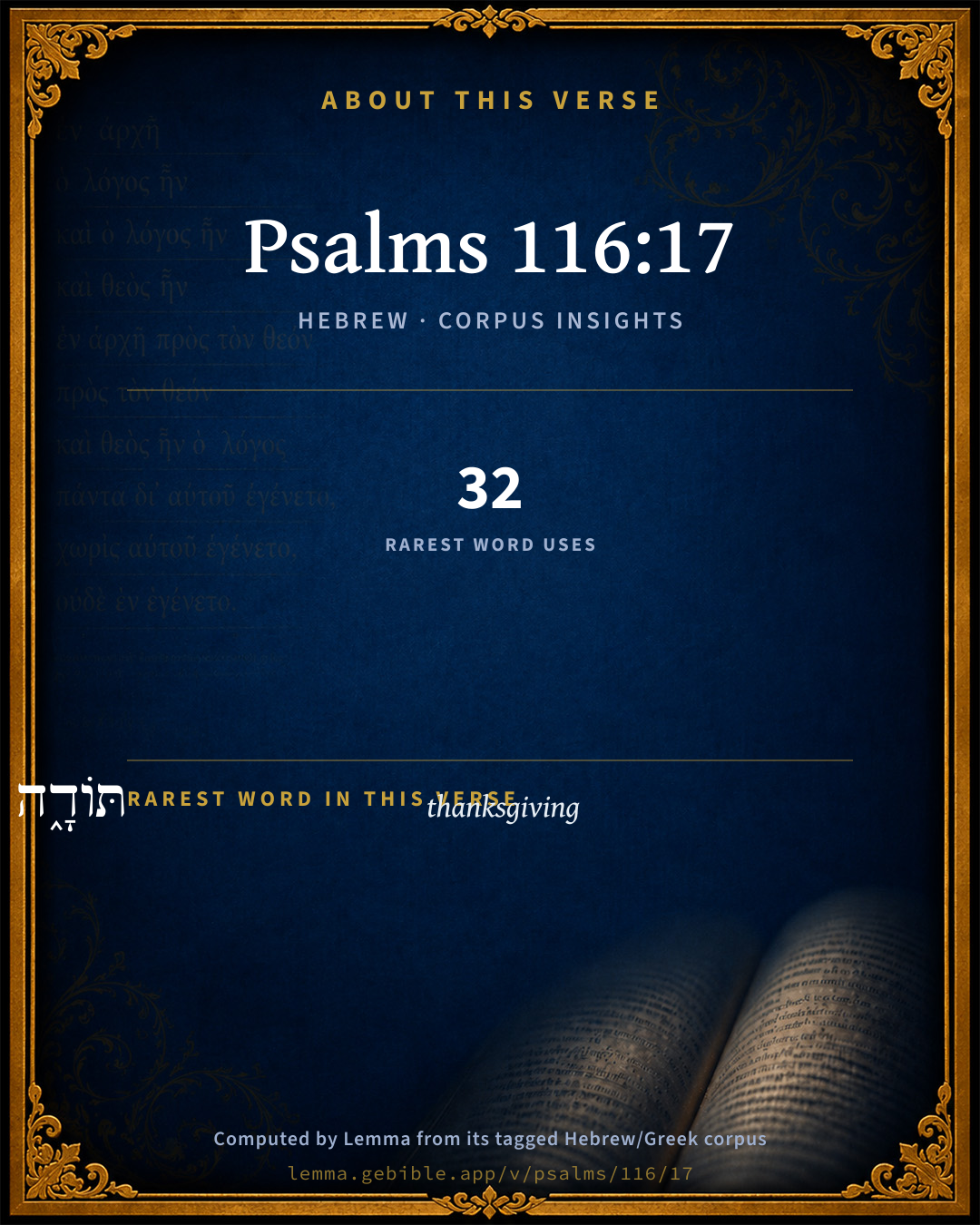
תּוֹדָ֑ה
tôwdâh
H8426
“thanksgiving”
Noun, Common, Feminine, Singular, Absolute
Part of Speech
Noun
Type
Common
Gender
Feminine
Number
Singular
State
Absolute
Full BDB Definition

Origin: from H3034

TWOT: 847b

confession, praise, thanksgiving - give praise to God - thanksgiving in songs of liturgical worship, hymn of praise - thanksgiving choir or procession or line or company - thank-offering, sacrifice of thanksgiving - confession
  1. אֶ֭זְבַּח zâbach H2076 “to sacrifice” Verb, Qal, Imperfect, 1st Person, Common, Singular
  2. זֶ֣בַח zebach H2077 “sacrifice of” Noun, Common, Masculine, Singular, Construct
  3. וּבְשֵׁ֖ם shêm H8034 “and · in/at · name of” Conjunction + Preposition + Noun, Common, Masculine, Singular, Construct
  4. יְהוָ֣ה Yᵉhôvâh H3068 “LORD” Noun, Proper
  5. אֶקְרָֽא qârâʼ H7121 “to call” Verb, Qal, Imperfect, 1st Person, Common, Singular

About this verse

These counts appear in no published source. They are computed here, from the morphology-tagged text and Lemma’s own curated glosses. What Lemma adds →

7
words
6
distinct lemmas
Wisdom
section

Shared distinctive vocabulary

תּוֹדָ֑ה thanksgiving H8426 occurs in 30 verses of the Hebrew Bible. Also found in:

Grammatical profile

  • 2 verbs
  • 4 nouns
  • 1 preposition

Verb forms

  • אֶ֭זְבַּח Qal · Imperfect
  • אֶקְרָֽא Qal · Imperfect

Hebrew & Septuagint length

In English translation the verse runs 17 words from the Hebrew and 15 from the Septuagint (LXX English) — closely comparable.

A rough comparison of the two English renderings, which tokenize alike — not a word-level alignment.

Word counts can differ between the Hebrew and the Greek without any difference in meaning — e.g. the Hebrew direct-object marker אֵת has no separate Greek word, and Greek often adds the article ὁ.

Cross-references

6

Topical passages linked to Psalms 116:17 in the Treasury of Scripture Knowledge — connected by theme and wording, ordered by reader-vote popularity; previews shown in the World English Bible.

  • Psalms 50:14 Offer to God the sacrifice of thanksgiving. Pay your vows to the Most High.
  • Leviticus 7:12 If he offers it for a thanksgiving, then he shall offer with the sacrifice of thanksgiving unleavened cakes mixed with oil, and unleavened wafers anointed with oil, and cakes mixed with oil.
  • Psalms 107:22 Let them offer the sacrifices of thanksgiving, And declare his works with singing.
  • Hebrews 13:15 Through him, then, let us offer up a sacrifice of praise to God continually, that is, the fruit of lips which make confession to his name.
  • Psalms 116:13 I will take the cup of salvation, and call on the name of Yahweh.
  • Acts 2:42 They continued steadfastly in the apostles' teaching and fellowship, in the breaking of bread, and prayer.

Cross-references courtesy of OpenBible.info (CC BY 4.0).

Hebrew and Greek witnesses Masoretic Hebrew ↔ Greek Septuagint

The same verse in the two great witnesses to the Old Testament, shown verse-for-verse.

You’re reading Greek Psalm 114 (Hebrew Psalm 116). The Septuagint counts the superscription, so verse numbers can differ from the Hebrew — chapter-level alignment, not verse-by-verse. Numbering follows Rahlfs.

These are two independent witnesses, not word-aligned to each other, and the Septuagint is shown in lemma (dictionary) form.

Hebrew Psalms 116:17 Masoretic · Westminster Leningrad Codex

לְֽךָ אֶ֭זְבַּח זֶ֣בַח תּוֹדָ֑ה וּבְשֵׁ֖ם יְהוָ֣ה אֶקְרָֽא

I will offer to you the sacrifice of thanksgiving, And will call on the name of Yahweh.

World English Bible · Public Domain

Greek LXX Greek Psalm 114:17 Septuagint · lemma form
The dead shall not praise you, O Lord, nor any that go down to Hades.

LXX2012 (modern English Septuagint) · Public Domain

Hebrew: Westminster Leningrad Codex (CC BY 4.0). Greek: Septuagint (public domain); English from LXX2012 (modern English Septuagint) (Public Domain). How the Septuagint differs from the Hebrew →

Commentary

Notes on Psalms 116:17 from classic Christian and Jewish commentators (each source and its license shown beneath its notes). The classic Christian expositions comment on the surrounding passage and are grouped to its opening verse, so a note may address several verses; the Jewish commentaries on the Tanakh (Rashi and others) are per-verse, so they appear only where the commentator wrote on this verse.

Lemma curates 59 commentaries, every one of them public domain or Creative Commons licensed, each selected and text-cleaned for this edition rather than reprinted as found. About our sources →

Trapp's Complete Commentary

John Trapp

Psa 116:17 I will offer to thee the sacrifice of thanksgiving, and will call upon the name of the LORD.

Ver. 17. I will offer to thee, &c.] I will perform to thee not ceremonial service only, but moral and spiritual; such as thou shalt accept through Christ, Col 3:17.

And will call, &c.] See Psa 116:13.

John Trapp, A Commentary or Exposition upon All the Books of the Old and New Testament (1647–1656) — public domain. Text from a community e-Sword module.

J. A. Alexander on Psalms

Joseph Addison Alexander

17. (Psa 116:17) To thee will I sacrifice a sacrifice of thanks, and on the name of Jehovah will I call. The sense is not, I will offer thanks instead of an oblation, but an oblation really expressive of thanksgiving and appointed for that purpose.

Joseph Addison Alexander, The Psalms Translated and Explained (1850) — public domain. Text from a community e-Sword module.

Adam Clarke's Commentary

Verse 17. I will offer to thee] As it is most probable that this Psalm celebrates the deliverance from Babylon, it is no wonder that we find the psalmist so intent on performing the rites of his religion in the temple at Jerusalem, which had been burnt with fire, and was now reviving out of its ruins, the temple service having been wholly interrupted for nearly four-score years.

Adam Clarke's Commentary on the Bible (1810–1826) — public domain. Text from a community e-Sword/MySword module.

John Calvin's Commentaries

17. I will sacrifice the sacrifices of praise to thee. He once more repeats what he had said about gratitude, and that publicly; for we must manifest our piety, not only by our secret affection before God, but also by an open profession in the sight of men. David, along with the people, observed the rites of the law, knowing that these, at that time, were not unmeaning services; but while he did this, he had a particular reference to the purpose for which they were appointed, and offered principally the sacrifices of praise and the calves of his lips. He speaks of the courts of God’s house, because at that time there was but one altar from which it was unlawful to depart, and it was the will of God that the holy assemblies should be held there, that the faithful might mutually stimulate one another to the cultivation of godliness.

John Calvin's Commentaries (1540-1563) — public domain. Text from the Calvin Translation Society English edition (1840s-50s) via the Christian Classics Ethereal Library (ccel.org). Calvin's coverage is partial (roughly two-thirds of the Bible); uncommented books and verses are honest gaps, never fabricated. The 19th-century editor's footnotes and remarks are omitted so the notes are faithfully Calvin's own voice.

The Cambridge Bible for Schools and Colleges

gen. ed. J. J. S. Perowne

17. Unto thee will I offer … and proclaim the name of Jehovah, as Psa_116:13.

sacrifice of thanksgiving] See Lev_7:11 ff.

The Cambridge Bible for Schools and Colleges (gen. ed. J. J. S. Perowne; Cambridge University Press, 1878–1918) — public domain. Text from a community e-Sword module.

John Gill's Exposition

In the courts of the Lord's house,.... This is added by way of explanation of Psa 116:18, what he meant by "the presence of all his people"; the assembly of the saints met together in the house of the Lord, at the door of the tabernacle, in the courts of it, where the people got together to worship God;

in the midst of thee, O Jerusalem; the Lord's house or tabernacle; for as yet the temple was not built, and the courts of it were in the midst of the city of Jerusalem. And this shows, as some interpreters have observed, that this psalm must have been written after David came to the kingdom, and had got this city into his hands, whither he brought the ark of the Lord. The whole signifies that he would praise the Lord publicly, as well as privately; and he concludes the psalm thus,

Praise ye the Lord; calling upon the Lord's people, in his house and courts, to join with him in this work of praise.

Next: Psalms Chapter 117

John Gill's Exposition of the Whole Bible (1746–1763) — public domain (CC PDM 1.0). Text via the HelloAO Bible API.

Albert Barnes' Notes on the Bible

I will offer to thee the sacrifice of thanksgiving - I will publicly thank and praise thee. See the notes at Psa 107:22.

And will call upon the name of the Lord - Will worship and praise the Lord.

Albert Barnes' Notes on the Bible (1834–1885) — public domain. Text from a community e-Sword/MySword module.

The Treasury of David

Charles H. Spurgeon

Ver. 17. I will offer to thee the sacrifice of thanksgiving. Being thy servant, I am bound to sacrifice to thee, and having received spiritual blessings at thy hands I will not bring bullock or goat, but I will bring that which is more suitable, namely, the thanksgiving of my heart. My inmost soul shall adore thee in gratitude.

And will call upon the name of the Lord, that is to say, I will bow before thee reverently, lift up my heart in love to thee, think upon thy character, and adore thee as thou dost reveal thyself. He is fond of this occupation, and several times in this Psalm declares that "he will call upon the name of the Lord, "while at the same time he rejoices that he had done so many a time before. Good feelings and actions bear repeating: the more of hearty callings upon God the better.

Ver. 17. The sacrifice of thanksgiving.

"When all the heart is pure, each warm desire

Sublimed by holy love's ethereal fire.

On winged words our breathing thoughts may rise,

And soar to heaven, a grateful sacrifice." James Scott.

Ver. 17. This is due to our God, good for ourselves, and encouraging to others.

Ver. 17. The sacrifice of thanksgiving.

1. How it may be rendered. In secret love, in conversation, in sacred song, in public testimony, in special gifts and works.

2. Why we should render it. For answered prayers (Ps 116:1-2), memorable deliverances (Ps 116:3), choice preservation (Ps 116:6); remarkable restoration (Ps 116:7-8), and for the fact of our being his servants (Ps 116:16).

3. When should we render it. Now, while the mercy is on the memory, and as often as fresh mercies come to us.

Psalms 116:18*

Charles H. Spurgeon's The Treasury of David (1869–1885) — public domain. Psalms only. Text from a community e-Sword/MySword module.

Whedon's Commentary on the Bible

Daniel D. Whedon

17, 18. These verses clearly show that the occasion of the psalm was one of public thanksgiving and sacrifice after a great deliverance. Psa_116:14; Psa_116:18, seem like a refrain, and their repetition indicates how sacredly the people hold their vows after so great a mercy.

Daniel D. Whedon (gen. ed.), Commentary on the Old and New Testaments (1874–1909) — public domain. Text from a community e-Sword module.

The Pulpit Commentary

I will offer to thee the sacrifice of thanksgiving. Scarcely an actual sacrifice. Rather, simple thanksgiving, which, from a sincere heart, is the best sacrifice. (see Ps 1 Ps 14 and Hos_14:2) And will call upon the Name of the Lord (comp. vers. 4 and 13).

Spiritual sacrifices.

"Sacrifice of thanksgiving." Acceptable to God, the great Spirit, not as thanksgiving, which may be as much a formality as a sacrifice, but as the sign of the thankful, loving heart, which gives itself to God in the thanks giving. The story of Cain and Abel, in the earliest age, stamps this truth. They did not merely bring their offerings as expressions of their thankfulness for temporal prosperity. The story clearly indicates that they looked for the Divine acceptance of themselves, in some sense, for the sake of their gift. Abel"s humble, earnest, grateful, trusting heart can receive God"s favor; from Cain"s formalities God"s favor must be withheld. Religion is not acts, but it can express itself in acts. Religion is heart-feeling. It is the devotion of a man"s self to God. Formal sacrifices are but the representation of the spiritual sacrifices for which God calls; and their value depends on the spiritual sacrifice being offered through them. "They that worship the Father must worship him in spirit and in truth." "Not sacrifices, not temples, not services, not prayers, not good deeds, not steadfast morality, not generous giving, can of them selves ever gain Divine favor. The Spirit-God asks for spirit-worship. Because man is a spirit, it is beneath his dignity to offer, and it is beneath the dignity of God to accept, other than spirit-worship.

I SPIRITUAL SACRIFICES AS THANKSGIVINGS. The formality of thanksgiving was strikingly illustrated in the great national services held when the Prince of Wales was restored to health. It was an appropriate national act; and to many devout souls it was also a spiritual sacrifice. The worship of the Church is a sacred duty to be formally done; but it only rises to its highest when the souls of the worshippers are fully in the praise. The spiritual element in formal worship is an unceasing care to all devout souls. God asks to hear men"s souls sing when their voices raise the psalm.

II SPIRITUAL SACRIFICES AS ADORATIONS. Calling upon the "Name." There is a feature in the early Jewish ritual which it is difficult to retain in the Christian. The Jew had sublime, reverent, oppressive views of the majesty and holiness of God. So there was an element of adoration in the worship, and an element of adoration in the psalms. The truth of the Divine Fatherhood is misapprehended if it is allowed to lighten the soul"s august impressions of the Divine glory.

III SPIRITUAL SACRIFICES AS PRAYERS. Our Lord spoke against "vain repetitions." Prayer is soul-dependence and soul-desire. It may be spoken out, but it may not. God reads hearts. R.T.

The Pulpit Commentary (1880–1919), ed. H.D.M. Spence-Jones & Joseph S. Exell — public domain. Text from a community e-Sword module.

Rashi

Rabbi Shlomo Yitzchaki (Rashi)

thanksgiving Sacrifices of thanksgiving for the miracles that You performed for me.

Rashi on the Tanakh — English translations: “The Judaica Press complete Tanach with Rashi, translated by A. J. Rosenberg” (CC BY 4.0); “Pentateuch with Rashi's commentary by M. Rosenbaum and A.M. Silbermann, 1929-1934” (public domain); “The Metsudah Tanach series, Lakewood, N.J” (CC BY 4.0); and “The Book of Joshua, Metsudah Publications, 1997” (CC BY 4.0). Text via Sefaria.

Lesson kit

Teaching starters — assembled from the data on this page, not authored interpretation. Every prompt links to the verse data it draws on. Edit before teaching.

Psalms, in the Wisdom, opens this verse with 7 words (6 distinct Hebrew lemmas). Its most distinctive word is tôwdâh (“thanksgiving”). A historical commentator’s framing appears above. Read the whole chapter for the surrounding context.

Discussion questions

  1. The word tôwdâh carries the sense “thanksgiving.” How does it shape the verse?
  2. Leviticus 7:12 shares the word «thanksgiving» with this verse. How do the two illuminate each other?
  3. These translations render this verse differently. What is at stake in choosing one wording over another?
  4. The verb «אֶ֭זְבַּח» is Qal Imperfect. How does its form color the action?
  5. Reading how Trapp's Complete Commentary and J. A. Alexander on Psalms read this verse, where do the two commentators agree and where do they part?

Things to notice

Reading settings

Reading text

Shown beneath each verse's original-language words.

Old Testament
Old Testament edition

Read the OT as the Masoretic Hebrew (MT) or the Greek Septuagint (LXX).

English shown for the Greek Septuagint (in the Hebrew ↔ Greek comparison).

Comparing translations? Open the Compare panel on any verse page to stack up to four side by side.