

Jeremiah 16:12

Hebrew (Westminster Leningrad Codex) Jeremiah 16:12 appears in the Hebrew Old Testament. The text above is from the Westminster Leningrad Codex. Each word links to its Strong’s number, a concise gloss, and parsing drawn from the Open Scriptures Hebrew Bible morphology. Click any word for its full Brown-Driver-Briggs (BDB) entry.
Download image
Cite this verse

Jeremiah 16:12 (World English Bible). Public Domain. Lemma interlinear Bible study tool, https://lemma.gebible.app/v/jeremiah/16/12.

Show BibTeX & RIS
BibTeX
RIS
English Translation
and you have done evil more than your fathers; for, behold, you walk every one after the stubbornness of his evil heart, so that you don't listen to me:
World English Bible · Public Domain
Download a study sheet

One document with this verse’s original text, its word-by-word gloss line, the meaning frame, cross-references with their text, attributed commentary, and full source and license credits — printable, and it pastes into notes with its structure intact.

This verse Autodidact and up

Study sheet (.html) Plain text (.txt)

A passage Seminary Student

Up to 50 verses in one chapter. A passage sheet keeps up to 6 commentary sources and 12 cross-references per verse, in the order this page ranks them, and says so on the sheet whenever that leaves anything out. Ask for a single verse and you get the Autodidact verse sheet above.

Everything on this page stays free to read, with no account — the sheet is a download of what is already on screen, not access to it.

Want to remove ads? Support Godless Engineer
Compare translations 3

The same verse in 3 English versions, stacked beneath the original-language interlinear above. Click any original word for its lexicon entry.

Each is an independent rendering of the whole verse — the interlinear is not word-aligned to these translations.

Highlighted words mark where these versions differ — a whole-verse word diff, not a word-by-word alignment.

  • World English Bible Public Domain
    and you have done evil more than your fathers; for, behold, you walk every one after the stubbornness of his evil heart, so that you don't listen to me:
  • King James Version Public Domain
    And ye have done worse than your fathers; for, behold, ye walk every one after the imagination of his evil heart, that they may not hearken unto me:
  • unfoldingWord Literal Text CC BY-SA 4.0
    And you yourselves have done evil, to do more than your fathers, and behold, each one is walking after the stubbornness of his evil heart; to not listen to me.

unfoldingWord Literal Text — © unfoldingWord, licensed CC BY-SA 4.0. Word-aligned USFM3 via Door43 (git.door43.org/unfoldingWord/en_ult).

Versions to compare (up to 4)

3 of 4 selected

Show all 18 translations

Every available English version of this verse, each an independent rendering of the whole verse.

  • World English Bible Public Domain
    and you have done evil more than your fathers; for, behold, you walk every one after the stubbornness of his evil heart, so that you don't listen to me:
  • Berean Standard Bible Public Domain
    And you have done more evil than your fathers. See how each of you follows the stubbornness of his evil heart instead of obeying Me.
  • Majority Standard Bible Public Domain
    And you have done more evil than your fathers. See how each of you follows the stubbornness of his evil heart instead of obeying Me.
  • King James Version Public Domain
    And ye have done worse than your fathers; for, behold, ye walk every one after the imagination of his evil heart, that they may not hearken unto me:
  • American Standard Version (1901) Public Domain
    and ye have done evil more than your fathers; for, behold, ye walk every one after the stubbornness of his evil heart, so that ye hearken not unto me:
  • Revised Version (1885) Public Domain
    and ye have done evil more than your fathers; for, behold, ye walk every one after the stubbornness of his evil heart, so that ye hearken not unto me:
  • Geneva Bible (1599) Public Domain
    (And ye haue done worse then your fathers: for beholde, you walke euery one after the stubbernesse of his wicked heart, and will not heare me)
  • Douay-Rheims (1899) Public Domain
    And you also have done worse than your fathers: for behold every one of you walketh after the perverseness of his evil heart, so as not to hearken to me.
  • Young's Literal Translation Public Domain
    Ye also have done evil above your fathers, And lo, ye are walking each after the stubbornness of his evil heart, So as not to hearken unto Me.
  • Literal Standard Version CC BY-SA 4.0
    You also have done evil above your fathers, || And behold, you are each walking after the stubbornness of his evil heart, || So as not to listen to Me.
  • Unlocked Literal Bible CC BY-SA 4.0
    But you yourselves have brought about more wickedness than your ancestors, for see, each person is walking by the stubbornness of his wicked heart; there is no one who listens to me.
  • unfoldingWord Literal Text CC BY-SA 4.0
    And you yourselves have done evil, to do more than your fathers, and behold, each one is walking after the stubbornness of his evil heart; to not listen to me.
  • Darby Bible Public Domain
    and you, ye have done still worse than your fathers; and there ye are walking every one after the stubbornness of his evil heart, not to hearken unto me:
  • World Messianic Bible Public Domain
    You have done evil more than your fathers, for behold, you each walk after the stubbornness of his evil heart, so that you don’t listen to me.
  • Webster's Bible Public Domain
    And ye have done worse than your fathers; for, behold, ye walk every one after the imagination of his evil heart, that they may not hearken to me:
  • Free Bible Version CC BY-SA 4.0
    You however have done even more evil than your forefathers. Look at how all of you followed your own stubborn evil thinking instead of obeying me.
  • Bible in Basic English Public Domain
    And you have done worse evil than your fathers; for see, every one of you is guided by the pride of his evil heart, so as not to give ear to me:
  • JPS Tanakh (1917) Public Domain
    and ye have done worse than your fathers; for, behold, ye walk every one after the stubbornness of his evil heart, so that ye hearken not unto Me;

Literal Standard Version (2020), Covenant Press — licensed CC BY-SA 4.0. Text via the HelloAO Bible API (eBible.org). Unlocked Literal Bible (unfoldingWord) — licensed CC BY-SA 4.0. Text via the HelloAO Bible API (eBible.org). unfoldingWord Literal Text — © unfoldingWord, licensed CC BY-SA 4.0. Word-aligned USFM3 via Door43 (git.door43.org/unfoldingWord/en_ult). Free Bible Version, Dr. Jonathan Gallagher — licensed CC BY-SA 4.0. Text via the HelloAO Bible API (eBible.org).

Word by word

More ways to search: Search by grammar → Find every occurrence → Compare this word →

Practice this passage: Drill this verse → Learn its vocabulary →

שְׁרִר֣וּת
shᵉrîyrûwth
H8307
“stubbornness of”
Noun, Common, Feminine, Singular, Construct
Part of Speech
Noun
Type
Common
Gender
Feminine
Number
Singular
State
Construct
Full BDB Definition

Origin: from H8324 in the sense of twisted, i.e. firm

TWOT: 2469d

stubbornness, hardness, firmness
  1. וְאַתֶּ֛ם ʼattâh H859 “and · you” Conjunction + Pronoun, Personal, 2nd Person, Masculine, Plural
  2. הֲרֵעֹתֶ֥ם râʻaʻ H7489 “to do evil” Verb, Hiphil, Perfect, 2nd Person, Masculine, Plural
  3. לַעֲשׂ֖וֹת ʻâsâh H6213 “to do” Preposition + Verb, Qal, Infinitive Construct
  4. מֵאֲבֽוֹתֵיכֶ֑ם ʼâb H1 “from · fathers · your” Preposition + Noun, Common, Masculine, Plural, Construct + Suffix, Personal, 2nd Person, Masculine, Plural
  5. וְהִנְּכֶ֣ם hên H2005 “and · behold · you” Conjunction + Particle, Demonstrative + Suffix, Personal, 2nd Person, Masculine, Plural
  6. הֹלְכִ֗ים hâlak H1980 “walking” Verb, Qal, Participle Active, Masculine, Plural, Absolute
  7. אִ֚ישׁ ʼîysh H376 “man” Noun, Common, Masculine, Singular, Absolute
  8. אַֽחֲרֵי֙ ʼachar H310 “after” Preposition
  9. לִבּֽוֹ lêb H3820 “heart · his” Noun, Common, Masculine, Singular, Construct + Suffix, Personal, 3rd Person, Masculine, Singular
  10. הָרָ֔ע raʻ H7451 “the · evil” Particle, Definite Article + Adjective, Adjective, Masculine, Singular, Absolute
  11. לְבִלְתִּ֖י biltîy H1115 “to/for · except” Preposition + Conjunction
  12. שְׁמֹ֥עַ shâmaʻ H8085 “to hear” Verb, Qal, Infinitive Construct
  13. אֵלָֽי ʼêl H413 “to · me” Preposition + Suffix, Personal, 1st Person, Common, Singular

About this verse

These counts appear in no published source. They are computed here, from the morphology-tagged text and Lemma’s own curated glosses. What Lemma adds →

14
words
14
distinct lemmas
Prophets
section

Notable vocabulary

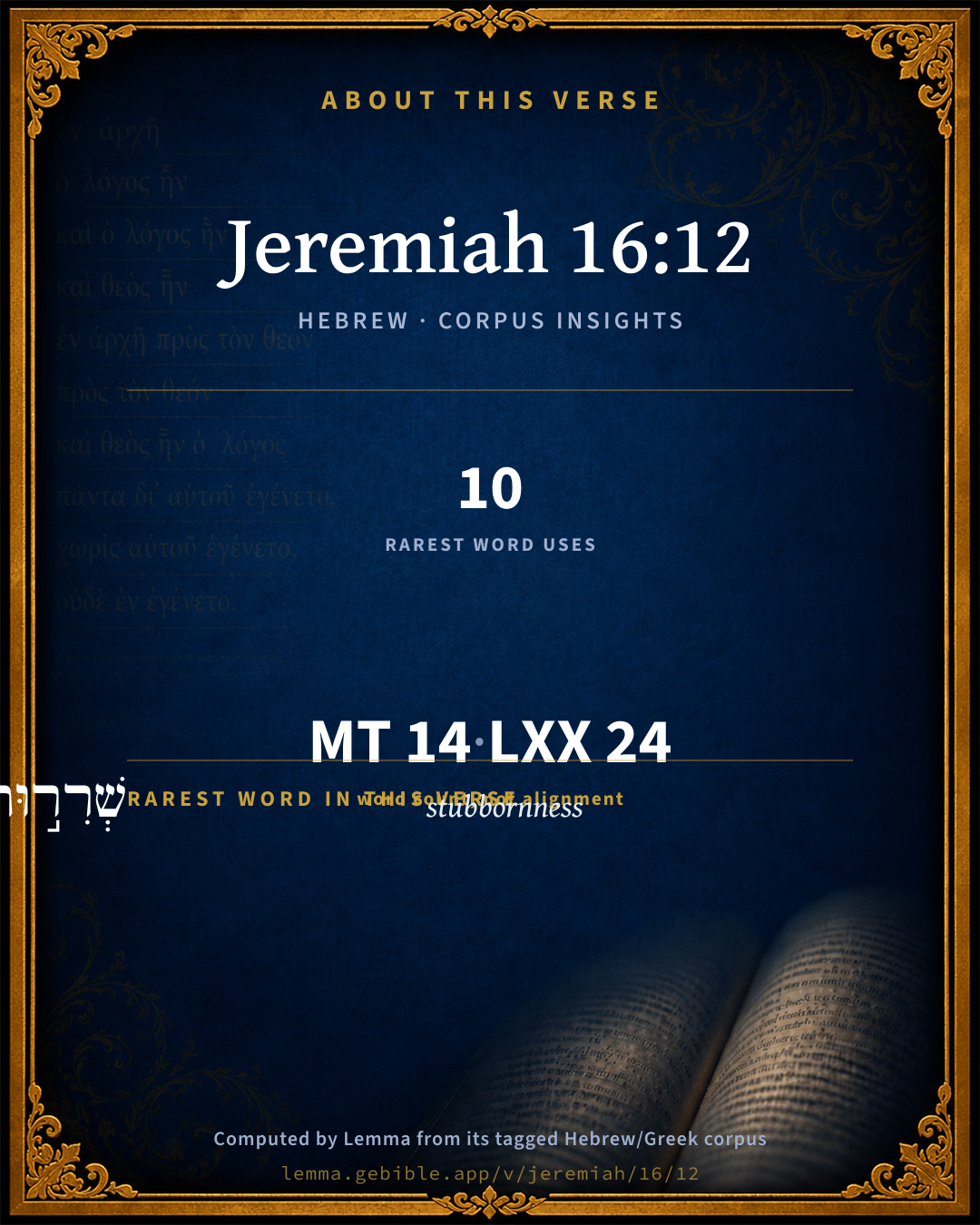
The rarest word here is שְׁרִר֣וּת stubbornness H8307 — appearing just 10 times in the whole Hebrew Bible.

Shared distinctive vocabulary

שְׁרִר֣וּת stubbornness H8307 occurs in 10 verses of the Hebrew Bible. Also found in:

Grammatical profile

  • 4 verbs
  • 4 nouns
  • 1 adjective
  • 1 pronoun
  • 2 prepositions
  • 1 conjunction
  • 1 particle

Verb forms

  • הֲרֵעֹתֶ֥ם Hiphil · Perfect
  • לַעֲשׂ֖וֹת Qal · Infinitive Construct
  • הֹלְכִ֗ים Qal · Participle Active
  • שְׁמֹ֥עַ Qal · Infinitive Construct

Hebrew & Septuagint length

In the original languages it is 14 Hebrew tokens and 24 Greek tokens — but the two are counted differently (Hebrew bundles its prefixes and suffixes into one token; the Greek is in lemma form), so that isn’t a like-for-like length.

Cross-references

16

Topical passages linked to Jeremiah 16:12 in the Treasury of Scripture Knowledge — connected by theme and wording, ordered by reader-vote popularity; previews shown in the World English Bible.

  • Jeremiah 7:26 yet they didn't listen to me, nor inclined their ear, but made their neck stiff: they did worse than their fathers.
  • Jeremiah 13:10 This evil people, who refuse to hear my words, who walk in the stubbornness of their heart, and are gone after other gods to serve them, and to worship them, shall even be as this belt, which is profitable for nothing.
  • Ecclesiastes 9:3 This is an evil in all that is done under the sun, that there is one event to all: yes also, the heart of the sons of men is full of evil, and madness is in their heart while they live, and after that they go to the dead.
  • Jeremiah 9:14 but have walked after the stubbornness of their own heart, and after the Baals, which their fathers taught them;
  • Judges 2:19 But it happened, when the judge was dead, that they turned back, and dealt more corruptly than their fathers, in following other gods to serve them, and to bow down to them; they didn't cease from their doings, nor from their stubborn way.
  • 1 Samuel 15:23 For rebellion is as the sin of witchcraft, and stubbornness is as idolatry and teraphim. Because you have rejected the word of Yahweh, he has also rejected you from being king.
  • Jeremiah 7:24 But they didn't listen nor turn their ear, but walked in [their own] counsels [and] in the stubbornness of their evil heart, and went backward, and not forward.
  • Mark 7:21 For from within, out of the hearts of men, proceed evil thoughts, adulteries, sexual sins, murders, thefts,
  • Genesis 6:5 Yahweh saw that the wickedness of man was great in the earth, and that every imagination of the thoughts of his heart was only evil continually.
  • Genesis 8:21 Yahweh smelled the sweet savor. Yahweh said in his heart, "I will not again curse the ground any more for man's sake, because the imagination of man's heart is evil from his youth; neither will I ever again strike everything living, as I have done.
  • Deuteronomy 9:27 Remember your servants, Abraham, Isaac, and Jacob; don't look to the stubbornness of this people, nor to their wickedness, nor to their sin,
  • Deuteronomy 29:19 and it happen, when he hears the words of this curse, that he bless himself in his heart, saying, I shall have peace, though I walk in the stubbornness of my heart, to destroy the moist with the dry.
  • Ecclesiastes 8:12 Though a sinner commits crimes a hundred times, and lives long, yet surely I know that it will be better with those who fear God, who are reverent before him.
  • Jeremiah 17:9 The heart is deceitful above all things, and it is exceedingly corrupt: who can know it?
  • 2 Timothy 3:13 But evil men and impostors will grow worse and worse, deceiving and being deceived.
  • Hebrews 3:12 Beware, brothers, lest perhaps there be in any one of you an evil heart of unbelief, in falling away from the living God;

Cross-references courtesy of OpenBible.info (CC BY 4.0).

Hebrew and Greek witnesses Masoretic Hebrew ↔ Greek Septuagint

The same verse in the two great witnesses to the Old Testament, shown verse-for-verse.

These are two independent witnesses, not word-aligned to each other, and the Septuagint is shown in lemma (dictionary) form.

Hebrew Jeremiah 16:12 Masoretic · Westminster Leningrad Codex

וְאַתֶּ֛ם הֲרֵעֹתֶ֥ם לַעֲשׂ֖וֹת מֵאֲבֽוֹתֵיכֶ֑ם וְהִנְּכֶ֣ם הֹלְכִ֗ים אִ֚ישׁ אַֽחֲרֵי֙ שְׁרִר֣וּת לִבּֽוֹ הָרָ֔ע לְבִלְתִּ֖י שְׁמֹ֥עַ אֵלָֽי

and you have done evil more than your fathers; for, behold, you walk every one after the stubbornness of his evil heart, so that you don't listen to me:

World English Bible · Public Domain

Greek LXX Structure differs

In the Septuagint, Jeremiah is about an eighth shorter than the Hebrew and arranges its material differently — the Oracles Against the Nations (Hebrew chapters 46–51) appear in the middle of the Greek book, after 25:13. Because the chapter and verse boundaries do not line up, a verse-for-verse comparison with the Hebrew is not shown.

A verse-for-verse comparison isn’t shown here because the chapters and verses don’t line up. Switch to the LXX edition with the MT / LXX toggle above to read the Greek directly.

On this verse, John Gill's Exposition discusses the Septuagint’s reading. Read the note in Commentary ↓

Hebrew: Westminster Leningrad Codex (CC BY 4.0). Greek: Septuagint (public domain); English from a public-domain English Septuagint. How the Septuagint differs from the Hebrew →

Targum (Aramaic paraphrase)

1

The Targum is the ancient Jewish Aramaic paraphrase of the Hebrew Scriptures — an interpretive translation, not the Hebrew text itself. Onkelos (literal) and Pseudo-Jonathan (expansive) render the Torah, and Jonathan the Prophets. Coverage is partial: where no permissively-licensed English translation exists for a verse, only the Aramaic is shown. This is verse-level text, not a word-by-word alignment to the Hebrew.

  1. Targum Jonathan Prophets (Joshua–Malachi)
    וְאַתּוּן אַבְאַשְׁתּוּן לְמֶעְבַּד מֵאֲבָהַתְכוֹן וְהָא אַתּוּן אָזְלִין גְבַר בָּתַר הִרְהוּר לִבֵּיהּ בִּישָׁא בְּדִיל דְלָא לְקַבָּלָא לְמֵימְרִי:

    (no public-domain English translation for this verse)

    Targum Jonathan — Aramaic: “Mikraot Gedolot” (public domain). English: “Sefaria Community Translation” (CC0 1.0 (public-domain dedication)); “London "Chaldee Paraphrase," 1871” (public domain). Text via Sefaria.

Commentary

Notes on Jeremiah 16:12 from classic Christian and Jewish commentators (each source and its license shown beneath its notes). The classic Christian expositions comment on the surrounding passage and are grouped to its opening verse, so a note may address several verses; the Jewish commentaries on the Tanakh (Rashi and others) are per-verse, so they appear only where the commentator wrote on this verse.

Lemma curates 59 commentaries, every one of them public domain or Creative Commons licensed, each selected and text-cleaned for this edition rather than reprinted as found. About our sources →

Trapp's Complete Commentary

John Trapp

Jer 16:12 And ye have done worse than your fathers; for, behold, ye walk every one after the imagination of his evil heart, that they may not hearken unto me:

Ver. 12. And ye have done worse.] See Jer 7:26.

For, behold, ye walk.] See Jer 9:13; Jer 11:8; Jer 13:10.

John Trapp, A Commentary or Exposition upon All the Books of the Old and New Testament (1647–1656) — public domain. Text from a community e-Sword module.

Jamieson, Fausset & Brown

Robert Jamieson, A. R. Fausset & David Brown

ye--emphatic: so far from avoiding your fathers' bad example, ye have done worse (Jer 7:26; Kg1 14:9).

imagination--rather, "stubborn perversity."

that they may not hearken--rather, connected with "ye"; "ye have walked . . . so as not to hearken to Me."

Jamieson, Fausset & Brown — Commentary Critical and Explanatory on the Whole Bible (1871) — public domain (CC PDM 1.0). Text via the HelloAO Bible API.

Adam Clarke's Commentary

Verse 12. And ye have done worse than your fathers] The sins of the fathers would not have been visited on the children, had they not followed their example, and become even worse than they.

Adam Clarke's Commentary on the Bible (1810–1826) — public domain. Text from a community e-Sword/MySword module.

John Calvin's Commentaries

I was constrained yesterday to leave unfinished the words of the Prophet. He said that the children were worse than their fathers, and gave the reason, Because they followed the wickedness of their evil heart, and hearkened not to God He seems to have said before the same thing of the fathers: it might then be asked, Why does he say that the children had done worse than their fathers, and pronounce their sins worse? Now we have already seen that sins became worse before God, when the children strengthened themselves in wickedness by following the examples of their fathers. We must also notice, that not only the law had been set before them, but that also Prophets had been often sent to them, who added their reproofs: and this is what Jeremiah seems to have expressed at the end of the verse, by saying that they hearkened not, though daily spoken to by the Prophets. It was then their obstinacy that God so severely punished: they had imitated their wicked fathers, and then they not only had despised, but also through their obstinate wickedness had rejected all the warnings which the Prophets gave them.

John Calvin's Commentaries (1540-1563) — public domain. Text from the Calvin Translation Society English edition (1840s-50s) via the Christian Classics Ethereal Library (ccel.org). Calvin's coverage is partial (roughly two-thirds of the Bible); uncommented books and verses are honest gaps, never fabricated. The 19th-century editor's footnotes and remarks are omitted so the notes are faithfully Calvin's own voice.

Ellicott's Commentary for English Readers

(12) Imagination.—Better, as before, stubbornness.

A Bible Commentary for English Readers, edited by Charles John Ellicott (1878–1897) — public domain. Text from a community e-Sword module.

The Cambridge Bible for Schools and Colleges

gen. ed. J. J. S. Perowne

12. stubbornness] Cp. ch. Jer_3:17.

The Cambridge Bible for Schools and Colleges (gen. ed. J. J. S. Perowne; Cambridge University Press, 1878–1918) — public domain. Text from a community e-Sword module.

John Gill's Exposition

Therefore will I call you out of this land,.... By force, and against their wills, whether they would or not, and with abhorrence and contempt: it is to be understood of their captivity, which was but a just punishment for the above sins; for since they had cast off the Lord and his worship, it was but just that they should be cast off by him, and cast out of their land, which they held by their obedience to him:

into a land that ye know not, neither ye nor your fathers; a foreign country, at a great distance from them; with which they had no alliance, correspondence, or commerce; and where they had no friends to converse with, or show them any respect; and whose language they understood not; all which was an aggravation of their captivity in it:

and there shall ye serve other gods day and night; should have their fill of idolatry, even to loathsomeness; and what they had done willingly in their own land, following the imagination of their own evil hearts, now they should be forced to; and what they did for their own pleasure, and at certain times, when they thought fit, now they should be obliged to attend tonight and day. The Targum is, "and there shall ye serve people that worship idols day and night"; that as they had served idols, now they should serve the people, the worshippers of those idols; the former was their sin, the latter their punishment:

where I will not show you favour; or, "not give you grace" (b); the favour and mercy of God serve to support persons in distress; but to be denied these is an aggravation of it, and must needs make the captivity of those people the more afflicting. Some understand this of the Lord's not suffering their enemies to show them any favour or mercy; so Kimchi,

"the enemy shall have no mercy on you, but make you serve with rigour;''

and to the same purpose the Targum, connecting them with the people, the idol worshippers, and paraphrasing them thus,

"who shall not be merciful to you;''

and so the Septuagint and Arabic versions, "who shall not give you mercy"; or "rest", as the Vulgate Latin. The Jews (c) interpret this of the Messiah, whose name, they say, is Chaninah, the word here used, whom the Lord would not give them where they were.

(b) "non dabo vobis gratiam", Cocceius, Schmidt; "non dedero vobis gratiam", Junius & Tremellius, Piscator. (c) T. Bab Sanhedrin, fol. 98. 2. Echa Rabbati, fol. 50. 2.

John Gill's Exposition of the Whole Bible (1746–1763) — public domain (CC PDM 1.0). Text via the HelloAO Bible API.

Albert Barnes' Notes on the Bible

Imaginations - Read stubbornness.

Albert Barnes' Notes on the Bible (1834–1885) — public domain. Text from a community e-Sword/MySword module.

Haydock's Catholic Bible Commentary

Fathers. Hence you are justly partakers of their punishment, Matthew xxiii. 32. (Calmet) --- A continuance in sin brings on severe punishments; after which, God again shews mercy. (Worthington)

George Leo Haydock (1774–1849), Haydock's Catholic Family Bible and Commentary, 1859 edition — public domain. Excludes Psalms (Douay-Rheims chapter numbering differs from Protestant) and Deuterocanonical books (Catholic canon only).

Matthew Poole's English Annotations

Ye in latter ages, in the time of Manasseh,

have done worse than your fathers did, and now in the time of Jehoiakim you run on much in the same course of idolatry and superstition, which in this is worse in you, because for thirty years together you had the better example of good Josiah the father of your present king, together with what his authority could do to reduce you; he hath not been gone now above five years, and you are returned to your old vomit, and are all of you serving me according to your own fancies, so stubborn are you, and resolved against obedience to me.

Matthew Poole's English Annotations on the Holy Bible (1683–1685) — public domain. Text from a community e-Sword/MySword module.

The Pulpit Commentary

Imagination; rather, stubbornness. (Jer_3:17)

"Worse than your fathers.

I EACH GENERATION SHOULD BE BETTER THAN THAT WHICH PRECEDES IT. The natural movement of all mankind should be onward and upward. We have the lessons of past history to warn and to inspire us; the continued, increasing, long-suffering mercy of God to urge us to serve him more faithfully; and the growing light of slowly accumulating knowledge to guide us into better paths. Later generations have more aids of Divine revelation than were vouchsafed to the earlier. The Jews under the prophets had more light, more Divine inducements to fidelity, than the Jews under Moses; and Christians have a much clearer light and much more powerful motives in the revelations of God"s will and of God"s love in Christ. To go back when we ought to go forward is doubly inexcusable. Christians are bad indeed if they fall lower than the men of Old Testament ages, and Protestants of modern times if they do not live up to the attainments of the Medieval Church.

II EVIL INCLINES TO GROW WORSE FROM GENERATION TO GENERATION. Men ought to improve; but if they begin a course of evil they deteriorate in it. Nothing in the world is stationary. Nations are either progressing or retrograding. Each generation is either better or worse than its predecessor. Evil has a contagious property, and if it is unchecked it is certain to spread like an epidemic. It is a leaven that, left to itself, will surely leaven the whole mass. We should, therefore, seek to stamp out a sin in its earlier stages. We must not trust to any necessary law of progress, any idea of the inherent goodness of human nature, any thought of the temporary character of evil, but seek at once to resist and overthrow the sin. Here is a warning to parents. Evil tendencies are hereditary. The vice, which seems to do little harm in our own day, taking root and spreading, will break out into worse fruits in our children"s time. How sad to leave only a bad example for our children to be referred to!

III IF EVIL IS TO BE CONQUERED IT MUST BE BY SOME SUPERHUMAN METHOD. The natural laws of progress fail here. Depravity unchecked grows more depraved. Innumerable practical reforms, new systems of morality, draconian codes, etc., have been tried, and all in vain. Josiah made the experiment with his violent reformation, but it failed of anything but superficial good. Some are now trusting to sanitary improvements, to industrial progress, to popular education; but these too will not touch the root of the sore. The history of sin furnishes the greatest proof of the need of a Divine redemption if the world is ever to be saved. For this Christ came, and now the highest progress of the world is to be traced to that new influence of life which he introduced to turn the current of history from deepening depravity to growing truth and righteousness.

The Pulpit Commentary (1880–1919), ed. H.D.M. Spence-Jones & Joseph S. Exell — public domain. Text from a community e-Sword module.

unfoldingWord translationNotes

Door43 World Missions Community

ancestors, for see, each person

"ancestors. Look at these people and you will see that each person"

walking by the stubbornness of his wicked heart

Yahweh speaks of a person's actions as if the person were walking along a path. Here the word "heart" represents the mind or will. See how you translated a similar phrase in Jeremiah 11:8. AT: "stubbornly doing the wicked things that he wants to do" (See: Metaphor and Metonymy)

who listens to me

"who does what I tell him to do"

throw you from this land

Yahweh speaks of forcefully removing the people from the land as if he were throwing them from the land. AT: "force you to leave this land and go" (See: Metaphor)

by day and night

The mention of both "day" and "night" means all the time. AT: "all the time" or "continually" (See: Merism)

translationWords

evil

walk

stiff-necked

heart

know

favor

unfoldingWord translationNotes — © Distant Shores Media and the Door43 World Missions Community, licensed CC BY-SA 4.0. Source: git.door43.org/Door43/en_tn.

Lesson kit

Teaching starters — assembled from the data on this page, not authored interpretation. Every prompt links to the verse data it draws on. Edit before teaching.

Jeremiah, in the Prophets, opens this verse with 14 words (14 distinct Hebrew lemmas). Its most distinctive word is shᵉrîyrûwth (“stubbornness”). A historical commentator’s framing appears above. Read the whole chapter for the surrounding context.

Discussion questions

  1. The word shᵉrîyrûwth carries the sense “stubbornness.” How does it shape the verse?
  2. How does Deuteronomy 29:19, which shares the word «stubbornness», read alongside this verse?
  3. The translations on this page render this verse differently — a whole-verse word diff, not a word-by-word alignment. What might account for the different wordings?
  4. «הֲרֵעֹתֶ֥ם» is a Hiphil Perfect verb. How does that grammatical form shape the action described?
  5. Compare how Trapp's Complete Commentary and Jamieson, Fausset & Brown read this verse. Where do they agree or differ?

Things to notice

Reading settings

Reading text

Shown beneath each verse's original-language words.

Old Testament
Old Testament edition

Read the OT as the Masoretic Hebrew (MT) or the Greek Septuagint (LXX).

English shown for the Greek Septuagint (in the Hebrew ↔ Greek comparison).

Comparing translations? Open the Compare panel on any verse page to stack up to four side by side.