
Proverbs 22:21

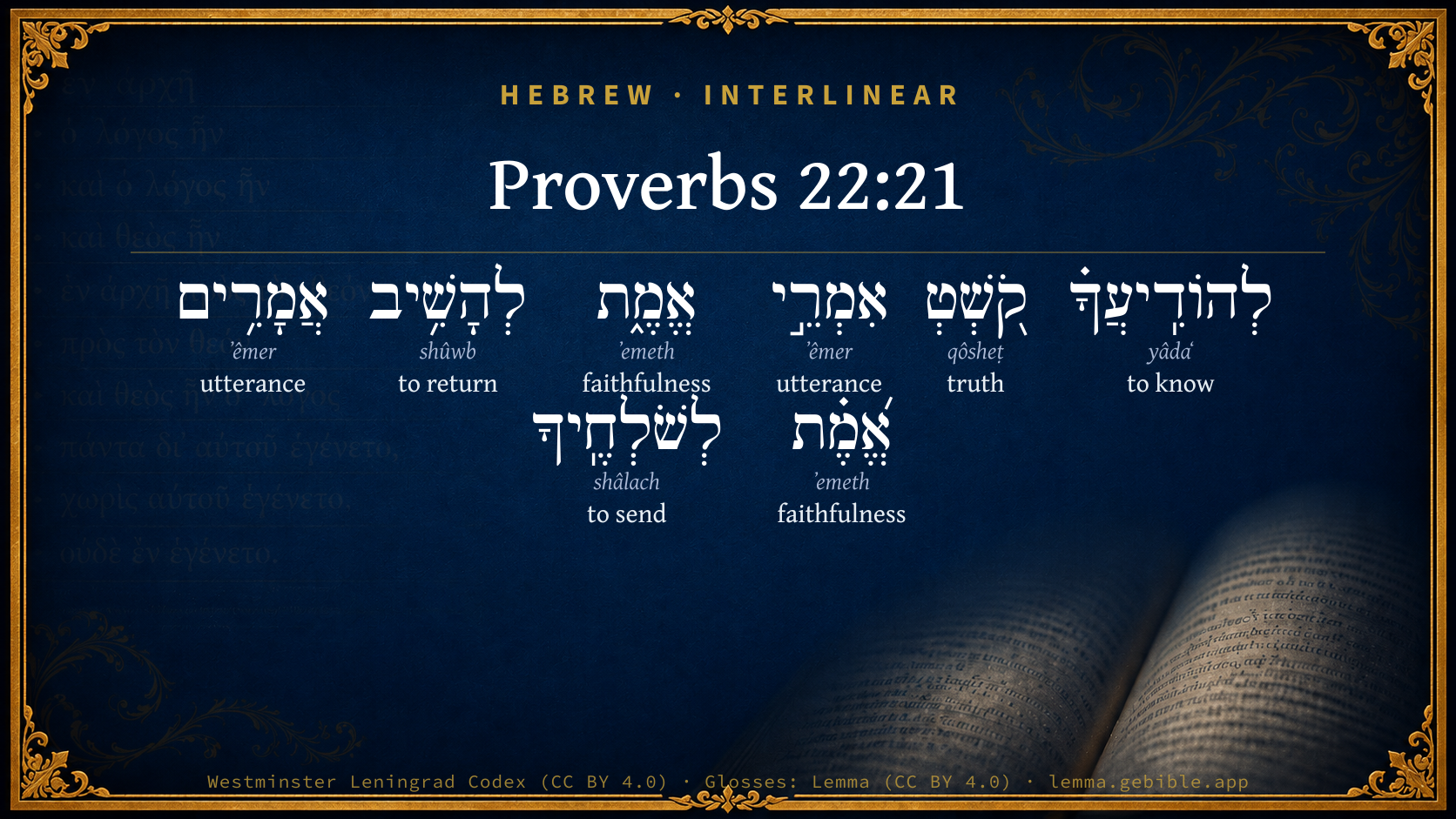
Hebrew (Westminster Leningrad Codex) Proverbs 22:21 appears in the Hebrew Old Testament. The text above is from the Westminster Leningrad Codex. Each word links to its Strong’s number, a concise gloss, and parsing drawn from the Open Scriptures Hebrew Bible morphology. Click any word for its full Brown-Driver-Briggs (BDB) entry.
Download image
Cite this verse

Proverbs 22:21 (World English Bible). Public Domain. Lemma interlinear Bible study tool, https://lemma.gebible.app/v/proverbs/22/21.

Show BibTeX & RIS
BibTeX
RIS
English Translation
To teach you truth, reliable words, To give sound answers to the ones who sent you?
World English Bible · Public Domain
Download a study sheet

One document with this verse’s original text, its word-by-word gloss line, the meaning frame, cross-references with their text, attributed commentary, and full source and license credits — printable, and it pastes into notes with its structure intact.

This verse Autodidact and up

Study sheet (.html) Plain text (.txt)

A passage Seminary Student

Up to 50 verses in one chapter. A passage sheet keeps up to 6 commentary sources and 12 cross-references per verse, in the order this page ranks them, and says so on the sheet whenever that leaves anything out. Ask for a single verse and you get the Autodidact verse sheet above.

Everything on this page stays free to read, with no account — the sheet is a download of what is already on screen, not access to it.

Want to remove ads? Support Godless Engineer
Compare translations 3

The same verse in 3 English versions, stacked beneath the original-language interlinear above. Click any original word for its lexicon entry.

Each is an independent rendering of the whole verse — the interlinear is not word-aligned to these translations.

Highlighted words mark where these versions differ — a whole-verse word diff, not a word-by-word alignment.

  • World English Bible Public Domain
    To teach you truth, reliable words, To give sound answers to the ones who sent you?
  • King James Version Public Domain
    That I might make thee know the certainty of the words of truth; that thou mightest answer the words of truth to them that send unto thee?
  • unfoldingWord Literal Text CC BY-SA 4.0
    to cause you to know the truth of the words of trustworthiness, to return trustworthy words to one who sent you?

unfoldingWord Literal Text — © unfoldingWord, licensed CC BY-SA 4.0. Word-aligned USFM3 via Door43 (git.door43.org/unfoldingWord/en_ult).

Versions to compare (up to 4)

3 of 4 selected

Show all 18 translations

Every available English version of this verse, each an independent rendering of the whole verse.

  • World English Bible Public Domain
    To teach you truth, reliable words, To give sound answers to the ones who sent you?
  • Berean Standard Bible Public Domain
    to show you true and reliable words, that you may soundly answer those who sent you?
  • Majority Standard Bible Public Domain
    to show you true and reliable words, that you may soundly answer those who sent you?
  • King James Version Public Domain
    That I might make thee know the certainty of the words of truth; that thou mightest answer the words of truth to them that send unto thee?
  • American Standard Version (1901) Public Domain
    To make thee know the certainty of the words of truth, That thou mayest carry back words of truth to them that send thee?
  • Revised Version (1885) Public Domain
    To make thee know the certainty of the words of truth, that thou mayest carry back words of truth to them that send thee?
  • Geneva Bible (1599) Public Domain
    That I might shewe thee the assurance of the wordes of trueth to answere the wordes of trueth to them that sende to thee?
  • Douay-Rheims (1899) Public Domain
    That I might shew thee the certainty, and the words of truth, to answer out of these to them that sent thee.
  • Young's Literal Translation Public Domain
    To cause thee to know the certainty of sayings of truth, To return sayings of truth to those sending thee.
  • Literal Standard Version CC BY-SA 4.0
    To cause you to know the certainty of sayings of truth, || To return sayings of truth to those sending you.
  • Unlocked Literal Bible CC BY-SA 4.0
    to teach you truth in these trustworthy words, so you may give trustworthy answers to those who sent you?
  • unfoldingWord Literal Text CC BY-SA 4.0
    to cause you to know the truth of the words of trustworthiness, to return trustworthy words to one who sent you?
  • Darby Bible Public Domain
    that I might make thee know the certainty of the words of truth; that thou mightest carry back words of truth to them that send thee?
  • World Messianic Bible Public Domain
    To teach you truth, reliable words, to give sound answers to the ones who sent you?
  • Webster's Bible Public Domain
    That I might make thee know the certainty of the words of truth; that thou mightest answer the words of truth to them that send to thee?
  • Free Bible Version CC BY-SA 4.0
    They are to make it clear to you what's right and true, so you can give a truthful explanation to those who sent you.
  • Bible in Basic English Public Domain
    To make you see how certain are true words, so that you may give a true answer to those who put questions to you?
  • JPS Tanakh (1917) Public Domain
    That I might make thee know the certainty of the words of truth, that thou mightest bring back words of truth to them that send thee?

Literal Standard Version (2020), Covenant Press — licensed CC BY-SA 4.0. Text via the HelloAO Bible API (eBible.org). Unlocked Literal Bible (unfoldingWord) — licensed CC BY-SA 4.0. Text via the HelloAO Bible API (eBible.org). unfoldingWord Literal Text — © unfoldingWord, licensed CC BY-SA 4.0. Word-aligned USFM3 via Door43 (git.door43.org/unfoldingWord/en_ult). Free Bible Version, Dr. Jonathan Gallagher — licensed CC BY-SA 4.0. Text via the HelloAO Bible API (eBible.org).

Word by word

More ways to search: Search by grammar → Find every occurrence → Compare this word →

Practice this passage: Drill this verse → Learn its vocabulary →

About this verse

These counts appear in no published source. They are computed here, from the morphology-tagged text and Lemma’s own curated glosses. What Lemma adds →

8
words
6
distinct lemmas
Wisdom
section

Notable vocabulary

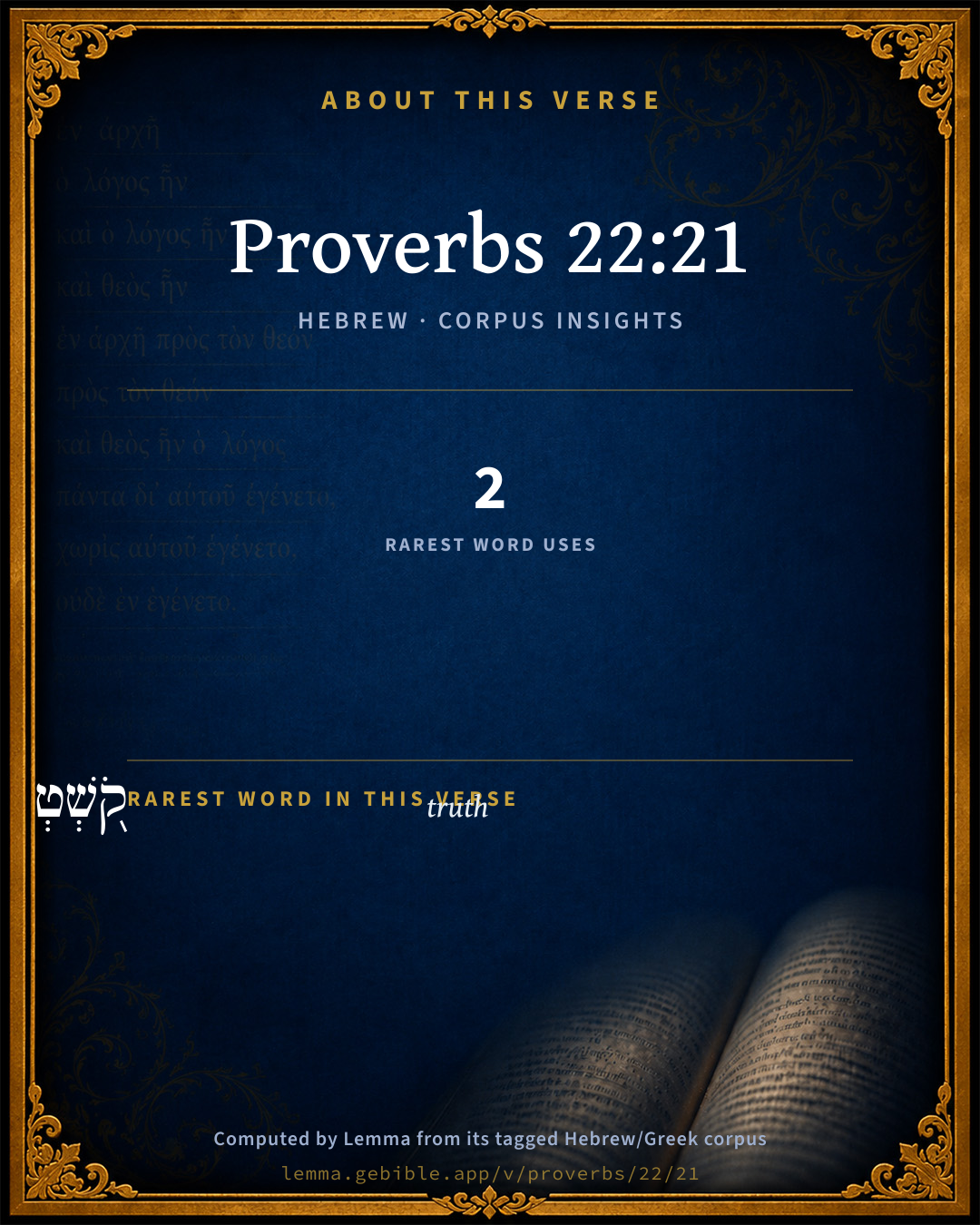
The rarest word here is קֹ֭שְׁטְ truth H7189 — appearing just 2 times in the whole Hebrew Bible.

Shared distinctive vocabulary

קֹ֭שְׁטְ truth H7189 occurs in 2 verses of the Hebrew Bible. Also found in:

Grammatical profile

  • 3 verbs
  • 5 nouns

Verb forms

  • לְהוֹדִֽיעֲךָ֗ Hiphil · Infinitive Construct
  • לְהָשִׁ֥יב Hiphil · Infinitive Construct
  • לְשֹׁלְחֶֽיךָ Qal · Participle Active

Repetition

Words recur within this verse — often emphatic in Hebrew:

  • אִמְרֵ֣י utterance H561 ×2
  • אֱמֶ֑ת faithfulness H571 ×2

Hebrew & Septuagint length

In English translation the verse runs 16 words from the Hebrew and 22 from the Septuagint (LXX English) — closely comparable.

A rough comparison of the two English renderings, which tokenize alike — not a word-level alignment.

Word counts can differ between the Hebrew and the Greek without any difference in meaning — e.g. the Hebrew direct-object marker אֵת has no separate Greek word, and Greek often adds the article ὁ.

Cross-references

4

Topical passages linked to Proverbs 22:21 in the Treasury of Scripture Knowledge — connected by theme and wording, ordered by reader-vote popularity; previews shown in the World English Bible.

  • Luke 1:3–4 it seemed good to me also, having traced the course of all things accurately from the first, to write to you in order, most excellent Theophilus;
  • 1 Peter 3:15 But sanctify the Lord God in your hearts; and always be ready to give an answer to everyone who asks you a reason concerning the hope that is in you, with humility and fear:
  • John 20:31 but these are written, that you may believe that Jesus is the Christ, the Son of God, and that believing you may have life in his name.
  • 1 John 5:13 These things I have written to you who believe in the name of the Son of God, that you may know that you have eternal life, and that you may continue to believe in the name of the Son of God.

Cross-references courtesy of OpenBible.info (CC BY 4.0).

Hebrew and Greek witnesses Masoretic Hebrew ↔ Greek Septuagint

The same verse in the two great witnesses to the Old Testament, shown verse-for-verse.

These are two independent witnesses, not word-aligned to each other, and the Septuagint is shown in lemma (dictionary) form.

Hebrew Proverbs 22:21 Masoretic · Westminster Leningrad Codex

לְהוֹדִֽיעֲךָ֗ קֹ֭שְׁטְ אִמְרֵ֣י אֱמֶ֑ת לְהָשִׁ֥יב אֲמָרִ֥ים אֱ֝מֶ֗ת לְשֹׁלְחֶֽיךָ

To teach you truth, reliable words, To give sound answers to the ones who sent you?

World English Bible · Public Domain

Greek LXX Proverbs 22:21 Septuagint · lemma form

διδάσκω οὖν σύ ἀληθής λόγος καί γνῶσις ἀγαθός ὑποἀκούω ὁ ἀποκρίνω λόγος ἀλήθεια ὁ προβάλλω σύ

I therefore teach you truth, and knowledge good to hear; that you may answer words of truth to them that question you.

LXX2012 (modern English Septuagint) · Public Domain

On this verse, Haydock's Catholic Bible Commentary discusses the Septuagint’s reading. Read the note in Commentary ↓

Hebrew: Westminster Leningrad Codex (CC BY 4.0). Greek: Septuagint (public domain); English from LXX2012 (modern English Septuagint) (Public Domain). How the Septuagint differs from the Hebrew →

Commentary

Notes on Proverbs 22:21 from classic Christian and Jewish commentators (each source and its license shown beneath its notes). The classic Christian expositions comment on the surrounding passage and are grouped to its opening verse, so a note may address several verses; the Jewish commentaries on the Tanakh (Rashi and others) are per-verse, so they appear only where the commentator wrote on this verse.

Lemma curates 59 commentaries, every one of them public domain or Creative Commons licensed, each selected and text-cleaned for this edition rather than reprinted as found. About our sources →

Trapp's Complete Commentary

John Trapp

Pro 22:21 That I might make thee know the certainty of the words of truth; that thou mightest answer the words of truth to them that send unto thee?

Ver. 21. That I might make thee know the certainty.] And so find firm footing for thy faith. {Luk 1:3; Luk 1:5} "These words of God are true," saith the angel. {Rev 21:5} These words are "faithful and true" {Rev 22:6} - void of all insincerity and falsehood. How can it be otherwise, whenas they are, as Gregory {a} speaks, Cor et anima, the very heart and soul of the God of truth? There must needs be a certainty in these words of truth, neither need we hang in suspense. When some took Christ for John Baptist, some for Elias, some for Jeremiah; But "whom say ye that I am?" {Mat 16:14-15} - to teach that Christ would not have men stand doubtful, halt between two, be in religion as beggars are in their way, ready to go which way soever the staff falleth; but to "search the Scriptures," and grounding thereon, to get a certainty, a "full assurance of understanding," {Col 2:2} so as to be able to say, "We have believed, therefore have we spoken." {2Co 4:13}

{a} Greg., in Reg. iii.

John Trapp, A Commentary or Exposition upon All the Books of the Old and New Testament (1647–1656) — public domain. Text from a community e-Sword module.

The Biblical Illustrator

Joseph S. Exell

Pro_22:21

That I might make thee know the certainty of the words of truth.

Certainties

This is an age of inquiry. The ideas of the ancient world are the ideas of the childhood of the race. The Bible is a human book, which we reverence and love as a sacred treasure on account of the Divine spirit which pervades it. Do not place the Bible on the altar of superstition and imagine it to be God. Seek God in it, but with this caution--that all of it is not the actual Word of God. Why should any man seek by unfair means to force another to think as he does? Does not Christ give us an example of mental freedom? He seeks the voluntary and unprejudiced consent of mind, heart, and will.

I. Know the certainty of the words of truth.

1. That God is the heavenly Father of mankind.

2. Our heavenly Father is just, merciful, and loving, and every man may have free access to the great parental heart.

3. Never attempt to escape from any penalty by doing wrong.

II. Wherever there is a penitent soul there is also a kind and forgiving God. Penitence is not perfection.

III. The transgressor must bear the penalty of his sin. It is a just and merciful law of God that the transgressor shall bear the penalty. The Lord Jesus will not save you from the physical penalty of your sin; but He will give you grace to bear the thorn which your own sin has thrust into your life. (William Birch.)

The Biblical Illustrator, edited by Joseph S. Exell (c. 1880s–1900s) — public domain. Text from a community e-Sword module.

Jamieson, Fausset & Brown

Robert Jamieson, A. R. Fausset & David Brown

Specially he desires to secure accuracy, so that his pupil may teach others.

Jamieson, Fausset & Brown — Commentary Critical and Explanatory on the Whole Bible (1871) — public domain (CC PDM 1.0). Text via the HelloAO Bible API.

Adam Clarke's Commentary

Verse 21. That I might make thee know the certainty of the words of truth]

1. These are words or doctrines of truth:

1) They are true in themselves.

2) Come from the God of truth.

3) Are truly fulfilled to all that believe.

2. These words of truth are certain, קשט koshet, they are not of dubious or difficult interpretation; they point directly to the great end for which God gave them; they promise, and they are fulfilled. He who pleads them by faith, receives their accomplishment in the spirit and power of Divine love. The Scriptures, as far as they concern the salvation of the soul, are to be experimentally understood; and, by this experimental knowledge, every believer has the witness in himself, and knows the certainty of the words of truth.

VI. What we know ourselves to be true, and of infinite importance to the welfare of men in general, we should carefully proclaim and witness, that they also may believe.

That thou mightest answer the words of truth]

1. When the doctrine of salvation is preached, there will be many inquirers. What is this doctrine? Have any persons received these blessings-the remission of sins, witness of the Holy Spirit, purification of the heart, c., &c.? Who are they? What are the collateral arguments that prove these things, and show us that you have not misapprehended the meaning of these Scriptures?

2. Inquiries of this kind should meet with the speediest and most distinct answers and the doctrines of truth should be supported and illustrated with the words of truth. "That thou mightest answer the words of truth to them that send unto thee."

Adam Clarke's Commentary on the Bible (1810–1826) — public domain. Text from a community e-Sword/MySword module.

Ellicott's Commentary for English Readers

(21) That thou mightest answer the words of truth to them that send unto thee?—This rendering is somewhat doubtful, but seems to give the best sense to the passage. The scholar is to be instructed not for his own profit alone, but in order that he may be able to teach others also. (Comp. 1Pe_3:15.)

A Bible Commentary for English Readers, edited by Charles John Ellicott (1878–1897) — public domain. Text from a community e-Sword module.

The Cambridge Bible for Schools and Colleges

gen. ed. J. J. S. Perowne

21. send unto thee] Rather, send thee, with A.V. marg. and R.V.

The verse is well rendered in the Rel. Tract. Society’s Annotated Bible:

“To teach thee truth, even words of faithfulness;

That thou mayest bring back faithful words to them that send thee”; i.e. to train thee in truthfulness, that thou mayest be faithful and trustworthy in whatever business thou art employed.

The Cambridge Bible for Schools and Colleges (gen. ed. J. J. S. Perowne; Cambridge University Press, 1878–1918) — public domain. Text from a community e-Sword module.

John Gill's Exposition

That I might make thee know the certainty of the words of truth,.... Such are the doctrines of the Gospel; they are "the words of truth"; are written in the Scriptures of truth; come from the God of truth; the subject matter of which is Christ, who is the truth, and which the Spirit of truth leads into: there is a "certainty" in these; they are in the sure word of prophecy; are contained in the inspired and infallible word of God, and are no other than the Gospel of God; nothing is more sure than that Jesus is the Christ, the Son of the living God, and truly and properly God; and that salvation is alone by him; and that whoever believes in him shall be saved; with many other things, which ministers of the word should affirm with boldness and assurance; and which others may come to a certain knowledge of, even to the riches of a full assurance of understanding; and which is the end of their being written in the word, and made known in the ministry of it;

that thou mightest answer the words of truth to them that send unto thee; or, "return" (e) them to those that send to know what are the words of truth; that inquire concerning them with meekness and fear, and to whom a reason of the hope is to be given; as such are capable of, who have had the certainty of these words made known unto them, or who have been assured of the truth of them: and so Jarchi interprets it, to them that ask of thee instruction; as if it was written, as Lyra says it should, "to them that inquire of thee". It may be rendered, "to them that send thee" (f); to search for those things, and get the knowledge of them, in order to communicate them, which, when obtained, may be done. Unless God, Father, Son, and Spirit, should be intended, who are concerned in the sending of ministers to preach the Gospel to men; to whom they are to return an account of the words of truth, and of their dispensation of them to the souls of men; which when faithfully done, and success, they give up their account with joy, and not with grief.

(e) (f) "qui miserunt te", V. L. "mittentibus te", Pagninus, Montanus, Gejerus, Michaelis, so Aben Ezra; "missoribus tui", Schultens.

John Gill's Exposition of the Whole Bible (1746–1763) — public domain (CC PDM 1.0). Text via the HelloAO Bible API.

Albert Barnes' Notes on the Bible

To them that send unto thee - Better as in the margin; compare Pro 10:26. The man who has learned the certainty of the words of truth will learn to observe it in all that men commit to him.

Albert Barnes' Notes on the Bible (1834–1885) — public domain. Text from a community e-Sword/MySword module.

Haydock's Catholic Bible Commentary

Sent. Septuagint, "are sent to thee." Thou mayst become a teacher, (Haydock) or give satisfaction to thy parents, who have sent thee to my school. (Calmet)

George Leo Haydock (1774–1849), Haydock's Catholic Family Bible and Commentary, 1859 edition — public domain. Excludes Psalms (Douay-Rheims chapter numbering differs from Protestant) and Deuterocanonical books (Catholic canon only).

Matthew Poole's English Annotations

That I may make thee know the certainty of the words of truth; that I may teach thee, not false, or vain, or uncertain things, as the teachers of the heathen nations do, but the true and infallible oracles of God.

That thou mightest answer the words of truth; that being instructed by me, thou mayst be able to give true, and solid, and satisfactory answers.

To them that send unto thee, to wit, for thine advice in great and difficult matters. Or, to those that send thee, i.e. that employ the in any business of moment, whereof they expect an account from thee.

Matthew Poole's English Annotations on the Holy Bible (1683–1685) — public domain. Text from a community e-Sword/MySword module.

Whedon's Commentary on the Bible

Daniel D. Whedon

21. The words of truth — The meaning is commonly supposed to be, that the pupil has been taught to discriminate between that which is true and good on the one hand, and false and evil on the other. So that he shall be capable of giving sound advice to those who consult him, and to manage the most difficult affairs to the satisfaction of those who employ him; as when a person is employed as an ambassador for a prince, or intrusted with any important agency for others.

Them that send unto thee — The marginal reading, “to those that send thee,” is preferred by some interpreters. Compare Pro_10:26; on the last clause, 1Pe_3:15.

Daniel D. Whedon (gen. ed.), Commentary on the Old and New Testaments (1874–1909) — public domain. Text from a community e-Sword module.

The Pulpit Commentary

That I might make thee know the certainty of the words of truth. The object intended is to teach the disciple the fixed rule (firmitatem, Vulgate) by which truthful words are guided. (see Luk_1:4) Septuagint, "I therefore teach thee a true word and knowledge good to learn." That thou mightest answer the words of truth to them that send unto thee. This implies that the pupil will be enabled to teach others who apply to him for instruction; "will be ready." as St. Peter says, "always to give an answer to every man that asketh you a reason of the hope that is in you". (1Pe_3:15) But the last expression is better translated, "them that send thee;" illis qui miserunt te, Vulgate; (see Pro_25:13) and we must conceive of these as being parents or tutors who send a youth to a school or wise man to be educated. The moralist expresses his desire that the disciple will carry home such wholesome, truthful doctrines as will prove that the pains expended upon him have not been useless. Septuagint, "That thou mayest answer words of truth to those who put questions to thee (toiv proballomenoiv soi )" The Syriac adds, "That I may make known unto thee counsel and wisdom." Bickell"s version (quoted by Cheyne) is, "That thou mayest know the rightness of these words, that thou mayest answer in true words to them that ask thee."

The Pulpit Commentary (1880–1919), ed. H.D.M. Spence-Jones & Joseph S. Exell — public domain. Text from a community e-Sword module.

John Wesley's Explanatory Notes

Answer - That thou mayst be able to give solid, and satisfactory answers.

John Wesley, Explanatory Notes Upon the Whole Bible (1754–1765) — public domain. Text via the GEBible commentary corpus.

Kretzmann's Popular Commentary

Paul E. Kretzmann

v. 21. that I might make thee know the certainty, the strict correctness or verity, of the words of truth, that thou, equipped with this knowledge, mightest answer the words of truth to them that send unto thee? The reference is to the parents, who have sent their son to the teacher of wisdom and expect him to become proficient in the principles of true wisdom. After this introductory admonition to heed the precepts of truth the author offers maxims of pious conduct.

Paul E. Kretzmann, Popular Commentary of the Bible (1921–1924) — public domain. Text from a community e-Sword module.

Rashi

Rabbi Shlomo Yitzchaki (Rashi)

to make known to you the certainty I wrote thirds for you in order that you should understand from them the certainty of the true words.

to respond with words of truth to those who send you To those who ask you for instruction.

Rashi on the Tanakh — English translations: “The Judaica Press complete Tanach with Rashi, translated by A. J. Rosenberg” (CC BY 4.0); “Pentateuch with Rashi's commentary by M. Rosenbaum and A.M. Silbermann, 1929-1934” (public domain); “The Metsudah Tanach series, Lakewood, N.J” (CC BY 4.0); and “The Book of Joshua, Metsudah Publications, 1997” (CC BY 4.0). Text via Sefaria.

Lesson kit

Teaching starters — assembled from the data on this page, not authored interpretation. Every prompt links to the verse data it draws on. Edit before teaching.

Proverbs, in the Wisdom, opens this verse with 8 words (6 distinct Hebrew lemmas). Its most distinctive word is qôsheṭ (“truth”). A historical commentator’s framing appears above. Read the whole chapter for the surrounding context.

Discussion questions

  1. What does “truth” (qôsheṭ) contribute to the verse as a whole?
  2. Psalms 60:4 shares the word «truth» with this verse. How do the two illuminate each other?
  3. “utterance” occurs 2× in this one verse. What is the effect of the repetition?
  4. These translations render this verse differently. What is at stake in choosing one wording over another?
  5. The verb «לְהוֹדִֽיעֲךָ֗» is Hiphil Infinitive Construct. How does its form color the action?
  6. Reading how Trapp's Complete Commentary and The Biblical Illustrator read this verse, where do the two commentators agree and where do they part?

Things to notice

  • These translations choose different wording for 22 words in this verse.
  • “utterance” occurs 2× in this single verse.
  • 6 distinct Hebrew lemmas span 8 words in this verse.

Reading settings

Reading text

Shown beneath each verse's original-language words.

Old Testament
Old Testament edition

Read the OT as the Masoretic Hebrew (MT) or the Greek Septuagint (LXX).

English shown for the Greek Septuagint (in the Hebrew ↔ Greek comparison).

Comparing translations? Open the Compare panel on any verse page to stack up to four side by side.