2 Thessalonians 3:14

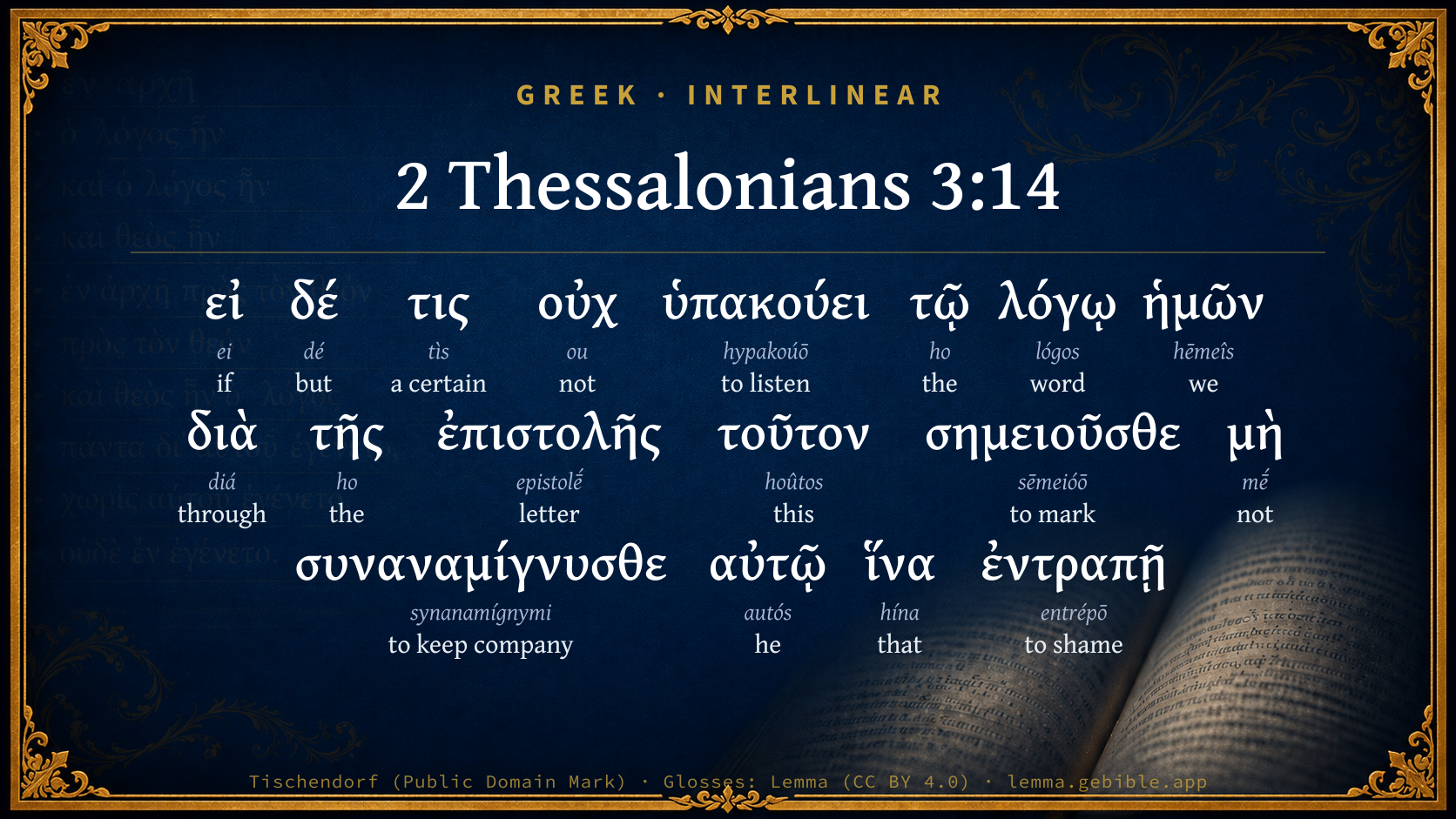
Greek (Tischendorf 8th ed.) 2 Thessalonians 3:14 appears in the Greek New Testament. The text above is from the Tischendorf 8th edition. Each word links to its Strong’s number and a concise gloss. Click any word for its full Thayer’s Greek Lexicon entry.
Download image
Cite this verse

2 Thessalonians 3:14 (World English Bible). Public Domain. Lemma interlinear Bible study tool, https://lemma.gebible.app/v/2-thessalonians/3/14.

Show BibTeX & RIS
BibTeX
RIS
English Translation
If any man doesn't obey our word in this letter, note that man, that you have no company with him, to the end that he may be ashamed.
World English Bible · Public Domain
Highlights
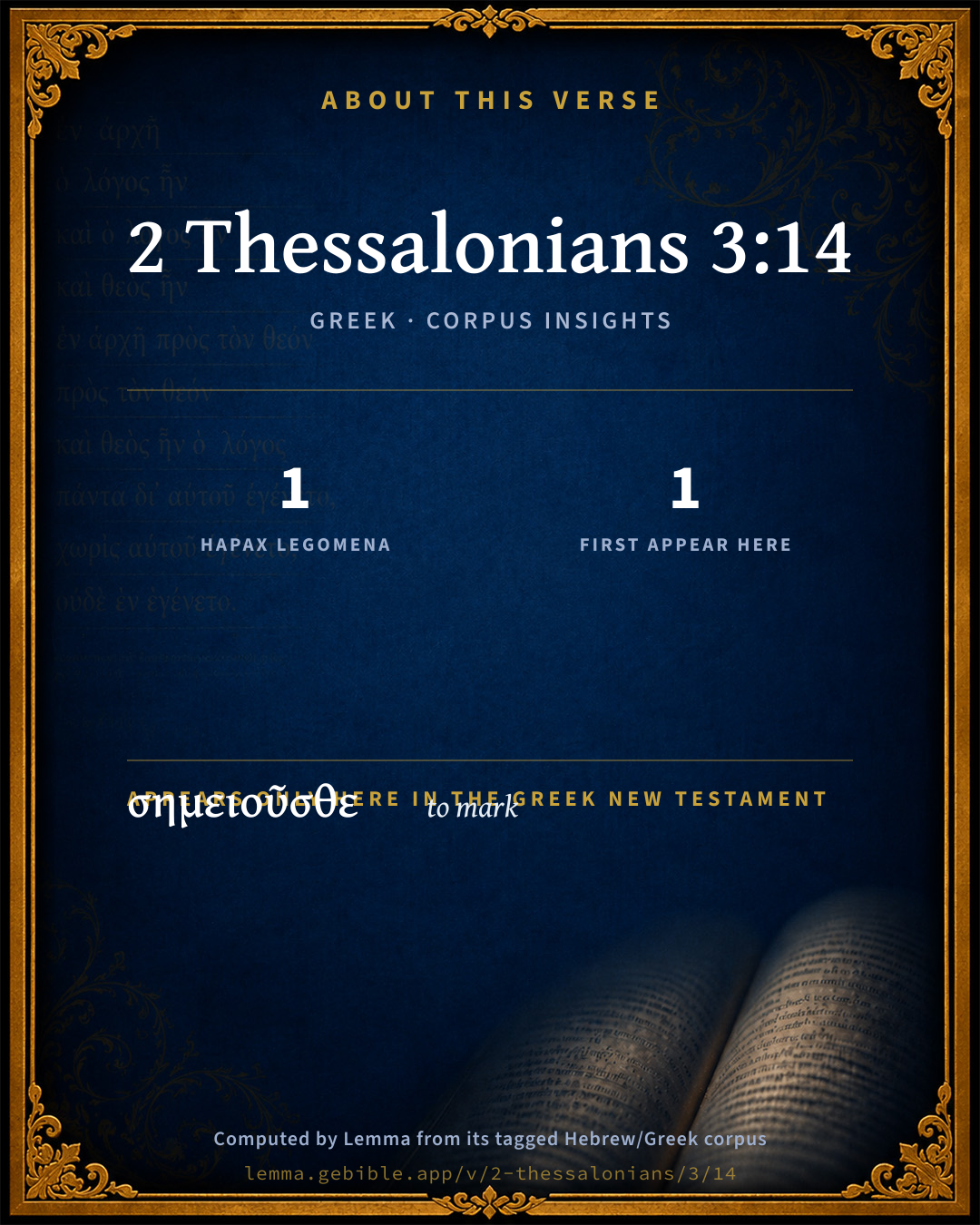
  • 1 hapax legomenon — only here in the Greek New Testament
  • 1 first appearance in the Greek New Testament
Full analysis ↓
Download a study sheet

One document with this verse’s original text, its word-by-word gloss line, the meaning frame, cross-references with their text, attributed commentary, and full source and license credits — printable, and it pastes into notes with its structure intact.

This verse Autodidact and up

Study sheet (.html) Plain text (.txt)

A passage Seminary Student

Up to 50 verses in one chapter. A passage sheet keeps up to 6 commentary sources and 12 cross-references per verse, in the order this page ranks them, and says so on the sheet whenever that leaves anything out. Ask for a single verse and you get the Autodidact verse sheet above.

Everything on this page stays free to read, with no account — the sheet is a download of what is already on screen, not access to it.

Want to remove ads? Support Godless Engineer
Compare translations 3

The same verse in 3 English versions, stacked beneath the original-language interlinear above. Click any original word for its lexicon entry.

Each is an independent rendering of the whole verse — the interlinear is not word-aligned to these translations.

Highlighted words mark where these versions differ — a whole-verse word diff, not a word-by-word alignment.

  • World English Bible Public Domain
    If any man doesn't obey our word in this letter, note that man, that you have no company with him, to the end that he may be ashamed.
  • King James Version Public Domain
    And if any man obey not our word by this epistle, note that man, and have no company with him, that he may be ashamed.
  • unfoldingWord Literal Text CC BY-SA 4.0
    Now if anyone does not obey our word through the letter, note this one—not to associate with him, so that he may be put to shame.

unfoldingWord Literal Text — © unfoldingWord, licensed CC BY-SA 4.0. Word-aligned USFM3 via Door43 (git.door43.org/unfoldingWord/en_ult).

Versions to compare (up to 4)

3 of 4 selected

Show all 19 translations

Every available English version of this verse, each an independent rendering of the whole verse.

  • World English Bible Public Domain
    If any man doesn't obey our word in this letter, note that man, that you have no company with him, to the end that he may be ashamed.
  • Berean Standard Bible Public Domain
    Take note of anyone who does not obey the instructions we have given in this letter. Do not associate with him, so that he may be ashamed.
  • Majority Standard Bible Public Domain
    Take note of anyone who does not obey the instructions we have given in this letter. Do not associate with him, so that he may be ashamed.
  • King James Version Public Domain
    And if any man obey not our word by this epistle, note that man, and have no company with him, that he may be ashamed.
  • American Standard Version (1901) Public Domain
    And if any man obeyeth not our word by this epistle, note that man, that ye have no company with him, to the end that he may be ashamed.
  • Revised Version (1885) Public Domain
    And if any man obeyeth not our word by this epistle, note that man, that ye have no company with him, to the end that he may be ashamed.
  • Geneva Bible (1599) Public Domain
    If any man obey not this our saying in this letter, note him, and haue no company with him, that he may be ashamed:
  • Douay-Rheims (1899) Public Domain
    And if any man obey not our word by this epistle, note that man, and do not keep company with him, that he may be ashamed:
  • Young's Literal Translation Public Domain
    and if any one do not obey our word through the letter, this one note ye, and have no company with him, that he may be ashamed,
  • Literal Standard Version CC BY-SA 4.0
    and if anyone does not obey our word through the letter, note this one, and have no company with him, that he may be ashamed,
  • Unlocked Literal Bible CC BY-SA 4.0
    If anyone does not obey our word in this letter, take note of him and have no association with him, so that he may be ashamed.
  • unfoldingWord Literal Text CC BY-SA 4.0
    Now if anyone does not obey our word through the letter, note this one—not to associate with him, so that he may be put to shame.
  • Darby Bible Public Domain
    But if any one obey not our word by the letter, mark that man, and do not keep company with him, that he may be ashamed of himself;
  • World Messianic Bible Public Domain
    If any man doesn’t obey our word in this letter, note that man and have no company with him, to the end that he may be ashamed.
  • Webster's Bible Public Domain
    And if any man obeyeth not our word by this epistle, note that man, and have no company with him, that he may be ashamed.
  • Free Bible Version CC BY-SA 4.0
    Take note of anyone who doesn't do what we're telling you in this letter, and make sure you don't associate with them, so that they may become embarrassed.
  • Bible in Basic English Public Domain
    And if any man does not give attention to what we have said in this letter, take note of that man, and keep away from him, so that he may be shamed.
  • Text-Critical English NT CC BY 4.0
    If anyone does not obey what we say in this letter, take note of him and do not associate with him, so that he will feel ashamed.
  • Tyndale New Testament (1534) Public Domain
    Yf eny man obey not oure sayinges sende vs worde of him by a letter: and have no companie with him that he maye be ashamed.

Literal Standard Version (2020), Covenant Press — licensed CC BY-SA 4.0. Text via the HelloAO Bible API (eBible.org). Unlocked Literal Bible (unfoldingWord) — licensed CC BY-SA 4.0. Text via the HelloAO Bible API (eBible.org). unfoldingWord Literal Text — © unfoldingWord, licensed CC BY-SA 4.0. Word-aligned USFM3 via Door43 (git.door43.org/unfoldingWord/en_ult). Free Bible Version, Dr. Jonathan Gallagher — licensed CC BY-SA 4.0. Text via the HelloAO Bible API (eBible.org).

Word by word

More ways to search: Search by grammar → Find every occurrence → Compare this word →

Practice this passage: Drill this verse → Learn its vocabulary →

σημειοῦσθε
sēmeióō
G4593
“to mark”
Verb, Present, Middle, Imperative, 2nd person, Plural
Part of Speech
Verb
Tense
Present
Voice
Middle
Mood
Imperative
Person
2nd person
Number
Plural
Full Thayer's Definition

Origin: from G4592

TDNT: 11:25,1

1. to mark, to note, distinguish by marking 2. to mark or note for one's self
  1. εἰ ei G1487 “if” Conditional
  2. δέ dé G1161 “but” Conjunction
  3. τις tìs G5100 “a certain” Indefinite pronoun, Nominative, Singular, Masculine
  4. οὐχ ou G3756 “not” Particle, Negative
  5. ὑπακούει hypakoúō G5219 “to listen” Verb, Present, Active, Indicative, 3rd person, Singular
  6. τῷ ho G3588 “the” Article, Dative, Singular, Masculine
  7. λόγῳ lógos G3056 “word” Noun, Dative, Singular, Masculine
  8. ἡμῶν hēmeîs G2249 “we” Personal pronoun, 1st person, Genitive, Plural
  9. διὰ diá G1223 “through” Preposition
  10. τῆς ho G3588 “the” Article, Genitive, Singular, Feminine
  11. ἐπιστολῆς epistolḗ G1992 “letter” Noun, Genitive, Singular, Feminine
  12. τοῦτον hoûtos G3778 “this” Demonstrative pronoun, Accusative, Singular, Masculine
  13. μὴ mḗ G3361 “not” Particle, Negative
  14. συναναμίγνυσθε synanamígnymi G4874 “to keep company” Verb, Present, Middle or Passive deponent, Imperative, 2nd person, Plural
  15. αὐτῷ autós G846 “he” Personal pronoun, Dative, Singular, Masculine
  16. ἵνα hína G2443 “that” Conjunction
  17. ἐντραπῇ entrépō G1788 “to shame” Verb, Aorist, Passive, Subjunctive, 3rd person, Singular

About this verse

These counts appear in no published source. They are computed here, from the morphology-tagged text and Lemma’s own curated glosses. What Lemma adds →

18
words
17
distinct lemmas
Pauline Epistles
section

Notable vocabulary

1 hapax legomenon — a word that appears only here in the entire Greek New Testament:

  • σημειοῦσθε to mark G4593

First appearance in Scripture

This word makes its first canonical appearance in the Greek New Testament here:

  • σημειοῦσθε to mark G4593

Shared distinctive vocabulary

συναναμίγνυσθε to keep company G4874 occurs in 3 verses of the Greek New Testament. Also found in:

Repetition

A word recurs within this verse:

Cross-references

17

Topical passages linked to 2 Thessalonians 3:14 in the Treasury of Scripture Knowledge — connected by theme and wording, ordered by reader-vote popularity; previews shown in the World English Bible.

  • Titus 3:10 Avoid a factious man after a first and second warning;
  • 1 Corinthians 5:11 But as it is, I wrote to you not to associate with anyone who is called a brother who is a sexual sinner, or covetous, or an idolater, or a slanderer, or a drunkard, or an extortioner. Don't even eat with such a person.
  • 2 Thessalonians 3:6 Now we command you, brothers, in the name of our Lord Jesus Christ, that you withdraw yourselves from every brother who walks in rebellion, and not after the tradition which they received from us.
  • Psalms 83:16 Fill their faces with confusion, That they may seek your name, Yahweh.
  • 1 Thessalonians 4:8 Therefore he who rejects doesn't reject man, but God, who has also given his Holy Spirit to you.
  • Proverbs 5:13 Neither have I obeyed the voice of my teachers, Nor turned my ear to those who instructed me!
  • Jeremiah 6:15 Were they ashamed when they had committed abomination? nay, they were not at all ashamed, neither could they blush: therefore they shall fall among those who fall; at the time that I visit them they shall be cast down, says Yahweh.
  • Zephaniah 3:2 She didn't obey the voice. She didn't receive correction. She didn't trust in Yahweh. She didn't draw near to her God.
  • Romans 16:17 Now I beg you, brothers, look out for those who are causing the divisions and occasions of stumbling, contrary to the doctrine which you learned, and turn away from them.
  • 1 Corinthians 5:9 I wrote to you in my letter to have no company with sexual sinners;
  • Philemon 1:21 Having confidence in your obedience, I write to you, knowing that you will do even beyond what I say.
  • Numbers 12:14 Yahweh said to Moses, If her father had but spit in her face, shouldn't she be ashamed seven days? let her be shut up outside of the camp seven days, and after that she shall be brought in again.
  • Deuteronomy 16:12 You shall remember that you were a bondservant in Egypt: and you shall observe and do these statutes.
  • Ezekiel 16:61–63 Then shall you remember your ways, and be ashamed, when you shall receive your sisters, your elder [sisters] and your younger; and I will give them to you for daughters, but not by your covenant.
  • Matthew 18:17 If he refuses to listen to them, tell it to the assembly. If he refuses to hear the assembly also, let him be to you as a Gentile or a tax collector.
  • 2 Corinthians 2:9 For to this end I also wrote, that I might know the proof of you, whether you are obedient in all things.
  • 2 Corinthians 10:6 and being in readiness to avenge all disobedience, when your obedience will be made full.

Cross-references courtesy of OpenBible.info (CC BY 4.0).

Commentary

Notes on 2 Thessalonians 3:14 from classic Christian and Jewish commentators (each source and its license shown beneath its notes). The classic Christian expositions comment on the surrounding passage and are grouped to its opening verse, so a note may address several verses; the Jewish commentaries on the Tanakh (Rashi and others) are per-verse, so they appear only where the commentator wrote on this verse.

Lemma curates 59 commentaries, every one of them public domain or Creative Commons licensed, each selected and text-cleaned for this edition rather than reprinted as found. About our sources →

The Biblical Illustrator

Joseph S. Exell

2Th_3:14-15

If any man obey not our word by this epistle, note that man

How to deal with the erring

No Christian duty more delicate and difficult than that we owe to the unbelieving, the disobedient, the erring, even for the haters and despisers of Christ and His Church.

1. Note this man. There should be a full realization of his error; no ignoring of it, or acquiescence in it; no belittling of it.

2. We are to note all such, separate ourselves from them, have no fellowship with them. And this implies--

(1) A defence of the truth, a vindication of the right.

(2) A bearing open, faithful witness for Christ, for the Church, etc.

3. But we are not to cast them off--abandon them as hopeless reprobates--withdraw sympathy, anxiety, prayer, effort in their behalf. Count him not as an enemy, but admonish him as a brother. Kindness, gentle entreaty, Christian endeavour, persisted in, may finally make him ashamed, and win him over. Oh, had heretics, schismatics, apostates, erring brethren of every kind, been always dealt with in this Christian way, how different had been the result! It is not too late to begin. (Homiletic Monthly.)

Church discipline

The Revised Version well brings out the meaning--Note that man, that ye have no company with him. It is no mark that is to be set upon him--no stigma, though this as a matter of fact would follow. It is to be a mental marking, and the purpose of it no formal excommunication but an avoidance (2Th_3:6), which would in the nature of things carry with it a kind of ecclesiastical censure and suspension. Thus it appears that such a one sets a mark upon himself. The disorder of his life is the mark of spiritual disease--the beginning of what may end in death. Like the spots on the body, indicating the first stages of the plague, which the Armenians call the pilotti, the pilots or harbingers of death, so upon the character of such unruly ones there are spots, which are pilots of the ruin of the soul. It is therefore dangerous for those who are whole to have company with these; but it is especially needful for the good of the erring brother himself. He may be led in this way to a wholesome shame, which Carlyle has called the soul of all virtues, of all good manners, and good morals. Yet he is still one of them, a brother, notwithstanding the severity of the treatment to which he is to be subjected. He is to be won back in the right way by brotherly admonition. Too harsh chiding, says Gregory Nazianzen, is like an axe which flieth from the handle. It may kill thy brother, when it should only cut down the briars of sin.

A faithful admonisher

Do you know nine-tenths of the trouble in this world is the manifestation of a wrong spirit? There was a man down in Georgia, one of the leading members of the Methodist Church in his place. He paid liberally, was wealthy and respected. There was a renter on his farm who belonged to the same church. They had a quarrel, came to harsh words, almost to blows. On Friday the preacher heard of this difficulty. On Saturday he came to his appointment. He first went to the renter and said, I hear that you and Brother So-and-So have had a difficulty. That wont do for brethren. I want you to agree with me, your pastor, that you will settle it and bury the whole question. I am perfectly willing to do anything that is right about it. I am ashamed of the way I did and talked. I am perfectly willing to do anything that you and the congregation say is right to do. He drove over to the rich mans and said, I understand you had a quarrel or difficulty with another brother of our church. I want you to promise me that you will drop the whole matter, and let us all go along as if nothing had happened. This brother said, That man has treated me badly. I will quit myself if you dont turn him out of the church. The pastor soon saw that he was possessed of a bad spirit. They walked out in the grove together, and the pastor said, Let us pray, and said he, finally, My brother, for the cause of Christ, for the sake of souls and harmony in the church, will you not give me your promise? If you dont turn him out I will never pay another cent. The preacher looked at him and said, I have done my best on you, and unless you become reconciled to your brother I will turn you out, if you paid 1,000,000 dols. a year! That man left the church and became a common drunkard, and has gone to ruin. What was the matter with him? Just a bad spirit. O Lord, create in us a right spirit. If you have a right spirit you will do right. (S. Jones.)

The Biblical Illustrator, edited by Joseph S. Exell (c. 1880s–1900s) — public domain. Text from a community e-Sword module.

The Preacher's Complete Homiletical Commentary

Joseph S. Exell (gen. ed.)

CRITICAL AND EXPLANATORY NOTES

2Th_3:14. Have no company with him.—The difference between this treatment of a delinquent and excommunication may be more in idea than fact. He would feel himself tabooed in either case. But this agrees better with the notion of Christians as being separated. “Come out from among them.” Cf. Tit_2:10. That he may be ashamed.—Not, of course, that he may become a laughing-stock, but that, feeling abashed, he may quickly put himself right with the community.

2Th_3:15. Yet count him not as an enemy.—When Christ says the impenitent brother is to be regarded as a Gentile, He gives no sanction to the way in which the Jew too often regarded the Gentile. Admonish him as a brother.—Who, though in error, has not sacrificed his claim to gentle treatment and consideration.

MAIN HOMILETICS OF THE PARAGRAPH.—2Th_3:14-15

Treatment of the Refractory.

After all the warnings of the apostle against erroneous views and his exhortations to Christian diligence, he foresees there may be some refractory members of the Church who still persist in their extravagances, reject all counsel, and defy all rule and order. In these verses he gives explicit directions how to deal with such. The inveterately lazy are often something worse than lazy, and are not easily reclaimed. When disobedience settles into a habit, stringent measures are necessary to arouse the victim to a sense of duty; and the efforts of restoration must be both resolute and kind.

I. It should be made evident that his conduct is an obstinate defiance of authority.—“And if any man obey not our word by this epistle, note that man” (2Th_3:14). Not only note that his disorderly behaviour is a scandal to Christianity and an example to be avoided, but let it be brought home to him, by direct and faithful dealing, that it is a grave breach of the highest law. We can make nothing of a fool till he is first convinced of his folly. The first step in the process of reformation is conviction of the need of reformation. It is said of Thoreau, the author, that “he was by nature of the opposition; there was a constitutional ‘No’ in him that could not be tortured into ‘Yes.’ ” There are many like him, even in the Christian Church. It may seem a difficult, almost an impossible task, to convince the refractory of his error; but it is the first thing to be done, and persevered in. When the hearers of Austin resented his reproofs, he used to say, “Change your conduct, and I will change my conversation.”

II. With the view of bringing him to repentance he is to be excluded from Christian fellowship.—“And have no company with him, that he may be ashamed” (2Th_3:14). The refractory practically excludes himself from every circle that loves order, harmony, and peace; for who can bear the rasping chatter of an irresponsible gossip who is constantly raking up and turning over everybody’s faults but his own? But the Church must take action unitedly in dealing with the contumacious. He must be deliberately and pointedly shunned, and, when compelled to be in his company, the members must show, by the reserve of their bearing towards him, how deeply he is grieving the hearts of the brethren and sinning against God. In the days when there was only one Church, and exclusion from it was regarded as the greatest calamity and disgrace, the fear of utter excommunication could not fail to have some effect upon those thus threatened with it. Few people can bear the test of being left severely alone. It gives them the opportunity for reflection, remorse, and reform.

III. Efforts should be made in the spirit of Christian brotherhood to effect his recovery.—“Yet count him not as an enemy, but admonish him as a brother” (2Th_3:15). Though shunned and threatened with exclusion from Church fellowship, he is not to be passed by with contemptuous silence. He is not a heretic or a blasphemer, nor is he guilty of any monstrous crime. He is sinning against the good order of society and the peace of the Church. He is still a brother, troublesome and unreasonable though he be; and while there is the least hope of his restoration, he should be faithfully admonished. He is not to be accused and slandered to outsiders; this will only aggravate his riotousness and make him more defiant. He must be seen privately and spoken to faithfully, but with the utmost tenderness. The Christian spirit teaches us to be discreet in all things, and especially in administering reproof. Virtue ceases to be virtuous when it lacks discretion, the queen of ethics. “To be plain,” writes Felltham, “argues honesty; but to be pleasing argues discretion. Sores are not to be anguished with rustic pressure, but gently stroked with a ladied hand. Physicians fire not their eyes at patients, but minister to their diseases. Let reproof be so as the offender may see affection, without arrogancy.”

Lessons.—

1. It is an important part of Church discipline to control the unruly.

2. It is in the power of one discontented person to work much mischief.

3. Church discipline must be administered with fidelity and Christian tenderness.

GERM NOTES ON THE VERSES

2Th_3:14-15. The Disobedient—

I. Should be specially noted.

II. Should not be admitted to intimate friendship without repentance.

III. Should be kindly but faithfully admonished.

2Th_3:14. Obedience should be prompt.—When a large passenger steamer was sinking, the question whether scores of her passengers and crew would be saved or drowned was settled within fifteen minutes. And millions have decided the momentous question of their eternal salvation or perdition in even less time than that. It seems to have been short work with Simon Peter when Jesus bade him quit the nets and follow Him. Peter obeyed at once. Prompt obedience honours God. It puts the soul immediately within the Almighty’s hold; and when Jesus has His omnipotent grasp of love upon me, none shall be able to pluck me out of His hands. Prompt obedience saves.—Cuyler.

The Preacher's Complete Homiletical Commentary (gen. ed. Joseph S. Exell; Funk & Wagnalls, c. 1892) — public domain (pre-1929). A full-Bible homiletical/sermon-outline anthology covering 65 of 66 books (2 John is absent from the source module). Text from a community e-Sword module.

Tyndale Open Study Notes

Tyndale Open Resources

3:14 Paul hoped that the disobedient Christians would be ashamed and repent (see study note on 3:6) in response to being shunned by the community.

Tyndale Open Study Notes — © Tyndale Open Resources, licensed CC BY-SA 4.0. Text via the HelloAO Bible API.

Bengel's Gnomon

Johann Albrecht Bengel

2Th 3:14.[30] Διὰ τῆς ἐπιστολῆς τοῦτον σημειοῦσθε, note this man by (this) letter) This same epistle is meant; comp. 1Th 5:27, where the article has the same demonstrative meaning: σημειοῦσθε, mark, with a note of censure; using this epistle for the sake of admonishing him, and inculcating it upon him. Comp. ויהיו לנם, καὶ ἐγενήθησαν ἐν σημείῳ (said of Korah and his company), and they became a sign, Num 26:10. The signification of the verb ΠΑΡΑΔΕΙΓΜΑΤΊΖΕΙΝ is akin to this. It may be done to others either by letters, if they are in a foreign land, or face to face, if present. This diversity of circumstances does not alter the meaning.—ἽΝΑ ἘΝΤΡΑΠῇ) that, having seen the judgment of others (respecting him), he may humble himself [be ashamed, Engl. Vers.]. נכנעו they humbled themselves, 2Ch 12:7.

[30] Τῷ λόγῳ ἡμῶν, our word) already spoken, ver. 10.—V. g.

Bengel's Gnomon of the New Testament — English translation (T&T Clark, Edinburgh, 1860) — public domain. Text from a community e-Sword module.

Meyer's Critical & Exegetical Commentary

Heinrich August Wilhelm Meyer

2Th_3:14. Διὰ τῆς ἐπιστολῆς] is, by Nicolas de Lyra, Luther, Calvin, Musculus, Hemming, Bullinger, Lucius Osiander, Balduin, Grotius, Calovius, Clericus, Sebastian Schmid, Bengel, Moldenhauer, Zachariae, Koppe, Krause, Pelt, Winer, p. 108 [E. T. 147], and others, united with what follows. It is usually explained: If any obey not my word, note that man to me in writing, sc. in order that I may direct what punishment is to be inflicted on him. But this interpretation is to be rejected(1) on account of the article τῆς, which, if unforced, can only denote a definite epistle lying before them, not an epistle to be written only at a later period; (2) as the inversion of the words: διὰ τῆς ἐπιστολῆς τοῦτον σημειοῦσθε, instead of the natural order: τοῦτον διὰ τῆς ἐπιστολῆς σημειοῦσθε, would not be justified; (3) lastly, because it is very improbable that Paul should still have retained for himself a statement of the punishment, as he has already in 2Th_3:6 stated the mode of punishment, and again repeated it in this verse, commanding them to withdraw from the society of every brother acting contrary to his admonitions. But interpretations in this connection, as that of Bengel: notate notâ censoriâ, hanc epistolam, ejus admonendi causa, adhibentes eique inculcantes, ut, aliorum judicio perspecto, se demittat, or that of Pelt: eum hac epistola freti severius tractate, alter the idea of the verb σημειοῦσθαι. We are obliged to unite διὰ τῆς ἐπιστολῆς with τῷ λόγῳ ἡμῶν. So, correctly, Chrysostom, Clarius, Estius, Piscator, Andrew Osiander, Aretius, Menochius, Vorstius, Cornelius a Lapide, Beza, Fromond., Hammond, Nat. Alexander, Joachim Lange, Harduin, Whitby, Benson, Bolten, Flatt, Schott, Olshausen, de Wette, Baumgarten-Crusius, Bloomfield, Alford, Ewald, Bisping, Buttmann, Gramm. des neutest. Sprachgebr. p. 80 [E. T. 92]; Hofmann, Riggenbach, and others. It was not necessary to repeat the article τῷ before διὰ τῆς ἐπιστολῆς, because τῷ λόγῳ ἡμῶν διὰ τῆς ἐπιστολῆς is blended into the unity of the idea of a written command. Comp. Winer, p. 123 [E. T. 169]. ἡ ἐπιστολή denotes the definite Epistle, i.e. our Second Epistle to the Thessalonians (comp. 1Th_5:27; Rom_16:22; Col_4:16); and the command expressed by that Epistle is the admonition in 2Th_3:12. The meaning is: But if any one acts contrary to my prohibition repeated in this Epistle, note that man, i.e. mark him, sc. in order to avoid intercourse with him (comp. 1Co_5:9; 1Co_5:11), and thereby to bring him to shame (and amendment); as Paul, explaining himself, expressly adds: καὶ μὴ συναναμίγνυσθε αὐτῷ, ἵνα ἐντραπῇ. This meaning also remains, if, instead of the Receptus καὶ μὴ συναναμίγνυσθε, we read, with Lachmann and Tischendorf 1, after A B D* א, the infinitive μὴ συναναμίγνυσθαι, only the form of expression being changed.

ἐντραπῇ] is passive, not middle (Pelt). Comp. Tit_2:8; 1Co_4:14; 1Co_6:5; 1Co_15:24.

Meyer — Critical and Exegetical Commentary on the New Testament — English translation by Peter Christie, edited by Frederick Crombie (T&T Clark, 1880) — public domain. Text from a community e-Sword module.

Expositor's Greek Testament

ed. W. Robertson Nicoll

2Th 3:14 . διὰ τ . ἐπ ., implying that the matter ends with this letter (Weiss); Paul has spoken his last word on the subject. With this and the following verse, cf. Did. xv. 3 ( ἐλέγχετε δὲ ἀλλήλους μὴ ἐν ὀργῇ ἀλλʼ ἐν εἰρήνῃ , ὡς ἔχετε ἐν τῷ εὐαγγελίῳ · καὶ παντὶ ἀστοχοῦντι κατὰ τοῦ ἑτέρου μηδεὶς λαλείτω μηδὲ παρʼ ὑμῶν ἀκουέτω , ἕως οὗ μετανοήσῃ ). ἐντραπῇ , “be ashamed” (= αἰδεῖσθαι as often).

The Expositor's Greek Testament, edited by W. Robertson Nicoll (1897–1910) — public domain. Text from a community e-Sword module.

Geneva Bible (1599)

Geneva Bible translators

The end of the excommunication is not the destruction, but the salvation of the sinner, that at least through shame he may be driven in repentance.

Excommunication is a punishment for the obstinate.

We must have no familiarity nor fellowship with the excommunicate.

Geneva Bible (1599) marginal notes — public domain. Text via Bolls.life.

Jamieson, Fausset & Brown

Robert Jamieson, A. R. Fausset & David Brown

note that man--mark him in your own mind as one to be avoided (Th2 3:6).

that he may be ashamed--Greek, "made to turn and look into himself, and so be put to shame." Feeling himself shunned by godly brethren, he may become ashamed of his course.

Jamieson, Fausset & Brown — Commentary Critical and Explanatory on the Whole Bible (1871) — public domain (CC PDM 1.0). Text via the HelloAO Bible API.

Adam Clarke's Commentary

Verse 14. If any man obey not] They had disobeyed his word in the first epistle, and the Church still continued to bear with them; now he tells the Church, if they still continue to disregard what is said to them, and particularly his word by this second epistle, they are to mark them as being totally incorrigible, and have no fellowship with them.

Some construe the words δια της επιστολης with τουτον σημειουσθε. Give me information of that man by a letter-let me hear of his continued obstinacy, and send me his name. This was probably in order to excommunicate him, and deliver him over to Satan for the destruction of the body, that the spirit might be saved in the day of the Lord Jesus. The words of the original will bear either construction, that in the text, or that given above.

Adam Clarke's Commentary on the Bible (1810–1826) — public domain. Text from a community e-Sword/MySword module.

John Calvin's Commentaries

14 If any one obeys not. He has already declared previously, that he commands nothing but from the Lord. Hence the man, that would not obey, would not be contumacious against a mere man, but would be rebellious against God himself; and accordingly he teaches that such persons ought to be severely chastised. And, in the first place, he desires that they be reported to him, that he may repress them by his authority; and, secondly, he orders them to be excommunicated, that, being touched with shame, they may repent. From this we infer, that we must not spare the reputation of those who cannot be arrested otherwise than by their faults being exposed; but we must take care to make known their distempers to the physician, that he may make it his endeavor to cure them.

Keep no company. I have no doubt that he refers to excommunication; for, besides that the (ἀταξία) disorder to which he had adverted deserved a severe chastisement, contumacy is an intolerable vice. He had said before, Withdraw yourselves from them, for they live in a disorderly manner, (2 Thessalonians 3:6.) And now he says, Keep no company, for they reject my admonition. He expresses, therefore, something more by this second manner of expression than by the former; for it is one thing to withdraw from intimate acquaintance with an individual, and quite another to keep altogether aloof from his society. In short, those that do not obey after being admonished, he excludes from the common society of believers. By this we are taught that we must employ the discipline of excommunication against all the obstinate persons who will not otherwise allow themselves to be brought under subjection, and must be branded with disgrace, until, having been brought under and subdued, they learn to obey.

That he may be ashamed. There are, it is true, other ends to be served by excommunication — that contagion may spread no farther, that the personal wickedness of one individual may not tend to the common disgrace of the Church, and that the example of severity may induce others to fear, (1 Timothy 5:20;) but Paul touches upon this one merely — that those who have sinned may by shame be constrained to repentance. For those that please themselves in their vices become more and more obstinate: thus sin is nourished by indulgence and dissimulation. This, therefore, is the best remedy — when a feeling of shame is awakened in the mind of the offender, so that he begins to be displeased with himself. It would, indeed, be a small point gained to have individuals made ashamed; but Paul had an eye to farther progress — when the offender, confounded by a discovery of his own baseness, is led in this way to a full amendment: for shame, like sorrow, is a useful preparation for hatred of sin. Hence all that become wanton must, as I have said, be restrained by this bridle, lest their audacity should be increased in consequence of impunity.

John Calvin's Commentaries (1540-1563) — public domain. Text from the Calvin Translation Society English edition (1840s-50s) via the Christian Classics Ethereal Library (ccel.org). Calvin's coverage is partial (roughly two-thirds of the Bible); uncommented books and verses are honest gaps, never fabricated. The 19th-century editor's footnotes and remarks are omitted so the notes are faithfully Calvin's own voice.

Ellicott's Commentary for English Readers

(14) And if any man,—An appeal to the rightminded, not only to persevere themselves, but to join with the overseers of their Church in enforcing discipline, as in 1Th_5:12-15.

By this epistle.—Rightly rendered. The marginal version, “by an Epistle,” is impossible, for in the Greek the definite article appears. It might, if the context suited, be attached to the following clause, instead of the foregoing, and translated, “by means of the Epistle signify that man,” meaning “in your answer.” But there is nothing to show that St. Paul was expecting any answer; and, for another thing, he has given them full directions for dealing with the case themselves, so that it would be superfluous to send the particulars to St. Paul. For several other weighty reasons it is best to attach the words to the hypothetical clause; and the sense will be, “There can be no excuse now. It was possible to forget or misinterpret our verbal tradition, painstaking and definite though it was; possible also to ignore the example which we set; but now you have it in black and white, and the man who does not submit to our directions in this form must be visited severely.” There are at least three places besides this in St. Paul’s writings where “the Epistle” stands absolutely for “the present Epistle,” viz., Rom_16:22; Col_4:16; 1Th_5:27; possibly a fourth might be added, 1Co_5:9; only once in a very clear context it refers to a former Letter (2Co_7:8).

Note that man.—The reflexive voice of the verb implies mutual warning against him: “Agree to set a mark upon him, to make a marked man of him.” The notion is that of making him easily recognisable, so that no Christian should “have company” with him unawares. (Comp. Gen_4:15.) The word and the thought in Rom_16:17 are slightly different. The best text goes on abruptly, without conjunction: “Note that man; have no company with him.” This social extrusion from good men’s conversation, not to speak of the Sacraments, would, to a Christian in a heathen city, be indeed a delivering to Satan, a thrusting into outer darkness.

That he may be ashamed—i.e., put to shame. Comp. 1Co_6:5; 1Co_15:34; Tit_2:8; and (for the end to be served by this shame) the first clause of the Commination of Sinners.

A Bible Commentary for English Readers, edited by Charles John Ellicott (1878–1897) — public domain. Text from a community e-Sword module.

The Cambridge Bible for Schools and Colleges

gen. ed. J. J. S. Perowne

14. And if any man obey not our word by this epistle] More strictly, But if any one obeys not, &c. As the writer passes, by a contrasting But in 2Th_3:13, from the disorderly fraction to the well-conducted majority of the Church, so he returns again from the latter to the former, in order to give his final directions concerning them. “Obeys not” (indicative): the Apostle is not providing for a contingency, but dealing with the existing case. The matter is put, according to the Greek epistolary idiom, from the standpoint of the readers. The letter has been read to the assembled Church; the disorderly have received the Apostle’s message; some acknowledge their fault, and submit; others—one or more—are still refractory; and he tells the Church how it must now proceed.

“Our word through the Epistle,”—i.e. what we say by this letter. Word and Epistle were distinguished in ch. 2Th_2:2; 2Th_2:15, here identified; the letter has the force and authority of the writer’s spoken word (see note on ch. 2Th_2:15).

note that man, and have no company with him] Better reading: note that man, that ye have no company with him (R.V.); i.e., “mark him as a man with whom you are not to associate,”—literally, not to be mixed up with him: comp. the use of the same verb in 1Co_5:9; 1Co_5:11. The “noting,” one imagines, would be effected by publicly naming the culprit in the Church as one disobedient to the Apostle’s command.

This “mark” set on the obstinate breaker of rule is intended for his good—to the end that he may be ashamed (R.V.), or abashed. This is all the punishment desired for him. If shame is awakened in him, when he finds himself condemned by the general sentiment and left alone, this may be the beginning of amendment. Compare the directions given in the extreme case of offence at Corinth, 2Co_2:6-8. The door for repentance is left wide open.

The Cambridge Bible for Schools and Colleges (gen. ed. J. J. S. Perowne; Cambridge University Press, 1878–1918) — public domain. Text from a community e-Sword module.

John Gill's Exposition

And if any man obey not our word,.... Of command, to work quietly, and eat his own bread, now signified "by this epistle", particularly in Th2 3:12,

note that man; some read this clause in connection with the preceding phrase, "by this epistle", or by an epistle; and so the Ethiopic version, "show", or "signify him by an epistle"; that is, give us notice of it by an epistle, that we may take him under our cognizance, and severely chastise him, according to the power and authority given us by Christ; but that phrase rather belongs to the preceding words: and the clause here respects the notice the church should take of such a person; not in a private way, or merely by way of admonition and reproof, such as is given before rejection from communion; but by the black mark of excommunication; lay him under censure, exclude him from your communion, put a brand upon him as a scabbed sheep, and separate him from the flock; and so the Syriac version renders it, "let him be separated from you" and this sense is confirmed by what follows,

and have no company with him; as little as can be in common and civil conversation, lest he should take encouragement from thence to continue in his sin, and lest others should think it is connived at; and much less at the Lord's table, or in a sacred and religious conversation, or in a way of church fellowship and communion:

that he may be ashamed; that he may have his eyes turned in him, as the word signifies, and he may be brought to a sight and sense of his sin, and be filled with shame for it, and loath it, and himself on the account of it, and truly repent of it, and forsake it; and this is the end of excommunication, at least one end, and a principal end of it, to recover persons out of the snare of the devil, and return them from the error of their ways: so the Jews say (s),

"in matters of heaven (of God or religion), if a man does not return privately, they "put him to shame" publicly; and publish his sin, and reproach him to his face, and despise and set him at nought until he returns to do well.''

(s) Maimon, Hilch. Deyot, c. 6. sect. 8.

John Gill's Exposition of the Whole Bible (1746–1763) — public domain (CC PDM 1.0). Text via the HelloAO Bible API.

Albert Barnes' Notes on the Bible

And if any man obey not our word by this epistle - Margin, “or signify that man by an epistle.” According to the marginal reading this would mean “signify, mark out, or designate that man to me by an epistle.” The difference is merely whether we unite the words “by the epistle” with what goes before, or what follows. The Greek would admit of either construction (Winer, p. 93), but it seems to me that the construction in the text is the correct one, because:

(1)The requirement was to proceed to discipline such a man by withdrawing from him;

(2)In order to do this it was not necessary that the case should be made known to Paul, for there was no supposable difficulty in it, and the effect would be only needless delay;

Paul regarded the right of discipline as residing in the church itself, and did not require that cases should be referred to him to determine; see the notes on 1Co 5:2-4.

(4)Though the Greek will admit of either construction, yet it rather favors this; see Oldhhausen, in loc. Note that man. The word here used, means to mark; to sign; to note with marks; and the idea is, set such a mark upon him that he shall be shunned; that is, withdraw all Christian fellowship from him.

And have no company with him - The Greek word here means, to mix up together; then to mingle together with; to have contact with. The idea is that they were not to mingle with him as a Christian brother, or as one of their own number. They were not to show that they regarded him as a worthy member of the church, or as having a claim to its privileges. The extent of their discipline was, that they were to withdraw from him; see the 2Th 3:6 note, and Mat 18:17 note; compare 2Jo 1:10-11.

Albert Barnes' Notes on the Bible (1834–1885) — public domain. Text from a community e-Sword/MySword module.

Haydock's Catholic Bible Commentary

Here the apostle teaches that our pastors must be obeyed, and not only secular princes; and with respect to such as will not be obedient to their spiritual governors, the apostle, (as St. Augustine affirmeth) ordains that they be corrected by admonition, by degradation, or excommunication. (Cont. Donat. post Callat. chap. iv. 20. & lib. de correp. & grat. chap. iii.)

George Leo Haydock (1774–1849), Haydock's Catholic Family Bible and Commentary, 1859 edition — public domain. Excludes Psalms (Douay-Rheims chapter numbering differs from Protestant) and Deuterocanonical books (Catholic canon only).

Matthew Poole's English Annotations

Here we have further commandments given concerning the disorderly; in case of obstinacy, to proceed further against them. The apostle had given commandments about their walking in his first preaching to them, after that he repeats them in his First Epistle, and again in this Second.

And now if any man obey not our word by this epistle, saith he, note that man; and he would have none excepted, either through fear or favour, and nothing done by partiality, 1Ti 5:21. What is meant by noting is disputed among expositors; more seems to be meant than marking them, Rom 16:17. Some take it for what we call excommunication; so Aug. lib. 3, Cont. Epist. Parmen. cap. 4. Theophyl. in locum; either the casting him out of the church, which is the greater, or suspension from the Lord’s supper, which is the lesser. As there were degrees of church censure among the Jews, so also we read practised in the gospel church, as is evident in the councils. Others think it is no more than a withdrawing from him, as was mentioned before, 2Th 3:6; but then the apostle saith the same thing over again, which seemeth needless. And he speaks here of some greater contumacy than before, when his word in this Second Epistle is not obeyed. We may suppose the apostle may mean not only a withdrawing from familiarity with him, but exposing his name to some public notice in the church, that both his crime and his name should be publicly noticed; as the apostle speaks of Hymeneus and Alexander, and Philetus, by name in his Epistles that were made public. σημειουσθε, note him by a sign, as the word signifies, which cannot well be done by a mere withdrawing. And seeing he speaks here of one that is not only disorderly, but obstinate, some further and more signal act of discipline is to be inflicted on him. And what word the apostle refers to in this Epistle as not obeyed is not expressed, neither need we limit it, but it may be meant of all his commandments herein, to which obedience was required. And the word, as written, is the word of God, and is to be obeyed as well as that which is preached. I know there is another reading of the text: If any man obey not our word, note that man by an epistle; and so it is in our margins. But this is not probable. By an epistle? To whom? To the apostle himself? And for what? To know how to proceed towards such a one? What need that, when he here gives direction about it to them; which follows.

And have no company with him; or be not mingled with him, which refers either to his crime, as the Greek word is so applied, Eph 5:11, or to his person also, as the word is used, 1Co 5:9. And yet some think the apostle here forbids only civil communion, not sacred, because the word in the text is generally so used, and so rendered by expositors; but sacred communion is expressed in the New Testament by another word, 1Jo 1:3. And if meant of sacred, it is then casting him out of the church, which is a delivering him up to Satan: see Estius in loc. And that seems not to agree with what follows:

Admonish him as a brother; and so not to be accounted as a heathen or a publican, Mat 18:17. And we know admonition goes before casting out. But to be thrust out of the company of the people of God in all civil, friendly society, is a great punishment and affliction. And some think, that the noting of him was to be done by the governors of the church, and the renouncing his company, by all the people: let the reader judge.

That he may be ashamed: the end of both is here expressed. This is not added before as a reason of withdrawing, and therefore some think the apostle required that only to avoid the infection of sin by familiar society; but this further proceeding here mentioned is to make the man ashamed that is obstinate in disobedience; but we need not so limit it. And this making him ashamed is not to be out of hatred to his person, but for his good, as all church censures ought to be so intended, to bring him to that shame that may be the first step to true repentance. There is a shamefulness in sin; and when sinners repent, they see it, and are ashamed, Isa 1:29; Eze 16:61; Rom 6:21; and God complains of sinners when not ashamed, Jer 3:3. Shame is a natural affection in men, and is not in the nature of beasts, neither was it in man before the fall; and though in itself it is no virtue, being the proper effect of sin, yet it is of use to restrain much open wickedness, and to keep decorum in men’s outward actions: and God makes use of it also in leading men to true repentance. To shame men out of envy or hatred is sinful, and against the law of charity; but to do it to bring them to repentance, is better than by flattery or familiar society to harden them in sin.

Matthew Poole's English Annotations on the Holy Bible (1683–1685) — public domain. Text from a community e-Sword/MySword module.

Whedon's Commentary on the Bible

Daniel D. Whedon

14. Note—Literally, set a mark upon. Make him a “marked man.” Let him be viewed by both the world and himself as disowned by the Church.

No company—Avoid such association with him as identifies him with the Church.

May be ashamed—The feeling proper for conduct which is a violation of Christian honour and self-respect, and conducive to the appropriate spirit of repentance.

Daniel D. Whedon (gen. ed.), Commentary on the Old and New Testaments (1874–1909) — public domain. Text from a community e-Sword module.

The Pulpit Commentary

And if any man obey not our word by this Epistle, note that man. Some attach the words, "by this Epistle," to" note that man," and render the clause, "Note that man by an epistle to me." Thus Calvin: "He desires that they may be reported to him, that he may reprove them by his authority." So also in the margin of our A.V: "Signify that man by an epistle." But the presence of the article denoting a definite Epistle, "this Epistle," and the order of the words in the Greek, are against this interpretation. Others render the clause, "Note that man by this Epistle;" point out to him the injunctions and the warnings which are contained in it against such a line of conduct; but such a meaning is too artificial. It is better, therefore, to attach the words, "by this Epistle," to "our word," as in the A.V: "If any man obey not our word by this Epistle." "Note that man;" that is, set a mark upon him, note him for the sake of avoidance, excommunicate him from your society. And have no company with him. Exclude him from your fellowship meetings, your love feasts. That he may be ashamed; the design or object of thus noting him. As if the apostle had said, "Bring the force of Christian opinion to bear upon him. Show your moral indignation by excluding him from the Christian community." The noting or excommunicating was more of the nature of a correction than of a punishment, and its design was the reclaiming of the offender.

Vers. 14, 15.

The true spirit of faithful dealing with an erring brother.

The apostle returns to this subject again.

I HIS REITERATED COMMAND. "If any man obey not our word by this Epistle, note that man, and have no company with him." Let him be a marked man, like a leper in your midst, standing wholly isolated in a heathen city. This would be a social extrusion deeply felt by a "brother" who would be cut off from the cordial greetings of the Church.

II THE DESIGN OF THIS SOCIAL EXCOMMUNICATION. "That he may be ashamed." It is not "for destruction," but for edification; it is to bring the offender to a due sense of his sin, and to a resolution for its abandonment.

III THE SPIRIT IN WHICH THE COMMAND IS TO BE CARRIED OUT. "Yet count him not as an enemy, but admonish him as a brother.

1. It is an injunction not to regard him as your enemy, or as an enemy of Christ, as if he had denied the faith, or sunk into profligacy, or relapsed into heathenism. There must be neither hostility nor carelessness on your side, but rather "the love that suffereth long, and is kind.

2. It is an injunction to affectionate admonition. "But admonish him as a brother." How this would be consistent with the withdrawal of all intercourse it is unnecessary to speculate. There was to be a faithful dealing with him that he might be won back, and "Satan have no advantage" over him. T.C.

Church discipline.

There are several references to Church discipline in the writings of St. Paul, showing that he was desirous to see order and a healthy character of Church life maintained among his readers. In an earlier verse of the present chapter (ver. 6) he advises the Thessalonians to withdraw themselves "from every brother that walketh disorderly;" now he bids them not keep company with those who refuse to obey his apostolic message.

I IDLENESS IS AN OFFENCE HEAVY ENOUGH TO MERIT CHURCH DISCIPLINE. The preceding verses show that St. Paul has in mind those idle busybodies who walked disorderly (ver. 11, etc.). We visit dishonesty, intemperance, etc., with censure. The apostle goes further, and selects idleness for special notice by the Church. So great does he feet the evil of it to be.

II NEGLECT OF APOSTOLIC INJUNCTIONS IS THE IMMEDIATE OCCASION FOR THE EXERCISE OF CHURCH DISCIPLINE. The idle are first to be admonished (ver. 12). When admonition fails, further measures must be taken. The apostles had no ambition to be lords over Christ"s heritage; though their commanding influence naturally gave great weight to their directions, similar to that which comes unsought to the European missionary among converts from heathen savagery, Nevertheless, it was not this adventitious authority that St. Paul relied upon. He wrote under inspiration. His message was prompted by the Divine Spirit. When we refuse to hearken to the admonitions of the New Testament we are resisting the Holy Spirit of God.

III CHURCH DISCIPLINE IS TO BE EXERCISED BY MEANS OF QUIET SEPARATION. There is no word here of physical force. It was impossible for a Christian community living in a pagan city to call in the aid of the civil power to execute its decrees; but there is every reason to believe that, had the possibility of anything of the kind been contemplated in the mind of St. Paul, he would have repudiated it holding as he did that his weapons were not carnal. Further, there is no reference to spiritual excommunication, no cursing with bell and book. Simple separation is all that is advised. This is a peaceful, gentle, but effective mode of censure. It would, of course, directly stop the evil practice of idlers living on the Church funds. And it would administer a rebuke that would be all the more eloquent that it was silent. It is always our duty to see that our Church fellowship is kept pure. We should have the courage to separate from those who disgrace the Christian name. We should be careful for our own sakes that the society we select to move in is healthy and elevated in moral tone. For the sake of others we should discourage unworthy conduct by refusing to associate with those who are guilty of it. Some who are not brave enough to do this are guilty of great meanness in talking against offenders behind their backs, while treating them in the most friendly way when in their presence.

IV THE OBJECT OF CHURCH DISCIPLINE IS TO RECOVER THE OFFENDER. The most stern penalties are to be inflicted with a merciful end. Here the mild punishment of quiet separation is to aim at restoring the wrong doer. First he is to be shamed, as he will be if there be any right spirit in him. Men should feel ashamed of idleness. Then and throughout he is to be regarded, not as an enemy, but only as an erring brother. Thus tender and sympathetic should Christians be with one another in regard to their failings, remembering that it is only through the forgiving grace of Christ that any of us enjoy the privileges of Christianity. There is no room for a Pharisee in the Church, and we must beware lest the exercise of Church discipline develop his ugly spirit. W.F.A.

The Pulpit Commentary (1880–1919), ed. H.D.M. Spence-Jones & Joseph S. Exell — public domain. Text from a community e-Sword module.

John Wesley's Explanatory Notes

Have no company with him - No intimacy, no familiarity, no needless correspondence.

John Wesley, Explanatory Notes Upon the Whole Bible (1754–1765) — public domain. Text via the GEBible commentary corpus.

Godbey's Commentary on the New Testament

William B. Godbey

ARGUMENT 10

CURE FOR HERESY

14. “If any one does not hearken to our Word through the epistle, spot him; have no fellowship with him, in order that he may be ashamed.” All the doctrines of grace in the Bible are beautifully focalized in the apostolical epistles. Consequently these plain, concise, inspired letters give you a miniature Bible, infinitely to your convenience and profit. Suppose this law were enforced in the Churches of the present day, what would become of bejeweled, gaudily-appareled, frolicking anti-holiness members? They would move out like a landslide, leaving the faithful few, who, like Zacharias and Elisabeth, “are walking in all the commandments and ordinances blameless.” We never can redeem the Church from sin, Satan, and hell, unless we enforce New Testament discipline. It is the imperative duty of every pastor this day to read these letters to every member, and see that they accept them, and govern their lives accordingly, with a distinct understanding that all recusants and delinquents forfeit their membership. Paul even obligated the Thessalonians, in a sacred oath, to read these letters to every member. What will the pastors do in judgment-day, when God shall hold them to a strict account for the souls committed to their care, whom they, by willful neglect of known duty, have permitted to slip through their fingers into hell? Here we see a plain commandment in the New Testament, to withhold fellowship from every brother and sister who do not hearken to the plain Word of God revealed in the Bible.

15. “Do not treat him as an enemy, but admonish him as a brother.” This excommunicated man is your brother in Adam, and may, by the grace of God, become your brother in Christ. Hence, when non-fellowshiped for disobedience, do not give him up, but pray for him and admonish the more faithfully that the Lord may use the severity of Church discipline to convict him and bring him to repentance.

17. These people had been troubled with a false letter by an enemy, bearing Paul’s counterfeit signature. Therefore, when Luke wrote the letters responsive to his dictation, Paul gave his autograph.

18. This benediction is commendable for its beauty, brevity, and grace. Use it freely in the dismission of your meetings.

William B. Godbey, Commentary on the New Testament (1896–1900) — public domain. Text from a community e-Sword module.

McGarvey & Pendleton's Commentaries

J. W. McGarvey

And if any man obeyeth not our word by this epistle, note that man, that ye have no company [fellowship] with him, to the end that he may be ashamed . [By noting your moral indignation, and seeing his conduct repudiated by the church.]

J. W. McGarvey (with Philip Y. Pendleton), Commentaries on the New Testament (The Fourfold Gospel, 1914; Acts; and the epistles) — public domain. Text from a community e-Sword/MySword module.

The People's New Testament

B. W. Johnson

14–16. If any man obey not. Whoever does not obey these charges, let him be noted, withdrawn from. See verse 6. He must be made ashamed of his course by seeing that it is repudiated by the church.

B. W. Johnson's The People's New Testament with Notes (1889–1891) — public domain. Electronic text from the Christian Classics Ethereal Library (CCEL) ThML edition.

Cambridge Greek Testament for Schools and Colleges

14. B and a number of minuscules read (λογῳ) υμων for ημων; Thphyl quotes Chr, seemingly by error, to the same effect. B makes the same senseless mistake in 2Co 6:11.

σημειουσθαι, in אD*GP 17, cop go. The confusion of -ε and -αι is the commonest of itacisms (“innumeris locis promiscue ponuntur,” Tischdf); the spelling of such verb-forms is no index to their grammatical meaning.

συναναμιγνυσθαι: so in אABGgr 17 (Dgr*, which must be peculiar, -μισγεσθαι); -σθε, in Db, cKLP &c. and versions. Dgr*GKLP &c. introduce και before μη συναναμ., understanding the verb surely as imperative, despite the -σθαι of D* and G. Cf. the notes on 2Th 2:2 and 1Th 5:13 above, and the Expository Note on this verse below.

14. εἰ δέ τις οὐχ ὑπακούει τῷ λόγῳ ἡμῶν διὰ τῆς ἐπιστολῆς. But if any one is disobeying our word (sent) through this letter. Remembering the neglect of the former admonition (1Th 4:11 f.), the writers anticipate that this remonstrance may be disregarded by some of the offenders. The matter is put, according to Greek epistolary idiom, from the readers’ standpoint—in present time. The Letter has been read in the assembly; the ἄτακτοι have received the Apostolic message; the Church appeals to them; some acknowledge their fault and promise amendment; one or more, it is feared, will prove refractory, giving no sign of obedience: the Church must now deal with these. Εἰ with present indicative assumes an existing case; see note on εἴ τις οὐ θέλει, 2Th 3:10—also on the use of οὐ rather than μή: the stronger particle assumes a positive refusal of obedience.

Διὰ τῆς ἐπιστολῆς qualifies the verbal noun λόγῳ—“our word (spoken, addressed to him) through the Epistle”: cf. note on the two nouns in 2Th 2:15. The λόγος in question is specifically the pointed command and appeal of the last verse. Ἡ ἐπιστολή, “the (present) letter,” as in 1Th 5:27; Rom 16:22; Col 4:16, &c.

Διὰ τῆς ἐπιστολῆς is attached by some of the older commentators to σημειοῦσθε—“note this man through letter (scil. to us),” as though the Thessalonians were instructed to send to the Apostles the names of recusants in writing; “eos vult apud se deferri” (Calvin). But the position of the clause, the use of the definite article, and the scope of the context are against this reading of the verse. The purpose of the σημειοῦσθαι is not to inform the Apostles at a distance, but to prevent συναναμίγνυσθαι on the spot. The διά clause insists that the “word conveyed by letter” shall take effect just as though it were directly uttered; see again note on εἴτε διὰ λόγου εἴτε διʼ ἐπιστολῆς ἡμῶν, 2Th 2:15.

τοῦτον σημειοῦσθε, μὴ συναναμίγνυσθαι αὐτῷ, take note of this man, not to associate with him—literally, “not to mix-up-along with him”: the same double compound is used in 1Co 5:9; 1Co 5:11; ἀναμίγνυσθαι is classical Greek in this sense; συναναμίγνυσθαι appears in the κοινή. Σημειοῦσθαι (middle), N.T. hap. leg.—“to put a mark upon”, or “make a note of, for oneself”—is another word of the κοινή (Attic ἀποσημαίνεσθαι). The “nothing”, one imagines, would be effected by publicly naming the culprit in the Church as thus under censure.

ἵνα ἐντραπῇ, that he may be abashed. Ἐντρέπομαι (cf. 1Co 4:14; Tit 2:8; Luk 18:2, &c.) is passive, signifying “to be turned in (upon oneself)”; the idiom only appears in later Greek. This is all the punishment desired, at least in the first instance; the door is left open for repentance. The direction of 1Co 5:13 is far sterner, as the offence was more heinous. Cf. the treatment of the later case of discipline (surely different from that of 1 Corinthians 5) at Corinth in 2Co 2:6-8.

Cambridge Greek Testament for Schools and Colleges (Cambridge University Press, 1896; 21 vols, various authors incl. Carr, Maclear, Plummer, Farrar, Lumby, Moule, M. R. James, Simcox) — public domain. Text from a community e-Sword module.

Alford’s Greek Testament

Henry Alford

14.] Many Commentators (Luth., Calv., Grot., Calov., Le Clerc, Beng., Pelt, Winer, al.) have joined διὰ τῆς ἐπιστολῆς with what follows, and explained it (usually, see below),—‘note that man by an Epistle (to me).’ But τῆς is decidedly against this rendering,—unless we suppose that it signifies ‘your’ answer to this. (Bengel and Pelt, taking τῆς ἐπ. for this Epistle, would render, ‘notate nota censoria, hanc Epist., ejus admonendi causa, adhibentes eique incultantes’ (Beng.),—‘Eum hac epistola freti severius tractate’ (Pelt): but both these require σημειοῦσθε to be diverted from its simple meaning.) The great objection to the above connexion is that St. Paul has already pointed out the manner of treating such an one, ver. 6, and is not likely to enjoin a further reference to himself on the subject. It is far better therefore, with Chrys. (there seems no reason for qualifying this by apparently, as Ellic), Est., Corn.-a-lap., Beza, Hamm., Whitby, Schott, Olsh., De W., Baum.-Crus., Lün., Ellic., all., to join διὰ τῆς ἐπ. with the preceding τῷ λόγ. ἡμ., and render it our word by this Epistle, as ἡ ἐπιστολή is undoubtedly used in reff., and the word is that in ver. 12.

σημειοῦσθε] mark, see ref. Polyb.: the ordinary meaning of the word: put a σημεῖον on him, by noticing him for the sake of avoidance. On what is called the dynamic middle, see Krüger, Sprachlehre, § 52. 8. 4.

Henry Alford, The Greek Testament (1849–1861) — public domain. Text from a community e-Sword module.

International Critical Commentary

14. εἰ δέ τις κτλ Anticipating the probability (cf. I 5:27) that some of the idlers would refuse to obey his evangelic utterance (τῷ λόγῳ ἡμῶ referring especially to v. 12) expressed in this letter, he orders the brethren, if the case should arise, to proceed to discipline, not with a view to excluding the disobedient among the idlers from the brotherhood, but in the hope of inducing them to repent and amend their idle ways. (1) First of all, he commands: σημειοῦσθ, “designate that man.” Just how they are to note him, whether in writing or by naming him publicly at a meeting, is not explained. (2) Then with an infinitive for an imperative (Rom 12:15, Php 3:16), he continues, interpreting the στέλλεσθα of v. 6: μὴ συναναμίγνυσθαι αὐτῷ, “let there be no intimate association with him.” The advance from νουθετεῖ (I 5:14) to “hold aloof from,” “do not associate with,” is necessary, and the severer measures are justified. It will be remembered that Paul had given orders to the idlers when he was present (v. 10, I 4:11), had repeated them in the first epistle (I 4:11-12; cf. 5:14), and has just reiterated them in a conciliatory manner in vv. 6-12 (cf. vv. 1-5), hinting at the same time (v. 13) that the majority must be tactful in their treatment of their delinquent brothers. If, however (εἰ δε), in spite of all this, some of the idle brothers persist in disobeying his orders as conveyed by letter (I 5:27), then they must be deprived of intimate association with the rest of their fellows (cf. 1Co 5:9. 1Co 5:11). But even so, absolute separation from the companionship of the brethren is not in mind; for Paul does not add here, as he does in 1Co 5:11, the μηδὲ συνεσθίει; and above all he does add here the significant v. 15. (3) Finally, the purpose of the discipline is explicitly mentioned, ἵνα ἐντραπῇ “that he may be shamed.” Reformation, not exclusion from the brotherhood, is intended.

ὁ λόγος ἡμῶ (2Co 1:18) could be the equivalent of τὸ εὐκγγέλιον ἡμῶ (2:1); here, however, it refers most probably to that element of the message of the gospel which is specified in v. 12. The obedience required (cf. Php 2:12) is not to Paul’s word as such but to his word as inspired by Christ (ἐν κυρίῳ v. 12). B, et al., read ὑμῶ for ἡμῶ; cf. Bא in 2Co 6:11 (καρδία ὑμῶ)—διὰ τῆς ἐπιστολῆ refers naturally to the present letter (so most from Chrys. and Th. Mops. to Dob.); but the presence of the article (τῆ) is not conclusive for this interpretation, as 1Co 5:10 shows. However, were Paul alluding to a letter that the converts are to send him (Erasmus, Calv., Grot., et al.), there would be no point in specifying the procedure to be followed (Lün.); and furthermore in that case we should expect σημειοῦσθε τοῦτον διʼ ἐπιστολῆ (GF omit τῆ). The phrase διὰ ἐπιστολῆ is to be joined closely with τῷ λόγῳ ἡμῶ, the article τῷ being supplied on the analogy of I 1:1 ἐκκλησίᾳ (τῇ) ἐν θεῷ—On εἰ δέ τι, cf. v. 10; for the condition, see BMT 242.—σημειοῦσθκ (BA have the imperative; אDGFP the infinitive) is found elsewhere in Gk. Bib. only Psa 4:7; it occurs in Polybius and Philo; and frequently in papyri, of the signature in writing (e. g. P. Oxy. 42, 5:8 (a.d. 323) σεσημείωμαι ἐμῇ χειρι). See further, 1 Clem. 43:1, and Sophocles, Lex. sub voc.—συναναμίγνυσθα is found elsewhere in the Gk. Bib. only 1Co 5:9, 1Co 5:11, Hos 7:8 (A) Eze 20:18 (A). The command is not direct “don’t you associate,” but indirect “let there be no intimate association with him.” BאA, et al., read the infinitive (not of purpose, but equivalent to an imperative); EKLP, et al., have the imperative. To relieve the asyndeton, GFKLP, et al., insert και before μη In Hos 7:8, Eze 20:18, B has the imperative, AQ the infinitive.—ἐντρέπει occurs in Gk Bib. only 1Co 4:14; the more common ἐντρέπεσθα is used either absolutely or with the accus. (Mar 12:6, Luk 18:2 Sap. 2:10, 7:6, etc.); for the passive here, compare the refrain in Psa 34:4, Psa 69:2 (39:15) αἰσχυνθείησαν καὶ ἐντρατείησα

International Critical Commentary — older volumes (1896–1929), various authors — public domain. Text from a community e-Sword module.

Vincent's Word Studies in the New Testament

Marvin R. Vincent

By this epistle. Connect with our word. The message we send in this letter. Not, as some, with the following words, note that man in your epistle.

Note [σημειουσθε] . N. T. o. Lit. set a mark on. The nature of the mark is indicated in the next clause.

Have no company with [μη συναναμιγνυσθαι] . P o. See on 1Co 5:9.

Be ashamed [εντραπη] . See on Mt 21:37, and 1Co 4:14.

Marvin R. Vincent, Word Studies in the New Testament (1887–1900) — public domain. Text from a community e-Sword/MySword module.

Lesson kit

Teaching starters — assembled from the data on this page, not authored interpretation. Every prompt links to the verse data it draws on. Edit before teaching.

2 Thessalonians, in the Pauline Epistles, opens this verse with 18 words (17 distinct Greek lemmas). Its most distinctive word is sēmeióō (“to mark”). A historical commentator’s framing appears above. Read the whole chapter for the surrounding context.

Discussion questions

  1. How does “to mark” (sēmeióō) shape what this verse is saying?
  2. This verse holds 1 word here found nowhere else in the Greek New Testament. What might the rare word draw attention to?
  3. The word “to mark” first appears here in Scripture. What is being introduced at this debut?
  4. 1 Corinthians 5:9 shares the word «to keep company» with this verse. How do the two illuminate each other?
  5. “the” occurs 2× in this one verse. What is the effect of the repetition?
  6. These translations render this verse differently. What is at stake in choosing one wording over another?
  7. Reading how The Biblical Illustrator and The Preacher's Complete Homiletical Commentary read this verse, where do the two commentators agree and where do they part?

Things to notice

  • 1 word in this verse appears nowhere else in the Greek New Testament.
  • 1 word makes its first canonical appearance in Scripture here.
  • These translations choose different wording for 18 words in this verse.
  • “the” occurs 2× in this single verse.
  • 17 distinct Greek lemmas span 18 words in this verse.

Reading settings

Reading text

Shown beneath each verse's original-language words.

Old Testament
Old Testament edition

Read the OT as the Masoretic Hebrew (MT) or the Greek Septuagint (LXX).

English shown for the Greek Septuagint (in the Hebrew ↔ Greek comparison).

Comparing translations? Open the Compare panel on any verse page to stack up to four side by side.