Colossians 3:20

Greek (Tischendorf 8th ed.) Colossians 3:20 appears in the Greek New Testament. The text above is from the Tischendorf 8th edition. Each word links to its Strong’s number and a concise gloss. Click any word for its full Thayer’s Greek Lexicon entry.
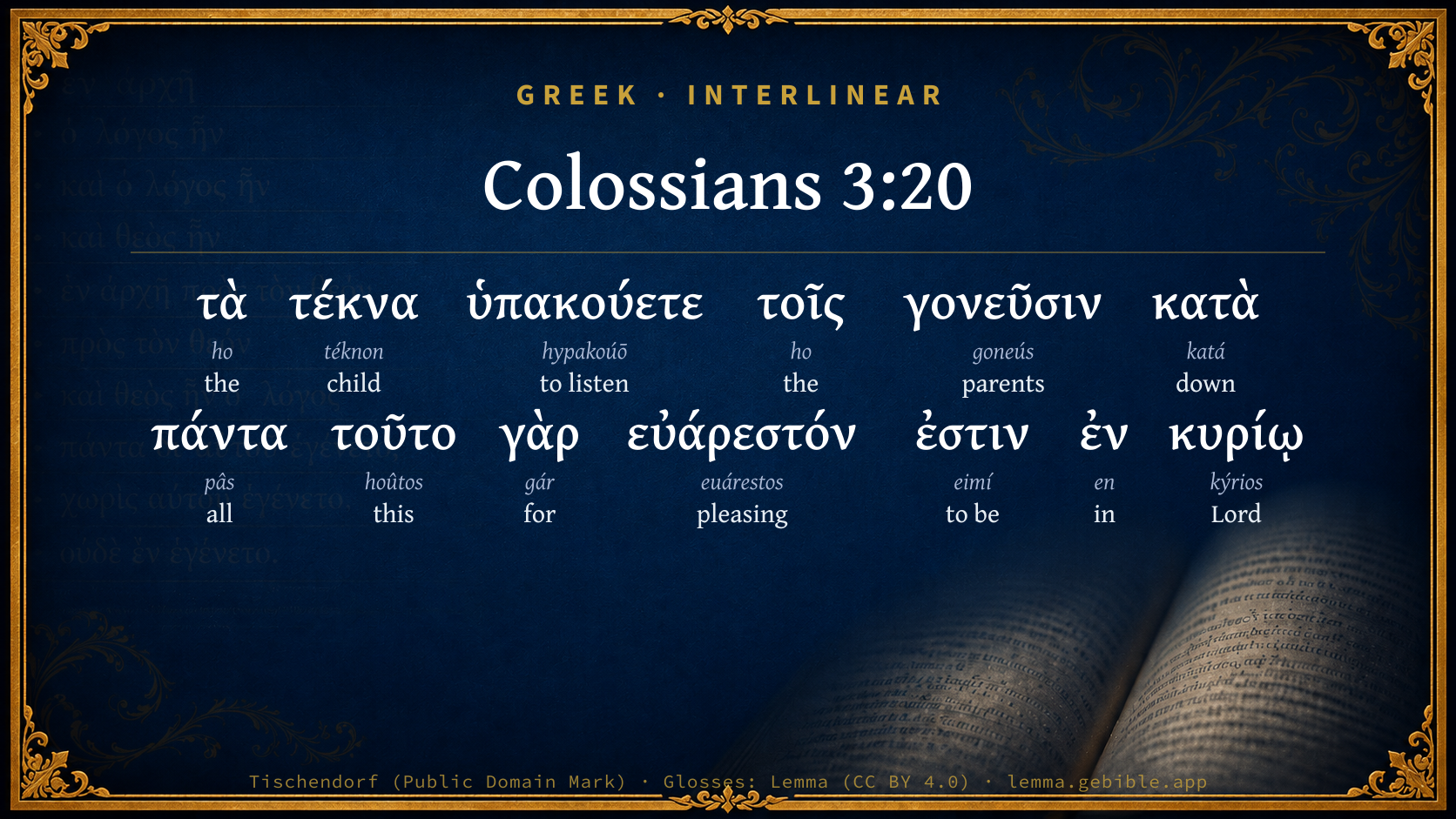
Download image
Cite this verse

Colossians 3:20 (World English Bible). Public Domain. Lemma interlinear Bible study tool, https://lemma.gebible.app/v/colossians/3/20.

Show BibTeX & RIS
BibTeX
RIS
English Translation
Children, obey your parents in all things, for this pleases the Lord.
World English Bible · Public Domain
Download a study sheet

One document with this verse’s original text, its word-by-word gloss line, the meaning frame, cross-references with their text, attributed commentary, and full source and license credits — printable, and it pastes into notes with its structure intact.

This verse Autodidact and up

Study sheet (.html) Plain text (.txt)

A passage Seminary Student

Up to 50 verses in one chapter. A passage sheet keeps up to 6 commentary sources and 12 cross-references per verse, in the order this page ranks them, and says so on the sheet whenever that leaves anything out. Ask for a single verse and you get the Autodidact verse sheet above.

Everything on this page stays free to read, with no account — the sheet is a download of what is already on screen, not access to it.

Want to remove ads? Support Godless Engineer
Compare translations 3

The same verse in 3 English versions, stacked beneath the original-language interlinear above. Click any original word for its lexicon entry.

Each is an independent rendering of the whole verse — the interlinear is not word-aligned to these translations.

Highlighted words mark where these versions differ — a whole-verse word diff, not a word-by-word alignment.

  • World English Bible Public Domain
    Children, obey your parents in all things, for this pleases the Lord.
  • King James Version Public Domain
    Children, obey your parents in all things: for this is well pleasing unto the Lord.
  • unfoldingWord Literal Text CC BY-SA 4.0
    Children, obey your parents in all things, for this is pleasing in the Lord.

unfoldingWord Literal Text — © unfoldingWord, licensed CC BY-SA 4.0. Word-aligned USFM3 via Door43 (git.door43.org/unfoldingWord/en_ult).

Versions to compare (up to 4)

3 of 4 selected

Show all 19 translations

Every available English version of this verse, each an independent rendering of the whole verse.

  • World English Bible Public Domain
    Children, obey your parents in all things, for this pleases the Lord.
  • Berean Standard Bible Public Domain
    Children, obey your parents in everything, for this is pleasing to the Lord.
  • Majority Standard Bible Public Domain
    Children, obey your parents in everything, for this is pleasing to the Lord.
  • King James Version Public Domain
    Children, obey your parents in all things: for this is well pleasing unto the Lord.
  • American Standard Version (1901) Public Domain
    Children, obey your parents in all things, for this is well-pleasing in the Lord.
  • Revised Version (1885) Public Domain
    Children, obey your parents in all things, for this is well-pleasing in the Lord.
  • Geneva Bible (1599) Public Domain
    Children, obey your parents in all thing for that is well pleasing vnto the Lord.
  • Douay-Rheims (1899) Public Domain
    Children, obey your parents in all things: for this is well pleasing to the Lord.
  • Young's Literal Translation Public Domain
    the children! obey the parents in all things, for this is well-pleasing to the Lord;
  • Literal Standard Version CC BY-SA 4.0
    the children: obey the parents in all things, for this is well-pleasing to the LORD;
  • Unlocked Literal Bible CC BY-SA 4.0
    Children, obey your parents in all things, for this is pleasing in the Lord.
  • unfoldingWord Literal Text CC BY-SA 4.0
    Children, obey your parents in all things, for this is pleasing in the Lord.
  • Darby Bible Public Domain
    Children, obey your parents in all things, for this is well-pleasing in [the] Lord.
  • World Messianic Bible Public Domain
    Children, obey your parents in all things, for this pleases the Lord.
  • Webster's Bible Public Domain
    Children, obey your parents in all things: for this is well-pleasing to the Lord.
  • Free Bible Version CC BY-SA 4.0
    You children, always do what your parents tell you because this is what pleases the Lord.
  • Bible in Basic English Public Domain
    Children, do the orders of your fathers and mothers in all things, for this is pleasing to the Lord.
  • Text-Critical English NT CC BY 4.0
    Children, obey your parents in everything, for this pleases the Lord.
  • Tyndale New Testament (1534) Public Domain
    Children obey youre fathers and mothers in all thinges for that is wel pleasynge vnto the lorde.

Literal Standard Version (2020), Covenant Press — licensed CC BY-SA 4.0. Text via the HelloAO Bible API (eBible.org). Unlocked Literal Bible (unfoldingWord) — licensed CC BY-SA 4.0. Text via the HelloAO Bible API (eBible.org). unfoldingWord Literal Text — © unfoldingWord, licensed CC BY-SA 4.0. Word-aligned USFM3 via Door43 (git.door43.org/unfoldingWord/en_ult). Free Bible Version, Dr. Jonathan Gallagher — licensed CC BY-SA 4.0. Text via the HelloAO Bible API (eBible.org).

Word by word

More ways to search: Search by grammar → Find every occurrence → Compare this word →

Practice this passage: Drill this verse → Learn its vocabulary →

About this verse

These counts appear in no published source. They are computed here, from the morphology-tagged text and Lemma’s own curated glosses. What Lemma adds →

13
words
12
distinct lemmas
Pauline Epistles
section

Notable vocabulary

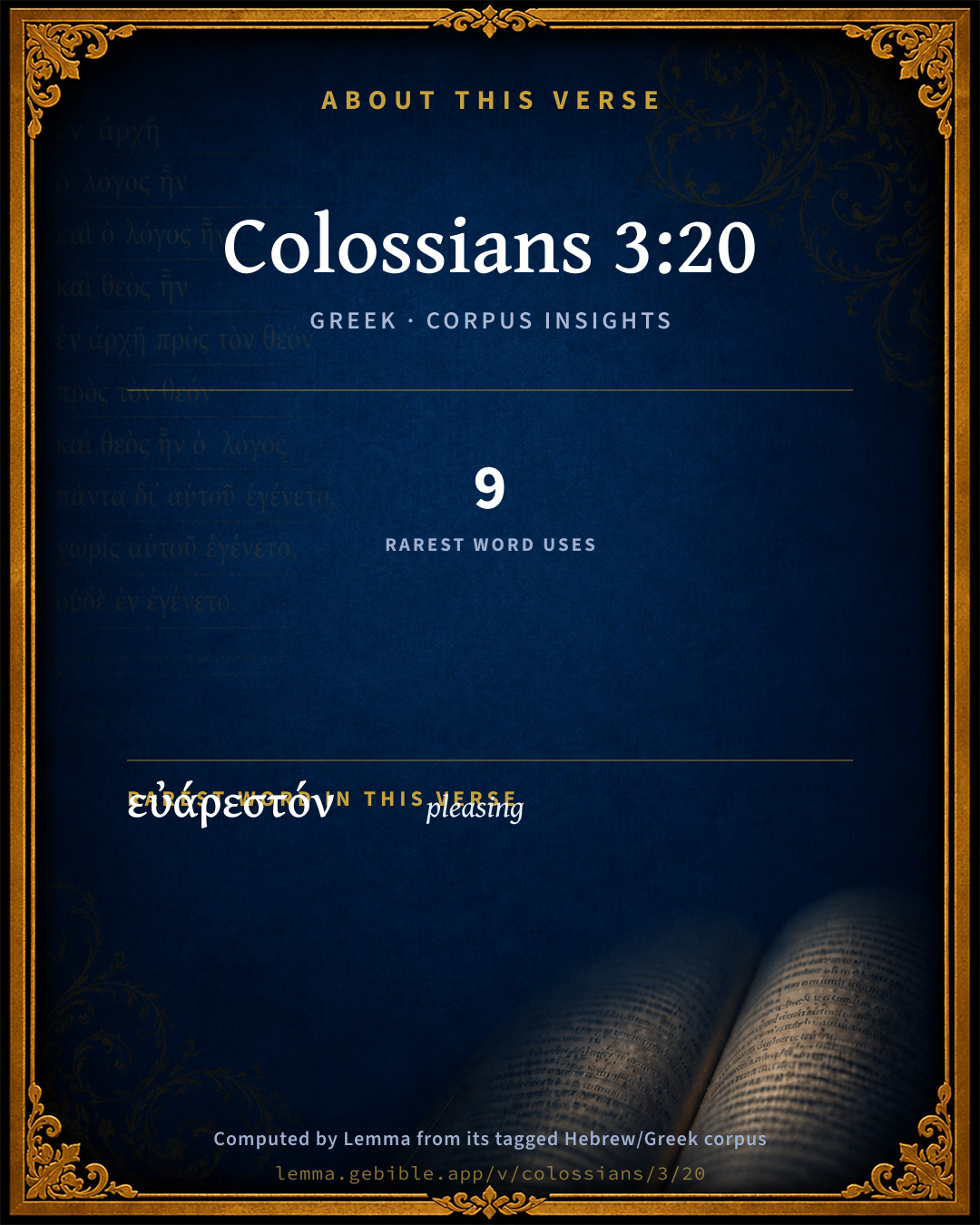
The rarest word here is εὐάρεστόν pleasing G2101 — appearing just 9 times in the whole Greek New Testament.

Shared distinctive vocabulary

εὐάρεστόν pleasing G2101 occurs in 9 verses of the Greek New Testament. Also found in:

Repetition

A word recurs within this verse:

Cross-references

19

Topical passages linked to Colossians 3:20 in the Treasury of Scripture Knowledge — connected by theme and wording, ordered by reader-vote popularity; previews shown in the World English Bible.

  • Exodus 20:12 "Honor your father and your mother, that your days may be long in the land which Yahweh your God gives you.
  • Ephesians 6:1–3 Children, obey your parents in the Lord, for this is right.
  • Proverbs 6:20 My son, keep your father's commandment, And don't forsake your mother's teaching.
  • Matthew 15:4–6 For God commanded, 'Honor your father and your mother,' and, 'He who speaks evil of father or mother, let him be put to death.'
  • Deuteronomy 27:16 Cursed be he who sets light by his father or his mother. All the people shall say, Amen.
  • Matthew 19:19 'Honor your father and mother.' And, 'You shall love your neighbor as yourself.'"
  • Leviticus 19:3 "'Each one of you shall respect his mother and his father. You shall keep my Sabbaths. I am Yahweh your God.
  • Proverbs 30:17 The eye that mocks at his father, And scorns obedience to his mother: The ravens of the valley shall pick it out, The young eagles shall eat it.
  • Proverbs 30:11 There is a generation that curses their father, And doesn't bless their mother.
  • Malachi 1:6 "A son honors his father, and a servant his master. If I am a father, then where is my honor? And if I am a master, where is the respect due me? Says Yahweh of Hosts to you, priests, who despise my name. You say, 'How have we despised your name?'
  • Colossians 1:10 that you may walk worthily of the Lord, to please him in all respects, bearing fruit in every good work, and increasing in the knowledge of God;
  • Proverbs 20:20 Whoever curses his father or his mother, His lamp shall be put out in blackness of darkness.
  • Ephesians 5:24 But as the assembly is subject to Christ, so let the wives also be to their own husbands in everything.
  • Titus 2:9 Exhort servants to be in subjection to their own masters, and to be well-pleasing in all things; not contradicting;
  • Hebrews 13:21 make you complete in every good work to do his will, working in you that which is well pleasing in his sight, through Jesus Christ, to whom be the glory forever and ever. Amen.
  • Genesis 28:7 and that Jacob obeyed his father and his mother, and was gone to Paddan Aram.
  • Deuteronomy 21:18–21 If a man have a stubborn and rebellious son, who will not obey the voice of his father, or the voice of his mother, and, though they chasten him, will not listen to them;
  • Ezekiel 22:7 In you have they set light by father and mother; in the midst of you have they dealt by oppression with the foreigner; in you have they wronged the fatherless and the widow.
  • Philippians 4:18 But I have all things, and abound. I am filled, having received from Epaphroditus the things that came from you, a sweet-smelling fragrance, an acceptable and well-pleasing sacrifice to God.

Cross-references courtesy of OpenBible.info (CC BY 4.0).

Commentary

Notes on Colossians 3:20 from classic Christian and Jewish commentators (each source and its license shown beneath its notes). The classic Christian expositions comment on the surrounding passage and are grouped to its opening verse, so a note may address several verses; the Jewish commentaries on the Tanakh (Rashi and others) are per-verse, so they appear only where the commentator wrote on this verse.

Lemma curates 59 commentaries, every one of them public domain or Creative Commons licensed, each selected and text-cleaned for this edition rather than reprinted as found. About our sources →

The Biblical Illustrator

Joseph S. Exell

Col_3:20-21

Children, obey your parents in all things.

The mutual offices of parents and children

Among all those mutual offices by which society is preserved those incumbent on parents and children are the most important. If a man neglect his children or misgovern them, how wilt he duly treat other dependants? Or if a child shake off the parental yoke, how will he bear that of a master or prince? Whereas a good child in the house is likely to be a good subject in the state, and a good father will prove a good master and magistrate (1Ti_3:4-5).

I. The duty of children.

1. Those addressed are of either sex. Daughters, therefore, must not urge their weakness, nor sons their strength, as a reason why obedience should be dispensed with. Nor must time or fortune, for children, of whatever age or rank, are unalterably their fathers and mothers (Gen_46:29).

2. The duty is obedience: which includes the honour prescribed by the law. But the term is used to show us that this honour is not a vain respect, and to condemn hypocritical obsequiousness (Mat_21:30).

3. The extent of the duty is universal. This is natural, and would have been literal but for sin. Now, however, exceptions must be introduced (Eph_6:1), and obedience in things not well pleasing to the Lord is prohibited. If a father should command his son to be an idolater, or to kill or hate his neighbour, or forbid him to embrace the service of God, obedience would be criminal (Luk_14:26; Mat_10:37). But children are to obey--

(1) In those things which are conformable to the Divine will--in which case Gods law has an additional sanction--viz., parental authority, and disobedience involves, therefore, double guilt.

(2) In things indifferent. I wish that fathers would confine themselves to what is human, yet if they command anything not repugnant to Gods law, however harsh, it must be obeyed.

(3) Whence it appears how dangerous and contrary to the Word of God is the doctrine of Rome, which enfranchises children from this authority, daughters at twelve and sons at fourteen, giving them liberty, in spite of their parents, to enter a cloister. This directly contradicts Num_30:3-8; Mat_15:4-6.

4. The enforcement. The apostle might have urged the justice of the thing itself, gratitude prompting it; or from nature, which has engraven this law on animals; or from the custom of all nations, who have authorized the veneration of parents as of sacred persons, and made piety at once Divine worship and filial obedience. But he alleges nothing but the sole will of God. That this is well pleasing to God is seen--

(1) From His commandment.

(2) The promise annexed.

(3) The punishments threatened (Deu_21:18; Exo_21:17 : Lev_20:9; Pro_20:20; Pro_30:17).

(4) His Fatherly relation (Mal_1:6).

II. The duties of parents.

1. The provocation forbidden is an ill effect of the abuse of parental authority. Fathers provoke their children--

(1) When they deny them a suitable maintenance (1Ti_3:1-16).

(2) When they give them inhuman or unrighteous commands (1Sa_20:34; Mat_14:8).

(3) When without necessity they compel them to perform sordid actions.

(4) When they assail them with irritating or angry words (1Sa_20:30).

(5) When they chastise them beyond measure or desert (2Sa_7:14).

2. To dissuade fathers from this fault, the apostle shows the evil it produces. Nothing more dejects the heart of a child than undue vigour.

(1) It saddens him when in the countenance and actions of that person to whom he should be most dear he sees nothing but aversion.

(2) It intimidates and deprives him of all courage for a good undertaking; for, finding himself ill-treated by his father, what can he hope for from others.

(3) Some get hardened, and fall by degrees into desperate impiety. (J. Daille.)

The obligations of parents and children

I. The duty of children.

1. The duty itself contains four things.

(1) Reverence (Lev_19:3; Lev_19:20; Heb_12:9).

(a) With respect to speech, that it be agreeable to the relation, graced with humility and modesty, giving them honourable titles, pleasing answers, respectful requests.

(b) With respect to behaviour. Rude and haughty looks cannot comport with this duty.

(2) Observance.

(a) Attending to their instructions.

(b) Executing their commands.

(c) Depending on their counsels--as regards a calling in life, and marriage.

(d) Following their examples.

(3) Pious regards.

(a) With respect to their benevolence towards us.

(b) With respect to their claims when in indigence, in infirmity, or dead.

(4) Submission.

(a) To their admonitions.

(b) To their corrections.

2. The extent of the duty. We cannot imagine that this is so universal and absolute as obedience to God. He is the only absolute lawgiver (Jam_4:12), and when parental claims conflict with His, we are absolved from our obedience. Hence we find Acrotatus commended among the ancients because, when his parents had required of him to do an unjust thing, he answered, I know you are willing I should do that which is just, for so you taught me to do; I will therefore do what you desire, but not what you bid.

3. The reason for the duty: because it is well pleasing to the Lord. The supreme authority of our heavenly Father makes any duties He requires highly reasonable: and in pleasing God you please your parents and yourself too, for you must needs be happy when God and you are pleased (Psa_19:11; Eph_6:1).

II. The office of parents. They are not to irritate their children, but, by parity of reasoning, to so comport themselves in good government as to secure their childrens honour. Let us look, then, at this positive side of the matter. L The more general parental duties.

(1) Prayer for all necessary things, but more particularly that they may be Gods children.

(2) Good behaviour (Pro_20:7; Pro_3:22).

2. More particular.

(1) Sustenance.

(2) Education (Eph_6:4; Pro_22:6).

(3) Disposal into some fit employment and marriage.

III. The means of managing the duties of both relations. 1, To children.

(1) Be thoroughly sensible of the mischief of disobedience, and the benefit of obedience.

(2) Remove all tendencies to the dishonour of parents, and set a value on their instructions.

(3) Perform all with sincerity and impartiality to both parents.

(4) Set about your filial duties willingly and readily.

(5) Persevere in all, whatever temptations you meet with.

2. To parents.

(1) Be sure you keep up the life and power of godliness in your domestic practice.

(2) Maintain your parental authority, and assert the dignity of your relation, yet with love and mildness.

(3) Sweeten all with expressions of endearment, to insinuate the more into their affections, but still with Christian prudence.

(4) Endeavour to carry it with all evenness and impartiality to every child, according to a rational proportion. (Richard Adams, A. M.)

The duties of parents and children

God hath set the solitary in families. The domestic constitution is the type of all governments. If discipline is neglected in the home, it is rarely that the loss is made up afterwards. Coleridge has said: If you bring up your children in a way which puts them out of sympathy with the religious feelings of the nation in which they live, the chances are that they will ultimately turn out ruffians or fanatics, and one as likely as the other. Lord Bacon observes that fathers have most comfort of the good proof of their sons; but the mothers have most discomfort of their ill proof. It is therefore of vital importance that the reciprocal duties of parents and children should be faithfully and diligently observed.

I. The duty of the child to the parent is to obey.

1. This obedience is universal. In all things. The law commands: Honour thy father, etc., and the most signal way is to obey. Parents have the wisdom of experience, and know the dangers that threaten their children, and are in a position to offer judicious counsel. Filial obedience should be prompt, cheerful, self-denying, uniform; not dilatory and reluctant.

2. This obedience is qualified and limited by the Divine approval.

II. The duty of the parent to the child is to rule.

1. The parent is not to rule in a spirit of exasperating severity. An excessive severity is as baneful as an excessive indulgence.

2. To rule in a spirit of exasperating severity tends only to dishearten. A certain writer has significantly said: What if God should place in your hand a diamond, and tell you to inscribe on it a sentence which should be read at the last day, and shown there as an index of your own thoughts and feelings? What care, what caution, would you exercise in the selection. Now this is what God has done. He has placed before you the immortal minds of your children, more imperishable than the diamond, on which you are about to inscribe every day and every hour, by your instruction, by your spirit, or by your example, something that will remain and be exhibited for or against you at the judgment day!

Lessons:

1. To rule wisely we must first learn to obey.

2. Disobedience is the essence of all sin.

3. That government is the most effective that tempers justice with mercy. (G. Barlow.)

Children entreated to obey their parents

I. Why you should obey.

1. Because it is your duty.

(1) God commands it, and He is so good that we ought to obey Him, and so great that He will not allow disobedience to go unpunished.

(2) Your parents command it, to whom you owe your all of earthly happiness.

2. Because it is your interest. Neither God nor your parents would wish it if it were not for your good.

(1) It will secure for you Gods blessing, whereas disobedience will bring down His curse. Remember Hophni and Phinehas, and Absalom.

(2) It will make you cheerful and happy in your minds, whereas disobedience makes you sullen and disagreeable to yourselves as well as others.

(3) It promotes your daily improvement. Disobey, and your evil dispositions will become daily more tyrannical.

(4) It makes others love you: but no one likes a disobedient child.

(5) It is most favourable to conversion, but the contrary almost precludes the hope of it.

3. Because you have the perfect pattern of our Lord to urge you to obey.

II. How you should obey.

1. Religiously. With a regard to what pleases God, and not what pleases self or parents so much.

2. Heartily and sincerely, as opposed to that hypocritical obedience which some children yield when their parents are in sight, because they are afraid of the consequences.

3. Completely. It is of no use for children to obey in some things and disobey in others; to do half what their parents command, and leave half undone.

4. Instantly, without waiting to ask the reason, or promising to obey at some future time.

5. Cheerfully. There is an obedience of the hand, but a disobedience of the heart.

6. Always. Not simply till you go to business, or are of age, or married. Despise not thy mother when she is old. (B. W. Noel, M. A.)

Obedience of children

The commander of the Orient, before the Battle of the Nile, placed his son, Cassabianea, thirteen years of age, on certain duty, to stay at his post till relieved by his fathers order. Soon after the father was slain. The boy held his post in the midst of fearful carnage, ignorant of his fathers fate; and while the sailors were deserting the burning and sinking ship, he cried, Father, may I go? The permission did not come, and there he stood at his post and perished. (E. Foster.)

Obedience to a master

The Hon. Thomas H. Benton was for many years a United States senator. When making a speech in New York once, he turned to the ladies present, and spoke about his mother in this way My mother asked me never to use tobacco, and I have never touched it from that day to this. She asked me never to gamble, and I never learned to gamble. When I was seven years old she asked me not to drink. I made a resolution of total abstinence. That resolution I have never broken. And now, whatever honour I may have gained, I owe it to my mother. (Kings Highway.)

The rarity of obedience

A tradesman advertised for a boy to assist in his shop, and go on errands. A few hours after the morning papers were circulated he had his shop thronged with all kinds of boys. Not know ing which to choose he advertised again: Wanted, to assist in a shop, a boy who obeys his mother. Only two boys ventured to apply for the situation. (J. Bate.)

Safety of obedience

A pointsman in Prussia was at the junction of two lines of railway, his lever in hand for a train that was signalled. The engine was within a few seconds of reaching the embankment, when the man, on turning his head, perceived his little boy playing on the rails on the line the train was to pass over. Lie down! he shouted to the child, but as to himself, he remained at his post. The train passed safely on its way. The father rushed forward expecting to take up a corpse, but what was his joy on finding that the boy had at once obeyed his order! He had lain down, and the whole train passed over him without injury. The next day the king sent for the man, and attached to his breast the medal for civil courage.

Disobedience regretted

When I was a boy, and a little reckless, my mother used to say to me, De Witt, you will be sorry for this when I am gone. I remember just how she looked, with her cap and spectacles. I remember just how she sat with the Bible on her lap. I laughed the admonition off, but she never said a truer thing in all her life. I have been sorry for it ever since. (T. De W. Talmage, D. D.)

Fathers, provoke not your children to wrath, lest they be discouraged.

The treatment that discourages piety

Discouraged, Paul means, in good. His language is addressed to fathers, for he seems to have had in view the case of advanced children; and yet the language is equally applicable to the case of mothers and very little children. Children are discouraged and hardened to good--

I. By too much prohibition. There is a monotony of continuous prohibition which is really awful. It does not stop with ten, like the words of Sinai, but keeps up the thunder from day to day. All commandments, of course, in such a strain come to sound Very much alike, and as they are all equally annoying, the child learns to hate them all. The study should be rather to forbid as few things as possible, and then soundly to enforce what is forbidden.

II. By unfeeling and absolute government. If a Christian father is felt to be a tyrant, he will seem to his child to be a tyrant in Gods name, and that will be enough to create a sullen prejudice against all sacred things. Nor is the case improved when the child is cowed into fear of such a parent, and thus reduced to submission. There is a beautiful courage in a childs approach to God; but if his courage even toward his father is broken down, he will only shrink from God with a greater fear.

III. By an over-exacting manner and a difficulty in being pleased. Children love approbation, and are specially disappointed when they fail of it in their meritorious endeavours, and especially when they are blamed for a trivial defect which, had they known, they would have avoided. But some parents appear to think it a matter of faithfulness to be not easily pleased, lest the children should have loose impressions of duty. They do not consider how they would fare if God should treat them in the same manner. But what can win a child to attempt to please God when His earthly representative is so difficult to please?

IV. By holding displeasure too long, and yielding with too great difficulty. It is right when children have done wrong to make them feel your displeasure; but that should not take the manner of a grudge, and hold on after repentance. On the contrary, there should be a hastening towards the child like the prodigals father, otherwise repentance will be turned into a sullen aversion, and into a feeling that there is the same heavy tariff of displeasure to be paid when he would turn towards God.

V. By hasty and false accusations. When good intentions are rated low, and children are put under the ban of dishonour, they are very likely to show that they are no better than they are taken to be. To batter self-respect is the surest way to break every natural charm of virtue and religion. The effect is scarcely better where acknowledged faults are exaggerated and set off by colours of derision. It will do for a parent to be severely just, but exaggerated justice is injustice, and more terribly so when it assumes the Christian name.

VI. By keeping children in a continual torment of suppression. We have no right to be anxious anywhere; it is unbelief which trust in God should set at rest. And we have less right to be, in that it destroys the comfort of others. Only to be in a room with an anxious person is enough to make one positively unhappy. What, then, is the woe put upon a hapless little one who is shut up day by day to the fearing look and deprecating whine, and supercautionary keeping of a nervously anxious mother. Nothing will so dreadfully overcast the sky of childhood as the weather this makes. It worries the child in every putting forth and play lest he should be hurt, and takes him away from every contact with the great worlds occasions that would school him for manhood. And then, since the child will most certainly learn how little reason there was for this eternal distress, he is sure to be issued finally in a feeling of confirmed disrespect. No, there must be a certain courage in maternity and the religion of it. The child must be wisely trusted to danger, and shown how to conquer it.

VII. By giving them tests of character that are inappropriate to their age. A child loses his temper, and the conclusion forthwith sprung upon him is that he has a bad heart. Whereupon he is reluctant to pray, as if the wrong were conclusive against him. But how would the father or mother fare if tested by the same rule? So, if the child evinces a desire to play on Sunday, has not the father, who has outgrown play, occupied himself even in church with his secular schemes? If a child is wholly perverse, it will not discourage him to tell him of it; but if he wants to be good, he should be shown how ready God is to help him and to forgive his faults.

VIII. By the holding aloof system by which children are denied a recognition of their church membership. The child giving evidence, however beautiful, of his piety, is still kept back from the Lords table, for the simple defect of years. As if years were a Scriptural evidence of grace. No plan could be devised for the discouragement of piety in children more certain in its object. They are only mocked and tantalized by their baptism itself. (H. Bushnell, D. D.)

The Biblical Illustrator, edited by Joseph S. Exell (c. 1880s–1900s) — public domain. Text from a community e-Sword module.

Whedon's Commentary on the Bible

Daniel D. Whedon

b. Children and parents, Col_3:20-21.

20. Children—The precept notes no exceptions. While obedience to parents is the natural duty of children, the reason here assigned is its acceptableness as befitting their relation as Christians. Most MSS. read εν κυριω, in the Lord.

Daniel D. Whedon (gen. ed.), Commentary on the Old and New Testaments (1874–1909) — public domain. Text from a community e-Sword module.

The Preacher's Complete Homiletical Commentary

Joseph S. Exell (gen. ed.)

CRITICAL AND EXPLANATORY NOTES

Col_3:20. For this is well-pleasing.—Eph_6:1 : “This is right.” What in Ephesians is regarded as an equitable due from child to parent is here looked at in another light. The best commentary is Luk_2:51-52. The child Jesus was subject to his parents and increased in favour with God.

Col_3:21. Fathers, provoke not your children.—The word for “provoke” is not the same as in Eph_6:4. There the word is “do not exasperate.” Here it is “do not irritate.” The difficulty of discriminating between them may perhaps show how near the original words are in meaning. “Irritation is the first consequence of being too exacting with children, and irritation leads to moroseness” (Lightfoot). Lest they be discouraged.—Broken-spirited. It is a sad sight to see a man for whom the stress of life has been too much, but to see a child cowed and dejected—the world has no sadder spectacle.

MAIN HOMILETICS OF THE PARAGRAPH.—Col_3:20-21

Duties of Parents and Children.

It is God who hath set the solitary in families. The domestic constitution is the formal type of all governments. If discipline is neglected in the home, it is rarely that the loss is made up when the untaught becomes a citizen of the world. Coleridge has well said: “If you bring up your children in a way which puts them out of sympathy with the religious feelings of the nation in which they live, the chances are that they will ultimately turn out ruffians or fanatics, and one as likely as the other.” “A wise son maketh a glad father; but a foolish son is the heaviness of his mother” (Pro_10:1). Lord Bacon observes that fathers have most comfort of the good proof of their sons, but the mothers have most discomfort of their ill proof. It is therefore of vital importance that the reciprocal duties of parents and children should be faithfully and diligently observed. These verses indicate the character of filial duty and of parental authority. Observe:—

I. That the duty of the child to the parent is to obey.—

1. This obedience is universal. “Children, obey your parents in all things” (Col_3:20). The Old Testament law commands, “Honour thy father and thy mother”; and the most signal way in which a child can honour his parents is to obey them. Parents have learnt wisdom by experience; they know the dangers that threaten their children, and are in a position to offer wise and judicious counsel. Filial obedience should be prompt, cheerful, self-denying, uniform; not dilatory and reluctant. It is universal in its obligation, and is binding, not only in those commands that are pleasant to obey, but in those that are troublesome, and that seem unreasonable and perverse, so long as they do not involve a violation of divine law. It is a painful spectacle to see a child defy parental authority, and even exult in his rebellion and in the distress it causes his father and mother. But filial disobedience rarely reaches such a pitch of cruel retaliation without there having been some defect in the early training. The child who renders due reverence to his parents is sure to meet with the rich rewards of heaven in the enjoyment of temporal and spiritual blessing.

2. This obedience is qualified and limited by the divine approval.—“For this is well-pleasing unto God” (Col_3:20). It is only when the commands of the parent are in harmony with the will of God that the child is bound to obey, and a powerful motive to practise obedience is derived from the fact that it “is well-pleasing unto the Lord.” The parent has no authority to enforce obedience beyond what has been given to him of God; and the exercise of that authority must ever be in subjection to the higher authority of the divine law. Obedience to parents in what is right is obedience to the Lord. It is the way of safety and of happiness. A little boy, about seven years old, was on a visit to a lady who was very fond of him. One day, at breakfast, there was some hot bread on the table, and it was handed to him; but he would not take it. “Do you not like hot bread?” asked the lady. “Yes,” said the boy; “I like it very much.” “Then, my dear, why do you do not take some?” “Because,” he said, “my father does not wish me to eat hot bread.” “But your father is a great way off,” said the lady, “and will not know whether you eat it or not. You may take it for once; there will be no harm in that.” “No, ma’am; I will not disobey my father and my mother. I must do what they have told me to do, although they are a great way off. I would not touch it if I was sure nobody would see me. I myself should know it, and that would be enough to make me unhappy.” A reckless disobedience of parental authority will not go unpunished. The example of Christ’s subjection to his earthly parents exalts filial duty into a sublime and holy exercise.

II. That the duty of the parent to the child is to rule.—

1. The parent is not to rule in a spirit of exasperating severity. “Fathers, provoke not your children to anger” (Col_3:21). The obedience of the child will be very much influenced by the character of the parental government. Counsel, remonstrance, and even chastisement will be necessary in the successful training of children. But discipline is to be administered so wisely, lovingly, and firmly as not to irritate to rebellion, but to subdue and bend into obedience. An excessive severity is as baneful as an excessive indulgence.

“The voice of parents is the voice of God,

For to their children they are heaven’s lieutenants;

Made fathers, not for common uses merely,

But to steer

The wanton freight of youth through storms and dangers,

Which, with full sails, they bear upon and straighten

The mortal line of life they bend so often.

For these are we made fathers, and for these

May challenge duty on our children’s part.

Obedience is the sacrifice of angels,

Whose form you carry.”—Shakespeare.

2. To rule in a spirit of exasperating severity tends only to dishearten.—“Lest they be discouraged” (Col_3:21). If the child sees that all his endeavours to please are in vain, and that he is repulsed with sternness and cruel severity, he loses heart, and becomes sullen or morose, or is stung into a state of desperate revenge. To be perpetually fault-finding, and to gratify your angry passions in brutal, savage chastisement, will crush the spirit of any youth, and perhaps transform him into a monster more terrible than yourself. Children are to be led, not driven; to be treated as reasonable beings, not forced like brute animals; to be encouraged by commendation where it is merited, and the defects of their obedience kindly interpreted. A certain writer has significantly said: “What if God should place in your hand a diamond, and tell you to inscribe on it a sentence which should be read at the last day, and shown there as an index of your own thoughts and feelings? What care, what caution, would you exercise in the selection! Now this is what God has done. He has placed before you the immortal minds of your children, more imperishable than the diamond, on which you are about to inscribe every day and every hour, by your instruction, by your spirit, or by your example, something that will remain and be exhibited for or against you at the judgment-day.”

Lessons.—

1. To rule wisely we must first learn to obey.

2. Disobedience is the essence of all sin.

3. That government is the most effective that tempers justice with mercy.

The Preacher's Complete Homiletical Commentary (gen. ed. Joseph S. Exell; Funk & Wagnalls, c. 1892) — public domain (pre-1929). A full-Bible homiletical/sermon-outline anthology covering 65 of 66 books (2 John is absent from the source module). Text from a community e-Sword module.

Lange's Commentary on the Holy Scriptures

b) To children and parents

(Col_3:20-21)

20Children, obey your parents in all things: for this is well pleasing unto [in]32 the Lord. 21Fathers, provoke not your children to anger [omit to anger],33 lest they be discouraged [disheartened].34

EXEGETICAL AND CRITICAL

Col_3:20. Children, obey your parents in all things.—See Eph_6:1. “In all things,” κατὰ πάντα, here definitely expresses what is indicated in the parallel passage by the phrase, “in the Lord:” it is not to be limited (Oeoumenius). It sets forth the principle, the rule, exceptions being left out of view (Meyer). [Eadie suggests, that as the reference is to Christian parents, who were to govern in a Christian spirit, the Apostle takes heed of an exception. On the exceptions see Bish. Taylor, Duct. Dub. III. 5. Ellicott remarks that ὑπακούειν includes not merely submission to authority, but obedience to a command. Titt. Syn. I. p. 193.—R.]

For this is well-pleasing in the Lord.—(Eph_6:1, “right”.) Hence the reference here is to judgment and complacency, there to precept and authority. “In the Lord,” before Him, as He looks at the matter. We need not supply τῷ θεῷ (Rom_12:2) in thought (De Wette), nor take ἐν κυρίῳ as the Christian qualification (Meyer) [Alford]; the former is not warranted by the context, the latter is contrary to usage and indistinct in itself. [Ellicott is more exact: the preposition defines the sphere in which the τὸ εὐάρεστον was especially felt and evinced to be so.—R.]

Col_3:21. Fathers, provoke not your children.—(See Eph_6:4 : παροργίζετε). The verb is used, 2Co_9:2, in a good sense, here in a bad sense; what is forbidden occurs’ through severe, unjust, capricious treatment. [We might render: “do not irritate your children.”—R.] The motive for the warning is found in the result, which is marked as fixed and certain: lest they be disheartened.—Bengel: “A broken spirit, the bane of youth." There is a lack of affection and confidence, pleasure and power for good and against evil.

DOCTRINAL AND ETHICAL

Comp. on Eph_4:1-4.

HOMILETICAL AND PRACTICAL

Starke: Disobedient children offend not only their parents, but God Himself; therefore they have no prosperity.—Children are not given for the service of parents, but parents are ordained for the benefit of children.—Actual chastisement should never be resorted to, until the child has been convinced of its guilt and well merited punishment, and God been earnestly implored to bless the infliction. The additional advantage thus gained is that meanwhile one’s rising passion can be allayed and the punishment inflicted with proper moderation. The child, too, is thereby shown that the chastisement springs from love, and is more of an advantage than a punishment.—In the discipline of children, ignorance, weakness, hastiness, thoughtlessness and childish character must be distinguished from wanton wickedness.

Rieger :—Our heavenly Father, the Father of our spirits, Himself carefully guards against our becoming disheartened under His chastisement, and nothing rejoices Him more than that we “cast not away our confidence;” and so also in the relations of parents and children, much depends upon our not being rendered morose by the faults, but taking courage in final triumph.

Passavant :—In this obedience of children from the very cradle lies the foundation and beginning of all good discipline, of all welfare and blessing, external and internal, in the heart, in the family, in the state, in all phases and circles of social life.—Has many a yoke of early years been borne in the patience of faith, with what a peaceful gaze does one look back! Those who have grown old should again take it upon them, and as children kneel before their parents.

Heubner :—Christian nurture dare not intimidate, but should promote a noble frankness and openness.

[Burkitt:—God takes a mighty pleasure in the performance of relative duties; they are not only pleasing, but well-pleasing to Him; we are no more really than what we are relatively in the account of God; that which we call the power of godliness, consists in a conscientious performance of relative duties.—R.]

[Henry:

Col_3:21. Let not your authority over them be exercised with rigor and severity, but with kindness and gentleness; lest you raise their passions and discourage them in their duty, and by holding the reins too strait, make them fly out with the greater fierceness. It is by the tenderness of parents, and dutifulness of children, that God ordinarily furnishes His Church with a seed to serve Him, and propagates religion from age to age.—R.]

[Eadie :—The child should feel that the punishment is not the result of fretful anger.—Children teased and irritated lose heart, renounce every endeavor to please, or render at best but a soulless obedience.—The twig is to be bent with caution, not broken in the efforts of a rude and hasty zeal.—Schenkel:—The evil effects of too severe a training of children. 1) In what they consist. 2) Whence they arise.—R.]

Footnotes:

[32]Col_3:20.—[“The reading of Rec., τῷ Κυρίῳ, has not the support of any uncial MS., and is rejected by all modern editors” (Ellicott). Tischendorf (eds. 2 and 7) reads ἐστιν εὐάρεστον, but the order of א. A. B. C. D. E. is εὐάρεστόνέστιν, followed by Lachmann, Meyer, Alford, Ellicott.—R.]

[33]Col_3:21.—Instead of ἐρεθίζετε (B. and others,) א. A. and others have παροργίζετε, undoubtedly taken from Eph_6:4. [Lachmann and Scholz adopt the latter reading. The E. V. inserts “to anger”—now unnecessary, since “provoke” implies this in modern usage.—R.]

[34]Col_3:21.—[Ἀθυμῶσιν, “disheartened,” Eadie, Alford, Ellicott. Older versions render: “made feeble-hearted,” “of a desperate mind.”—R.]

Lange's Commentary on the Holy Scriptures (Critical, Doctrinal, and Homiletical), ed. John Peter Lange, English translation edited by Philip Schaff (1864–1880) — public domain. Text from a community e-Sword module.

Meyer's Critical & Exegetical Commentary

Heinrich August Wilhelm Meyer

Col_3:20 f. Comp. Eph_6:1-4, where likewise is given a characteristic development in fuller detail of what is here only succinctly stated.

κατὰ πάντα] not to be restricted; for Paul is quoting the rule, that which holds good principaliter in the relation of children, while possible exceptional cases obviously come under the principle of obeying God rather than man (Oecumenius: δίχα τῶν εἰς ἀσέβειαν φερόντων). Comp. Eph_5:24.

εὐάρεστόν ἐστιν ἐν κυρίῳ] In connection with this reading (see the critical remarks), to supply τῷ Θεῷ to εὐάρ. is arbitrary (in opposition to de Wette and Baumgarten-Crusius), since this is not suggested by the context as in Rom_12:1-2; nor is ἐ̓ν κυρίῳ to be taken as instead of the dative (Flatt, Bähr, Bleek), or in the sense: coram Domino (Böhmer), but rather as in Col_3:18. We have to leave εὐάρ. without any other more precise definition than what is contained in ἐν κυρ., so that it is affirmed of childlike obedience, that it is well-pleasing, and that indeed not in a worldly fashion apart from Christ, οὐκ ἀπὸ τῆς φύσεως μόνης (Chrysostom), but in a definite Christian character; consequently the Christian ethical beauty, in which the δίκαιον (Eph_6:1) of that virtue manifests itself. Comp. προσφιλῆ in Php_4:8. It would be a perfectly groundless violence to couple, with Hofmann, ἐν κυρίῳ with ὑπακούετε τ. γ. κ. π., notwithstanding the clause which is introduced by γάρ.

Col_3:21. οἱ πατέρες] they, and not the mothers, are addressed as holding the government of the household, also in reference to education. Comp. on Eph_6:4.

ἐρεθίζετε] irritate, very frequent in the classics and LXX., especially in connection with anger, as here (comp. Eph_6:4). This irritation takes place through unjust or over-severe (ἐστὶν ὅπου καὶ συγχωρεῖν ὀφείλετε, Chrysostom) treatment, which the child, provoked thereby to anger, must bear without being able to get satisfaction for its injured sense of justice; whereby it becomes liable to a spiritless and sullen, and therefore immoral, resignation, a despair paralysing all moral power of will; hence ἵνα μὴ ἀθυμῶσιν. This verb is only found here in the N. T., but frequently in LXX., also Jdt_7:22; 1Ma_4:27; and in classic writers from the time of Thucydides (v. 91. 1, vii. 21, al.). Its opposite is θαῤῥεῖν. Bengel aptly says: fractus animus pestis juventutis.

Meyer — Critical and Exegetical Commentary on the New Testament — English translation by Peter Christie, edited by Frederick Crombie (T&T Clark, 1880) — public domain. Text from a community e-Sword module.

Expositor's Greek Testament

ed. W. Robertson Nicoll

Col 3:20 . κατὰ πάντα is omitted in Eph 6:1 .

The Expositor's Greek Testament, edited by W. Robertson Nicoll (1897–1910) — public domain. Text from a community e-Sword module.

Geneva Bible (1599)

Geneva Bible translators

In the Lord, and so is it expounded, Eph. 5:19.

He requireth of children, that according to God’s Commandment they be obedient to their parents.

Geneva Bible (1599) marginal notes — public domain. Text via Bolls.life.

Jamieson, Fausset & Brown

Robert Jamieson, A. R. Fausset & David Brown

(Eph 6:1.)

unto the Lord--The oldest manuscripts read, "IN the Lord," that is, this is acceptable to God when it is done in the Lord, namely, from the principle of faith,and as disciples in union with the Lord.

Jamieson, Fausset & Brown — Commentary Critical and Explanatory on the Whole Bible (1871) — public domain (CC PDM 1.0). Text via the HelloAO Bible API.

Adam Clarke's Commentary

Verse 20. Children, obey - in all things] That is, in the Lord-in every thing that your parents command you, which is not contrary to the will or word of God.

Adam Clarke's Commentary on the Bible (1810–1826) — public domain. Text from a community e-Sword/MySword module.

John Calvin's Commentaries

20 Children, obey your parents. He enjoins it upon children to obey their parents, without any exception. But what if parents should feel disposed to constrain them to anything that is unlawful; will they in that case, too, obey without any reservation? Now it were worse than unreasonable, that the, authority of men should prevail at the expense of neglecting God. I answer, that here, too, we must understand as implied what he expresses elsewhere, (Ephesians 6:1) — in the Lord. But for what purpose does he employ a term of universality? I answer again, that it is to shew, that obedience must be rendered not merely to just commands, but also to such as are unreasonable. For many make themselves compliant with the wishes of their parents only where the command is not grievous or inconvenient. But, on the other hand, this one thing ought to be considered by children — that whoever may be their parents, they have been allotted to them by the providence of God, who by his appointment makes children subject to their parents.

In all things, therefore, that they may not refuse anything, however difficult or disagreeable — in all things, that in things indifferent they may give deference to the station which their parents occupy — in all things, that they may not put themselves on a footing of equality with their parents, in the way of questioning and debating, or disputing, it being always understood that conscience is not to be infringed upon. He prohibits parents from exercising an immoderate harshness, lest their children should be so disheartened as to be incapable of receiving any honorable training; for we see, from daily experience, the advantage of a liberal education.

John Calvin's Commentaries (1540-1563) — public domain. Text from the Calvin Translation Society English edition (1840s-50s) via the Christian Classics Ethereal Library (ccel.org). Calvin's coverage is partial (roughly two-thirds of the Bible); uncommented books and verses are honest gaps, never fabricated. The 19th-century editor's footnotes and remarks are omitted so the notes are faithfully Calvin's own voice.

The Cambridge Bible for Schools and Colleges

gen. ed. J. J. S. Perowne

20. Children] Cp. Eph_6:1-3.

obey] The same word as that below, Col_3:22. The wife “submits herself” as to a guiding friend; the child, and the servant, recognize in parent and master a lawful commander.

Disobedience to parents, as a definite act of rebellion against God (Exo_20:12; Exo_21:17; Lev_19:3; Lev_20:9; Deu_5:16), is always noted in Scripture as a grave crime, and a symptom of general moral mischief. Cp. Deu_21:18-21; Pro_20:20; Pro_30:17; Mat_15:4-6; Rom_1:30; 2Ti_3:2.—It is in the school of the well-ordered Christian home that the true idea of the Christian’s position, filial in its freedom, yet (1Co_9:21) “law-abiding unto Christ,” should be first illustrated as well as taught.

parents] Mothers as well as fathers. Scripture uniformly upholds the authority of the mother. See reff. in last note, and Pro_1:8; Pro_6:20.

in all things] with the sole limitation of the supreme claims of the Heavenly Father, which may conceivably collide with those of the earthly parents. Cp. Mat_10:37. But let the child be slow indeed to apply this principle in practice. The case can scarcely arise save where the parent directly and positively requires the child to renounce the Lord.

well pleasing unto the Lord] Jesus Christ. Quesnel beautifully says, “Why does He seem here specially to delight in filial obedience? Because it was His own universal virtue, the soul and law of all His actions.”

The Cambridge Bible for Schools and Colleges (gen. ed. J. J. S. Perowne; Cambridge University Press, 1878–1918) — public domain. Text from a community e-Sword module.

John Gill's Exposition

Children, obey your parents,.... Both father and mother; See Gill on Eph 6:1.

in all things; not in things sinful, which are contrary to the law of God, and Gospel of Christ; in things repugnant to the duties of religion, the ordinances of the Gospel, and the doctrines of Christ, parents are to be neglected and disobeyed. God is to be regarded, and not men; but in all things good and lawful, and in all things that are of an indifferent nature, which may, or may not be done, in these things the will of earthly parents is to be attended to; of which there is a considerable instance in the Rechabites, see Jer 35:6 and even they are to be obeyed in things that are hard and difficult to be complied with, and which are disagreeable to flesh and blood, as the cases of Isaac and Jephthah's daughter show.

For this is well pleasing unto the Lord; and is a reason sufficient to engage to the performance of the duty; for whatever is grateful and well pleasing to God ought to be done with pleasure by us, from a principle of love to him, by faith in him, and with a view to his glory; and then such an action is acceptable in his sight through Jesus Christ our Lord. The Alexandrian copy reads, "in the Lord"; and so the Vulgate Latin version.

John Gill's Exposition of the Whole Bible (1746–1763) — public domain (CC PDM 1.0). Text via the HelloAO Bible API.

Trapp's Complete Commentary

John Trapp

20 Children, obey your parents in all things: for this is well pleasing unto the Lord.

Ver. 20. In all things] Vultu saepe laeditur pietas. {See Trapp on "Eph 6:1"}

John Trapp, A Commentary or Exposition upon All the Books of the Old and New Testament (1647–1656) — public domain. Text from a community e-Sword module.

Albert Barnes' Notes on the Bible

Children, obey your parents ... - Notes, Eph 6:1-4.

Albert Barnes' Notes on the Bible (1834–1885) — public domain. Text from a community e-Sword/MySword module.

Matthew Poole's English Annotations

By children he understands both males and females.

Obey your parents; he requires them to yield humble subjection to those that brought them forth, or have just authority over them; see Exo 20:12; Eph 6:1; paying reverence to them, Lev 19:3; Heb 12:9; observing their holy and prudent prescriptions, Luk 2:51; showing piety and kindness to them in all grateful offices, 1Ti 5:4, and submitting to their parental discipline, Jer 35:6; Heb 12:9.

In all things; in whatsoever is agreeable to the mind of the supreme Governor, who is absolute Sovereign, Act 4:19; 5:29.

For this is well pleasing unto the Lord; and this upon the most cogent reason imaginable, because it is not barely pleasing, but

well pleasing, or very acceptable, to the Lord, who arms parents with authority over their children, Eph 6:1-3.

Matthew Poole's English Annotations on the Holy Bible (1683–1685) — public domain. Text from a community e-Sword/MySword module.

The Pulpit Commentary

To children, be obedient to your parents in all things; for this is well pleasing in the Lord (Eph_6:1, Eph_6:2; Deu_5:16; Lev_19:3 Pro_23:22; Luk_2:51, Luk_2:52) In Eph_6:1, Eph_6:2) "in all things" (katanta, "in regard to all things") is wanting; and not the extent, but the intrinsic rightness of the command as it is found in the Decalogue is insisted on. But here, where "Christ is all and in all" (ver. 11), it is "in the Lord" (Revised Text) that the child"s obedience is declared to be "well pleasing." There is something especially pleasing in the behaviour of a lovingly obedient child, that wins "favour" both "with God and man". (Luk_2:52) The law of filial obedience has its creative ground "in him", (Col_1:16) and is an essential part of the Christian order of life, which is the natural order restored and perfected. "Well pleasing" is a favourite word of St. Paul"s (Col_1:10; Eph_5:10; Php_4:8; Rom_14:18; Tit_2:9, etc.; used also in Hebrews)

The duties of children.

obey your parents in all things: for this is well pleasing to the Lord.

I THE DUTY OF CHILDREN m OBEDIENCE. This includes:

1. Reverence. (Lev_19:3; Eph_6:1, Eph_6:2)

2. Readiness to receive instruction from parents. (Pro_1:8)

3. Submission to their rebukes. (Pro_13:1)

4. Gratitude. (1Ti_5:4)

5. Submission to their just commands. They are to obey "in all things," that is, in all lawful things, for it must be done "in the Lord". (Eph_6:1)

II THE GROUNDS OF THIS DUTY. "For this is well pleasing to the Lord." This is, in itself, a sufficient reason for filial obedience, But it is well pleasing to the Lord for several reasons. It is not enough to serve God, but we must serve him so as to please him. (Heb_12:28)

1. It is agreeable to his Law. (Exo_20:12)

2. It is right in itself. (Eph_6:1)

3. Christ was obedient to his parents. (Luk_2:51)

4. It is necessary to the good order of family life.

5. The welfare of the child depends upon its obedience, especially at a time when it cannot reason upon what is right. T. C.

Vers. 20, 21.

Children and parents.

The family and the Church, the natural and spiritual home, are the two most sacred associations on earth, having as their Head. "the Father from whom every family in heaven and on earth is named". (Eph_3:15) The strength of the nation and the welfare of the world are inseparably bound up with families. Madame de Stael, asked by Bonaparte what was the greatest want of France, replied, "Mothers." The gospel brings to families the blessing of Abraham (Gen_17:7) and of Jesus Christ (Mat_19:13-16; Act_2:39) It has messages to children and to parents.

I THE MESSAGE OF THE GOSPEL TO CHILDREN. Children have a place in the kingdom of heaven, (Mar_10:16) recognized by baptism into the Name of Christ, the Lord of all. (Mat_28:18-20) Hence they are addressed as called to be young disciples. The obedience of childhood to both parents (Pro_1:8) prepares for dutiful love in more advanced years, (Pro_23:22) and teaches lessons of submission to the will of the Divine Father. Three motives are suggested in these messages.

1. "For this is right. (Eph_6:1) There is a fine ring as of genuine metal in this motive the supremacy of duty irrespective of reward. Obedience is but payment in part of a debt due to parents.

2. "This is well pleasing in the Lord. Remembering the one qualification suggested by "in the Lord," children may enjoy Enoch"s testimony. (Heb_11:5)

3. It has a special promise, (Eph_6:2, Eph_6:3) which was given to Gentiles. Illustrate from the national persistence of the Chinese; from the continuance of the Rechabites; (Jer_35:18, Jer_35:19; and see Smith"s "Dictionary of the Bible," 2:1008) and from the tendency of obedience and purity in youth to promote health and long life in maturity. But the complexity of natural laws forbids us to consider this an absolute promise to each individual. The most dutiful Child among men (Luk_2:51; Joh_19:25-27) died young under the law of obedience and sacrifice for others. (Joh_12:24-26)

II THE MESSAGE OF THE GOSPEL TO PARENTS. Combining ver. Eph_6:4, we are reminded of the following truths.

1. The grave responsibility of parents towards their children: who bear on them the image of God, though marred by evil; who belong to Christ and have a place in the kingdom of God, and yet are in a world of sin; who have to be steered through the perils of youth to a Christian manhood and womanhood, which we desire to be something better than our own.

2. The privilege of recognizing their relationship to Christ. They belong to him. They need not to be brought into, but to be brought up in, the nurture of the Lord. Christ (Joh_1:9) is nearer to them and speaks to them earlier than we can. If we are giving to them wise Christian nurture we should expect that they will grow up within the shelter of the fold, following the Shepherd"s steps.

3. There is a treatment which discourages early piety. Anything calculated to provoke to anger tends to discourage children from believing they can be young disciples and seeking to live as such. Hence this caution to fathers (as heads of the home and as more likely to abuse their authority). From which caution and the precept in Eph_6:4, we may gather such hints on parental duty as the following. Make the character and temperament of each child a special study, employing moral principles impartially, but adapting treatment to individual cases. Rule by love and not by fear, avoiding the perils of over indulgence (1Sa_3:13; 1Ki_1:6) and over commandment, never making false threats, nor hesitating to revoke a hasty command which reflection will not justify; nor punishing under the influence of passion. Seek to win the confidence of the children in regard to their spiritual history. Do not propose to them tests of Christian character unsuitable to their age, or visit childish faults as though they were grave moral delinquencies. In choosing for them companions, schools, occupations, "seek first the kingdom of God," etc. (As warning illustrations, cf. Gen_13:10-13 Gen_19:14, Gen_19:31, etc.; 2Ch_18:1 2Ch_21:6) In every department of life seek to combine the needed discipline (paideia) and instruction (nouqesia) with that personal influence and example which alone can make them "the chastening and admonition of the Lord.

4. Children are a most powerful and touching motive to parental piety. (Joh_17:19) E.S.P.

Vers. 20, 21.

Children and parents. (See on Eph_6:1-4) W.F.A.

The Pulpit Commentary (1880–1919), ed. H.D.M. Spence-Jones & Joseph S. Exell — public domain. Text from a community e-Sword module.

Burkitt's Expository Notes on the New Testament

William Burkitt

Observe here, The duty bound upon all children, and that is, obedience to their parents; this implies inward reverence, outward observance, a pious regard to their instructions, a following their good examples.

Observe, 2. The object of this duty; Obey your parents, that is, both parents; as obedience is due from all children, so it is payable to all parents, to mothers as well as fathers; nay, Lev 19:3 the mother is named first, because in regard of the weakness of her sex, she is the most liable to contempt.

Observe, 3. The extent of the duty, in all things, that is, in all lawful things, and in all indifferent things, in every thing that is not sinful; though to the child it may seem unnecessary or unreasonable, yet the parents command is to be obeyed.

Observe, 4. The argument and motive to excite and quicken to this duty, It is well pleasing unto the Lord; thereby they do acceptable service unto the Lord, who will reward it with long life on earth, and eternal life in heaven.

God takes a mighty pleasure in the performance of relative duties; they are not only pleasing, but well pleasing to him; we are no more really, than what we are relatively in the account of God; that which we call the power of godliness, consists in a conscientioius performance of relative duties.

William Burkitt's Expository Notes on the New Testament (1700–1703) — public domain. Text from a community e-Sword module.

The People's New Testament

B. W. Johnson

20. Children, obey your parents. See notes on Eph. 6:1.

B. W. Johnson's The People's New Testament with Notes (1889–1891) — public domain. Electronic text from the Christian Classics Ethereal Library (CCEL) ThML edition.

Cambridge Greek Testament for Schools and Colleges

20. τὰ τέκνα. || Eph 6:1-3.

ὑπακούετε, Col 3:22. See note on ὑποτάσσεσθε, Col 3:18.

τοῖς γονεῦσιν. In contrast to a mark of the ungodly (γονεῦσιν ἀπειθεῖς) both then, Rom 1:30, and in the last days, 2Ti 3:2.

κατὰ πάντα. Emphatic. Such a case as that contemplated in Mat 10:35-37 || Luk 12:53 would not exist in a strictly Christian household, and in any case τέκνα implies an age with which independent thought and action are hardly consistent. The terms in the Gospels are ἄνθρωπος, υἱός, θυγάτηρ.

τοῦτο γὰρ, i.e. this complete obedience.

εὐάρεστόν ἐστιν, “well-pleasing.” The compound adjective, verb and adverb are peculiar to St Paul and the Epistle to the Hebrews. Ct. ἀρεστός in St John (Joh 8:29 and 1Jn 3:22) and Acts (Act 6:2; Act 12:3). In || Eph 6:1 obedience is called δίκαιον, here it is regarded as giving pleasure. To whom is not stated, presumably to any and all who see it, including of course Him to whom the very springs of our actions are open, Heb 4:12-13.

ἐν κυρίῳ. Cf. Col 3:18. It is impossible to follow the Peshiṭta in translating “before our Lord” (cf. Heb 13:21, τὸ εὐάρεστον ἐνώπιον αὐτοῦ; cf. 1Jn 3:22). It, however, probably read τῷ κυρίῳ; cf. its translation of Eph 5:10.

Cambridge Greek Testament for Schools and Colleges (Cambridge University Press, 1896; 21 vols, various authors incl. Carr, Maclear, Plummer, Farrar, Lumby, Moule, M. R. James, Simcox) — public domain. Text from a community e-Sword module.

Alford’s Greek Testament

Henry Alford

20.] See Eph 6:1.

κατὰ πάντα, the exceptions not being taken into account: St. Paul’s usual way of stating a general rule. It is best to take εὐάρεστον, as Mey. absolutely, as προσφιλῆ, Php 4:8: the Christian qualification being given by the ἐν κυρίῳ: De W., al., understand τῷ θεῷ, which would render that qualification meaningless.

Henry Alford, The Greek Testament (1849–1861) — public domain. Text from a community e-Sword module.

International Critical Commentary

20. τὰ τέκνα, κ.τ.λ. See Eph 6:1. Disobedience to parents is mentioned as a vice of the heathen, Rom 1:30, κατὰ πάντα.There would be no propriety in suggesting the possibility in a Christian family of a conflict between duty to parents and duty to God.

εὐάρεστον There is no need to supply τῷ Θεῷ the adjective is taken absolutely, like προσφιλῆ in Php 4:8, and is sufficiently defined by ἐν Κυρίῳ. In Rom 12:2 εὐάρεστου seems also to be absolute, τὸ θέλημα τοῦ Θεοῦ τὸ ἀγαθὸν καὶ εὐάρ. καὶ τέλειον.

The Rec. Text has, instead of ἐν Κυρίῳ,τῷ Κυρίῳ, with many cursives, Boh., Eth., Clem., al.

ἐν Κυρίῳ is the reading of all the uncials, most cursives, and versions.

The Rec. arose from a desire to give a dative to εὐάρεστον.

International Critical Commentary — older volumes (1896–1929), various authors — public domain. Text from a community e-Sword module.

Vincent's Word Studies in the New Testament

Marvin R. Vincent

This is well pleasing. Expanded in Eph 6:2, 3. Unto the Lord should be in the Lord.

Marvin R. Vincent, Word Studies in the New Testament (1887–1900) — public domain. Text from a community e-Sword/MySword module.

Lightfoot's Colossians and Philemon

J. B. Lightfoot

20. κατὰ πάντα] as ver. 22. The rule is stated absolutely, because the exceptions are so few that they may be disregarded.

εὐάρεστόν ἐστιν] ‘is well pleasing, commendable’. The received text supplies this adjective with a dative of reference τῷ Κυρίῳ (from Ephes. v. 10), but ἐν Κυρίῳ is unquestionably the right reading. With the reading thus corrected εὐάρεστον, like ἀνῆκεν ver. 18, must be taken absolutely, as perhaps in Rom. xii. 2 τὸ θέλημα τοῦ Θἑοῦ τὸ ἀγαθὸν καὶ εὐάρεστον καὶ τέλειον: comp. Phil. iv. 8 ὅσα σεμνά ... ὅσα προσφιλῆ. The qualification ἐν Κυρίῳ implies ‘as judged by a Christian standard’, ‘as judged by those who are members of Christ’s body.’

J. B. Lightfoot, St Paul's Epistles to the Colossians and Philemon: a revised text with introductions, notes and dissertations (London: Macmillan, 1875) — public domain. Electronic text from Project Gutenberg (ebook #50857). Covers Colossians and Philemon only (the verse-by-verse notes; introductions and dissertations are omitted); Lightfoot's companion Galatians and Philippians volumes are not included, as the available public-domain scans carry garbled Greek that cannot be faithfully reproduced.

Lesson kit

Teaching starters — assembled from the data on this page, not authored interpretation. Every prompt links to the verse data it draws on. Edit before teaching.

Colossians, in the Pauline Epistles, opens this verse with 13 words (12 distinct Greek lemmas). Its most distinctive word is euárestos (“pleasing”). A historical commentator’s framing appears above. Read the whole chapter for the surrounding context.

Discussion questions

  1. What does “pleasing” (euárestos) contribute to the verse as a whole?
  2. How does Romans 12:1, which shares the word «pleasing», read alongside this verse?
  3. What does the repetition of “the” (2× in this one verse) do in this verse?
  4. The translations on this page render this verse differently — a whole-verse word diff, not a word-by-word alignment. What might account for the different wordings?
  5. Compare how The Biblical Illustrator and Whedon's Commentary on the Bible read this verse. Where do they agree or differ?

Things to notice

Reading settings

Reading text

Shown beneath each verse's original-language words.

Old Testament
Old Testament edition

Read the OT as the Masoretic Hebrew (MT) or the Greek Septuagint (LXX).

English shown for the Greek Septuagint (in the Hebrew ↔ Greek comparison).

Comparing translations? Open the Compare panel on any verse page to stack up to four side by side.