
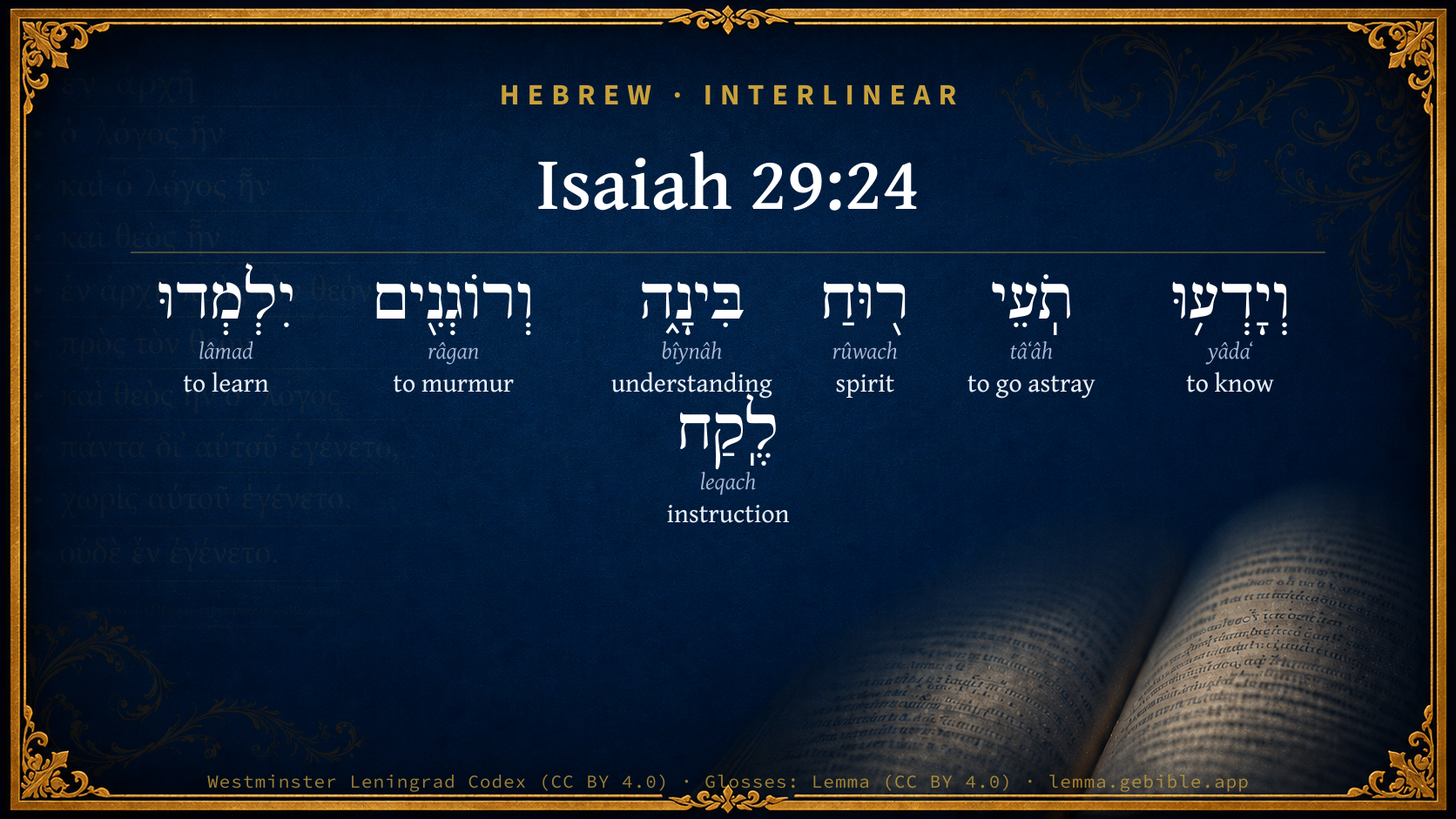
Isaiah 29:24

Hebrew (Westminster Leningrad Codex) Isaiah 29:24 appears in the Hebrew Old Testament. The text above is from the Westminster Leningrad Codex. Each word links to its Strong’s number, a concise gloss, and parsing drawn from the Open Scriptures Hebrew Bible morphology. Click any word for its full Brown-Driver-Briggs (BDB) entry.
Download image
Cite this verse

Isaiah 29:24 (World English Bible). Public Domain. Lemma interlinear Bible study tool, https://lemma.gebible.app/v/isaiah/29/24.

Show BibTeX & RIS
BibTeX
RIS
English Translation
They also who err in spirit shall come to understanding, and those who murmur shall receive instruction.
World English Bible · Public Domain
Download a study sheet

One document with this verse’s original text, its word-by-word gloss line, the meaning frame, cross-references with their text, attributed commentary, and full source and license credits — printable, and it pastes into notes with its structure intact.

This verse Autodidact and up

Study sheet (.html) Plain text (.txt)

A passage Seminary Student

Up to 50 verses in one chapter. A passage sheet keeps up to 6 commentary sources and 12 cross-references per verse, in the order this page ranks them, and says so on the sheet whenever that leaves anything out. Ask for a single verse and you get the Autodidact verse sheet above.

Everything on this page stays free to read, with no account — the sheet is a download of what is already on screen, not access to it.

Want to remove ads? Support Godless Engineer
Compare translations 3

The same verse in 3 English versions, stacked beneath the original-language interlinear above. Click any original word for its lexicon entry.

Each is an independent rendering of the whole verse — the interlinear is not word-aligned to these translations.

Highlighted words mark where these versions differ — a whole-verse word diff, not a word-by-word alignment.

  • World English Bible Public Domain
    They also who err in spirit shall come to understanding, and those who murmur shall receive instruction.
  • King James Version Public Domain
    They also that erred in spirit shall come to understanding, and they that murmured shall learn doctrine.
  • unfoldingWord Literal Text CC BY-SA 4.0
    And the ones erring in spirit will know understanding, and the ones grumbling will learn instruction.”

unfoldingWord Literal Text — © unfoldingWord, licensed CC BY-SA 4.0. Word-aligned USFM3 via Door43 (git.door43.org/unfoldingWord/en_ult).

Versions to compare (up to 4)

3 of 4 selected

Show all 18 translations

Every available English version of this verse, each an independent rendering of the whole verse.

  • World English Bible Public Domain
    They also who err in spirit shall come to understanding, and those who murmur shall receive instruction.
  • Berean Standard Bible Public Domain
    Then the wayward in spirit will come to understanding, and those who grumble will accept instruction.”
  • Majority Standard Bible Public Domain
    Then the wayward in spirit will come to understanding, and those who grumble will accept instruction.”
  • King James Version Public Domain
    They also that erred in spirit shall come to understanding, and they that murmured shall learn doctrine.
  • American Standard Version (1901) Public Domain
    They also that err in spirit shall come to understanding, and they that murmur shall receive instruction.
  • Revised Version (1885) Public Domain
    They also that err in spirit shall come to understanding, and they that murmur shall learn doctrine.
  • Geneva Bible (1599) Public Domain
    Then they that erred in spirit, shall haue vnderstanding, and they that murmured, shall learne doctrine.
  • Douay-Rheims (1899) Public Domain
    And they that erred in spirit, shall know understanding, and they that murmured, shall learn the law.
  • Young's Literal Translation Public Domain
    And the erring in spirit have known understanding, And murmurers learn doctrine!'
  • Literal Standard Version CC BY-SA 4.0
    And the erring in spirit have known understanding, || And murmurers learn doctrine!”
  • Unlocked Literal Bible CC BY-SA 4.0
    Those who err in spirit will gain understanding, and complainers will learn knowledge.”
  • unfoldingWord Literal Text CC BY-SA 4.0
    And the ones erring in spirit will know understanding, and the ones grumbling will learn instruction.”
  • Darby Bible Public Domain
    And they that are of erring spirit shall know understanding, and the disobedient shall learn doctrine.
  • World Messianic Bible Public Domain
    They also who err in spirit will come to understanding, and those who grumble will receive instruction.”
  • Webster's Bible Public Domain
    They also that erred in spirit shall come to understanding, and they that murmured shall learn doctrine.
  • Free Bible Version CC BY-SA 4.0
    Those who've gone astray will understand their mistakes; those who grumble will learn how to receive instruction.”
  • Bible in Basic English Public Domain
    Those whose hearts were turned away from him will get knowledge, and those who made an outcry against him will give attention to his teaching.
  • JPS Tanakh (1917) Public Domain
    They also that err in spirit shall come to understanding, and they that murmur shall learn instruction.

Literal Standard Version (2020), Covenant Press — licensed CC BY-SA 4.0. Text via the HelloAO Bible API (eBible.org). Unlocked Literal Bible (unfoldingWord) — licensed CC BY-SA 4.0. Text via the HelloAO Bible API (eBible.org). unfoldingWord Literal Text — © unfoldingWord, licensed CC BY-SA 4.0. Word-aligned USFM3 via Door43 (git.door43.org/unfoldingWord/en_ult). Free Bible Version, Dr. Jonathan Gallagher — licensed CC BY-SA 4.0. Text via the HelloAO Bible API (eBible.org).

Word by word

More ways to search: Search by grammar → Find every occurrence → Compare this word →

Practice this passage: Drill this verse → Learn its vocabulary →

About this verse

These counts appear in no published source. They are computed here, from the morphology-tagged text and Lemma’s own curated glosses. What Lemma adds →

7
words
7
distinct lemmas
Prophets
section

Notable vocabulary

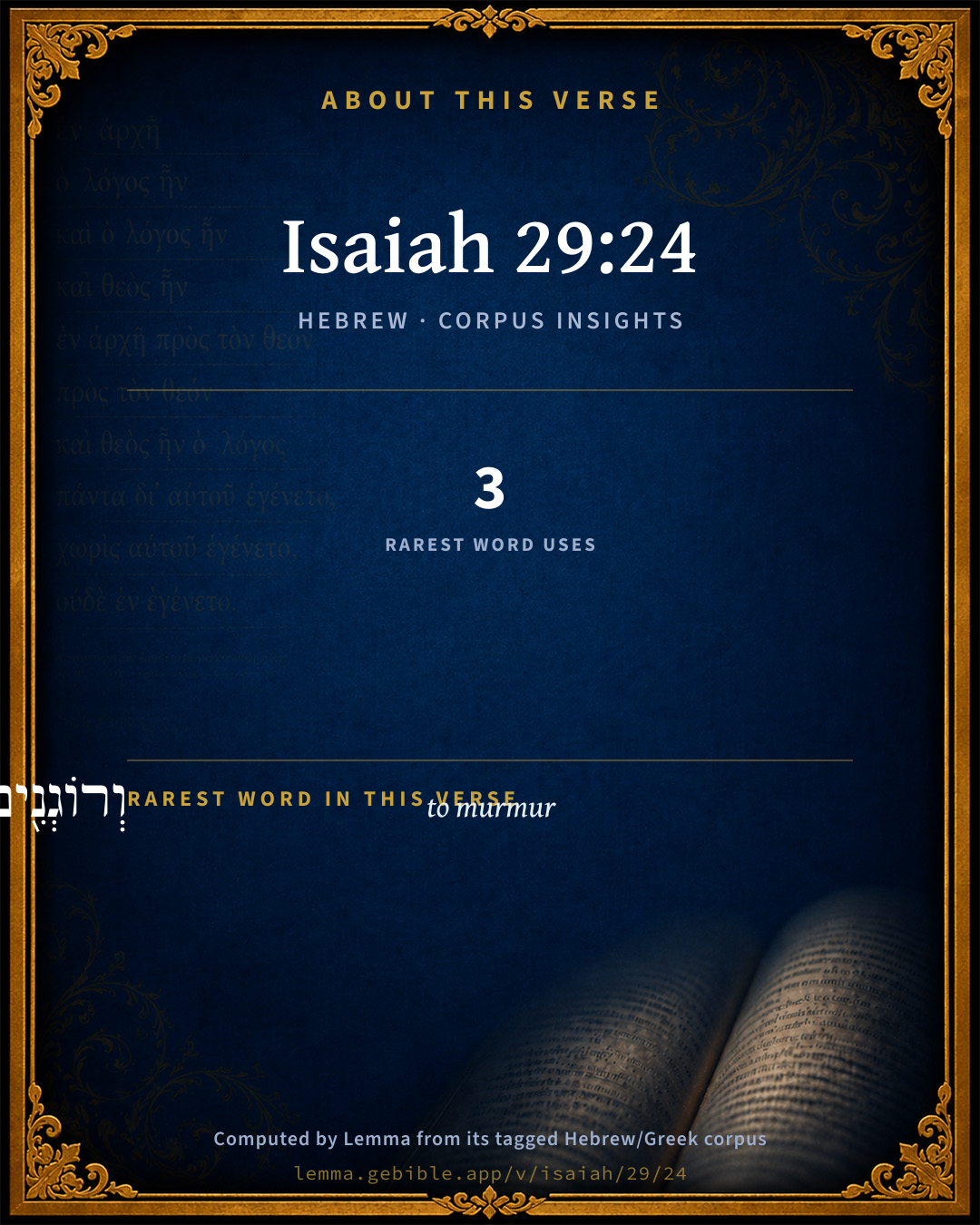
The rarest word here is וְרוֹגְנִ֖ים to murmur H7279 — appearing just 3 times in the whole Hebrew Bible.

Shared distinctive vocabulary

וְרוֹגְנִ֖ים to murmur H7279 occurs in 3 verses of the Hebrew Bible. Also found in:

Grammatical profile

  • 4 verbs
  • 3 nouns

Verb forms

  • וְיָדְע֥וּ Qal · Sequential Perfect
  • תֹֽעֵי Qal · Participle Active
  • וְרוֹגְנִ֖ים Qal · Participle Active
  • יִלְמְדוּ Qal · Imperfect

Hebrew & Septuagint length

In English translation the verse runs 17 words from the Hebrew and 24 from the Septuagint (LXX English) — the Septuagint runs noticeably longer here. See the side-by-side →

A rough comparison of the two English renderings, which tokenize alike — not a word-level alignment.

Word counts can differ between the Hebrew and the Greek without any difference in meaning — e.g. the Hebrew direct-object marker אֵת has no separate Greek word, and Greek often adds the article ὁ.

Cross-references

16

Topical passages linked to Isaiah 29:24 in the Treasury of Scripture Knowledge — connected by theme and wording, ordered by reader-vote popularity; previews shown in the World English Bible.

  • Isaiah 28:7 Even these reel with wine, and stagger with strong drink; the priest and the prophet reel with strong drink, they are swallowed up of wine, they stagger with strong drink; they err in vision, they stumble in judgment.
  • Luke 15:17–19 But when he came to himself he said, 'How many hired servants of my father's have bread enough to spare, and I'm dying with hunger!
  • Hebrews 5:2 The high priest can deal gently with those who are ignorant and going astray, because he himself is also surrounded with weakness.
  • 1 Timothy 1:13–15 although I was before a blasphemer, a persecutor, and insolent. However, I obtained mercy, because I did it ignorantly in unbelief.
  • Revelation 20:2–3 He seized the dragon, the old serpent, which is the devil and Satan, who deceives the whole inhabited earth, and bound him for a thousand years,
  • Isaiah 29:10–11 For Yahweh has poured out on you the spirit of deep sleep, and has closed your eyes, the prophets; and your heads, the seers, has he covered.
  • Isaiah 30:21 and your ears shall hear a word behind you, saying, This is the way, walk you in it; when you turn to the right hand, and when you turn to the left.
  • Isaiah 41:20 that they may see, and know, and consider, and understand together, that the hand of Yahweh has done this, and the Holy One of Israel has created it.
  • Isaiah 60:16 You shall also suck the milk of the nations, and shall suck the breast of kings; and you shall know that I, Yahweh, am your Savior, and your Redeemer, the Mighty One of Jacob.
  • Zechariah 12:10 I will pour on the house of David, and on the inhabitants of Jerusalem, the spirit of grace and of supplication; and they will look to me whom they have pierced; and they shall mourn for him, as one mourns for his only son, and will grieve bitterly for him, as one grieves for his firstborn.
  • Matthew 21:28–32 But what do you think? A man had two sons, and he came to the first, and said, 'Son, go work today in my vineyard.'
  • Luke 7:47 Therefore I tell you, her sins, which are many, are forgiven, for she loved much. But to whom little is forgiven, the same loves little."
  • Acts 2:37 Now when they heard this, they were cut to the heart, and said to Peter and the rest of the apostles, "Brothers, what shall we do?"
  • Acts 6:7 The word of God increased and the number of the disciples multiplied in Jerusalem exceedingly. A great company of the priests were obedient to the faith.
  • Acts 9:19–20 He took food and was strengthened. Saul stayed several days with the disciples who were at Damascus.
  • 1 Corinthians 6:11 Such were some of you, but you were washed. But you were sanctified. But you were justified in the name of the Lord Jesus, and in the Spirit of our God.

Cross-references courtesy of OpenBible.info (CC BY 4.0).

Hebrew and Greek witnesses Masoretic Hebrew ↔ Greek Septuagint

The same verse in the two great witnesses to the Old Testament, shown verse-for-verse.

Here the Septuagint runs noticeably longer than the Hebrew — LXX2012 (modern English Septuagint) 24 words vs World English Bible 17. A rough length comparison of the two English translations, not a word-level alignment — read both below.

These are two independent witnesses, not word-aligned to each other, and the Septuagint is shown in lemma (dictionary) form.

Hebrew Isaiah 29:24 Masoretic · Westminster Leningrad Codex

וְיָדְע֥וּ תֹֽעֵי ר֖וּחַ בִּינָ֑ה וְרוֹגְנִ֖ים יִלְמְדוּ לֶֽקַח

They also who err in spirit shall come to understanding, and those who murmur shall receive instruction.

World English Bible · Public Domain

Greek LXX Isaiah 29:24 Septuagint · lemma form

καί γιγνώσκω ὁ ὁ πνεῦμα πλανάω σύνεσις ὁ δέ γογγύζω μανθάνω ὑποἀκούω καί ὁ γλῶσσα ὁ ψελλίζω μανθάνω λαλέω εἰρήνη

And they that erred in spirit shall know understanding, and the murmurers shall learn obedience, and the stammering tongues shall learn to speak peace.

LXX2012 (modern English Septuagint) · Public Domain

Hebrew: Westminster Leningrad Codex (CC BY 4.0). Greek: Septuagint (public domain); English from LXX2012 (modern English Septuagint) (Public Domain). How the Septuagint differs from the Hebrew →

Targum (Aramaic paraphrase)

1

The Targum is the ancient Jewish Aramaic paraphrase of the Hebrew Scriptures — an interpretive translation, not the Hebrew text itself. Onkelos (literal) and Pseudo-Jonathan (expansive) render the Torah, and Jonathan the Prophets. Coverage is partial: where no permissively-licensed English translation exists for a verse, only the Aramaic is shown. This is verse-level text, not a word-by-word alignment to the Hebrew.

  1. Targum Jonathan Prophets (Joshua–Malachi)
    וְיֵדְעוּן דְלָא אֲלִיפוּ רוּחַ דְסוּכְלְתָנוּ וְדַהֲווֹ אָמְרִין לֵית כָּל אִלֵין יְקַבְּלוּן אוּלְפַן:

    And they who were not taught by the spirit of understanding shall have knowledge; and they who said, All these things are nothing, shall receive instruction.

    Targum Jonathan — Aramaic: “Mikraot Gedolot” (public domain). English: “Sefaria Community Translation” (CC0 1.0 (public-domain dedication)); “London "Chaldee Paraphrase," 1871” (public domain). Text via Sefaria.

Commentary

Notes on Isaiah 29:24 from classic Christian and Jewish commentators (each source and its license shown beneath its notes). The classic Christian expositions comment on the surrounding passage and are grouped to its opening verse, so a note may address several verses; the Jewish commentaries on the Tanakh (Rashi and others) are per-verse, so they appear only where the commentator wrote on this verse.

Lemma curates 59 commentaries, every one of them public domain or Creative Commons licensed, each selected and text-cleaned for this edition rather than reprinted as found. About our sources →

Trapp's Complete Commentary

John Trapp

Isa 29:24 They also that erred in spirit shall come to understanding, and they that murmured shall learn doctrine.

Ver. 24. They also that erred in spirit.] Erroneous opinions, and muttering against ministers, are here instanced as two special obstacles to effectual conversion. Those that relinquish not these two evils are far enough from God’s kingdom, and yet today nothing is more ordinary; hence so few converts, so many apostates.

John Trapp, A Commentary or Exposition upon All the Books of the Old and New Testament (1647–1656) — public domain. Text from a community e-Sword module.

Geneva Bible (1599)

Geneva Bible translators

Signifying, that except God give understanding, and knowledge, man cannot but still err and murmur against him.

Geneva Bible (1599) marginal notes — public domain. Text via Bolls.life.

Jamieson, Fausset & Brown

Robert Jamieson, A. R. Fausset & David Brown

They . . . that erred-- (Isa 28:7).

learn doctrine--rather, "shall receive discipline" or "instruction." "Murmuring" was the characteristic of Israel's rebellion against God (Exo 16:8; Psa 106:25). This shall be so no more. Chastisements, and, in HORSLEY'S view, the piety of the Gentiles provoking the Jews to holy jealousy (Rom 11:11, Rom 11:14), shall then produce the desired effect.

Jewish ambassadors were now on their way to Egypt to seek aid against Assyria (Isa 30:2-6, Isa 30:15; Isa 31:1). Isaiah denounces this reliance on Egypt rather than on Jehovah. God had prohibited such alliances with heathen nations, and it was a leading part of Jewish polity that they should be a separate people (Exo 23:32; Deu 7:2).

Next: Isaiah Chapter 30

Jamieson, Fausset & Brown — Commentary Critical and Explanatory on the Whole Bible (1871) — public domain (CC PDM 1.0). Text via the HelloAO Bible API.

Ellicott's Commentary for English Readers

(24) They that murmured shall learn doctrine.—Better, instruction. The word is prominent in the sapiential books of Israel, and is therefore adapted to describe the process of growth and education that followed on conversion. The word, too, “murmured” is noticeable, as occurring only in Deu_1:27; Psa_106:25, of which its use here may be an echo.

A Bible Commentary for English Readers, edited by Charles John Ellicott (1878–1897) — public domain. Text from a community e-Sword module.

The Cambridge Bible for Schools and Colleges

gen. ed. J. J. S. Perowne

24. The meaning is that even the least capable and most refractory classes of the community shall willingly subject themselves to the teaching of revelation.

understanding and doctrine are words characteristic of the Hebrew Wisdom Literature (Isa_28:29).

The Cambridge Bible for Schools and Colleges (gen. ed. J. J. S. Perowne; Cambridge University Press, 1878–1918) — public domain. Text from a community e-Sword module.

John Gill's Exposition

They also that erred in spirit,.... In judgment, and in spiritual things; as the Jews have done, ever since the Messiah's coming, being given up to a spirit of error, as the Targum, on Isa 29:10 calls it; they have erred concerning the Scriptures, and the prophecies of them; concerning the Messiah, his work and office; concerning his truths and his ordinances, and by preferring their traditions to the word of God: but these

shall come to understanding; to a spiritual understanding of Christ, and salvation by him; of his Gospel, and the doctrines of it; as well as of themselves, their state and condition:

and they that murmured; at Christ, and what was delivered by him; at the reception of sinners by him; at the calling of the Gentiles; and at the providence of God that have attended them, ever since their rejection of the true Messiah:

shall learn doctrine; the doctrine of the Messiah; not the law, as Kimchi and Ben Melech; but the Gospel, which Christ "received" from his Father, as the word (f) used signifies, and his disciples received from him, and the church has received from them, and has been transmitted to us Gentiles, and will be to the Jews in the latter day, who will learn the true knowledge of it.

(f) a "capere, accipere, est id quod aliquis sibi sumit dicendum", Gusset. Ebr. Comment. p. 443.

Next: Isaiah Chapter 30

John Gill's Exposition of the Whole Bible (1746–1763) — public domain (CC PDM 1.0). Text via the HelloAO Bible API.

Albert Barnes' Notes on the Bible

They also that erred in spirit - (see Isa 29:9-10).

Shall learn doctrine - When” this would occur the prophet does not state. It “may” be intended to denote the times of Hezekiah; or the times subsequent to the captivity; or possibly it may refer to the times under the Messiah. All that the prophet teaches is, that at some future period in the history of the Jews, there would be such a reform that they should be regarded as the worthy descendants of the pious patriarch Jacob.

Albert Barnes' Notes on the Bible (1834–1885) — public domain. Text from a community e-Sword/MySword module.

Haydock's Catholic Bible Commentary

Murmured. Magicians, (Grotius) or false sages, chap. xxviii. 9. (Calmet)

George Leo Haydock (1774–1849), Haydock's Catholic Family Bible and Commentary, 1859 edition — public domain. Excludes Psalms (Douay-Rheims chapter numbering differs from Protestant) and Deuterocanonical books (Catholic canon only).

Matthew Poole's English Annotations

They also that erred in spirit; those Gentiles whose spirits or minds were ignorant of and erred from God’s truth, and who were led aside by a lying spirit, or by the spirit of error and delusion, to idolatry, and all manner of impiety,

Shall come to understanding; shall come to the knowledge of the truth.

They that murmured shall learn doctrine; they that would not receive the doctrine of God, but murmured at God’s faithful prophets and teachers, who delivered it, which was the practice of divers, both Jews and Gentiles, shall now learn doctrine, and receive God’s truth in the love of it.

Matthew Poole's English Annotations on the Holy Bible (1683–1685) — public domain. Text from a community e-Sword/MySword module.

The Pulpit Commentary

They also that erred in spirit; i.e. those who were blind and deaf (ver. 18). Shall come to understanding; literally, shall know understanding; i.e. recover their power of spiritual discernment. They that murmured. The reference cannot be to the "murmuring" in Egypt, though the verb used occurs only elsewhere in Deu_1:27 and Psa_106:25, where that murmuring is spoken of. We must look for some later discontent, which we may find in quite recent "murmuring resistance to the admonitions of Jehovah" (Delitzsch), without going back so far as the time of the Exodus. Shall learn doctrine; i.e. "shall willingly receive the teaching, of God"s prophets, and profit by it."

The Pulpit Commentary (1880–1919), ed. H.D.M. Spence-Jones & Joseph S. Exell — public domain. Text from a community e-Sword module.

John Wesley's Explanatory Notes

That erred - Those Gentiles who erred from God's truth. Murmured - They that murmured at God's faithful teachers, shall now receive God's truth in the love of it.

John Wesley, Explanatory Notes Upon the Whole Bible (1754–1765) — public domain. Text via the GEBible commentary corpus.

J. A. Alexander on Isaiah

Joseph Addison Alexander

“Then shall the erring in spirit know wisdom, and the murmurers (or rebels) shall receive instruction.” These words would be perfectly appropriate as a general description of the reclaiming and converting influence to be exerted upon men in general. But under this more vague and comprehensive sense, the context, and especially the verse immediately preceding, seems to show that there is one more specific and significant included. If the foregoing verse predicts the reception of the Gentiles into the family of Israel, and if this reception, as we learn from the New Testament, was connected with the disinheriting of most of the natural descendants, who are nevertheless to be restored hereafter, then the promise of this final restoration is a stroke still wanting to complete the fine prophetic picture now before us. That finishing stroke is given in this closing verse, which adds to the promise that the Gentiles shall become the heirs of Israel, another that the heirs of Israel according to the flesh shall themselves be restored to their long lost heritage, not by excluding their successors in their turn, but by peaceful and brotherly participation with them. This application of the last part of the chapter to the calling of the Gentiles and the restoration of the Jews has been founded, as the reader will observe, not on any forced accommodation of particular expressions, but on various detached points, all combining to confirm this exegetical hypothesis, as the only one which furnishes a key to the consistent exposition of the chapter, as a concatenated prophecy without abrupt transitions or a mixture of incongruous materials.

Joseph Addison Alexander, The Prophecies of Isaiah (1846–1847; New York: Scribner, 1870–1878) — public domain. Text from a community e-Sword module.

Rashi

Rabbi Shlomo Yitzchaki (Rashi)

and grumblers shall learn instruction (וְרוֹגְנִים) an expression similar to (Deut. 1:27) “And you grumbled (וַתְּרָגְנוּ) in your tents.” Those who were complaining and grumbling about the words of the prophets shall learn instruction.

Rashi on the Tanakh — English translations: “The Judaica Press complete Tanach with Rashi, translated by A. J. Rosenberg” (CC BY 4.0); “Pentateuch with Rashi's commentary by M. Rosenbaum and A.M. Silbermann, 1929-1934” (public domain); “The Metsudah Tanach series, Lakewood, N.J” (CC BY 4.0); and “The Book of Joshua, Metsudah Publications, 1997” (CC BY 4.0). Text via Sefaria.

Ibn Ezra

Rabbi Abraham ibn Ezra

ורגנים And they that murmured, comp. יתרגנו and you were murmuring (Deut. 1:27). They are the opposite of those that learn doctrine.

Ibn Ezra on the Tanakh — English translations: “Sefaria Community Translation” (CC0 1.0 (public-domain dedication)); “Yalkut, Sifsei Chachomim Chumash, Metsudah Publications, 2009” (CC BY 4.0); and “Commentary of Ibn Ezra on Isaiah - trans. by M. Friedlander, 1873” (public domain). Text via Sefaria.

Lesson kit

Teaching starters — assembled from the data on this page, not authored interpretation. Every prompt links to the verse data it draws on. Edit before teaching.

Isaiah, in the Prophets, opens this verse with 7 words (7 distinct Hebrew lemmas). Its most distinctive word is râgan (“to murmur”). The Greek Septuagint runs longer here. A historical commentator’s framing appears above. Read the whole chapter for the surrounding context.

Discussion questions

  1. How does “to murmur” (râgan) shape what this verse is saying?
  2. Deuteronomy 1:27 shares the word «to murmur» with this verse. How do the two illuminate each other?
  3. Compared with the Hebrew, the Septuagint runs longer here. What questions does that raise?
  4. These translations render this verse differently; the difference is in the English rendering, not the original. What questions does that raise?
  5. The verb «וְיָדְע֥וּ» is Qal Sequential Perfect. How does its form color the action?
  6. Reading how Trapp's Complete Commentary and Geneva Bible (1599) read this verse, where do the two commentators agree and where do they part?

Things to notice

Reading settings

Reading text

Shown beneath each verse's original-language words.

Old Testament
Old Testament edition

Read the OT as the Masoretic Hebrew (MT) or the Greek Septuagint (LXX).

English shown for the Greek Septuagint (in the Hebrew ↔ Greek comparison).

Comparing translations? Open the Compare panel on any verse page to stack up to four side by side.