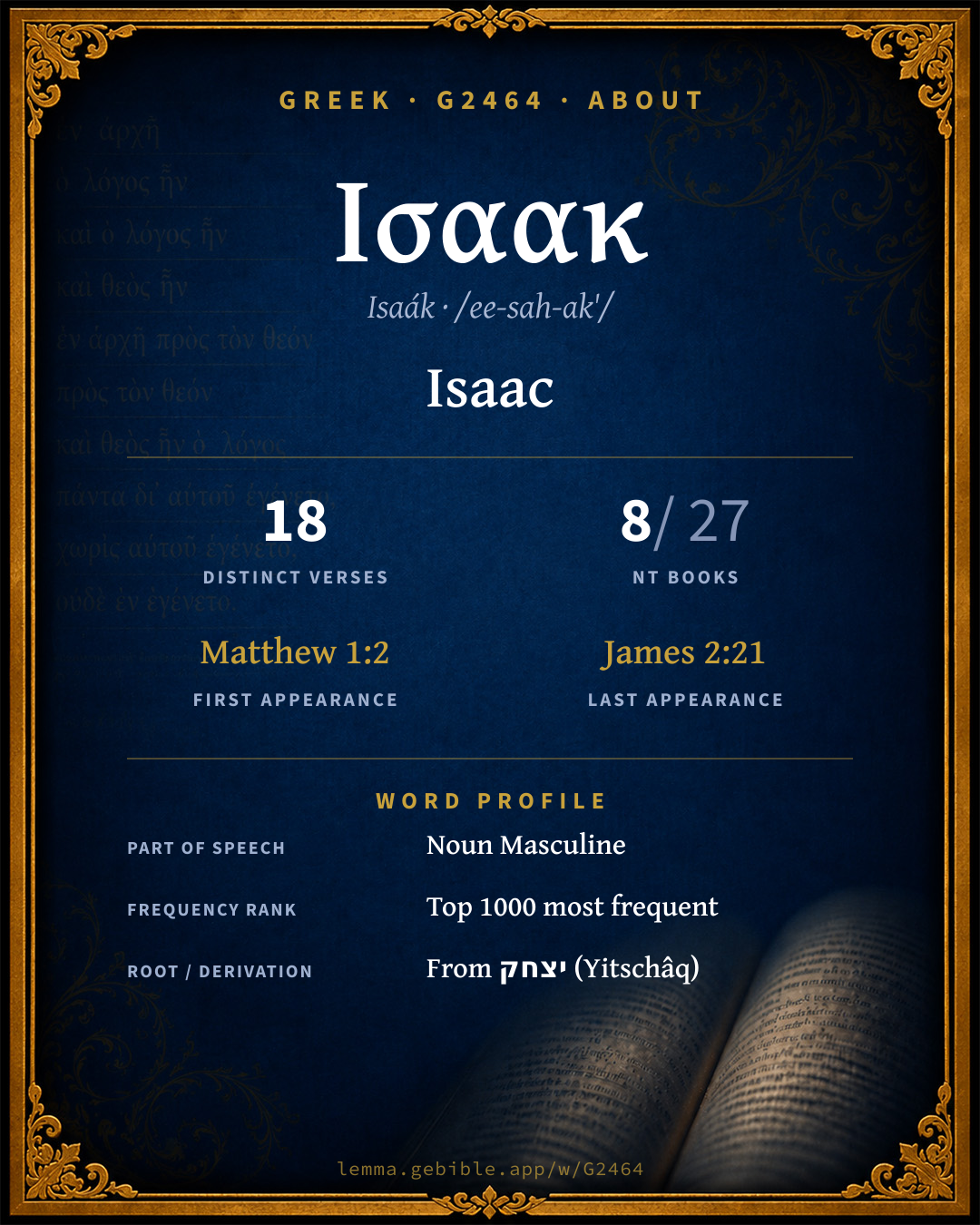
Ἰσαάκ
Isaac
Thayer's lists 2 entries for ‘Isaac’ fuller range ↓
Full lexicon entry — Thayer's Greek Lexicon
From Thayer's Greek Lexicon
Where this word appears
Every verse where G2464 appears — 18 distinct verses across 8 books. Click any verse to open its interlinear word-by-word view. Verse text shown in the World English Bible for context — . Each verse’s Greek form is shown with its reference; the English is not keyword-highlighted, since the data carries no word-level English alignment. Use “Compare translations” on any verse to read it across multiple English versions. This concordance covers the Greek New Testament; Septuagint (Greek Old Testament) occurrences of this word are not indexed here.
Matthew 3 verses
- Matthew 1:2 Ἰσαάκ Ἰσαὰκ n proper indecl n proper indecl Abraham became the father of Isaac. Isaac became the father of Jacob. Jacob became the father of Judah and his brothers.
- Matthew 8:11 Ἰσαὰκ n proper indecl I tell you that many will come from the east and the west, and will sit down with Abraham, Isaac, and Jacob in the Kingdom of Heaven,
- Matthew 22:32 Ἰσαὰκ n proper indecl 'I am the God of Abraham, and the God of Isaac, and the God of Jacob?' God is not the God of the dead, but of the living."
Mark 1 verse
Luke 3 verses
- Luke 3:34 Ἰσαὰκ n proper indecl the son of Jacob, the son of Isaac, the son of Abraham, the son of Terah, the son of Nahor,
- Luke 13:28 Ἰσαὰκ n proper indecl There will be weeping and gnashing of teeth, when you see Abraham, Isaac, Jacob, and all the prophets, in the Kingdom of God, and yourselves being thrown outside.
- Luke 20:37 Ἰσαὰκ n proper indecl But that the dead are raised, even Moses showed at the bush, when he called the Lord 'The God of Abraham, the God of Isaac, and the God of Jacob.'
Acts 3 verses
- Acts 3:13 Ἰσαὰκ n proper indecl The God of Abraham, Isaac, and Jacob, the God of our fathers, has glorified his Servant Jesus, whom you delivered up, and denied in the presence of Pilate, when he had determined to release him.
- Acts 7:8 Ἰσαὰκ Ἰσαὰκ n proper indecl n proper indecl He gave him the covenant of circumcision. So Abraham became the father of Isaac, and circumcised him the eighth day. Isaac became the father of Jacob, and Jacob became the father of the twelve patriarchs.
- Acts 7:32 Ἰσαὰκ n proper indecl 'I am the God of your fathers, the God of Abraham, the God of Isaac, and the God of Jacob.' Moses trembled, and dared not look.
Romans 2 verses
Galatians 1 verse
Hebrews 4 verses
- Hebrews 11:9 Ἰσαὰκ n proper indecl By faith, he lived as an alien in the land of promise, as in a land not his own, dwelling in tents, with Isaac and Jacob, the heirs with him of the same promise.
- Hebrews 11:17 Ἰσαὰκ n proper indecl By faith, Abraham, being tested, offered up Isaac. Yes, he who had gladly received the promises was offering up his one and only son;
- Hebrews 11:18 Ἰσαὰκ n proper indecl even he to whom it was said, "In Isaac will your seed be called;"
- Hebrews 11:20 Ἰσαὰκ n proper indecl By faith, Isaac blessed Jacob and Esau, even concerning things to come.
James 1 verse
About this entry
At a glance — auto-summarized from this page’s data, not written by a person. Every figure links to its source below. This summary describes the numbers; it doesn’t interpret them.
Ισαακ (Isaák) is a Greek name most often rendered “Isaac.” Scripture first uses it in Matthew 1:2. Spanning 18 verses in 8 books, it ranks among the uncommon words of the Greek New Testament. The sections below give every occurrence and version rendering.
Gloss history
Strong's 1890 vs modern scholarship
About this word
Strong's G2464 catalogs a Greek word from the Greek New Testament.
These counts are not copied from any lexicon or concordance. They are computed here, from the morphology-tagged Greek New Testament. What Lemma adds →
- 18
- distinct verses
- The word appears in 18 distinct verses.
- 8 / 27
- NT books
- The word appears in 8 of 27 New Testament books.
- #622
- by frequency
- Top 1000 most frequent Greek words (rank 622 of 5,347 Greek words by occurrence).
View all 18 occurrences in the concordance →
By section of the New Testament
By traditional corpus
Conventional, traditional groupings — biblical authorship is debated, so this is a traditional corpus grouping, not an authorship claim. Some books belong to more than one corpus (Luke is in both the Gospels and the Lukan corpus, and so on), so these shares overlap and need not total 100%. Each figure is a share of the word’s 18 distinct verses.
- Gospels 7 verses · 39%
- Lukan (Luke–Acts) 6 verses · 33%
- Hebrews 4 verses · 22%
- Pauline corpus 3 verses · 17%
- General (Catholic) Epistles 1 verse · 6%
How translations render this word
Counts come from each version’s own published word-to-Strong’s tagging or interlinear alignment — an approximate guide to how each version renders this word, not a word-level alignment the data otherwise carries. Because each total is that version’s own tagged count, the per-version totals vary from one another and need not match the appearance or distinct-verse counts above. These counts may also differ from a printed concordance because Lemma counts each distinctly tagged rendering and does not collapse phrase taggings into a single head-word total. This is a fixed set of word-tagged versions (KJV, ASV, BSB, ULT) and does not change with the reading translation you choose elsewhere. Each version’s license is shown beside its name below (and on Sources).
- King James Version: Isaac 19×
- American Standard Version: Isaac 17×
- Berean Standard Bible: Isaac 20×
- unfoldingWord Literal Text: Isaac 20×
King James Version Public Domain
Renders G2464 across 20 tagged occurrences — most commonly:
Plus 1 rendering that appears only once — usually multi-word phrases or single function words the recovered tagging swept in, not distinct renderings.
American Standard Version Public Domain
Renders G2464 across 20 tagged occurrences — most commonly:
Plus 3 renderings that appear only once — usually multi-word phrases or single function words the recovered tagging swept in, not distinct renderings.
Berean Standard Bible Public Domain
Renders G2464 across 20 tagged occurrences — most commonly:
unfoldingWord Literal Text CC BY-SA 4.0
Renders G2464 across 20 tagged occurrences — most commonly:
Senses in Thayer's
The 2 senses Thayer's distinguishes for this word, in lexicon order (not ranked by frequency or importance). The full entry — with sub-senses — is in the Lexicon Entry tab.
- Isaac = "to laugh"
- the son of Abraham and Sarah
Word origin
Derived from יצחק (Yitschâq) (H3327) — Isaac.
Of hebrew origin [ H3327 ]; Isaac (that is Jitschak ) the son of Abraham : - Isaac.
— Strong’s Exhaustive Concordance (1890), public domain.
Forms in the corpus
The 2 distinct written forms G2464 takes in the Greek New Testament, most frequent first — each parse links to that case’s occurrences in the concordance.
| Form | Parsing | Example | Uses |
|---|---|---|---|
| Ἰσαὰκ Isaàk | Noun, Proper, indeclinable | Matthew 1:2 | 19 |
| Ἰσαάκ Isaák | Noun, Proper, indeclinable | Matthew 1:2 | 1 |
Bible dictionary
Public-domain dictionary articles matched to this entry by name (Isaac). A biblical name can be shared by more than one person or place, so an article may treat several.
Easton's Bible Dictionary · M. G. Easton, 1897
Laughter. (1) Israel, or the kingdom of the ten tribes (Amos 7:9, 16).
(2.) The only son of Abraham by Sarah. He was the longest lived of the three patriarchs (Gen. 21:1-3). He was circumcised when eight days old (4-7); and when he was probably two years old a great feast was held in connection with his being weaned.
The next memorable event in his life is that connected with the command of God given to Abraham to offer him up as a sacrifice on a mountain in the land of Moriah (Gen. 22). (See ABRAHAM.) When he was forty years of age Rebekah was chosen for his wife (Gen. 24). After the death and burial of his father he took up his residence at Beer-lahai-roi (25:7-11), where his two sons, Esau and Jacob, were born (21-26), the former of whom seems to have been his favourite son (27, 28).
In consequence of a famine (Gen. 26:1) Isaac went to Gerar, where he practised deception as to his relation to Rebekah, imitating the conduct of his father in Egypt (12:12-20) and in Gerar (20:2). The Philistine king rebuked him for his prevarication.
After sojourning for some time in the land of the Philistines, he returned to Beersheba, where God gave him fresh assurance of covenant blessing, and where Abimelech entered into a covenant of peace with him.
The next chief event in his life was the blessing of his sons (Gen. 27:1). He died at Mamre, "being old and full of days" (35:27-29), one hundred and eighty years old, and was buried in the cave of Machpelah.
In the New Testament reference is made to his having been "offered up" by his father (Heb. 11:17; James 2:21), and to his blessing his sons (Heb. 11:20). As the child of promise, he is contrasted with Ishmael (Rom. 9:7, 10; Gal. 4:28; Heb. 11:18).
Isaac is "at once a counterpart of his father in simple devoutness and purity of life, and a contrast in his passive weakness of character, which in part, at least, may have sprung from his relations to his mother and wife. After the expulsion of Ishmael and Hagar, Isaac had no competitor, and grew up in the shade of Sarah's tent, moulded into feminine softness by habitual submission to her strong, loving will." His life was so quiet and uneventful that it was spent "within the circle of a few miles; so guileless that he let Jacob overreach him rather than disbelieve his assurance; so tender that his mother's death was the poignant sorrow of years; so patient and gentle that peace with his neighbours was dearer than even such a coveted possession as a well of living water dug by his own men; so grandly obedient that he put his life at his father's disposal; so firm in his reliance on God that his greatest concern through life was to honour the divine promise given to his race.", Geikie's Hours, etc.
Smith's Bible Dictionary · William Smith, 1863
(laughter), the son whom Sara bore to Abraham, in the hundredth year of his age, at Gerar. (B.C. 1897.) In his infancy he became the object of Ishmael's jealousy; and in his youth the victim, in intention, of Abraham's great sacrificial act of faith. When forty years old he married Rebekah his cousin, by whom, when he was sixty, he had two sons, Esau and Jacob. Driven by famine to Gerar, he acquired great wealth by his flocks but was repeatedly dispossessed by the Philistines of the wells which he sunk at convenient stations. After the deceit by which Jacob acquired his father's blessing Isaac sent his son to seek a wife in Padan-aram; and all that we know of him during the last forty-three years of his life in that he saw that God, with a large and prosperous family, return to him at Hebron. (Genesis 36:27) before he died there, at the age of 180 years. He was buried by his two sons in the cave of Machpelah. In the New Testament reference is made to the offering of Isaac (Hebrews 11:17; James 2:21) and to his blessing his sons. (Hebrews 11:20) In (Galatians 4:28-31) he is contrasted with Ishmael. In reference to the offering up of Isaac by Abraham, the primary doctrine taught are those of sacrifice and substitution, as the means appointed by God for taking away sin; and, as co-ordinate with these, the need of the obedience of faith, on the part of man, to receive the benefit. (Hebrews 11:17) The animal which God provided and Abraham offered was in the whole history of sacrifice the recognized type of "the Lamb of God, that taketh away the sins of the world." Isaac is the type of humanity itself, devoted to death for sin.
Hitchcock's Bible Names Dictionary · Roswell D. Hitchcock, 1869
laughter
Classic public-domain reference works; full attribution on Sources.
Septuagint usage
The same Greek word Ισαακ appears 117 times in the Greek Old Testament (Septuagint), across 110 verses in 12 books.
- 117
- LXX occurrences
- Tagged occurrences of this Greek word in the Septuagint.
- 110
- verses
- Distinct Septuagint verses containing this word.
- 12 / 39
- OT books
- The word appears in 12 of the 39 Old Testament books.
Sample Septuagint occurrences
- Genesis 17:19 ισαακ
- Exodus 2:24 ισαακ
- Leviticus 26:42 ισαακ
- Numbers 32:11 ισαακ
- Deuteronomy 1:8 ισαακ
- Joshua 24:3 ισαακ
- 1 Kings 18:36 ισαακ
- 2 Kings 13:23 ισαακ
- 1 Chronicles 1:16 ισαακ
- 2 Chronicles 30:6 ισαακ
- Psalms 104:9 ισαακ
- Daniel 3:35 ισαακ
Septuagint occurrences (same lexeme)
Every verse where the same Strong’s number (G2464) appears in the Greek Septuagint — showing the first 50 of 110. Verse text shown in the World English Bible for context; the Greek form is the matched word — the English is not keyword-highlighted.
- Genesis 17:19 ισαακ God said, "No, but Sarah, your wife, will bear you a son. You shall call his name Isaac. I will establish my covenant with him for an everlasting covenant for his seed after him.
- Genesis 17:21 ισαακ But my covenant I establish with Isaac, whom Sarah will bear to you at this set time in the next year."
- Genesis 21:3 ισαακ Abraham called his son who was born to him, whom Sarah bare to him, Isaac.
- Genesis 21:4 ισαακ Abraham circumcised his son, Isaac, when he was eight days old, as God had commanded him.
- Genesis 21:5 ισαακ Abraham was one hundred years old when his son, Isaac, was born to him.
- Genesis 21:8 ισαακ The child grew, and was weaned. Abraham made a great feast on the day that Isaac was weaned.
- Genesis 21:9 ισαακ Sarah saw the son of Hagar the Egyptian, whom she had borne to Abraham, mocking.
- Genesis 21:10 ισαακ Therefore she said to Abraham, "Cast out this handmaid and her son! For the son of this handmaid will not be heir with my son, even with Isaac."
- Genesis 21:12 ισαακ God said to Abraham, "Don't let it be grievous in your sight because of the boy, and because of your handmaid. In all that Sarah says to you, listen to her voice. For from Isaac will your seed be called.
- Genesis 22:2 ισαακ He said, "Now take your son, your only son, whom you love, even Isaac, and go into the land of Moriah. Offer him there for a burnt offering on one of the mountains which I will tell you of."
- Genesis 22:3 ισαακ Abraham rose early in the morning, and saddled his donkey, and took two of his young men with him, and Isaac his son. He split the wood for the burnt offering, and rose up, and went to the place of which God had told him.
- Genesis 22:6 ισαακ Abraham took the wood of the burnt offering and laid it on Isaac his son. He took in his hand the fire and the knife. They both went together.
- Genesis 22:7 ισαακ Isaac spoke to Abraham his father, and said, "My father?" He said, "Here I am, my son." He said, "Here is the fire and the wood, but where is the lamb for a burnt offering?"
- Genesis 22:9 ισαακ They came to the place which God had told him of. Abraham built the altar there, and laid the wood in order, bound Isaac his son, and laid him on the altar, on the wood.
- Genesis 22:13 ισαακ Abraham lifted up his eyes, and looked, and saw that behind him was a ram caught in the thicket by his horns. Abraham went and took the ram, and offered him up for a burnt offering instead of his son.
- Genesis 24:3 ισαακ I will make you swear by Yahweh, the God of heaven and the God of the earth, that you shall not take a wife for my son of the daughters of the Canaanites, among whom I live.
- Genesis 24:4 ισαακ But you shall go to my country, and to my relatives, and take a wife for my son Isaac."
- Genesis 24:7 ισαακ Yahweh, the God of heaven, who took me from my father's house, and from the land of my birth, who spoke to me, and who swore to me, saying, 'I will give this land to your seed.' He will send his angel before you, and you shall take a wife for my son from there.
- Genesis 24:14 ισαακ Let it happen, that the young lady to whom I will say, 'Please let down your pitcher, that I may drink.' She will say, 'Drink, and I will also give your camels a drink.' Let the same be she who you have appointed for your servant Isaac. Thereby will I know that you have shown kindness to my master."
- Genesis 24:44 ισαακ She will tell me, "Drink, and I will also draw for your camels." Let the same be the woman whom Yahweh has appointed for my master's son.'
- Genesis 24:62 ισαακ Isaac came from the way of Beer Lahai Roi. For he lived in the land of the South.
- Genesis 24:63 ισαακ Isaac went out to meditate in the field at the evening. He lifted up his eyes, and saw, and, behold, there were camels coming.
- Genesis 24:64 ισαακ Rebekah lifted up her eyes, and when she saw Isaac, she dismounted from the camel.
- Genesis 24:66 ισαακ The servant told Isaac all the things that he had done.
- Genesis 24:67 ισαακ Isaac brought her into his mother Sarah's tent, and took Rebekah, and she became his wife. He loved her. Isaac was comforted after his mother's death.
- Genesis 25:5 ισαακ Abraham gave all that he had to Isaac,
- Genesis 25:6 ισαακ but to the sons of the concubines who Abraham had, Abraham gave gifts. He sent them away from Isaac his son, while he yet lived, eastward, to the east country.
- Genesis 25:9 ισαακ Isaac and Ishmael, his sons, buried him in the cave of Machpelah, in the field of Ephron, the son of Zohar the Hittite, which is before Mamre,
- Genesis 25:11 ισαακ It happened after the death of Abraham, that God blessed Isaac, his son. Isaac lived by Beer Lahai Roi.
- Genesis 25:19 ισαακ This is the history of the generations of Isaac, Abraham's son. Abraham became the father of Isaac.
- Genesis 25:20 ισαακ Isaac was forty years old when he took Rebekah, the daughter of Bethuel the Syrian of Paddan Aram, the sister of Laban the Syrian, to be his wife.
- Genesis 25:21 ισαακ Isaac entreated Yahweh for his wife, because she was barren. Yahweh was entreated by him, and Rebekah his wife conceived.
- Genesis 25:26 ισαακ After that, his brother came out, and his hand had hold on Esau's heel. He was named Jacob. Isaac was sixty years old when she bore them.
- Genesis 25:28 ισαακ Now Isaac loved Esau, because he ate his venison. Rebekah loved Jacob.
- Genesis 26:1 ισαακ There was a famine in the land, besides the first famine that was in the days of Abraham. Isaac went to Abimelech king of the Philistines, to Gerar.
- Genesis 26:6 ισαακ Isaac lived in Gerar.
- Genesis 26:8 ισαακ It happened, when he had been there a long time, that Abimelech king of the Philistines looked out at a window, and saw, and, behold, Isaac was caressing Rebekah, his wife.
- Genesis 26:9 ισαακ Abimelech called Isaac, and said, "Behold, surely she is your wife. Why did you say, 'She is my sister?'" Isaac said to him, "Because I said, 'Lest I die because of her.'"
- Genesis 26:12 ισαακ Isaac sowed in that land, and reaped in the same year one hundred times what he planted. Yahweh blessed him.
- Genesis 26:16 ισαακ Abimelech said to Isaac, "Go from us, for you are much mightier than we."
- Genesis 26:17 ισαακ Isaac departed from there, encamped in the valley of Gerar, and lived there.
- Genesis 26:18 ισαακ Isaac dug again the wells of water, which they had dug in the days of Abraham his father. For the Philistines had stopped them after the death of Abraham. He called their names after the names by which his father had called them.
- Genesis 26:19 ισαακ Isaac's servants dug in the valley, and found there a well of springing water.
- Genesis 26:20 ισαακ The herdsmen of Gerar argued with Isaac's herdsmen, saying, "The water is ours." He called the name of the well Esek, because they contended with him.
- Genesis 26:21 ισαακ They dug another well, and they argued over that, also. He called the name of it Sitnah.
- Genesis 26:25 ισαακ He built an altar there, and called on the name of Yahweh, and pitched his tent there. There Isaac's servants dug a well.
- Genesis 26:27 ισαακ Isaac said to them, "Why have you come to me, since you hate me, and have sent me away from you?"
- Genesis 26:31 ισαακ They rose up some time in the morning, and swore one to another. Isaac sent them away, and they departed from him in peace.
- Genesis 26:32 ισαακ It happened the same day, that Isaac's servants came, and told him concerning the well which they had dug, and said to him, "We have found water."
- Genesis 26:35 ισαακ They grieved Isaac and Rebekah's spirits.
These are occurrences of the same Greek lexeme (G2464) in the Septuagint — not a translation of any one Hebrew word. The store carries no word-level Hebrew↔Greek alignment, so no Hebrew original is asserted here. Counts come from the recovered LXX Strong's tagging — high-frequency vocabulary is well covered, while rare or late forms may be untagged — so they reflect tagged occurrences and may slightly undercount.