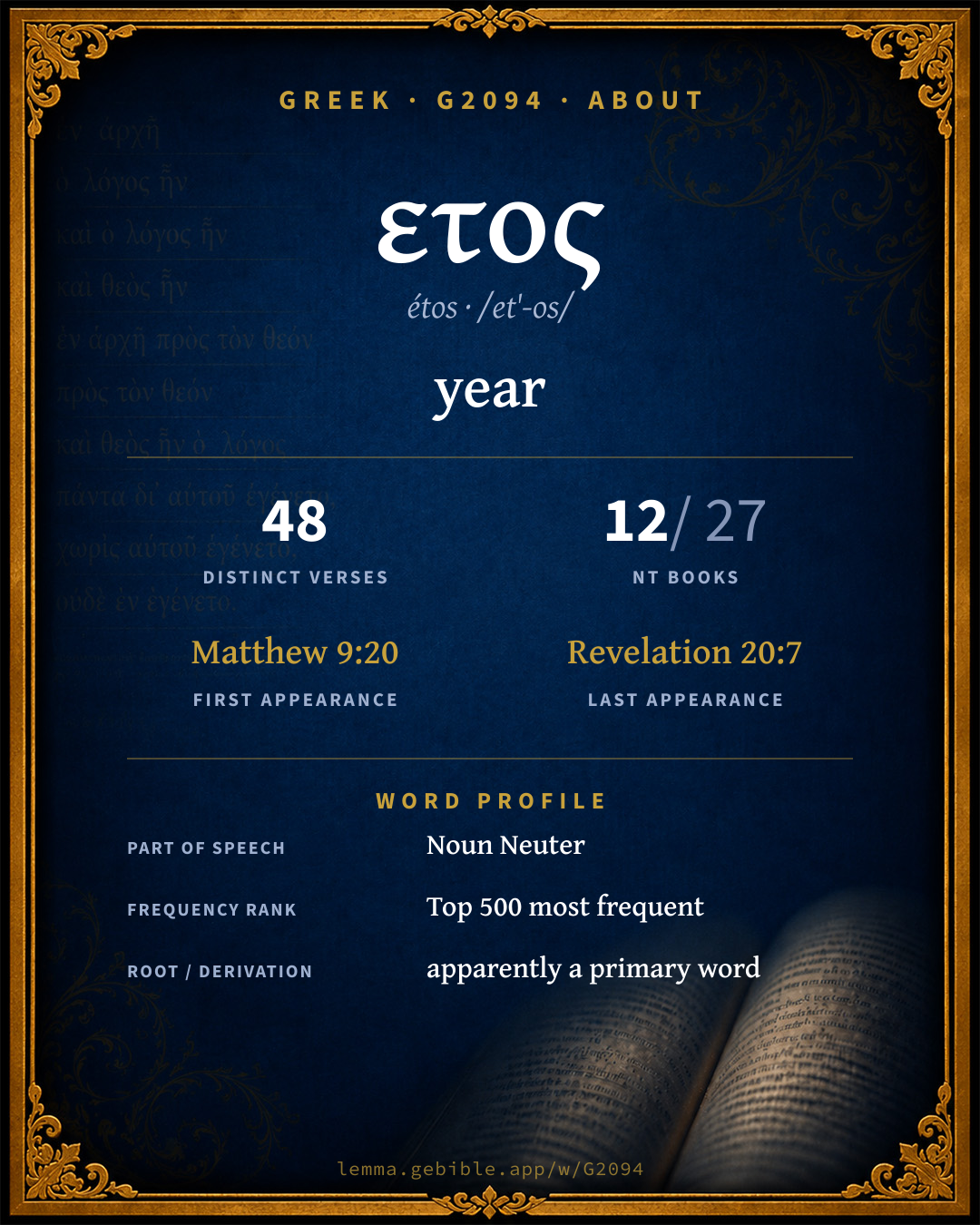
ἔτος
year
Full lexicon entry — Thayer's Greek Lexicon
From Thayer's Greek Lexicon
Where this word appears
See every Accusative-case word in the Greek New Testament →
Grammar key — what these labels mean
Part of speech
- Noun
- A naming word — a person, place, thing, or idea.
Case
- Accusative
- The case of the direct object and of extent.
- Genitive
- The case of source, possession, or “of” — answers “whose / from what.”
- Nominative
- The case of the subject (and the predicate nominative).
- Dative
- The case of the indirect object, means, or location — “to / for / with / in.”
Gender
- Neuter
- Grammatically neuter.
Number
- Plural
- More than one.
- Singular
- One.
Grammatical forms
- Noun, Accusative, Plural, Neuter 23 times (47%)
- Noun, Genitive, Plural, Neuter 15 times (31%)
- Noun, Nominative, Plural, Neuter 6 times (12%)
- Noun, Accusative, Singular, Neuter 2 times (4%)
- Noun, Dative, Plural, Neuter 2 times (4%)
- Noun, Dative, Singular, Neuter 1 time (2%)
Parsed forms decoded from the imported morphology (Robinson–Tischendorf, public domain), counted across 49 parsed occurrences — not distinct verses.
Every verse where G2094 appears — 48 distinct verses across 12 books. Click any verse to open its interlinear word-by-word view. Verse text shown in the World English Bible for context — . Each verse’s Greek form is shown with its reference; the English is not keyword-highlighted, since the data carries no word-level English alignment. Use “Compare translations” on any verse to read it across multiple English versions. This concordance covers the Greek New Testament; Septuagint (Greek Old Testament) occurrences of this word are not indexed here.
Matthew 1 verse
Mark 2 verses
Luke 15 verses
- Luke 2:36 ἔτη n acc pl neut There was one Anna, a prophetess, the daughter of Phanuel, of the tribe of Asher (she was of a great age, having lived with a husband seven years from her virginity,
- Luke 2:37 ἐτῶν n gen pl neut and she had been a widow for about eighty-four years), who didn't depart from the temple, worshipping with fastings and petitions night and day.
- Luke 2:41 ἔτος n acc sg neut His parents went every year to Jerusalem at the feast of the Passover.
- Luke 2:42 ἐτῶν n gen pl neut When he was twelve years old, they went up to Jerusalem according to the custom of the feast,
- Luke 3:1 ἔτει n dat sg neut Now in the fifteenth year of the reign of Tiberius Caesar, Pontius Pilate being governor of Judea, and Herod being tetrarch of Galilee, and his brother Philip tetrarch of the region of Ituraea and Trachonitis, and Lysanias tetrarch of Abilene,
- Luke 3:23 ἐτῶν n gen pl neut Jesus himself, when he began to teach, was about thirty years old, being the son (as was supposed) of Joseph, the son of Heli,
- Luke 4:25 ἔτη n acc pl neut But truly I tell you, there were many widows in Israel in the days of Elijah, when the sky was shut up three years and six months, when a great famine came over all the land.
- Luke 8:42 ἐτῶν n gen pl neut for he had an only daughter, about twelve years of age, and she was dying. But as he went, the multitudes pressed against him.
- Luke 8:43 ἐτῶν n gen pl neut A woman who had a flow of blood for twelve years, who had spent all her living on physicians, and could not be healed by any,
- Luke 12:19 ἔτη n acc pl neut I will tell my soul, "Soul, you have many goods laid up for many years. Take your ease, eat, drink, be merry."'
- Luke 13:7 ἔτη n acc pl neut He said to the vine dresser, 'Behold, these three years I have come looking for fruit on this fig tree, and found none. Cut it down. Why does it waste the soil?'
- Luke 13:8 ἔτος n acc sg neut He answered, 'Lord, leave it alone this year also, until I dig around it, and fertilize it.
- Luke 13:11 ἔτη n acc pl neut Behold, there was a woman who had a spirit of infirmity eighteen years, and she was bent over, and could in no way straighten herself up.
- Luke 13:16 ἔτη n acc pl neut Ought not this woman, being a daughter of Abraham, whom Satan had bound eighteen long years, be freed from this bondage on the Sabbath day?"
- Luke 15:29 ἔτη n acc pl neut But he answered his father, 'Behold, these many years I have served you, and I never disobeyed a commandment of yours, but you never gave me a goat, that I might celebrate with my friends.
John 3 verses
- John 2:20 ἔτεσιν n dat pl neut The Jews therefore said, "Forty-six years was this temple in building, and will you raise it up in three days?"
- John 5:5 ἔτη n acc pl neut A certain man was there, who had been sick for thirty-eight years.
- John 8:57 ἔτη n acc pl neut The Jews therefore said to him, "You are not yet fifty years old, and have you seen Abraham?"
Acts 11 verses
- Acts 4:22 ἐτῶν n gen pl neut For the man on whom this miracle of healing was performed was more than forty years old.
- Acts 7:6 ἔτη n acc pl neut God spoke in this way: that his seed would live as aliens in a strange land, and that they would be enslaved and mistreated for four hundred years.
- Acts 7:30 ἐτῶν n gen pl neut "When forty years were fulfilled, an angel of the Lord appeared to him in the wilderness of Mount Sinai, in a flame of fire in a bush.
- Acts 7:36 ἔτη n acc pl neut This man led them out, having worked wonders and signs in Egypt, in the Red Sea, and in the wilderness for forty years.
- Acts 7:42 ἔτη n acc pl neut But God turned, and gave them up to serve the host of the sky, as it is written in the book of the prophets, 'Did you offer to me slain animals and sacrifices Forty years in the wilderness, O house of Israel?
- Acts 9:33 ἐτῶν n gen pl neut There he found a certain man named Aeneas, who had been bedridden for eight years, because he was paralyzed.
- Acts 13:20 ἔτεσιν n dat pl neut After these things he gave them judges until Samuel the prophet.
- Acts 13:21 ἔτη n acc pl neut Afterward they asked for a king, and God gave to them Saul the son of Kish, a man of the tribe of Benjamin, for forty years.
- Acts 19:10 ἔτη n acc pl neut This continued for two years, so that all those who lived in Asia heard the word of the Lord Jesus, both Jews and Greeks.
- Acts 24:10 ἐτῶν n gen pl neut When the governor had beckoned to him to speak, Paul answered, "Because I know that you have been a judge of this nation for many years, I cheerfully make my defense,
- Acts 24:17 ἐτῶν n gen pl neut Now after some years, I came to bring gifts for the needy to my nation, and offerings;
Romans 1 verse
2 Corinthians 1 verse
Galatians 3 verses
- Galatians 1:18 ἔτη n acc pl neut Then after three years I went up to Jerusalem to visit Peter, and stayed with him fifteen days.
- Galatians 2:1 ἐτῶν n gen pl neut Then after a period of fourteen years I went up again to Jerusalem with Barnabas, taking Titus also with me.
- Galatians 3:17 ἔτη n acc pl neut Now I say this. A covenant confirmed beforehand by God in Christ, the law, which came four hundred thirty years after, does not annul, so as to make the promise of no effect.
1 Timothy 1 verse
Hebrews 3 verses
- Hebrews 1:12 ἔτη n nom pl neut As a mantle you will roll them up, And they will be changed; But you are the same. Your years will not fail."
- Hebrews 3:9 ἔτη n acc pl neut Where your fathers tested me by proving me, And saw my works for forty years.
- Hebrews 3:17 ἔτη n acc pl neut With whom was he displeased forty years? Wasn't it with those who sinned, whose bodies fell in the wilderness?
2 Peter 1 verse
Revelation 6 verses
- Revelation 20:2 ἔτη n acc pl neut He seized the dragon, the old serpent, which is the devil and Satan, who deceives the whole inhabited earth, and bound him for a thousand years,
- Revelation 20:3 ἔτη n nom pl neut and cast him into the abyss, and shut it, and sealed it over him, that he should deceive the nations no more, until the thousand years were finished. After this, he must be freed for a short time.
- Revelation 20:4 ἔτη n acc pl neut I saw thrones, and they sat on them, and judgment was given to them. I saw the souls of those who had been beheaded for the testimony of Jesus, and for the word of God, and such as didn't worship the beast nor his image, and didn't receive the mark on their forehead and on their hand. They lived, and reigned with Christ for the thousand years.
- Revelation 20:5 ἔτη n nom pl neut The rest of the dead didn't live until the thousand years were finished. This is the first resurrection.
- Revelation 20:6 ἔτη n acc pl neut Blessed and holy is he who has part in the first resurrection. Over these, the second death has no power, but they will be priests of God and of Christ, and will reign with him one thousand years.
- Revelation 20:7 ἔτη n nom pl neut And after the thousand years, Satan will be released from his prison,
About this entry
At a glance — auto-summarized from this page’s data, not written by a person. Every figure links to its source below. This summary describes the numbers; it doesn’t interpret them.
At its core, ετος (étos) means “year.” Scripture first uses it in Matthew 9:20. Spanning 48 verses in 12 books, it ranks among the moderately common words of the Greek New Testament. Its uses concentrate in Luke (31% of all occurrences). From the same root come ετι. Each statement above links to its evidence; the full detail follows below.
Gloss history
Strong's 1890 vs modern scholarship

About this word
Strong's G2094 catalogs a Greek word from the Greek New Testament.
These counts are not copied from any lexicon or concordance. They are computed here, from the morphology-tagged Greek New Testament. What Lemma adds →
- 48
- distinct verses
- The word appears in 48 distinct verses.
- 12 / 27
- NT books
- The word appears in 12 of 27 New Testament books.
- #316
- by frequency
- Top 500 most frequent Greek words (rank 316 of 5,347 Greek words by occurrence).
View all 48 occurrences in the concordance →
Most concentrated in
- Luke 15 verses 31%
- Acts 11 verses 23%
- Revelation 6 verses 13%
By section of the New Testament
By traditional corpus
Conventional, traditional groupings — biblical authorship is debated, so this is a traditional corpus grouping, not an authorship claim. Some books belong to more than one corpus (Luke is in both the Gospels and the Lukan corpus, and so on), so these shares overlap and need not total 100%. Each figure is a share of the word’s 48 distinct verses.
- Lukan (Luke–Acts) 26 verses · 54%
- Gospels 21 verses · 44%
- Johannine 9 verses · 19%
- Pauline corpus 6 verses · 13%
- Revelation 6 verses · 13%
- Hebrews 3 verses · 6%
- General (Catholic) Epistles 1 verse · 2%
How translations render this word
Counts come from each version’s own published word-to-Strong’s tagging or interlinear alignment — an approximate guide to how each version renders this word, not a word-level alignment the data otherwise carries. Because each total is that version’s own tagged count, the per-version totals vary from one another and need not match the appearance or distinct-verse counts above. These counts may also differ from a printed concordance because Lemma counts each distinctly tagged rendering and does not collapse phrase taggings into a single head-word total. This is a fixed set of word-tagged versions (KJV, ASV, BSB, ULT) and does not change with the reading translation you choose elsewhere. Each version’s license is shown beside its name below (and on Sources).
- King James Version: Years 39×, Years old 4×, Year 3×
- American Standard Version: Years 39×, Year 3×, Years old 3×
- Berean Standard Bible: Years 43×, Year 3×
- unfoldingWord Literal Text: Years 41×, For 11×, Years old 5×
King James Version Public Domain
Renders G2094 across 48 tagged occurrences — most commonly:
Not rendered by a distinct English word in 1 further occurrence.
American Standard Version Public Domain
Renders G2094 across 50 tagged occurrences — most commonly:
Plus 3 renderings that appear only once — usually multi-word phrases or single function words the recovered tagging swept in, not distinct renderings.
Berean Standard Bible Public Domain
Renders G2094 across 47 tagged occurrences — most commonly:
Plus 1 rendering that appears only once — usually multi-word phrases or single function words the recovered tagging swept in, not distinct renderings. Not rendered by a distinct English word in 2 further occurrences.
unfoldingWord Literal Text CC BY-SA 4.0
Renders G2094 across 63 tagged occurrences — most commonly:
Plus 3 renderings that appear only once — usually multi-word phrases or single function words the recovered tagging swept in, not distinct renderings.
Senses in Thayer's
The 1 sense Thayer's distinguishes for this word, in lexicon order (not ranked by frequency or importance). The full entry — with sub-senses — is in the Lexicon Entry tab.
- year
Word origin
Origin: apparently a primary word
Apparently a primary word; a year : - year.
— Strong’s Exhaustive Concordance (1890), public domain.
Forms in the corpus
The 5 distinct written forms G2094 takes in the Greek New Testament, most frequent first — each parse links to that case’s occurrences in the concordance.
| Form | Parsing | Example | Uses |
|---|---|---|---|
| ἔτη étē | Noun, Accusative, Plural, Neuter | Matthew 9:20 | 29 |
| ἐτῶν etō̂n | Noun, Genitive, Plural, Neuter | Mark 5:42 | 15 |
| ἔτεσιν étesin | Noun, Dative, Plural, Neuter | John 2:20 | 2 |
| ἔτος étos | Noun, Accusative, Singular, Neuter | Luke 2:41 | 2 |
| ἔτει étei | Noun, Dative, Singular, Neuter | Luke 3:1 | 1 |
Same root — word family
Other Thayer's entries built from the same root as G2094, grouped by Strong’s listed origin. These share a root / origin per the lexicon — not necessarily a shared meaning. Each links to that word’s own entry.
Derived from this word
Compare all same-root words → They share a root, not necessarily a meaning.
Septuagint usage
The same Greek word ετος appears 589 times in the Greek Old Testament (Septuagint), across 479 verses in 30 books.
- 589
- LXX occurrences
- Tagged occurrences of this Greek word in the Septuagint.
- 479
- verses
- Distinct Septuagint verses containing this word.
- 30 / 39
- OT books
- The word appears in 30 of the 39 Old Testament books.
Sample Septuagint occurrences
- Genesis 5:3 ἔτος
- Exodus 6:16 ἔτος
- Leviticus 19:23 ἔτος
- Numbers 1:1 ἔτος
- Deuteronomy 1:3 ἔτος
- Joshua 5:6 ἔτος
- Judges 2:8 ἔτος
- Ruth 1:4 ἔτος
- 1 Samuel 2:9 ἔτος
- 2 Samuel 2:10 ἔτος
- 1 Kings 2:11 ἔτος
- 2 Kings 1:18 ἔτος
Septuagint occurrences (same lexeme)
Every verse where the same Strong’s number (G2094) appears in the Greek Septuagint — showing the first 50 of 479. Verse text shown in the World English Bible for context; the Greek form is the matched word — the English is not keyword-highlighted.
- Genesis 5:3 ἔτος Adam lived one hundred thirty years, and became the father of a son in his own likeness, after his image, and named him Seth.
- Genesis 5:4 ἔτος The days of Adam after he became the father of Seth were eight hundred years, and he became the father of sons and daughters.
- Genesis 5:5 ἔτος All the days that Adam lived were nine hundred thirty years, then he died.
- Genesis 5:6 ἔτος Seth lived one hundred five years, and became the father of Enosh.
- Genesis 5:7 ἔτος Seth lived after he became the father of Enosh eight hundred seven years, and became the father of sons and daughters.
- Genesis 5:8 ἔτος All the days of Seth were nine hundred twelve years, then he died.
- Genesis 5:9 ἔτος Enosh lived ninety years, and became the father of Kenan.
- Genesis 5:10 ἔτος Enosh lived after he became the father of Kenan, eight hundred fifteen years, and became the father of sons and daughters.
- Genesis 5:11 ἔτος All the days of Enosh were nine hundred five years, then he died.
- Genesis 5:12 ἔτος Kenan lived seventy years, and became the father of Mahalalel.
- Genesis 5:13 ἔτος Kenan lived after he became the father of Mahalalel eight hundred forty years, and became the father of sons and daughters
- Genesis 5:14 ἔτος and all the days of Kenan were nine hundred ten years, then he died.
- Genesis 5:15 ἔτος Mahalalel lived sixty-five years, and became the father of Jared.
- Genesis 5:16 ἔτος Mahalalel lived after he became the father of Jared eight hundred thirty years, and became the father of sons and daughters.
- Genesis 5:17 ἔτος All the days of Mahalalel were eight hundred ninety-five years, then he died.
- Genesis 5:18 ἔτος Jared lived one hundred sixty-two years, and became the father of Enoch.
- Genesis 5:19 ἔτος Jared lived after he became the father of Enoch eight hundred years, and became the father of sons and daughters.
- Genesis 5:20 ἔτος All the days of Jared were nine hundred sixty-two years, then he died.
- Genesis 5:21 ἔτος Enoch lived sixty-five years, and became the father of Methuselah.
- Genesis 5:22 ἔτος Enoch walked with God after he became the father of Methuselah three hundred years, and became the father of sons and daughters.
- Genesis 5:23 ἔτος all the days of Enoch were three hundred sixty-five years.
- Genesis 5:25 ἔτος Methuselah lived one hundred eighty-seven years, and became the father of Lamech.
- Genesis 5:26 ἔτος Methuselah lived after he became the father of Lamech seven hundred eighty-two years, and became the father of sons and daughters.
- Genesis 5:27 ἔτος All the days of Methuselah were nine hundred sixty-nine years, then he died.
- Genesis 5:28 ἔτος Lamech lived one hundred eighty-two years, and became the father of a son,
- Genesis 5:30 ἔτος Lamech lived after he became the father of Noah five hundred ninety-five years, and became the father of sons and daughters.
- Genesis 5:31 ἔτος All the days of Lamech were seven hundred seventy-seven years, then he died.
- Genesis 5:32 ἔτος Noah was five hundred years old, and Noah became the father of Shem, Ham, and Japheth.
- Genesis 6:3 ἔτος Yahweh said, "My Spirit will not strive with man forever, because he also is flesh; yet will his days be one hundred twenty years."
- Genesis 7:6 ἔτος Noah was six hundred years old when the flood of waters came on the earth.
- Genesis 7:11 ἔτος In the six hundredth year of Noah's life, in the second month, on the seventeenth day of the month, on the same day all the fountains of the great deep were burst open, and the sky's windows were opened.
- Genesis 8:13 ἔτος It happened in the six hundred first year, in the first month, the first day of the month, the waters were dried up from off the earth. Noah removed the covering of the ark, and looked. He saw that the surface of the ground was dried.
- Genesis 9:28 ἔτος Noah lived three hundred fifty years after the flood.
- Genesis 9:29 ἔτος All the days of Noah were nine hundred fifty years, then he died.
- Genesis 11:10 ἔτος This is the history of the generations of Shem. Shem was one hundred years old, and became the father of Arpachshad two years after the flood.
- Genesis 11:11 ἔτος Shem lived after he became the father of Arpachshad five hundred years, and became the father of sons and daughters.
- Genesis 11:12 ἔτος Arpachshad lived thirty-five years, and became the father of Shelah.
- Genesis 11:13 ἔτος Arpachshad lived after he became the father of Shelah four hundred three years, and became the father of sons and daughters.
- Genesis 11:14 ἔτος Shelah lived thirty years, and became the father of Eber:
- Genesis 11:15 ἔτος and Shelah lived after he became the father of Eber four hundred three years, and became the father of sons and daughters.
- Genesis 11:16 ἔτος Eber lived thirty-four years, and became the father of Peleg.
- Genesis 11:17 ἔτος Eber lived after he became the father of Peleg four hundred thirty years, and became the father of sons and daughters.
- Genesis 11:18 ἔτος Peleg lived thirty years, and became the father of Reu.
- Genesis 11:19 ἔτος Peleg lived after he became the father of Reu two hundred nine years, and became the father of sons and daughters.
- Genesis 11:20 ἔτος Reu lived thirty-two years, and became the father of Serug.
- Genesis 11:21 ἔτος Reu lived after he became the father of Serug two hundred seven years, and became the father of sons and daughters.
- Genesis 11:22 ἔτος Serug lived thirty years, and became the father of Nahor.
- Genesis 11:23 ἔτος Serug lived after he became the father of Nahor two hundred years, and became the father of sons and daughters.
- Genesis 11:24 ἔτος Nahor lived twenty-nine years, and became the father of Terah.
- Genesis 11:25 ἔτος Nahor lived after he became the father of Terah one hundred nineteen years, and became the father of sons and daughters.
These are occurrences of the same Greek lexeme (G2094) in the Septuagint — not a translation of any one Hebrew word. The store carries no word-level Hebrew↔Greek alignment, so no Hebrew original is asserted here. Counts come from the recovered LXX Strong's tagging — high-frequency vocabulary is well covered, while rare or late forms may be untagged — so they reflect tagged occurrences and may slightly undercount.