
Galatians 1:18

Greek (Tischendorf 8th ed.) Galatians 1:18 appears in the Greek New Testament. The text above is from the Tischendorf 8th edition. Each word links to its Strong’s number and a concise gloss. Click any word for its full Thayer’s Greek Lexicon entry.
Download image
Cite this verse

Galatians 1:18 (World English Bible). Public Domain. Lemma interlinear Bible study tool, https://lemma.gebible.app/v/galatians/1/18.

Show BibTeX & RIS
BibTeX
RIS
English Translation
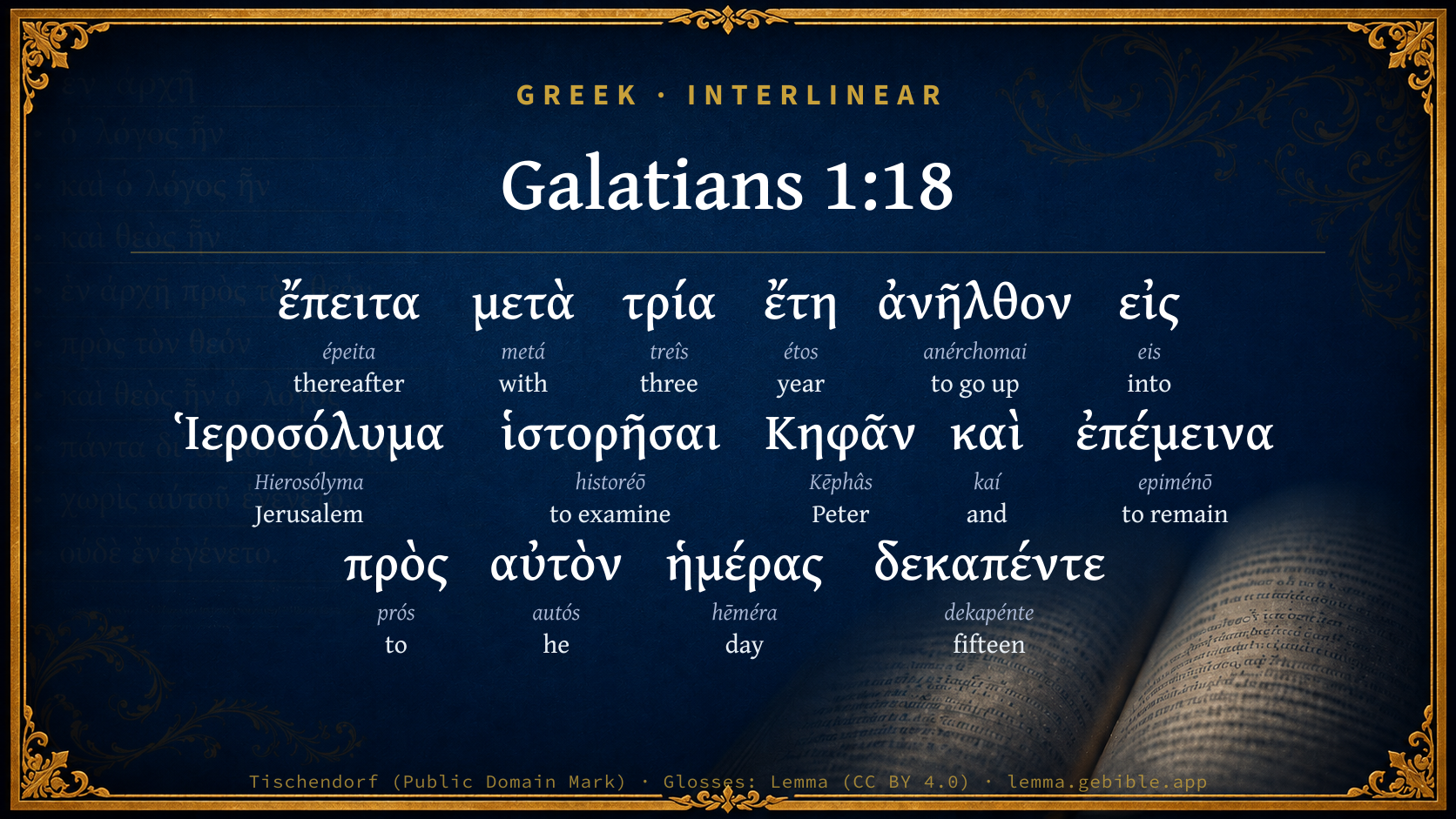
Then after three years I went up to Jerusalem to visit Peter, and stayed with him fifteen days.
World English Bible · Public Domain
Highlights
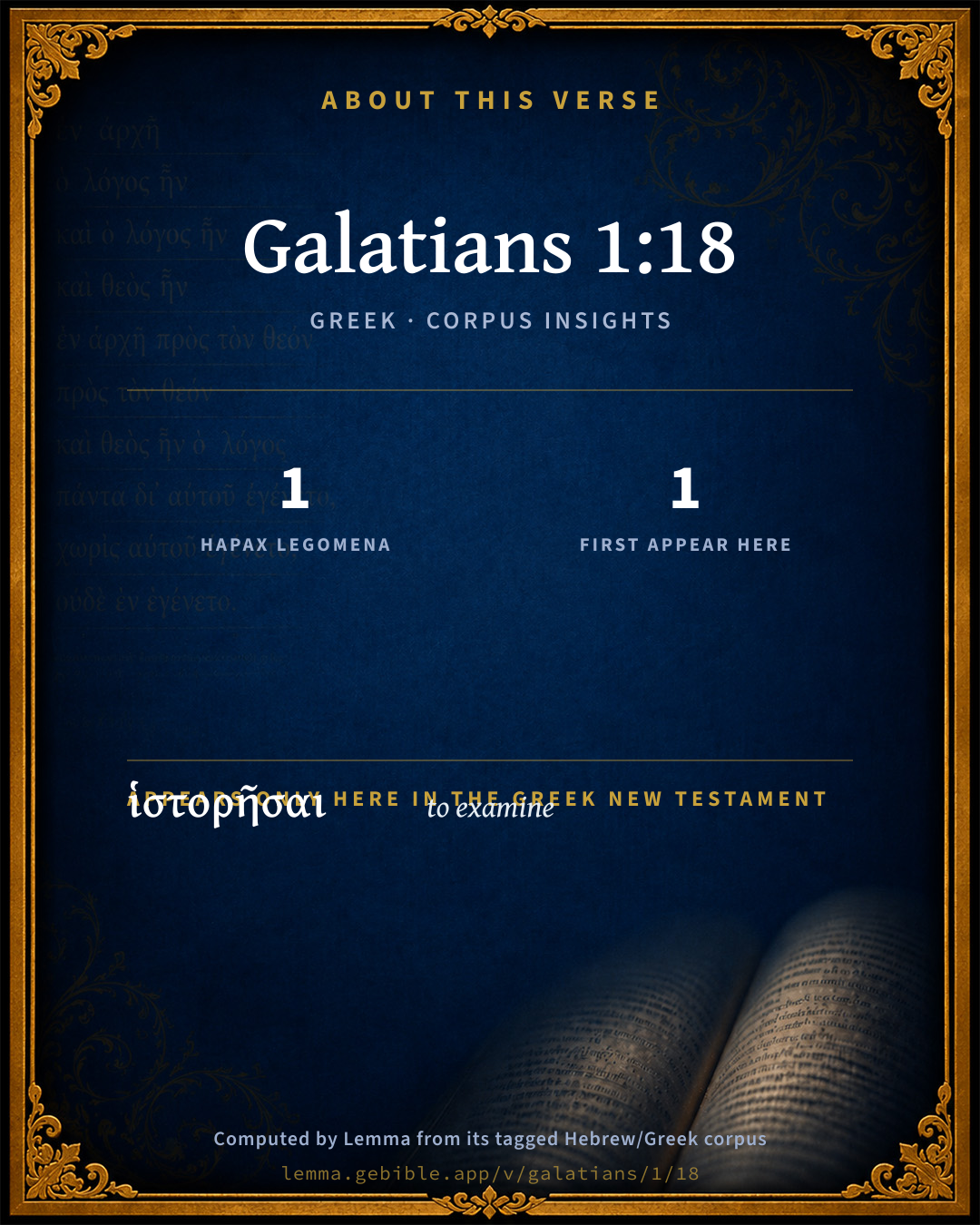
  • 1 hapax legomenon — only here in the Greek New Testament
  • 1 first appearance in the Greek New Testament
Full analysis ↓
Download a study sheet

One document with this verse’s original text, its word-by-word gloss line, the meaning frame, cross-references with their text, attributed commentary, and full source and license credits — printable, and it pastes into notes with its structure intact.

This verse Autodidact and up

Study sheet (.html) Plain text (.txt)

A passage Seminary Student

Up to 50 verses in one chapter. A passage sheet keeps up to 6 commentary sources and 12 cross-references per verse, in the order this page ranks them, and says so on the sheet whenever that leaves anything out. Ask for a single verse and you get the Autodidact verse sheet above.

Everything on this page stays free to read, with no account — the sheet is a download of what is already on screen, not access to it.

Want to remove ads? Support Godless Engineer
Compare translations 3

The same verse in 3 English versions, stacked beneath the original-language interlinear above. Click any original word for its lexicon entry.

Each is an independent rendering of the whole verse — the interlinear is not word-aligned to these translations.

Highlighted words mark where these versions differ — a whole-verse word diff, not a word-by-word alignment.

  • World English Bible Public Domain
    Then after three years I went up to Jerusalem to visit Peter, and stayed with him fifteen days.
  • King James Version Public Domain
    Then after three years I went up to Jerusalem to see Peter, and abode with him fifteen days.
  • unfoldingWord Literal Text CC BY-SA 4.0
    Then after three years I went up to Jerusalem to visit Cephas and I stayed with him fifteen days.

unfoldingWord Literal Text — © unfoldingWord, licensed CC BY-SA 4.0. Word-aligned USFM3 via Door43 (git.door43.org/unfoldingWord/en_ult).

Versions to compare (up to 4)

3 of 4 selected

Show all 19 translations

Every available English version of this verse, each an independent rendering of the whole verse.

  • World English Bible Public Domain
    Then after three years I went up to Jerusalem to visit Peter, and stayed with him fifteen days.
  • Berean Standard Bible Public Domain
    Only after three years did I go up to Jerusalem to confer with Cephas, and I stayed with him fifteen days.
  • Majority Standard Bible Public Domain
    Only after three years did I go up to Jerusalem to confer with Peter, and I stayed with him fifteen days.
  • King James Version Public Domain
    Then after three years I went up to Jerusalem to see Peter, and abode with him fifteen days.
  • American Standard Version (1901) Public Domain
    Then after three years I went up to Jerusalem to visit Cephas, and tarried with him fifteen days.
  • Revised Version (1885) Public Domain
    Then after three years I went up to Jerusalem to visit Cephas, and tarried with him fifteen days.
  • Geneva Bible (1599) Public Domain
    Then after three yeeres I came againe to Hierusalem to visite Peter, and abode with him fifteene dayes.
  • Douay-Rheims (1899) Public Domain
    Then, after three years, I went to Jerusalem, to see Peter, and I tarried with him fifteen days.
  • Young's Literal Translation Public Domain
    then, after three years I went up to Jerusalem to enquire about Peter, and remained with him fifteen days,
  • Literal Standard Version CC BY-SA 4.0
    then, after three years I went up to Jerusalem to inquire about Peter, and remained with him fifteen days,
  • Unlocked Literal Bible CC BY-SA 4.0
    Then after three years I went up to Jerusalem to get to know Cephas and I stayed with him fifteen days.
  • unfoldingWord Literal Text CC BY-SA 4.0
    Then after three years I went up to Jerusalem to visit Cephas and I stayed with him fifteen days.
  • Darby Bible Public Domain
    Then after three years I went up to Jerusalem to make acquaintance with Peter, and I remained with him fifteen days;
  • World Messianic Bible Public Domain
    Then after three years I went up to Jerusalem to visit Peter, and stayed with him fifteen days.
  • Webster's Bible Public Domain
    Then after three years I went to Jerusalem to see Peter, and abode with him fifteen days.
  • Free Bible Version CC BY-SA 4.0
    After three years I went to Jerusalem to visit Peter. I stayed with him for two weeks.
  • Bible in Basic English Public Domain
    Then after three years I went up to Jerusalem to see Cephas, and was there with him fifteen days.
  • Text-Critical English NT CC BY 4.0
    Then after three years I went up to Jerusalem to become acquainted with Peter, and I stayed with him for fifteen days.
  • Tyndale New Testament (1534) Public Domain
    Then after thre yeare I returned to Ierusalem to se Peter and abode with him.xv. dayes

Literal Standard Version (2020), Covenant Press — licensed CC BY-SA 4.0. Text via the HelloAO Bible API (eBible.org). Unlocked Literal Bible (unfoldingWord) — licensed CC BY-SA 4.0. Text via the HelloAO Bible API (eBible.org). unfoldingWord Literal Text — © unfoldingWord, licensed CC BY-SA 4.0. Word-aligned USFM3 via Door43 (git.door43.org/unfoldingWord/en_ult). Free Bible Version, Dr. Jonathan Gallagher — licensed CC BY-SA 4.0. Text via the HelloAO Bible API (eBible.org).

Word by word

More ways to search: Search by grammar → Find every occurrence → Compare this word →

Practice this passage: Drill this verse → Learn its vocabulary →

ἱστορῆσαι
historéō
G2477
“to examine”
Verb, Aorist, Active, Infinitive
Part of Speech
Verb
Tense
Aorist
Voice
Active
Mood
Infinitive
Full Thayer's Definition

Origin: from a derivative of G1492

TDNT: 09:31,4

1. to enquire into, examine, investigate 2. to find out, learn, by enquiry 3. to gain knowledge of by visiting a. of some distinguished person, to become personally acquainted with, know face to face
  1. ἔπειτα épeita G1899 “thereafter” Adverb
  2. μετὰ metá G3326 “with” Preposition
  3. τρία treîs G5140 “three” Adjective, Accusative, Plural, Neuter
  4. ἔτη étos G2094 “year” Noun, Accusative, Plural, Neuter
  5. ἀνῆλθον anérchomai G424 “to go up” Verb, Aorist, Active, Indicative, 1st person, Singular
  6. εἰς eis G1519 “into” Preposition
  7. Ἱεροσόλυμα Hierosólyma G2414 “Jerusalem” Noun, Accusative, Singular, Feminine
  8. Κηφᾶν Kēphâs G2786 “Peter” Noun, Accusative, Singular, Masculine
  9. καὶ kaí G2532 “and” Conjunction
  10. ἐπέμεινα epiménō G1961 “to remain” Verb, Aorist, Active, Indicative, 1st person, Singular
  11. πρὸς prós G4314 “to” Preposition
  12. αὐτὸν autós G846 “he” Personal pronoun, Accusative, Singular, Masculine
  13. ἡμέρας hēméra G2250 “day” Noun, Accusative, Plural, Feminine
  14. δεκαπέντε dekapénte G1178 “fifteen” Adjective, Numeral (indeclinable)

About this verse

These counts appear in no published source. They are computed here, from the morphology-tagged text and Lemma’s own curated glosses. What Lemma adds →

15
words
15
distinct lemmas
Pauline Epistles
section

Notable vocabulary

1 hapax legomenon — a word that appears only here in the entire Greek New Testament:

  • ἱστορῆσαι to examine G2477

First appearance in Scripture

This word makes its first canonical appearance in the Greek New Testament here:

  • ἱστορῆσαι to examine G2477

Shared distinctive vocabulary

ἀνῆλθον to go up G424 occurs in 3 verses of the Greek New Testament. Also found in:
Cross-references

3

Topical passages linked to Galatians 1:18 in the Treasury of Scripture Knowledge — connected by theme and wording, ordered by reader-vote popularity; previews shown in the World English Bible.

  • Acts 9:22–23 But Saul increased more in strength, and confounded the Jews who lived at Damascus, proving that this is the Christ.
  • Acts 9:26–29 When Saul had come to Jerusalem, he tried to join himself to the disciples; but they were all afraid of him, not believing that he was a disciple.
  • Acts 22:17–18 "It happened that, when I had returned to Jerusalem, and while I prayed in the temple, I fell into a trance,

Cross-references courtesy of OpenBible.info (CC BY 4.0).

Where the printed editions differ

1 variant

Places in this verse where the major printed Greek editions disagree on the wording in a way that affects the translation — a comparison of editions, not a manuscript-by-manuscript collation. The editions are the modern critical texts (Nestlé-Aland 28/27, SBL, Westcott-Hort, Tregelles, Tyndale House) and the traditional texts behind the KJV (the Textus Receptus and the Byzantine/Majority text). It is not a claim about which reading is original.

  1. Different wording
    Κηφᾶν

    “Cephas”

    In NA28NA27TynSBLWHTreg Not in TRByz

    Πέτρον (Petron) 'Peter' occurs in traditional manuscripts (TR+Byz) instead of Κηφᾶν (Kēphan) 'Cephas' in older manuscripts (NA28+NA27+Tyn+SBL+WH+Treg)

Textual data: Translators Amalgamated Greek New Testament (STEPBible TAGNT) · CC BY 4.0.

Commentary

Notes on Galatians 1:18 from classic Christian and Jewish commentators (each source and its license shown beneath its notes). The classic Christian expositions comment on the surrounding passage and are grouped to its opening verse, so a note may address several verses; the Jewish commentaries on the Tanakh (Rashi and others) are per-verse, so they appear only where the commentator wrote on this verse.

Lemma curates 59 commentaries, every one of them public domain or Creative Commons licensed, each selected and text-cleaned for this edition rather than reprinted as found. About our sources →

The Biblical Illustrator

Joseph S. Exell

Gal_1:18

Then after three years I went up to Jerusalem.

St. Pauls return to Jerusalem

He returned from a spiritual as Ezra had from a bodily captivity, and to his renewed mind all things appeared new. What an emotion smote his heart at the first distant view of the Temple, that house of sacrifice, that edifice of prophecy. Its sacrifices had been realized; its prophecies fulfilled. As he approached the gates, he might have trodden the very spot where he had assisted in the death of Stephen, and he entered them perfectly content, were it Gods will, to be dragged to the same fate. When he entered the city, what deep thoughts were suggested by the haunts of his youth, and by the sight of those spots where he had so eagerly sought that knowledge which he had now so eagerly abandoned. What an intolerable burden he had cast off. He felt as a glorified spirit may be supposed to feel on revisiting the scenes of its fleshly sojourn. (Archdeacon Evans.)

The abode with Peter

The fifteen days were doubtless spent in conversation about the mission and life of Christ; and it seems certain--though St. Paul repudiates the presumption that he derived any part of his authority, or of the exposition which he gave of the gospel, from any person whatsoever--that he must have heard during this fortnight many of those facts of the private life of Christ, which were so well known to the chief of the Twelve, and many of those discourses which Peter so clearly remembered. (Paul of Tarsus.)

Christian friendship

I. The visit to peter.

1. After three years seclusion Paul would yearn for fellowship with such a heart as Peters.

2. The visit shows us that

(1) he was not primarily in quest of knowledge, nor

(2) to secure an ecclesiastical status.

3. It was a visit of pure friendship.

II. The lessons it suggests. That Christian friendship is--

1. All-embracing. It includes differences of rank, gifts, culture, temperament.

2. No men could be more diverse than Peter and Paul, and yet neither disparaged or envied the other.

II. Equalizing. Paul could now meet on equal terms the most distinguished men of his day: Peter the premier apostle, James the Lords brother. One is your Master, etc.

III. Hospitable. Paul, once a dreaded persecutor, now found a welcome and a home from the chief of the persecuted. Peter a married man. Fraternal intercourse and fellowship:--

I. The nature of Christian fellowship.

1. A fellowship in Christ.

2. A fellowship of love.

3. A fellowship in which individual interests are advanced by mutual help.

II. The advantages of Christian fellowship.

1. Their fellowship would be profitable, because each would contribute towards a clearer apprehension of Christ and the work of the Holy Spirit.

2. The fellowship would be profitable, because it would assure each that the Christian life is one of great trial.

3. The fellowship would be profitable, because each of the apostles would see that the Christian life is one of certain comfort.

III. To secure Christian fellowship often requires personal sacrifice. To see Peter and the others, Paul undertook a considerable journey, and exposed himself on the one hand to the scorn and enmity of his former friends, and on the other to the coldness and suspicion of the disciples in Jerusalem. Lessons:

1. That the opportunities for Christian fellowship are usually brief; they should therefore, when presented, be diligently improved. Paul could only remain fifteen days at Jerusalem: the persecutions of his enemies compelled him to leave.

2. Such opportunities being made the most of, lead to glorious results in time and eternity. Who can tell how much the Christian world is indebted to the harmonious fellowship of Peter, James, and Paul at Jerusalem? (R. Nicholls.)

The Biblical Illustrator, edited by Joseph S. Exell (c. 1880s–1900s) — public domain. Text from a community e-Sword module.

Joseph Benson's Commentary

Gal 1:18-19. Then, after three years — Wherein I had given full proof of my apostleship; I went up to Jerusalem to see Peter — And converse with him; and abode with him fifteen days — During which they doubtless discoursed at large together on the mutual success of their ministry. “This being Paul’s first visit to Jerusalem since his conversion, the brethren there shunned him, suspecting that he feigned himself a disciple with a view to betray them. But Barnabas, who probably had learned the particulars of his conversion from Ananias, took and brought him to the apostles, (Peter and James,) and declared to them how he had seen the Lord in the way, Act 9:27. It does not appear that on this occasion any thing was said, either by Barnabas or by Saul, concerning Christ’s making Saul an apostle at the time he converted him, or concerning his sending him to preach to the idolatrous Gentiles, as is related by the apostle himself, Act 26:16-18. These things were not mentioned in Jerusalem till Paul went up to the council, fourteen years after his conversion, Gal 2:2; Gal 2:7-9.” But other of the apostles saw I none, save James the Lord’s brother — Or kinsman, as the word here signifies; for he was the son of Alpheus, by Mary the sister of our Lord’s mother. That Paul made so short a stay at Jerusalem, at this time, was probably owing to Christ’s appearing to him in a trance, while in the temple, and commanding him to depart quickly from Jerusalem, Act 22:18. The brethren also, it seems, advised him to depart, because the Hellenist Jews were determined to kill him.

Joseph Benson's Commentary on the Old and New Testaments (1811–1818) — public domain. Text from a community e-Sword module.

The Expositor's Bible

Chapter 6

PAUL AND THE PRIMITIVE CHURCH.

Gal_1:18-24

FOR the first two years of his Christian life, Paul held no intercourse whatever with the Church at Jerusalem and its chiefs. His relation with them was commenced by the visit he paid to Peter in the third year after his conversion. And that relation was more precisely determined and made public when, after successfully prosecuting for fourteen years his mission to the heathen, the Apostle again went up to Jerusalem to defend the liberty of the Gentile Church. {Gal_2:1-10}

A clear understanding of this course of events was essential to the vindication of Pauls position in the eyes of the Galatians. The "troublers" told them that Pauls doctrine was not that of the mother Church; that his knowledge of the gospel and authority to preach it came from the elder Apostles, with whom, since his attack upon Peter at Antioch, he was at open variance. They themselves had come down from Judea on purpose to set his pretensions in their true light, and to teach the Gentiles the way of the Lord more perfectly.

Modern rationalism has espoused the cause of these "deceitful workers." {2Co_11:13-15} It endeavours to rehabilitate the Judaistic party. The "critical" school maintain that the opposition of the Circumcisionists to the Apostle Paul was perfectly legitimate. They hold that the "pseud-apostles" of Corinth, the "certain from James," the "troublers" and "false brethren privily brought in" of this Epistle, did in truth represent, as they claimed to do, the principles of the Jewish Christian Church; and that there was a radical divergence between the Pauline and Petrine gospels, of which the two Apostles were fully aware from the time of their encounter at Antioch. However Paul may have wished to disguise the fact to himself, the teaching of the Twelve was identical, we are told, with that "other gospel" on which he pronounces his anathema; the original Church of Jesus never emancipated itself from the trammels of legalism; the Apostle Paul, and not his Master, was in reality the author of evangelical doctrine, the founder of the Catholic Church. The conflict between Peter and Paul at Antioch, related in this Epistle, supplies, in the view of Baur and his followers, the key to the history of the Early Church.

The Ebionite assumption of a personal rivalry between the two Apostles and an intrinsic opposition in their doctrine, hitherto regarded as the invention of a desperate and decaying heretical sect, these ingenious critics have adopted for the basis of their "scientific" reconstruction of the New Testament. Pauls Judaising hinderers and troublers are to be canonised; and the pseudo-Clementine writings, forsooth, must take the place of the discredited Acts of the Apostles. Verily "the whirligig of time hath its revenges." To empanel Paul on his accusers side, and to make this Epistle above all convict him of heterodoxy, is an attempt which dazzles by its very daring.

Let us endeavour to form a clear conception of the facts touching Pauls connection with the first Apostles and his attitude and feeling towards the Jewish Church, as they are in evidence in the first two chapters of this Epistle.

1. On the one hand, it is clear that the Gentile Apostles relations to Peter and the Twelve were those of personal independence and official equality.

This is the aspect of the case on which Paul lays stress. His sceptical critics argue that under his assertion of independence there is concealed an opposition of principle, a "radical divergence." The sense of independence is unmistakable. It is on that side that the Apostle seeks to guard himself. With this aim he styles himself at the outset "an Apostle not from men, nor by man"-neither man-made nor man-sent. Such apostles there were; and in this character, we imagine, the Galatian Judaistic teachers, like those of Corinth, professed to appear, as the emissaries of the Church in Jerusalem and the authorised exponents of the teaching of the "pillars" there. Paul is an Apostle at firsthand, taking his commission directly from Jesus Christ. In that quality he pronounces his benediction and his anathema. To support this assumption he has shown how impossible it was in point of time and circumstances that he should have been beholden for his gospel to the Jerusalem Church and the elder Apostles. So far as regarded the manner of his conversion and the events of the first decisive years in which his Christian principles and vocation took their shape, his position had been altogether detached and singular; the Jewish Apostles could in no way claim him for their son in the gospel.

But at last, "after three years," Saul "did go up to Jerusalem." What was it for? To report himself to the authorities of the Church and place himself under their direction? To seek Peters instruction, in order to obtain a more assured knowledge of the gospel he had embraced? Nothing of the kind.

Not even "to question Cephas," as some render ιστορησαι following an older classical usage-"to gain information" from him; but "I went up to make acquaintance with Cephas." Saul went to Jerusalem carrying in his heart the consciousness of his high vocation, seeking, as an equal with an equal, to make personal acquaintance with the leader of the Twelve. Cephas (as he was called at Jerusalem) must have been at this time to Paul a profoundly interesting personality. He was the one man above all others whom the Apostle felt he must get to know, with whom it was necessary for him to have a thorough understanding.

How momentous was this meeting! How much we could wish to know what passed between these two in the conversations of the fortnight they spent together. One can imagine the delight with which Peter would relate to his listener the scenes of the life of Jesus; how the two men would weep together at the recital of the Passion, the betrayal, trial and denial, the agony of the Garden, the horror of the cross; with what mingled awe and triumph he would describe the events of the Resurrection and the Forty Days, the Ascension, and the baptism of fire. In Pauls account of the appearances of the risen Christ, {1Co_15:4-8} written many years afterwards, there are statements most naturally explained as a recollection of what he had heard privately from Peter, and possibly also from James, at this conference. For it is in his gospel message and doctrine, and his Apostolic commission, not in regard to the details of the biography of Jesus, that Paul claims to be independent of tradition. And with what deep emotion would Peter receive in turn from Pauls lips the account of his meeting with Jesus, of the three dark days that followed, of the message sent through Ananias, and the revelations made and purposes formed during the Arabian exile. Between two such men, met at such a time, there would surely be an entire frankness of communication and a brotherly exchange of convictions and of plans. In that case Paul could not fail to inform the elder Apostle of the extent of the commission he had received from their common Master; although he does not appear to have made any public and formal assertion of his Apostolic dignity for a considerable time afterwards. The supposition of a private cognisance on Peters part of Pauls true status makes the open recognition which took place fourteen years later easy to understand. {Gal_2:6-10}

"But other of the Apostles," Paul goes on to say, "saw I none, but only James the brother of the Lord." James, no Apostle surely; neither in the higher sense, for he cannot be reasonably identified with "James the son of Alphaeus"; nor in the lower, for he was, as far as we can learn, stationary at Jerusalem. But he stood so near the Apostles, and was in every way so important a person, that if Paul had omitted the name of James in this connection, he would have seemed to pass over a material fact. The reference to James in 1Co_15:7 - a hint deeply interesting in itself, and lending so much dignity to the position of James-suggests that Paul had been at this time in confidential intercourse with James as well as Peter, each relating to the other how he had "seen the Lord."

So cardinal are the facts just stated (Gal_1:15-19), as bearing on Pauls apostleship, and so contrary to the representations made by the Judaisers, that he pauses to call God to witness his veracity: "Now in what I am writing to you, lo, before God, I lie not." The Apostle never makes this appeal lightly; but only in support of some averment in which his personal honour and his strongest feelings are involved. {see Rom_9:1; 2Co_1:17-18; 2Co_1:23; 1Th_2:5} It was alleged, with some show of proof, that Paul was an underling of the authorities of the Church at Jerusalem, and that all he knew of the gospel had been learned from the Twelve. From ver. 2 onwards he has been making a circumstantial contradiction of these assertions: He protests that up to the time when he commenced his Gentile mission, he had been under no mans tutelage or tuition in respect to his knowledge of the gospel. He can say no more to prove his case. Either his opposers or himself are uttering falsehood. The Galatians knew, or ought to know, how incapable he is of such deceit. Solemnly therefore he avouches, closing the matter so far, as if drawing himself up to his utmost height: "Behold, before God, I do not lie!"

But now we are confronted with the narrative of the Acts, {Act_9:26-30} which renders a very different account of this passage in the Apostles life. (To Act_9:26-27 of Lukes narrative we have already alluded in the concluding paragraphs of chapter 5.) We are told there that Barnabas introduced Saul "to the Apostles"; here, that he saw none of them but Cephas, and only James besides. The number of the Apostolate present in Jerusalem at the time is a particular that does not engage Lukes mind; while it is of the essence of Pauls affirmation. What the Acts relates is that Saul, through Barnabas intervention, was now received by the Apostolic fellowship as a Christian brother, and as one who "had seen the Lord." The object which Saul had in coming to Jerusalem, and the fact that just then Cephas was the only one of the Twelve to be found in the city, along with James-these are matters which only come into view from the private and personal standpoint to which Paul admits us. For the rest, there is certainly no contradiction when we read in the one report that Paul "went up to make acquaintance with Cephas," and in the other, that he "was with them going in and out at Jerusalem, preaching boldly in the name of the Lord"; that "he spake and disputed against the Hellenists," moving their anger so violently that his life was again in danger, and he had to be carried down to Caesarea and shipped off to Tarsus. Saul was not the man to hide his head in Jerusalem. We can understand how greatly his spirit was stirred by his arrival there, and by the recollection of his last passage through the city gates. In these very synagogues of the Hellenists he had himself confronted Stephen; outside those walls he had assisted to stone the martyr. Pauls address, delivered many years later to the Jewish mob that attempted his life in Jerusalem, shows how deeply these remembrances troubled his soul. {Act_22:17-22} And they would not suffer him now to be silent. He hoped that his testimony to Christ, delivered in the spot where he had been so notorious as a persecutor, would produce a softening effect on his old companions. It was sure to affect them powerfully, one way or the other. As the event proved, it did not take many words from Sauls lips to awaken against, him the same fury that hurried Stephen to his death. A fortnight was time quite sufficient, under the circumstances, to make Jerusalem, as we say, too hot to hold Saul. Nor can we wonder, knowing his love for his kindred, that there needed a special command from heaven, {Act_22:21} joined to the friendly compulsion of the Church, to induce him to yield ground and quit the city. But he had accomplished something; he had "made acquaintance with Cephas."

This brief visit to the Holy City was a second crisis in Pauls career. He was now thrust forth upon his mission to the heathen. It was evident that he was not to look for success among his Jewish brethren. He lost no opportunity of appealing to them; but it was commonly with the same result as at Damascus and Jerusalem. Throughout life he carried with him this "great sorrow and unceasing pain of heart," that to his "kinsmen according to the flesh," for whose salvation he could consent to forfeit his own, his gospel was hid. In their eyes he was a traitor to Israel, and must count upon their enmity. Everything conspired to point in one direction: "Depart," the Divine voice had said, "for I will send thee far hence unto the Gentiles." And Paul obeyed. "I went," he relates here, "into the regions of Syria and Cilicia" (Act_22:21).

To Tarsus, the Cilician capital, Saul voyaged from Judea. So we learn from Act_9:30. His native place had the first claim on the Apostle after Jerusalem, and afforded the best starting-point for his independent mission. Syria, however, precedes Cilicia in the text; it was the leading province of these two, in which Paul was occupied during the fourteen years ensuing, and became the seat of distinguished Churches. In Antioch, the Syrian capital, Christianity was already planted. {Act_11:19-21} The close connection of the Churches of these provinces, and their predominantly Gentile character, are both evident from the letter addressed to them subsequently by the Council of Jerusalem. {Act_15:23-24} Act_15:41 shows that a number of Christian societies owning Pauls authority were found at a later time in this region. And there was a highroad direct from Syro-Cilicia to Galatia, which Paul traversed in his second visit to the latter country; {Act_18:22-23} so that the Galatians would doubtless be aware of the existence of these older Gentile Churches, and of their relation to Paul. He has no need to dwell on this first chapter of his missionary history. After but a fortnights visit to Jerusalem, Paul went into these Gentile regions, and there for twice seven years-with what success was known to all-"preached the faith of which once he made havoc."

This period was divided into two parts. For five or six years the Apostle laboured alone; afterwards in conjunction with Barnabas, who invited his help at Antioch. {Act_11:25-26} Barnabas was Pauls senior, and had for some time held the leading position in the Church of Antioch; and Paul was personally indebted to this generous man. He accepted the position of helper to Barnabas without any compromise of his higher authority, as yet held in reserve. He accompanied Barnabas to Jerusalem in 44 (or 45) A.D., with the contribution made by the Syrian Church for the relief of the famine-stricken Judean brethren-a visit which Paul seems here to forget. But the Church at Jerusalem was at that time undergoing a severe persecution; its leaders were either in prison or in flight. The two delegates can have done little more than convey the moneys entrusted to them, and that with the utmost secrecy. Possibly Paul on this occasion never set foot inside the city. In any case, the event had no bearing on the Apostles present contention.

Between this journey and the really important visit to Jerusalem introduced Gal_2:1, Barnabas and Paul undertook, at the prompting of the Holy Spirit expressed through the Church of Antioch, {Act_13:1-4} the missionary expedition described in Acts 13, 14. Under the trials of this journey the ascendency of the younger evangelist became patent to all. Paul was marked out in the eyes of the Gentiles as their born leader, the Apostle of heathen Christianity. He appears to have taken the chief part in the discussion with the Judaists respecting circumcision, which immediately ensued at Antioch; and was put at the head of the deputation sent up to Jerusalem concerning this question. This was a turning-point in the Apostles history. It brought about the public recognition of his leadership in the Church. The seal of man was now to be set upon the secret election of God.

During this long period, the Apostle tells us, he "remained unknown by face to the Churches of Judea." Absent for so many years from. the metropolis, after a fortnights flying visit, spent in private intercourse with Peter and James, and in controversy in the Hellenistic synagogues where few Christians of the city would be likely to follow him, Paul was a stranger to the bulk of the Judean disciples. But they watched his course, notwithstanding, with lively interest and with devout thanksgiving to God (Gal_1:22-23). Throughout this first period of his ministry the Apostle acted in complete independence of the Jewish Church, making no report to its chiefs, nor seeking any direction from them. Accordingly, when afterwards he did go up to Jerusalem and laid before the authorities there his gospel to the heathen, they had nothing to add to it; they did not take upon themselves to give him any advice or injunction, beyond the wish that he and Barnabas should "remember the poor," as he was already forward to Gal_2:1-10. Indeed the three famous Pillars of the Jewish Church at this time openly acknowledged Pauls equality with Peter in the Apostleship, and resigned to his direction the Gentile province. Finally, at Antioch, the head-quarters of Gentile Christianity, when Peter compromised the truth of the gospel by yielding to Judaistic pressure, Paul had not hesitated publicly to reprove him. {Gal_2:11-21} He had been compelled in this way to carry the vindication of the gospel to the furthest lengths; and he had done this successfully. It is only when we reach the end of the second chapter that we discover how much the Apostle meant when he said, "My gospel is not according to man."

If there was any man to whom as a Christian teacher he was bound to defer, any one who might be regarded as his official superior, it was the Apostle Peter. Yet against this very Cephas he had dared openly to measure himself. Had he been a disciple of the Jewish Apostle, a servant of the Jerusalem Church, how would this have been possible? Had he not possessed an authority derived immediately from Christ, how could he have stood out alone, against the prerogative of Peter, against the personal friendship and local influence of Barnabas, against the example of all his Jewish brethren? Nay, he was prepared to rebuke all the Apostles, and anathematise all the angels, rather than see Christs gospel set at nought.

For it was in his view "the gospel of the glory of the blessed God, committed to my trust!". {1Ti_1:2}

2. But while Paul stoutly maintains his independence, he does this in such a way as to show that there was no hostility or personal rivalry between himself and the first Apostles. His relations to the Jewish Church were all the while those of friendly acquaintance and brotherly recognition.

That Nazarene sect which he had of old time persecuted, was "the Church of God" (Gal_1:13). To the end of his life this thought gave a poignancy to the Apostles recollection of his early days. To "the Churches of Judea" he attaches the epithet in Christ, a phrase of peculiar depth of meaning with Paul, which he could never have conferred as matter of formal courtesy, nor by way of mere distinction between the Church and the Synagogue. From Pauls lips this title is a guarantee of orthodoxy. It satisfies us that the "other gospel" of the Circumcisionists was very far from being the gospel of the Jewish Christian Church at large. Paul is careful to record the sympathy which the Judean brethren cherished for his missionary work in its earliest stages, although their knowledge of him was comparatively distant: "Only they continued to hear that our old persecutor is preaching the faith which once he sought to destroy. And in me they glorify God." Nor does he drop the smallest hint to show that the disposition of the Churches in the mother country toward himself, or his judgment respecting them, had undergone any change up to the time of his writing this Epistle.

He speaks of the elder Apostles in terms of unfeigned respect. In his reference in Gal_2:11-21 to the error of Peter, there is great plainness of speech, but no bitterness. When the Apostle says that he "went up to Jerusalem to see Peter," and describes James as "the Lords brother," and when he refers to both of them, along with John, as "those accounted to be pillars," can he mean anything but honour to these honoured men? To read into these expressions a covert jealousy and to suppose them written by way of disparagement, seems to us a strangely jaundiced and small-minded sort of criticism. The Apostle testifies that Peter held a Divine trust in the Gospel, and that God had "wrought for Peter" to this effect, as for himself. By claiming the testimony of the Pillars at Jerusalem to his vocation, he shows his profound respect for theirs. When the unfortunate difference arose between Peter and himself at Antioch, Paul is careful to show that the Jewish Apostle on that occasion was influenced by the circumstances of the moment, and nevertheless remained true in his real convictions to the common gospel.

In view of these facts, it is impossible to believe, as the Tendency critics would have us do, that Paul when he wrote this letter was at feud with the Jewish Church. In that case, while he taxes Peter with "dissimulation," {Gal_2:11-13} he is himself the real dissembler, and has carried his dissimulation to amazing lengths. If he is in this Epistle contending against the Primitive Church and its leaders, he has concealed his sentiments toward them with an art so crafty as to overreach itself. He has taught his readers to reverence those whom on this hypothesis he was most concerned to discredit. The terms under which he refers to Cephas and the Judean Churches would be just so many testimonies against himself, if their doctrine was the "other gospel" of the Galatian troublers, and if Paul and the Twelve were rivals for the suffrages of the Gentile Christians.

The one word which wears a colour of detraction is the parenthesis in Gal_2:6. "whatever aforetime they (those of repute) were, makes no difference to me. God accepts no mans person." But this is no more than Paul has already said in Gal_1:16-17. At the first, after receiving his gospel from the Lord in person, he felt it to be out of place for him to "confer with flesh and blood." So now, even in the presence of the first Apostles, the earthly companions of his Master, he cannot abate his pretensions, nor forget that his ministry stands on a level as exalted as theirs. This language is in precise accord with that of 1Co_15:10. The suggestion that the repeated οι δοκουντες conveys a sneer against the leaders at Jerusalem, as "seeming" to be more than they were, is an insult to Paul that recoils upon the critics who utter it. The phrase denotes "those of repute," "reputed to be pillars," the acknowledged heads of the mother Church. Their position was recognised on all hands; Paul assumes it, and argues upon it. He desires to magnify, not to minify, the importance of these illustrious men. They were pillars of his own cause. It is a maladroit interpretation that would have Paul cry down James and the Twelve. By so much as he impaired their worth, he must assuredly have impaired his own. If their status was mere seeming, of what value was their endorsement of his? But for a preconceived opinion, no one, we may safely affirm, reading this Epistle would have gathered that Peters "gospel of the circumcision" was the "other gospel" of Galatia, or that the "certain from James" of Gal_2:12 represented the views and the policy of the first Apostles. The assumption that Peters dissimulation at Antioch expressed the settled doctrine of the Jewish Apostolic Church, is unhistorical. The Judaisers abused the authority of Peter and James when they pleaded it in favour of their agitation. So we are told expressly in Acts 15.; and a candid interpretation of this letter bears out the statements of Luke. In James and Peter, Paul and John, there were indeed "diversities of gifts and operations," but they had received the same Spirit; they served the same Lord. They held alike the one and only gospel of the grace of God.

William Robertson Nicoll, ed., The Expositor's Bible (London: Hodder & Stoughton, 1887–1910) — public domain. 65 of 66 books (1 Corinthians is not separately keyed, as that volume carries no machine-parseable verse references); section-level commentary keyed to the opening verse. Introductory and overview sections not keyed to a specific passage are excluded.

Tyndale Open Study Notes

Tyndale Open Resources

1:18-20 Peter and James had fifteen days to talk with Paul about his message, which was clearly in harmony with theirs. Paul did not receive a commission from the Jerusalem church—his apostleship did not derive from Jerusalem.

1:18 three years later (or in the third year): Either three years after Paul’s conversion or after his return from Arabia. This event is probably the visit recorded in Acts 9:26-30. • to get to know Peter: Peter had something Paul did not: deep personal acquaintance with Jesus during Jesus’ earthly ministry. • Fifteen days was much too short a time for Paul to become dependent on Peter as his mentor, but plenty of time for the content of each man’s preaching to be thoroughly discussed.

Tyndale Open Study Notes — © Tyndale Open Resources, licensed CC BY-SA 4.0. Text via the HelloAO Bible API.

Bengel's Gnomon

Johann Albrecht Bengel

Gal 1:18. Τρία, three) After he had given proofs of the apostolic office.—ἱστορῆσαι) a weighty expression,[5] as referring to an important matter. He did not say ἰδεῖν [though Engl. Vers. so renders it, to see], but ἱστορῆσαι, “which,” (says Chyrs.) “is said by those who accurately observe (οι καταμανθάνοντες) great and splendid cities.” Plutarch represents Solon and many others as having travelled for the purpose of acquiring great wisdom and information (ἱστορίας). Julian, when he was about to consult the diviners in the cities of Greece, alleged as the cause of his going, the extensive information of Greece (καθʼ ἱστορίαν τῆς Ἑλλάδος), and of the schools there. Greg. Naz., Or. 4, Cresoll. theatr. rhet., p. 163.—Πἑτρον, Peter) Therefore Paul preferred him to the other apostles, ch. Gal 2:7.—δεκαπέντε, fifteen) during so short a time, Paul means to say, Peter would not have been able to have made me an apostle. [It is profitable to observe rather carefully, what are the dealings of God with thee, that when circumstances permit, thou mayest confidently appeal to them even after a long interval.—V. g.]

[5] Ἱστορέω Th. ἳστωρ, ἴσημι; to become acquainted with anything by visiting and inquiry, Pol. ix. 14, 3. Ἱστορ, τινὰ, to become acquainted with one by a face to face interview.—ED.

See Wahl. Clav.

Bengel's Gnomon of the New Testament — English translation (T&T Clark, Edinburgh, 1860) — public domain. Text from a community e-Sword module.

Meyer's Critical & Exegetical Commentary

Heinrich August Wilhelm Meyer

Gal_1:18. Ἔπειτα] After that, namely, after my second sojourn in Damascuswhence he escaped, as is related Act_9:24 f.; 2Co_11:32 f. The more precise statement of time then follows in the words μετὰ ἔτη τρία (comp. Gal_2:1), in which the terminus a quo is taken to be either his conversion (as by most expositors, including Winer, Fritzsche, Rückert, Usteri, Matthies, Schott, Olshausen, Baumgarten-Crusius, de Wette, Hilgenfeld, Ewald, Wieseler, Hofmann, Reithmayr, Caspari) or his return from Arabia (Marsh, Koppe, Borger). The former is to be preferred, as is suggested by the context in οὐδὲ ἀπῆλθον εἰς Ἱεροσόλυμα … μετὰ ἔτη τρία ἀνῆλθον εἰς Ἱεροσολ. Comp. also on Gal_2:1.

ἀνῆλθον εἰς Ἱεροσ.] This is (contrary to Jeromes view) the first journey to Jerusalem, not omitted in the Acts (Laurent), but mentioned in Act_9:26. The quite untenable arguments of Köhler (Abfassungszeit, p. 1 f.) against this identity are refuted by Anger, Rat. temp. p. 124 f. It must, however, be conceded that the account in Acts must receive a partial correction from our passage (see on Act_9:26 f.); a necessity, however, which is exaggerated by Baur, Hilgenfeld, and Zeller, and is attributed to intentional alteration of the history on the part of the author of Acts, it being supposed that the latter was unwilling to do the very thing which Paul in our passage wishes, namely, to bring out his independence of the original apostles. But this consciousness of independence is not to be exaggerated, as if Paul had felt himself alien in the very centre of his being from Peter (Holsten).

ἱστορῆσαι Κηφᾶν] in order to make the personal acquaintance of Cephas; not, therefore, in order to obtain instruction. But the position of Peter as κορυφαῖος (Theodoret) in the apostolic circle, especially urged by the Catholics (see Windischmann and Reithmayr), appears at all events from this passage to have been then known to Paul and acknowledged by him. Ἱστορεῖν, coram cognoscere, which does not occur elsewhere in the N.T., is found in this sense applied to a person also in Joseph. Bell. vi. 1. 8, οὐκ ἄσημος ὤν ἀνὴρ, ὃν ἐγὼ κατʼ ἐκεῖνον ἱστόρησα τὸν πόλεμον, Antt. i. 11. 4, viii. 2. 5; frequently also in the Clementines. It is often used by Greek authors (comp also the passages from Josephus in Krebs, Obss. p. 318) in reference to things, as τὴν πόλιν, τὴν χώραν, τὴν νόσον κ.τ.λ. See Wetstein and Kypke. Bengel, moreover, well says: grave verbum ut de re magna; non dixit ἰδεῖν (as in Joh_12:21) sed ἱστορῆσαι. Comp. Chrysostom.

καὶ ἐπέμεινα πρὸς αὐτόν] Comp. 1Co_16:7. πρός, with, conveys the direction of the intercourse implied in ἐπέμ. Comp. Mat_26:55; Joh_1:1; and the passages in Fritzsche, ad Marc. p. 202. Comp. Ellendt, Lex. Soph. II. p. 653.

ἡμέρας δεκαπέντε] For the historical cause why he did not remain longer, see Act_9:29; Act_22:17 ff. The intention, however, which induced Paul to specify the time, is manifest from the whole connection,that the reader might judge for himself whether so short a sojourn, the object of which was to become personally acquainted for the first time with Peter, could have been also intended for the further object of receiving evangelic instruction, especially when Paul had himself been preaching the gospel already so long (for three years). This intention is denied by Rückert, because the period of fifteen days was not so short but that during it Paul might have been instructed by Peter. But Paul is giving an historical account; and in doing this the mention of a time so short could not but be welcome to him for his purpose, without his wishing to give it forth as a stringent proof. This, notwithstanding what Paul emphatically adds in Gal_1:19, it certainly was not, as is evident even from the high representative repute of Peter.[36] But the briefer his stay at that time, devoted to making the personal acquaintance of Peter, had been, the more it told against the notion of his having received instruction, although Paul naturally could not, and would not, represent this time as shorter than it had really been. Rückerts arbitrary conjecture is therefore quite superfluous, that Paul mentions the fifteen days on account of the false allegation of his opponents that he had been first brought to Christianity by the apostles, or had, at any rate, spent a long time with them and as their disciple, but that he sought ungratefully and arrogantly either to conceal or deny these facts. According to Holsten, Peter and James were the representatives of the ἕτερον εὐαγγ., who in consequence could not have exerted any influence on Pauls Gentile gospel. But this they were not at all. See on Gal_2:1 ff. and on Acts 15.

[36] Hofmann is of opinion that Paul desired his readers to understand that he could not have journeyed to Jerusalem in order to ask the opinion and advice of the apostolic body there. As if Peter and James could not have been apostolic body enough! Taking refuge in this way behind the distinction between apostles and the apostolic body was foreign to Paul.

Meyer — Critical and Exegetical Commentary on the New Testament — English translation by Peter Christie, edited by Frederick Crombie (T&T Clark, 1880) — public domain. Text from a community e-Sword module.

Expositor's Greek Testament

ed. W. Robertson Nicoll

Gal 1:18 . Ἔπειτα . The thrice-repeated Ἔπειτα in this verse, in Gal 1:21 , and in Gal 2:1 , singles out three events in the Apostle’s life bearing on his intercourse with the Church of Jerusalem: his first introduction to them, his departure to a distant sphere of labour, and his return to Jerusalem with Barnabas. The object of this sketch was not to write a history of those years, but to fix attention on certain salient incidents which threw light on the real nature of his intercourse with Jerusalem. μετὰ τρία ἔτη . A different preposition is here employed from that used in Gal 2:1 , which describes a mission within fourteen years. In this case no precise date is implied; for the object is not to date the visit, but to show that three full years at least had elapsed before Paul had any intercourse with the Twelve. ἱστορῆσαι : to enquire of Cephas, i.e. , to obtain information from him. This is the usual meaning of the verb; in Herodotus, and elsewhere, it denotes visits paid to places of interest with a view to getting information about them on the spot. The circumstances in which Paul found himself at that time make this sense very appropriate. He had been suddenly driven from his ministry at Damascus, and was compelled to seek a new sphere. He could not turn to any adviser more valuable than Peter for determining his future course. For that Apostle was not only prominent in the general government of the Church, but had taken the lead in its expansion by his visits to Samaria, to the maritime plain, and to Cæsarea, and by his baptism of Gentiles. In spite, therefore, of the danger of revisiting Jerusalem, Paul repaired thither to consult Peter as to how he could best serve Christ. Κηφᾶν . Several MSS. give the Greek form, Πέτρον , of this name; but the Hebrew form appears to be the original reading throughout the Epistle, except in Gal 2:7-8 . At Jerusalem he was probably known by the name Cephas, but in the Greek Church at large by the name Peter. ἐπέμεινα . Both in the Acts and in the Pauline Epistles this verb denotes the continuance or prolongation of a stay. πρὸς αὐτόν . This can hardly be = παρʼ αὐτῷ , I abode with him . The clause expresses rather the motive for Paul’s lingering at Jerusalem, I tarried to see him fifteen days .

This narrative is so independent of the account given of Paul’s first meeting with the Twelve in Act 9:26-29 , that some critics question the identity of the two visits. But it is clear that both passages alike refer to Paul’s first return to Jerusalem, after a prolonged sojourn at Damascus; and the subtle harmony of the two narratives is as conspicuous as their independence in details. The history states the bare fact that Paul, finding his life in imminent danger from the Jews at Damascus, fled to Jerusalem; the Epistle explains why he encountered so obvious a danger; the Epistle states that he prolonged his stay to see Peter; the history explains that he was unable to gain access to the Apostles for a time. The history records the principal events of the visit from the historical point of view, e.g. , the apprehensions felt by the Christian body, the intervention of Barnabas, the attempts on Paul’s life; the autobiography passes these by as foreign to its purpose, but is far richer in personal details, relating incidentally the date, the motive, and the duration of the visit, and particularising the brethren whom Paul saw on the occasion; whereas in the Acts mention is merely made of the disciples generally.

The Expositor's Greek Testament, edited by W. Robertson Nicoll (1897–1910) — public domain. Text from a community e-Sword module.

Cambridge Greek Testament for Schools and Colleges

18–24. A short visit to Jerusalem and then a long absence. Yet the churches of Judaea, though they knew me not by sight, recognized me and my work

(Gal 1:18) Then three years from my conversion I did go up to Jerusalem to gratify my curiosity to see Cephas, and I stayed with him only a fortnight. (Gal 1:19) But I saw no other of the Apostles, with the exception of one who is not quite in the same class, James the brother of the Lord. (Gal 1:20) God is my witness to the truth of my statements. (Gal 1:21) Then I went far away into the country districts of Syria and of Cilicia. (Gal 1:22) But I was entirely unknown by sight to the Christian churches of Judaea. (Gal 1:23) Only they were hearing: Our former persecutor is now preaching the glad tidings of the faith of which once he used to make havoc. (Gal 1:24) And they found occasion in me to glorify God.

18. ἔπειτα. “The twice-repeated ἔπειτα in this verse, in Gal 1:21 and in Gal 2:1, singles out three events in the Apostle’s life bearing upon his intercourse with the Church of Jerusalem: his first introduction to them, his departure to a distant sphere of labour, and his return to Jerusalem with Barnabas” (Rendall). In itself ἔπειτα may mark either a fresh stage in the enumeration (1Co 12:28; Heb 7:2), or a point of time consecutive to what has preceded (1Co 15:23; 1Co 15:46; Heb 7:27). Often of course the two coalesce, as is expressly brought out by μετὰ τοῦτο in Joh 11:7 and in our verse by the following words. See also Gal 2:1 note.

μετὰ τρία ἔτη. From his conversion. For this is the only important time that he has as yet mentioned. He was emphasizing the fact that so long a period elapsed between that and his visit to Jerusalem. He contrasts the end of the three years with their beginning, οὐδὲ ἀνῆλθον (Gal 1:17).

ἀνῆλθον. See the note on ἀνέβην Gal 2:1. The visit is that recorded in Act 9:26.

ἱστορῆσαι[59]. In the Greek Bible only in 1Es 1:31 (33) bis, 40 (42) in the meaning of “relate.” Here it = “see,” differing from ἰδεῖν “only as it has for its object any remarkable person or thing. Thus ἱστορῆσαι πόλιν is to visit the curiosities of a place. Josephus (Ant. I. 11. 4, [§ 203]), speaking of Lot’s wife, says: εἱς στήλην ἁλῶν μετέβαλεν. ἱστόρησα δ ̓ αὐτήν· ἔτι γἁρ καὶ νῦν διαμένει” (Field, Notes on the translation of the N.T.). Cf. also Moulton and Milligan, Expositor, VII. 7, p. 474, 1909. Chrysostom writes: οὐκ εἶπεν “ἰδεῖν” Πἐτρον, ἀλλ ̓ “ἱστορῆσαι” Πέτρον, ὅπερ οἱ τὰς μεγάλας πόλεις καὶ λαμπρὰς καταμανθάνοντες λέγουσιν. οὕτω πολλῆς ἄξιον ἡγεῖτο σπουδῆς εἷναι καὶ τὸ μόνον ἰδεῖν τὸν ἄνδρα. The word, that is to say, suggests that St Paul’s visit to Jerusalem was prompted more by curiosity to see St Peter than by any other motive. Jülicher (Paulus und Jesus, p. 55) thinks that he went in order to learn the facts of our Lord’s life on earth. But this is to forget the abundant evidence that at least the main facts of that life were circulated orally among all believers almost or quite from the very first.

[59] Is affixed to a word it means that all the passages are mentioned where that word occurs in the New Testament.

Κηφᾶν. See notes on Textual Criticism, Gal 2:9; Gal 2:11; Gal 2:14; elsewhere only in Joh 1:42; 1Co 1:12; 1Co 3:22; 1Co 9:5; 1Co 15:5. Contrast Πέτρος in Gal 2:7-8 (Paul[60]). The Aramaic term is generally employed in this epistle and 1 Cor. because it was more often on the lips of the Jewish-Christian emissaries, and therefore St Paul reverts to it after mentioning the form that was in general use among Greek-speaking Christians.

[60] Is affixed to a word it means that all the passages are mentioned where that word occurs in the New Testament.

καὶ ἐπέμεινα πρὸς αὐτὸν, “I prolonged my stay with him,” Act 10:48. The ἑπί “is not per se intensive, but appears to denote rest at a place,” Ell. on Col 1:23. For the construction see 1Co 16:7.

ἡμέρας δεκαπέντε. Not long enough for me to become his disciple.

Cambridge Greek Testament for Schools and Colleges (Cambridge University Press, 1896; 21 vols, various authors incl. Carr, Maclear, Plummer, Farrar, Lumby, Moule, M. R. James, Simcox) — public domain. Text from a community e-Sword module.

Jamieson, Fausset & Brown

Robert Jamieson, A. R. Fausset & David Brown

after three years--dating from my conversion, as appears by the contrast to "immediately" (Gal 1:16). This is the same visit to Jerusalem as in Act 9:26, and at this visit occurred the vision (Act 22:17-18). The incident which led to his leaving Damascus (Act 9:25; Co2 11:33) was not the main cause of his going to Jerusalem. So that there is no discrepancy in the statement here that he went "to see Peter"; or rather, as Greek, "to make the acquaintance of"; "to become personally acquainted with." The two oldest manuscripts read, "Cephas," the name given Peter elsewhere in the Epistle, the Hebrew name; as Peter is the Greek (Joh 1:42). Appropriate to the view of him here as the apostle especially of the Hebrews. It is remarkable that Peter himself, in his Epistles, uses the Greek name Peter, perhaps to mark his antagonism to the Judaizers who would cling to the Hebraic form. He was prominent among the apostles, though James, as bishop of Jerusalem, had the chief authority there (Mat 16:18).

abode--or "tarried" [ELLICOTT].

fifteen days--only fifteen days; contrasting with the long period of three years, during which, previously, he had exercised an independent commission in preaching: a fact proving on the face of it, how little he owed to Peter in regard to his apostolical authority or instruction. The Greek for "to see," at the same time implies visiting a person important to know, such as Peter was. The plots of the Jews prevented him staying longer (Act 9:29). Also, the vision directing him to depart to the Gentiles, for that the people of Jerusalem would not receive his testimony (Act 22:17-18).

Jamieson, Fausset & Brown — Commentary Critical and Explanatory on the Whole Bible (1871) — public domain (CC PDM 1.0). Text via the HelloAO Bible API.

Adam Clarke's Commentary

Verse 18. After three years I went up to Jerusalem to see Peter] These three years may be reckoned either from the departure of Paul from Jerusalem, or from his return from Arabia to Damascus.

To see Peter - Ιστορησαι Πετρον, to become personally acquainted with Peter; for this is the proper import of the verb ιστορειν, from which we have the word ιστορια, history, which signifies a relation of things from personal knowledge and actual acquaintance. How far this is, now, from the sense in which we must take the word, ninety-nine of every hundred of our histories sufficiently show. They are any thing but true relations of facts and persons.

And abode with him fifteen days.] It was not, therefore, to get religious knowledge from him that he paid him this visit. He knew as much of the Jewish religion as Peter did, if not more; and as to the Gospel, he received that from the same source, and had preached it three years before this.

Adam Clarke's Commentary on the Bible (1810–1826) — public domain. Text from a community e-Sword/MySword module.

John Calvin's Commentaries

18. Then after three years. It was not till three years after he had begun to discharge the apostolic office, that he went up to Jerusalem. Thus, he did not, at the outset, receive the calling of men. But lest it should be supposed that he had separate interests from theirs, and was desirous to avoid their society, he tells us that he went up for the express purpose to see Peter. Although he had not waited for their sanction before undertaking the office, yet it was not against their will, but with their full consent and approbation, that he held the rank of an apostle. He is desirous to shew that at no period was he at variance with the apostles, and that even now he is in full harmony with all their views. By mentioning the short time that he remained there, he shews that he had come, not with a view to learn, but solely for mutual intercourse.

John Calvin's Commentaries (1540-1563) — public domain. Text from the Calvin Translation Society English edition (1840s-50s) via the Christian Classics Ethereal Library (ccel.org). Calvin's coverage is partial (roughly two-thirds of the Bible); uncommented books and verses are honest gaps, never fabricated. The 19th-century editor's footnotes and remarks are omitted so the notes are faithfully Calvin's own voice.

Ellicott's Commentary for English Readers

(18) After three years.—This date is probably to be reckoned from the great turning-point in the Apostle’s career—his conversion. It need not necessarily mean three full years, just as the three days during which our Lord lay in the grave were not three full days. It may have been only one whole year and parts of two others; but the phrase may equally well cover three whole years. This ambiguity shows the difficulty of constructing any precise system of chronology.

To see.—The word used is a somewhat peculiar one, and is applied specially to sight-seeing—in the first instance of things and places, but secondarily also of persons. It would be used only of something notable. St. Paul’s object was to make the personal acquaintance of St. Peter as the head of the Christian community, not to seek instruction from him.

Peter.—The true reading here is undoubtedly Cephas. There is a natural tendency in the MSS. to substitute the more common name for the less common. St. Paul seems to have used the two names indifferently.

Roman Catholic commentators argue from this passage, not without reason, that St. Peter must at this time have taken the lead in the Church.

Fifteen days.—Only a small portion of this time can have been actually spent in the company of St. Peter, as we gather from the Acts that much of it must have been occupied by public disputations with the Greek-speaking Jews. (See Act_9:28-29.)

(18-24) Nor did that consultation with the elder Apostles, which had hitherto been impossible, take place when, at last, after the lapse of three years, the Apostle did go up to Jerusalem. He saw indeed Peter and James, but for so short a time that he could have learnt nothing essential from them. To the rest of the churches of Judæa he was known only by report; and they were too rejoiced at his conversion to show any jealousy of him.

A Bible Commentary for English Readers, edited by Charles John Ellicott (1878–1897) — public domain. Text from a community e-Sword module.

The Cambridge Bible for Schools and Colleges

gen. ed. J. J. S. Perowne

18. It was not till three years after his conversion that St Paul went up to Jerusalem to visit St Peter.

to see] to become personally acquainted with. The word in the original is used of those who visit great and famous cities. He was introduced to the Apostles by Barnabas (Act_9:27).

Peter] The more probable reading is ‘Cephas’, the Aramaic equivalent of the Greek ‘Petros’, the name given by our Lord to Simon Bar-Jona (Joh_1:43; Mat_16:18).

fifteen days] St Paul does not disguise the fact that he spent a fortnight in the society, perhaps as the guest of Peter. But, as Bengel observes, it was hardly long enough for him to have been made an apostle by Cephas. Part too (perhaps a great part) of the time was spent in disputation with the Grecian Jews. The visit was terminated by their conspiring to take his life (Act_9:29-30), and by a command of the Lord in a vision to go unto the Gentiles (Act_22:17-21).

The Cambridge Bible for Schools and Colleges (gen. ed. J. J. S. Perowne; Cambridge University Press, 1878–1918) — public domain. Text from a community e-Sword module.

John Gill's Exposition

Then after three years I went up to Jerusalem,.... Not three years after his return to Damascus, but after his conversion; and now it was that he moved to become a member of the church at Jerusalem; but they did not care to admit him, fearing that he was not a disciple, till such time that Barnabas took him, and brought him to the Apostles Peter and James, and related his conversion and his boldness in preaching the Gospel at Damascus: his view in going up to Jerusalem at this time was partly his own safety, being obliged to fly from Damascus, but chiefly

to see Peter. The Alexandrian copy, and another, read "Cephas", and so does the Ethiopic version, the same with Peter: not to see what sort of a man he was, but to pay him a Christian visit; to converse with him about spiritual things; to know how the work of God went on under him, as the minister of the circumcision; and to relate to him, what success he had met with as the minister of the uncircumcision; but not to receive the Gospel from him, or to be ordained a preacher of it by him; for he had been three years already in the work of the ministry, before he made him this visit; and besides, his stay with him was very short, nor could he have received much from him, in so short a time, in an ordinary way:

and abode with him fifteen days; and even all this time was not wholly spent in conversation with him; for he was, during this time, coming in and going out at Jerusalem, where he preached boldly in the name of Christ, and disputed against the Grecians.

John Gill's Exposition of the Whole Bible (1746–1763) — public domain (CC PDM 1.0). Text via the HelloAO Bible API.

Trapp's Complete Commentary

John Trapp

18 Then after three years I went up to Jerusalem to see Peter, and abode with him fifteen days.

Ver. 18. To see Peter] Not by way of idle visit, but thoroughly to observe the history of his Christian practice for godly imitation. {a} Historiae sunt fidae monitrices. Histor is a faithful warning.

{a} ιστορησαι, videndo observare.

John Trapp, A Commentary or Exposition upon All the Books of the Old and New Testament (1647–1656) — public domain. Text from a community e-Sword module.

Albert Barnes' Notes on the Bible

Then after three years - Probably three years after his departure from Jerusalem to Damascus, not after his return to Arabia. So most commentators have understood it.

Went up to Jerusalem - More correctly, as in the margin, returned.

To see Peter - Peter was the oldest and most distinguished of the apostles. In Gal 2:9, he, with James and John, is called a pillar. But why Paul went particularly to see him is not known. It was probably, however, from the celebrity and distinction which he knew Peter had among the apostles that he wished to become particularly acquainted with him. The word which is here rendered “to see” (ἱστορῆσαι historēsai) is by no means that which is commonly employed to denote that idea. It occurs nowhere else in the New Testament; and properly means to ascertain by personal inquiry and examination, and then to narrate, as a historian was accustomed to do, whence our word history. The notion of personally seeing and examining, is one that belongs essentially to the word, and the idea here is that of seeing or visiting Peter in order to a personal acquaintance.

And abode with him fifteen days - Probably, says Bloomfield, including three Lord’s days. Why he departed then is unknown. Beza supposes that it was on account of the plots of the Grecians against him, and their intention to destroy him Act 9:29; but this is not assigned by Paul himself as a reason. It is probable that the purpose of his visit to Peter would be accomplished in that time, and he would not spend more time than was necessary with him. It is clear that in the short space of two weeks he could not have been very extensively taught by Peter the nature of the Christian religion, and probably the time is mentioned here to show that he had not been under the teaching of the apostles.

Albert Barnes' Notes on the Bible (1834–1885) — public domain. Text from a community e-Sword/MySword module.

Haydock's Catholic Bible Commentary

Then three years after, I came to Jerusalem to see (and as St. John Chrysostom says, out of respect to make a visit to) Peter, but staid only at Jerusalem fifteen days, and saw none of the apostles except him, and James, the brother, or cousin of our Lord; so that I was yet unknown by face to the Christian churches in Judea. (Witham)

George Leo Haydock (1774–1849), Haydock's Catholic Family Bible and Commentary, 1859 edition — public domain. Excludes Psalms (Douay-Rheims chapter numbering differs from Protestant) and Deuterocanonical books (Catholic canon only).

Matthew Poole's English Annotations

These three years were spent partly in Arabia, partly at Damascus, whither he returned; and he, being there, was not idle, but, as Luke informs us, preached Christ in the synagogues, confounded the Jews, proving that this was the very Christ, which made the Jews take counsel to kill him: here it was that he escaped them, by being let down over the wall in a basket, Act 9:20,22-25. Then he went to Jerusalem, where his conversion, and call to preach the gospel, was not heard of, (possibly in regard of the remoteness of Arabia, where he had spent most of those three years; or in regard of the troubled state of the church at Jerusalem at this time), insomuch that the disciples were afraid to admit him to join with them, until Barnabas had given testimony concerning him, Act 9:27. He tells us here that he stayed there but

fifteen days; during which time Luke tells us, Act 9:29, he spake boldly in the name of the Lord Jesus, and disputed against the Grecians.

Matthew Poole's English Annotations on the Holy Bible (1683–1685) — public domain. Text from a community e-Sword/MySword module.

Whedon's Commentary on the Bible

Daniel D. Whedon

18. Three years—Styled many days by Luke. Act_9:23. In addition to what we have there said, we add the following from Lightfoot: “Many days in the Septuagint denotes any indefinite period, however long.

Gen_37:34; 2Sa_14:2; 1Ki_3:11, ‘a long life.’”

See Peter—The Greek word is expressive, to be acquainted with Peter. For Peter, the better reading is Cephas, as in Gal_2:11.

Fifteen days—That is, a fortnight, including, perhaps, two sabbaths; departing doubtless on the fifteenth day. “This,” says Wordsworth, “was long enough for Peter to have detected and exposed him had he been unsound.” It was too short, Paul argues, for him to have borrowed Peter’s gospel.

Daniel D. Whedon (gen. ed.), Commentary on the Old and New Testaments (1874–1909) — public domain. Text from a community e-Sword module.

The Pulpit Commentary

Then after three years (epeita metaa eth). The apostle"s object is to illustrate the independent source of his doctrine as not derived from men. This he does here by indicating how long an interval elapsed after he first was made acquainted with it before he ever got to even know Peter. By this he gives his readers to feel how strongly assured from the very first was his conviction of the sufficiency and certain truth of those views of the "gospel" which had been divinely communicated to him. The obvious inference from this view of the writer"s present purpose is that, in his reckoning of time, the terminus a quo in this verse is the era of "God"s revealing his Son in him," which in effect was that of his conversion. There are two modes of computing time employed in the New Testament the inclusive and the non-inclusive. According to the former, just as "after three days" in Mat_27:63 and in Mar_8:31, means in fact "on the next day after but one;" so in the present instance, "after three years" may denote a not greater interval than "in the next year after but one." Compare the "by the space of three years" (trieti) of Act_20:31, taken in conjunction with "for the space of two years" of Act_19:10. On the other hand, according to the non-inclusive way exemplified in the "after six days" of Mat_17:1; Mar_9:2 (compared with the "about eight days" of Luk_9:28) the interval denoted may have been no less than three whole years. Since it is to the interest of the apostle"s argument to mark the interval at its greatest, the reader will probably be of opinion that, if St. Paul had had in his mind a space of time which was not in reality less than three years, he would have used a form of expression more clearly marking this, and not one which might be easily taken as meaning less; and therefore that the phrase, "after three years," means in reality no more than "in the year after the next, not before." I went up to Jerusalem (ajnhlqon eijv JIerosoluma). The apostle writes "went up" with a Jew"s instinctive feeling of Jerusalem being the capital and centre of his nation and its religion; a feeling which would be all the stronger through the consciousness that it was as yet the capital and centre also of Christendom itself. To see Peter iJstorhsai Khsan Receptus, PetronD; to acquaint myself with Cephas. As the Greek verb here used which is found nowhere else in the New Testament, and not found at all in the Septuagint has been often misunderstood, it seems desirable to give a somewhat full account of the manner in which it is employed in other writers. The verb iJstorein, derived, through istwr or istwr, knowing, learned, from the conjectural root eidw, in the older Greek most commonly means "inquire of some one about some person or thing," and is constructed like ejperwtan and other verbs of questioning. Thus, Eurip., "Phaen," 621, JWv ti m iJstoreiv tode; "Ask me this question;" Soph., "OEd. Tyr.," 1156, On ou=tov iJstorei, "Whom this man is inquiring about." So in Herod., 2:19. But sometimes, still in the older Greek, it means simply "knowing" or" personally knowing," with no associated notion of asking questions; as e.g. "Pers.," 454, Kakwv tollon iJstorwn, "Ill apprised of the future;" "Eum.," 455, Patera d iJstoreiv kalwv, "My father thou knowest well." In the later Greek it frequently denotes personally acquainting one"s self with some object, whether a person or a thing. Here again, as in its use just exemplified from Aeschylus, the notion of asking questions is altogether absent. Thus, Josephus, "Boll. Jud:," 6:1, 8, jAnhr on ejgwrhsa tolemon, "When I got personally to know;" "Ant.," 8:2, 5, JIstorhsa gar tina jEleazaron, "I have in person Seen Eleazar, releasing demoniacs," etc.; "Ant.," 1:11, 4, JIstorhka d aujthn, "I have myself been and seen it (i.e. the pillar of salt);" Plutarch, "Thes.," 30, Thran ijstorhsai, "See, inspect the country;" "Pomp.," 40, JIstorhsai thlin, "See, or inspect the city." The result of this evidence is that, in all probability, the apostle means that he went up to Jerusalem to acquaint himself with Cephas. That in the present instance the verb was not at all meant to suggest the notion of questioning, either directly or by implication, though no doubt in the older form of the language it often means questioning, appears from two considerations:

(1) The words, "I went to question Cephas," with no indication added, either specific or general, of the matters to be inquired about, would present a very bald and imperfect sentence;

(2) it would seem strangely incongruous that the apostle, just when concerned to give point to his affirmation that he received not his gospel from men, but fully and completely from God, should tell his readers that two or three years after his conversion he went up to Jerusalem to make inquiries of Cephas. Neither would the general use of the verb warrant us in understanding St. Paul to say that his object in making this journey was to "see Cephas" in that sense in which we sometimes employ the English verb, to denote a friendly visit; nor again would it justify us in interpreting it to mean "to put myself on a footing of acquaintanceship and friendship with him." No instance has been adduced in which the word has either of these two turns of meaning. Its import in the present instance appears to be this: St. Paul was hearing continually in all quarters a variety of statements respecting Cephas, the leader of the apostles, Cephas"s doctrine, Cephas"s manner of conduct both personal and ministerial, statements, we may be sure, not always agreeing together. He knew the great importance of Cephas"s position in the Church, not only with reference to the Jewish section of it with which that apostle was the most immediately associated, but also with reference to Gentile believers, he having been first of all the apostles divinely commissioned to open the door to the Gentiles. For the prudent shaping, then, of his own course in the prosecution of his ministry as apostle, it was of deep moment for St. Paul that he should have a more exact understanding of Cephas"s personality, and of Cephas"s principles of conduct in dealing both with Jews and Gentiles, than he could possibly gain from mere hearsay. He therefore resolved, most assuredly under Divine guidance, himself to repair to Jerusalem, to apprise himself by personal observation and intercourse of the true character of this most highly gifted and most influential leader of Jewish Christendom. Thus much, and so far as I can perceive no more than this, does the usage of the verb in the Greek of the time warrant us in finding in St. Paul"s use of it in the present passage. And this view of it is confirmed by its singular appropriateness, when thus understood, to the connection in which it stands. No term could have more significantly implied the feeling which the writer entertained of the independence of his own position as a messenger of Christ to the world. Cephas"s own self, he intimates, was the object which he sought by that journey to get to know. That is, there is not the faintest suggestion in the phrase employed of his having felt his own knowledge of the gospel to he imperfect, and that he wished to confer with Peter for the purpose of integrating his views. While, however, with the apostle the ruling motive in taking that journey may be supposed to have been as now stated, we are still at liberty to surmise that there were other accessory inducements. If St. Paul felt that it was urgently needful for him, in the prosecution of his great mission, to know Cephas well, he could not but have also felt that it was of importance for the success of the great cause that Cephas should by personal intercourse be enabled to appreciate more certainly and distinctly than was otherwise possible what manner of man Saul himself now was, and should begin to recognize the gifts and calling which their common Lord had conferred upon him. Further, it is impossible not to believe that Saul would welcome with joy the opportunity which this visit would afford him of obtaining, from the lips of one who was a very principal eye-witness and minister in the matter discoursed on, more precise and more reliable accounts than it is probable he had as yet received, of many particulars appertaining to Christ"s sojourn upon earth. And what a story Cephas had to tell him! With what ravishment of listening attention would Saul drink in at his lips the marvels of that Divine life and death, which it had been his privilege so closely to observe! And, on the other side, what joy on earth had the elder apostle greater than that of pouring into a truly sympathetic bosom those precious treasures of reminiscence. His two Epistles, written long after, evince clearly the profound, sweet complacency with which his mind was wont to dwell upon them. If, in Plato"s immortal "Phaedo," a disciple of the martyred Socrates, when invited by a fellow-disciple, who by accident had not been at Athens at the time, to tell him the particulars of his master"s death, would comply with alacrity, "for that to him nothing ever was so sweet as to be remembering Socrates, whether telling of him himself or hearing another do it" (2. 3:5," Bekk"), how much more might not Cephas feel thus in transmitting to his attentive auditor those leaves of the tree of life which are for the healing of the nations! Nor can we doubt that Cephas would rehearse to him the particulars of the Lord"s dealings with his own individual spirit: his own first interview with its then mysterious word, "Thou shalt be called Cephas!" the summons, "Follow me;" the restoration to health of his fever-stricken wife"s mother; the miraculous draught of fishes, with the outcry, "Depart from me, for I am a sinful man," and the gracious response, "Fear not; from henceforth thou shalt catch men;" the walking on the sea, with its "Lord, save me!" the confession of his faith, "Thou art the Christ, the Son of the living God," with the presently ensuing shrinking from the predicted cross, and the merited rebuke, "Get thee behind me, Satan!" the beatifying sight of the Transfiguration; the confident "Though all should deny thee, yet will I never deny thee," so soon rebuked by the triple denial, and the Lord"s glance of reproving love; the appearing of the risen Christ to him individually on Easter Day; the morning scene by the margin of the Sea of Tiberias, with its triple confession of love and its triple charge; the closing scene on Mount Olivet; his wondrously blessed discourse on the day of Pentecost; his great work again with Cornelius, so full of in-retest for the newly constituted apostle of the Gentiles now hearing it. The story, told, we may be sure, with quivering lips, with streaming eyes, with features kindling with a rapture of holy, heavenly joy, unfolded a marvellous record of the redeeming Master"s love and wisdom and power in dealing with that human soul; a Saviour"s work, such as might even in some respects match that which Saul had himself to record. And this no doubt mutual interchange of spiritual experience would reveal each to the other, so as they never could else have been revealed. Saul had come thither for the purpose of acquainting himself with Cephas"s personality; he went away knowing something of the weaknesses of his temperament, as well as able to love and admire his loyalty of soul and straightforwardness in action, his zeal, the warmth, the impetuosity even, of his affections, his tender entire devotion to his Lord. It is interesting in this relation to remark that when, in writing to the Corinthians, St. Paul recites historical proofs of Christ"s resurrection, the five appearances of the risen Christ specified by him which were antecedent to the one vouchsafed to himself, are those which he was likely to have been told of on the occasion of this visit, when, as he states, he saw, together with Cephas, also James the Lord"s brother. Of those five appearances, that to "James" the Lord"s brother in all probability is not mentioned in the Gospels at all; that to St. Peter only in the way of most cursory allusion by the Pauline evangelist St. Luke. It would seem as if thus early was stamped on St. Paul"s mind a form of historical recital available for customary use ever after. The certain truth of these appearances he then got to be assured of through personal testimony borne to himself by Peter and by James. And abode with him fifteen days (kaimeina prov aujtorav dekapente); and I tarried with him fifteen days. The use of the preposition here rendered "with" is illustrated 1Co_16:6, 1Co_16:7; Mat_13:56; Joh_1:1; 1Th_3:4; 2Th_2:5. Since in the midst of a populous city the propinquity and (probably) association expressed by the preposition is referred to the one individual Cephas, the phrase, "I tarried with him," is with the greatest probability taken to indicate a sojourn at St. Peter"s house. Else, why did not St. Paul write, "I tarried in Jerusalem"? And this circumstance the apostle, as it should seem, indicates, with a latent reference to its significance. The fact was significant in various ways. It testified most openly and emphatically to a wondrous transformation in the mutual sentiments with which the two men regarded one another. It was but a short while ago, only some two or three years more or less, that Saul was viewed by St. Peter with repugnance and dread, as the bitter and influential persecutor of that flock of Christ which the Lord had so pointedly committed especially to his affectionate tendence. Even personally on his own behalf Peter "must have feared him, perhaps even have hidden himself from him, when he forced his way into Christian homes" (Dr. Farrar, "Life of St. Paul," vol. 1. p. 231). Only quite lately had the scattered members of the Church ceased to fear fresh onslaughts of the persecution which Saul had so eagerly pressed forward, and begun once more to openly assemble at Jerusalem. Yet now there were here to be seen, on the one side Cephas, forgivingly, affectionately welcoming Saul to his house; and on the other, the late scornful and hostile Pharisee submitting to be beholden to Cephas for hospitality! to Cephas for public recognition as a brother in Christ! That it was with a lively recollection of that newborn mutual brotherliness that the apostle penned this brief record of his visit to Cephas, dry and colourless matter-of-fact as it at first seems, we cannot doubt when we look back upon the highly coloured picture of his previous animosity against the Church of God, and his intense Pharisaism, and also observe that immediately after he brings directly into view the sentiments of wonder and adoring gratitude to God with which the Churches of Judaea beheld the change which had taken place in him. His mind is too intent upon the pressing business of the hour to allow itself in melting mood to loiter upon mere reminiscences of the past; it takes in, nevertheless, with however rapid a glance, the remembrance of those days; how strange, and withal how affecting, his position bad then been felt to be! We are not, however, to suppose that St. Paul devoted this most noteworthy fortnight altogether, or perhaps even principally, to fraternal intercourse with Cephas and James and the other newly found brethren in Christ residing in the capital. We learn from the history of the Acts that, after the misgiving, which not unnaturally bad been at first felt by even the leaders of the Christian community, as to the reality of his conversion to the faith, had been overcome through the interposition of the generoushearted Barnabas, his ardent zeal thrust him forth without delay upon giving public proof of his consecration to the cause of Christ. He owed it to that cause that, in the place where he had so grievously and publicly sinned against it, he should try what he could to undo, if only he might, the mischief which when last at Jerusalem he had but too well succeeded in effecting. For this end he addressed himself to that very portion of the population amongst whom in those days of sin his hostility had been so conspicuously shown. He sought out the Hellenist Jews, whom he had then been so active in hounding on to their assault upon the holy Stephen, eagerly striving now by exhortation and argument to win them to believe. The endeavour was, however, fruitless. The evil which he had wrought in the past it was not given him in this field to repair. Christ himself, appearing in vision, warned him to desist. Earnestly he entreated to be permitted thus to plead for him; but his Master peremptorily commanded him to leave the city. "Depart quickly: they will not receive of thee testimony concerning me". (Act_22:18) The wish was natural, and to his honour; but it was not for this that his steps had been directed to Jerusalem. He should work for Christ extensively elsewhere, and not ineffectually; but here he was forbidden to stay. The eager, and for himself fearless, champion obeys, curbing his resolute spirit to compliance with the arrangements which the brethren at Jerusalem made for his safe transmission to Caesarea, from whence he sailed for Tarsus. (Ac 9)

The Pulpit Commentary (1880–1919), ed. H.D.M. Spence-Jones & Joseph S. Exell — public domain. Text from a community e-Sword module.

John Wesley's Explanatory Notes

Then after three years - Wherein I had given full proof of my apostleship. I went to visit Peter - To converse with him.

John Wesley, Explanatory Notes Upon the Whole Bible (1754–1765) — public domain. Text via the GEBible commentary corpus.

Luther on Galatians

Martin Luther

VERSES 18, 19. Then after three years I went up to Jerusalem to see Peter, and abode with him fifteen days. But other of the apostles saw I none, save James the Lord’s brother.

Paul minutely recounts his personal history to stop the cavil of the false apostles. Paul does not deny that he had been with some of the apostles. He went to Jerusalem uninvited, not to be instructed, but to visit with Peter. Luke reports the occasion in the ninth chapter of the Book of Acts. Barnabas introduced Paul to the apostles and related to them how Paul had met the Lord Jesus on the way to Damascus, also how Paul had preached boldly at Damascus in the name of Jesus. Paul says that he saw Peter and James, but he denies that he learned anything from them.

Why does Paul harp on this seemingly unimportant fact? To convince the churches of Galatia that his Gospel was the true Word of Christ which he learned from Christ Himself and from no man. Paul was forced to affirm and re-affirm this fact. His usefulness to all the churches that had used him as their pastor and teacher was at stake.

Martin Luther — Commentary on the Epistle to the Galatians (1535), English translation by Theodore Graebner (Zondervan, 1939) — public domain (U.S. copyright not renewed). Text from a community e-Sword module.

Kretzmann's Popular Commentary

Paul E. Kretzmann

Paul’s visit to Jerusalem:

v. 18. Then, after three years, I went up to Jerusalem to see Peter, and abode with him fifteen days.

v. 19. But other of the apostles saw I none save James, the Lord’s brother.

v. 20. Now the things which I write unto you, behold, before God, I lie not.

v. 21. Afterwards I came into the regions of Syria and Cilicia,

v. 22. and was unknown by face unto the churches of Judea which were in Christ;

v. 23. but they had heard only that he which persecuted us in times past now preacheth the faith which once he destroyed.

v. 24. And they glorified God in me.

Just how long Paul remained in Arabia cannot be ascertained; many commentators believe that his trip was only of short duration, his activity in Damascus occupying the greater part of the time. Three years after his conversion and call to his apostolic office, after his flight from Damascus, he made the journey up to Jerusalem, Act 9:26-29. His object in doing so, as he hastens to add, was not to receive his commission to preach at the hands of the apostles, but to visit Peter, to become personally acquainted with him It was Barnabas who at that time introduced Paul to Peter, Act 9:27. That he could not have taken a course of instruction in the Christian doctrine at that time is shown by the fact that he remained in Jerusalem only fifteen days. He undoubtedly consulted with Peter, but he spent much of the time also with the other brethren and in disputes with the Jews, Act 9:29, as well as in the Temple, where, in a trance, he received the command to set out on his missionary work among the Gentiles, Act 22:17-21. Incidentally, Paul states, he saw none of the other apostles at that time, all being absent from Jerusalem in the work of their calling. Only James, the brother of the Lord, had been present besides Peter. And lest any person in the Galatian congregations, under the influence of the false teachers, should question this statement, the apostle adds a solemn oath, asserting and attesting that he was not writing a falsehood. Not only his apostolic dignity, but the truth of the Gospel preached by him was at stake, and he felt it necessary to make such a strong exclamation.

The apostle now summarizes, giving an account of his early missionary labors. Having left Jerusalem, he went to his home city, Tarsus in Cilicia, Act 9:30, and afterward was active, with Barnabas, in Antioch, the metropolis of Syria, Act 11:26. This again shows that the apostles were not his teachers, but that he himself was at once minister and apostle with full authority. And as a further proof of his not having been a disciple of the apostles he refers to the fact that he was unknown by sight to the congregations of Judea that were in Christ; they did not even know him personally, as they undoubtedly would have, had he spent a longer time in their midst as a pupil of one or several apostles. Note that the congregations and therefore the Christians composing them are described as being in Christ; the Lord is the power by which they came into being, their inspiration, their life. Mark also that the congregations of Judea are here spoken of as many local organizations, not as mere branches of the mother congregation in Jerusalem. The only report about Paul that came to these brethren in Judea stated that the former persecutor was now preaching the faith which he once was destroying, that is, had attempted to exterminate. Whereas he had formerly made every effort to hinder men from believing in Christ, he now bent all his powers to have men come to the faith. And so they glorified and praised God in the apostle, rightly ascribing the change in his attitude entirely to the grace of God working in his heart, even as it does today.

Summary

After a brief introduction and doxology, Paul states his reason for writing the epistle and then immediately enters upon the historical and apologetical part of his letter by defending his apostolic commission.

Paul E. Kretzmann, Popular Commentary of the Bible (1921–1924) — public domain. Text from a community e-Sword module.

Burkitt's Expository Notes on the New Testament

William Burkitt

Here is a third evidence to prove, that St. Paul received his ministry and message by divine revelation from Jesus Christ, and not from man, or by man. He acknowledges that not till three years after his conversion, when he had preached the gospel in the deserts of Arabia, had he ever seen Peter, or any other of the apostles, and consequently could not receive the knowledge of the gospel from him or them, as his adversaries the false apostles would insinuate and suggest. True, after his three years preaching in, and his return from Arabia, he went up to Jerusalem, and saw Peter and James, and conversed with them for fifteen days: But the shortness of his stay with them is an evidence that he went not up to Jerusalem to learn the gospel from them, much less to pay homage to St. Peter as the prince of the apostles; for St. Paul often affirms, in his epistles, that he was not inferior to St. Peter, nor came behind the chiefest of the apostles; but it was only a familiar and friendly visit, given by one minister of Christ to another, in token of mutual consent and agreement in the same truth preached by both; and by no means to receive ordination from Peter, or divine instructions (for he had a higher teacher than him, even Christ himself) or to acknowledge any subjection to him, by owning his supremacy over all the apostles; as the church of Rome would bear us in hand he did, in defiance of what St. Paul himself declares to the contrary. But we cannot help it, if men who have their credulity at their own disposal, and can believe what they list, will yield their assent to what is contrary to divine revelation and the reason of things. Very evident it is to any impartial observer, that St. Paul’s visit at Jerusalem was a visit of civil courtesy, yet for the spiritual consolation and mutual edification both of himself and the apostles, whom he thus visited.

From hence learn, 1. That the ministers of Christ should be so far from living at variance with, or at any distance in affection from each other, that they ought to maintain correspondency and familiarity with one another, and to give friendly visits to each other, in token of their harmony and mutual agreement in the same divine truths delivered by them. Thus did our apostle here; he took a journey to Jerusalem to see Peter, and James, our Lord’s kinsman.

Learn, 2. From the shortness of his visit and stay at Jerusalem, though it was in the most delightful and desirable, yea, most profitable company, yet it was but for fifteen days; he hastens away to his charge again.

Thence note, that though the ministers of Christ may and ought to visit each other, as an evidence of reciprocal affection, and in order to mutual direction, edification and consolation; yet ought their meetings to be neither so frequent, nor of so long continuance, that thereby their several flocks should suffer prejudice: After a short time spent in visiting, we must return to our business, and mind, above all things, our ministerial charge: I went to see Peter, but abode with him only fifteen days.

William Burkitt's Expository Notes on the New Testament (1700–1703) — public domain. Text from a community e-Sword module.

McGarvey & Pendleton's Commentaries

J. W. McGarvey

Then after three years I went up to Jerusalem to visit Cephas, and tarried with him fifteen days .

J. W. McGarvey (with Philip Y. Pendleton), Commentaries on the New Testament (The Fourfold Gospel, 1914; Acts; and the epistles) — public domain. Text from a community e-Sword/MySword module.

The People's New Testament

B. W. Johnson

18–24. Then after three years. Three years after conversion. This journey to Jerusalem, hurried by persecution at Damascus (2 Cor. 11:32), was probably a.d. 40. To see Peter. He had probably never met him before. He desired to form his acquaintance and counsel over their great work. He then remained fifteen days, not long enough to have been taught the gospel by Peter, if that had been his object.

B. W. Johnson's The People's New Testament with Notes (1889–1891) — public domain. Electronic text from the Christian Classics Ethereal Library (CCEL) ThML edition.

unfoldingWord translationNotes

Door43 World Missions Community

I saw none of the other apostles except James

This double negative emphasizes that James was the only apostle whom Paul saw. AT: "the only other apostle I saw was James" (See: Double Negatives)

before God

Paul wants the Galatians to understand that Paul is completely serious and that he knows that God hears what he says and will judge him if he does not tell the truth.

In what I write to you, I assure you before God, that I am not lying

Paul uses litotes to emphasize that he is telling the truth. AT: "I am not lying to you in the messages I write to you" or "in the things I write to you I am telling you the truth" (See: Litotes)

translationWords

Jerusalem

Peter

apostle

James (brother of Jesus)

lord

God

unfoldingWord translationNotes — © Distant Shores Media and the Door43 World Missions Community, licensed CC BY-SA 4.0. Source: git.door43.org/Door43/en_tn.

Alford’s Greek Testament

Henry Alford

18-24.] But after a very short visit to Peter at Jerusalem, he retired to Syria and Cilicia.

18.] At first sight, it would appear as if the three years were to be reckoned from his return to Damascus: but on closer examination we see that μετὰ ἔτη τρ. stands in opposition to εὐθέως above, and the ἀνῆλθον κ.τ.λ. here answers to ἀπῆλθον κ.τ.λ. there. So that we must reckon them from his conversion: ὅτε δὲ εὐδόκησεν κ.τ.λ. ruling the whole narrative. See also on ch. 2:1.

This is the journey of Act 9:26,—where see note. There is no real discrepancy between that account and this. The incident which led to his leaving Damascus (Act 9:25. 2Co 11:32, 2Co 11:33) has not necessarily any connexion with his purpose in going to Jerusalem: a purpose which may have been entertained before, or determined on after, that incident. To this visit must be referred the vision of Act 22:17, Act 22:18.

ἱστορ. Κηφ.] to make the acquaintance of Cephas—not to get information or instruction from him: see reff., and Ellic. here. Peter was at this early period the prominent person among the Apostles; see note on Mat 16:18.

ἐπέμ. πρός] originally a pregnant construction, but from usage become idiomatic. See reff.

ἡμέρ. δεκαπ.] mentioned to shew how little of his institution as an Apostle he could have owed to Peter. Why no longer, see in Act 9:29; Act 22:17-21. [On the form δεκαπέντε see Moulton’s Winer, p. 313, note 5.]

Henry Alford, The Greek Testament (1849–1861) — public domain. Text from a community e-Sword module.

International Critical Commentary

18. Ἔπειτα μετὰ τρία ἔτη ἀνῆλθον εἰς Ἰεροσόλυμα ἱστορῆσαι Κηφᾶν, “Then after three years I went up to Jerusalem to visit Cephas.” The phrase “after three years” is argumentative in purpose, not merely chronological. The mention of the period subsequent to his conversion during which he voluntarily abstained from contact with the apostles at Jerusalem tends to show his entire independence of them. The three years are therefore doubtless to be reckoned not from his return to Damascus, but from the crisis of his life which preceded his departure from Damascus. The exact length of the interval can not be determined from this phrase, which is probably a round number (cf. Act 20:31, and with it Act 19:8, Act 19:10, Act 19:22). In reckoning the years of their kings the later Jews apparently counted the years from one New Year’s Day, the 1st of Abib (or Nisan) to another, and the fraction of a year on either side as a year. See Wieseler, Chronological Synopsis of the Four Gospels, pp. 53 ff. But we do not know that Paul would have followed the same method in a statement such as this. It is not possible in any case to determine how large a part of the three years was spent in Arabia.

Κηφᾶν is the reading of א*AB 33, 424:2, 1912, Syr. (psh. hcl-mg. pal.) Boh. Aeth. The Western and Syrian authorities generally read Πέτρον, which is evidently the substitution of the more familiar for the less familiar name of the apostle.

The verb ἱστορέω (cognate with ἴστωρ, ἴδρις, οἱδα) is found in Greek writers from Herodotus down, meaning “to inquire”; in Aristotle and later writers in the sense “to narrate,” “to report”; it has this sense also in 1 Esdr. 1:31 (33), 40 (42), the only passages in biblical Greek beside the present one in which the word occurs at all; it occurs in Plut. Thes. 30:4; Pomp. 40:1; Polyb. 3. 48:12, with the meaning “to visit” (places), and in Jos. (Ant. 8. 46 [2:5] Bell. 6. 81 [1:8]); Clem. Rom. (8:24) meaning “to visit” (persons). See Hilg. and Ell. ad loc. The sense in the present passage is evidently that which is found also in Josephus. By the use of this word Paul characterises his journey as having had for its purpose personal acquaintance with Peter, rather than the receiving of instruction. Cf. v. 12, and see below on πρὸς αὐτόν.

καὶ ἐπέμεινα πρὸς αὐτὸν ἡμέρας δεκαπέντε· “And I remained with him fifteen days.” The use of the phrase πρὸς αὐτόν, with its personal pronoun in the singular, referring definitely to Peter, rather than πρός with a plural pronoun or an adverb of place, emphasises the purely personal character of the visit. On the preposition πρός with the accusative after a verb not expressing motion, cf. Th. s. v. I 2 b, and for exx. in Paul see 1Th 3:4, Gal 2:5, Gal 2:4:18, Gal 2:20, etc. The mention of the brief duration of the stay is intended, especially in contrast with the three years of absence from Jerusalem, to show how impossible it was to regard him as a disciple of the Twelve, learning all that he knew of the gospel from them. Cf. οὔτε ἐδιδάχθην, v. 12.

International Critical Commentary — older volumes (1896–1929), various authors — public domain. Text from a community e-Sword module.

Vincent's Word Studies in the New Testament

Marvin R. Vincent

To see [ιστορησαι] . N. T. o.

1. To inquire into :

2. to find out by inquiring :

3. to gain knowledge by visiting; to become personally acquainted with. In LXX, only 1 Esd 1:33, 42, to relate, to record. Often in Class. The word here indicates that Paul went, not to obtain instruction, but to form acquaintance with Peter.

Cephas. See on Mt 16:18; Joh 1:42; 1Co 1:12.

Marvin R. Vincent, Word Studies in the New Testament (1887–1900) — public domain. Text from a community e-Sword/MySword module.

Lesson kit

Teaching starters — assembled from the data on this page, not authored interpretation. Every prompt links to the verse data it draws on. Edit before teaching.

Galatians, in the Pauline Epistles, opens this verse with 15 words (15 distinct Greek lemmas). Its most distinctive word is historéō (“to examine”). A historical commentator’s framing appears above. Read the whole chapter for the surrounding context.

Discussion questions

  1. The word historéō carries the sense “to examine.” How does it shape the verse?
  2. This verse holds 1 word here found nowhere else in the Greek New Testament. What might the rare word draw attention to?
  3. The word “to examine” first appears here in Scripture. What is being introduced at this debut?
  4. John 6:3 shares the word «to go up» with this verse. How do the two illuminate each other?
  5. These translations render this verse differently. What is at stake in choosing one wording over another?
  6. Reading how The Biblical Illustrator and Joseph Benson's Commentary read this verse, where do the two commentators agree and where do they part?

Things to notice

  • 1 word in this verse appears nowhere else in the Greek New Testament.
  • 1 word makes its first canonical appearance in Scripture here.
  • These translations choose different wording for 6 words in this verse.
  • 15 distinct Greek lemmas span 15 words in this verse.

Reading settings

Reading text

Shown beneath each verse's original-language words.

Old Testament
Old Testament edition

Read the OT as the Masoretic Hebrew (MT) or the Greek Septuagint (LXX).

English shown for the Greek Septuagint (in the Hebrew ↔ Greek comparison).

Comparing translations? Open the Compare panel on any verse page to stack up to four side by side.