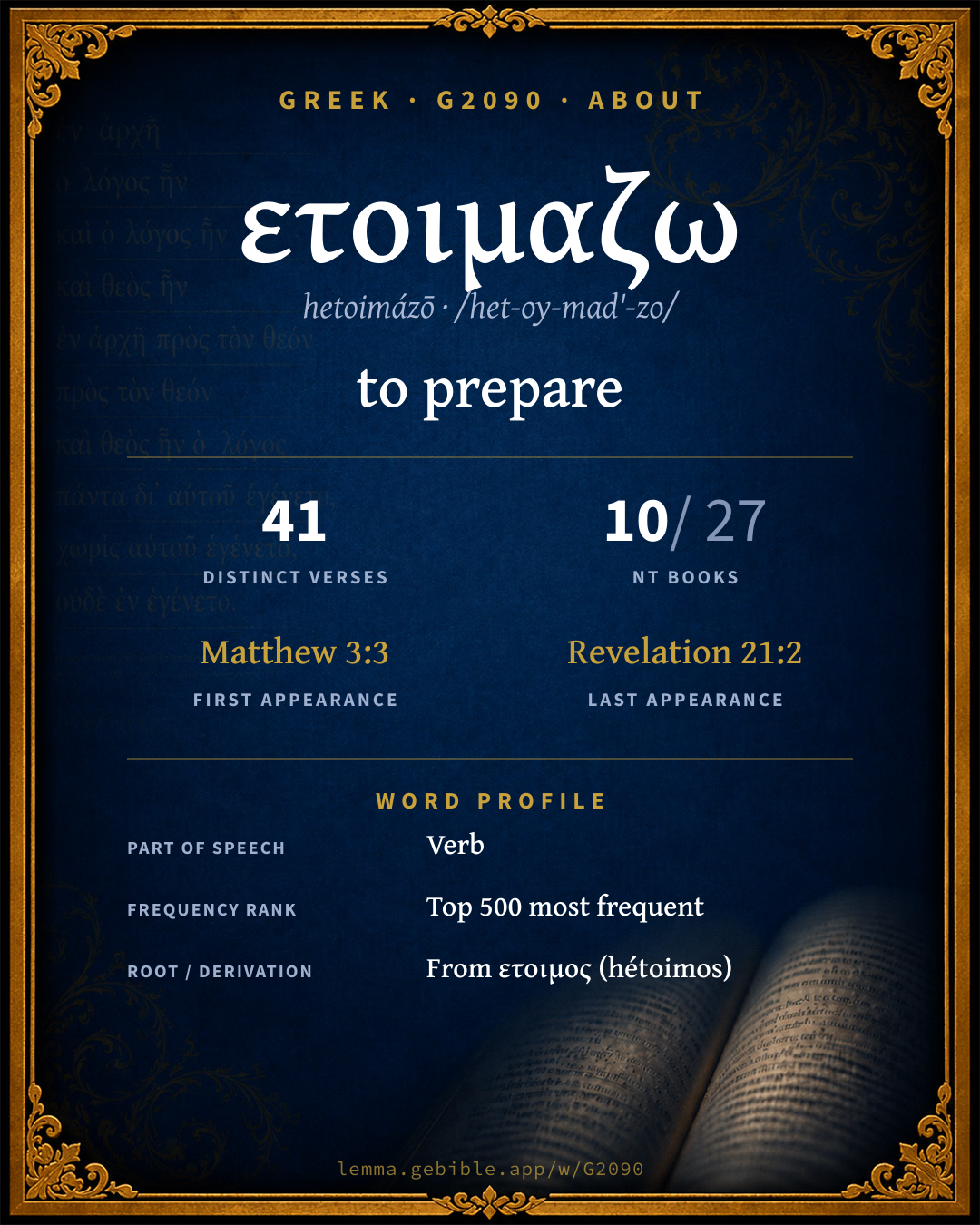
ἑτοιμάζω
to prepare
‘to prepare’ is one of 2 main senses fuller range ↓
Full lexicon entry — Thayer's Greek Lexicon
From Thayer's Greek Lexicon
Where this word appears
See every Aorist-tense verb in the Greek New Testament →
Grammar key — what these labels mean
Part of speech
- Verb
- An action or state-of-being word.
Tense
- Aorist
- Action viewed as a simple whole, without regard to duration — often past (perfective aspect).
- Perfect
- A completed past action with continuing present results.
- Present
- Ongoing or general action in present time (imperfective aspect).
Voice
- Active
- The subject performs the action.
- Passive
- The subject receives the action.
Mood
- Imperative
- Expresses a command or request.
- Indicative
- States a fact or asks a factual question (the mood of reality).
- Infinitive
- A verbal noun (“to write”), unmarked for person or number.
- Subjunctive
- Expresses probability, purpose, or possibility (the mood of contingency).
- Participle
- A verbal adjective (“writing,” “having written”).
Case
- Accusative
- The case of the direct object and of extent.
- Nominative
- The case of the subject (and the predicate nominative).
- Dative
- The case of the indirect object, means, or location — “to / for / with / in.”
Person
- 2nd person
- The one addressed (“you”).
- 3rd person
- The one spoken about (“he / she / it / they”).
- 1st person
- The speaker (“I / we”).
Gender
- Feminine
- Grammatically feminine.
- Masculine
- Grammatically masculine.
- Neuter
- Grammatically neuter.
Number
- Plural
- More than one.
- Singular
- One.
Grammatical forms 20 distinct
- Verb, Aorist, Active, Imperative, 2nd person, Plural 7 times (17%)
- Verb, Aorist, Active, Indicative, 3rd person, Plural 6 times (15%)
- Verb, Aorist, Active, Infinitive 4 times (10%)
- Verb, Aorist, Active, Indicative, 3rd person, Singular 3 times (7%)
- Verb, Aorist, Active, Subjunctive, 1st person, Plural 3 times (7%)
- Verb, Aorist, Active, Indicative, 2nd person, Singular 2 times (5%)
- Verb, Perfect, Passive, Indicative, 3rd person, Singular 2 times (5%)
- Verb, Perfect, Passive, Participle, Accusative, Singular, Feminine 2 times (5%)
+12 more forms (12 occurrences)
Parsed forms decoded from the imported morphology (Robinson–Tischendorf, public domain), counted across 41 parsed occurrences — not distinct verses.
Every verse where G2090 appears — 41 distinct verses across 10 books. Click any verse to open its interlinear word-by-word view. Verse text shown in the World English Bible for context — . Each verse’s Greek form is shown with its reference; the English is not keyword-highlighted, since the data carries no word-level English alignment. Use “Compare translations” on any verse to read it across multiple English versions. This concordance covers the Greek New Testament; Septuagint (Greek Old Testament) occurrences of this word are not indexed here.
Matthew 7 verses
- Matthew 3:3 ἑτοιμάσατε aor act impv 2pl For this is he who was spoken of by Isaiah the prophet, saying, "The voice of one crying in the wilderness, Make ready the way of the Lord, Make his paths straight."
- Matthew 20:23 ἡτοίμασται perf pass ind 3sg He said to them, "You will indeed drink my cup, and be baptized with the baptism that I am baptized with, but to sit on my right hand and on my left hand is not mine to give; but it is for whom it has been prepared by my Father."
- Matthew 22:4 ἡτοίμακα perf act ind 1sg Again he sent out other servants, saying, 'Tell those who are invited, "Behold, I have made ready my dinner. My oxen and my fatlings are killed, and all things are ready. Come to the marriage feast!"'
- Matthew 25:34 ἡτοιμασμένην perf pass ptcp acc sg fem Then the King will tell those on his right hand, 'Come, blessed of my Father, inherit the Kingdom prepared for you from the foundation of the world;
- Matthew 25:41 ἡτοιμασμένον perf pass ptcp acc sg neut Then he will say also to those on the left hand, 'Depart from me, you cursed, into the eternal fire which is prepared for the devil and his angels;
- Matthew 26:17 ἑτοιμάσωμέν aor act subj 1pl Now on the first day of unleavened bread, the disciples came to Jesus, saying to him, "Where do you want us to prepare for you to eat the Passover?"
- Matthew 26:19 ἡτοίμασαν aor act ind 3pl The disciples did as Jesus commanded them, and they prepared the Passover.
Mark 6 verses
- Mark 1:3 ἑτοιμάσατε aor act impv 2pl The voice of one crying in the wilderness, 'Make ready the way of the Lord! Make his paths straight!'"
- Mark 10:40 ἡτοίμασται perf pass ind 3sg but to sit at my right hand and at my left hand is not mine to give, but for whom it has been prepared."
- Mark 14:12 ἑτοιμάσωμεν aor act subj 1pl On the first day of unleavened bread, when they sacrificed the Passover, his disciples asked him, "Where do you want us to go and make ready that you may eat the Passover?"
- Mark 14:15 ἑτοιμάσατε aor act impv 2pl He will himself show you a large upper room furnished and ready. Make ready for us there."
- Mark 14:16 ἡτοίμασαν aor act ind 3pl His disciples went out, and came into the city, and found things as he had said to them, and they prepared the Passover.
- Mark 15:1 ἑτοιμάσαντες aor act ptcp nom pl masc Immediately in the morning the chief priests, with the elders and scribes, and the whole council, held a consultation, and bound Jesus, and carried him away, and delivered him up to Pilate.
Luke 14 verses
- Luke 1:17 ἑτοιμάσαι aor act inf He will go before him in the spirit and power of Elijah, 'to turn the hearts of the fathers to the children,' and the disobedient to the wisdom of the just; to make ready a people prepared for the Lord."
- Luke 1:76 ἑτοιμάσαι aor act inf And you, child, will be called a prophet of the Most High, For you will go before the face of the Lord to make ready his ways,
- Luke 2:31 ἡτοίμασας aor act ind 2sg Which you have prepared before the face of all peoples;
- Luke 3:4 ἑτοιμάσατε aor act impv 2pl As it is written in the book of the words of Isaiah the prophet, "The voice of one crying in the wilderness, 'Make ready the way of the Lord. Make his paths straight.
- Luke 9:52 ἑτοιμάσαι aor act inf and sent messengers before his face. They went, and entered into a village of the Samaritans, so as to prepare for him.
- Luke 12:20 ἡτοίμασας aor act ind 2sg "But God said to him, 'You foolish one, tonight your soul is required of you. The things which you have prepared--whose will they be?'
- Luke 12:47 ἑτοιμάσας aor act ptcp nom sg masc That servant, who knew his lord's will, and didn't prepare, nor do what he wanted, will be beaten with many stripes,
- Luke 17:8 ἑτοίμασον aor act impv 2sg and will not rather tell him, 'Prepare my supper, clothe yourself properly, and serve me, while I eat and drink. Afterward you shall eat and drink'?
- Luke 22:8 ἑτοιμάσατε aor act impv 2pl He sent Peter and John, saying, "Go and prepare the Passover for us, that we may eat."
- Luke 22:9 ἑτοιμάσωμεν aor act subj 1pl They said to him, "Where do you want us to prepare?"
- Luke 22:12 ἑτοιμάσατε aor act impv 2pl He will show you a large, furnished upper room. Make preparations there."
- Luke 22:13 ἡτοίμασαν aor act ind 3pl They went, found things as he had told them, and they prepared the Passover.
- Luke 23:56 ἡτοίμασαν aor act ind 3pl They returned, and prepared spices and ointments. On the Sabbath they rested according to the commandment.
- Luke 24:1 ἡτοίμασαν aor act ind 3pl But on the first day of the week, at early dawn, they and some others came to the tomb, bringing the spices which they had prepared.
John 2 verses
- John 14:2 ἑτοιμάσαι aor act inf In my Father's house are many mansions. If it weren't so, I would have told you. I am going to prepare a place for you.
- John 14:3 ἑτοιμάσω aor act subj 1sg If I go and prepare a place for you, I will come again, and will receive you to myself; that where I am, you may be there also.
Acts 1 verse
1 Corinthians 1 verse
2 Timothy 1 verse
Philemon 1 verse
Hebrews 1 verse
Revelation 7 verses
- Revelation 8:6 ἡτοίμασαν aor act ind 3pl The seven angels who had the seven trumpets prepared themselves to sound.
- Revelation 9:7 ἡτοιμασμένοις perf pass ptcp dat pl masc The shapes of the locusts were like horses prepared for war. On their heads were something like golden crowns, and their faces were like people's faces.
- Revelation 9:15 ἡτοιμασμένοι perf pass ptcp nom pl masc The four angels were freed who had been prepared for that hour and day and month and year, so that they might kill one third of mankind.
- Revelation 12:6 ἡτοιμασμένον perf pass ptcp acc sg masc The woman fled into the wilderness, where she has a place prepared by God, that there they may nourish her one thousand two hundred sixty days.
- Revelation 16:12 ἑτοιμασθῇ aor pass subj 3sg The sixth poured out his bowl on the great river, the Euphrates. Its water was dried up, that the way might be made ready for the kings that come from the sunrise.
- Revelation 19:7 ἡτοίμασεν aor act ind 3sg Let us rejoice and be exceedingly glad, and let us give the glory to him. For the marriage of the Lamb has come, and his wife has made herself ready."
- Revelation 21:2 ἡτοιμασμένην perf pass ptcp acc sg fem I saw the holy city, New Jerusalem, coming down out of heaven from God, made ready like a bride adorned for her husband.
About this entry
At a glance — auto-summarized from this page’s data, not written by a person. Every figure links to its source below. This summary describes the numbers; it doesn’t interpret them.
ετοιμαζω (hetoimázō) is a Greek verb most often rendered “to prepare.” Where the King James Version says “prepared,” newer translations reach for “prepare” (Berean Standard Bible); the renderings breakdown has the detail. The Greek New Testament uses it across 41 verses — moderately common. Luke dominates its distribution — 14 of 41 verses. Its lexical range runs to 2 senses. For the data behind this summary, explore the sense tree and the renderings breakdown below.
Gloss history
Strong's 1890 vs modern scholarship
About this word
Strong's G2090 catalogs a Greek word from the Greek New Testament.
These counts are not copied from any lexicon or concordance. They are computed here, from the morphology-tagged Greek New Testament. What Lemma adds →
- 41
- distinct verses
- The word appears in 41 distinct verses.
- 10 / 27
- NT books
- The word appears in 10 of 27 New Testament books.
- #364
- by frequency
- Top 500 most frequent Greek words (rank 364 of 5,347 Greek words by occurrence).
View all 41 occurrences in the concordance →
Most concentrated in
- Luke 14 verses 34%
- Matthew 7 verses 17%
- Revelation 7 verses 17%
By section of the New Testament
By traditional corpus
Conventional, traditional groupings — biblical authorship is debated, so this is a traditional corpus grouping, not an authorship claim. Some books belong to more than one corpus (Luke is in both the Gospels and the Lukan corpus, and so on), so these shares overlap and need not total 100%. Each figure is a share of the word’s 41 distinct verses.
- Gospels 29 verses · 71%
- Lukan (Luke–Acts) 15 verses · 37%
- Johannine 9 verses · 22%
- Revelation 7 verses · 17%
- Pauline corpus 3 verses · 7%
- Hebrews 1 verse · 2%
How translations render this word
Counts come from each version’s own published word-to-Strong’s tagging or interlinear alignment — an approximate guide to how each version renders this word, not a word-level alignment the data otherwise carries. Because each total is that version’s own tagged count, the per-version totals vary from one another and need not match the appearance or distinct-verse counts above. These counts may also differ from a printed concordance because Lemma counts each distinctly tagged rendering and does not collapse phrase taggings into a single head-word total. This is a fixed set of word-tagged versions (KJV, ASV, BSB, ULT) and does not change with the reading translation you choose elsewhere. Each version’s license is shown beside its name below (and on Sources).
- King James Version: Prepared 9×, Make ready 6×, Prepare 6×
- American Standard Version: Make ready 9×, Prepared 7×, Make ye 3×
- Berean Standard Bible: Prepare 14×, Prepared 7×, Make preparations 3×
- unfoldingWord Literal Text: Prepare 10×, Prepared 5×, Make ready 4×
King James Version Public Domain
Renders G2090 across 41 tagged occurrences — most commonly:
Plus 10 renderings that appear only once — usually multi-word phrases or single function words the recovered tagging swept in, not distinct renderings.
American Standard Version Public Domain
Renders G2090 across 42 tagged occurrences — most commonly:
Plus 9 renderings that appear only once — usually multi-word phrases or single function words the recovered tagging swept in, not distinct renderings.
Berean Standard Bible Public Domain
Renders G2090 across 40 tagged occurrences — most commonly:
Plus 14 renderings that appear only once — usually multi-word phrases or single function words the recovered tagging swept in, not distinct renderings.
unfoldingWord Literal Text CC BY-SA 4.0
Renders G2090 across 45 tagged occurrences — most commonly:
Plus 12 renderings that appear only once — usually multi-word phrases or single function words the recovered tagging swept in, not distinct renderings.
Senses in Thayer's
The 2 senses Thayer's distinguishes for this word, in lexicon order (not ranked by frequency or importance). The full entry — with sub-senses — is in the Lexicon Entry tab.
- to make the necessary preparations, get everything ready
- metaph.
Word origin
Derived from ετοιμος (hétoimos) (G2092) — ready.
Forms in the corpus
The 19 distinct written forms G2090 takes in the Greek New Testament, most frequent first — each parse links to that tense’s occurrences in the concordance.
Same root — word family
Other Thayer's entries built from the same root as G2090, grouped by Strong’s listed origin. These share a root / origin per the lexicon — not necessarily a shared meaning. Each links to that word’s own entry.
Derives from
Shares the same root
Derived from this word
Compare all same-root words → Showing 4 of 5 — not the complete family. They share a root, not necessarily a meaning.
Septuagint usage
The same Greek word ετοιμαζω appears 133 times in the Greek Old Testament (Septuagint), across 126 verses in 25 books.
- 133
- LXX occurrences
- Tagged occurrences of this Greek word in the Septuagint.
- 126
- verses
- Distinct Septuagint verses containing this word.
- 25 / 39
- OT books
- The word appears in 25 of the 39 Old Testament books.
Sample Septuagint occurrences
- Genesis 24:14 ἑτοιμάζω
- Exodus 15:17 ἑτοιμάζω
- Numbers 23:1 ἑτοιμάζω
- Joshua 1:11 ἑτοιμάζω
- 1 Samuel 2:3 ἑτοιμάζω
- 2 Samuel 5:12 ἑτοιμάζω
- 1 Kings 2:12 ἑτοιμάζω
- 2 Kings 12:12 ἑτοιμάζω
- 1 Chronicles 9:32 ἑτοιμάζω
- 2 Chronicles 1:4 ἑτοιμάζω
- Ezra 3:3 ἑτοιμάζω
- Esther 5:12 ἑτοιμάζω
Septuagint occurrences (same lexeme)
Every verse where the same Strong’s number (G2090) appears in the Greek Septuagint — showing the first 50 of 126. Verse text shown in the World English Bible for context; the Greek form is the matched word — the English is not keyword-highlighted.
- Genesis 24:14 ἑτοιμάζω Let it happen, that the young lady to whom I will say, 'Please let down your pitcher, that I may drink.' She will say, 'Drink, and I will also give your camels a drink.' Let the same be she who you have appointed for your servant Isaac. Thereby will I know that you have shown kindness to my master."
- Genesis 24:31 ἑτοιμάζω He said, "Come in, you blessed of Yahweh. Why do you stand outside? For I have prepared the house, and room for the camels."
- Genesis 24:44 ἑτοιμάζω She will tell me, "Drink, and I will also draw for your camels." Let the same be the woman whom Yahweh has appointed for my master's son.'
- Genesis 43:16 ἑτοιμάζω When Joseph saw Benjamin with them, he said to the steward of his house, "Bring the men into the house, and butcher an animal, and make ready; for the men will dine with me at noon."
- Genesis 43:25 ἑτοιμάζω They made ready the present for Joseph's coming at noon, for they heard that they should eat bread there.
- Exodus 15:17 ἑτοιμάζω You shall bring them in, and plant them in the mountain of your inheritance, The place, Yahweh, which you have made for yourself to dwell in; The sanctuary, Lord, which your hands have established.
- Exodus 16:5 ἑτοιμάζω It shall come to pass on the sixth day, that they shall prepare that which they bring in, and it shall be twice as much as they gather daily."
- Exodus 23:20 ἑτοιμάζω "Behold, I send an angel before you, to keep you by the way, and to bring you into the place which I have prepared.
- Numbers 23:1 ἑτοιμάζω Balaam said to Balak, Build me here seven altars, and prepare me here seven bulls and seven rams.
- Numbers 23:4 ἑτοιμάζω God met Balaam: and he said to him, I have prepared the seven altars, and I have offered up a bull and a ram on every altar.
- Numbers 23:29 ἑτοιμάζω Balaam said to Balak, Build me here seven altars, and prepare me here seven bulls and seven rams.
- Joshua 1:11 ἑτοιμάζω Pass through the midst of the camp, and command the people, saying, Prepare food; for within three days you are to pass over this Jordan, to go in to possess the land, which Yahweh your God gives you to possess it.
- Joshua 9:4 ἑτοιμάζω they also resorted to a ruse, and went and made as if they had been ambassadors, and took old sacks on their donkeys, and wine-skins, old and torn and bound up,
- 1 Samuel 2:3 ἑτοιμάζω Talk no more so exceeding proudly; Don't let arrogance come out of your mouth; For Yahweh is a God of knowledge, By him actions are weighed.
- 1 Samuel 7:3 ἑτοιμάζω Samuel spoke to all the house of Israel, saying, If you do return to Yahweh with all your heart, then put away the foreign gods and the Ashtaroth from among you, and direct your hearts to Yahweh, and serve him only; and he will deliver you out of the hand of the Philistines.
- 1 Samuel 13:13 ἑτοιμάζω Samuel said to Saul, You have done foolishly; you have not kept the commandment of Yahweh your God, which he commanded you: for now would Yahweh have established your kingdom on Israel forever.
- 1 Samuel 20:31 ἑτοιμάζω For as long as the son of Jesse lives on the earth, you shall not be established, nor your kingdom. Therefore now send and bring him to me, for he shall surely die.
- 1 Samuel 23:22 ἑτοιμάζω Please go make yet more sure, and know and see his place where his haunt is, [and] who has seen him there; for it is told me that he deals very subtly.
- 2 Samuel 5:12 ἑτοιμάζω David perceived that Yahweh had established him king over Israel, and that he had exalted his kingdom for his people Israel's sake.
- 2 Samuel 7:12 ἑτοιμάζω When your days are fulfilled, and you shall sleep with your fathers, I will set up your seed after you, who shall proceed out of your bowels, and I will establish his kingdom.
- 2 Samuel 7:24 ἑτοιμάζω You did establish to yourself your people Israel to be a people to you forever; and you, Yahweh, became their God.
- 1 Kings 2:12 ἑτοιμάζω Solomon sat on the throne of David his father; and his kingdom was established greatly.
- 1 Kings 2:24 ἑτοιμάζω Now therefore as Yahweh lives, who has established me, and set me on the throne of David my father, and who has made me a house, as he promised, surely Adonijah shall be put to death this day.
- 1 Kings 5:31 ἑτοιμάζω
- 2 Kings 12:12 ἑτοιμάζω and to the masons and the stone cutters, and for buying timber and hewn stone to repair the breaches of the house of Yahweh, and for all that was laid out for the house to repair it.
- 1 Chronicles 9:32 ἑτοιμάζω Some of their brothers, of the sons of the Kohathites, were over the show bread, to prepare it every Sabbath.
- 1 Chronicles 12:40 ἑτοιμάζω Moreover those who were near to them, [even] as far as Issachar and Zebulun and Naphtali, brought bread on donkeys, and on camels, and on mules, and on oxen, food of meal, cakes of figs, and clusters of raisins, and wine, and oil, and oxen, and sheep in abundance: for there was joy in Israel.
- 1 Chronicles 14:2 ἑτοιμάζω David perceived that Yahweh had established him king over Israel; for his kingdom was exalted on high, for his people Israel's sake.
- 1 Chronicles 15:1 ἑτοιμάζω [David] made him houses in the city of David; and he prepared a place for the ark of God, and pitched for it a tent.
- 1 Chronicles 15:3 ἑτοιμάζω David assembled all Israel at Jerusalem, to bring up the ark of Yahweh to its place, which he had prepared for it.
- 1 Chronicles 15:12 ἑτοιμάζω and said to them, You are the heads of the fathers' [houses] of the Levites: sanctify yourselves, both you and your brothers, that you may bring up the ark of Yahweh, the God of Israel, to [the place] that I have prepared for it.
- 1 Chronicles 17:11 ἑτοιμάζω It shall happen, when your days are fulfilled that you must go to be with your fathers, that I will set up your seed after you, who shall be of your sons; and I will establish his kingdom.
- 1 Chronicles 22:3 ἑτοιμάζω David prepared iron in abundance for the nails for the doors of the gates, and for the couplings; and brass in abundance without weight;
- 1 Chronicles 22:5 ἑτοιμάζω David said, Solomon my son is young and tender, and the house that is to be built for Yahweh must be exceedingly magnificent, of fame and of glory throughout all countries: I will therefore make preparation for it. So David prepared abundantly before his death.
- 1 Chronicles 22:14 ἑτοιμάζω Now, behold, in my affliction I have prepared for the house of Yahweh one hundred thousand talents of gold, and one thousand thousand talents of silver, and of brass and iron without weight; for it is in abundance: timber also and stone have I prepared; and you may add to them.
- 1 Chronicles 28:2 ἑτοιμάζω Then David the king stood up on his feet, and said, Hear me, my brothers, and my people: as for me, it was in my heart to build a house of rest for the ark of the covenant of Yahweh, and for the footstool of our God; and I had made ready for the building.
- 1 Chronicles 29:2 ἑτοιμάζω Now I have prepared with all my might for the house of my God the gold for the [things of] gold, and the silver for the [things of] silver, and the brass for the [things of] brass, the iron for the [things of] iron, and wood for the [things of] wood; onyx stones, and [stones] to be set, stones for inlaid work, and of various colors, and all manner of precious stones, and marble stones in abundance.
- 1 Chronicles 29:3 ἑτοιμάζω In addition, because I have set my affection on the house of my God, seeing that I have a treasure of my own of gold and silver, I give it to the house of my God, over and above all that I have prepared for the holy house,
- 1 Chronicles 29:16 ἑτοιμάζω Yahweh our God, all this store that we have prepared to build you a house for your holy name comes of your hand, and is all your own.
- 2 Chronicles 1:4 ἑτοιμάζω But David had brought the ark of God up from Kiriath Jearim to [the place] that David had prepared for it; for he had pitched a tent for it at Jerusalem.
- 2 Chronicles 2:6 ἑτοιμάζω But who is able to build him a house, seeing heaven and the heaven of heavens can't contain him? who am I then, that I should build him a house, save only to burn incense before him?
- 2 Chronicles 2:8 ἑτοιμάζω Send me also cedar trees, fir trees, and algum trees, out of Lebanon; for I know that your servants know how to cut timber in Lebanon: and, behold, my servants shall be with your servants,
- 2 Chronicles 3:1 ἑτοιμάζω Then Solomon began to build the house of Yahweh at Jerusalem on Mount Moriah, where [Yahweh] appeared to David his father, which he made ready in the place that David had appointed, in the threshing floor of Ornan the Jebusite.
- 2 Chronicles 8:16 ἑτοιμάζω Now all the work of Solomon was prepared to the day of the foundation of the house of Yahweh, and until it was finished. [So] the house of Yahweh was completed.
- 2 Chronicles 12:1 ἑτοιμάζω It happened, when the kingdom of Rehoboam was established, and he was strong, that he forsook the law of Yahweh, and all Israel with him.
- 2 Chronicles 26:14 ἑτοιμάζω Uzziah prepared for them, even for all the host, shields, and spears, and helmets, and coats of mail, and bows, and stones for slinging.
- 2 Chronicles 27:6 ἑτοιμάζω So Jotham became mighty, because he ordered his ways before Yahweh his God.
- 2 Chronicles 29:19 ἑτοιμάζω Moreover all the vessels, which king Ahaz in his reign did cast away when he trespassed, have we prepared and sanctified; and, behold, they are before the altar of Yahweh.
- 2 Chronicles 29:36 ἑτοιμάζω Hezekiah rejoiced, and all the people, because of that which God had prepared for the people: for the thing was done suddenly.
- 2 Chronicles 31:11 ἑτοιμάζω Then Hezekiah commanded to prepare chambers in the house of Yahweh; and they prepared them.
These are occurrences of the same Greek lexeme (G2090) in the Septuagint — not a translation of any one Hebrew word. The store carries no word-level Hebrew↔Greek alignment, so no Hebrew original is asserted here. Counts come from the recovered LXX Strong's tagging — high-frequency vocabulary is well covered, while rare or late forms may be untagged — so they reflect tagged occurrences and may slightly undercount.