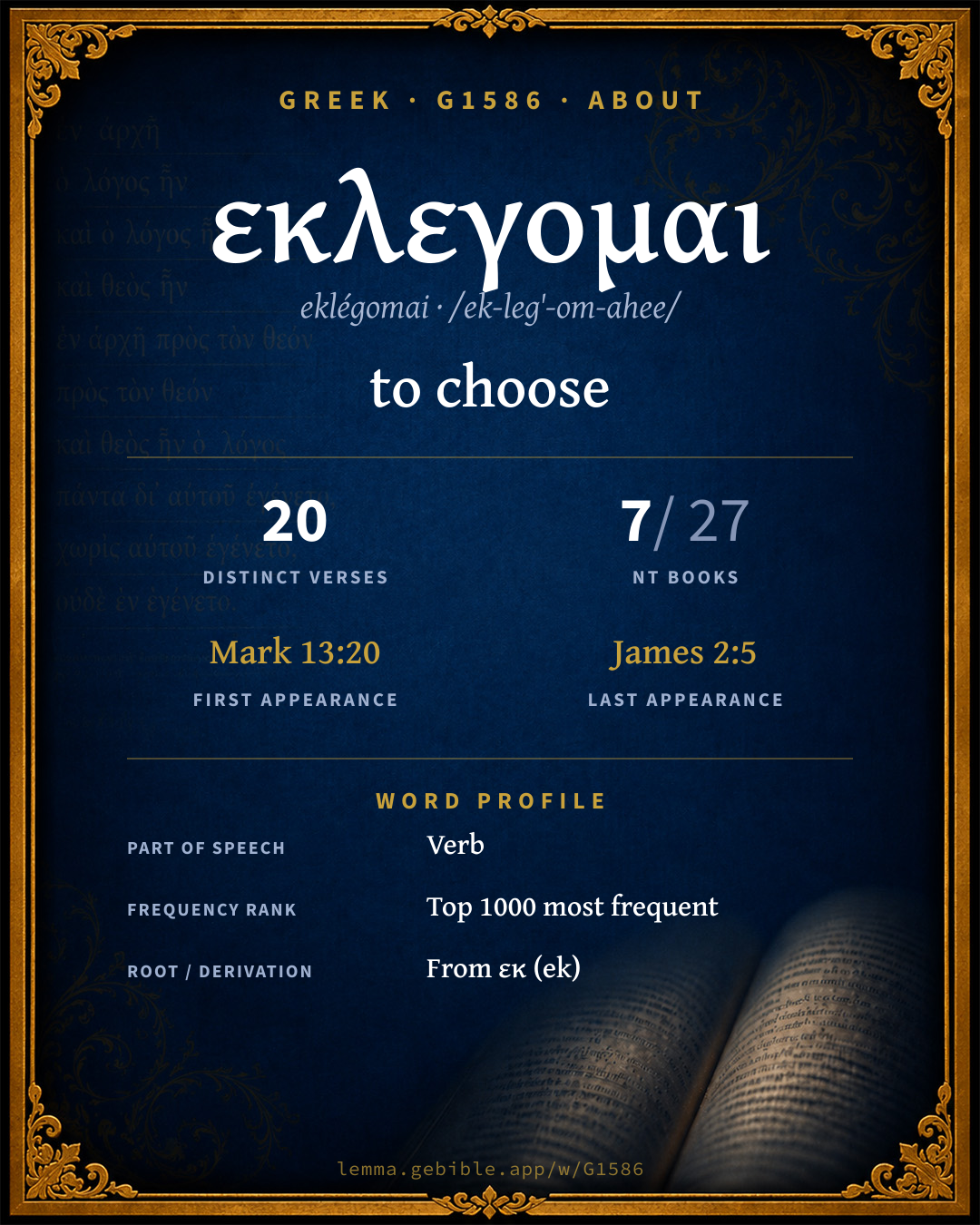
ἐκλέγομαι
to choose
‘to choose’ is one of 2 main senses fuller range ↓
Full lexicon entry — Thayer's Greek Lexicon
From Thayer's Greek Lexicon
Where this word appears
See every Aorist-tense verb in the Greek New Testament →
Grammar key — what these labels mean
Part of speech
- Verb
- An action or state-of-being word.
Tense
- Aorist
- Action viewed as a simple whole, without regard to duration — often past (perfective aspect).
- Imperfect
- Continuous or repeated action in past time (“was writing”).
- Perfect
- A completed past action with continuing present results.
Voice
- Middle
- The subject acts on or for itself, or with special interest in the action.
- Passive
- The subject receives the action.
Mood
- Indicative
- States a fact or asks a factual question (the mood of reality).
- Participle
- A verbal adjective (“writing,” “having written”).
Case
- Accusative
- The case of the direct object and of extent.
- Nominative
- The case of the subject (and the predicate nominative).
Person
- 3rd person
- The one spoken about (“he / she / it / they”).
- 1st person
- The speaker (“I / we”).
- 2nd person
- The one addressed (“you”).
Gender
- Masculine
- Grammatically masculine.
Number
- Singular
- One.
- Plural
- More than one.
Grammatical forms 9 distinct
- Verb, Aorist, Middle, Indicative, 3rd person, Singular 10 times (45%)
- Verb, Aorist, Middle, Indicative, 1st person, Singular 4 times (18%)
- Verb, Aorist, Middle, Participle, Accusative, Plural, Masculine 2 times (9%)
- Verb, Aorist, Middle, Indicative, 2nd person, Plural 1 time (5%)
- Verb, Aorist, Middle, Indicative, 2nd person, Singular 1 time (5%)
- Verb, Aorist, Middle, Indicative, 3rd person, Plural 1 time (5%)
- Verb, Aorist, Middle, Participle, Nominative, Singular, Masculine 1 time (5%)
- Verb, Imperfect, Middle, Indicative, 3rd person, Plural 1 time (5%)
+1 more form (1 occurrence)
Parsed forms decoded from the imported morphology (Robinson–Tischendorf, public domain), counted across 22 parsed occurrences — not distinct verses.
Every verse where G1586 appears — 20 distinct verses across 7 books. Click any verse to open its interlinear word-by-word view. Verse text shown in the World English Bible for context — . Each verse’s Greek form is shown with its reference; the English is not keyword-highlighted, since the data carries no word-level English alignment. Use “Compare translations” on any verse to read it across multiple English versions. This concordance covers the Greek New Testament; Septuagint (Greek Old Testament) occurrences of this word are not indexed here.
Mark 1 verse
Luke 4 verses
- Luke 6:13 ἐκλεξάμενος aor mid ptcp nom sg masc When it was day, he called his disciples, and from them he chose twelve, whom he also named apostles:
- Luke 9:35 ἐκλελεγμένος perf pass ptcp nom sg masc A voice came out of the cloud, saying, "This is my beloved Son. Listen to him!"
- Luke 10:42 ἐξελέξατο aor mid ind 3sg but one thing is needed. Mary has chosen the good part, which will not be taken away from her."
- Luke 14:7 ἐξελέγοντο impf mid ind 3pl He spoke a parable to those who were invited, when he noticed how they chose the best seats, and said to them,
John 4 verses
- John 6:70 ἐξελεξάμην aor mid ind 1sg Jesus answered them, "Didn't I choose you, the twelve, and one of you is a devil?"
- John 13:18 ἐξελεξάμην aor mid ind 1sg I don't speak concerning all of you. I know whom I have chosen. But that the Scripture may be fulfilled, 'He who eats bread with me has lifted up his heel against me.'
- John 15:16 ἐξελέξασθε ἐξελεξάμην aor mid ind 2pl aor mid ind 1sg You didn't choose me, but I chose you, and appointed you, that you should go and bear fruit, and that your fruit should remain; that whatever you will ask of the Father in my name, he may give it to you.
- John 15:19 ἐξελεξάμην aor mid ind 1sg If you were of the world, the world would love its own. But because you are not of the world, since I chose you out of the world, therefore the world hates you.
Acts 7 verses
- Acts 1:2 ἐξελέξατο aor mid ind 3sg until the day in which he was received up, after he had given commandment through the Holy Spirit to the apostles whom he had chosen.
- Acts 1:24 ἐξελέξω aor mid ind 2sg They prayed, and said, "You, Lord, who know the hearts of all men, show which one of these two you have chosen
- Acts 6:5 ἐξελέξαντο aor mid ind 3pl These words pleased the whole multitude. They chose Stephen, a man full of faith and of the Holy Spirit, Philip, Prochorus, Nicanor, Timon, Parmenas, and Nicolaus, a proselyte of Antioch;
- Acts 13:17 ἐξελέξατο aor mid ind 3sg The God of this people chose our fathers, and exalted the people when they stayed as aliens in the land of Egypt, and with an uplifted arm, he led them out of it.
- Acts 15:7 ἐξελέξατο aor mid ind 3sg When there had been much discussion, Peter rose up and said to them, "Brothers, you know that a good while ago God made choice among you, that by my mouth the Gentiles should hear the word of the Gospel, and believe.
- Acts 15:22 ἐκλεξαμένους aor mid ptcp acc pl masc Then it seemed good to the apostles and the elders, with the whole assembly, to choose men out of their company, and send them to Antioch with Paul and Barnabas: Judas called Barsabbas, and Silas, chief men among the brothers.
- Acts 15:25 ἐκλεξαμένους aor mid ptcp acc pl masc it seemed good to us, having come to one accord, to choose out men and send them to you with our beloved Barnabas and Paul,
1 Corinthians 2 verses
- 1 Corinthians 1:27 ἐξελέξατο ἐξελέξατο aor mid ind 3sg aor mid ind 3sg but God chose the foolish things of the world that he might put to shame those who are wise. God chose the weak things of the world, that he might put to shame the things that are strong;
- 1 Corinthians 1:28 ἐξελέξατο aor mid ind 3sg and God chose the lowly things of the world, and the things that are despised, and the things that are not, that he might bring to nothing the things that are:
Ephesians 1 verse
James 1 verse
About this entry
At a glance — auto-summarized from this page’s data, not written by a person. Every figure links to its source below. This summary describes the numbers; it doesn’t interpret them.
The Greek verb εκλεγομαι centers on the idea of “to choose.” Where the King James Version says “chosen,” newer translations reach for “chose” (Berean Standard Bible); the renderings breakdown has the detail. It appears 20 verses across 7 books of the Greek New Testament, among its uncommon vocabulary. The word gravitates to Acts (35%), then Luke and John. Thayer's distinguishes 2 senses for it. For the data behind this summary, explore the sense tree and the renderings breakdown below.
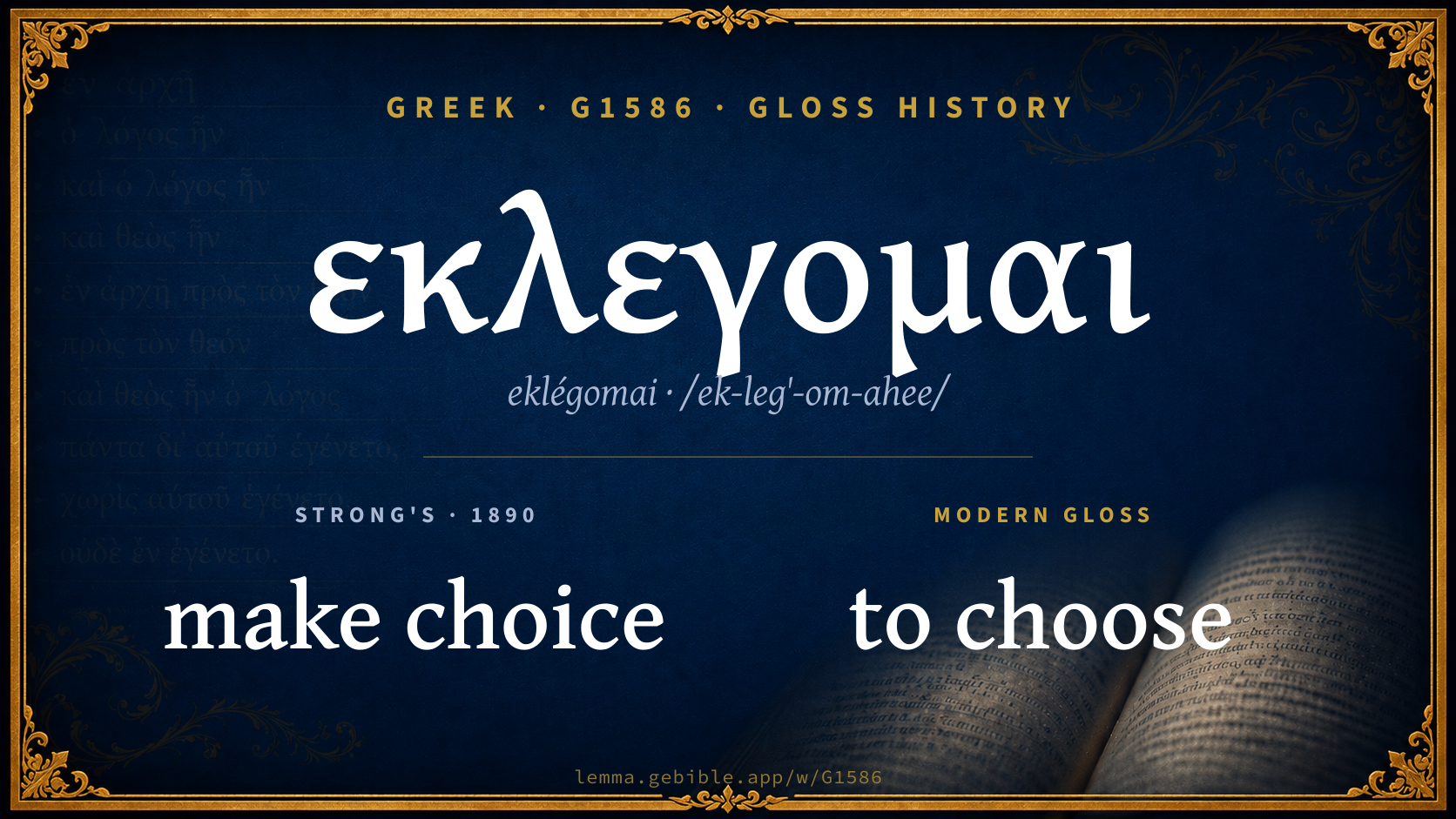
Gloss history
Strong's 1890 vs modern scholarship
About this word
Strong's G1586 catalogs a Greek word from the Greek New Testament.
These counts are not copied from any lexicon or concordance. They are computed here, from the morphology-tagged Greek New Testament. What Lemma adds →
- 20
- distinct verses
- The word appears in 20 distinct verses.
- 7 / 27
- NT books
- The word appears in 7 of 27 New Testament books.
- #586
- by frequency
- Top 1000 most frequent Greek words (rank 586 of 5,347 Greek words by occurrence).
View all 20 occurrences in the concordance →
By section of the New Testament
By traditional corpus
Conventional, traditional groupings — biblical authorship is debated, so this is a traditional corpus grouping, not an authorship claim. Some books belong to more than one corpus (Luke is in both the Gospels and the Lukan corpus, and so on), so these shares overlap and need not total 100%. Each figure is a share of the word’s 20 distinct verses.
- Lukan (Luke–Acts) 11 verses · 55%
- Gospels 9 verses · 45%
- Johannine 4 verses · 20%
- Pauline corpus 3 verses · 15%
- General (Catholic) Epistles 1 verse · 5%
How translations render this word
Counts come from each version’s own published word-to-Strong’s tagging or interlinear alignment — an approximate guide to how each version renders this word, not a word-level alignment the data otherwise carries. Because each total is that version’s own tagged count, the per-version totals vary from one another and need not match the appearance or distinct-verse counts above. These counts may also differ from a printed concordance because Lemma counts each distinctly tagged rendering and does not collapse phrase taggings into a single head-word total. This is a fixed set of word-tagged versions (KJV, ASV, BSB, ULT) and does not change with the reading translation you choose elsewhere. Each version’s license is shown beside its name below (and on Sources).
- King James Version: Chosen 6×, Hath chosen 3×, Hath 2×
- American Standard Version: Choose 6×, Chose 5×, Did 3×
- Berean Standard Bible: Chose 7×, Choose 2×, Chosen 2×
- unfoldingWord Literal Text: Chose 7×, Choose 3×, Did 3×
King James Version Public Domain
Renders G1586 across 25 tagged occurrences — most commonly:
Plus 8 renderings that appear only once — usually multi-word phrases or single function words the recovered tagging swept in, not distinct renderings.
American Standard Version Public Domain
Renders G1586 across 24 tagged occurrences — most commonly:
Plus 7 renderings that appear only once — usually multi-word phrases or single function words the recovered tagging swept in, not distinct renderings.
Berean Standard Bible Public Domain
Renders G1586 across 22 tagged occurrences — most commonly:
Plus 9 renderings that appear only once — usually multi-word phrases or single function words the recovered tagging swept in, not distinct renderings.
unfoldingWord Literal Text CC BY-SA 4.0
Renders G1586 across 25 tagged occurrences — most commonly:
Plus 7 renderings that appear only once — usually multi-word phrases or single function words the recovered tagging swept in, not distinct renderings.
Senses in Thayer's
The 2 senses Thayer's distinguishes for this word, in lexicon order (not ranked by frequency or importance). The full entry — with sub-senses — is in the Lexicon Entry tab.
- to pick out, choose, to pick or choose out for one's self
- so that the ground of the choice lies in Christ and his merits only
Word origin
Derived from εκ (ek) (G1537) — from.
Forms in the corpus
The 9 distinct written forms G1586 takes in the Greek New Testament, most frequent first — each parse links to that tense’s occurrences in the concordance.
| Form | Parsing | Example | Uses |
|---|---|---|---|
| ἐξελέξατο exeléxato | Verb, Aorist, Middle, Indicative, 3rd person, Singular | Mark 13:20 | 10 |
| ἐξελεξάμην exelexámēn | Verb, Aorist, Middle, Indicative, 1st person, Singular | John 6:70 | 4 |
| ἐκλεξαμένους eklexaménous | Verb, Aorist, Middle, Participle, Accusative, Plural, Masculine | Acts 15:22 | 2 |
| ἐκλελεγμένος eklelegménos | Verb, Perfect, Passive, Participle, Nominative, Singular, Masculine | Luke 9:35 | 1 |
| ἐκλεξάμενος eklexámenos | Verb, Aorist, Middle, Participle, Nominative, Singular, Masculine | Luke 6:13 | 1 |
| ἐξελέγοντο exelégonto | Verb, Imperfect, Middle, Indicative, 3rd person, Plural | Luke 14:7 | 1 |
| ἐξελέξαντο exeléxanto | Verb, Aorist, Middle, Indicative, 3rd person, Plural | Acts 6:5 | 1 |
| ἐξελέξασθε exeléxasthe | Verb, Aorist, Middle, Indicative, 2nd person, Plural | John 15:16 | 1 |
| ἐξελέξω exeléxō | Verb, Aorist, Middle, Indicative, 2nd person, Singular | Acts 1:24 | 1 |
Same root — word family
Other Thayer's entries built from the same root as G1586, grouped by Strong’s listed origin. These share a root / origin per the lexicon — not necessarily a shared meaning. Each links to that word’s own entry.
Derives from
Shares the same root
- εκβαλλω ekbállō G1544 to cast out
- εκβασις ékbasis G1545 exit
- εκγαμιζω ekgamízō G1547 to give in marriage
- εκγαμισκω ekgamískō G1548 to give in marriage
- εκγονον ékgonon G1549 offspring
- εκδαπαναω ekdapanáō G1550 to spend
- εκδεχομαι ekdéchomai G1551 to receive
- εκδηλος ékdēlos G1552 evident
- εκδημεω ekdēméō G1553 to depart
- εκδιδωμι ekdídōmi G1554 to give out
- εκδιηγεομαι ekdiēgéomai G1555 to relate
- εκδικος ékdikos G1558 without justice
- εκδιωκω ekdiṓkō G1559 to banish
- εκδοτος ékdotos G1560 delivered up
- εκδυω ekdýō G1562 to put off
- εκζητεω ekzētéō G1567 to seek out
- εκθαμβος ékthambos G1569 astonished
- εκθετος ékthetos G1570 exposed
- εκκαθαιρω ekkathaírō G1571 to cleanse
- εκκαιω ekkaíō G1572 to burn
- εκκακεω ekkakéō G1573 to be exhausted
- εκκεντεω ekkentéō G1574 to pierce
- εκκλαω ekkláō G1575 to cut off
- εκκλειω ekkleíō G1576 to shut out
+88 more words share this root (not shown).
Derived from this word
Compare all same-root words → Showing 4 of 116 — not the complete family. They share a root, not necessarily a meaning.
Septuagint usage
The same Greek word εκλεγομαι appears 126 times in the Greek Old Testament (Septuagint), across 120 verses in 20 books.
- 126
- LXX occurrences
- Tagged occurrences of this Greek word in the Septuagint.
- 120
- verses
- Distinct Septuagint verses containing this word.
- 20 / 39
- OT books
- The word appears in 20 of the 39 Old Testament books.
Sample Septuagint occurrences
- Genesis 6:2 ἐκλέγω
- Numbers 16:5 ἐκλέγω
- Deuteronomy 1:33 ἐκλέγω
- Joshua 9:27 ἐκλέγω
- Judges 5:8 ἐκλέγω
- 1 Samuel 2:28 ἐκλέγω
- 2 Samuel 6:21 ἐκλέγω
- 1 Kings 3:8 ἐκλέγω
- 2 Kings 21:7 ἐκλέγω
- 1 Chronicles 15:2 ἐκλέγω
- 2 Chronicles 6:5 ἐκλέγω
- Ezra 11:9 ἐκλέγω
Septuagint occurrences (same lexeme)
Every verse where the same Strong’s number (G1586) appears in the Greek Septuagint — showing the first 50 of 120. Verse text shown in the World English Bible for context; the Greek form is the matched word — the English is not keyword-highlighted.
- Genesis 6:2 ἐκλέγω that God's sons saw that men's daughters were beautiful, and they took for themselves wives of all that they chose.
- Genesis 13:11 ἐκλέγω So Lot chose the Plain of the Jordan for himself. Lot traveled east, and they separated themselves the one from the other.
- Numbers 16:5 ἐκλέγω and he spoke to Korah and to all his company, saying, In the morning Yahweh will show who are his, and who is holy, and will cause him to come near to him: even him whom he shall choose will he cause to come near to him.
- Numbers 16:7 ἐκλέγω and put fire in them, and put incense on them before Yahweh tomorrow: and it shall be that the man whom Yahweh does choose, he [shall be] holy: you take too much on you, you sons of Levi.
- Numbers 17:20 ἐκλέγω
- Deuteronomy 1:33 ἐκλέγω who went before you in the way, to seek you out a place to pitch your tents in, in fire by night, to show you by what way you should go, and in the cloud by day.
- Deuteronomy 4:37 ἐκλέγω Because he loved your fathers, therefore he chose their seed after them, and brought you out with his presence, with his great power, out of Egypt;
- Deuteronomy 7:7 ἐκλέγω Yahweh didn't set his love on you, nor choose you, because you were more in number than any people; for you were the fewest of all peoples:
- Deuteronomy 10:15 ἐκλέγω Only Yahweh had a delight in your fathers to love them, and he chose their seed after them, even you above all peoples, as at this day.
- Deuteronomy 12:5 ἐκλέγω But to the place which Yahweh your God shall choose out of all your tribes, to put his name there, even to his habitation shall you seek, and there you shall come;
- Deuteronomy 12:11 ἐκλέγω then it shall happen that to the place which Yahweh your God shall choose, to cause his name to dwell there, there shall you bring all that I command you: your burnt offerings, and your sacrifices, your tithes, and the heave-offering of your hand, and all your choice vows which you vow to Yahweh.
- Deuteronomy 12:14 ἐκλέγω but in the place which Yahweh shall choose in one of your tribes, there you shall offer your burnt offerings, and there you shall do all that I command you.
- Deuteronomy 12:18 ἐκλέγω but you shall eat them before Yahweh your God in the place which Yahweh your God shall choose, you, and your son, and your daughter, and your man-servant, and your maid-servant, and the Levite who is within your gates: and you shall rejoice before Yahweh your God in all that you put your hand to.
- Deuteronomy 12:21 ἐκλέγω If the place which Yahweh your God shall choose, to put his name there, be too far from you, then you shall kill of your herd and of your flock, which Yahweh has given you, as I have commanded you; and you may eat within your gates, after all the desire of your soul.
- Deuteronomy 12:26 ἐκλέγω Only your holy things which you have, and your vows, you shall take, and go to the place which Yahweh shall choose:
- Deuteronomy 14:2 ἐκλέγω For you are a holy people to Yahweh your God, and Yahweh has chosen you to be a people for his own possession, above all peoples who are on the face of the earth.
- Deuteronomy 14:23 ἐκλέγω You shall eat before Yahweh your God, in the place which he shall choose, to cause his name to dwell there, the tithe of your grain, of your new wine, and of your oil, and the firstborn of your herd and of your flock; that you may learn to fear Yahweh your God always.
- Deuteronomy 14:24 ἐκλέγω If the way be too long for you, so that you are not able to carry it, because the place is too far from you, which Yahweh your God shall choose, to set his name there, when Yahweh your God shall bless you;
- Deuteronomy 14:25 ἐκλέγω then shall you turn it into money, and bind up the money in your hand, and shall go to the place which Yahweh your God shall choose:
- Deuteronomy 15:20 ἐκλέγω You shall eat it before Yahweh your God year by year in the place which Yahweh shall choose, you and your household.
- Deuteronomy 16:2 ἐκλέγω You shall sacrifice the Passover to Yahweh your God, of the flock and the herd, in the place which Yahweh shall choose, to cause his name to dwell there.
- Deuteronomy 16:6 ἐκλέγω but at the place which Yahweh your God shall choose, to cause his name to dwell in, there you shall sacrifice the Passover at even, at the going down of the sun, at the season that you came forth out of Egypt.
- Deuteronomy 16:7 ἐκλέγω You shall roast and eat it in the place which Yahweh your God shall choose: and you shall turn in the morning, and go to your tents.
- Deuteronomy 16:11 ἐκλέγω and you shall rejoice before Yahweh your God, you, and your son, and your daughter, and your man-servant, and your maid-servant, and the Levite who is within your gates, and the foreigner, and the fatherless, and the widow, who are in the midst of you, in the place which Yahweh your God shall choose, to cause his name to dwell there.
- Deuteronomy 16:15 ἐκλέγω Seven days shall you keep a feast to Yahweh your God in the place which Yahweh shall choose; because Yahweh your God will bless you in all your increase, and in all the work of your hands, and you shall be altogether joyful.
- Deuteronomy 16:16 ἐκλέγω Three times in a year shall all your males appear before Yahweh your God in the place which he shall choose: in the feast of unleavened bread, and in the feast of weeks, and in the feast of tents; and they shall not appear before Yahweh empty:
- Deuteronomy 17:8 ἐκλέγω If there arise a matter too hard for you in judgment, between blood and blood, between plea and plea, and between stroke and stroke, being matters of controversy within your gates; then shall you arise, and go up to the place which Yahweh your God shall choose;
- Deuteronomy 17:10 ἐκλέγω You shall do according to the tenor of the sentence which they shall show you from that place which Yahweh shall choose; and you shall observe to do according to all that they shall teach you:
- Deuteronomy 17:15 ἐκλέγω you shall surely set him king over you, whom Yahweh your God shall choose: one from among your brothers shall you set king over you; you may not put a foreigner over you, who is not your brother.
- Deuteronomy 18:5 ἐκλέγω For Yahweh your God has chosen him out of all your tribes, to stand to minister in the name of Yahweh, him and his sons for ever.
- Deuteronomy 18:6 ἐκλέγω If a Levite comes from any of your gates out of all Israel, where he lives as a foreigner, and comes with all the desire of his soul to the place which Yahweh shall choose;
- Deuteronomy 26:2 ἐκλέγω that you shall take of the first of all the fruit of the ground, which you shall bring in from your land that Yahweh your God gives you; and you shall put it in a basket, and shall go to the place which Yahweh your God shall choose, to cause his name to dwell there.
- Deuteronomy 30:19 ἐκλέγω I call heaven and earth to witness against you this day, that I have set before you life and death, the blessing and the curse: therefore choose life, that you may live, you and your seed;
- Deuteronomy 31:11 ἐκλέγω when all Israel is come to appear before Yahweh your God in the place which he shall choose, you shall read this law before all Israel in their hearing.
- Joshua 9:27 ἐκλέγω That day Joshua made those wood cutters and drawers of water for the congregation, and for the altar of Yahweh, to this day, in the place which he should choose.
- Joshua 24:22 ἐκλέγω Joshua said to the people, You are witnesses against yourselves that you have chosen you Yahweh, to serve him. They said, We are witnesses.
- Judges 5:8 ἐκλέγω They chose new gods; Then was war in the gates: Was there a shield or spear seen Among forty thousand in Israel?
- Judges 10:14 ἐκλέγω Go and cry to the gods which you have chosen; let them save you in the time of your distress.
- 1 Samuel 2:28 ἐκλέγω and did I choose him out of all the tribes of Israel to be my priest, to go up to my altar, to burn incense, to wear an ephod before me? and did I give to the house of your father all the offerings of the children of Israel made by fire?
- 1 Samuel 8:18 ἐκλέγω You shall cry out in that day because of your king whom you shall have chosen you; and Yahweh will not answer you in that day.
- 1 Samuel 10:24 ἐκλέγω Samuel said to all the people, "You see him whom Yahweh has chosen, that there is none like him among all the people?" All the people shouted, and said, [Long] live the king.
- 1 Samuel 12:13 ἐκλέγω Now therefore see the king whom you have chosen, and whom you have asked for: and, behold, Yahweh has set a king over you.
- 1 Samuel 13:2 ἐκλέγω Saul chose him three thousand men of Israel, of which two thousand were with Saul in Michmash and in the Mount of Bethel, and one thousand were with Jonathan in Gibeah of Benjamin: and the rest of the people he sent every man to his tent.
- 1 Samuel 16:8 ἐκλέγω Then Jesse called Abinadab, and made him pass before Samuel. He said, Neither has Yahweh chosen this.
- 1 Samuel 16:9 ἐκλέγω Then Jesse made Shammah to pass by. He said, Neither has Yahweh chosen this.
- 1 Samuel 16:10 ἐκλέγω Jesse made seven of his sons to pass before Samuel. Samuel said to Jesse, Yahweh has not chosen these.
- 1 Samuel 17:8 ἐκλέγω He stood and cried to the armies of Israel, and said to them, Why are you come out to set your battle in array? am I not a Philistine, and you servants to Saul? choose you a man for you, and let him come down to me.
- 1 Samuel 17:20 ἐκλέγω David rose up early in the morning, and left the sheep with a keeper, and took, and went, as Jesse had commanded him; and he came to the place of the wagons, as the host which was going forth to the fight shouted for the battle.
- 2 Samuel 6:21 ἐκλέγω David said to Michal, [It was] before Yahweh, who chose me above your father, and above all his house, to appoint me prince over the people of Yahweh, over Israel: therefore will I play before Yahweh.
- 2 Samuel 16:18 ἐκλέγω Hushai said to Absalom, No; but whom Yahweh, and this people, and all the men of Israel have chosen, his will I be, and with him will I abide.
These are occurrences of the same Greek lexeme (G1586) in the Septuagint — not a translation of any one Hebrew word. The store carries no word-level Hebrew↔Greek alignment, so no Hebrew original is asserted here. Counts come from the recovered LXX Strong's tagging — high-frequency vocabulary is well covered, while rare or late forms may be untagged — so they reflect tagged occurrences and may slightly undercount.