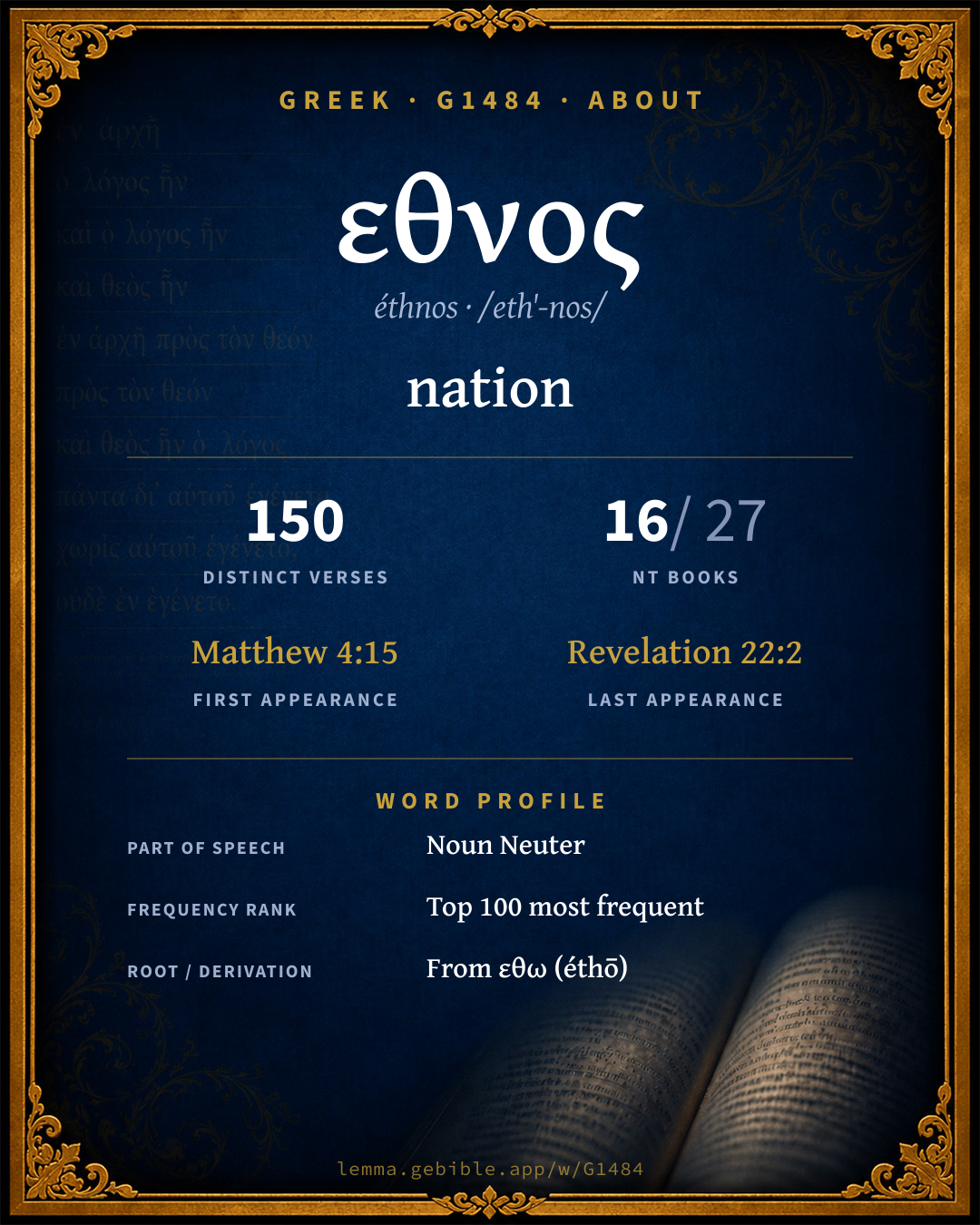
ἔθνος
nation
‘nation’ is one of 5 main senses fuller range ↓
Full lexicon entry — Thayer's Greek Lexicon
From Thayer's Greek Lexicon
Where this word appears
See every Dative-case word in the Greek New Testament →
Grammar key — what these labels mean
Part of speech
- Noun
- A naming word — a person, place, thing, or idea.
Case
- Genitive
- The case of source, possession, or “of” — answers “whose / from what.”
- Dative
- The case of the indirect object, means, or location — “to / for / with / in.”
- Nominative
- The case of the subject (and the predicate nominative).
- Accusative
- The case of the direct object and of extent.
- Vocative
- The case of direct address (“O Lord”).
Gender
- Neuter
- Grammatically neuter.
Number
- Plural
- More than one.
- Singular
- One.
1 verse where G1484 appears in the Genitive case in the Book of 1 Timothy. Filtered view — show all forms. Click any verse to open its interlinear word-by-word view. Verse text shown in the World English Bible for context — . Each verse’s Greek form is shown with its reference; the English is not keyword-highlighted, since the data carries no word-level English alignment. Use “Compare translations” on any verse to read it across multiple English versions. This concordance covers the Greek New Testament; Septuagint (Greek Old Testament) occurrences of this word are not indexed here.
1 Timothy
About this entry
At a glance — auto-summarized from this page’s data, not written by a person. Every figure links to its source below. This summary describes the numbers; it doesn’t interpret them.
“nation” is the headline sense of the Greek noun εθνος (éthnos). Catalogued under 5 senses, its meaning is not single-sense. It appears 150 verses across 16 books of the Greek New Testament, among its common vocabulary. More than a quarter of its appearances fall in Acts. Scripture first uses it in Matthew 4:15. The sections below give every sense, occurrence, and version rendering.
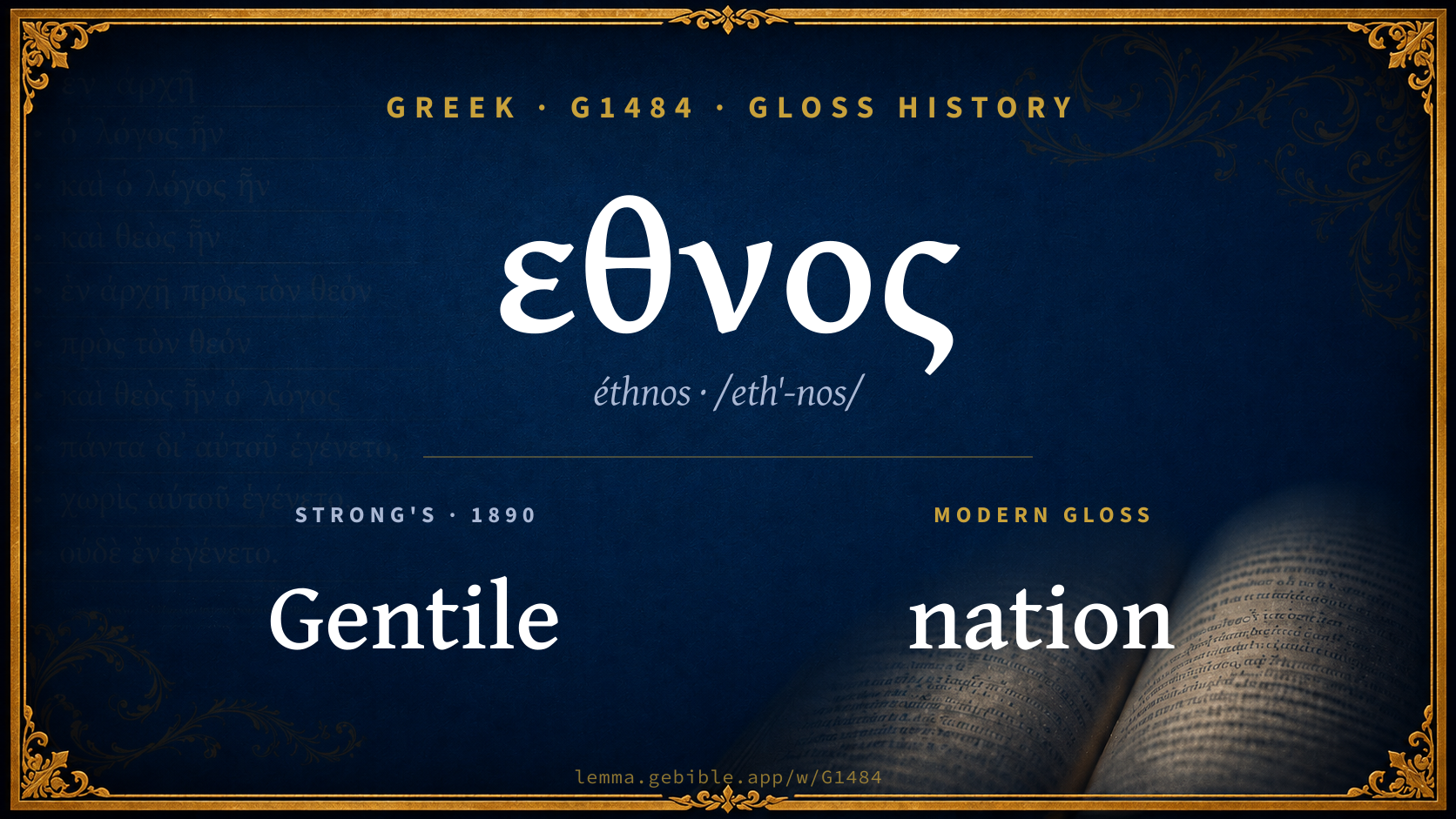
Gloss history
Strong's 1890 vs modern scholarship
About this word
Strong's G1484 catalogs a Greek word from the Greek New Testament.
These counts are not copied from any lexicon or concordance. They are computed here, from the morphology-tagged Greek New Testament. What Lemma adds →
- 150
- distinct verses
- The word appears in 150 distinct verses.
- 16 / 27
- NT books
- The word appears in 16 of 27 New Testament books.
- #98
- by frequency
- Top 100 most frequent Greek words (rank 98 of 5,347 Greek words by occurrence).
View all 150 occurrences in the concordance →
Most concentrated in
- Acts 43 verses 29%
- Romans 23 verses 15%
- Revelation 23 verses 15%
By section of the New Testament
By traditional corpus
Conventional, traditional groupings — biblical authorship is debated, so this is a traditional corpus grouping, not an authorship claim. Some books belong to more than one corpus (Luke is in both the Gospels and the Lukan corpus, and so on), so these shares overlap and need not total 100%. Each figure is a share of the word’s 150 distinct verses.
- Lukan (Luke–Acts) 53 verses · 35%
- Pauline corpus 47 verses · 31%
- Gospels 34 verses · 23%
- Johannine 28 verses · 19%
- Revelation 23 verses · 15%
- General (Catholic) Epistles 3 verses · 2%
How translations render this word
Counts come from each version’s own published word-to-Strong’s tagging or interlinear alignment — an approximate guide to how each version renders this word, not a word-level alignment the data otherwise carries. Because each total is that version’s own tagged count, the per-version totals vary from one another and need not match the appearance or distinct-verse counts above. These counts may also differ from a printed concordance because Lemma counts each distinctly tagged rendering and does not collapse phrase taggings into a single head-word total. This is a fixed set of word-tagged versions (KJV, ASV, BSB, ULT) and does not change with the reading translation you choose elsewhere. Each version’s license is shown beside its name below (and on Sources).
- King James Version: Gentiles 90×, Nations 37×, Nation 26×
- American Standard Version: Gentiles 85×, Nations 36×, Nation 31×
- Berean Standard Bible: Gentiles 86×, Nations 37×, Nation 27×
- unfoldingWord Literal Text: Gentiles 86×, Nations 40×, Nation 31×
King James Version Public Domain
Renders G1484 across 164 tagged occurrences — most commonly:
Plus 4 renderings that appear only once — usually multi-word phrases or single function words the recovered tagging swept in, not distinct renderings.
American Standard Version Public Domain
Renders G1484 across 159 tagged occurrences — most commonly:
Plus 5 renderings that appear only once — usually multi-word phrases or single function words the recovered tagging swept in, not distinct renderings.
Berean Standard Bible Public Domain
Renders G1484 across 162 tagged occurrences — most commonly:
Plus 2 renderings that appear only once — usually multi-word phrases or single function words the recovered tagging swept in, not distinct renderings. Not rendered by a distinct English word in 1 further occurrence.
unfoldingWord Literal Text CC BY-SA 4.0
Renders G1484 across 173 tagged occurrences — most commonly:
Plus 4 renderings that appear only once — usually multi-word phrases or single function words the recovered tagging swept in, not distinct renderings.
Senses in Thayer's
The 5 senses Thayer's distinguishes for this word, in lexicon order (not ranked by frequency or importance). The full entry — with sub-senses — is in the Lexicon Entry tab.
- a multitude (whether of men or of beasts) associated or living together
- a multitude of individuals of the same nature or genus
- a tribe, nation, people group
- in the OT, foreign nations not worshipping the true God, pagans, Gentiles
- Paul uses the term for Gentile Christians
Word origin
Derived from εθω (éthō) (G1486) — to be accustomed.
Probably from G1486 ; a race (as of the same habit ) that is a tribe ; specifically a foreign ( non-Jewish ) one (usually by implication pagan ): - Gentile heathen nation people.
— Strong’s Exhaustive Concordance (1890), public domain.
Forms in the corpus
The 6 distinct written forms G1484 takes in the Greek New Testament, most frequent first — each parse links to that case’s occurrences in the concordance.
| Form | Parsing | Example | Uses |
|---|---|---|---|
| ἔθνη éthnē | Noun, Nominative, Plural, Neuter | Matthew 6:32 | 52 |
| ἐθνῶν ethnō̂n | Noun, Genitive, Plural, Neuter | Matthew 4:15 | 46 |
| ἔθνεσιν éthnesin | Noun, Dative, Plural, Neuter | Matthew 10:18 | 32 |
| ἔθνος éthnos | Noun, Accusative, Singular, Neuter | Matthew 24:7 | 18 |
| ἔθνει éthnei | Noun, Dative, Singular, Neuter | Matthew 21:43 | 7 |
| ἔθνους éthnous | Noun, Genitive, Singular, Neuter | John 11:51 | 7 |
Same root — word family
Other Thayer's entries built from the same root as G1484, grouped by Strong’s listed origin. These share a root / origin per the lexicon — not necessarily a shared meaning. Each links to that word’s own entry.
Derives from
Shares the same root
Derived from this word
Compare all same-root words → Showing 4 of 5 — not the complete family. They share a root, not necessarily a meaning.
Septuagint usage
The same Greek word εθνος appears 719 times in the Greek Old Testament (Septuagint), across 643 verses in 34 books.
- 719
- LXX occurrences
- Tagged occurrences of this Greek word in the Septuagint.
- 643
- verses
- Distinct Septuagint verses containing this word.
- 34 / 39
- OT books
- The word appears in 34 of the 39 Old Testament books.
Sample Septuagint occurrences
- Genesis 10:5 ἔθνος
- Exodus 1:9 ἔθνος
- Leviticus 18:24 ἔθνος
- Numbers 13:28 ἔθνος
- Deuteronomy 1:28 ἔθνος
- Joshua 4:24 ἔθνος
- Judges 2:12 ἔθνος
- 1 Samuel 8:5 ἔθνος
- 2 Samuel 7:23 ἔθνος
- 1 Kings 11:2 ἔθνος
- 2 Kings 6:18 ἔθνος
- 1 Chronicles 14:17 ἔθνος
Septuagint occurrences (same lexeme)
Every verse where the same Strong’s number (G1484) appears in the Greek Septuagint — showing the first 50 of 643. Verse text shown in the World English Bible for context; the Greek form is the matched word — the English is not keyword-highlighted.
- Genesis 10:5 ἔθνος Of these were the isles of the nations divided in their lands, everyone after his language, after their families, in their nations.
- Genesis 10:20 ἔθνος These are the sons of Ham, after their families, after their languages, in their lands, in their nations.
- Genesis 10:31 ἔθνος These are the sons of Shem, after their families, after their languages, in their lands, after their nations.
- Genesis 10:32 ἔθνος These are the families of the sons of Noah, after their generations, in their nations. Of these were the nations divided in the earth after the flood.
- Genesis 12:2 ἔθνος I will make of you a great nation. I will bless you, and make your name great. You will be a blessing.
- Genesis 14:1 ἔθνος It happened in the days of Amraphel, king of Shinar, Arioch, king of Ellasar, Chedorlaomer, king of Elam, and Tidal, king of Goiim,
- Genesis 14:5 ἔθνος In the fourteenth year Chedorlaomer came, and the kings who were with him, and struck the Rephaim in Ashteroth Karnaim, and the Zuzim in Ham, and the Emim in Shaveh-kiriathaim,
- Genesis 14:9 ἔθνος against Chedorlaomer king of Elam, and Tidal king of Goiim, and Amraphel king of Shinar, and Arioch king of Ellasar; four kings against the five.
- Genesis 15:14 ἔθνος I will also judge that nation, whom they will serve. Afterward they will come out with great substance.
- Genesis 17:4 ἔθνος "As for me, behold, my covenant is with you. You will be the father of a multitude of nations.
- Genesis 17:5 ἔθνος Neither will your name any more be called Abram, but your name will be Abraham; for the father of a multitude of nations have I made you.
- Genesis 17:6 ἔθνος I will make you exceeding fruitful, and I will make nations of you. Kings will come out of you.
- Genesis 17:16 ἔθνος I will bless her, and moreover I will give you a son by her. Yes, I will bless her, and she will be a mother of nations. Kings of peoples will come from her."
- Genesis 17:20 ἔθνος As for Ishmael, I have heard you. Behold, I have blessed him, and will make him fruitful, and will multiply him exceedingly. He will become the father of twelve princes, and I will make him a great nation.
- Genesis 17:27 ἔθνος All the men of his house, those born in the house, and those bought with money of a foreigner, were circumcised with him.
- Genesis 18:18 ἔθνος seeing that Abraham has surely become a great and mighty nation, and all the nations of the earth will be blessed in him?
- Genesis 20:4 ἔθνος Now Abimelech had not come near her. He said, "Lord, will you kill even a righteous nation?
- Genesis 21:13 ἔθνος Also of the son of the handmaid will I make a nation, because he is your seed."
- Genesis 21:18 ἔθνος Get up, lift up the boy, and hold him in your hand. For I will make him a great nation."
- Genesis 22:18 ἔθνος In your seed will all the nations of the earth be blessed, because you have obeyed my voice."
- Genesis 25:16 ἔθνος These are the sons of Ishmael, and these are their names, by their villages, and by their encampments: twelve princes, according to their nations.
- Genesis 25:23 ἔθνος Yahweh said to her, Two nations are in your womb, Two peoples will be separated from your body. The one people will be stronger than the other people. The elder will serve the younger.
- Genesis 26:4 ἔθνος I will multiply your seed as the stars of the sky, and will give to your seed all these lands. In your seed will all the nations of the earth be blessed,
- Genesis 27:29 ἔθνος Let peoples serve you, Nations bow down to you. Be lord over your brothers, Let your mother's sons bow down to you. Cursed be everyone who curses you, Blessed be everyone who blesses you."
- Genesis 28:3 ἔθνος May God Almighty bless you, and make you fruitful, and multiply you, that you may be a company of peoples,
- Genesis 35:11 ἔθνος God said to him, "I am God Almighty. Be fruitful and multiply. A nation and a company of nations will be from you, and kings will come out of your loins.
- Genesis 36:40 ἔθνος These are the names of the chiefs who came from Esau, according to their families, after their places, and by their names: chief Timna, chief Alvah, chief Jetheth,
- Genesis 46:3 ἔθνος He said, "I am God, the God of your father. Don't be afraid to go down into Egypt; for there I will make of you a great nation.
- Genesis 48:4 ἔθνος and said to me, 'Behold, I will make you fruitful, and multiply you, and I will make of you a company of peoples, and will give this land to your seed after you for an everlasting possession.'
- Genesis 48:19 ἔθνος His father refused, and said, "I know, my son, I know. He also will become a people, and he also will be great. However, his younger brother will be greater than he, and his seed will become a multitude of nations."
- Genesis 49:10 ἔθνος The scepter will not depart from Judah, Nor the ruler's staff from between his feet, Until he comes to whom it belongs. To him will the obedience of the peoples be.
- Exodus 1:9 ἔθνος He said to his people, "Behold, the people of the children of Israel are more and mightier than we.
- Exodus 9:24 ἔθνος So there was very severe hail, and lightning mixed with the hail, such as had not been in all the land of Egypt since it became a nation.
- Exodus 15:14 ἔθνος The peoples have heard. They tremble. Pangs have taken hold on the inhabitants of Philistia.
- Exodus 19:5 ἔθνος Now therefore, if you will indeed obey my voice, and keep my covenant, then you shall be my own possession from among all peoples; for all the earth is mine;
- Exodus 19:6 ἔθνος and you shall be to me a kingdom of priests, and a holy nation.' These are the words which you shall speak to the children of Israel."
- Exodus 21:8 ἔθνος If she doesn't please her master, who has married her to himself, then he shall let her be redeemed. He shall have no right to sell her to a foreign people, seeing he has dealt deceitfully with her.
- Exodus 23:11 ἔθνος but the seventh year you shall let it rest and lie fallow, that the poor of your people may eat; and what they leave the animal of the field shall eat. In like manner you shall deal with your vineyard and with your olive grove.
- Exodus 23:18 ἔθνος "You shall not offer the blood of my sacrifice with leavened bread, neither shall the fat of my feast remain all night until the morning.
- Exodus 23:22 ἔθνος But if you indeed listen to his voice, and do all that I speak, then I will be an enemy to your enemies, and an adversary to your adversaries.
- Exodus 23:27 ἔθνος I will send my terror before you, and will confuse all the people to whom you come, and I will make all your enemies turn their backs to you.
- Exodus 32:10 ἔθνος Now therefore leave me alone, that my wrath may burn hot against them, and that I may consume them; and I will make of you a great nation."
- Exodus 33:13 ἔθνος Now therefore, if I have found favor in your sight, please show me now your ways, that I may know you, so that I may find favor in your sight: and consider that this nation is your people."
- Exodus 33:16 ἔθνος For how would people know that I have found favor in your sight, I and your people? Isn't it in that you go with us, so that we are separated, I and your people, from all the people who are on the surface of the earth?"
- Exodus 34:10 ἔθνος He said, "Behold, I make a covenant: before all your people I will do marvels, such as have not been worked in all the earth, nor in any nation; and all the people among which you are shall see the work of Yahweh; for it is an awesome thing that I do with you.
- Exodus 34:24 ἔθνος For I will drive out nations before you and enlarge your borders; neither shall any man desire your land when you go up to appear before Yahweh, your God, three times in the year.
- Leviticus 18:24 ἔθνος "'Don't defile yourselves in any of these things: for in all these the nations which I am casting out before you were defiled.
- Leviticus 18:28 ἔθνος that the land not vomit you out also, when you defile it, as it vomited out the nation that was before you.
- Leviticus 19:16 ἔθνος "'You shall not go up and down as a slanderer among your people; neither shall you stand against the life of your neighbor. I am Yahweh.
- Leviticus 20:2 ἔθνος "Moreover, you shall tell the children of Israel, 'Anyone of the children of Israel, or of the strangers who live as foreigners in Israel, who gives any of his seed to Molech; he shall surely be put to death. The people of the land shall stone him with stones.
These are occurrences of the same Greek lexeme (G1484) in the Septuagint — not a translation of any one Hebrew word. The store carries no word-level Hebrew↔Greek alignment, so no Hebrew original is asserted here. Counts come from the recovered LXX Strong's tagging — high-frequency vocabulary is well covered, while rare or late forms may be untagged — so they reflect tagged occurrences and may slightly undercount.