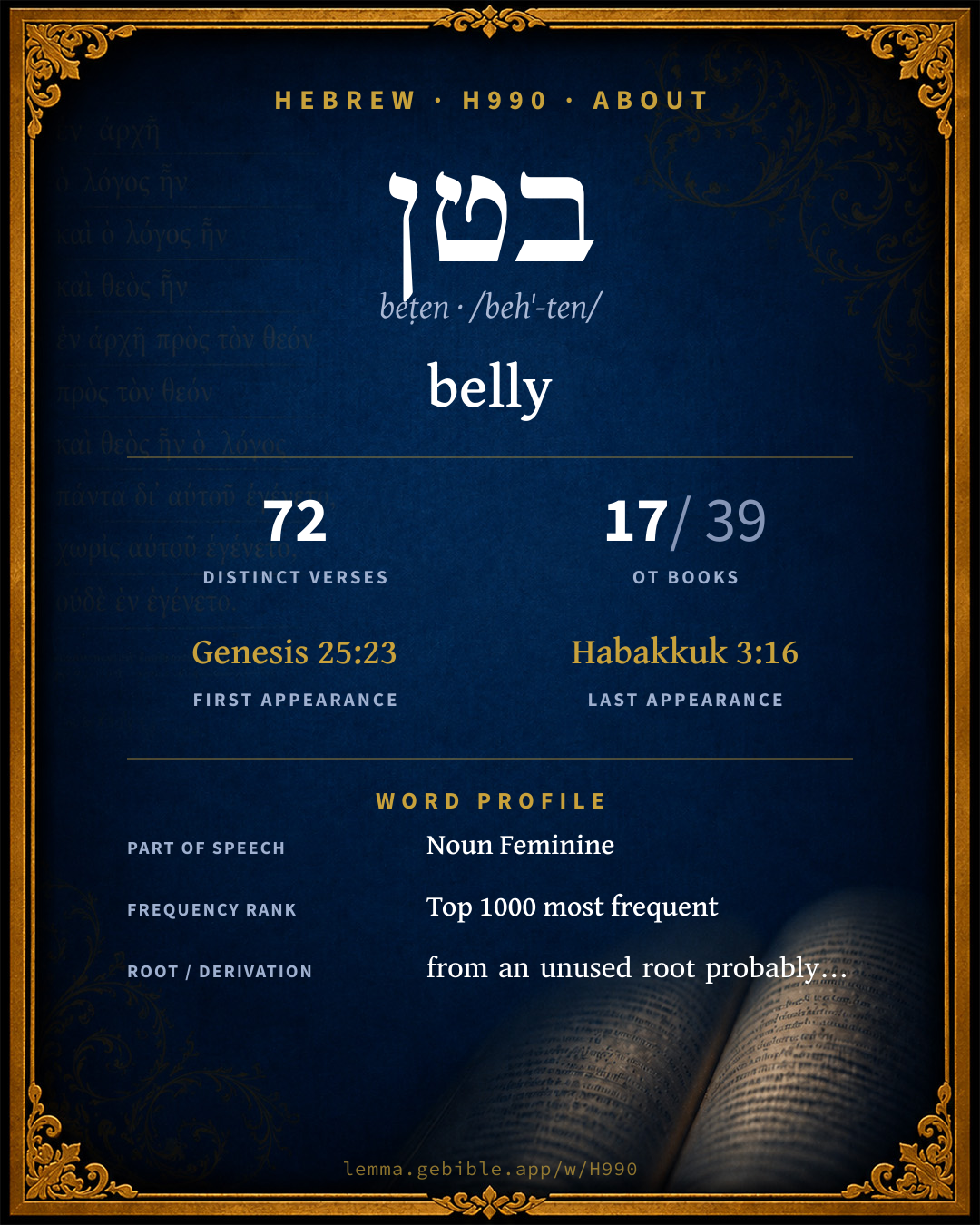
בֶּ֫טֶן
belly
also: womb, body fuller range ↓
Full lexicon entry — Brown-Driver-Briggs (BDB)
From Brown-Driver-Briggs (BDB)
Where this word appears
See every Construct-state word in the Hebrew Bible →
Grammar key — what these labels mean
Part of speech
- Noun
- A naming word — a person, place, thing, or idea.
Noun type
- Common
- A common noun — a general class of person, place, or thing (“king,” “city,” “water”), not a specific name.
State
- Absolute
- The independent form of a noun, not bound to a following word.
- Construct
- A noun bound to a following noun in a possessive / “of” relationship (the construct chain).
Gender
- Feminine
- Grammatically feminine.
Number
- Singular
- One.
46 distinct verses where H990 appears in the Construct state, across 15 books. Filtered view — show all forms. Click any verse to open its interlinear word-by-word view. Verse text shown in the World English Bible for context — . Each verse’s Hebrew form is shown with its reference; the English is not keyword-highlighted, since the data carries no word-level English alignment. Use “Compare translations” on any verse to read it across multiple English versions. This concordance covers the Hebrew Bible; Septuagint (Greek Old Testament) occurrences are not indexed here.
Genesis 3 verses
- Genesis 25:23 בְּ/בִטְנֵ֔/ךְ prep + n c fs cs + sfx pers 2fs Yahweh said to her, Two nations are in your womb, Two peoples will be separated from your body. The one people will be stronger than the other people. The elder will serve the younger.
- Genesis 25:24 בְּ/בִטְנָֽ/הּ prep + n c fs cs + sfx pers 3fs When her days to be delivered were fulfilled, behold, there were twins in her womb.
- Genesis 38:27 בְּ/בִטְנָֽ/הּ prep + n c fs cs + sfx pers 3fs It happened in the time of her travail, that behold, twins were in her womb.
Numbers 2 verses
- Numbers 5:21 בִּטְנֵ֖/ךְ n c fs cs + sfx pers 2fs then the priest shall cause the woman to swear with the oath of cursing, and the priest shall tell the woman, 'Yahweh make you a curse and an oath among your people, when Yahweh allows your thigh to fall away, and your body to swell;
- Numbers 5:27 בִטְנָ֔/הּ n c fs cs + sfx pers 3fs When he has made her drink the water, then it shall happen, if she is defiled, and has committed a trespass against her husband, that the water that causes the curse will enter into her and become bitter, and her body will swell, and her thigh will fall away: and the woman will be a curse among her people.
Deuteronomy 6 verses
- Deuteronomy 7:13 בִטְנְ/ךָ֣ n c fs cs + sfx pers 2ms and he will love you, and bless you, and multiply you; he will also bless the fruit of your body and the fruit of your ground, your grain and your new wine and your oil, the increase of your cattle and the young of your flock, in the land which he swore to your fathers to give you.
- Deuteronomy 28:4 בִטְנְ/ךָ֛ n c fs cs + sfx pers 2ms Blessed shall be the fruit of your body, and the fruit of your ground, and the fruit of your animals, the increase of your cattle, and the young of your flock.
- Deuteronomy 28:11 בִטְנְ/ךָ֛ n c fs cs + sfx pers 2ms Yahweh will make you plenteous for good, in the fruit of your body, and in the fruit of your cattle, and in the fruit of your ground, in the land which Yahweh swore to your fathers to give you.
- Deuteronomy 28:18 בִטְנְ/ךָ֖ n c fs cs + sfx pers 2ms Cursed shall be the fruit of your body, and the fruit of your ground, the increase of your cattle, and the young of your flock.
- Deuteronomy 28:53 בִטְנְ/ךָ֗ n c fs cs + sfx pers 2ms You shall eat the fruit of your own body, the flesh of your sons and of your daughters, whom Yahweh your God has given you, in the siege and in the distress with which your enemies shall distress you.
- Deuteronomy 30:9 בִטְנְ/ךָ֜ n c fs cs + sfx pers 2ms Yahweh your God will make you plenteous in all the work of your hand, in the fruit of your body, and in the fruit of your cattle, and in the fruit of your ground, for good: for Yahweh will again rejoice over you for good, as he rejoiced over your fathers;
Judges 3 verses
- Judges 3:21 בְּ/בִטְנֽ/וֹ prep + n c fs cs + sfx pers 3ms Ehud put forth his left hand, and took the sword from his right thigh, and thrust it into his body:
- Judges 3:22 מִ/בִּטְנ֑/וֹ prep + n c fs cs + sfx pers 3ms and the haft also went in after the blade; and the fat closed on the blade, for he didn't draw the sword out of his body; and it came out behind.
- Judges 16:17 מִ/בֶּ֣טֶן prep + n c fs cs He told her all his heart, and said to her, "No razor has ever come on my head; for I have been a Nazirite to God from my mother's womb. If I am shaved, then my strength will go from me, and I will become weak, and be like any other man."
Job 13 verses
- Job 1:21 מִ/בֶּ֣טֶן prep + n c fs cs He said, "Naked I came out of my mother's womb, and naked shall I return there. Yahweh gave, and Yahweh has taken away. Blessed be the name of Yahweh."
- Job 3:10 בִטְנִ֑/י n c fs cs + sfx pers 1cs Because it didn't shut up the doors of my mother's womb, Nor did it hide trouble from my eyes.
- Job 15:2 בִּטְנֽ/וֹ n c fs cs + sfx pers 3ms "Should a wise man answer with vain knowledge, And fill himself with the east wind?
- Job 15:35 וּ֝/בִטְנָ֗/ם conj + n c fs cs + sfx pers 3mp They conceive mischief, and bring forth iniquity. Their heart prepares deceit."
- Job 19:17 בִטְנִֽ/י n c fs cs + sfx pers 1cs My breath is offensive to my wife. I am loathsome to the children of my own mother.
- Job 20:15 מִ֝/בִּטְנ֗/וֹ prep + n c fs cs + sfx pers 3ms He has swallowed down riches, and he shall vomit them up again. God will cast them out of his belly.
- Job 20:20 בְּ/בִטְנ֑/וֹ prep + n c fs cs + sfx pers 3ms "Because he knew no quietness within him, He shall not save anything of that in which he delights.
- Job 20:23 בִטְנ֗/וֹ n c fs cs + sfx pers 3ms When he is about to fill his belly, God will cast the fierceness of his wrath on him. It will rain on him while he is eating.
- Job 31:18 וּ/מִ/בֶּ֖טֶן conj + prep + n c fs cs (No, from my youth he grew up with me as with a father, Her have I guided from my mother's womb);
- Job 32:18 בִּטְנִֽ/י n c fs cs + sfx pers 1cs For I am full of words. The spirit within me constrains me.
- Job 32:19 בִטְנִ֗/י n c fs cs + sfx pers 1cs Behold, my breast is as wine which has no vent; Like new wineskins it is ready to burst.
- Job 38:29 מִ/בֶּ֣טֶן prep + n c fs cs Out of whose womb came the ice? The gray frost of the sky, who has given birth to it?
- Job 40:16 בִטְנֽ/וֹ n c fs cs + sfx pers 3ms Look now, his strength is in his loins, His force is in the muscles of his belly.
Psalms 6 verses
- Psalms 17:14 בִ֫טְנָ֥/ם n c fs cs + sfx pers 3mp From men by your hand, Yahweh, From men of the world, whose portion is in this life. You fill the belly of your cherished ones. Your sons have plenty, And they store up wealth for their children.
- Psalms 22:10 מִ/בֶּ֥טֶן prep + n c fs cs I was thrown on you from my mother's womb. You are my God since my mother bore me.
- Psalms 31:9 וּ/בִטְנִֽ/י conj + n c fs cs + sfx pers 1cs Have mercy on me, Yahweh, for I am in distress. My eye, my soul, and my body waste away with grief.
- Psalms 44:25 בִּטְנֵֽ/נוּ n c fs cs + sfx pers 1cp For our soul is bowed down to the dust. Our body cleaves to the earth.
- Psalms 132:11 בִטְנְ/ךָ֑ n c fs cs + sfx pers 2ms Yahweh has sworn to David in truth. He will not turn from it: "I will set the fruit of your body on your throne.
- Psalms 139:13 בְּ/בֶ֣טֶן prep + n c fs cs For you formed my inmost being. You knit me together in my mother's womb.
Proverbs 4 verses
- Proverbs 13:25 וּ/בֶ֖טֶן conj + n c fs cs The righteous one eats to the satisfying of his soul, But the belly of the wicked goes hungry.
- Proverbs 18:20 בִּטְנ֑/וֹ n c fs cs + sfx pers 3ms A man's stomach is filled with the fruit of his mouth. With the harvest of his lips he is satisfied.
- Proverbs 22:18 בְּ/בִטְנֶ֑/ךָ prep + n c fs cs + sfx pers 2ms For it is a pleasant thing if you keep them within you, If all of them are ready on your lips.
- Proverbs 31:2 בִּטְנִ֑/י n c fs cs + sfx pers 1cs "Oh, my son!" Oh, son of my womb! Oh, son of my vows!
Ecclesiastes 2 verses
- Ecclesiastes 5:15 מִ/בֶּ֣טֶן prep + n c fs cs As he came forth from his mother's womb, naked shall he go again as he came, and shall take nothing for his labor, which he may carry away in his hand.
- Ecclesiastes 11:5 בְּ/בֶ֣טֶן prep + n c fs cs As you don't know what is the way of the wind, Nor how the bones grow in the womb of her who is with child; Even so you don't know the work of God who does all.
Song of Solomon 1 verse
Isaiah 1 verse
Ezekiel 1 verse
Hosea 1 verse
Jonah 1 verse
Micah 1 verse
Habakkuk 1 verse
About this entry
At a glance — auto-summarized from this page’s data, not written by a person. Every figure links to its source below. This summary describes the numbers; it doesn’t interpret them.
בטן (beṭen) is a Hebrew noun most often rendered “belly.” It first appears in Genesis 25:23. With 72 verses in 17 books, it is a moderately common word in the Hebrew Bible. Beyond its headline sense, its full sense range takes in “womb” and “body”. It clusters with בטן and בטן under a shared root. The sections below give every sense, occurrence, and version rendering.
Gloss history
Strong's 1890 vs modern scholarship
About this word
Strong's H990 catalogs a Hebrew word from the Hebrew Old Testament.
These counts are not copied from any lexicon or concordance. They are computed here, from the morphology-tagged Hebrew Old Testament. What Lemma adds →
- 72
- distinct verses
- The word appears in 72 distinct verses.
- 17 / 39
- OT books
- The word appears in 17 of 39 Old Testament books.
- #550
- by frequency
- Top 1000 most frequent Hebrew words (rank 550 of 8,640 Hebrew words by occurrence).
View all 72 occurrences in the concordance →
By section of the Old Testament
By traditional corpus
Conventional, traditional groupings — biblical authorship is debated, so this is a traditional corpus grouping, not an authorship claim. Each share is this word’s portion of its verses in that division of the Hebrew canon. Each figure is a share of the word’s 72 distinct verses.
- Writings (Ketuvim) 37 verses · 51%
- Prophets (Nevi'im) 22 verses · 31%
- Torah (Pentateuch) 13 verses · 18%
How translations render this word
Counts come from each version’s own published word-to-Strong’s tagging or interlinear alignment — an approximate guide to how each version renders this word, not a word-level alignment the data otherwise carries. Because each total is that version’s own tagged count, the per-version totals vary from one another and need not match the appearance or distinct-verse counts above. These counts may also differ from a printed concordance because Lemma counts each distinctly tagged rendering and does not collapse phrase taggings into a single head-word total. This is a fixed set of word-tagged versions (KJV, ASV, BSB, ULT) and does not change with the reading translation you choose elsewhere. Each version’s license is shown beside its name below (and on Sources).
BDB lists this Strong’s number as 2 distinct words (homographs). Each count above pools all of them and is not split by sense — see the Senses section below. A low-frequency rendering may belong to a different one of those words, not the primary meaning.
- King James Version†: Belly 26×, Womb 24×, Body 6×
- American Standard Version†: Womb 14×, Body 12×, 's womb 5×
- Berean Standard Bible†: Womb 34×, Belly 8×, Stomach 3×
- unfoldingWord Literal Text†: Womb 28×, Belly 27×, Womb of 5×
King James Version Public Domain
Renders H990 across 72† tagged occurrences — most commonly:
Plus 12 renderings that appear only once — usually multi-word phrases or single function words the recovered tagging swept in, not distinct renderings.
American Standard Version Public Domain
Renders H990 across 69† tagged occurrences — most commonly:
Plus 29 renderings that appear only once — usually multi-word phrases or single function words the recovered tagging swept in, not distinct renderings.
Berean Standard Bible Public Domain
Renders H990 across 64† tagged occurrences — most commonly:
Plus 17 renderings that appear only once — usually multi-word phrases or single function words the recovered tagging swept in, not distinct renderings. Not rendered by a distinct English word in 8 further occurrences.
unfoldingWord Literal Text CC BY-SA 4.0
Renders H990 across 76† tagged occurrences — most commonly:
Plus 10 renderings that appear only once — usually multi-word phrases or single function words the recovered tagging swept in, not distinct renderings.
6 senses and sub-senses in the full BDB
What do BDB’s symbols mean?
BDB uses these scholarly abbreviations:
| Symbol | Meaning |
|---|---|
| 𝔊 | the Septuagint (the ancient Greek translation, LXX) |
| 𝔙 | the Vulgate (the Latin translation) |
| 𝔖 | the Syriac version (the Peshitta) |
| 𝔗 | the Targum (the Aramaic translation) |
| ψ | the Psalms |
| √ | root (the underlying root or stem) |
| ‖ | parallel passage (a synonymous or contrasted parallel) |
| † | the dagger: every passage where the word occurs is cited |
The 6 senses and sub-senses the full Brown-Driver-Briggs lexicon distinguishes for this word, in lexicon order (not ranked by frequency), with BDB’s own verbatim wording and sub-sense lettering. Shown in Hebrew script with BDB’s own scholarly abbreviations. The condensed entry is in the Lexicon Entry tab. See also the Forms in the corpus table below.
בטן I
- 1.
- a. belly, abdomen, of man Ju 3:21, 22; of woman Nu 5:21, 22, 27; as beautiful in form Ct 7:3; as seat of hunger Pr 13:25; as eating Ez 3:3 (‖ מֵעִים); cf. Pr 18:20 (fig.); as seat of passion, avarice, etc. Jb 20:20, 23; in fig. of God’s casting riches out of extortioner’s belly Jb 20:15 (‖ וַיְקִאֶנּוּ), cf. also ψ 17:14; fig. of innermost part of a man = inmost soul Pr 18:8 = 26:22, 20:27, 30 (all חַדְרֵי ב׳); as seat of intell. faculties (= Eng. breast or bosom) 22:18 (cf. מֵעִים ψ 40:9) Jb 15:2, 35; 32:18, רוּחַ בִּטְנִי v 19; as trembling at theophany Hb 3:16. e.g. Judges 3:21
- b. belly of hippopotamus Jb 40:16. e.g. Job 40:16
- c. בֶּטֶן שְׁאוֹל Jon 2:3 (Jonah’s prayer: ‖ מְצוּלָה בִּלְבַב יַמִּים). e.g. Jonah 2:3
- 2. body, opp. soul ψ 31:10 (opp. נֶפֶשׁ), also 44:26 (opp. id.;—on this cf. ZimBP 71). e.g. Psalms 31:10
- 3. womb Gn 25:23, 24; 38:27 (all J) Ho 12:4 Jb 10:19 (‖ רֶחֶם v 18) Ec 11:5 Jb 31:15 הֲלֹא בַבֶּטֶן עֹשֵׂנִי עָשָׂ֑הוּ did not he that made me in the womb make him (‖ וַיְכֻנֶנּוּ בָּרֶחֶם אֶחָד); cf. ψ 139:13 תְּסֻכֵּנִי בְּבֶטֶן, & Je 1:5; especially פְּרִי ב׳ i.e. offspring Gn 30:2 (E) ψ 127:3 Is 13:18; Pr 31:2 בַּר בִּטְנִי = my son (‖ בְּרִי) cf. בֶּן־בִּטְנָהּ Is 49:15; of birth יָצָא מִבֶּטֶן Jb 1:21; 3:11 Ec 5:14; בֶּטֶן alone = birth Ho 9:11 (‖ לֵרָה, הֵרָיוֹן), cf. fig. מִבֶּטֶן מִי יָצָא הַקָּ֑רַח Jb 38:29 out of whose womb came the ice? cf. לֹא סָגַר דַּלְתֵי בִּטְנִי Jb 3:10 i.e. of my (mother’s) womb; גָּחָה מִבֶּטֶן take, draw out of the womb, subj. י׳ (i.e. cause to be born) ψ 22:10; פְּרִי בֶטֶן used also of father Mi 6:7, cf. ψ 132:11 (David as ancestor of Messian. king); Jb 19:17 בְּנֵי בִטְנִי sons of my body, of doubtful interpr., perhaps = sons of my (mother’s) womb, cf. 3:10 (Ges De), i.e. my brothers or men of my clan RSK 33 f., others my sons (Ew), my grandsons (Di); also in addressing Isr. as a whole (masc. sf.) Dt 7:13; 28:4, 11, 18, 53; 30:9, cf. מַחֲמַדֵּי בִטְנָם Ho 9:16 beloved ones of their womb; מִן־הַבֶּטֶן (מִבֶּטֶן) = from birth Ju 13:5, 7 ψ 58:4; 71:6, cf. also Is 44:2, 24; 46:3 (‖ רָ֑חַם) 48:8; 49:1, 5; מִבֶּטֶן אִמִּי id. Ju 16:17 Jb 31:18 ψ 22:11 (‖ רֶחֶם). e.g. Genesis 25:23
- 4. architectural word of some rounded projection connected with the two pillars Jachin & Boaz bell, cushion 1 K 7:20. e.g. 1 Kings 7:20
בטן II loc. city in Asher Jos 19
Senses from the full Brown-Driver-Briggs lexicon (Brown, Driver, Briggs; Oxford 1906 — public domain), digitized via Sefaria, supplemented by the OpenScriptures HebrewLexicon (CC BY 4.0). Full attribution on Sources.
Word origin
I. n.f. Nu 5:25 belly, body, womb (Arabic بَطْنٌ )—בּ׳ abs. Ju 13:7 +; בָּ֑טֶן v 5 +; cstr. בֶּטֶן ψ 139:13 +; sf. בִּטְנִי Jb 3:10 +; בִּטְנְךָ Dt 7:13 +; בִּטְנֵךְ Gn 25:23; בִּטְנוֹ Jb 15:2 +, etc.;—
II. n.pr.loc. city in Asher Jos 19:25 (= depression, basin, valley? cf. Arabic بَطْنٌ, Lane220 col. 3) = Βατναί, called Βεθβετεν cf. LagOnom. 236, 2nd ed. 249; 𝔊 Βαιθοκ, 𝔊L Βετελ.
— Brown-Driver-Briggs (Oxford 1906, public domain), digitized via Sefaria, supplemented by the OpenScriptures HebrewLexicon (CC BY 4.0). See Sources.
Origin: from an unused root probably meaning to be hollow
Jastrow Dictionary
A second Hebrew/Aramaic lexicon for comparison, covering Aramaic and post-biblical (Talmudic, Targumic, Midrashic) usage that the biblical-Hebrew BDB does not. Matched by lemma rather than by Strong’s number, so a lemma may carry more than one Jastrow headword (shown separately below), and the entries cover usage well beyond the Bible.
בְּטַן
- (v. בטי) to be pregnant. Targ. Prov. XXV, 23.—Gen. R. s. 98 (play on triyah, Jud. XV, 15, as if τρία, three) בָּטְנָה תרין she was going with two (making together three). Lam. R. to I, 1 רבתי (חד מאת׳ 7). [Targ. Jud. XV, 15 בטינתא, v. טִינָתָא.] e.g. Judges 15:15
בֶּטֶן
- v. בטי) belly. Nidd. 31ᵇ. Sot. 28ᵃ בִּטְנוֹ וכ׳ the belly of the adulterer; a. fr.
A Dictionary of the Targumim, the Talmud Babli and Yerushalmi, and the Midrashic Literature (Marcus Jastrow; London, Luzac, 1903) — Public Domain. Digitized via Sefaria. Digitized via Sefaria. Full attribution on Sources.
Forms in the corpus
The 56 distinct written forms H990 takes in the Hebrew Bible, most frequent first — each parse links to that state’s occurrences in the concordance. Hebrew forms include their vowel points and cantillation, so a single lemma takes many written forms.
Same root — word family
Other BDB entries built from the same root as H990, grouped by Strong’s listed origin. These share a root / origin per the lexicon — not necessarily a shared meaning. Each links to that word’s own entry.
Derived from this word
Proper names from this root
People and places named from this root — a name, not an additional meaning of the word.
Compare all same-root words → 1 of the same-root words is a proper name (a person or place). They share a root, not necessarily a meaning.
Septuagint verse parallels
This word appears in 66 verses that also exist in the Greek Old Testament (Septuagint), out of the 72 Hebrew verses it occurs in. You can read those verses in Greek by switching the Old Testament edition to the Septuagint.
Read these verses in the Septuagint
- Genesis 25:23
- Numbers 5:21
- Deuteronomy 7:13
- Judges 3:21
- 1 Kings 7:20
- Job 1:21
- Psalms 17:14
- Proverbs 13:25
- Ecclesiastes 5:15
- Song of Solomon 7:2
- Isaiah 13:18
- Jeremiah 1:5
This is a verse-level parallel only — the same verses exist in both the Hebrew and Greek Old Testaments. No word-level Hebrew↔Greek correspondence is claimed: the data carries no such alignment, so no Greek word is shown as this Hebrew word’s translation. Coverage is not total — the Septuagint omits the deuterocanon and renumbers the Psalms, so some Hebrew verses have no direct Greek parallel.