Isaiah 44:2

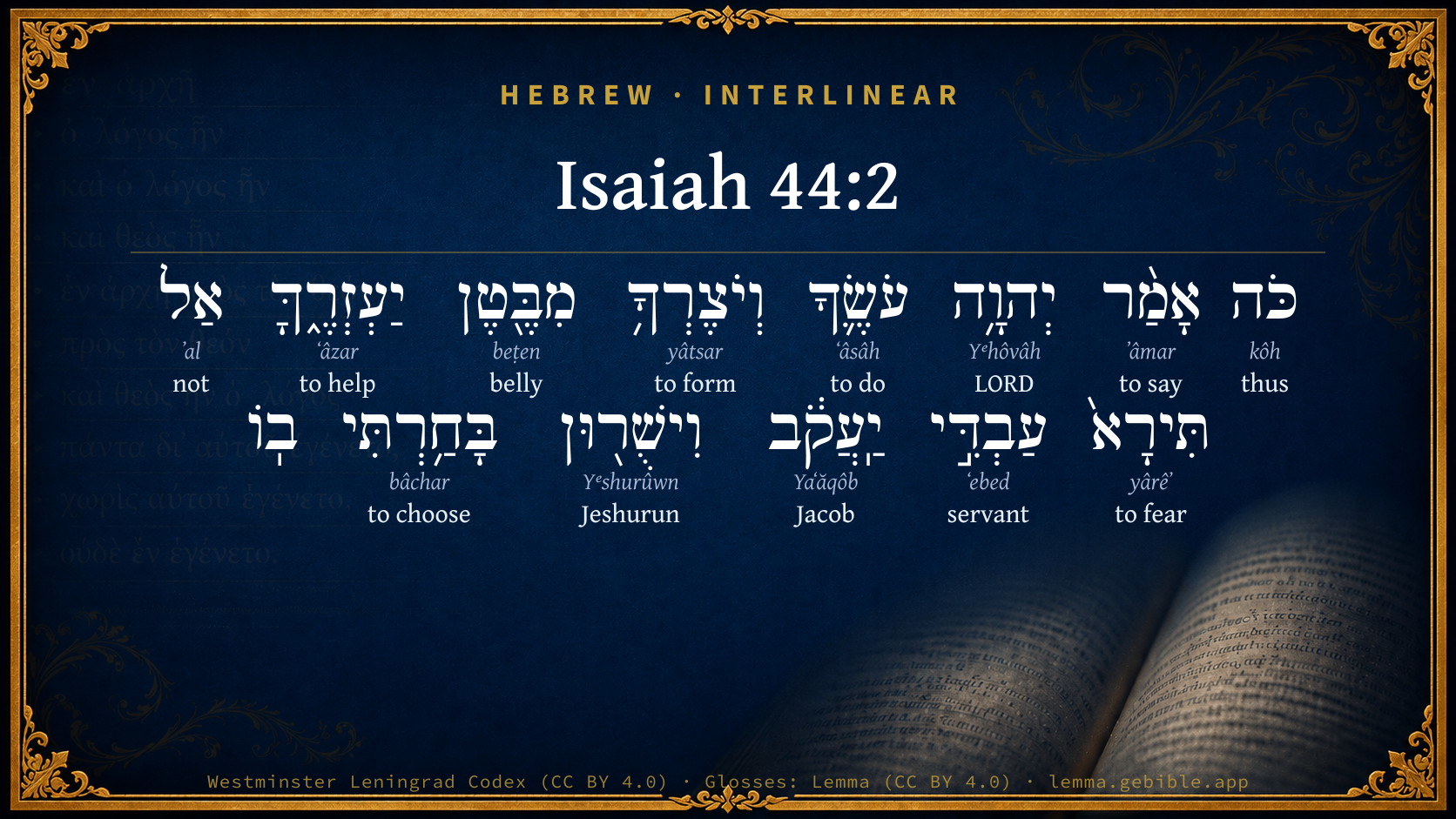
Hebrew (Westminster Leningrad Codex) Isaiah 44:2 appears in the Hebrew Old Testament. The text above is from the Westminster Leningrad Codex. Each word links to its Strong’s number, a concise gloss, and parsing drawn from the Open Scriptures Hebrew Bible morphology. Click any word for its full Brown-Driver-Briggs (BDB) entry.
Download image
Cite this verse

Isaiah 44:2 (World English Bible). Public Domain. Lemma interlinear Bible study tool, https://lemma.gebible.app/v/isaiah/44/2.

Show BibTeX & RIS
BibTeX
RIS
English Translation
Thus says Yahweh who made you, and formed you from the womb, who will help you: Don't be afraid, Jacob my servant; and you, Jeshurun, whom I have chosen.
World English Bible · Public Domain
Download a study sheet

One document with this verse’s original text, its word-by-word gloss line, the meaning frame, cross-references with their text, attributed commentary, and full source and license credits — printable, and it pastes into notes with its structure intact.

This verse Autodidact and up

Study sheet (.html) Plain text (.txt)

A passage Seminary Student

Up to 50 verses in one chapter. A passage sheet keeps up to 6 commentary sources and 12 cross-references per verse, in the order this page ranks them, and says so on the sheet whenever that leaves anything out. Ask for a single verse and you get the Autodidact verse sheet above.

Everything on this page stays free to read, with no account — the sheet is a download of what is already on screen, not access to it.

Want to remove ads? Support Godless Engineer
Compare translations 3

The same verse in 3 English versions, stacked beneath the original-language interlinear above. Click any original word for its lexicon entry.

Each is an independent rendering of the whole verse — the interlinear is not word-aligned to these translations.

Highlighted words mark where these versions differ — a whole-verse word diff, not a word-by-word alignment.

  • World English Bible Public Domain
    Thus says Yahweh who made you, and formed you from the womb, who will help you: Don't be afraid, Jacob my servant; and you, Jeshurun, whom I have chosen.
  • King James Version Public Domain
    Thus saith the LORD that made thee, and formed thee from the womb, which will help thee; Fear not, O Jacob, my servant; and thou, Jesurun, whom I have chosen.
  • unfoldingWord Literal Text CC BY-SA 4.0
    Thus says Yahweh, your maker and your fashioner from the womb, he helps you: “May you not fear, Jacob, my servant, and Jeshurun, I have chosen him.

unfoldingWord Literal Text — © unfoldingWord, licensed CC BY-SA 4.0. Word-aligned USFM3 via Door43 (git.door43.org/unfoldingWord/en_ult).

Versions to compare (up to 4)

3 of 4 selected

Show all 18 translations

Every available English version of this verse, each an independent rendering of the whole verse.

  • World English Bible Public Domain
    Thus says Yahweh who made you, and formed you from the womb, who will help you: Don't be afraid, Jacob my servant; and you, Jeshurun, whom I have chosen.
  • Berean Standard Bible Public Domain
    This is the word of the LORD, your Maker, who formed you from the womb and who will help you: “Do not be afraid, O Jacob My servant, Jeshurun, whom I have chosen.
  • Majority Standard Bible Public Domain
    This is the word of the LORD, your Maker, who formed you from the womb and who will help you: “Do not be afraid, O Jacob My servant, Jeshurun, whom I have chosen.
  • King James Version Public Domain
    Thus saith the LORD that made thee, and formed thee from the womb, which will help thee; Fear not, O Jacob, my servant; and thou, Jesurun, whom I have chosen.
  • American Standard Version (1901) Public Domain
    Thus saith Jehovah that made thee, and formed thee from the womb, who will help thee: Fear not, O Jacob my servant; and thou, Jeshurun, whom I have chosen.
  • Revised Version (1885) Public Domain
    Thus saith the LORD that made thee, and formed thee from the womb, who will help thee: Fear not, O Jacob my servant; and thou, Jeshurun, whom I have chosen.
  • Geneva Bible (1599) Public Domain
    Thus sayeth the Lord, that made thee, and formed thee from the wombe: he wil helpe thee. Feare not, O Iaakob, my seruaunt, and thou righteous, whome I haue chosen.
  • Douay-Rheims (1899) Public Domain
    Thus saith the Lord that made and formed thee, thy helper from the womb: Fear not, O my servant Jacob, and thou most righteous whom I have chosen.
  • Young's Literal Translation Public Domain
    Thus said Jehovah, thy Maker, and thy Former, From the womb He doth help thee; Fear not, my servant Jacob, And Jeshurun, whom I have fixed on.
  • Literal Standard Version CC BY-SA 4.0
    Thus said YHWH, your Maker, and your Former, || From the womb He helps you: Do not fear, My servant Jacob, || And Yeshurun, whom I have fixed on.
  • Unlocked Literal Bible CC BY-SA 4.0
    This is what Yahweh says, he who made you and formed you in the womb and who will help you: “Do not fear, Jacob my servant; and you, Jeshurun, whom I have chosen.
  • unfoldingWord Literal Text CC BY-SA 4.0
    Thus says Yahweh, your maker and your fashioner from the womb, he helps you: “May you not fear, Jacob, my servant, and Jeshurun, I have chosen him.
  • Darby Bible Public Domain
    thus saith Jehovah, that made thee, and formed thee from the womb, who helpeth thee, Fear not, Jacob, my servant, and thou, Jeshurun, whom I have chosen.
  • World Messianic Bible Public Domain
    This is what the LORD who made you, and formed you from the womb, who will help you says: “Don’t be afraid, Jacob my servant; and you, Jeshurun, whom I have chosen.
  • Webster's Bible Public Domain
    Thus saith the LORD that made thee, and formed thee from the womb, who will help thee: Fear not, O Jacob, my servant; and thou, Jesurun, whom I have chosen.
  • Free Bible Version CC BY-SA 4.0
    This is what the Lord says, the one who made you, who formed you in the womb, and who will help you: Don't be afraid, Jacob, my servant, Jeshurun, the one I've chosen.
  • Bible in Basic English Public Domain
    The Lord who made you, forming you in your mother's body, the Lord, your helper, says, Have no fear, O Jacob my servant, and you, Jeshurun, whom I have taken for myself.
  • JPS Tanakh (1917) Public Domain
    Thus saith the LORD that made thee, and formed thee from the womb, who will help thee: Fear not, O Jacob My servant, and thou, Jeshurun, whom I have chosen.

Literal Standard Version (2020), Covenant Press — licensed CC BY-SA 4.0. Text via the HelloAO Bible API (eBible.org). Unlocked Literal Bible (unfoldingWord) — licensed CC BY-SA 4.0. Text via the HelloAO Bible API (eBible.org). unfoldingWord Literal Text — © unfoldingWord, licensed CC BY-SA 4.0. Word-aligned USFM3 via Door43 (git.door43.org/unfoldingWord/en_ult). Free Bible Version, Dr. Jonathan Gallagher — licensed CC BY-SA 4.0. Text via the HelloAO Bible API (eBible.org).

Word by word

More ways to search: Search by grammar → Find every occurrence → Compare this word →

Practice this passage: Drill this verse → Learn its vocabulary →

וִישֻׁר֖וּן
Yᵉshurûwn
H3484
“and · Jeshurun”
Conjunction + Noun, Proper
Part of Speech
Conjunction + Noun
Type
Proper
Full BDB Definition

Origin: from H3474

TWOT: None

Jeshurun = "upright one" - a symbolic name for Israel describing her ideal character
  1. כֹּה kôh H3541 “thus” Adverb
  2. אָמַ֨ר ʼâmar H559 “to say” Verb, Qal, Perfect, 3rd Person, Masculine, Singular
  3. יְהוָ֥ה Yᵉhôvâh H3068 “LORD” Noun, Proper
  4. עֹשֶׂ֛ךָ ʻâsâh H6213 “doing · you” Verb, Qal, Participle Active, Masculine, Singular, Construct + Suffix, Personal, 2nd Person, Masculine, Singular
  5. וְיֹצֶרְךָ֥ yâtsar H3335 “and · forming · you” Conjunction + Verb, Qal, Participle Active, Masculine, Singular, Construct + Suffix, Personal, 2nd Person, Masculine, Singular
  6. מִבֶּ֖טֶן beṭen H990 “from · belly” Preposition + Noun, Common, Feminine, Singular, Absolute
  7. יַעְזְרֶ֑ךָּ ʻâzar H5826 “to help · you” Verb, Qal, Imperfect, 3rd Person, Masculine, Singular + Suffix, Personal, 2nd Person, Masculine, Singular
  8. אַל ʼal H408 “not” Particle, Negative
  9. תִּירָא֙ yârêʼ H3372 “to fear” Verb, Qal, Jussive, 2nd Person, Masculine, Singular
  10. עַבְדִּ֣י ʻebed H5650 “servant · my” Noun, Common, Masculine, Singular, Construct + Suffix, Personal, 1st Person, Common, Singular
  11. יַֽעֲקֹ֔ב Yaʻăqôb H3290 “Jacob” Noun, Proper
  12. בָּחַ֥רְתִּי bâchar H977 “to choose” Verb, Qal, Perfect, 1st Person, Common, Singular

About this verse

These counts appear in no published source. They are computed here, from the morphology-tagged text and Lemma’s own curated glosses. What Lemma adds →

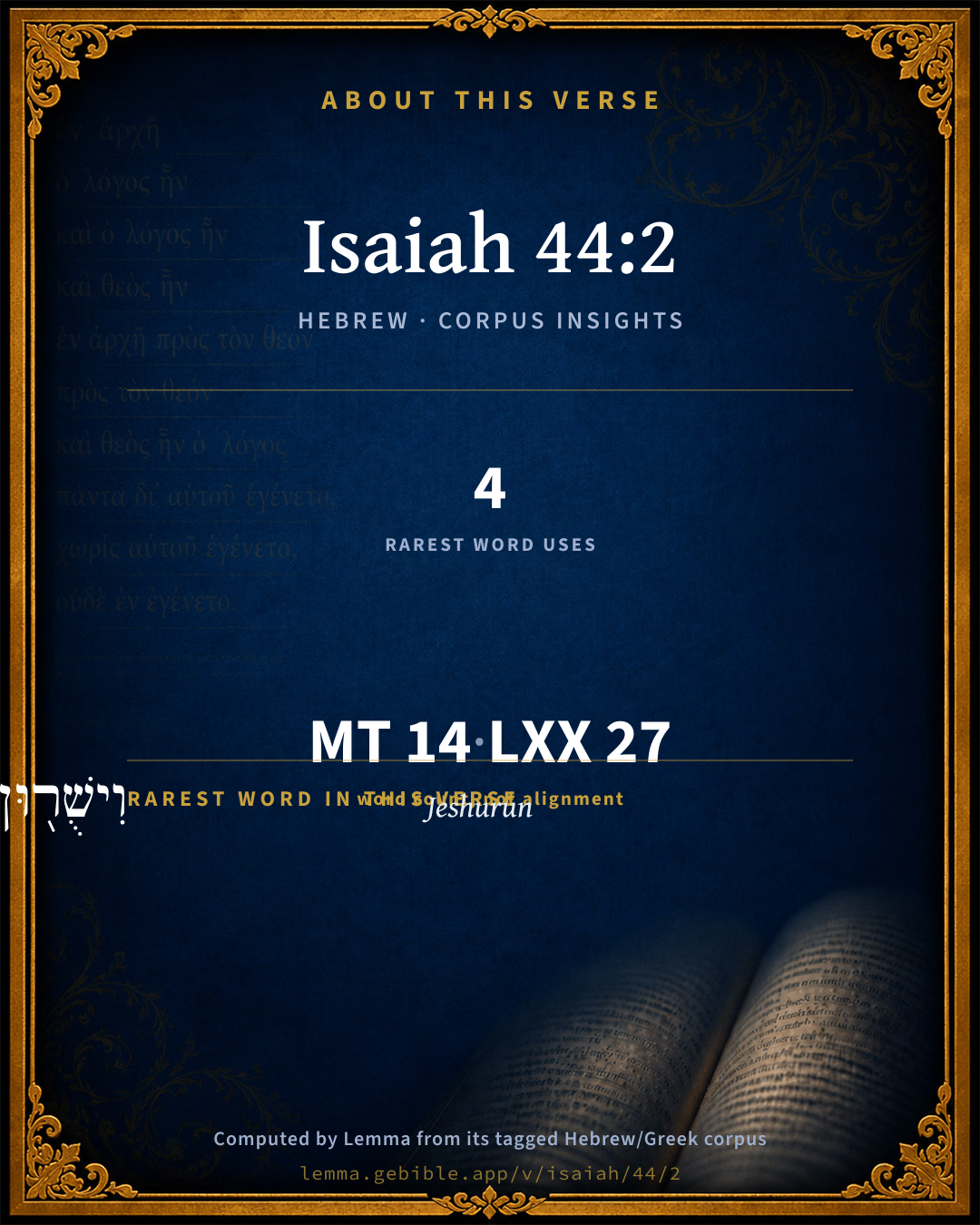
14
words
13
distinct lemmas
Prophets
section

Notable vocabulary

The rarest word here is וִישֻׁר֖וּן Jeshurun H3484 — appearing just 4 times in the whole Hebrew Bible.

Shared distinctive vocabulary

וִישֻׁר֖וּן Jeshurun H3484 occurs in 4 verses of the Hebrew Bible. Also found in:

Grammatical profile

  • 6 verbs
  • 5 nouns
  • 1 preposition
  • 1 adverb
  • 1 particle

Verb forms

  • אָמַ֨ר Qal · Perfect
  • עֹשֶׂ֛ךָ Qal · Participle Active
  • וְיֹצֶרְךָ֥ Qal · Participle Active
  • יַעְזְרֶ֑ךָּ Qal · Imperfect
  • תִּירָא֙ Qal · Jussive
  • בָּחַ֥רְתִּי Qal · Perfect

Hebrew & Septuagint length

In English translation the verse runs 29 words from the Hebrew and 33 from the Septuagint (LXX English) — closely comparable.

A rough comparison of the two English renderings, which tokenize alike — not a word-level alignment.

Word counts can differ between the Hebrew and the Greek without any difference in meaning — e.g. the Hebrew direct-object marker אֵת has no separate Greek word, and Greek often adds the article ὁ.

In the original languages it is 14 Hebrew tokens and 27 Greek tokens — but the two are counted differently (Hebrew bundles its prefixes and suffixes into one token; the Greek is in lemma form), so that isn’t a like-for-like length.

Cross-references

22

Topical passages linked to Isaiah 44:2 in the Treasury of Scripture Knowledge — connected by theme and wording, ordered by reader-vote popularity; previews shown in the World English Bible.

  • Jeremiah 1:5 Before I formed you in the belly I knew you, and before you came forth out of the womb I sanctified you; I have appointed you a prophet to the nations.
  • Isaiah 43:1 But now thus says Yahweh who created you, Jacob, and he who formed you, Israel: Don't be afraid, for I have redeemed you; I have called you by your name, you are mine.
  • Isaiah 46:3–4 Listen to me, house of Jacob, and all the remnant of the house of Israel, that have been borne [by me] from their birth, that have been carried from the womb;
  • Isaiah 44:24 Thus says Yahweh, your Redeemer, and he who formed you from the womb: I am Yahweh, who makes all things; who stretches forth the heavens alone; who spreads abroad the earth (who is with me?);
  • Isaiah 43:7 everyone who is called by my name, and whom I have created for my glory, whom I have formed, yes, whom I have made.
  • Isaiah 49:1 Listen, isles, to me; and listen, you peoples, from far: Yahweh has called me from the womb; from the bowels of my mother has he made mention of my name:
  • Ephesians 1:4 even as he chose us in him before the foundation of the world, that we would be holy and without blemish before him in love;
  • Isaiah 41:10 Don't you be afraid, for I am with you; don't be dismayed, for I am your God; I will strengthen you; yes, I will help you; yes, I will uphold you with the right hand of my righteousness.
  • Ezekiel 16:4–8 As for your birth, in the day you were born your navel was not cut, neither were you washed in water to cleanse you; you weren't salted at all, nor swaddled at all.
  • Romans 8:30 Whom he predestined, those he also called. Whom he called, those he also justified. Whom he justified, those he also glorified.
  • Psalms 71:6 I have relied on you from the womb. You are he who took me out of my mother's womb. I will always praise you.
  • Isaiah 43:21 the people which I formed for myself, that they might set forth my praise.
  • 1 Thessalonians 1:4 We know, brothers loved by God, that you are chosen,
  • Luke 12:32 Don't be afraid, little flock, for it is your Father's good pleasure to give you the Kingdom.
  • Isaiah 44:21 Remember these things, Jacob, and Israel; for you are my servant: I have formed you; you are my servant: Israel, you shall not be forgotten by me.
  • Hebrews 4:16 Let us therefore draw near with boldness to the throne of grace, that we may receive mercy, and may find grace for help in time of need.
  • Psalms 46:5 God is in her midst. She shall not be moved. God will help her at dawn.
  • Isaiah 43:5 Don't be afraid; for I am with you: I will bring your seed from the east, and gather you from the west;
  • Ezekiel 20:5–12 and tell them, Thus says the Lord Yahweh: In the day when I chose Israel, and swore to the seed of the house of Jacob, and made myself known to them in the land of Egypt, when I swore to them, saying, I am Yahweh your God;
  • Isaiah 41:14 Don't be afraid, you worm Jacob, and you men of Israel; I will help you, says Yahweh, and your Redeemer is the Holy One of Israel.
  • Deuteronomy 33:5 He was king in Jeshurun, When the heads of the people were gathered, All the tribes of Israel together.
  • Deuteronomy 32:15 But Jeshurun grew fat, and kicked: You have grown fat, you are grown thick, you are become sleek; Then he forsook God who made him, Lightly esteemed the Rock of his salvation.

Cross-references courtesy of OpenBible.info (CC BY 4.0).

Hebrew and Greek witnesses Masoretic Hebrew ↔ Greek Septuagint

The same verse in the two great witnesses to the Old Testament, shown verse-for-verse.

These are two independent witnesses, not word-aligned to each other, and the Septuagint is shown in lemma (dictionary) form.

Hebrew Isaiah 44:2 Masoretic · Westminster Leningrad Codex

כֹּה אָמַ֨ר יְהוָ֥ה עֹשֶׂ֛ךָ וְיֹצֶרְךָ֥ מִבֶּ֖טֶן יַעְזְרֶ֑ךָּ אַל תִּירָא֙ עַבְדִּ֣י יַֽעֲקֹ֔ב וִישֻׁר֖וּן בָּחַ֥רְתִּי בֽוֹ

Thus says Yahweh who made you, and formed you from the womb, who will help you: Don't be afraid, Jacob my servant; and you, Jeshurun, whom I have chosen.

World English Bible · Public Domain

Greek LXX Isaiah 44:2 Septuagint · lemma form

οὕτως λέγω κύριος ὁ θεός ὁ ποιέω σύ καί ὁ πλάσσω σύ ἐκ κοιλία ἔτι βοηθέω μή φοβέω παῖς ἐγώ ἰακώβ καί ὁ ἀγαπάω ἰσραήλ ὅς ἐκλέγω

Thus says the Lord God that made you, and he that formed you from the womb; You shall yet be helped: fear not, my servant Jacob; and beloved Israel, whom I have chosen.

LXX2012 (modern English Septuagint) · Public Domain

On this verse, Trapp's Complete Commentary discusses the Septuagint’s reading. Read the note in Commentary ↓

Hebrew: Westminster Leningrad Codex (CC BY 4.0). Greek: Septuagint (public domain); English from LXX2012 (modern English Septuagint) (Public Domain). How the Septuagint differs from the Hebrew →

Targum (Aramaic paraphrase)

1

The Targum is the ancient Jewish Aramaic paraphrase of the Hebrew Scriptures — an interpretive translation, not the Hebrew text itself. Onkelos (literal) and Pseudo-Jonathan (expansive) render the Torah, and Jonathan the Prophets. Coverage is partial: where no permissively-licensed English translation exists for a verse, only the Aramaic is shown. This is verse-level text, not a word-by-word alignment to the Hebrew.

  1. Targum Jonathan Prophets (Joshua–Malachi)
    כִּדְנַן אֲמַר יְיָ דְעַבְדָךְ וּדְאַתְקְנָךְ מִמְעִין יְסַעְדִינָךְ לָא תִדְחַל עַבְדִי יַעֲקֹב וְיִשְׂרָאֵל דְאִתְרְעִיתִי בֵיהּ:

    Thus saith the Lord, thy Maker; and He that formed thee from the womb, He will help thee; Fear not, O Jacob, my servant, and thou, O Israel, whom I have chosen.

    Targum Jonathan — Aramaic: “Mikraot Gedolot” (public domain). English: “Sefaria Community Translation” (CC0 1.0 (public-domain dedication)); “London "Chaldee Paraphrase," 1871” (public domain). Text via Sefaria.

Commentary

Notes on Isaiah 44:2 from classic Christian and Jewish commentators (each source and its license shown beneath its notes). The classic Christian expositions comment on the surrounding passage and are grouped to its opening verse, so a note may address several verses; the Jewish commentaries on the Tanakh (Rashi and others) are per-verse, so they appear only where the commentator wrote on this verse.

Lemma curates 59 commentaries, every one of them public domain or Creative Commons licensed, each selected and text-cleaned for this edition rather than reprinted as found. About our sources →

Trapp's Complete Commentary

John Trapp

Isa 44:2 Thus saith the LORD that made thee, and formed thee from the womb, [which] will help thee; Fear not, O Jacob, my servant; and thou, Jesurun, whom I have chosen.

Ver. 2. Thus saith the Lord that made thee.] See on Isa 43:1; Isa 43:7; Isa 43:21, and observe how this chapter runneth parallel with the former; yea, how the prophet, from Isa 40:1-31 to Isa 66:1-24, doth one and the same thing almost, labouring to comfort his people against the Babylonian captivity, and to arm them against the sin of idolatry, whereunto, as of themselves they were overly prone, so they should be sure to be strongly tempted among those idolaters.

And thou, Jeshurun.] Thou who art upright or righteous, with a twofold righteousness, viz., imputed and imparted. The Septuagint renders it Dilecte or Dilectule, my dearly beloved.

John Trapp, A Commentary or Exposition upon All the Books of the Old and New Testament (1647–1656) — public domain. Text from a community e-Sword module.

Geneva Bible (1599)

Geneva Bible translators

He treated and chose thee from the beginning of his own mercy, and before thou couldest merit anything.

Whom God accepteth as righteous: or which haddest occasion thereunto because of the Law, and of thine holy vocation.

Geneva Bible (1599) marginal notes — public domain. Text via Bolls.life.

Jamieson, Fausset & Brown

Robert Jamieson, A. R. Fausset & David Brown

(Isa 43:1, Isa 43:7).

formed . . . from . . . womb--(So Isa 44:24; Isa 49:1, Isa 49:5). The sense is similar to that in Isa 1:2, "I have nourished and brought up children."

Jesurun--A diminutive term of endearment applied to Israel. The full title of affection was Israelun; contracted it became Jeshurun, with an allusion to the Hebrew root, jashar, "upright," "perfect" (see on Isa 42:19, note on "He that is perfect") [GESENIUS], (Deu 32:15).

Jamieson, Fausset & Brown — Commentary Critical and Explanatory on the Whole Bible (1871) — public domain (CC PDM 1.0). Text via the HelloAO Bible API.

Adam Clarke's Commentary

Verse 2. Jesurun] Jeshurun means Israel. This name was given to that people by Moses, De 32:15; De 33:5, De 33:26. The most probable account of it seems to be that in which the Jewish commentators agree; namely, that it is derived from ישר yashar, and signifies upright. In the same manner, Israel, as a people, is called משלם meshullam, perfect, Isa 42:19, They were taught of God, and abundantly furnished with the means of rectitude and perfection in his service and worship. Grotius thinks that ישרון yeshurun is a diminutive of ישראל yishrael, Israel; expressing peculiar fondness and affection; Ισραηλιδιον, O little Israel.

Adam Clarke's Commentary on the Bible (1810–1826) — public domain. Text from a community e-Sword/MySword module.

Ellicott's Commentary for English Readers

(2) Thou, Jesurun . . .—The ideal name of Israel as “the upright one;” so the Book of Jasher is the book of the “upright,” of the heroes of Israel. (See Note on Deu_32:15.) The name is substituted for the Israel of the preceding verse, as pointing to the purpose of God in their election.

A Bible Commentary for English Readers, edited by Charles John Ellicott (1878–1897) — public domain. Text from a community e-Sword module.

The Cambridge Bible for Schools and Colleges

gen. ed. J. J. S. Perowne

2. formed thee from the womb] See Isa_44:24, ch. Isa_49:5.

Jeshurun occurs again only in Deu_32:15; Deu_33:5; Deu_33:26; always as a synonym for Israel and a title of honour (hardly a diminutive, as the termination might suggest). It means the “Upright One,” being formed from an adj. yâshâr, which is applied to Israel in Num_23:10, and perhaps also in the phrase “book of Jashar” (see Jos_10:13, R.V.). The history of the name is, however, altogether obscure. The opinion that it was coined in opposition to Jacob (“the supplanter”) has little to recommend it; although that antithesis may have led to its selection by this prophet.

Should the recent supposed discovery of the name Israel on an Egyptian monument of the reign of Merenptah be confirmed, it is possible that fresh light may be thrown on the relation of the two names Israel and Jeshurun. The form in which the word there appears is said to be Yishir’il, the sibilant agreeing with Jeshurun but differing from the traditional pronunciation of Yisrâ’el. Yishir’il and Yeshûrûn might be derivations from a common root, yâshar. (Brandt, Theologisch Tijdschrift, 1896, p. 511; cf. Renan, Hist. du peuple d’Israël, Vol. i., p. 106).

The Cambridge Bible for Schools and Colleges (gen. ed. J. J. S. Perowne; Cambridge University Press, 1878–1918) — public domain. Text from a community e-Sword module.

John Gill's Exposition

Thus saith the Lord that made thee, and formed thee from the womb,.... Which is not to be understood of the forming of the people of Israel into a commonwealth or church state, for this is not said of the body of them; nor of the natural creation and formation of these individuals, but of their new creation, regeneration, and spiritual formation; which, as it was owing to the grace and power of God, by which the Lord describes himself, who is speaking to them, the consideration of it might serve to encourage their faith and confidence in the performance of the promises about to be made to them; see Psa 100:3, which "will help thee"; in the exercise of grace, in the performance of duty, in suffering for his name's sake in every time of trouble, and out of all trouble, and that right early, and when none else can:

fear not, O Jacob, my servant, and thou Jesurun, whom I have chosen; the titles are as before, only instead of "Israel" is "Jesurun", which is a name of the people of Israel, Deu 32:15 and here the Targum instead of it puts Israel; and so the Syriac and Arabic versions. The Septuagint version renders it, "beloved Israel"; the word signifies upright; and so the Vulgate Latin version translates it, "O thou most upright one" (w); and well agrees with this little remnant of Israelites indeed, in whom there was no guile. Some derive the word from one that signifies to "see", "behold", "contemplate" (x); and so it may be rendered, "the seeing ones whom I have chosen", such whose eyes the Lord opened to see their own vileness and sinfulness, and the glory of Christ and salvation by him: these are bid not to fear: not any of their enemies, though they themselves were but worms; and though their number was small, and they weak and feeble, and their enemies numerous, strong, and mighty; and though their countrymen would reproach, revile, and persecute them for Christ's sake, and they should be obliged to turn to the Gentiles, and carry the Gospel among them, when those of their nation would reject it, which would issue in the ruin of it, as before predicted; see Isa 41:10.

(w) "et rectissime", V. L. a "rectum fuit, Forerius"; so Ben Melech says, that Israel is called Jeshurun, because he is upright among the people. (x) A "contemplari, respicere".

John Gill's Exposition of the Whole Bible (1746–1763) — public domain (CC PDM 1.0). Text via the HelloAO Bible API.

Albert Barnes' Notes on the Bible

Thus saith the Lord that made thee - (See the note at Isa 43:1).

And formed thee from the womb - This is equivalent to the declaration that he was their Maker, or Creator. It means, that from the very beginning of their history as a people, he had formed and moulded all their institutions, and directed all things in regard to them - as much as he is the former of the body from the commencement of its existence. It may be observed that the words, ‘from the womb,’ are joined by some interpreters with the phrase, ‘that formed thee,’ meaning, that he had been the originator of all their customs, privileges, and laws, from the beginning of their history; and by others with the phrase, ‘will help thee,’ meaning, that from the commencement of their existence as a nation, he had been their helper. According to the Masoretic marks of distinction, the former is the true sense. So the Septuagint, Aben Ezra, Kimchi, Lowth, etc.; but Jerome, Luther, and some others, prefer the latter mode.

Fear not - (See the note at Isa 41:10). Though you have sinned as a people Isa 43:23-24, Isa 43:27, and though all these heavy judgments have come upon you Isa 43:28, yet you have no reason to fear that God will finally abandon and destroy you.

And thou Jeshurun - (וישׁרוּן vayeshurûn). This word occurs but four times in the Bible, as a poetical name for the people of Israel, apparently expressing affection and tenderness (Deu 32:15; Deu 33:5, Deu 33:26; and in this place). It is, says Gesenius (Commentary in loc.), ‘a flattering appellation (schmeichelwort) for Israel,’ and is probably a diminutive from ישׁור yāshûr = ישׁר yāshâr, the passive form in an intransitive verb with an active signification. The ending ון ôn, he adds, is terminatio charitiva - a termination indicating affection, or kindness. In his Lexicon, he observes, however (as translated by Robinson), that ‘it seems not improbable that it was a diminutive form of the name ישׂראל yı̂s'râ'ēl, which was current in common life for the fuller form ישׂיאלוּן yı̂s'râ'ēlûn, title of affection for Israel, but, like other common words of this sort, contracted, and more freely inflected, so as at the same time to imply an allusion to the signification of right or uprightness, contained in the root ישׁר yâshar.’ Jerome renders it, Rectissime - ‘Most upright.’ The Septuagint renders it, Ἠγαπημένος Ἰσραήλ Ēgapēmenos Israēl - ‘Beloved Israel.’ The Syriac renders it, ‘Israel.’ So also the Chaldee. It is, doubtless, a title of affection, and probably includes the notion of uprightness, or integrity.

Albert Barnes' Notes on the Bible (1834–1885) — public domain. Text from a community e-Sword/MySword module.

Matthew Poole's English Annotations

From the womb; from the time of thy birth, or coming out of the womb. From that time that I first took thee to be my people, I have been forming and fashioning thee, by giving thee laws, and ordinances, and teachers, by threatenings and corrections, and many other ways. He seems to allude to the practice of midwives, who use to compose all the parts of the new-born infant into a right frame.

Jesurun; another name of Jacob or Israel, given to him Deu 32:15; 33:5,26.

Matthew Poole's English Annotations on the Holy Bible (1683–1685) — public domain. Text from a community e-Sword/MySword module.

Whedon's Commentary on the Bible

Daniel D. Whedon

2. Fear not — Notwithstanding so many backslidings, God has intense love for his chosen, and to signify this he applies to them the name Jeshurun, which means, “people of my deepest affection.” — Gesenius. This name, with same meaning, is found in Deu_32:14; Deu_33:5; Deu_33:26. The name implies all that belongs to the designation elect people.

Daniel D. Whedon (gen. ed.), Commentary on the Old and New Testaments (1874–1909) — public domain. Text from a community e-Sword module.

The Pulpit Commentary

The Lord that made thee, and formed thee from the womb. (Isa_35:6 Isa_43:20 Isa_55:1) the simple maim, "water" or "waters," is the word used. At other times we have instead, or in addition, "rain", (Isa_5:6 Isa_30:23 Isa_55:10) or "dew", (Isa_26:19) or "rivers", (Isa_30:25 Isa_32:2 Isa_33:21 Isa_41:18 Isa_43:19, etc.) or "streams", (Isa_30:25 Isa_35:6) or "floods" (as in this place). At his coming on earth, our blessed Lord took up the comparison, and has made it familiar to all men throughout the whole Christian world. (see Joh_3:5 Joh_4:10, Joh_4:11, 13-15 7:37-39) We may note here that the "water" is only poured on him who is athirst for it. Thy seed... thine offspring. Not "Israel after the flesh" only, but also Israel after the Spirit the true "Israel of God". (Gal_6:16)

Vers. 3, 4. Water a symbol of Divine grace.

It has been shown (in the comment on ver. 3)

(1) how this symbolism pervades the prophecies of Isaiah; and

(2) what an echo it found in the teaching of our Lord.

An analogy thus recommended seems entitled to be viewed as something more than poetic imagery, and may properly be made the subject of our serious thought. In what respects, then, we may ask, does the symbolism hold?

I WATER IS COMMON, ABUNDANT, FREELY GIVEN TO MANKIND AT LARGE. So is it with Divine grace. Christ, the Light of the world, lighteth every man that cometh into it. (Joh_1:9) What men call "the light of nature" is an illumination poured by God into the soul, and this light is common to all. It shows men the way that they should walk in; it enables them to discern between right and wrong; if they would follow it, it would guide them to heaven. Nor does Divine grace stop at this point. To those who struggle to do right God"s assisting grace is never wanting. His Spirit strives with all men; (Gen_6:3) his mercy is over all his; (Psa_145:9) he is "no respecter of persons". (Act_10:34)

II WATER IS ABSOLUTELY NECESSARY TO LIFE. Nothing living, whether animal or vegetable, can exist without water. No spiritual life can exist without grace. Without moisture, neither can the embryo be formed, nor will the seed germinate. Without grace there is no commencement of spiritual life. Water is needed for the sustentation of both plants and animals. Grace is needed for the sustentation of the quickened spirit.

III WATER CLEANSES MEN"S BODIES FROM ALL FILTH AND POLLUTION. The pace of God cleanses their souls from the filthiness and impurity of sin. His grace is the "one fountain opened for sin and for uncleanness"; (Zec_13:1) the precious influences of his Spirit can alone take away impurity, and make the soiled soul once more clean in his sight. Wonderful is the cleansing power of water; still more wonderful is the guilt-removing power of grace. Sins that were "as scarlet" are by grace made "white as snow;" iniquities that were "red as crimson" become. (as Isa_1:18) It is not merely that the sins themselves are forgiven, but the "evil heart," from which they proceeded, is washed, sanctified, and cleansed, so as to retain no taint of evil.

IV WATER REFRESHES AND RENOVATES THOSE WHO ABE WEARY AND FAINT. There is no refreshment to the faint and weary soul comparable to the pouring out upon it of God"s Spirit. When "the parched ground becomes a pool, and the thirsty land springs of water", (Isa_35:7) the result is a complete transformation of the whole appearance of things. "The wilderness and the solitary place" at once "are glad... the desert rejoices and blossoms like the rose It blossoms abundantly... the glory of Lebanon is given to it, the excellency of Carmel and Sharon". (Isa_35:1, Isa_35:2) Similarly, when the dry and thirsty soul obtains a "time of refreshing from the Lord", (Act_3:19) its whole condition is on a sudden changed. Gladness succeeds to gloom, happiness to despair, an almost ecstatic bliss to a dull, gnawing sense of misery. The soul puts forth blossoms rejoices with joy and singing (see the Psalms, passim).

HOMILIES BY W. CLARKSON Vers. 3-5. The indispensable blessing.

We may well speak of water in the natural realm and of its antitype in the spiritual as

I THE INDISPENSABLE BLESSING. There may be abundance of earth, and it may be of the most valuable quality; there may be the utmost diligence in the field, and the latest agricultural science; but if the rain be withheld, if no water can be obtained to nourish the sown seed, there can be no harvest, the indispensable blessing is not bestowed. So is it in the sphere which is more sacred and more serious. You may have the soil of spiritual human nature, you may have the seed of Divine truth, you may have the diligent and watchful culture of the Christian pastor; but if the influences of the Holy Spirit do not descend, there will be no ingathering for the Husbandman. God must pour down his rich blessing, or all our labours in the Master"s vineyard will be barren of result; there will be nothing for Heaven to see but thirsty land, dry ground, fruitless farming.

II THE FIELD WHERE WE MOST DESIRE THAT THESE RAINS SHOULD FALL. "I will pour my Spirit upon thy seed, and my blessing upon thine offspring." We desire that God should be blessing the ministry we render to the aged; we are more solicitous that words of Divine wisdom should penetrate the minds and affect the lives of men of middle life, on whom such duties devolve, with whom so many issues rest; but we are most concerned that the truth of Christ should enter the understanding, cleanse the conscience, possess the soul, of the young.

1. They are, in a peculiar degree, the objects of our love; they may be "ourseed, our offspring." But if not, we are strongly attached to them, and therefore interested in their spiritual welfare.

2. They stand at a point where religious decision will make the verygreatest difference. If now they seek God and surrender themselves to his service, they will have a large and noble contribution to make to the cause of righteousness, to the service of mankind.

3. Unaffected and unwon in youth, the obstacles in the way of decision and devotion are continually increasing.

III THE BLESSED RESULT OF THE DIVINE BESTOWAL. There will be a glorious spiritual upspringing. "They shall spring up," etc. There shall be the signs of abounding life. The life that will be seen when the floods of heavenly influence are poured forth will be manifest in:

1. The stem of sacred conviction. God"s truth revealed by Jesus Christ will be the staple of human thought.

2. The flower of fitting utterance. (Ver. 5.)

1. The Name of Christ will be honoured by a Christian profession; and

2. the people of God will be honoured by close association with them.

3. The fruit of holy usefulness. C.

The Pulpit Commentary (1880–1919), ed. H.D.M. Spence-Jones & Joseph S. Exell — public domain. Text from a community e-Sword module.

John Wesley's Explanatory Notes

Formed thee - From the time that I first took thee to be my people, I have been forming and fashioning thee. Jesurun - Another name of Jacob or Israel, given to him, Deut. xxxii, 15.

John Wesley, Explanatory Notes Upon the Whole Bible (1754–1765) — public domain. Text via the GEBible commentary corpus.

J. A. Alexander on Isaiah

Joseph Addison Alexander

“Thus saith Jehovah, thy maker and thy former from the womb will help thee; fear not, my servant Jacob, and Jeshurun whom I have chosen.” The simplest construction is to make the words of Jehovah begin with ‘thy maker’, the transition from the third to the first person being altogether natural and one of perpetual occurrence in Isaiah. ‘Thy maker will help’ thee is equivalent to ‘I, Who am thy maker, will help thee.’ But even on the common supposition, that, the words of God begin with the second clause, it is better to take He will help thee as a short independent clause, parenthetically thrown in to complete the description or to connect it with what follows. ‘Thus saith thy maker and thy former from the womb — he will help thee — Fear not etc.’ The use of these expressions in addressing Israel only shows that the conception present to the writer’s mind is that of an individual man. Jeshurun occurs only here and in Deu 32:15; Deu 33:5; Deu 33:26.

Joseph Addison Alexander, The Prophecies of Isaiah (1846–1847; New York: Scribner, 1870–1878) — public domain. Text from a community e-Sword module.

Scofield Reference Notes

C. I. Scofield

Jesurun

i.e. upright. Symbolical name of Israel. Deu 32:15; Deu 33:5; Deu 33:26

The Scofield Reference Bible (1917 edition), notes by C. I. Scofield — public domain. Text from a community e-Sword module.

Ibn Ezra

Rabbi Abraham ibn Ezra

From the womb. With this expression the prophet alludes to Jacob (comp. Hos. 12:4; in my commentary thereon I shall explain it), or metaphorically to the time, when Israel was declared to be the people of the Lord.

ישרון Jesurun. It is originally an adjective derived from ישר right; there is no other instance of this form.

Ibn Ezra on the Tanakh — English translations: “Sefaria Community Translation” (CC0 1.0 (public-domain dedication)); “Yalkut, Sifsei Chachomim Chumash, Metsudah Publications, 2009” (CC BY 4.0); and “Commentary of Ibn Ezra on Isaiah - trans. by M. Friedlander, 1873” (public domain). Text via Sefaria.

Lesson kit

Teaching starters — assembled from the data on this page, not authored interpretation. Every prompt links to the verse data it draws on. Edit before teaching.

Isaiah, in the Prophets, opens this verse with 14 words (13 distinct Hebrew lemmas). Its most distinctive word is Yᵉshurûwn (“Jeshurun”). A historical commentator’s framing appears above. Read the whole chapter for the surrounding context.

Discussion questions

  1. How does “Jeshurun” (Yᵉshurûwn) shape what this verse is saying?
  2. How does Deuteronomy 32:15, which shares the word «Jeshurun», read alongside this verse?
  3. These translations render this verse differently; the difference is in the English rendering, not the original. What questions does that raise?
  4. «אָמַ֨ר» is a Qal Perfect verb. How does that grammatical form shape the action described?
  5. Compare how Trapp's Complete Commentary and Geneva Bible (1599) read this verse. Where do they agree or differ?

Things to notice

Reading settings

Reading text

Shown beneath each verse's original-language words.

Old Testament
Old Testament edition

Read the OT as the Masoretic Hebrew (MT) or the Greek Septuagint (LXX).

English shown for the Greek Septuagint (in the Hebrew ↔ Greek comparison).

Comparing translations? Open the Compare panel on any verse page to stack up to four side by side.