Jeremiah 1:5

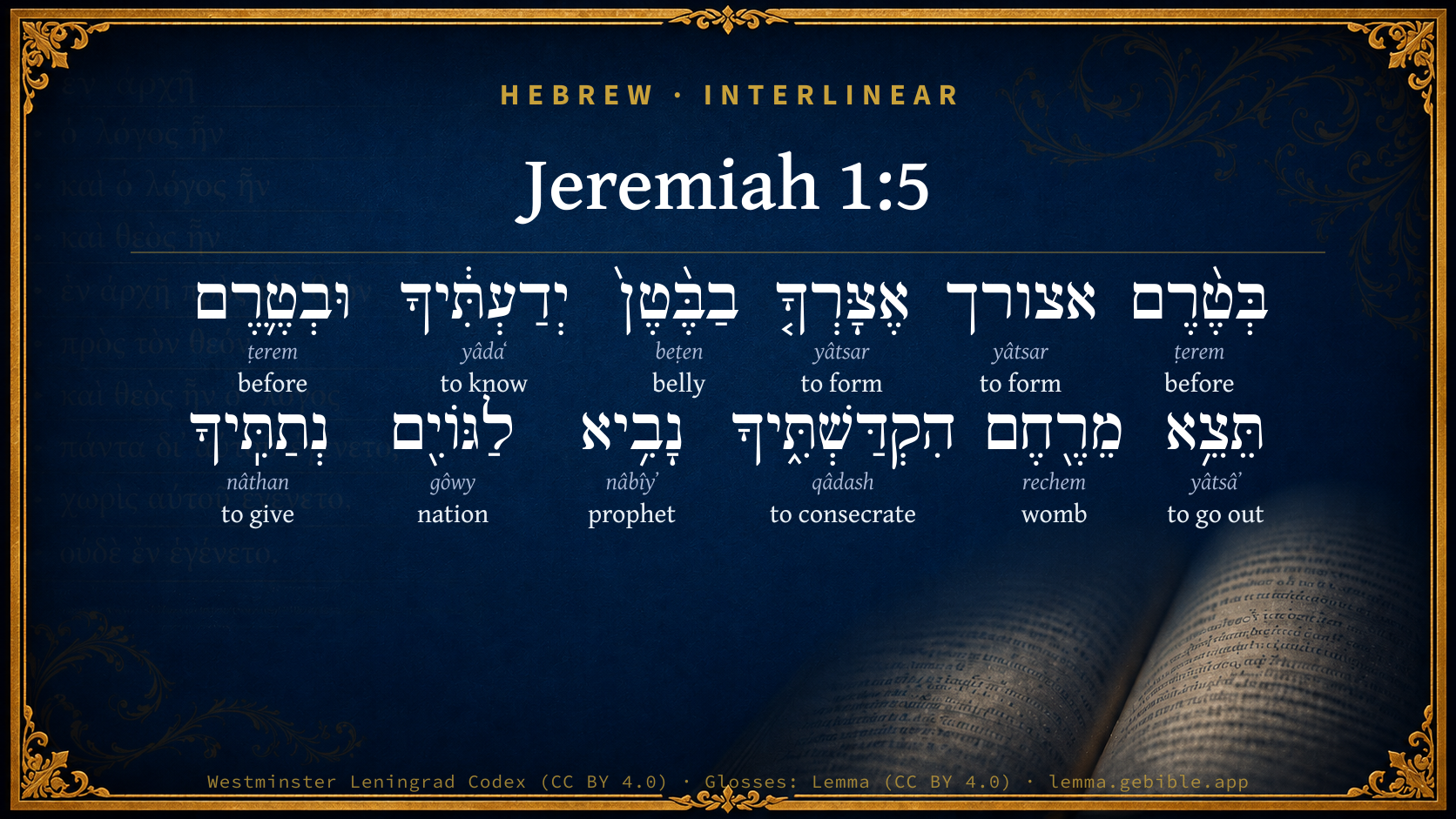
Hebrew (Westminster Leningrad Codex) Jeremiah 1:5 appears in the Hebrew Old Testament. The text above is from the Westminster Leningrad Codex. Each word links to its Strong’s number, a concise gloss, and parsing drawn from the Open Scriptures Hebrew Bible morphology. Click any word for its full Brown-Driver-Briggs (BDB) entry.
Download image
Cite this verse

Jeremiah 1:5 (World English Bible). Public Domain. Lemma interlinear Bible study tool, https://lemma.gebible.app/v/jeremiah/1/5.

Show BibTeX & RIS
BibTeX
RIS
English Translation
Before I formed you in the belly I knew you, and before you came forth out of the womb I sanctified you; I have appointed you a prophet to the nations.
World English Bible · Public Domain
Download a study sheet

One document with this verse’s original text, its word-by-word gloss line, the meaning frame, cross-references with their text, attributed commentary, and full source and license credits — printable, and it pastes into notes with its structure intact.

This verse Autodidact and up

Study sheet (.html) Plain text (.txt)

A passage Seminary Student

Up to 50 verses in one chapter. A passage sheet keeps up to 6 commentary sources and 12 cross-references per verse, in the order this page ranks them, and says so on the sheet whenever that leaves anything out. Ask for a single verse and you get the Autodidact verse sheet above.

Everything on this page stays free to read, with no account — the sheet is a download of what is already on screen, not access to it.

Want to remove ads? Support Godless Engineer
Compare translations 3

The same verse in 3 English versions, stacked beneath the original-language interlinear above. Click any original word for its lexicon entry.

Each is an independent rendering of the whole verse — the interlinear is not word-aligned to these translations.

Highlighted words mark where these versions differ — a whole-verse word diff, not a word-by-word alignment.

  • World English Bible Public Domain
    Before I formed you in the belly I knew you, and before you came forth out of the womb I sanctified you; I have appointed you a prophet to the nations.
  • King James Version Public Domain
    Before I formed thee in the belly I knew thee; and before thou camest forth out of the womb I sanctified thee, and I ordained thee a prophet unto the nations.
  • unfoldingWord Literal Text CC BY-SA 4.0
    “Before I formed you in the belly, I knew you, and before you came out from the womb I set you apart; I appointed you a prophet to the nations.”

unfoldingWord Literal Text — © unfoldingWord, licensed CC BY-SA 4.0. Word-aligned USFM3 via Door43 (git.door43.org/unfoldingWord/en_ult).

Versions to compare (up to 4)

3 of 4 selected

Show all 18 translations

Every available English version of this verse, each an independent rendering of the whole verse.

  • World English Bible Public Domain
    Before I formed you in the belly I knew you, and before you came forth out of the womb I sanctified you; I have appointed you a prophet to the nations.
  • Berean Standard Bible Public Domain
    “Before I formed you in the womb I knew you, and before you were born I set you apart and appointed you as a prophet to the nations.”
  • Majority Standard Bible Public Domain
    “Before I formed you in the womb I knew you, and before you were born I set you apart and appointed you as a prophet to the nations.”
  • King James Version Public Domain
    Before I formed thee in the belly I knew thee; and before thou camest forth out of the womb I sanctified thee, and I ordained thee a prophet unto the nations.
  • American Standard Version (1901) Public Domain
    Before I formed thee in the belly I knew thee, and before thou camest forth out of the womb I sanctified thee; I have appointed thee a prophet unto the nations.
  • Revised Version (1885) Public Domain
    Before I formed thee in the belly I knew thee, and before thou camest forth out of the womb I sanctified thee; I have appointed thee a prophet unto the nations.
  • Geneva Bible (1599) Public Domain
    Before I formed thee in the wombe, I knewe thee, and before thou camest out of the wombe, I sanctified thee, and ordeined thee to be a Prophet vnto the nations.
  • Douay-Rheims (1899) Public Domain
    Before I formed thee in the bowels of thy mother, I knew thee: and before thou camest forth out of the womb, I sanctified thee, and made thee a prophet unto the nations.
  • Young's Literal Translation Public Domain
    `Before I form thee in the belly, I have known thee; and before thou comest forth from the womb I have separated thee, a prophet to nations I have made thee.'
  • Literal Standard Version CC BY-SA 4.0
    “Before I form you in the belly, I have known you; and before you come forth from the womb I have separated you; I have made you a prophet to the nations.”
  • Unlocked Literal Bible CC BY-SA 4.0
    “Before I formed you in the womb, I chose you; before you came out from the womb I set you apart; I made you a prophet to the nations.”
  • unfoldingWord Literal Text CC BY-SA 4.0
    “Before I formed you in the belly, I knew you, and before you came out from the womb I set you apart; I appointed you a prophet to the nations.”
  • Darby Bible Public Domain
    Before I formed thee in the belly I knew thee; and before thou camest forth out of the womb I hallowed thee, I appointed thee a prophet unto the nations.
  • World Messianic Bible Public Domain
    “Before I formed you in the womb, I knew you. Before you were born, I sanctified you. I have appointed you a prophet to the nations.”
  • Webster's Bible Public Domain
    Before I formed thee in embryo I knew thee; and before thou wast born I sanctified thee, and I ordained thee a prophet to the nations.
  • Free Bible Version CC BY-SA 4.0
    “I knew exactly who you would be before I created you in your mother's womb; I chose you before you were born to be a prophet to the nations.”
  • Bible in Basic English Public Domain
    Before you were formed in the body of your mother I had knowledge of you, and before your birth I made you holy; I have given you the work of being a prophet to the nations.
  • JPS Tanakh (1917) Public Domain
    Before I formed thee in the belly I knew thee, and before thou camest forth out of the womb I sanctified thee; I have appointed thee a prophet unto the nations.

Literal Standard Version (2020), Covenant Press — licensed CC BY-SA 4.0. Text via the HelloAO Bible API (eBible.org). Unlocked Literal Bible (unfoldingWord) — licensed CC BY-SA 4.0. Text via the HelloAO Bible API (eBible.org). unfoldingWord Literal Text — © unfoldingWord, licensed CC BY-SA 4.0. Word-aligned USFM3 via Door43 (git.door43.org/unfoldingWord/en_ult). Free Bible Version, Dr. Jonathan Gallagher — licensed CC BY-SA 4.0. Text via the HelloAO Bible API (eBible.org).

Word by word

More ways to search: Search by grammar → Find every occurrence → Compare this word →

Practice this passage: Drill this verse → Learn its vocabulary →

מֵרֶ֖חֶם
rechem
H7358
“from · womb”
Preposition + Noun, Common, Masculine, Singular, Absolute
Part of Speech
Preposition + Noun
Type
Common
Gender
Masculine
Number
Singular
State
Absolute
Full BDB Definition

Origin: from H7355

TWOT: 2146a

womb - womb - womb-man, woman-slave, woman, two women
  1. בְּטֶ֨רֶם ṭerem H2962 “in/at · before” Preposition + Adverb
  2. אצורך yâtsar H3335 “to form · you” Verb, Qal, Imperfect, 1st Person, Common, Singular + Suffix, Personal, 2nd Person, Masculine, Singular
  3. אֶצָּרְךָ֤ yâtsar H3335 “to form · you” Verb, Qal, Imperfect, 1st Person, Common, Singular + Suffix, Personal, 2nd Person, Masculine, Singular
  4. בַבֶּ֨טֶן֙ beṭen H990 “in/at the · belly” Preposition, Determined + Noun, Common, Feminine, Singular, Absolute
  5. יְדַעְתִּ֔יךָ yâdaʻ H3045 “to know · you” Verb, Qal, Perfect, 1st Person, Common, Singular + Suffix, Personal, 2nd Person, Masculine, Singular
  6. וּבְטֶ֛רֶם ṭerem H2962 “and · in/at · before” Conjunction + Preposition + Adverb
  7. תֵּצֵ֥א yâtsâʼ H3318 “to go out” Verb, Qal, Imperfect, 2nd Person, Masculine, Singular
  8. הִקְדַּשְׁתִּ֑יךָ qâdash H6942 “to consecrate · you” Verb, Hiphil, Perfect, 1st Person, Common, Singular + Suffix, Personal, 2nd Person, Masculine, Singular
  9. נָבִ֥יא nâbîyʼ H5030 “prophet” Noun, Common, Masculine, Singular, Absolute
  10. לַגּוֹיִ֖ם gôwy H1471 “to/for the · nations” Preposition, Determined + Noun, Common, Masculine, Plural, Absolute
  11. נְתַתִּֽיךָ nâthan H5414 “to give · you” Verb, Qal, Perfect, 1st Person, Common, Singular + Suffix, Personal, 2nd Person, Masculine, Singular

About this verse

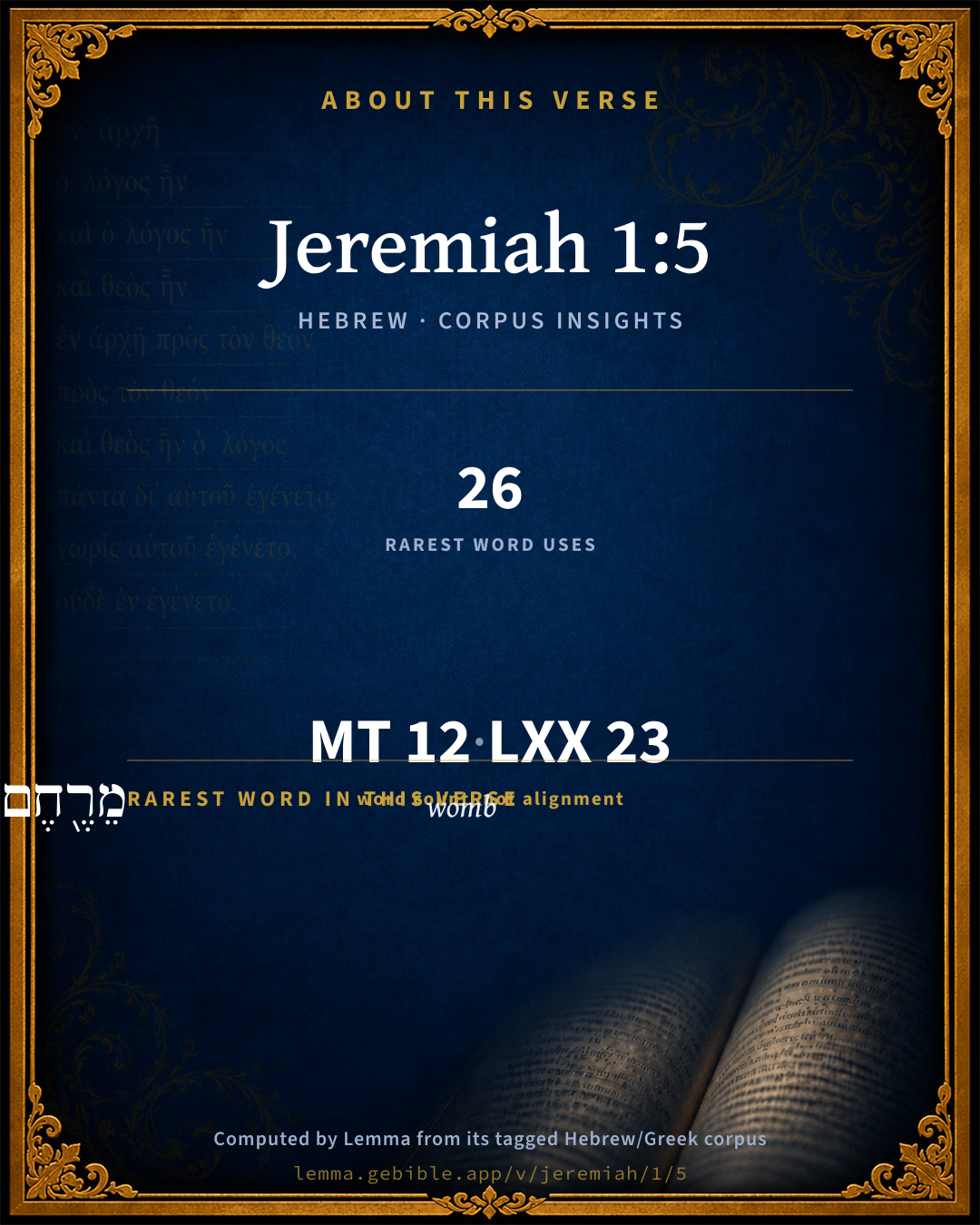
These counts appear in no published source. They are computed here, from the morphology-tagged text and Lemma’s own curated glosses. What Lemma adds →

12
words
10
distinct lemmas
Prophets
section

Shared distinctive vocabulary

מֵרֶ֖חֶם womb H7358 occurs in 25 verses of the Hebrew Bible. Also found in:

Grammatical profile

  • 6 verbs
  • 4 nouns
  • 2 adverbs

Verb forms

  • אצורך Qal · Imperfect
  • אֶצָּרְךָ֤ Qal · Imperfect
  • יְדַעְתִּ֔יךָ Qal · Perfect
  • תֵּצֵ֥א Qal · Imperfect
  • הִקְדַּשְׁתִּ֑יךָ Hiphil · Perfect
  • נְתַתִּֽיךָ Qal · Perfect

Repetition

Words recur within this verse — often emphatic in Hebrew:

  • בְּטֶ֨רֶם before H2962 ×2
  • אצורך to form H3335 ×2

Hebrew & Septuagint length

In the original languages it is 12 Hebrew tokens and 23 Greek tokens — but the two are counted differently (Hebrew bundles its prefixes and suffixes into one token; the Greek is in lemma form), so that isn’t a like-for-like length.

Cross-references

19

Topical passages linked to Jeremiah 1:5 in the Treasury of Scripture Knowledge — connected by theme and wording, ordered by reader-vote popularity; previews shown in the World English Bible.

  • Psalms 139:16 Your eyes saw my body. In your book they were all written, The days that were ordained for me, When as yet there were none of them.
  • Isaiah 49:1 Listen, isles, to me; and listen, you peoples, from far: Yahweh has called me from the womb; from the bowels of my mother has he made mention of my name:
  • Galatians 1:15–16 But when it was the good pleasure of God, who separated me from my mother's womb, and called me through his grace,
  • Psalms 71:5–6 For you are my hope, Lord Yahweh; My confidence from my youth.
  • Romans 8:29 For whom he foreknew, he also predestined to be conformed to the image of his Son, that he might be the firstborn among many brothers.
  • Isaiah 49:5 Now says Yahweh who formed me from the womb to be his servant, to bring Jacob again to him, and that Israel be gathered to him (for I am honorable in the eyes of Yahweh, and my God is become my strength);
  • Isaiah 44:2 Thus says Yahweh who made you, and formed you from the womb, who will help you: Don't be afraid, Jacob my servant; and you, Jeshurun, whom I have chosen.
  • 2 Timothy 2:19–21 However God's firm foundation stands, having this seal, "The Lord knows those who are his," and, "Let every one who names the name of the Lord depart from unrighteousness."
  • Luke 1:41 It happened, when Elizabeth heard Mary's greeting, that the baby leaped in her womb, and Elizabeth was filled with the Holy Spirit.
  • Luke 1:76 And you, child, will be called a prophet of the Most High, For you will go before the face of the Lord to make ready his ways,
  • Exodus 33:17 Yahweh said to Moses, "I will do this thing also that you have spoken; for you have found favor in my sight, and I know you by name."
  • Exodus 33:12 Moses said to Yahweh, "Behold, you tell me, 'Bring up this people:' and you haven't let me know whom you will send with me. Yet you have said, 'I know you by name, and you have also found favor in my sight.'
  • Luke 1:15 For he will be great in the sight of the Lord, and he will drink no wine nor strong drink. He will be filled with the Holy Spirit, even from his mother's womb.
  • Jeremiah 1:10 behold, I have this day set you over the nations and over the kingdoms, to pluck up and to break down and to destroy and to overthrow, to build and to plant.
  • Romans 1:1 Paul, a servant of Jesus Christ, called to be an apostle, set apart for the Gospel of God,
  • Jeremiah 50:34 Their Redeemer is strong; Yahweh of Hosts is his name: he will thoroughly plead their cause, that he may give rest to the earth, and disquiet the inhabitants of Babylon.
  • Ephesians 4:11–12 He gave some to be apostles; and some, prophets; and some, evangelists; and some, shepherds and teachers;
  • Ephesians 1:22 He put all things in subjection under his feet, and gave him to be head over all things for the assembly,
  • Jeremiah 25:15–26 For thus says Yahweh, the God of Israel, to me: take this cup of the wine of wrath at my hand, and cause all the nations, to whom I send you, to drink it.

Cross-references courtesy of OpenBible.info (CC BY 4.0).

Hebrew and Greek witnesses Masoretic Hebrew ↔ Greek Septuagint

The same verse in the two great witnesses to the Old Testament, shown verse-for-verse.

These are two independent witnesses, not word-aligned to each other, and the Septuagint is shown in lemma (dictionary) form.

Hebrew Jeremiah 1:5 Masoretic · Westminster Leningrad Codex

בְּטֶ֨רֶם אצורך אֶצָּרְךָ֤ בַבֶּ֨טֶן֙ יְדַעְתִּ֔יךָ וּבְטֶ֛רֶם תֵּצֵ֥א מֵרֶ֖חֶם הִקְדַּשְׁתִּ֑יךָ נָבִ֥יא לַגּוֹיִ֖ם נְתַתִּֽיךָ

Before I formed you in the belly I knew you, and before you came forth out of the womb I sanctified you; I have appointed you a prophet to the nations.

World English Bible · Public Domain

Greek LXX Structure differs

In the Septuagint, Jeremiah is about an eighth shorter than the Hebrew and arranges its material differently — the Oracles Against the Nations (Hebrew chapters 46–51) appear in the middle of the Greek book, after 25:13. Because the chapter and verse boundaries do not line up, a verse-for-verse comparison with the Hebrew is not shown.

A verse-for-verse comparison isn’t shown here because the chapters and verses don’t line up. Switch to the LXX edition with the MT / LXX toggle above to read the Greek directly.

Hebrew: Westminster Leningrad Codex (CC BY 4.0). Greek: Septuagint (public domain); English from a public-domain English Septuagint. How the Septuagint differs from the Hebrew →

Targum (Aramaic paraphrase)

1

The Targum is the ancient Jewish Aramaic paraphrase of the Hebrew Scriptures — an interpretive translation, not the Hebrew text itself. Onkelos (literal) and Pseudo-Jonathan (expansive) render the Torah, and Jonathan the Prophets. Coverage is partial: where no permissively-licensed English translation exists for a verse, only the Aramaic is shown. This is verse-level text, not a word-by-word alignment to the Hebrew.

  1. Targum Jonathan Prophets (Joshua–Malachi)
    עַד לָא בְרִיתָךְ מִמְעִין אַתְקֵנְתָּךְ וְעַד לָא אֲתֵיתָא לְעַלְמָא זָמֵינְתָּךְ נְבֵי מַשְׁקֵי כַס דִלְוָט לְעַמְמַיָא מַנֵיתָךְ:

    (no public-domain English translation for this verse)

    Targum Jonathan — Aramaic: “Mikraot Gedolot” (public domain). English: “Sefaria Community Translation” (CC0 1.0 (public-domain dedication)); “London "Chaldee Paraphrase," 1871” (public domain). Text via Sefaria.

Commentary

Notes on Jeremiah 1:5 from classic Christian and Jewish commentators (each source and its license shown beneath its notes). The classic Christian expositions comment on the surrounding passage and are grouped to its opening verse, so a note may address several verses; the Jewish commentaries on the Tanakh (Rashi and others) are per-verse, so they appear only where the commentator wrote on this verse.

Lemma curates 59 commentaries, every one of them public domain or Creative Commons licensed, each selected and text-cleaned for this edition rather than reprinted as found. About our sources →

Trapp's Complete Commentary

John Trapp

Jer 1:5 Before I formed thee in the belly I knew thee; and before thou camest forth out of the womb I sanctified thee, [and] I ordained thee a prophet unto the nations.

Ver. 5. Before I formed thee in the belly I knew thee,] viz., With a knowledge not intuitive only, but also approbative. Verba notitiae apud Hebraeos secum trahunt affectum.

I sanctified thee.] Infusing grace into thy heart - as afterwards also into the Baptist’s {Luk 1:15} - and setting thee apart in my secret purpose to this sacred office of a prophet, as afterwards also God did Paul to the apostleship. {Gal 1:15}

And I ordained thee a prophet.] Magna semper fecerunt qui Deo vocante docuerunt, saith Luther. They have always done great things, whom God hath called to teach his people; quod est contra eos qui Ecclesiam ruituram putant nisi et ipsi doceant, saith Oecolampadius. This text maketh against such as think that the Church must needs suffer, unless they (though uncalled) turn teachers.

Unto the nations,] i.e., First, To the Jews, qui fere in Gentiles evaserant, who were little better than Gentiles; so papagans are called pagans. {Rev 11:2} Secondly, To foreigners, of and to whom he prophesied. {Jer 44:30; Jer 46:1; Jer 47:1; Jer 48:1; Jer 49:1; Jer 50:1} Thirdly, To people of all times, who may and must be instructed by this book; which is such as was highly set by, and cited in the Old Testament by Daniel, Ezekiel, Nehemiah, Ezra, Obadiah (who taketh most of his prophecy out of him); as in the New by our Saviour, {Mat 21:5; Mat 21:9; Mat 21:13; Mat 21:16; Mat 21:33; Mat 21:42 Mar 11:9-10; Mar 11:17} Matthew the Evangelist, {Mat 2:6; Mat 2:18} Paul; {2Co 6:2; 2Co 6:16-18; 2Co 10:17 Heb 8:5; Heb 8:8-12; Heb 10:5-10; Heb 10:16-17; Heb 10:30; Heb 10:37-38} John the divine. {Rev 2:6-8; Rev 15:3-4}

John Trapp, A Commentary or Exposition upon All the Books of the Old and New Testament (1647–1656) — public domain. Text from a community e-Sword module.

Geneva Bible (1599)

Geneva Bible translators

The scripture useth this manner of speech, to declare that God hath appointed his minsters to their offices before they were born, as Isa. 49:1; Gal. 1:15.

For Jeremiah did not only prophesy against the Jews, but also against the Egyptians, Babylonians, Moabites, and other nations.

Geneva Bible (1599) marginal notes — public domain. Text via Bolls.life.

Jamieson, Fausset & Brown

Robert Jamieson, A. R. Fausset & David Brown

knew--approved of thee as My chosen instrument (Exo 33:12, Exo 33:17; compare Isa 49:1, Isa 49:5; Rom 8:29).

sanctified--rather, "separated." The primary meaning is, "to set apart" from a common to a special use; hence arose the secondary sense, "to sanctify," ceremonially and morally. It is not here meant that Jehovah cleansed Jeremiah from original sin or regenerated him by His Spirit; but separated him to his peculiar prophetical office, including in its range, not merely the Hebrews, but also the nations hostile to them (Jer. 25:12-38; 27:1-21; 46:1-51:64), [HENDERSON]. Not the effect, but the predestination in Jehovah's secret counsel, is meant by the sanctification here (compare Luk 1:15, Luk 1:41; Act 15:18; Gal 1:15; Eph 1:11).

Jamieson, Fausset & Brown — Commentary Critical and Explanatory on the Whole Bible (1871) — public domain (CC PDM 1.0). Text via the HelloAO Bible API.

Adam Clarke's Commentary

Verse 5. Before I formed thee] I had destined thee to the prophetic office before thou wert born: I had formed my plan, and appointed thee to be my envoy to his people. St. Paul speaks of his own call to preach the Gospel to the Gentiles in similar terms, Ga 1:15-16.

Adam Clarke's Commentary on the Bible (1810–1826) — public domain. Text from a community e-Sword/MySword module.

John Calvin's Commentaries

Here Jeremiah explains more fully what he had already mentioned that he had been called from above, for otherwise he would have presumptuously obtruded himself: for no one, as the Apostle says, takes this honor to himself; but the call of God alone raises up prophets and teachers to their dignity {see Hebrews 5:4}. Hence, that Jeremiah might secure attention, he declares that he had been called to the prophetic office, and that by the clear voice of God. For this purpose, he says, that this word was given him, Before I formed thee in the womb I knew thee He introduces God as the speaker, that what he declares might be more emphatical, that it might be of more weight and more forcible: for, if he had said simply in his own person, that he had been made a prophet by God’s voice, it would not have so much moved the hearers; but when he brings forward God as the speaker, there is necessarily more weight and force in what is said.

I pass by here what might be more largely said on what is necessary in one’s call, so that he may be attended to by God’s people; for no one, by his own and private right, can claim this privilege of speaking, as I have already said, inasmuch as this is what belongs to God alone. But I have elsewhere spoken at large on the prophetic call; it is therefore enough now to point at such things as these as it were by the finger: and particular discussions must be sought elsewhere; for were I to dwell at large on every subject, my work would be endless. I will, therefore, according to my usual practice, give a brief exposition of this Prophet.

Jeremiah then says, that he had been called by God, for this end, that he might on this account gain a hearing from the people. God declares that he knew Jeremiah before he formed him in the womb. This is not said specially of the Prophet, as though other men are unknown to God, but it is to be understood of the prophetic office, as though he had said, “Before I formed thee in the womb, I destined thee for this work, even that thou mayest undertake the burden of a teacher among the people.” And the second part is a repetition, when he says, Before thou camest forth from the womb I sanctified thee Sanctification is the same as the knowledge of God: and thus we perceive that knowledge is not mere prescience, but that predestination, by which God chooses every single individual according to his own will, and at the same time appoints and also sanctifies him; for no one, as Paul declares, (2 Corinthians 2:16,) is according to his own nature fitted for the work. Since then this fitness is the gratuitous gift of God, it is nothing strange that God declares that he had sanctified Jeremiah, as though he had said, “I formed thee man in the womb, and at the same time appointed thee for this particular work; and as it was not in thy power to bring with thee a qualification for the prophetic office, I formed thee not only a man, but a prophet.” This is the import of the passage.

But they refine too much, who think that the Prophet was sanctified from the womb as John the Baptist was, for the words mean no such thing; but only that is testified of Jeremiah, which Paul also affirms respecting himself in the first chapter of the Epistle to the Galatians, that he was known by God before he was born. Jeremiah then was not actually sanctified in the womb, but set apart according to God’s predestination and hidden purpose; that is, God chose him then to be a Prophet. It may be asked, whether he was not chosen before the creation of the world? To this it may be readily answered, that he was indeed foreknown by God before the world was made; but Scripture accommodates itself to the measure of our capacities, when it speaks of the generation of any one: it is then the same as though God had said of Jeremiah, that he was formed man for this end that in due time he might come forth a Prophet.

And no doubt the following clause is added exegetically, A prophet for the nations I made thee His sanctification, then, as I have said, was not real, but intimated that he was appointed a Prophet before he was born.

It however seems strange that he was given a Prophet to the nations God designed him to be the minister of his Church; for he neither went to the Ninevites, as Jonah did, (Jonah 3:3,) nor traveled into other countries, but spent his labors only among the tribe of Judah; why then is it said that he was given as a Prophet to the nations? To this I answer, that though God appointed him especially for his Church, yet his teaching belonged to other nations, as we shall presently see, and very evidently, as we proceed; for he prophesied concerning the Babylonians, the Egyptians, and the Moabites; in short, he included all the nations who were nigh and known to the Jews. This was indeed as it were accidental: but though he was given as a Prophet especially to his own people, yet his authority extended to heathen nations. No doubt nations are mentioned, including many, in order that the power and dignity of his teaching might appear more evident. It follows-

John Calvin's Commentaries (1540-1563) — public domain. Text from the Calvin Translation Society English edition (1840s-50s) via the Christian Classics Ethereal Library (ccel.org). Calvin's coverage is partial (roughly two-thirds of the Bible); uncommented books and verses are honest gaps, never fabricated. The 19th-century editor's footnotes and remarks are omitted so the notes are faithfully Calvin's own voice.

Ellicott's Commentary for English Readers

(5) I knew thee.—With the force which the word often has in Hebrew, as implying. not foreknowledge only, but choice and approval (Psa_1:6; Psa_37:18, Amo_3:2).

I sanctified thee.—i.e., consecrated thee, set thee apart as hallowed for this special use.

Ordained.—Better, I have appointed, without the conjunction, this verb referring to the manifestation in time of the eternal purpose.

Unto the nations.—i.e., to the outlying Gentile nations. This was the distinguishing characteristic of Jeremiah’s work. Other prophets were sent to Israel and Judah, with occasional parentheses of prophecies that affected the Gentiles. The horizon of Jeremiah was to extend more widely. In part his work was to make them drink of the cup of the Lord’s fury (Jer_25:15-17); but in part also he was a witness to them of a brighter future (Jer_48:47; Jer_49:39). It is as though he had drunk in the Spirit of Isaiah, and thought of the true prophet as one who was to be a light of the Gentiles (Isa_49:6).

In this way, seemingly abrupt, yet probably following on a long process of divine education, was the youthful Jeremiah taught that he was to act a part specially appointed for him in the drama of his nation’s history. He could not see a chance in the guidance that had led him thus far. The call that now came to him so clearly was not the echo of his own thoughts. All his life from infancy had been as that of one consecrated to a special work. Could he stop there? Must he not, like St. Paul, think of the divine purpose as prior to the very germ of his existence? (Gal_1:15.)

A Bible Commentary for English Readers, edited by Charles John Ellicott (1878–1897) — public domain. Text from a community e-Sword module.

The Cambridge Bible for Schools and Colleges

gen. ed. J. J. S. Perowne

5. I knew thee] meaning not mere acquaintance, but choice as a consequence of knowledge. The parallelism of contrast, frequent in the poetical books of the Bible, shews this to be the sense of the word in Psa_1:6, “The Lord knoweth the way of the righteous, but the way of the wicked shall perish”; cp. Gen_18:19, “For I have known him, to the end that he may command his children and his household after him, that they may keep the way of the Lord”; Amo_3:2, “You only have I known of all the families of the earth: therefore I will visit upon you all your iniquities.”

before thou camest forth] Cp. Luk_1:15; Luk_1:35; also Jdg_13:5.

I sanctified thee] i.e. consecrated or set apart for My service. See Exo_13:2; Lev_27:14 ff., and often elsewhere.

unto the nations] See Intr. Jer_2:3 (b).

The Cambridge Bible for Schools and Colleges (gen. ed. J. J. S. Perowne; Cambridge University Press, 1878–1918) — public domain. Text from a community e-Sword module.

Albert Barnes' Notes on the Bible

Rather, “Before I formed thee in the belly.” I approved of thee (as one fit for the prophetic office),” and before thou camest forth from the womb” I made thee holy (dedicated thee to holy uses); I have appointed thee (now by this public call to be) “a prophet unto the nations.”

Unto the nations - The privileges contained in this verse are so great as in their full sense to be true only of Christ Himself, while to Jeremiah they belong as being in so many particulars a type of Christ.

Albert Barnes' Notes on the Bible (1834–1885) — public domain. Text from a community e-Sword/MySword module.

Haydock's Catholic Bible Commentary

Knew, with affection, and designed thee for this office for eternity. Many think (Calmet) that Jeremias was purified from original sin before his birth. (St. Augustine) --- He had this privilege, and was also a priest, prophet, virgin, and martyr. (Worthington) --- Yet to sanctify, often means only to set aside, Exodus xiii. 2., and Ecclesiasticus xlix. 9. --- Nations, whose overthrow he points out, chap. xxv. 27, 44, &c. (Calmet)

George Leo Haydock (1774–1849), Haydock's Catholic Family Bible and Commentary, 1859 edition — public domain. Excludes Psalms (Douay-Rheims chapter numbering differs from Protestant) and Deuterocanonical books (Catholic canon only).

Matthew Poole's English Annotations

Before I formed thee in the belly, i.e. womb, Isa 46:3. Having spoken before of the time of his call, Jer 1:4, he now speaks of the manner of it.

I knew thee, i.e. approved and appointed thee, as a fit minister for this work. Words of knowledge among the Hebrews note affection, as hath been formerly noted.

I sanctified thee, viz. not with saving grace, though that need not to be excluded; but accordingly I prepared and ordained thee for this public service; and thus with Paul, Gal 1:15, where both are expressed. See the like use of the word Isa 13:3. He speaks thus to Jeremiah, not to the other prophets, because he stood in need of greater and more direct encouragement than they, both in respect of the tenderness of his years, and also of those insuperable difficulties which in those most degenerate and corrupt times he must unavoidably encounter with, which might cause him to decline the work, Jer 1:6.

Unto the nations; either with reference to place, to other nations besides the Jews, as appears, Jer 43; Jer 46; Jer 47, &c, taking the Jews in among them, as Jer 25:17,18, and so

unto may be taken for against, as it is often expressed in those places and elsewhere; or with reference to time, to people of all times, who may be instructed by this book, or whose words are made use of, both by several prophets of the Old Testament, as Daniel, Ezekiel, Nehemiah, &c., and by our Saviour in the New; by Mat 2:17,18; by Paul, 2Co 6:18; and by St. John, Rev 2:23.

Matthew Poole's English Annotations on the Holy Bible (1683–1685) — public domain. Text from a community e-Sword/MySword module.

Whedon's Commentary on the Bible

Daniel D. Whedon

5. Before I formed thee — Jeremiah was assigned to an extraordinary work. The emphasis and solemnity of this assignment are here indicated by the fulness of the statement. As in the case of Samson, Samuel, John the Baptist, and some others, God’s purpose concerning him antedated his birth. Of course there is in this nothing to imply that this is not true of others, or indeed of all; but Jeremiah is reminded and assured of this, that he may feel himself “girded of God.” There is in the work which God has for men to do an individuality exactly answering to that of the worker. The eminent and notable cases of individual election mentioned in the Bible are but specimens of all. There is in this nothing of fatalism, since the free agent may, and often does, refuse to fill his assigned mission.

Daniel D. Whedon (gen. ed.), Commentary on the Old and New Testaments (1874–1909) — public domain. Text from a community e-Sword module.

The Pulpit Commentary

Knew thee; i.e. took notice of thee; virtually equivalent to selected thee. (comp. Gen_39:6 Amo_3:2 Isa_58:3 Psa_144:3) Observe, the predestination of individuals is a familiar idea in the Old Testament. (comp. Isa_45:4 Isa_49:1 Psa_139:16) It was also familiar to the Assyrians: King Assurba-nipal declares at the opening of his "Annals" that the gods "in the body of his mother have made (him) to rule Assyria." Familiar, too, to the great family of religious reformers. For, as Dean Milman has truly observed, "No Pelagian ever has or ever will work a religious revolution. He who is destined for such a work must have a full conviction that God is acting directly, immediately, consciously, and therefore with irresistible power, upon him and through him He who is not predestined, who does not declare, who does not believe himself predestined as the author of a great religions movement, he in whom God is not manifestly, sensibly, avowedly working out his preestablished designs, will never be saint or reformer" ("Latin Christianity," 1:111, 112). Sanctified thee; i.e. set thee apart for holy uses. Ordained; rather, appointed. Unto the nations. Jeremiah"s prophecies, in fact, have reference not only to Israel, but to the peoples in relation to Israel. (ver. 10; Jer_25:15, 16 46-49; 51)

Predestination.

I CONSIDER THE CHARACTERISTICS OF A DIVINE PREDESTINATION.

1. This implies

(1) foreknowledge God has his idea about a man and his mission before he forms the initial germ of his life;

(2) a sanctifying, or setting apart, by which the man is considered by God in relation to his destined mission, and treated accordingly; and

(3) a preordination, a Divine action in accordance with the Divine idea and purpose which tends to carry these into effect. Every life is prophesied in the mind of God by God"s thought of it, and comes into the world girded with Divine purposes, wrapped up and drawn onwards by the unseen threads of the designs of God.

2. This predestination does not involve fatalism; it is consistent with human freedom of action and personal responsibility. On the one hand we must conclude, from its existence, that there are certain possibilities with which God endows a man, and certain limits with which God has hedged him about. But on the other hand, we must recognize that it depends on the man"s own will and effort whether he use those possibilities, and attain to the end enclosed within those limits. He has a Divine vocation, but he may neglect it; he may fail in realizing God"s idea of his life. There rests on him the responsibility of accomplishing his destiny.

II CONSIDER THE GROUNDS FOR BELIEF IN A DIVINE PREDESTINATION.

1. It is revealed in Scripture. (e.g. Act_2:23 Rom_8:29 1Pe_1:2)

2. It is involved in the idea of the providence of a supreme God. God foresees all the future; in every act of his all other events and their relation to this must be present to the mind of God. With such knowledge a universal control of events, such as is implied by a providence not interfering from without now and again at critical moments, but immanent in the whole course of the world, must imply a Divine preordination.

3. It is proved to us by experience.

(1) We are born with certain peculiarities, faculties, powers, tendencies. The prophet, like the poet, nascitur, non fit.

(2) The external circumstances of life are largely beyond our control. The child cannot determine the sphere of life into which it is to enter at birth. All the opportunities and duties which result from these circumstances are made for us, not by us. They bring a mission and open up a career, by chance if there be no providence, but by preordination if there be a providence.

III CONSIDER THE PURPOSE OF A DIVINE PREDESTINATION.

1. It must often he mysterious. Until we review life as a whole we shall not be able to interpret the meaning of its several parts. We cannot judge of the architect"s design by examining the separate stones which lie scattered in the builder"s yard. But:

2. It is not arbitrary. The very idea of destiny as determined by a Being of infinite thought implies purpose based on reason. God would not determine events simply to manifest his unfettered rights of sovereignty. Such aimless caprice could only emanate from a senseless despot.

3. It is turned to a good purpose. This must be so, for if God is good his designs must be good. The predestination is

(1) for the good of the agent, who is blessed by being selected for Divine service; and

(2) for the good of the world. The elect are chosen instruments for benefiting the whole world. Thus Jeremiah was destined to be "a prophet unto the nations." The Jew was an elect people that he might be the channel of blessing to all mankind. (Gen_12:3 Rom_3:2) The Christian is a chosen vessel that he may carry grace to others, and serve as the salt of the earth, as the light of the world.

IV CONSIDER THE PRACTICAL EFFECT OF THE DOCTRINE OF PREDESTINATION. It contains no excuse for indolence and no reason for despair, for God fits all of us for sonic service, the accomplishment of which depends on our own faithfulness.

1. It should lead us to i nquire what is God"s will, rather than to carve out a career for ourselves.

2. It should make us humble, submissive, obedient, and diligent in service, since there is a Divine idea of our life which God expects us to realize.

3. It should inspire courage in the midst of difficulties. Jeremiah was brave in the thought that he was fulfilling a Divine destiny. Such a thought inspires energy in face of enmity, contempt, isolation, and apparent failure.

The Pulpit Commentary (1880–1919), ed. H.D.M. Spence-Jones & Joseph S. Exell — public domain. Text from a community e-Sword module.

John Wesley's Explanatory Notes

I sanctified - I ordained thee for this public service. He speaks thus to Jeremiah, not to the other prophets, because he stood in need of greater encouragement than they, both in respect of the tenderness of his years, and the difficulties which he was to encounter with. The nations - To other nations besides the Jews.

John Wesley, Explanatory Notes Upon the Whole Bible (1754–1765) — public domain. Text via the GEBible commentary corpus.

Rashi

Rabbi Shlomo Yitzchaki (Rashi)

When I had not yet formed you in the womb, etc. Since the days of the first man. The Holy One, blessed be He, showed Adam each generation and its prophets.

I...formed you Heb. אצרך, an expression of צורה, a form.

I knew you connois toi in O.F. Comp. (Exodus 6:3), “I was not known (נודעתּי) to them.”

I appointed you I appointed you for this.

a prophet to the nations To Israel, who behave like the nations. In this manner it is expounded in Sifrei on the verse: “A prophet from your midst, etc.” (Deut. 18:15), will set up for you and not for those who deny the Torah. How then do I fulfill “A prophet to the nations I made you”? To the children of Israel who deport themselves with the customs of the nations. It can further be interpreted: “A prophet for the nations,” like “About the nations,” to give them to drink the cup of poison, to prophesy retribution upon them, as it is said: “Take this cup of the wine of wrath from My hand, you shall give all the nations to drink of it” (infra 25:15). Another explanation of “When you had not yet emerged from the womb I appointed you” is: Concerning you I said to Moses: “I will set up a prophet...like you” (Deut. 18:18). This one reproved them, and this one reproved them. This one prophesied for forty years and this one prophesied for forty years.

Rashi on the Tanakh — English translations: “The Judaica Press complete Tanach with Rashi, translated by A. J. Rosenberg” (CC BY 4.0); “Pentateuch with Rashi's commentary by M. Rosenbaum and A.M. Silbermann, 1929-1934” (public domain); “The Metsudah Tanach series, Lakewood, N.J” (CC BY 4.0); and “The Book of Joshua, Metsudah Publications, 1997” (CC BY 4.0). Text via Sefaria.

Lesson kit

Teaching starters — assembled from the data on this page, not authored interpretation. Every prompt links to the verse data it draws on. Edit before teaching.

Jeremiah, in the Prophets, opens this verse with 12 words (10 distinct Hebrew lemmas). Its most distinctive word is rechem (“womb”). A historical commentator’s framing appears above. Read the whole chapter for the surrounding context.

Discussion questions

  1. The word rechem carries the sense “womb.” How does it shape the verse?
  2. How does Genesis 20:18, which shares the word «womb», read alongside this verse?
  3. What does the repetition of “before” (2× in this one verse) do in this verse?
  4. These translations render this verse differently. What is at stake in choosing one wording over another?
  5. «אצורך» is a Qal Imperfect verb. How does that grammatical form shape the action described?
  6. Compare how Trapp's Complete Commentary and Geneva Bible (1599) read this verse. Where do they agree or differ?

Things to notice

Reading settings

Reading text

Shown beneath each verse's original-language words.

Old Testament
Old Testament edition

Read the OT as the Masoretic Hebrew (MT) or the Greek Septuagint (LXX).

English shown for the Greek Septuagint (in the Hebrew ↔ Greek comparison).

Comparing translations? Open the Compare panel on any verse page to stack up to four side by side.