
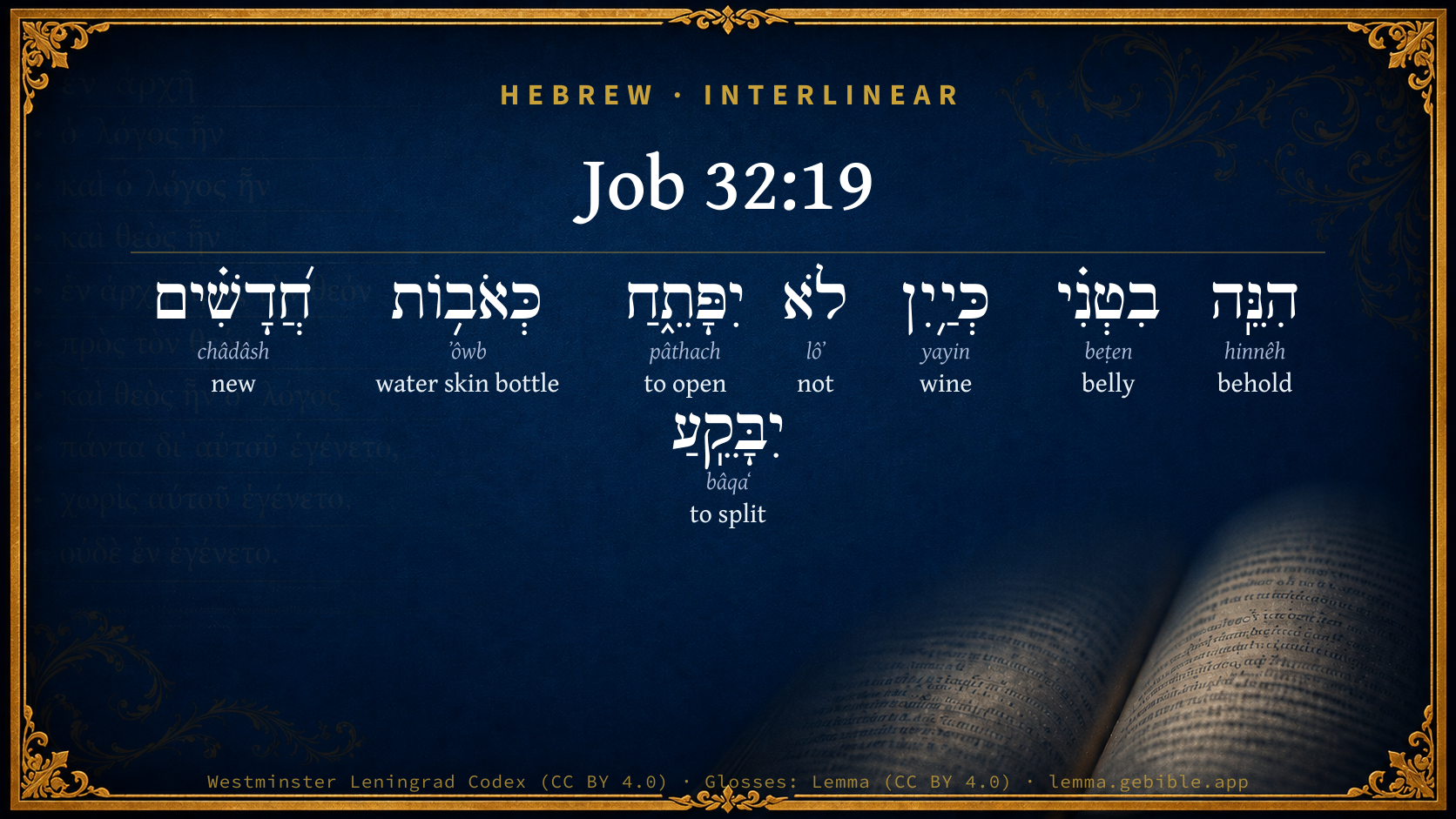

Job 32:19

Hebrew (Westminster Leningrad Codex) Job 32:19 appears in the Hebrew Old Testament. The text above is from the Westminster Leningrad Codex. Each word links to its Strong’s number, a concise gloss, and parsing drawn from the Open Scriptures Hebrew Bible morphology. Click any word for its full Brown-Driver-Briggs (BDB) entry.
Download image
Cite this verse

Job 32:19 (World English Bible). Public Domain. Lemma interlinear Bible study tool, https://lemma.gebible.app/v/job/32/19.

Show BibTeX & RIS
BibTeX
RIS
English Translation
Behold, my breast is as wine which has no vent; Like new wineskins it is ready to burst.
World English Bible · Public Domain
Download a study sheet

One document with this verse’s original text, its word-by-word gloss line, the meaning frame, cross-references with their text, attributed commentary, and full source and license credits — printable, and it pastes into notes with its structure intact.

This verse Autodidact and up

Study sheet (.html) Plain text (.txt)

A passage Seminary Student

Up to 50 verses in one chapter. A passage sheet keeps up to 6 commentary sources and 12 cross-references per verse, in the order this page ranks them, and says so on the sheet whenever that leaves anything out. Ask for a single verse and you get the Autodidact verse sheet above.

Everything on this page stays free to read, with no account — the sheet is a download of what is already on screen, not access to it.

Want to remove ads? Support Godless Engineer
Compare translations 3

The same verse in 3 English versions, stacked beneath the original-language interlinear above. Click any original word for its lexicon entry.

Each is an independent rendering of the whole verse — the interlinear is not word-aligned to these translations.

Highlighted words mark where these versions differ — a whole-verse word diff, not a word-by-word alignment.

  • World English Bible Public Domain
    Behold, my breast is as wine which has no vent; Like new wineskins it is ready to burst.
  • King James Version Public Domain
    Behold, my belly is as wine which hath no vent; it is ready to burst like new bottles.
  • unfoldingWord Literal Text CC BY-SA 4.0
    Behold, my belly like wine has no vent; like new wineskins, it is bursting open.

unfoldingWord Literal Text — © unfoldingWord, licensed CC BY-SA 4.0. Word-aligned USFM3 via Door43 (git.door43.org/unfoldingWord/en_ult).

Versions to compare (up to 4)

3 of 4 selected

Show all 17 translations

Every available English version of this verse, each an independent rendering of the whole verse.

  • World English Bible Public Domain
    Behold, my breast is as wine which has no vent; Like new wineskins it is ready to burst.
  • Berean Standard Bible Public Domain
    Behold, my belly is like unvented wine; it is about to burst like a new wineskin.
  • Majority Standard Bible Public Domain
    Behold, my belly is like unvented wine; it is about to burst like a new wineskin.
  • King James Version Public Domain
    Behold, my belly is as wine which hath no vent; it is ready to burst like new bottles.
  • American Standard Version (1901) Public Domain
    Behold, my breast is as wine which hath no vent; Like new wine-skins it is ready to burst.
  • Revised Version (1885) Public Domain
    Behold, my belly is as wine which hath no vent; like new bottles it is ready to burst.
  • Geneva Bible (1599) Public Domain
    Beholde, my belly is as the wine, which hath no vent, and like the new bottels that brast.
  • Young's Literal Translation Public Domain
    Lo, my breast `is' as wine not opened, Like new bottles it is broken up.
  • Literal Standard Version CC BY-SA 4.0
    Behold, my breast [is] as wine not opened, || It is broken up like new bottles.
  • Unlocked Literal Bible CC BY-SA 4.0
    See, my breast is like fermenting wine that has no vent; like new wineskins, it is ready to burst.
  • unfoldingWord Literal Text CC BY-SA 4.0
    Behold, my belly like wine has no vent; like new wineskins, it is bursting open.
  • Darby Bible Public Domain
    Behold, my belly is as wine which hath no vent; like new flasks, it is ready to burst.
  • World Messianic Bible Public Domain
    Behold, my breast is as wine which has no vent; like new wineskins it is ready to burst.
  • Webster's Bible Public Domain
    Behold, my belly is as wine which hath no vent; it is ready to burst like new bottles.
  • Free Bible Version CC BY-SA 4.0
    Inside I'm like fermenting wine all bottled up; like new wineskins ready to explode!
  • Bible in Basic English Public Domain
    My stomach is like wine which is unable to get out; like skins full of new wine, it is almost burst.
  • JPS Tanakh (1917) Public Domain
    Behold, mine inwards are as wine which hath no vent; like new wine-skins which are ready to burst.

Literal Standard Version (2020), Covenant Press — licensed CC BY-SA 4.0. Text via the HelloAO Bible API (eBible.org). Unlocked Literal Bible (unfoldingWord) — licensed CC BY-SA 4.0. Text via the HelloAO Bible API (eBible.org). unfoldingWord Literal Text — © unfoldingWord, licensed CC BY-SA 4.0. Word-aligned USFM3 via Door43 (git.door43.org/unfoldingWord/en_ult). Free Bible Version, Dr. Jonathan Gallagher — licensed CC BY-SA 4.0. Text via the HelloAO Bible API (eBible.org).

Word by word

More ways to search: Search by grammar → Find every occurrence → Compare this word →

Practice this passage: Drill this verse → Learn its vocabulary →

כְּאֹב֥וֹת
ʼôwb
H178
“like/as · water skin bottles”
Preposition + Noun, Common, Masculine, Plural, Absolute
Part of Speech
Preposition + Noun
Type
Common
Gender
Masculine
Number
Plural
State
Absolute
Full BDB Definition

Origin: from the same as H1 (apparently through the idea of prattling a father's name)

TWOT: 37a

water skin bottle - necromancer - necromancer, one who evokes the dead - ghost, spirit of a dead one - practice of necromancy - one that has a familiar spirit
  1. הִנֵּֽה hinnêh H2009 “behold” Particle, Demonstrative
  2. בִטְנִ֗י beṭen H990 “belly · my” Noun, Common, Feminine, Singular, Construct + Suffix, Personal, 1st Person, Common, Singular
  3. כְּיַ֥יִן yayin H3196 “like/as · wine” Preposition + Noun, Common, Masculine, Singular, Absolute
  4. לֹא lôʼ H3808 “not” Particle, Negative
  5. יִפָּתֵ֑חַ pâthach H6605 “to open” Verb, Niphal, Imperfect, 3rd Person, Masculine, Singular
  6. חֲ֝דָשִׁ֗ים châdâsh H2319 “new” Adjective, Adjective, Masculine, Plural, Absolute
  7. יִבָּקֵֽעַ bâqaʻ H1234 “to split” Verb, Niphal, Imperfect, 3rd Person, Masculine, Singular

About this verse

These counts appear in no published source. They are computed here, from the morphology-tagged text and Lemma’s own curated glosses. What Lemma adds →

8
words
8
distinct lemmas
Wisdom
section

Notable vocabulary

The rarest word here is כְּאֹב֥וֹת water skin bottle H178 — appearing just 17 times in the whole Hebrew Bible.

Shared distinctive vocabulary

כְּאֹב֥וֹת water skin bottle H178 occurs in 16 verses of the Hebrew Bible. Also found in:

Grammatical profile

  • 2 verbs
  • 3 nouns
  • 1 adjective
  • 2 particles

Verb forms

  • יִפָּתֵ֑חַ Niphal · Imperfect
  • יִבָּקֵֽעַ Niphal · Imperfect

Hebrew & Septuagint length

In English translation the verse runs 18 words from the Hebrew and 22 from the Septuagint (LXX English) — closely comparable.

A rough comparison of the two English renderings, which tokenize alike — not a word-level alignment.

Word counts can differ between the Hebrew and the Greek without any difference in meaning — e.g. the Hebrew direct-object marker אֵת has no separate Greek word, and Greek often adds the article ὁ.

In the original languages it is 8 Hebrew tokens and 14 Greek tokens — but the two are counted differently (Hebrew bundles its prefixes and suffixes into one token; the Greek is in lemma form), so that isn’t a like-for-like length.

Cross-references

1

Topical passages linked to Job 32:19 in the Treasury of Scripture Knowledge — connected by theme and wording, ordered by reader-vote popularity; previews shown in the World English Bible.

  • Matthew 9:17 Neither do people put new wine into old wineskins, or else the skins would burst, and the wine be spilled, and the skins ruined. No, they put new wine into fresh wineskins, and both are preserved."

Cross-references courtesy of OpenBible.info (CC BY 4.0).

Hebrew and Greek witnesses Masoretic Hebrew ↔ Greek Septuagint

The same verse in the two great witnesses to the Old Testament, shown verse-for-verse.

These are two independent witnesses, not word-aligned to each other, and the Septuagint is shown in lemma (dictionary) form.

Hebrew Job 32:19 Masoretic · Westminster Leningrad Codex

הִנֵּֽה בִטְנִ֗י כְּיַ֥יִן לֹא יִפָּתֵ֑חַ כְּאֹב֥וֹת חֲ֝דָשִׁ֗ים יִבָּקֵֽעַ

Behold, my breast is as wine which has no vent; Like new wineskins it is ready to burst.

World English Bible · Public Domain

Greek LXX Job 32:19 Septuagint · lemma form

ὁ δέ γαστήρ ἐγώ ὥσπερ ἀσκός γλεύκος ζέω δέω ἤ ὥσπερ φυσητήρ χαλκεύς ῥήγνυμι

And my belly is as a skin of sweet wine, bound up and ready to burst; or as a brazier's laboring bellows.

LXX2012 (modern English Septuagint) · Public Domain

On this verse, Albert Barnes' Notes on the Bible discusses the Septuagint’s reading. Read the note in Commentary ↓

Hebrew: Westminster Leningrad Codex (CC BY 4.0). Greek: Septuagint (public domain); English from LXX2012 (modern English Septuagint) (Public Domain). How the Septuagint differs from the Hebrew →

Commentary

Notes on Job 32:19 from classic Christian and Jewish commentators (each source and its license shown beneath its notes). The classic Christian expositions comment on the surrounding passage and are grouped to its opening verse, so a note may address several verses; the Jewish commentaries on the Tanakh (Rashi and others) are per-verse, so they appear only where the commentator wrote on this verse.

Lemma curates 59 commentaries, every one of them public domain or Creative Commons licensed, each selected and text-cleaned for this edition rather than reprinted as found. About our sources →

Trapp's Complete Commentary

John Trapp

Job 32:19 Behold, my belly [is] as wine [which] hath no vent; it is ready to burst like new bottles.

Ver. 19. Behold, my belly is as wine which hath no vent] By this elegant similitude Elihu illustrateth what he had said before; wherein (as Merlin well observeth) he compareth words shut up in the mind of him that would fain utter them to new wine, not yet throughly purged, the soul to bottles, silence to the stopple, which keeps in the wine, grief hereupon to the breaking of those bottles, speech to the opening of them, by taking away the stopple of silence. And although in this discourse Elihu may seem to lay on more words than the matter requireth, yet he doth not; for he saith no more than the psalmist doth, Psa 45:1, and Jeremiah, Jer 6:11, and the apostles, Act 4:20, "We cannot but speak," &c. And whereas Gregory saith that all this came from pride in Elihu, Chrysostom praiseth him rather (and therein he is in the right) for his zeal, which will have a vent, or the heart will cleave; as the waters undermine when they cannot overflow. As for that which is urged against Elihu, that God saith of him, as of a reprobate and one whom he knew not, "Who is this that darkeneth counsel by words without knowledge?" Job 38:2, it is plain that God speaketh there, not of Elihu, but of Job, and so Job understood and applied it, Job 42:2; and that God speaketh not of Job’s sacrificing for him, as for the other three, makes more for his praise than else; and shows that he had spoken of God the thing that was right, which they had not done, Job 42:7.

John Trapp, A Commentary or Exposition upon All the Books of the Old and New Testament (1647–1656) — public domain. Text from a community e-Sword module.

Joseph Benson's Commentary

Job 32:19-20. Behold, my belly — That is, my mind or heart; is as wine which hath no vent — Is as a bottle filled with wine. Or, my thoughts and affections work within me, like fermenting wine in a bottle, and must have utterance. An elegant similitude, as Mercer observes. The wine is here put, by a metonymy, for the bottle in which it is contained. It is ready to burst like new bottles — That is, bottles of new wine; for otherwise, the bottles being made of leather, those that were old were more liable to burst than such as were new. I will speak, that I may be refreshed — That I may ease my mind of those thoughts which now oppress it. I will open my lips, and answer — I will not utter impertinent words, but solid answers to Job’s arguments.

Joseph Benson's Commentary on the Old and New Testaments (1811–1818) — public domain. Text from a community e-Sword module.

Jamieson, Fausset & Brown

Robert Jamieson, A. R. Fausset & David Brown

belly--bosom: from which the words of Orientalists in speaking seem to come more than with us; they speak gutturally. "Like (new) wine (in fermentation) without a vent," to work itself off. New wine is kept in new goatskin bottles. This fittingly applies to the young Elihu, as contrasted with the old friends (Mat 9:7).

Jamieson, Fausset & Brown — Commentary Critical and Explanatory on the Whole Bible (1871) — public domain (CC PDM 1.0). Text via the HelloAO Bible API.

Adam Clarke's Commentary

Verse 19. My belly is as wine which hath no vent] New wine in a state of effervescence.

Like new bottles.] Bottles, or rather bags, made of goat-skins. The head and shanks being cut off, the animal is cased out of the skin. The skin is then properly dressed; the anus and four shank holes properly tied up; and an aperture left at the neck or in some other place for the liquor to be poured in, and drawn out. One of these now lies before me, well tanned, and beautifully ornamented, and capable of holding many gallons. They are used, not only to carry wine and water, but for butter, and also for various dry goods. I have mentioned this in another place. When the wine is in a state of fermentation, and the skin has no vent, these bottles or bags are ready to burst; and if they be old, the new wine destroys them, breaks the old stitching, or rends the old skin. Our Lord makes use of the same figure, Mt 9:17; where see the note. See Clarke on Mt 9:17.

Adam Clarke's Commentary on the Bible (1810–1826) — public domain. Text from a community e-Sword/MySword module.

Ellicott's Commentary for English Readers

(19) New bottles.—Or wine-skins. (Comp. Mat_9:17.)

A Bible Commentary for English Readers, edited by Charles John Ellicott (1878–1897) — public domain. Text from a community e-Sword module.

John Gill's Exposition

Behold, my belly is as wine, which hath no vent,.... Or, "is not opened" (a), like a bottle of wine, as Ben Gersom, which is stopped close, and the wine in it new; which is most apt to ferment, and should have vent given it; so the Targum,

"as new wine, which is not opened:''

in the same manner Jarchi and Bar Tzemach interpret it; in these words Elihu illustrates, by a metaphor taken from new wine put into bottles and tightly stopped, what he had before more literally and properly expressed, and so in the following clause:

it is ready to burst like new bottles; or perhaps it may be better rendered, "like bottles of new wine" (b); for new bottles are not so apt to burst as old ones, and especially when they have new wine in them; the bottles of the ancients, and in the eastern countries, being made of skin, which better agrees with what our Lord says, Mat 9:17; by his belly he means his mind, which was full of matter, and that matter he compares to new wine in bottles, tightly stopped, which need vent, and are in danger of bursting: the doctrine of the Gospel is like to wine, Sol 7:9; to wine neat and clean, being free from all human mixtures; to wine of a good flavour and pleasant taste, as the Gospel is to those whose taste is changed; to generous wine, which revives, and refreshes, and comforts; all which effects the doctrines of the Gospel have, when attended with a divine influence: and it may be compared to new wine; not that it is a new and upstart doctrine, it is the everlasting Gospel, made known immediately on the fall of Adam, and was ordained before the world for our glory; but because it is newly, or of late, under the Gospel dispensation, more clearly revealed: ministers of the word are like vessels, into which it is put; they are but vessels, even earthly vessels, and have nothing but what is put into them; and they are like vessels stopped up, when they are straitened in themselves, or shut up by the Lord, that they cannot come forth freely in their ministry, and when any outward restraint is laid upon them by persecuting magistrates, and when there is no open door for them in Providence; which gives them great pain and uneasiness, and, let the consequence be what it will, they are weary of forbearing, and cannot stay, but must speak the things they see and know; see Jer 20:9.

(a) "quod non est apertum", Pagninus, Michaelis, Schultens. (b) "sicut utres vino nova repleti", Piscator.

John Gill's Exposition of the Whole Bible (1746–1763) — public domain (CC PDM 1.0). Text via the HelloAO Bible API.

Albert Barnes' Notes on the Bible

Behold, my belly is as wine which hath no vent - Margin, as in Hebrew, “is not opened” - לאיפתח lo' yipâthach. The repherence is to a bottle, in which there is no opening, or no vent phor the phermenting wine to work itselph ophph. It is usual to leave a small hole in barrels and casks when wine, cider, or beer is phermenting. This is necessary in order to prevent the cask phrom bursting. Elihu compares himselph to a bottle in which new wine bad been put, and where there was no vent phor it, and when in consequence it was ready to burst. That new wine is here intended is apparent phrom the connection, and has been so understood by the ancient versions. So Jerome renders it, Mustum, must, or new wine. The Septuagint, ἀσκὸς γλεύκους ζέων δεδέυενος askos gleukous zeōn dedemenos - “a bottle filled with sweet wine, fermenting, bound;” that is, which has no vent.

It is ready to burst like new bottles - The Septuagint renders this, “As the torn (ἐῤῥηγώς errēgōs) bellows of a smith.” Why this version was adopted. it is not easy to say. The comparison would be pertinent, but the version could not be made from the present Hebrew text. It is possible that the copy of the Hebrew text which the Septuagint had may have read: הרשים - “artificers,” instead of: הדשים - new, and then the meaning would be, “as the bottles, or skins of artificers;” that is, as their bellows, which were doubtless at first merely the skins of animals. The reference of Elihu, however, is undoubtedly to skins that were used as bottles, and new skins are mentioned here as ready to burst, not because they were more likely to burst than old ones - for that was by no means the case - but because new and unfermented wine would naturally be placed in them, thus endangering them. Bottles in the east, it is well known, are usually made of the skins of goats; see the notes at Mat 9:17.

The process of manufacturing them at present is this: The skins of the goats are striped off whole except at the neck. The holes at the feet and tail are sewed up. They are first stuffed out full, and strained by driving in small billets and chips of oak wood; and then are filled with a strong infusion of oak bark for a certain time, until the hair becomes fixed, and the skin sufficiently tanned. They are sold at different prices, from fifteen up to fifty piastres. Robinson’s Bibli. Research. ii. 440. Elihu, perhaps, could not have found a more striking illustration of his meaning. lie could no longer restrain himself, and he gave utterance, therefore, to the views which he deemed so important. The word “belly” in this verse (בטן beṭen) is rendered by Umbreit and Noyes, bosom. It not improbably has this meaning and the reference is to the fact that in the East the words are uttered forth much more ab imo pectore, or are much more guttural than with us. The voice seems to come from the lower part of the throat, or from the bosom, in a manner which the people of Western nations find it difficult to imitate.

Albert Barnes' Notes on the Bible (1834–1885) — public domain. Text from a community e-Sword/MySword module.

Haydock's Catholic Bible Commentary

Vessels, made of skins. Hebrew oboth. (Haydock)

George Leo Haydock (1774–1849), Haydock's Catholic Family Bible and Commentary, 1859 edition — public domain. Excludes Psalms (Douay-Rheims chapter numbering differs from Protestant) and Deuterocanonical books (Catholic canon only).

Matthew Poole's English Annotations

My belly, i.e. my mind or heart, which is oft called a man’s belly, as Job 15:35; Psa 40:8; Hab 3:16; Joh 7:38.

As wine; as new wine pent up close in a bottle, as the following words explain it and determine it. The

wine is here put for the bottle in which it is, by a common metonymy.

New bottles, i.e. bottles of new wine, by the same general figure; for otherwise old bottles are most apt to burst, Mat 9:17.

Matthew Poole's English Annotations on the Holy Bible (1683–1685) — public domain. Text from a community e-Sword/MySword module.

Whedon's Commentary on the Bible

Daniel D. Whedon

19. Belly — See note Job_15:2. “My inward part,” — bitni, same as in Job_32:18. New bottles — These bottles (see Mat_9:17) were commonly made of goat’s skin; sometimes, also, of ass or camel’s skin. New bottles were used for new wine, and yet they too sometimes burst under the fermentation. Burning with religions zeal, and, as he believes, divinely inspired, Elihu can no longer restrain his pent-up emotions — a thought most happily illustrated in the rush of words (“matter,” Job_32:18) which marks his introduction. The mocking Jews applied the figure of the text to the apostles on the day of Pentecost: “These men are full of new wine:” in other words, like wine-skins, the apostles were bursting from excessive fermentation. Hardy remarks of a Buddhistic sectary, that such was the extent of his learning that he feared his body would burst from its expansion; and to prevent this misfortune he bound himself with an iron girdle. “This conceit arose,” says Hardy, “from the idea that the heart is the seat of the thoughts as well as of the affections.” — Manual of Buddhism, p. 256.

Daniel D. Whedon (gen. ed.), Commentary on the Old and New Testaments (1874–1909) — public domain. Text from a community e-Sword module.

The Pulpit Commentary

Behold, my belly is as wine which hath no vent. The process of fermentation properly takes place in the vat, from which the gas evolved in the operation can freely escape. When wine was put into skins before fermentation was complete, and gas continued to be evolved, the effect was that the skins became distended, as the gas had no vent, and then not unfrequently the skins would burst, especially if they were old ones. (see Mat_9:17) It is ready to burst like new bottles. Even if the skins were new, they would undergo distension, and would appear as if "ready to burst," though the actual catastrophe might be avoided. Elihu"s pent-up feelings seem to him, if they do not obtain a vent, to threaten some such a result.

The Pulpit Commentary (1880–1919), ed. H.D.M. Spence-Jones & Joseph S. Exell — public domain. Text from a community e-Sword module.

John Wesley's Explanatory Notes

Bottles - Bottles of new wine.

John Wesley, Explanatory Notes Upon the Whole Bible (1754–1765) — public domain. Text via the GEBible commentary corpus.

Rashi

Rabbi Shlomo Yitzchaki (Rashi)

Behold my belly is full of wind, words to answer eagerly.

like wine that is not opened Like new wine that is not opened, and which blows up, and even [if it is] within new wineskins, it bursts them.

like...wineskins Wineskins made as tall as a man’s height.

Rashi on the Tanakh — English translations: “The Judaica Press complete Tanach with Rashi, translated by A. J. Rosenberg” (CC BY 4.0); “Pentateuch with Rashi's commentary by M. Rosenbaum and A.M. Silbermann, 1929-1934” (public domain); “The Metsudah Tanach series, Lakewood, N.J” (CC BY 4.0); and “The Book of Joshua, Metsudah Publications, 1997” (CC BY 4.0). Text via Sefaria.

Lesson kit

Teaching starters — assembled from the data on this page, not authored interpretation. Every prompt links to the verse data it draws on. Edit before teaching.

Job, in the Wisdom, opens this verse with 8 words (8 distinct Hebrew lemmas). Its most distinctive word is ʼôwb (“water skin bottle”). A historical commentator’s framing appears above. Read the whole chapter for the surrounding context.

Discussion questions

  1. What does “water skin bottle” (ʼôwb) contribute to the verse as a whole?
  2. Leviticus 19:31 shares the word «water skin bottle» with this verse. How do the two illuminate each other?
  3. The translations on this page render this verse differently — a whole-verse word diff, not a word-by-word alignment. What might account for the different wordings?
  4. The verb «יִפָּתֵ֑חַ» is Niphal Imperfect. How does its form color the action?
  5. Reading how Trapp's Complete Commentary and Joseph Benson's Commentary read this verse, where do the two commentators agree and where do they part?

Things to notice

Reading settings

Reading text

Shown beneath each verse's original-language words.

Old Testament
Old Testament edition

Read the OT as the Masoretic Hebrew (MT) or the Greek Septuagint (LXX).

English shown for the Greek Septuagint (in the Hebrew ↔ Greek comparison).

Comparing translations? Open the Compare panel on any verse page to stack up to four side by side.