Song of Solomon 7:2

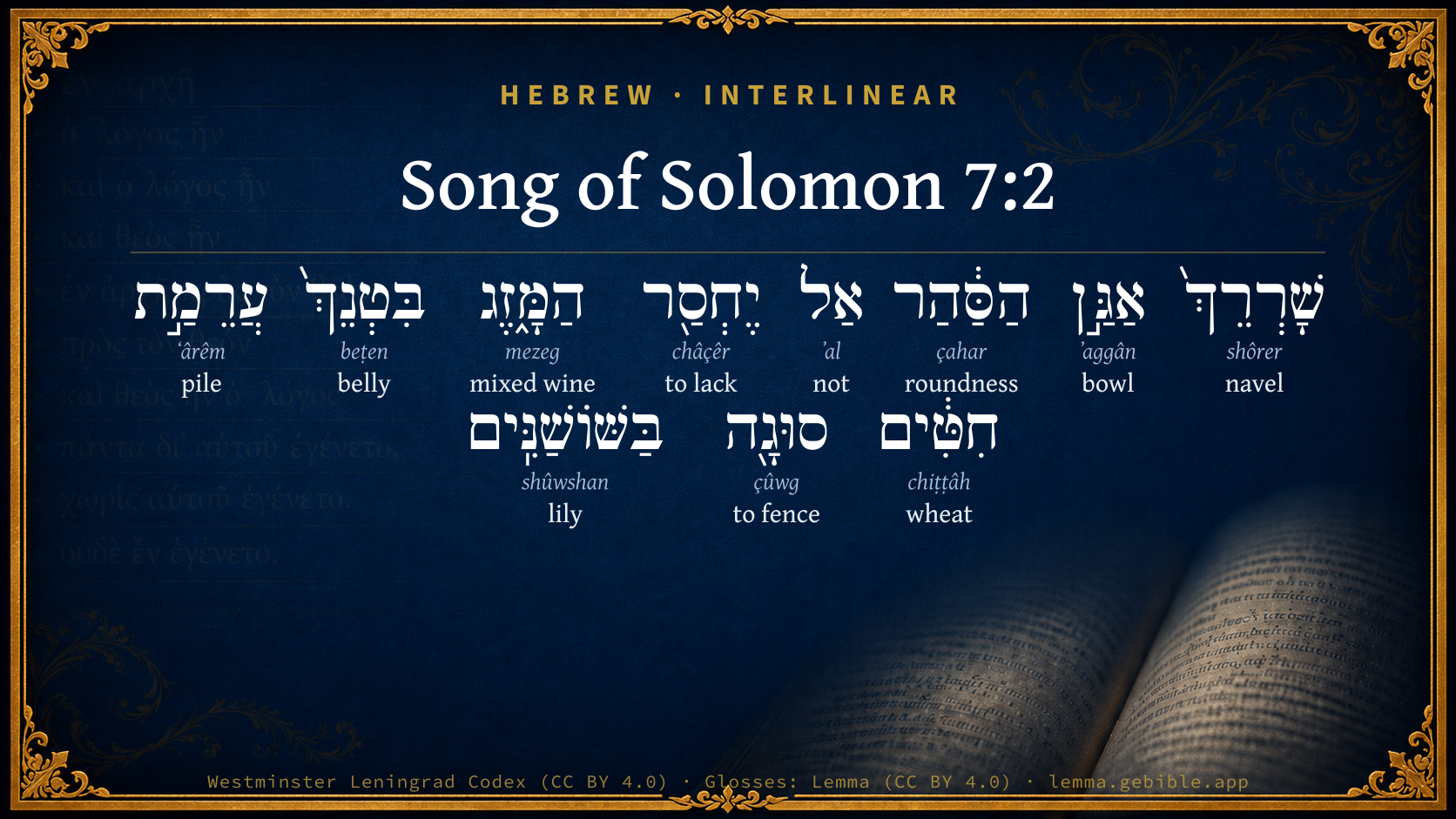
Hebrew (Westminster Leningrad Codex) Song of Solomon 7:2 appears in the Hebrew Old Testament. The text above is from the Westminster Leningrad Codex. Each word links to its Strong’s number, a concise gloss, and parsing drawn from the Open Scriptures Hebrew Bible morphology. Click any word for its full Brown-Driver-Briggs (BDB) entry.
Download image
Cite this verse

Song of Solomon 7:2 (World English Bible). Public Domain. Lemma interlinear Bible study tool, https://lemma.gebible.app/v/song-of-solomon/7/2.

Show BibTeX & RIS
BibTeX
RIS
English Translation
Your body is like a round goblet, No mixed wine is wanting. Your waist is like a heap of wheat, Set about with lilies.
World English Bible · Public Domain
Highlights
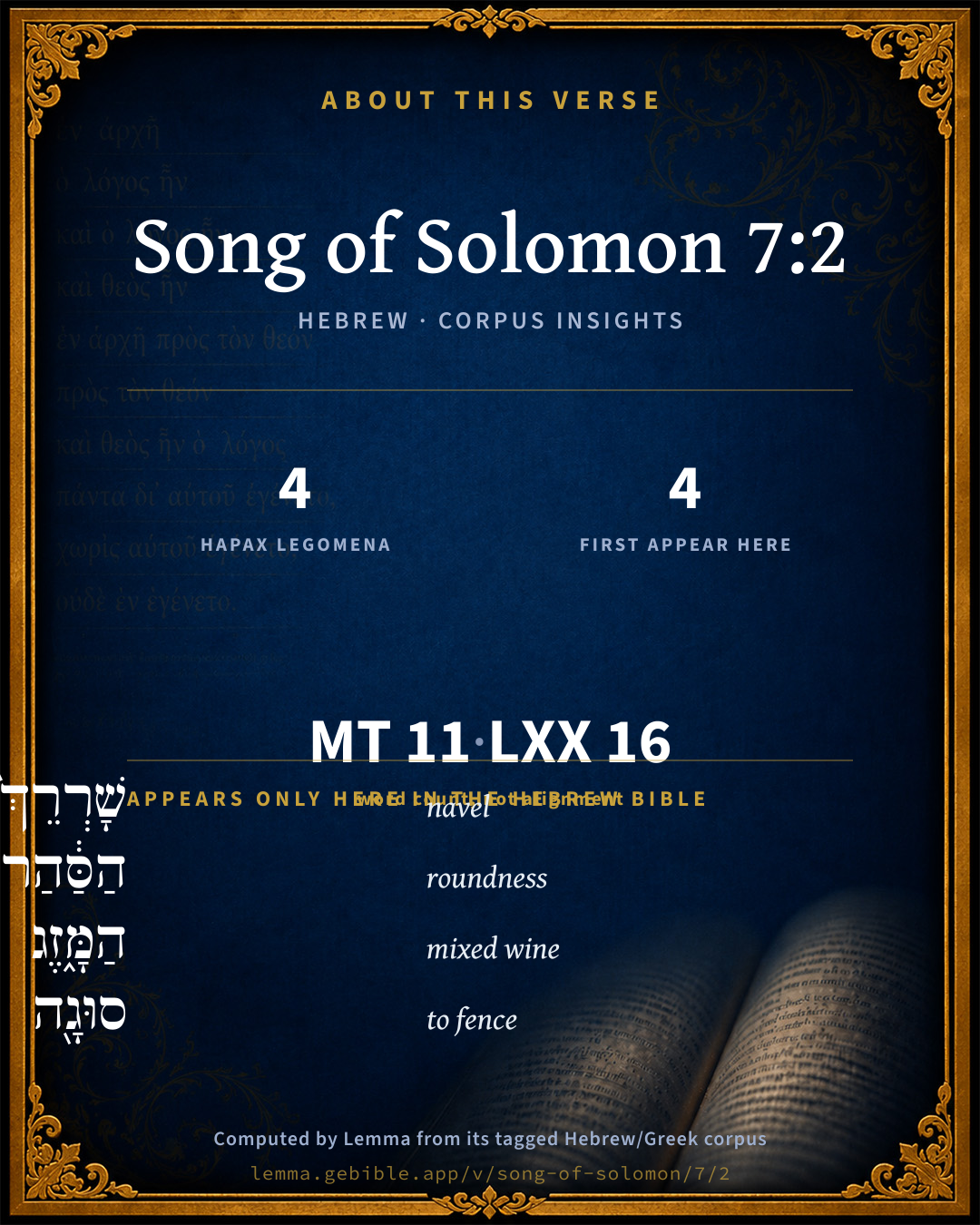
  • 4 hapax legomena — only here in the Hebrew Bible
  • 4 first appearances in the Hebrew Bible
Full analysis ↓
Download a study sheet

One document with this verse’s original text, its word-by-word gloss line, the meaning frame, cross-references with their text, attributed commentary, and full source and license credits — printable, and it pastes into notes with its structure intact.

This verse Autodidact and up

Study sheet (.html) Plain text (.txt)

A passage Seminary Student

Up to 50 verses in one chapter. A passage sheet keeps up to 6 commentary sources and 12 cross-references per verse, in the order this page ranks them, and says so on the sheet whenever that leaves anything out. Ask for a single verse and you get the Autodidact verse sheet above.

Everything on this page stays free to read, with no account — the sheet is a download of what is already on screen, not access to it.

Want to remove ads? Support Godless Engineer
Compare translations 3

The same verse in 3 English versions, stacked beneath the original-language interlinear above. Click any original word for its lexicon entry.

Each is an independent rendering of the whole verse — the interlinear is not word-aligned to these translations.

Highlighted words mark where these versions differ — a whole-verse word diff, not a word-by-word alignment.

  • World English Bible Public Domain
    Your body is like a round goblet, No mixed wine is wanting. Your waist is like a heap of wheat, Set about with lilies.
  • King James Version Public Domain
    Thy navel is like a round goblet, which wanteth not liquor: thy belly is like an heap of wheat set about with lilies.
  • unfoldingWord Literal Text CC BY-SA 4.0
    Your navel the rounded bowl— that never lacks spiced wine. Your belly a heap of wheat encircled with the lilies.

unfoldingWord Literal Text — © unfoldingWord, licensed CC BY-SA 4.0. Word-aligned USFM3 via Door43 (git.door43.org/unfoldingWord/en_ult).

Versions to compare (up to 4)

3 of 4 selected

Show all 18 translations

Every available English version of this verse, each an independent rendering of the whole verse.

  • World English Bible Public Domain
    Your body is like a round goblet, No mixed wine is wanting. Your waist is like a heap of wheat, Set about with lilies.
  • Berean Standard Bible Public Domain
    Your navel is a rounded goblet; it never lacks blended wine. Your waist is a mound of wheat encircled by the lilies.
  • Majority Standard Bible Public Domain
    Your navel is a rounded goblet; it never lacks blended wine. Your waist is a mound of wheat encircled by the lilies.
  • King James Version Public Domain
    Thy navel is like a round goblet, which wanteth not liquor: thy belly is like an heap of wheat set about with lilies.
  • American Standard Version (1901) Public Domain
    Thy body is `like' a round goblet, `Wherein' no mingled wine is wanting: Thy waist is `like' a heap of wheat Set about with lilies.
  • Revised Version (1885) Public Domain
    Thy navel is like a round goblet, wherein no mingled wine is wanting: thy belly is like an heap of wheat set about with lilies.
  • Geneva Bible (1599) Public Domain
    Thy nauel is as a round cuppe that wanteth not licour: thy belly is as an heape of wheat compassed about with lilies.
  • Douay-Rheims (1899) Public Domain
    Thy navel is like a round bowl never wanting cups. Thy belly is like a heap of wheat, set about with lilies.
  • Young's Literal Translation Public Domain
    Thy waist `is' a basin of roundness, It lacketh not the mixture, Thy body a heap of wheat, fenced with lilies,
  • Literal Standard Version CC BY-SA 4.0
    Your waist [is] a basin of roundness, || It does not lack the mixture, || Your body a heap of wheat, fenced with lilies,
  • Unlocked Literal Bible CC BY-SA 4.0
    Your navel is like a round bowl; may it never lack mixed wine. Your belly is like a mound of wheat encircled with lilies.
  • unfoldingWord Literal Text CC BY-SA 4.0
    Your navel the rounded bowl— that never lacks spiced wine. Your belly a heap of wheat encircled with the lilies.
  • Darby Bible Public Domain
    Thy navel is a round goblet, [which] wanteth not mixed wine; Thy belly a heap of wheat, set about with lilies;
  • World Messianic Bible Public Domain
    Your body is like a round goblet, no mixed wine is wanting. Your waist is like a heap of wheat, set about with lilies.
  • Webster's Bible Public Domain
    Thy navel is like a round goblet, which wanteth not liquor: thy belly is like a heap of wheat set about with lilies.
  • Free Bible Version CC BY-SA 4.0
    Your navel is like a round bowl—may it never lack spiced wine! Your abdomen is like a mound of wheat surrounded by lilies.
  • Bible in Basic English Public Domain
    Your stomach is a store of grain with lilies round it, and in the middle a round cup full of wine.
  • JPS Tanakh (1917) Public Domain
    (7-3) Thy navel is like a round goblet, wherein no mingled wine is wanting; thy belly is like a heap of wheat set about with lilies.

Literal Standard Version (2020), Covenant Press — licensed CC BY-SA 4.0. Text via the HelloAO Bible API (eBible.org). Unlocked Literal Bible (unfoldingWord) — licensed CC BY-SA 4.0. Text via the HelloAO Bible API (eBible.org). unfoldingWord Literal Text — © unfoldingWord, licensed CC BY-SA 4.0. Word-aligned USFM3 via Door43 (git.door43.org/unfoldingWord/en_ult). Free Bible Version, Dr. Jonathan Gallagher — licensed CC BY-SA 4.0. Text via the HelloAO Bible API (eBible.org).

Word by word

More ways to search: Search by grammar → Find every occurrence → Compare this word →

Practice this passage: Drill this verse → Learn its vocabulary →

שָׁרְרֵךְ֙
shôrer
H8326
“navel · your”
Noun, Common, Masculine, Singular, Construct + Suffix, Personal, 2nd Person, Feminine, Singular
Part of Speech
Noun
Type
Common
Gender
Masculine
Number
Singular
State
Construct
Full BDB Definition

Origin: from H8324 in the sense of twisting (compare H8270 )

TWOT: 2469a

navel, umbilical cord
  1. אַגַּ֣ן ʼaggân H101 “bowl of” Noun, Common, Masculine, Singular, Construct
  2. הַסַּ֔הַר çahar H5469 “the · roundness” Particle, Definite Article + Noun, Common, Masculine, Singular, Absolute
  3. אַל ʼal H408 “not” Particle, Negative
  4. יֶחְסַ֖ר châçêr H2637 “to lack” Verb, Qal, Jussive, 3rd Person, Masculine, Singular
  5. הַמָּ֑זֶג mezeg H4197 “the · mixed wine” Particle, Definite Article + Noun, Common, Masculine, Singular, Absolute
  6. בִּטְנֵךְ֙ beṭen H990 “belly · your” Noun, Common, Feminine, Singular, Construct + Suffix, Personal, 2nd Person, Feminine, Singular
  7. עֲרֵמַ֣ת ʻârêm H6194 “pile of” Noun, Common, Feminine, Singular, Construct
  8. חִטִּ֔ים chiṭṭâh H2406 “wheat” Noun, Common, Feminine, Plural, Absolute
  9. סוּגָ֖ה çûwg H5473 “fenced” Verb, Qal Passive, Participle Passive, Feminine, Singular, Absolute
  10. בַּשּׁוֹשַׁנִּֽים shûwshan H7799 “in/at the · lilies” Preposition, Determined + Noun, Common, Both, Plural, Absolute

About this verse

These counts appear in no published source. They are computed here, from the morphology-tagged text and Lemma’s own curated glosses. What Lemma adds →

11
words
11
distinct lemmas
Wisdom
section

Notable vocabulary

4 hapax legomena — words that appear only here in the entire Hebrew Bible:

  • שָׁרְרֵךְ֙ navel H8326
  • הַסַּ֔הַר roundness H5469
  • הַמָּ֑זֶג mixed wine H4197
  • סוּגָ֖ה to fence H5473

First appearance in Scripture

These words make their first canonical appearance in the Hebrew Bible here:

  • שָׁרְרֵךְ֙ navel H8326
  • הַסַּ֔הַר roundness H5469
  • הַמָּ֑זֶג mixed wine H4197
  • סוּגָ֖ה to fence H5473

Shared distinctive vocabulary

אַגַּ֣ן bowl H101 occurs in 3 verses of the Hebrew Bible. Also found in:

Grammatical profile

  • 2 verbs
  • 8 nouns
  • 1 particle

Verb forms

  • יֶחְסַ֖ר Qal · Jussive
  • סוּגָ֖ה Qal Passive · Participle Passive

Hebrew & Septuagint length

In English translation the verse runs 24 words from the Hebrew and 22 from the Septuagint (LXX English) — closely comparable.

A rough comparison of the two English renderings, which tokenize alike — not a word-level alignment.

Word counts can differ between the Hebrew and the Greek without any difference in meaning — e.g. the Hebrew direct-object marker אֵת has no separate Greek word, and Greek often adds the article ὁ.

In the original languages it is 11 Hebrew tokens and 16 Greek tokens — but the two are counted differently (Hebrew bundles its prefixes and suffixes into one token; the Greek is in lemma form), so that isn’t a like-for-like length.

Cross-references

6

Topical passages linked to Song of Solomon 7:2 in the Treasury of Scripture Knowledge — connected by theme and wording, ordered by reader-vote popularity; previews shown in the World English Bible.

  • Psalms 45:16 Your sons will take the place of your fathers. You shall make them princes in all the earth.
  • Proverbs 3:8 It will be health to your body, And nourishment to your bones.
  • Song of Solomon 5:14 His hands are like rings of gold set with beryl. His body is like ivory work overlaid with sapphires.
  • Isaiah 46:3 Listen to me, house of Jacob, and all the remnant of the house of Israel, that have been borne [by me] from their birth, that have been carried from the womb;
  • Jeremiah 1:5 Before I formed you in the belly I knew you, and before you came forth out of the womb I sanctified you; I have appointed you a prophet to the nations.
  • Romans 7:4 Therefore, my brothers, you also were made dead to the law through the body of Christ, that you would be joined to another, to him who was raised from the dead, that we might bring forth fruit to God.

Cross-references courtesy of OpenBible.info (CC BY 4.0).

Hebrew and Greek witnesses Masoretic Hebrew ↔ Greek Septuagint

The same verse in the two great witnesses to the Old Testament, shown verse-for-verse.

These are two independent witnesses, not word-aligned to each other, and the Septuagint is shown in lemma (dictionary) form.

Hebrew Song of Solomon 7:2 Masoretic · Westminster Leningrad Codex

שָׁרְרֵךְ֙ אַגַּ֣ן הַסַּ֔הַר אַל יֶחְסַ֖ר הַמָּ֑זֶג בִּטְנֵךְ֙ עֲרֵמַ֣ת חִטִּ֔ים סוּגָ֖ה בַּשּׁוֹשַׁנִּֽים

Your body is like a round goblet, No mixed wine is wanting. Your waist is like a heap of wheat, Set about with lilies.

World English Bible · Public Domain

Greek LXX Song of Solomon 7:2 Septuagint · lemma form

τίς ὡραιοῦμαι διάβημα σύ ἐν ὑπόδημα θυγάτηρ ναδαβ ῥυθμός μηρός σύ ὅμοιος ὁρμίσκος ἔργον χείρ τεχνίτης

Your navel is as a turned bowl, not lacking liquor; your belly is as a heap of wheat set about with lilies.

LXX2012 (modern English Septuagint) · Public Domain

Hebrew: Westminster Leningrad Codex (CC BY 4.0). Greek: Septuagint (public domain); English from LXX2012 (modern English Septuagint) (Public Domain). How the Septuagint differs from the Hebrew →

Commentary

Notes on Song of Solomon 7:2 from classic Christian and Jewish commentators (each source and its license shown beneath its notes). The classic Christian expositions comment on the surrounding passage and are grouped to its opening verse, so a note may address several verses; the Jewish commentaries on the Tanakh (Rashi and others) are per-verse, so they appear only where the commentator wrote on this verse.

Lemma curates 59 commentaries, every one of them public domain or Creative Commons licensed, each selected and text-cleaned for this edition rather than reprinted as found. About our sources →

Trapp's Complete Commentary

John Trapp

Son 7:2 Thy navel [is like] a round goblet, [which] wanteth not liquor: thy belly [is like] an heap of wheat set about with lilies.

Ver. 2. Thy navel is like a round goblet, &c.] There are those who expound this text as the two sacraments. The navel is baptism, that nourisheth newborn babes in the womh of the Church. See hence the use of it, even to infants, who can receive nourishment by the navel, though they can neither take nor chew nor suck meat with hand or mouth. Note this against Anabaptists, saith Mr Cotton upon these words, this navel never wants liquor; there is a continual matter of instruction and comfort to be fetched from baptism against all temptations. A Christian, saith Chrysostom, should never step out of doors, or lie down in his bed, or go into his closet, but he should remember that word, Abrenuncio, I forsake the devil and all his works, &c. Luther tells of a certain holy virgin, that used to quench the devil’s fiery darts with the water of baptism: for as often as she was tempted to do anything not beseeming her profession, she would resist the devil, steadfast in the faith, and stop his mouth with this short but full answer, Christiana sum, I am a Christian; I have been "baptized into the death of Christ"; I have also "put on Christ by baptism"; I am a votary, the vows of God are upon me, &c. But what a horrible shame is that to the Papists, and what a sore stumblingblock must it needs be to the poor Jews that live among them, that in Rome a Jewish maid may not be admitted into the stews of whoredom, unless she will be first baptized? This is related and bewailed by Espencaeus, {a} a moderate Papist.

Thy belly is like an heap of wheat, set about with lilies.] Some understand hereby that other sacrament of the Lord’s Supper, called a "heap of wheat," for its store of excellent nourishment; and said to be "set about with lilies" - that is, with Christians, white and of holy conversation. Basil calls such, stars of the world and flowers of the churches {b} Chrysostom calls them earthly angels, and saith that they were puriores coelo, purer than the heaven in their common conversation, but especially when they came to the Lord’s table - that dreadful {c} table, as he calleth it - whereunto all must come with the best preparation they can make, wash and be clean - wash their hands in innocence before they compass God’s altar, wash their "hearts," {Jer 4:14} their "feet." {Joh 13:10} "He that is washed (sc., for the outside) needeth not save to wash his feet, but is clean every whit"; an allusion to those that, having bathed their bodies, foul their feet by going out of the bath, and so are fain to wash them again. The inwards and the feet in a sacrifice were to be washed above the rest, because the entrails contain the excrements, and the legs tread in the dirt. The soul is apt to gather soil by meddling with earthly things, though lawful; how much more to be defiled with the soot of sin, as if she had "lain among the pots." All Christ’s Nazarites, his votaries, must come to his feast "purer than snow, whiter than milk," &c., {Lam 4:7} since at this sacrament they do renew the nuptials of Christ, and take a corporal oath to cleave close to him with full purpose of heart all the days of their lives. As for those that presume to come unpreparedly, that want their wedding garment, they are no otherwise bidden to the feast of the King than Haman was to Queen Esther’s. Sin brought to the Sacrament petitions against a man, as Esther did against Haman at the banquet of wine; {Est 7:2; Est 7:6} pick out that time, and he shall find God no less angry than Haman did Ahasuerus. For "this is that which the Lord hath said, I will be sanctified in all them that draw near unto me." Of communicants, God seems to say, as Solomon did of Adonijah, "If he show himself a worthy man, there shall not one hair of him fall to the earth: but if wickedness be found in him, he shall die." {1Ki 1:52}

{a} De Contin., lib. iii. cap. 4.

{b} Aστερας της οικουμενης ανθε των εκκλησιων.

{c} φρικωδης

John Trapp, A Commentary or Exposition upon All the Books of the Old and New Testament (1647–1656) — public domain. Text from a community e-Sword module.

Tyndale Open Study Notes

Tyndale Open Resources

7:2 Between your thighs lies a mound of wheat (literally Your belly is like a mound of wheat): The man is either describing the woman’s smoothly rounded abdomen or her pubic mound.

Tyndale Open Study Notes — © Tyndale Open Resources, licensed CC BY-SA 4.0. Text via the HelloAO Bible API.

Adam Clarke's Commentary

Verse 2. Thy navel is like a round goblet] This may also refer to some ornamental dress about the loins. These suppositions are rendered very probable from hundreds of the best finished and highly decorated drawings of Asiatic ladies in my own collection, where every thing appears in the drawings, as in nature.

A heap of wheat set about with lilies.] This is another instance of the same kind. The richly embroidered dresses in the above drawings may amply illustrate this also. Ainsworth supposes the metaphor is taken from a pregnant woman; the child in the womb being nourished by means of the umbilical cord or navel string, till it is brought into the world. After which it is fed by means of the mother's breasts, which are immediately mentioned. Possibly the whole may allude to the bride's pregnancy.

Adam Clarke's Commentary on the Bible (1810–1826) — public domain. Text from a community e-Sword/MySword module.

Ellicott's Commentary for English Readers

(2) Heap of wheat set about with lilies.—Wetstein (quoted by Delitzsch in his Appendix) remarks that in Syria the colour of wheat is regarded as the most beautiful colour the human body can have; and after remarking on the custom of decorating the heaps of winnowed corn with flowers in token of the joy of harvest, says:—“The appearance of such heaps of wheat, which one may see in long parallel rows on the threshing-floors of a village, is very pleasing to a peasant; and the comparison of the Song (Son_7:5) every Arabian will regard as beautiful.”

A Bible Commentary for English Readers, edited by Charles John Ellicott (1878–1897) — public domain. Text from a community e-Sword module.

The Cambridge Bible for Schools and Colleges

gen. ed. J. J. S. Perowne

2. Thy navel] Better, Thy body.

which wanteth not] This should be let not liquor be wanting.

liquor] Heb. mezegh is wine mixed with snow or water.

thy belly is like a heap of wheat] The point of the comparison is the yellowish-white colour of wheat threshed and winnowed, which is considered in Syria the perfect colour of the human skin. The soft curves of such a heap may also be referred to. The lilies may possibly indicate some part of the dress, but most probably belong to the simile only. Heaps of corn are still decorated with flowers on festal occasions, and the contrast of the scarlet lilies or anemones would bring out the colour of the grain.

The Cambridge Bible for Schools and Colleges (gen. ed. J. J. S. Perowne; Cambridge University Press, 1878–1918) — public domain. Text from a community e-Sword module.

Albert Barnes' Notes on the Bible

Or, Thy lap is like a moon-shaped bowl where mixed wine faileth not.” The wine in the bowl rising to the brim adds to the beauty of the vessel, and gives a more pleasing image to the eye. Some interpret, “thy girdle is like a moon-shaped bowl,” or “bears a moon-shaped ornament” (compare Isa 3:18).

Set about with lilies - The contrast is one of colors, the flowers, it may be, representing the purple of the robe. “The heap of wheat is not seen because covered by the lilies.”

Albert Barnes' Notes on the Bible (1834–1885) — public domain. Text from a community e-Sword/MySword module.

Matthew Poole's English Annotations

Thy navel is like a round goblet, to which it is not unfitly compared, because it is of a round form, and hollow, and hath windings and circlings in it,

which wanteth not liquor; thy navel is not only comely, but fruitful. For the navel is the proper instrument of nourishing the child or children which are in the womb. And so this seems to signify the church’s fruitfulness, partly in herself, in cherishing and improving all the graces and good motions of God’s Spirit within her; and principally in reference to those many children which she bears and feeds in her womb with the wholesome liquor of God’s ordinances. Thy belly, in which thy children are for a time contained and fed, is like a heap of wheat, i.e. of wheat corn, round and swelling, as it is in women with child, and full of nourishment, not only of liquor, as was last said, but also of meat, which may note the various provisions which Christ hath laid up in his church according to the several capacities of her children, milk for babes, and stronger meat for those who are grown up. Set about with lilies; not for defence, which the church doth not need, having the strong God for her Protector, but for ornament and beauty; whereby is implied that she is not only fruitful, but beautiful, and that her children are not only numerous and well fed, but also comely and delightful to the eye, as lilies are, and withal pure and innocent, in which respect both Christ and the church are compared to lilies, Son 2:1,2.

Matthew Poole's English Annotations on the Holy Bible (1683–1685) — public domain. Text from a community e-Sword/MySword module.

Whedon's Commentary on the Bible

Daniel D. Whedon

2. Which wanteth not liquor — Hebrew, Spiced wine should not be lacking. Set about, etc. — Grain threshed in the fields and left in a heap was “set about” with thorn bushes, to protect it from animals. From that usage this figure is taken, lilies, fair and white, being substituted for thorns. Plumpness and corpulency have always been reckoned in the East as elements of beauty in the feminine person. There can be no doubt that the writer here represents the King’s fatal disregard of the moral sentiment stated by our Lord, Mat_5:28.

Daniel D. Whedon (gen. ed.), Commentary on the Old and New Testaments (1874–1909) — public domain. Text from a community e-Sword module.

The Pulpit Commentary

Thy navel is like a round goblet, wherein no mingled wine is wanting: thy belly is like a heap of wheat set about with lilies. It must be remembered that ladies are speaking of one who is in the ladies" apartment. There is nettling indelicate in the description, though it is scarcely Western. The "round goblet," or basin, with mixed wine, i.e. wine with water or snow mixed with it, is intended to convey the idea of the shape of the lovely body with its flesh colour appearing through the semitransparent clothing, and moving gracefully like the diluted wine in the glass goblet. The navel is referred to simply as the center of the body, which it is in infants, and nearly so in adults. Perhaps Delitzsch is right in thinking that there may be an attempt to describe the navel itself as like the whirling hollow of water in a basin. In the latter part of the verse the shape of the body is undoubtedly intended. "To the present day winnowed and sifted corn is piled up in great heaps of symmetrical, half-spherical form, which are then frequently stuck over with things that move in the wind, for the purpose of protecting them against birds. The appearance of such heaps of wheat," says Wetstein, "which one may see in long parallel rows on the threshing floors of a village, is very pleasing to a peasant; and the comparison of the song every Arabian will regard as beautiful." According to the Moslem Sunnas, the colour of wheat was that of Adam. The white is a subdued white, denoting both perfect spotlessness and the purity of health. The smooth, round, fair body of the maiden is seen to advantage in the varied movements of the dance.

The Pulpit Commentary (1880–1919), ed. H.D.M. Spence-Jones & Joseph S. Exell — public domain. Text from a community e-Sword module.

unfoldingWord translationNotes

Door43 World Missions Community

General Information:

The young woman's lover continues describing the one he loves.

Your navel is like a round bowl

A bowl is round. The woman's navel is round. (See: Simile)

navel

the spot on the stomach left from the cord that attaches a baby to its mother

may it never lack mixed wine

People used large bowls to mix wine with water or spices at feasts. Drinking wine is a metaphor for enjoying beauty. The litotes can be translated as a positive. AT: "may it always contain mixed wine" or "may I always enjoy its beauty" (See: Metaphor and Litotes)

Your belly is like a mound of wheat encircled with lilies

The Israelites thought mounds of wheat and lilies were pleasant to look at. Much wheat was a sign that there would be much food to eat. They threshed wheat in high, dry places, and lilies grow in low, wet places, so this simile combines beautiful sights that people would not usually see at the same time. (See: Simile)

Your belly is like a mound of wheat

People thought that the color of wheat was the most beautiful color of skin and that round piles of wheat were beautiful. AT: "Your belly has a beautiful color and is round like a pile of wheat" (See: Simile)

a mound of wheat

This is a pile of the grains of wheat after people remove the parts of it that they do not use.

encircled with lilies

"with lilies all around it"

lilies

sweet-smelling flowers that grow in places where there is much water. Translate as the plural of "lily" in Song of Songs 2:1.

translationWords

like

wine

wheat

unfoldingWord translationNotes — © Distant Shores Media and the Door43 World Missions Community, licensed CC BY-SA 4.0. Source: git.door43.org/Door43/en_tn.

Rashi

Rabbi Shlomo Yitzchaki (Rashi)

How fair are your feet in sandals They say to her: We want you to cleave to us because of the beauty and the esteem that we saw in you when you were still beautiful.

How fair are your feet in the festive pilgrimages, O daughter of princes!

The curves of your thighs are like jewels A collection of gold jewels is called חֲלִי כֶתֶם, al chali in Arabic. And our Sages interpreted this as referring to the holes of the foundations [of the altar] for the libations, which were created during the Six Days of Creation, round as a thigh. like jewels Heb. חֲלָאִים, like the hollow of (חוּלְיַת) a pit.

the handiwork of a craftsman [They are] the [work of the] hands of the Holy One, blessed be He. [See] Tractate Succah (49a). craftsman Heb. אֳמָן, like אוּמָן. In the praise of the Holy One, blessed be He, the Israelites praise Him from top to bottom. They commence, so to speak, from “His head is as finest gold,” and progressively descend to “His legs are as pillars of marble,” since they come to appease Him, to draw down His Shechinah from the heavenly abodes to the earthly abodes. He, however, counts their praises from bottom to top: “How fair are your feet!” and He progressively counts until, “Your head upon you is like Carmel,” until He comes to draw them to Him.

Rashi on the Tanakh — English translations: “The Judaica Press complete Tanach with Rashi, translated by A. J. Rosenberg” (CC BY 4.0); “Pentateuch with Rashi's commentary by M. Rosenbaum and A.M. Silbermann, 1929-1934” (public domain); “The Metsudah Tanach series, Lakewood, N.J” (CC BY 4.0); and “The Book of Joshua, Metsudah Publications, 1997” (CC BY 4.0). Text via Sefaria.

Lesson kit

Teaching starters — assembled from the data on this page, not authored interpretation. Every prompt links to the verse data it draws on. Edit before teaching.

Song of Solomon, in the Wisdom, opens this verse with 11 words (11 distinct Hebrew lemmas). Its most distinctive word is shôrer (“navel”). A historical commentator’s framing appears above. Read the whole chapter for the surrounding context.

Discussion questions

  1. The word shôrer carries the sense “navel.” How does it shape the verse?
  2. This verse holds 4 words here found nowhere else in the Hebrew Bible. What might the rare words draw attention to?
  3. 4 words here appear for the first time in Scripture. What is being introduced at this debut?
  4. Exodus 24:6 shares the word «bowl» with this verse. How do the two illuminate each other?
  5. The translations on this page render this verse differently — a whole-verse word diff, not a word-by-word alignment. What might account for the different wordings?
  6. The verb «יֶחְסַ֖ר» is Qal Jussive. How does its form color the action?
  7. Reading how Trapp's Complete Commentary and Tyndale Open Study Notes read this verse, where do the two commentators agree and where do they part?

Things to notice

Reading settings

Reading text

Shown beneath each verse's original-language words.

Old Testament
Old Testament edition

Read the OT as the Masoretic Hebrew (MT) or the Greek Septuagint (LXX).

English shown for the Greek Septuagint (in the Hebrew ↔ Greek comparison).

Comparing translations? Open the Compare panel on any verse page to stack up to four side by side.