
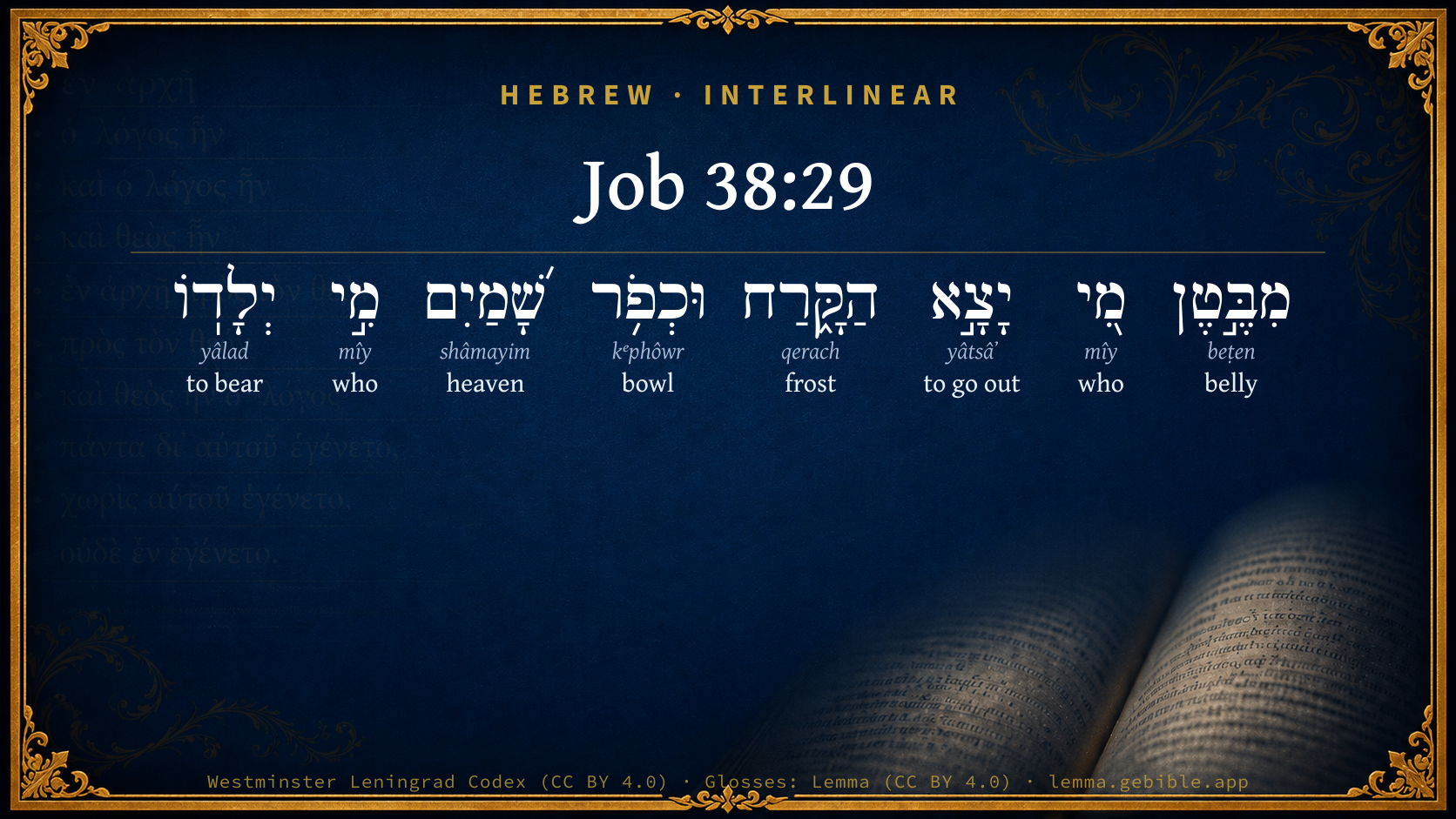
Job 38:29

Hebrew (Westminster Leningrad Codex) Job 38:29 appears in the Hebrew Old Testament. The text above is from the Westminster Leningrad Codex. Each word links to its Strong’s number, a concise gloss, and parsing drawn from the Open Scriptures Hebrew Bible morphology. Click any word for its full Brown-Driver-Briggs (BDB) entry.
Download image
Cite this verse

Job 38:29 (World English Bible). Public Domain. Lemma interlinear Bible study tool, https://lemma.gebible.app/v/job/38/29.

Show BibTeX & RIS
BibTeX
RIS
English Translation
Out of whose womb came the ice? The gray frost of the sky, who has given birth to it?
World English Bible · Public Domain
Download a study sheet

One document with this verse’s original text, its word-by-word gloss line, the meaning frame, cross-references with their text, attributed commentary, and full source and license credits — printable, and it pastes into notes with its structure intact.

This verse Autodidact and up

Study sheet (.html) Plain text (.txt)

A passage Seminary Student

Up to 50 verses in one chapter. A passage sheet keeps up to 6 commentary sources and 12 cross-references per verse, in the order this page ranks them, and says so on the sheet whenever that leaves anything out. Ask for a single verse and you get the Autodidact verse sheet above.

Everything on this page stays free to read, with no account — the sheet is a download of what is already on screen, not access to it.

Want to remove ads? Support Godless Engineer
Compare translations 3

The same verse in 3 English versions, stacked beneath the original-language interlinear above. Click any original word for its lexicon entry.

Each is an independent rendering of the whole verse — the interlinear is not word-aligned to these translations.

Highlighted words mark where these versions differ — a whole-verse word diff, not a word-by-word alignment.

  • World English Bible Public Domain
    Out of whose womb came the ice? The gray frost of the sky, who has given birth to it?
  • King James Version Public Domain
    Out of whose womb came the ice? and the hoary frost of heaven, who hath gendered it?
  • unfoldingWord Literal Text CC BY-SA 4.0
    From whose womb does ice come? And the frost of the skies, who bears it?

unfoldingWord Literal Text — © unfoldingWord, licensed CC BY-SA 4.0. Word-aligned USFM3 via Door43 (git.door43.org/unfoldingWord/en_ult).

Versions to compare (up to 4)

3 of 4 selected

Show all 18 translations

Every available English version of this verse, each an independent rendering of the whole verse.

  • World English Bible Public Domain
    Out of whose womb came the ice? The gray frost of the sky, who has given birth to it?
  • Berean Standard Bible Public Domain
    From whose womb does the ice emerge? Who gives birth to the frost from heaven,
  • Majority Standard Bible Public Domain
    From whose womb does the ice emerge? Who gives birth to the frost from heaven,
  • King James Version Public Domain
    Out of whose womb came the ice? and the hoary frost of heaven, who hath gendered it?
  • American Standard Version (1901) Public Domain
    Out of whose womb came the ice? And the hoary frost of heaven, who hath gendered it?
  • Revised Version (1885) Public Domain
    Out of whose womb came the ice? and the hoary frost of heaven, who hath gendered it?
  • Geneva Bible (1599) Public Domain
    Out of whose wombe came the yee? who hath ingendred the frost of the heauen?
  • Douay-Rheims (1899) Public Domain
    Out of whose womb came the ice; and the frost from heaven who hath gendered it?
  • Young's Literal Translation Public Domain
    From whose belly came forth the ice? And the hoar-frost of the heavens, Who hath begotten it?
  • Literal Standard Version CC BY-SA 4.0
    From whose belly came forth the ice? And the hoarfrost of the heavens, || Who has begotten it?
  • Unlocked Literal Bible CC BY-SA 4.0
    Out of whose womb did the ice come? Who bore the white frost out of the sky?
  • unfoldingWord Literal Text CC BY-SA 4.0
    From whose womb does ice come? And the frost of the skies, who bears it?
  • Darby Bible Public Domain
    Out of whose womb cometh the ice? and the hoary frost of heaven, who bringeth it forth?
  • World Messianic Bible Public Domain
    Whose womb did the ice come out of? Who has given birth to the gray frost of the sky?
  • Webster's Bible Public Domain
    Out of whose womb came the ice? and the hoary frost of heaven, who hath gendered it?
  • Free Bible Version CC BY-SA 4.0
    Who was the mother of ice? Does the frost of the air have a mother?
  • Bible in Basic English Public Domain
    Out of whose body came the ice? and who gave birth to the cold mist of heaven?
  • JPS Tanakh (1917) Public Domain
    Out of whose womb came the ice? And the hoar-frost of heaven, who hath gendered it?

Literal Standard Version (2020), Covenant Press — licensed CC BY-SA 4.0. Text via the HelloAO Bible API (eBible.org). Unlocked Literal Bible (unfoldingWord) — licensed CC BY-SA 4.0. Text via the HelloAO Bible API (eBible.org). unfoldingWord Literal Text — © unfoldingWord, licensed CC BY-SA 4.0. Word-aligned USFM3 via Door43 (git.door43.org/unfoldingWord/en_ult). Free Bible Version, Dr. Jonathan Gallagher — licensed CC BY-SA 4.0. Text via the HelloAO Bible API (eBible.org).

Word by word

More ways to search: Search by grammar → Find every occurrence → Compare this word →

Practice this passage: Drill this verse → Learn its vocabulary →

About this verse

These counts appear in no published source. They are computed here, from the morphology-tagged text and Lemma’s own curated glosses. What Lemma adds →

8
words
7
distinct lemmas
Wisdom
section

Notable vocabulary

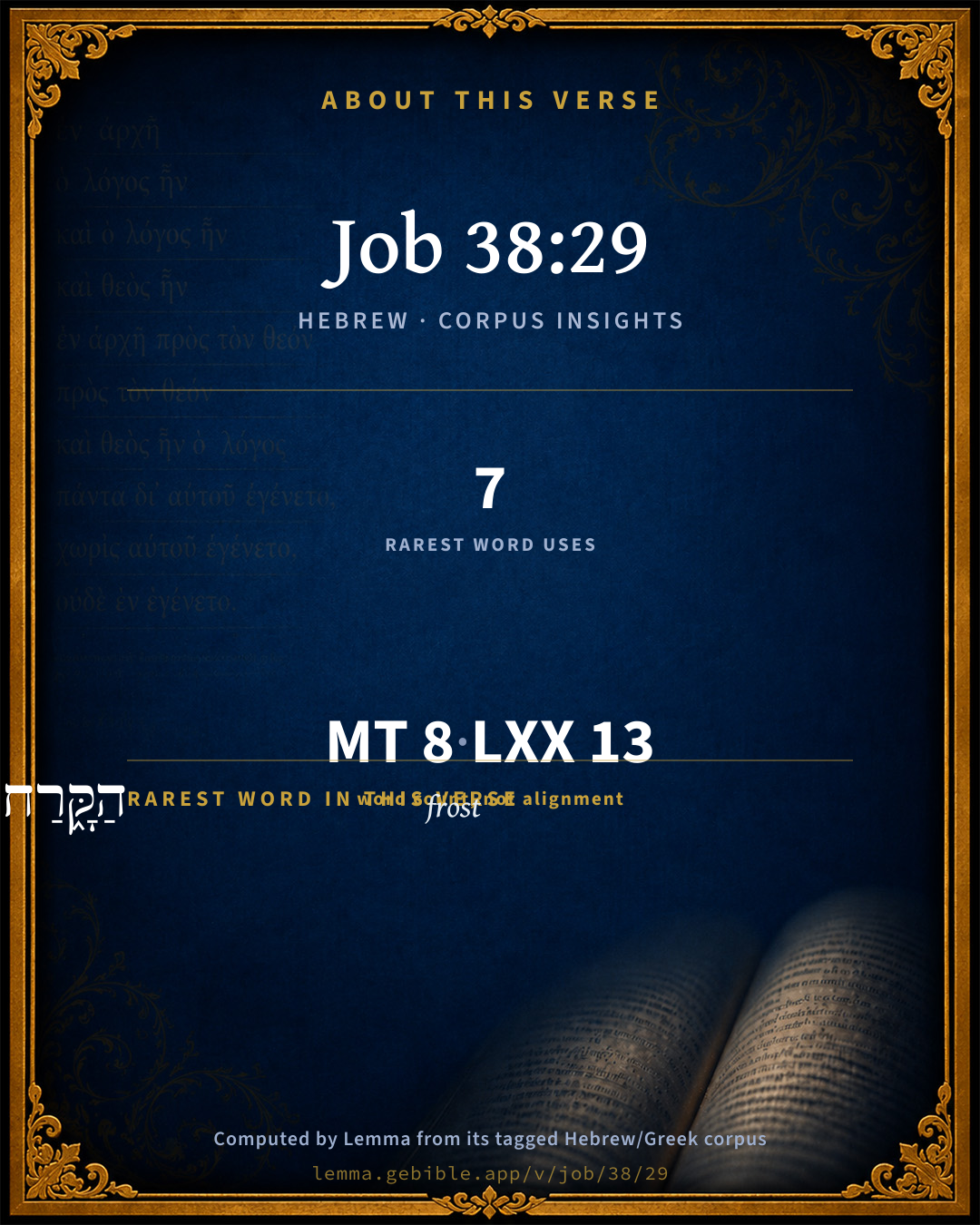
The rarest word here is הַקָּ֑רַח frost H7140 — appearing just 7 times in the whole Hebrew Bible.

Shared distinctive vocabulary

הַקָּ֑רַח frost H7140 occurs in 7 verses of the Hebrew Bible. Also found in:

Grammatical profile

  • 2 verbs
  • 4 nouns
  • 2 particles

Verb forms

  • יָצָ֣א Qal · Perfect
  • יְלָדֽוֹ Qal · Perfect

Repetition

A word recurs within this verse — often emphatic in Hebrew:

Hebrew & Septuagint length

In English translation the verse runs 19 words from the Hebrew and 17 from the Septuagint (LXX English) — closely comparable.

A rough comparison of the two English renderings, which tokenize alike — not a word-level alignment.

Word counts can differ between the Hebrew and the Greek without any difference in meaning — e.g. the Hebrew direct-object marker אֵת has no separate Greek word, and Greek often adds the article ὁ.

In the original languages it is 8 Hebrew tokens and 13 Greek tokens — but the two are counted differently (Hebrew bundles its prefixes and suffixes into one token; the Greek is in lemma form), so that isn’t a like-for-like length.

Cross-references

4

Topical passages linked to Job 38:29 in the Treasury of Scripture Knowledge — connected by theme and wording, ordered by reader-vote popularity; previews shown in the World English Bible.

  • Psalms 147:16–17 He gives snow like wool, And scatters frost like ashes.
  • Job 37:10 By the breath of God, ice is given, And the breadth of the waters is frozen.
  • Job 6:16 Which are black by reason of the ice, in which the snow hides itself:
  • Job 38:8 "Or who shut up the sea with doors, When it broke forth from the womb,

Cross-references courtesy of OpenBible.info (CC BY 4.0).

Hebrew and Greek witnesses Masoretic Hebrew ↔ Greek Septuagint

The same verse in the two great witnesses to the Old Testament, shown verse-for-verse.

These are two independent witnesses, not word-aligned to each other, and the Septuagint is shown in lemma (dictionary) form.

Hebrew Job 38:29 Masoretic · Westminster Leningrad Codex

מִבֶּ֣טֶן מִ֭י יָצָ֣א הַקָּ֑רַח וּכְפֹ֥ר שָׁ֝מַיִם מִ֣י יְלָדֽוֹ

Out of whose womb came the ice? The gray frost of the sky, who has given birth to it?

World English Bible · Public Domain

Greek LXX Job 38:29 Septuagint · lemma form

ἐκ γαστήρ δέ τίς ἐκπορεύομαι ὁ κρυστάλλος πάχνη δέ ἐν οὐρανός τίς τίκτω

And out of whose womb comes the ice? and who has produced the frost in the sky,

LXX2012 (modern English Septuagint) · Public Domain

Hebrew: Westminster Leningrad Codex (CC BY 4.0). Greek: Septuagint (public domain); English from LXX2012 (modern English Septuagint) (Public Domain). How the Septuagint differs from the Hebrew →

Commentary

Notes on Job 38:29 from classic Christian and Jewish commentators (each source and its license shown beneath its notes). The classic Christian expositions comment on the surrounding passage and are grouped to its opening verse, so a note may address several verses; the Jewish commentaries on the Tanakh (Rashi and others) are per-verse, so they appear only where the commentator wrote on this verse.

Lemma curates 59 commentaries, every one of them public domain or Creative Commons licensed, each selected and text-cleaned for this edition rather than reprinted as found. About our sources →

Jamieson, Fausset & Brown

Robert Jamieson, A. R. Fausset & David Brown

job 38:29Job 37:10.

Jamieson, Fausset & Brown — Commentary Critical and Explanatory on the Whole Bible (1871) — public domain (CC PDM 1.0). Text via the HelloAO Bible API.

Trapp's Complete Commentary

John Trapp

Job 38:29 Out of whose womb came the ice? and the hoary frost of heaven, who hath gendered it?

Ver. 29. Out of whose womb came the ice] Indeed of ice and water is said in a sense,

Mater me genuit: eadem mox gignitur ex me.

But these creatures are not produced by causes which are constant and invariable in nature, as human generation is, but they proceed from God’s pure and simple free will.

And the hoary frost of heaven, who hath gendered it?] Out of the heaven, that is, out of the lower region of the air, cometh the matter of it, but God maketh it. Naturalists say that the hoar frost is a vapour congealed by a cold wind in cold places of the lower region of the air; as in winter we see the breath that cometh out of the mouth to congeal and hang upon the beard and hairs. This hoar frost is answerable in the counter point to the dew, but lasteth much longer.

John Trapp, A Commentary or Exposition upon All the Books of the Old and New Testament (1647–1656) — public domain. Text from a community e-Sword module.

Adam Clarke's Commentary

Verse 29. Out of whose womb came the ice?] ICE is a solid, transparent, and brittle body, formed of water by means of cold. Some philosophers suppose that ice is only the re-establishment of water in its natural state; that the mere absence of fire is sufficient to account for this re-establishment; and that the fluidity of water is a real fusion, like that of metals exposed to the action of fire; and differing only in this, that a greater portion of fire is necessary to one than the other. Ice, therefore, is supposed to be the natural state of water; so that in its natural state water is solid, and becomes fluid only by the action of fire, as solid metallic bodies are brought into a state of fusion by the same means.

Ice is lighter than water, its specific gravity being to that of water as eight to nine. This rarefaction of ice is supposed to be owing to the air-bubbles produced in water by freezing, and which, being considerably larger in proportion to the water frozen, render the body so much specifically lighter; hence ice always floats on water. The air-bubbles, during their production, acquire a great expansive power, so as to burst the containing vessels, be they ever so strong. See examples in Clarke's note on "Job 37:10".

The hoary frost of heaven, who hath gendered it?] Hoar-frost is the congelation of dew, in frosty mornings, on the grass. It consists of an assemblage of little crystals of ice, which are of various figures, according to the different disposition of the vapours when met and condensed by the cold. Its production is owing to some laws with which we are not yet acquainted. Of this subject, after the lapse and experience of between two and three thousand years, we know about as much as Job did. And the question, What hath engendered the hoar-frost of heaven! is, to this hour, nearly as inexplicable to us as it was to him! Is it enough to say that hoar-frost is water deposited from the atmosphere at a low temperature, so as to produce congelation?

Adam Clarke's Commentary on the Bible (1810–1826) — public domain. Text from a community e-Sword/MySword module.

The Cambridge Bible for Schools and Colleges

gen. ed. J. J. S. Perowne

29. who hath gendered it] Rather, brought it forth, or borne it (Isa_49:21), as the parallelism of the first clause requires.

The Cambridge Bible for Schools and Colleges (gen. ed. J. J. S. Perowne; Cambridge University Press, 1878–1918) — public domain. Text from a community e-Sword module.

John Gill's Exposition

Canst thou bind the sweet influences of Pleiades,.... Of which See Gill on Job 9:9; and this constellation of the seven stars which is meant, rising in the spring, the pleasantnesses of the season, as the word may be rendered, may be intended here; which cannot be restrained or hindered from taking place in the proper course of the year; which is beautifully described in Sol 2:12; and may in a spiritual sense relate to the effects of powerful and efficacious grace, the influences of which are irresistible, and cause a springtime in the souls of men, where it was before winter, a state of darkness, deadness, coldness, hardness, and unfruitfulness, but now the reverse. Some versions read, "the bands of the Pleiades" (l), as if the sense was, canst thou gather and bind, or cluster together, such a constellation as the seven stars be, as I have done? thou canst not; and so not stop their rising or hinder their influences, according to the other versions:

or loose the bands of Orion? of which See Gill on Job 9:9 and Amo 5:8. This constellation appears in the winter, and brings with it stormy winds, rain, snow, and frost, which latter binds up the earth, that seeds and roots in it cannot spring up; and binds the hands of men from working, by benumbing them, or rendering their materials or utensils useless; for which reasons bands are ascribed to Orion, and are such strong ones that it is not in the power of men to loose: the seasons are not to be altered by men; and, Job might be taught by this that it was not in his power to make any change in the dispensations of Providence; to turn the winter of adversity into the spring of prosperity; and therefore it was best silently to submit to the sovereignty of God, and wait his time for a change of circumstances.

(l) , Sept. "nexus stellarum", Schmidt; so Jarchi and Targum.--According to the Talmud, the word signifies an hundred stars. Vid. T. Bab. Beracot, fol. 58. 2.

John Gill's Exposition of the Whole Bible (1746–1763) — public domain (CC PDM 1.0). Text via the HelloAO Bible API.

Albert Barnes' Notes on the Bible

Out of whose womb came the ice? - That is, who has caused or produced it? The idea is, that it was not by any human agency, or in any known way by which living beings were propagated.

And the hoary frost of heaven - Which seems to fall from heaven. The sense is, that it is caused wholly by God; see the notes at Job 37:10.

Albert Barnes' Notes on the Bible (1834–1885) — public domain. Text from a community e-Sword/MySword module.

Matthew Poole's English Annotations

What man either can produce them, or doth fully understand where or how they are engendered? For philosophers speak of these things only by guess, and the reasons which some assign for them are confuted by others; and so they will confute one another to the end of the world, and prove nothing solidly but their own ignorance and the reasonableness of these questions.

Matthew Poole's English Annotations on the Holy Bible (1683–1685) — public domain. Text from a community e-Sword/MySword module.

The Pulpit Commentary

Out of whose womb came the ice? Modern scientists admit that the process by which a liquid is metamorphosed into a solid transcends their utmost power of thought. They know nothing more than the fact that at the temperature of 32 Fahr. water, and at other temperatures other liquids, are solidified (see an article by Professor Tyndall on the generation of a snowflake in the Contemporary Review of 1880). It is thus not only creation itself, but the transformations of created things, that transcend the scientific intellect and are inexplicable. And the hoary frost of heaven, who hath gendered it? This is the same question as that of the previous clause, expressed in different words

The Pulpit Commentary (1880–1919), ed. H.D.M. Spence-Jones & Joseph S. Exell — public domain. Text from a community e-Sword module.

Rashi

Rabbi Shlomo Yitzchaki (Rashi)

and the frost glass or glassa in Old French.

Rashi on the Tanakh — English translations: “The Judaica Press complete Tanach with Rashi, translated by A. J. Rosenberg” (CC BY 4.0); “Pentateuch with Rashi's commentary by M. Rosenbaum and A.M. Silbermann, 1929-1934” (public domain); “The Metsudah Tanach series, Lakewood, N.J” (CC BY 4.0); and “The Book of Joshua, Metsudah Publications, 1997” (CC BY 4.0). Text via Sefaria.

Lesson kit

Teaching starters — assembled from the data on this page, not authored interpretation. Every prompt links to the verse data it draws on. Edit before teaching.

Job, in the Wisdom, opens this verse with 8 words (7 distinct Hebrew lemmas). Its most distinctive word is qerach (“frost”). A historical commentator’s framing appears above. Read the whole chapter for the surrounding context.

Discussion questions

  1. What does “frost” (qerach) contribute to the verse as a whole?
  2. How does Genesis 31:40, which shares the word «frost», read alongside this verse?
  3. What does the repetition of “who” (2× in this one verse) do in this verse?
  4. The translations on this page render this verse differently — a whole-verse word diff, not a word-by-word alignment. What might account for the different wordings?
  5. «יָצָ֣א» is a Qal Perfect verb. How does that grammatical form shape the action described?
  6. Compare how Jamieson, Fausset & Brown and Trapp's Complete Commentary read this verse. Where do they agree or differ?

Things to notice

Reading settings

Reading text

Shown beneath each verse's original-language words.

Old Testament
Old Testament edition

Read the OT as the Masoretic Hebrew (MT) or the Greek Septuagint (LXX).

English shown for the Greek Septuagint (in the Hebrew ↔ Greek comparison).

Comparing translations? Open the Compare panel on any verse page to stack up to four side by side.