Job 20:23

Hebrew (Westminster Leningrad Codex) Job 20:23 appears in the Hebrew Old Testament. The text above is from the Westminster Leningrad Codex. Each word links to its Strong’s number, a concise gloss, and parsing drawn from the Open Scriptures Hebrew Bible morphology. Click any word for its full Brown-Driver-Briggs (BDB) entry.
Download image
Cite this verse

Job 20:23 (World English Bible). Public Domain. Lemma interlinear Bible study tool, https://lemma.gebible.app/v/job/20/23.

Show BibTeX & RIS
BibTeX
RIS
English Translation
When he is about to fill his belly, God will cast the fierceness of his wrath on him. It will rain on him while he is eating.
World English Bible · Public Domain
Highlights
  • 1 first appearance in the Hebrew Bible
Full analysis ↓
Download a study sheet

One document with this verse’s original text, its word-by-word gloss line, the meaning frame, cross-references with their text, attributed commentary, and full source and license credits — printable, and it pastes into notes with its structure intact.

This verse Autodidact and up

Study sheet (.html) Plain text (.txt)

A passage Seminary Student

Up to 50 verses in one chapter. A passage sheet keeps up to 6 commentary sources and 12 cross-references per verse, in the order this page ranks them, and says so on the sheet whenever that leaves anything out. Ask for a single verse and you get the Autodidact verse sheet above.

Everything on this page stays free to read, with no account — the sheet is a download of what is already on screen, not access to it.

Want to remove ads? Support Godless Engineer
Compare translations 3

The same verse in 3 English versions, stacked beneath the original-language interlinear above. Click any original word for its lexicon entry.

Each is an independent rendering of the whole verse — the interlinear is not word-aligned to these translations.

Highlighted words mark where these versions differ — a whole-verse word diff, not a word-by-word alignment.

  • World English Bible Public Domain
    When he is about to fill his belly, God will cast the fierceness of his wrath on him. It will rain on him while he is eating.
  • King James Version Public Domain
    When he is about to fill his belly, God shall cast the fury of his wrath upon him, and shall rain it upon him while he is eating.
  • unfoldingWord Literal Text CC BY-SA 4.0
    He will be to fill his belly, he will send the burning of his nose against him, and he will rain upon him in his eating.

unfoldingWord Literal Text — © unfoldingWord, licensed CC BY-SA 4.0. Word-aligned USFM3 via Door43 (git.door43.org/unfoldingWord/en_ult).

Versions to compare (up to 4)

3 of 4 selected

Show all 18 translations

Every available English version of this verse, each an independent rendering of the whole verse.

  • World English Bible Public Domain
    When he is about to fill his belly, God will cast the fierceness of his wrath on him. It will rain on him while he is eating.
  • Berean Standard Bible Public Domain
    When he has filled his stomach, God will vent His fury upon him, raining it down on him as he eats.
  • Majority Standard Bible Public Domain
    When he has filled his stomach, God will vent His fury upon him, raining it down on him as he eats.
  • King James Version Public Domain
    When he is about to fill his belly, God shall cast the fury of his wrath upon him, and shall rain it upon him while he is eating.
  • American Standard Version (1901) Public Domain
    When he is about to fill his belly, `God' will cast the fierceness of his wrath upon him, And will rain it upon him while he is eating.
  • Revised Version (1885) Public Domain
    When he is about to fill his belly, God shall cast the fierceness of his wrath upon him, and shall rain it upon him while he is eating.
  • Geneva Bible (1599) Public Domain
    He shall be about to fill his belly, but God shall sende vpon him his fierce wrath, and shall cause to rayne vpon him, euen vpon his meate.
  • Douay-Rheims (1899) Public Domain
    May his belly be filled, that God may send forth the wrath of his indignation upon him, and rain down his war upon him.
  • Young's Literal Translation Public Domain
    It cometh to pass, at the filling of his belly, He sendeth forth against him The fierceness of His anger, Yea, He raineth on him in his eating.
  • Literal Standard Version CC BY-SA 4.0
    It comes to pass, at the filling of his belly, || He sends forth against him || The fierceness of His anger, || Indeed, He rains on him in his eating.
  • Unlocked Literal Bible CC BY-SA 4.0
    When he is about to fill his stomach, God will throw the fierceness of his wrath on him; God will rain it down on him while he is eating.
  • unfoldingWord Literal Text CC BY-SA 4.0
    He will be to fill his belly, he will send the burning of his nose against him, and he will rain upon him in his eating.
  • Darby Bible Public Domain
    It shall be that, to fill his belly, he will cast his fierce anger upon him, and will rain it upon him into his flesh.
  • World Messianic Bible Public Domain
    When he is about to fill his belly, God will cast the fierceness of his wrath on him. It will rain on him while he is eating.
  • Webster's Bible Public Domain
    When he is about to fill his belly, God shall cast the fury of his wrath upon him, and shall rain it upon him while he is eating.
  • Free Bible Version CC BY-SA 4.0
    While they are busy filling their bellies, God's hostility will burn against them, raining down on them.
  • Bible in Basic English Public Domain
    God gives him his desire, and sends the heat of his wrath on him, making it come down on him like rain.
  • JPS Tanakh (1917) Public Domain
    It shall be for the filling of his belly; He shall cast the fierceness of His wrath upon him, and shall cause it to rain upon him into his flesh.

Literal Standard Version (2020), Covenant Press — licensed CC BY-SA 4.0. Text via the HelloAO Bible API (eBible.org). Unlocked Literal Bible (unfoldingWord) — licensed CC BY-SA 4.0. Text via the HelloAO Bible API (eBible.org). unfoldingWord Literal Text — © unfoldingWord, licensed CC BY-SA 4.0. Word-aligned USFM3 via Door43 (git.door43.org/unfoldingWord/en_ult). Free Bible Version, Dr. Jonathan Gallagher — licensed CC BY-SA 4.0. Text via the HelloAO Bible API (eBible.org).

Word by word

More ways to search: Search by grammar → Find every occurrence → Compare this word →

Practice this passage: Drill this verse → Learn its vocabulary →

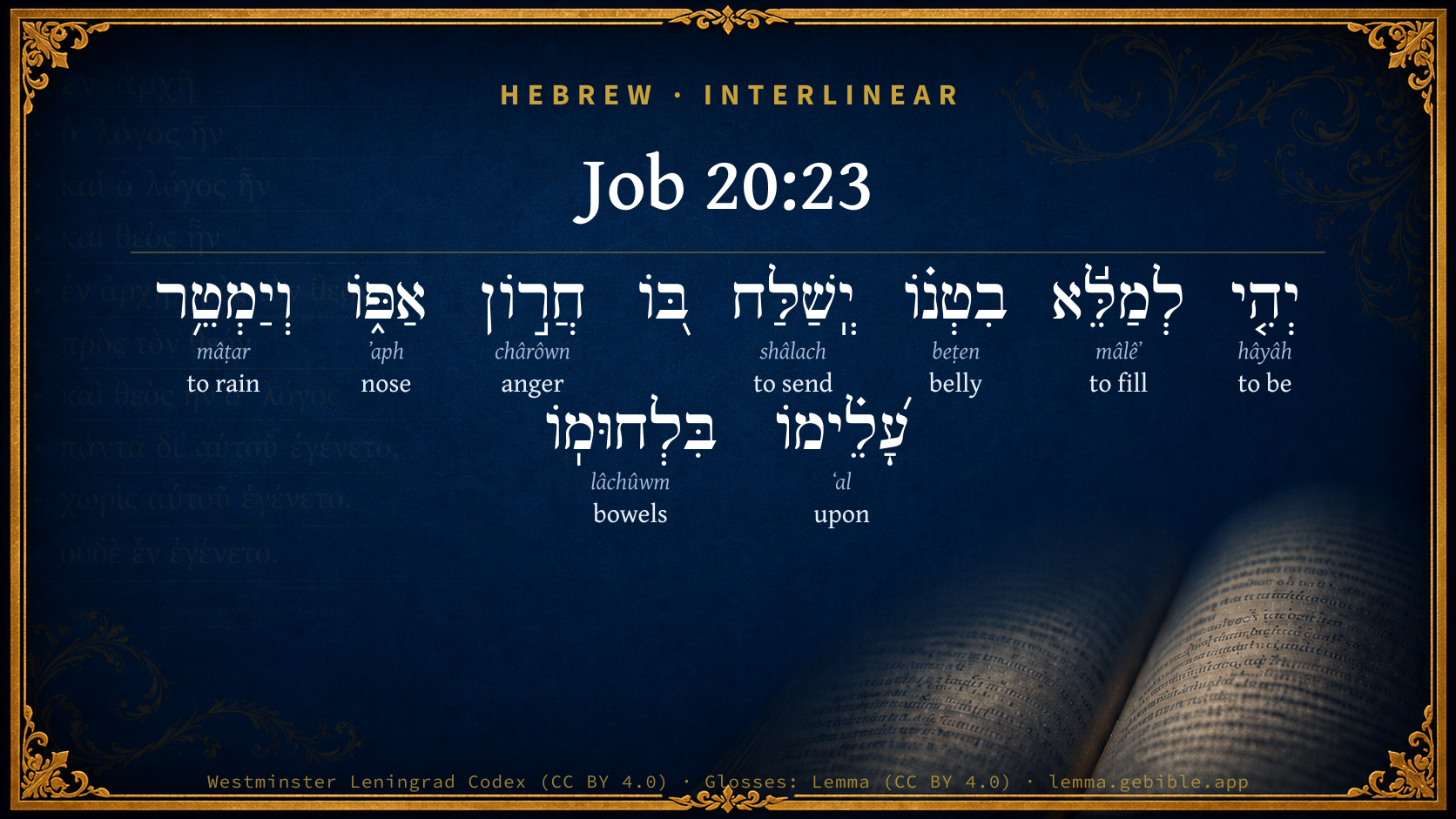
בִּלְחוּמֽוֹ
lâchûwm
H3894
“in/at · bowels · his”
Preposition + Noun, Common, Masculine, Singular, Construct + Suffix, Personal, 3rd Person, Masculine, Singular
Part of Speech
Preposition + Noun
Type
Common
Gender
Masculine
Number
Singular
State
Construct
Full BDB Definition

Origin: passive participle of H3898

TWOT: 1104b

intestines, bowels - meaning uncertain - (CLBL) food, something eaten
  1. יְהִ֤י hâyâh H1961 “to be” Verb, Qal, Jussive, 3rd Person, Masculine, Singular
  2. לְמַלֵּ֬א mâlêʼ H4390 “to fill” Preposition + Verb, Piel, Infinitive Construct
  3. בִטְנ֗וֹ beṭen H990 “belly · his” Noun, Common, Feminine, Singular, Construct + Suffix, Personal, 3rd Person, Masculine, Singular
  4. יְֽשַׁלַּח shâlach H7971 “to send” Verb, Piel, Imperfect, 3rd Person, Masculine, Singular
  5. חֲר֣וֹן chârôwn H2740 “anger of” Noun, Common, Masculine, Singular, Construct
  6. אַפּ֑וֹ ʼaph H639 “nose · his” Noun, Common, Masculine, Singular, Construct + Suffix, Personal, 3rd Person, Masculine, Singular
  7. וְיַמְטֵ֥ר mâṭar H4305 “and · to rain” Conjunction + Verb, Hiphil, Imperfect, 3rd Person, Masculine, Singular
  8. עָ֝לֵ֗ימוֹ ʻal H5921 “upon · him” Preposition + Suffix, Personal, 3rd Person, Masculine, Singular

About this verse

These counts appear in no published source. They are computed here, from the morphology-tagged text and Lemma’s own curated glosses. What Lemma adds →

10
words
9
distinct lemmas
Wisdom
section

Notable vocabulary

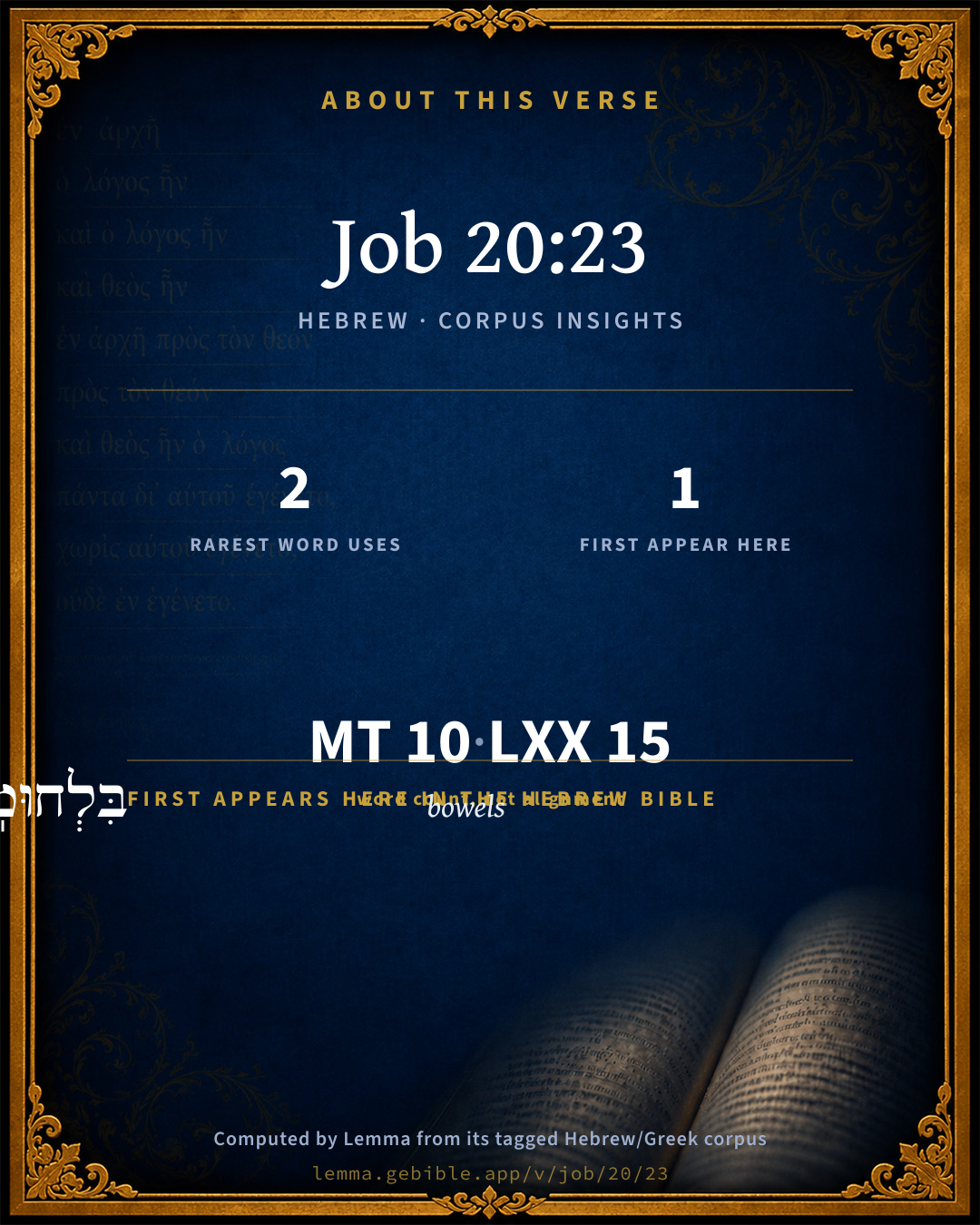
The rarest word here is בִּלְחוּמֽוֹ bowels H3894 — appearing just 2 times in the whole Hebrew Bible.

First appearance in Scripture

This word makes its first canonical appearance in the Hebrew Bible here:

  • בִּלְחוּמֽוֹ bowels H3894

Shared distinctive vocabulary

בִּלְחוּמֽוֹ bowels H3894 occurs in 2 verses of the Hebrew Bible. Also found in:

Grammatical profile

  • 4 verbs
  • 4 nouns
  • 2 prepositions

Verb forms

  • יְהִ֤י Qal · Jussive
  • לְמַלֵּ֬א Piel · Infinitive Construct
  • יְֽשַׁלַּח Piel · Imperfect
  • וְיַמְטֵ֥ר Hiphil · Imperfect

Hebrew & Septuagint length

In English translation the verse runs 27 words from the Hebrew and 27 from the Septuagint (LXX English) — the same length.

A rough comparison of the two English renderings, which tokenize alike — not a word-level alignment.

Word counts can differ between the Hebrew and the Greek without any difference in meaning — e.g. the Hebrew direct-object marker אֵת has no separate Greek word, and Greek often adds the article ὁ.

In the original languages it is 10 Hebrew tokens and 15 Greek tokens — but the two are counted differently (Hebrew bundles its prefixes and suffixes into one token; the Greek is in lemma form), so that isn’t a like-for-like length.

Cross-references

8

Topical passages linked to Job 20:23 in the Treasury of Scripture Knowledge — connected by theme and wording, ordered by reader-vote popularity; previews shown in the World English Bible.

  • Psalms 78:30–31 They didn't turn from their cravings. Their food was yet in their mouths,
  • Numbers 11:33 While the flesh was yet between their teeth, before it was chewed, the anger of Yahweh was kindled against the people, and Yahweh struck the people with a very great plague.
  • Genesis 19:24 Then Yahweh rained on Sodom and on Gomorrah sulfur and fire from Yahweh out of the sky.
  • Exodus 9:23 Moses stretched forth his rod toward the heavens, and Yahweh sent thunder, hail, and lightning flashed down to the earth. Yahweh rained hail on the land of Egypt.
  • Psalms 11:6 On the wicked he will rain blazing coals; Fire, sulfur, and scorching wind shall be the portion of their cup.
  • Isaiah 21:4 My heart flutters, horror has frightened me; the twilight that I desired has been turned into trembling to me.
  • Malachi 2:2 If you will not listen, and if you will not lay it to heart, to give glory to my name," says Yahweh of Hosts, "then will I send the curse on you, and I will curse your blessings. Indeed, I have cursed them already, because you do not lay it to heart.
  • Luke 12:17–20 He reasoned within himself, saying, 'What will I do, because I don't have room to store my crops?'

Cross-references courtesy of OpenBible.info (CC BY 4.0).

Hebrew and Greek witnesses Masoretic Hebrew ↔ Greek Septuagint

The same verse in the two great witnesses to the Old Testament, shown verse-for-verse.

These are two independent witnesses, not word-aligned to each other, and the Septuagint is shown in lemma (dictionary) form.

Hebrew Job 20:23 Masoretic · Westminster Leningrad Codex

יְהִ֤י לְמַלֵּ֬א בִטְנ֗וֹ יְֽשַׁלַּח בּ֭וֹ חֲר֣וֹן אַפּ֑וֹ וְיַמְטֵ֥ר עָ֝לֵ֗ימוֹ בִּלְחוּמֽוֹ

When he is about to fill his belly, God will cast the fierceness of his wrath on him. It will rain on him while he is eating.

World English Bible · Public Domain

Greek LXX Job 20:23 Septuagint · lemma form

εἰ πῶς πληρόω γαστήρ αὐτός ἐπι ἀποστέλλω ἐπί αὐτός θυμός ὀργή νίπτω ἐπί αὐτός ὀδύνη

If by any means he would fill his belly, let God send upon him the fury of wrath; let him bring a torrent of pains upon him.

LXX2012 (modern English Septuagint) · Public Domain

On this verse, Haydock's Catholic Bible Commentary discusses the Septuagint’s reading. Read the note in Commentary ↓

Hebrew: Westminster Leningrad Codex (CC BY 4.0). Greek: Septuagint (public domain); English from LXX2012 (modern English Septuagint) (Public Domain). How the Septuagint differs from the Hebrew →

Commentary

Notes on Job 20:23 from classic Christian and Jewish commentators (each source and its license shown beneath its notes). The classic Christian expositions comment on the surrounding passage and are grouped to its opening verse, so a note may address several verses; the Jewish commentaries on the Tanakh (Rashi and others) are per-verse, so they appear only where the commentator wrote on this verse.

Lemma curates 59 commentaries, every one of them public domain or Creative Commons licensed, each selected and text-cleaned for this edition rather than reprinted as found. About our sources →

Matthew Henry's Commentary

Zophar, having described the many embarrassments and vexations which commonly attend the wicked practices of oppressors and cruel men, here comes to show their utter ruin at last.

I. Their ruin will take its rise from God's wrath and vengeance, Job 20:23. The hand of the wicked was upon him (Job 20:22), every hand of the wicked. His hand was against every one, and therefore every man's hand will be against him. Yet, in grappling with these, he might go near to make his part good; but his heart cannot endure, nor his hands be strong, when God shall deal with him (Eze 22:14), when God shall cast the fury of his wrath upon him and rain it upon him. Every word here speaks terror. It is not only the justice of God that is engaged against him, but his wrath, the deep resentment of provocations given to himself; it is the fury of his wrath, incensed to the highest degree; it is cast upon him with force and fierceness; it is rained upon him in abundance; it comes on his head like the fire and brimstone upon Sodom, to which the psalmist also refers, Psa 11:6. On the wicked God shall rain fire and brimstone. There is no fence against this, but in Christ, who is the only covert from the storm and tempest, Isa 32:2. This wrath shall be cast upon him when he is about to fill his belly, just going to glut himself with what he has gotten and promising himself abundant satisfaction in it. Then, when he is eating, shall this tempest surprise him, when he is secure and easy, and in apprehension of no danger; as the ruin of the old world and Sodom came when they were in the depth of their security and the height of their sensuality, as Christ observes, Luk 17:26, etc. Perhaps Zophar here reflects on the death of Job's children when they were eating and drinking.

II. Their ruin will be inevitable, and there will be no possibility of escaping it (Job 20:24): He shall flee from the iron weapon. Flight argues guilt. He will not humble himself under the judgments of God, nor seek means to make his peace with him. All his care is to escape the vengeance that pursues him, but in vain: if he escape the sword, yet the bow of steel shall strike him through. God has weapons of all sorts; he has both whet his sword and bent his bow (Psa 7:12, Psa 7:13); he can deal with his enemies cominus vel eminus - at hand or afar off. He has a sword for those that think to fight it out with him by their strength, and a bow for those that think to avoid him by their craft. See Isa 24:17, Isa 24:18; Jer 48:43, Jer 48:44. He that is marked for ruin, though he may escape one judgment, will find another ready for him.

III. It will be a total terrible ruin. When the dart that has struck him through (for when God shoots he is sure to hit his mark, when he strikes he strikes home) comes to be drawn out of his body, when the glittering sword (the lightning, so the word is), the flaming sword, the sword that is bathed in heaven (Isa 34:5), comes out of his gall, O what terrors are upon him! How strong are the convulsions, how violent are the dying agonies! How terrible are the arrests of death to a wicked man!

IV. Sometimes it is a ruin that comes upon him insensibly, Job 20:26. 1. The darkness he is wrapped up in is a hidden darkness: it is all darkness, utter darkness, without the least mixture of light, and it is hid in his secret place, whither he has retreated and where he hopes to shelter himself; he never retires into his own conscience but he finds himself in the dark and utterly at a loss. 2. The fire he is consumed by is a fire not blown, kindled without noise, a consumption which every body sees the effect of, but nobody sees the cause of. It is plain that the gourd is withered, but the worm at the root, that causes it to wither, is out of sight. He is wasted by a soft gentle fire - surely, but very slowly. When the fuel is very combustible, the fire needs no blowing, and that is his case; he is ripe for ruin. The proud, and those that do wickedly, shall be stubble, Mal 4:1. An unquenchable fire shall consume him (so some read it), and that is certainly true of hell-fire.

V. It is a ruin, not only to himself, but to his family: It shall go ill with him that is left in his tabernacle, for the curse shall reach him, and he shall be cut off perhaps by the same grievous disease. There is an entail of wrath upon the family, which will destroy both his heirs and his inheritance, Job 20:28. 1. His posterity will be rooted out: The increase of his house shall depart, shall either be cut off by untimely deaths or forced to run their country. Numerous and growing families, if wicked and vile, are soon reduced, dispersed, and extirpated, by the judgments of God. 2. His estate will be sunk. His goods shall flow away from his family as fast as ever they flowed into it, when the day of God's wrath comes, for which, all the while his estate was in the getting by fraud and oppression, he was treasuring up wrath.

VI. It is a ruin which will manifestly appear to be just and righteous, and what he has brought upon himself by his own wickedness; for (Job 20:27) the heaven shall reveal his iniquity, that is, the God of heaven, who sees all the secret wickedness of the wicked, will, by some means or other, let all the world know what a base man he has been, that they may own the justice of God in all that is brought upon him. The earth also shall rise up against him, both to discover his wickedness and to avenge it. The earth shall disclose her blood, Isa 26:21. The earth will rise up against him (as the stomach rises against that which is loathsome), and will no longer keep him. The heaven reveals his iniquity, and therefore will not receive him. Whither then must he go but to hell? If the God of heaven and earth be his enemy, neither heaven nor earth will show him any kindness, but all the hosts of both are and will be at war with him.

VII. Zophar concludes like an orator (Job 20:29): This is the portion of a wicked man from God; it is allotted him, it is designed him, as his portion. He will have it at last, as a child has his portion, and he will have it for a perpetuity; it is what he must abide by: This is the heritage of his decree from God; it is the settled rule of his judgment, and fair warning is given of it. O wicked man! thou shalt surely die, Eze 33:8. Though impenitent sinners do not always fall under such temporal judgments as are here described (therein Zophar was mistaken), yet the wrath of God abides upon them, and they are made miserable by spiritual judgments, which are much worse, their consciences being either, on the one hand, a terror to them, and then they are in continual amazement, or, on the other hand, seared and silenced, and then they are given up to a reprobate sense and bound over to eternal ruin. Never was any doctrine better explained, or worse applied, than this by Zophar, who intended by all this to prove Job a hypocrite. Let us receive the good explication, and make a better application, for warning to ourselves to stand in awe and not to sin.

Matthew Henry's Commentary on the Whole Bible (1708–1710) — public domain (CC PDM 1.0). Text via the HelloAO Bible API.

Trapp's Complete Commentary

John Trapp

Job 20:23 [When] he is about to fill his belly, [God] shall cast the fury of his wrath upon him, and shall rain [it] upon him while he is eating.

Ver. 23. When he is about to fill his belly] It appeareth, by this expression, that it was belly timber wherein the wicked man placed his sufficiency, Job 20:22, his felicity, Si ventri bene sit, si lateri, saith the Epicure in Horace. If the belly may be filled, the body fitted, that is all that these Lurcones, these profligates, look after. Polyphemus knew no other god but his belly. There were belly gods in St Paul’s time, such as of whom he could not speak with dry eyes, Php 3:18-19. Such are compared by Clement of Alexandria to the sea ass, that hath his heart in his belly. By others to the locust, the belly whereof is said to be joined to his mouth, and to end at his tail; to the fish called Blax, that is altogether unprofitable; and to rats and mice, good for nothing but to devour victuals. When therefore such a pamphagus is about to fill his belly and to pamper his paunch, or otherwise to gorge himself with the full messes of sin’s dainties (as the viper lives on venomous things, the spider on aconite, the sow on swill, as Tartarians on carrion, holding them as dainty as other men do venison), then, saith Zophar,

God shall cast the fury of his wrath upon him] Heb. He shall send forth, &c. He will no longer keep in his judgments in the chains of mercy, but give them their full forth upon this wicked oppressor; and that even very then, when he bids his heart make merry, and assures himself of unchangeable happiness. For,

He shall rain it upon him (that is, reveal it from heaven against him, Rom 1:18) while he is eating] Mat 24:38. As it befell those cormorants, Num 11:33, and the old world, Luk 17:26-27 Sudden destruction cometh upon them, as travail upon a woman with child; Vel ut pluvia quae sereno coelo inopinantes opprimit. Or as foul weather that comes unsent for, and oft unlooked for. The Vulgate rendereth it, And he shall rain his war upon him. But this Zophar setteth forth in the next verse, where he denounceth war and weapons.

John Trapp, A Commentary or Exposition upon All the Books of the Old and New Testament (1647–1656) — public domain. Text from a community e-Sword module.

Joseph Benson's Commentary

Job 20:23. When he is about to fill his belly — That is, when he has enough to satisfy all his appetites, and shall design to indulge them in the pleasurable enjoyment of all his gains, and to spend his days in sensuality; God shall cast the fury of his wrath upon him — Some dreadful and destructive judgment. And shall rain it upon him — This phrase denotes both the author of his plagues, God, and the nature and quality of them, that they shall come upon him like rain, with great vehemence, so that he cannot prevent or avoid them; while he is eating — As it fell upon thy sons, Job 1:18-19.

Joseph Benson's Commentary on the Old and New Testaments (1811–1818) — public domain. Text from a community e-Sword module.

Whedon's Commentary on the Bible

Daniel D. Whedon

Fourth strophe — Heaven and earth conspire to make the doom of the wicked complete and inevitable, Job_20:23-28.

23. About to fill his belly — Literally, It shall be to fill his belly.

God shall cast — Rather, he casts on him the fury of his wrath, and causes (it) to rain upon him with his food.

While he is eating — Literally, in his food. לחום, bowels, (Hitzig,) flesh, (Delitzsch.) The employment of unusual words leads Delitzsch to remark, “the morally indignant speech, which threatens punishment, intentionally seeks after rare solemn words and darksome tones.” But a little while ago the wicked hid dainty morsels of wickedness under his tongue, which were too delicious to swallow, (Job_20:12-13;) now his food is mixed with the wrath of God, which he, perforce, must swallow. “As he could never be satisfied with sensuous goods, (Job_20:20) God will satisfy him — with his punishments.” — Hirtzel. The Parthians poured melted gold down the throat of the greedy Roman general Crassus, whom they had defeated and slain. — RAWLINSON, Sixth Monarchy, p. 175. The first word, יהי, is jussive, like the expressions “casts” and “causes to rain,” and indicates the speaker’s acquiescence in the retributions of God. They are a kind of amen to the divine will.

Daniel D. Whedon (gen. ed.), Commentary on the Old and New Testaments (1874–1909) — public domain. Text from a community e-Sword module.

Geneva Bible (1599)

Geneva Bible translators

Some read, upon his flesh, alluding to Job, whose flesh was smitten with a scab.

Geneva Bible (1599) marginal notes — public domain. Text via Bolls.life.

Jamieson, Fausset & Brown

Robert Jamieson, A. R. Fausset & David Brown

Rather, "God shall cast (may God send) [UMBREIT] upon him the fury of His wrath to fill his belly!"

while . . . eating--rather, "shall rain it upon him for his food!" Fiery rain, that is, lightning (Psa 11:6; alluding to Job's misfortune, Job 1:16). The force of the image is felt by picturing to one's self the opposite nature of a refreshing rain in the desert (Exo 16:4; Psa 68:9).

Jamieson, Fausset & Brown — Commentary Critical and Explanatory on the Whole Bible (1871) — public domain (CC PDM 1.0). Text via the HelloAO Bible API.

Adam Clarke's Commentary

Verse 23. When he is about to fill his belly] Here seems a plain allusion to the lustings of the children of Israel in the desert. God showered down quails upon them, and showered down his wrath while the flesh was in their mouth. The allusion is too plain to be mistaken; and this gives some countenance to the bishop of Killala's version of the 20th verse, Job 20:20: -

"Because he acknowledged not the quail in his stomach,

In the midst of his delight he shall not escape."

That שלו, which we translate quietness, means a quail, also the history of the Hebrews' lustings, Ex 16:2-11, and Nu 11:31-35, sufficiently proves. Let the reader mark all the expressions here, Job 20:20-23, and compare them with Nu 11:31-35, and he will probably be of opinion that Zophar has that history immediately in view, which speaks of the Hebrews' murmurings for bread and flesh, and the miraculous showers of manna and quails, and the judgments that fell on them for their murmurings. Let us compare a few passages: -

Ver. 20. He shall not feel quietness] שלו selav, the quail. "He shall not save of that which he desired."

Ver. 21: There shall none of his meat be left.] Ex 16:19: "Let no man leave of it till the morning."

Ver. 22. In the fulness of his sufficiency, he shall be in straits.] Ex 16:20: "But some of them left of it until the morning, and it bred worms and stank."

Ver. 23. When he is about to fill his belly, God shall cast the fury of his wrath upon him, and shall rain it upon him while he is eating.] Nu 11:33: "And while the flesh was yet between their teeth, ere it was chewed, the wrath of the Lord was kindled against the people, and the Lord smote the people with a very great plague." Ps 78:26-30: "He rained flesh upon them as dust, and feathered fowls like as the sand of the sea: so they did eat and were filled-but, while the meat was in their mouth, the wrath of God came upon them," &c. These show to what Zophar refers.

Adam Clarke's Commentary on the Bible (1810–1826) — public domain. Text from a community e-Sword/MySword module.

The Cambridge Bible for Schools and Colleges

gen. ed. J. J. S. Perowne

23. His belly shall be filled!

God shall cast the fury of his wrath upon him,

And shall rain upon him his food.

The food which the sinner shall be sated with is the terrible rain of judgments which God shall shower upon him; cf. Psa_11:6, Upon the wicked he shall rain snares, fire and brimstone and a burning tempest: this shall be the portion of their cup.

23–29. His insatiable greed shall be satisfied at last. God shall fill him full of his judgments.

The Cambridge Bible for Schools and Colleges (gen. ed. J. J. S. Perowne; Cambridge University Press, 1878–1918) — public domain. Text from a community e-Sword module.

John Gill's Exposition

When he is about to fill his belly,.... Either in a literal sense, when he is about to take an ordinary meal to satisfy nature; or in a figurative sense, when he is seeking to increase his worldly riches, and his barns and coffers, and endeavouring to get satisfaction therein:

God shall cast the fury of his wrath upon him; or "send it out on him" (c); out of the treasures of it, which are laid up with him, Deu 32:34; into his conscience, and fill him with a dreadful sense and apprehension of it, and that with great force and violence, and cast it, and pour it on him like fire, or any scalding liquor, which is very terrible and intolerable. This intends the indignation of God against sin, and his just punishment of it, according to the rigour of his justice; sometimes it is only a little wrath and displeasure he shows, he does not stir up all his wrath; but here it is threatened he will cast it, and pour it in great plenty, even "the fury" of it, in the most awful and terrible manner:

and shall rain it upon him while he is eating; signifying, that the wrath of God shall be revealed from heaven against him, from whence rain comes; that it shall fall on him from above, unseen, suddenly, and at an unawares, and come with a force and violence not to be resisted, and in great abundance and profusion. The allusion seems to be to the raining of fire and brimstone on Sodom and Gomorrah, the inhabitants of which were indulging themselves in gratifying the flesh, when that judgment came upon them, Luk 17:28; and so it was with the Israelites, when they sinned against God in the wilderness, Psa 78:30; perhaps Zophar may glance at Job's children being slain while they were eating and drinking in their elder brother's house, Job 1:18. Some render it, "upon his food" (d); his meat, a curse going along with it, while he is eating it, his table becoming a snare unto him; or upon his wealth and riches, he is endeavouring to fill his belly or satisfy himself with; and others, "upon his flesh", as the Targum; or "into his flesh"; as Broughton, and so many of the Jewish commentators (e) meaning his body, filling it with diseases, so that there is no soundness in it, but is in pain, and wasting, and consuming; and Job's case may be referred to, his body being full of boils and ulcers.

(c) "mittet in eum", Pagninus, Montanus, Schmidt; so Mercerus, Piscator. (d) "in cibum illius", Tigurine version. (e) Aben Ezra, Ben Gersom, Bar Tzemach; "in carne ejus", Pagninus, Montanus; "super carnem ejus", Beza; "in carnem ejus", Drusius, Mercer, Schmidt.

John Gill's Exposition of the Whole Bible (1746–1763) — public domain (CC PDM 1.0). Text via the HelloAO Bible API.

Albert Barnes' Notes on the Bible

When he is about to fill his belly - Or rather, “there shall be enough to fill his belly.” But what “kind” of food it should be, is indicated in the following part of the verse. “God” would fill him with the food of his displeasure. It is spoken sarcastically, as of a gormandizer, or a man who lived to enjoy eating, and the meaning is, that he should for once have enough. So Rosenmuller interprets it.

God shall cast the fury - This is the kind of food that he shall have. God shall fill him with the tokens of his wrath - and he shall have enough.

And shall rain it upon him while he is eating - Noyes renders this, “And rain it down upon him for his food.” The meaning is, that God would pour down his wrath like a plentiful shower while he was in the act of eating. In the very midst of his enjoyments God would fill him with the tokens of his displeasure. There can be no doubt that Zophar designed that this should be understood to be applicable to Job. Indeed no one can fail to see that his remarks are made with consummate skill, and that they are such as would be fitted “to cut deep,” as they were doubtless intended to do. The speaker does not, indeed, make a direct application of them, but he so makes his selection of proverbs that there could be no difficulty in perceiving that they were designed to apply to him, who, from such a height of prosperity, had been so suddenly plunged into so deep calamity.

Albert Barnes' Notes on the Bible (1834–1885) — public domain. Text from a community e-Sword/MySword module.

Haydock's Catholic Bible Commentary

May. Hebrew, "And when he shall be about to fill his belly," like king Baltassar, death shall hurry him away. (Calmet) --- Rain. Septuagint, "hurl sorrows upon him," (Haydock) by an untimely death, followed with eternal hunger and thirst. Thus was treat the rich glutton, Luke xvi. 22. (Calmet)

George Leo Haydock (1774–1849), Haydock's Catholic Family Bible and Commentary, 1859 edition — public domain. Excludes Psalms (Douay-Rheims chapter numbering differs from Protestant) and Deuterocanonical books (Catholic canon only).

Matthew Poole's English Annotations

When he is about to fill his belly, i.e. when he hath enough and abundance to satisfy all his appetites, and shall design to take the pleasure of all his gains, and to spend his days in epicurism and sensuality. God; who is oft understood in this book where he is not expressed; and so he is here, as appears from the following words, because there is no other person here expressed who was to inflict these evils upon him, and because they, are said to be rained down upon him; which implies their coming from Heaven, or from God. The fury of his wrath; some dreadful and destructive judgment.

Shall rain it upon him. This phrase notes both the author of his plagues, God, and the nature and quality of them, that they shall come upon him like rain, i.e. with great vehemency, and so as he cannot prevent or avoid it.

While he is eating; as it fell upon thy sons, Job 1:18,19. Compare Psa 78:30,31.

Matthew Poole's English Annotations on the Holy Bible (1683–1685) — public domain. Text from a community e-Sword/MySword module.

The Pulpit Commentary

When he is about to fill his belly (comp. vers. 12-18); i.e. "when he is on the point of making some fresh attack upon the weak and defenceless." God shall east the fury of his wrath upon him. (comp. Psa_78:30, Psa_78:31, where a far less harmful lust is noted as having brought down the Divine vengeance) And shall rain it upon him while he is eating; or, as his food. (comp. Psa_11:6, "Upon the wicked he shall rain snares, fire and brimstone, storm and tempest: this shall be the portion of their cup

The Pulpit Commentary (1880–1919), ed. H.D.M. Spence-Jones & Joseph S. Exell — public domain. Text from a community e-Sword module.

John Wesley's Explanatory Notes

Rain - This phrase denotes both the author of his plagues, God, and the nature and quality of them, that they shall come upon him like rain; with great vehemency, so that he cannot prevent or avoid it. Eating - As it fell upon thy sons.

John Wesley, Explanatory Notes Upon the Whole Bible (1754–1765) — public domain. Text via the GEBible commentary corpus.

unfoldingWord translationNotes

Door43 World Missions Community

General Information:

Zophar continues speaking to Job.

to fill his stomach

Here "fill his stomach" is a metonym meaning eat a lot. (See: Metonymy)

God will throw the fierceness of his wrath on him

The "fierceness of his wrath" represents God's anger and punishment. Throwing the punishment on him represents punishing him severely. AT: "God will be angry and throw down his punishment on him" or "God will be angry and punish him severely" (See: Metaphor)

God will rain it down on him

"God will cause it to rain down on him." Here "rain it down on him" represents causing much punishment to happen to the man. AT: "God will punish him severely" (See: Metaphor)

will flee from the iron weapon

The iron weapon represents the person carrying it. AT: "will flee from the person carrying an iron weapon" (See: Metonymy)

a bow of bronze will shoot him

The bow represents the person who shoots an arrow with it. AT: "someone with a bronze bow will shoot him" (See: Metonymy)

liver

This is a large and important part of the body. If someone shoots through it with an arrow, the person who is shot will die.

Terrors come over him

He will suddenly become very afraid. AT: "he is terrified" (See: Metaphor)

translationWords

wrath

bow and arrow

bronze

pierce

terror

unfoldingWord translationNotes — © Distant Shores Media and the Door43 World Missions Community, licensed CC BY-SA 4.0. Source: git.door43.org/Door43/en_tn.

Rashi

Rabbi Shlomo Yitzchaki (Rashi)

It shall come to pass that to fill his belly, He shall send upon him His burning wrath The sending of His burning wrath will be [enough] to fill his belly. This is not an expression of a curse but an expression of prophecy and of the future.

and rain upon them The Holy One, blessed be He.

with His battle With the fury of His battle, coals, fire, and brimstone, as the matter is stated (Gen. 19: 24): “And the Lord rained upon Sodom etc.”

Rashi on the Tanakh — English translations: “The Judaica Press complete Tanach with Rashi, translated by A. J. Rosenberg” (CC BY 4.0); “Pentateuch with Rashi's commentary by M. Rosenbaum and A.M. Silbermann, 1929-1934” (public domain); “The Metsudah Tanach series, Lakewood, N.J” (CC BY 4.0); and “The Book of Joshua, Metsudah Publications, 1997” (CC BY 4.0). Text via Sefaria.

Lesson kit

Teaching starters — assembled from the data on this page, not authored interpretation. Every prompt links to the verse data it draws on. Edit before teaching.

Job, in the Wisdom, opens this verse with 10 words (9 distinct Hebrew lemmas). Its most distinctive word is lâchûwm (“bowels”). A historical commentator’s framing appears above. Read the whole chapter for the surrounding context.

Discussion questions

  1. How does “bowels” (lâchûwm) shape what this verse is saying?
  2. The word “bowels” first appears here in Scripture. What is being introduced at this debut?
  3. Zephaniah 1:17 shares the word «bowels» with this verse. How do the two illuminate each other?
  4. These translations render this verse differently. What is at stake in choosing one wording over another?
  5. The verb «יְהִ֤י» is Qal Jussive. How does its form color the action?
  6. Reading how Matthew Henry's Commentary and Trapp's Complete Commentary read this verse, where do the two commentators agree and where do they part?

Things to notice

Reading settings

Reading text

Shown beneath each verse's original-language words.

Old Testament
Old Testament edition

Read the OT as the Masoretic Hebrew (MT) or the Greek Septuagint (LXX).

English shown for the Greek Septuagint (in the Hebrew ↔ Greek comparison).

Comparing translations? Open the Compare panel on any verse page to stack up to four side by side.