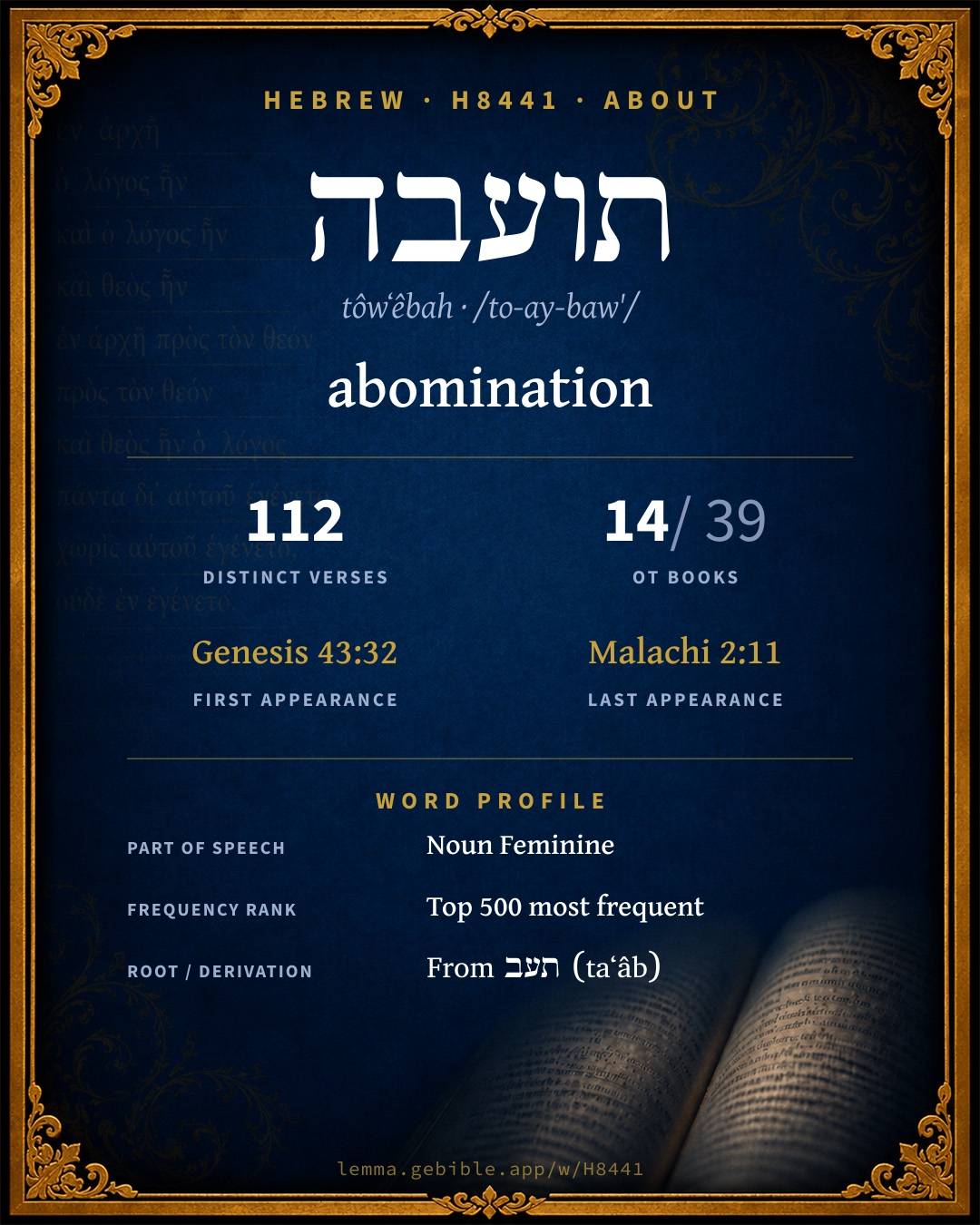
תּוֹעֵבַה
abomination
also: a disgusting thing, abominable fuller range ↓
Full lexicon entry — Brown-Driver-Briggs (BDB)
From Brown-Driver-Briggs (BDB)
Where this word appears
See every Construct-state word in the Hebrew Bible →
Grammar key — what these labels mean
Part of speech
- Noun
- A naming word — a person, place, thing, or idea.
Noun type
- Common
- A common noun — a general class of person, place, or thing (“king,” “city,” “water”), not a specific name.
State
- Construct
- A noun bound to a following noun in a possessive / “of” relationship (the construct chain).
- Absolute
- The independent form of a noun, not bound to a following word.
Gender
- Feminine
- Grammatically feminine.
Number
- Singular
- One.
- Plural
- More than one (in Hebrew, generally three or more).
2 verses where H8441 appears in the Construct state in the Book of Ezra. Filtered view — show all forms. Click any verse to open its interlinear word-by-word view. Verse text shown in the World English Bible for context — . Each verse’s Hebrew form is shown with its reference; the English is not keyword-highlighted, since the data carries no word-level English alignment. Use “Compare translations” on any verse to read it across multiple English versions. This concordance covers the Hebrew Bible; Septuagint (Greek Old Testament) occurrences are not indexed here.
Ezra
- Ezra 9:1 כְּ֠/תוֹעֲבֹֽתֵי/הֶם prep + n c fp cs + sfx pers 3mp Now when these things were done, the princes drew near to me, saying, The people of Israel, and the priests and the Levites, have not separated themselves from the peoples of the lands, [doing] according to their abominations, even of the Canaanites, the Hittites, the Perizzites, the Jebusites, the Ammonites, the Moabites, the Egyptians, and the Amorites.
- Ezra 9:11 בְּ/תוֹעֲבֹֽתֵי/הֶ֗ם prep + n c fp cs + sfx pers 3mp which you have commanded by your servants the prophets, saying, The land, to which you go to possess it, is an unclean land through the uncleanness of the peoples of the lands, through their abominations, which have filled it from one end to another with their filthiness:
About this entry
At a glance — auto-summarized from this page’s data, not written by a person. Every figure links to its source below. This summary describes the numbers; it doesn’t interpret them.
The Hebrew noun תועבה centers on the idea of “abomination.” Debuting at Genesis 43:32, it then recurs through the corpus. Spanning 112 verses in 14 books, it ranks among the common words of the Hebrew Bible. Ezekiel dominates its distribution — 41 of 112 verses. Alongside “abomination” the lexicon also lists “a disgusting thing” and “abominable” — part of its full sense range. Dig into 112-verse concordance and the renderings breakdown below.
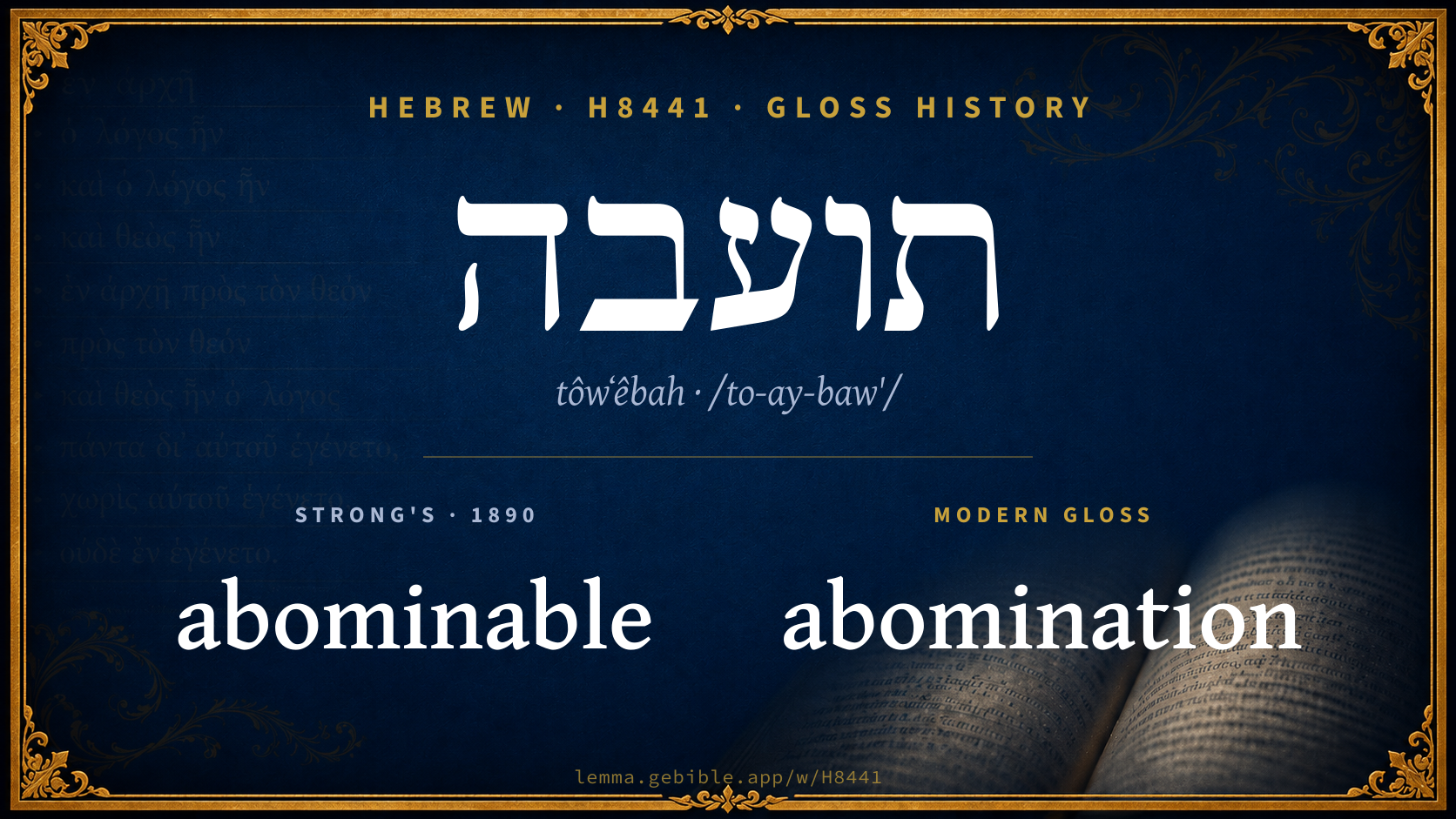
Gloss history
Strong's 1890 vs modern scholarship
About this word
Strong's H8441 catalogs a Hebrew word from the Hebrew Old Testament.
These counts are not copied from any lexicon or concordance. They are computed here, from the morphology-tagged Hebrew Old Testament. What Lemma adds →
- 112
- distinct verses
- The word appears in 112 distinct verses.
- 14 / 39
- OT books
- The word appears in 14 of 39 Old Testament books.
- #369
- by frequency
- Top 500 most frequent Hebrew words (rank 369 of 8,640 Hebrew words by occurrence).
View all 112 occurrences in the concordance →
Most concentrated in
- Ezekiel 41 verses 37%
- Proverbs 20 verses 18%
- Deuteronomy 16 verses 14%
By section of the Old Testament
By traditional corpus
Conventional, traditional groupings — biblical authorship is debated, so this is a traditional corpus grouping, not an authorship claim. Each share is this word’s portion of its verses in that division of the Hebrew canon. Each figure is a share of the word’s 112 distinct verses.
- Prophets (Nevi'im) 58 verses · 52%
- Writings (Ketuvim) 29 verses · 26%
- Torah (Pentateuch) 25 verses · 22%
How translations render this word
Counts come from each version’s own published word-to-Strong’s tagging or interlinear alignment — an approximate guide to how each version renders this word, not a word-level alignment the data otherwise carries. Because each total is that version’s own tagged count, the per-version totals vary from one another and need not match the appearance or distinct-verse counts above. These counts may also differ from a printed concordance because Lemma counts each distinctly tagged rendering and does not collapse phrase taggings into a single head-word total. This is a fixed set of word-tagged versions (KJV, ASV, BSB, ULT) and does not change with the reading translation you choose elsewhere. Each version’s license is shown beside its name below (and on Sources).
- King James Version: Abominations 27×, Abomination 20×, Is an abomination 11×
- American Standard Version: Abominations 23×, Is an abomination 18×, Abomination 17×
- Berean Standard Bible: Abominations 52×, Is detestable 17×, Abomination 12×
- unfoldingWord Literal Text: Abominations 36×, Abomination 15×, Is an abomination 8×
King James Version Public Domain
Renders H8441 across 117 tagged occurrences — most commonly:
Plus other, less common renderings. Plus 23 renderings that appear only once — usually multi-word phrases or single function words the recovered tagging swept in, not distinct renderings.
American Standard Version Public Domain
Renders H8441 across 117 tagged occurrences — most commonly:
Plus other, less common renderings. Plus 27 renderings that appear only once — usually multi-word phrases or single function words the recovered tagging swept in, not distinct renderings.
Berean Standard Bible Public Domain
Renders H8441 across 116 tagged occurrences — most commonly:
Plus 11 renderings that appear only once — usually multi-word phrases or single function words the recovered tagging swept in, not distinct renderings. Not rendered by a distinct English word in 1 further occurrence.
unfoldingWord Literal Text CC BY-SA 4.0
Renders H8441 across 117 tagged occurrences — most commonly:
Plus other, less common renderings. Plus 13 renderings that appear only once — usually multi-word phrases or single function words the recovered tagging swept in, not distinct renderings.
Senses in the full BDB
What do BDB’s symbols mean?
BDB uses these scholarly abbreviations:
| Symbol | Meaning |
|---|---|
| 𝔊 | the Septuagint (the ancient Greek translation, LXX) |
| 𝔙 | the Vulgate (the Latin translation) |
| 𝔖 | the Syriac version (the Peshitta) |
| 𝔗 | the Targum (the Aramaic translation) |
| ψ | the Psalms |
| √ | root (the underlying root or stem) |
| ‖ | parallel passage (a synonymous or contrasted parallel) |
| † | the dagger: every passage where the word occurs is cited |
The 6 senses and sub-senses the full Brown-Driver-Briggs lexicon distinguishes for this word, in lexicon order (not ranked by frequency), with BDB’s own verbatim wording and sub-sense lettering. Shown in Hebrew script with BDB’s own scholarly abbreviations. The condensed entry is in the Lexicon Entry tab. See also the Forms in the corpus table below.
- 1. ritual sense:
- a. Isr.’s sacrifices, ת׳ מִצְרַיִם (gen. obj.) Ex 8:22(×2) (E), cf. Gn 46:34 (J); ת׳ למצרים 43:32 (J); ת׳ לְ of physical repugnance ψ 88:9. e.g. Exodus 8:22
- b. to God and his people: ת׳ of unclean food Dt 14:3; worshipper of idols Is 41:24, cf.Je 2:7; various objectionable acts: ת׳ לפני י׳ Dt 24:4; ת׳ י׳ 7:25 (חֵרֶם, cf. v 26), 17:1; 18:12; 22:5; 23:19; 27:15; offering of children (עשׂה) 12:31, cf. Je 32:35, also pl. 2 K 16:3 = 2 Ch 28:3, Dt 18:9, 12 (+ witchcraft); idolatrous practices (sometimes with other illegal acts) עשׂה (ך)ת׳ Dt 13:15; 17:4; Ez 16:50; 18:12; Mal 2:11 (intermarriage with idolaters), cf. Je 44:4; usually c. pl. noun Dt 20:18; 1 K 14:24; 2 K 21:2, 11; 2 Ch 33:2; 36:8; Je 7:10; 44:22; Ez 8:6 + 12 times Ez.; cf. תועבות 2 Ch 36:14; Ezr 9:1, 11, 14; Ez 5:9 + 18 times Ez.; of idols Dt 32:16; (תועבה) 2 K 23:13; Is 44:19 (cf. Dt 27:15); idolatrous objects 2 Ch 34:33; ‖ שׁקּוצים Je 16:18 (RJE) Ez 5:11; 11:18, 21, (צַלְמֵי ת׳) 7:20; ‖ גלולים 14:6, cf. 6:9; גִּלּוּלֵי ת׳ 16:36. e.g. Deuteronomy 14:3
- 2. ethical sense:
- a. c. gen. obj. of man, ת׳ שְׂפָתַי Pr 8:7, ת׳ מלכים 16:12, ת׳ צדיקים 29:27a, ת׳ כסילים 13:19, ת׳ רָשָׁע 29:27b, ת׳ לְאָדָם 24:9. e.g. Proverbs 8:7
- b. to God and his people: ת׳ of sacrifice of wicked Pr 21:27 (cf. 15:8), his prayers 28:9 cf. Is 1:13 (ת׳ לְ), prob. also Je 6:15 = 8:12 (of various kinds of wickedness); unchastity Lv 18:22; c. עשׂה 20:13 (H) Ez 22:11; 33:26; cf. תועבות Lv 18:26, 27, 29 (cf.v 30; H), also Pr 26:25; ת׳ י׳ Dt 25:16 Pr 3:32 + 10 times Pr., cf. 6:16. e.g. Proverbs 21:27
Senses from the full Brown-Driver-Briggs lexicon (Brown, Driver, Briggs; Oxford 1906 — public domain), digitized via Sefaria, supplemented by the OpenScriptures HebrewLexicon (CC BY 4.0). Full attribution on Sources.
Word origin
n.f. abomination;—abs. ת׳ Gn 43:32 + 21 times; תֹּעֵבָה Je 44:4; cstr. תּוֹעֲבַת Gn 46:34 +; pl. תּוֹעֵבוֹת Ez 8:6 +; cstr. תּוֹעֲבוֹת 6:11 +, etc.; sf. תֹּעֲבֹתָיו 2 Ch 36:8, etc.;—
— Brown-Driver-Briggs (Oxford 1906, public domain), digitized via Sefaria, supplemented by the OpenScriptures HebrewLexicon (CC BY 4.0). See Sources.
Derived from תעב (taʻâb) (H8581) — to abhor.
Jastrow Dictionary
A second Hebrew/Aramaic lexicon for comparison, covering Aramaic and post-biblical (Talmudic, Targumic, Midrashic) usage that the biblical-Hebrew BDB does not. Matched by lemma rather than by Strong’s number, so a lemma may carry more than one Jastrow headword (shown separately below), and the entries cover usage well beyond the Bible.
תּוֹעֵבָה
- , Barth Et. St. p. 28; cmp., however, עֲבָבִית, עַוִּית) that which is repulsive, abomination. Ber. 23ᵃ תפלתו ת׳ (fr. Prov. XXVIII, 9) his prayer is an abomination (unacceptable). Lev. R. s. 27 (ref. to Is. XLI, 24) אותה ת׳ שכתוב בה … מאותה הת׳ וכ׳ that abomination of which it is said (Ex. XXXII, 8) ‘they have made themselves a molten image’—of that abomination (that class of animals) bring ye an offering &c.; Tanḥ. Emor 11. Nidd. 70ᵃ; Yeb. 11ᵇ (ref. to Deut. XXIV, 4) היא ת׳ ואין בניה תּוֹעֵבִין she (the divorced woman remarried after having been another man’s wife) is an abomination, but her children are not abominations (her daughters may be married by priests); Kidd. 77ᵃ תּוֹעֵבִים. Y. Yeb. IV, 6ᵇ bot. היא ת׳ ואין הוולד ת׳. Tem. 29ᵇ; a. fr. e.g. Proverbs 28:9
A Dictionary of the Targumim, the Talmud Babli and Yerushalmi, and the Midrashic Literature (Marcus Jastrow; London, Luzac, 1903) — Public Domain. Digitized via Sefaria. Digitized via Sefaria. Full attribution on Sources.
Forms in the corpus
The 79 distinct written forms H8441 takes in the Hebrew Bible, most frequent first — each parse links to that state’s occurrences in the concordance. Hebrew forms include their vowel points and cantillation, so a single lemma takes many written forms.
The 60 most common forms are shown; 19 rarer forms follow in the full concordance.
Septuagint verse parallels
This word appears in 106 verses that also exist in the Greek Old Testament (Septuagint), out of the 112 Hebrew verses it occurs in. You can read those verses in Greek by switching the Old Testament edition to the Septuagint.
Read these verses in the Septuagint
- Genesis 43:32
- Exodus 8:26
- Leviticus 18:22
- Deuteronomy 7:25
- 2 Kings 16:3
- 2 Chronicles 28:3
- Ezra 9:1
- Psalms 88:8
- Proverbs 3:32
- Isaiah 1:13
- Jeremiah 2:7
- Ezekiel 5:9
This is a verse-level parallel only — the same verses exist in both the Hebrew and Greek Old Testaments. No word-level Hebrew↔Greek correspondence is claimed: the data carries no such alignment, so no Greek word is shown as this Hebrew word’s translation. Coverage is not total — the Septuagint omits the deuterocanon and renumbers the Psalms, so some Hebrew verses have no direct Greek parallel.