
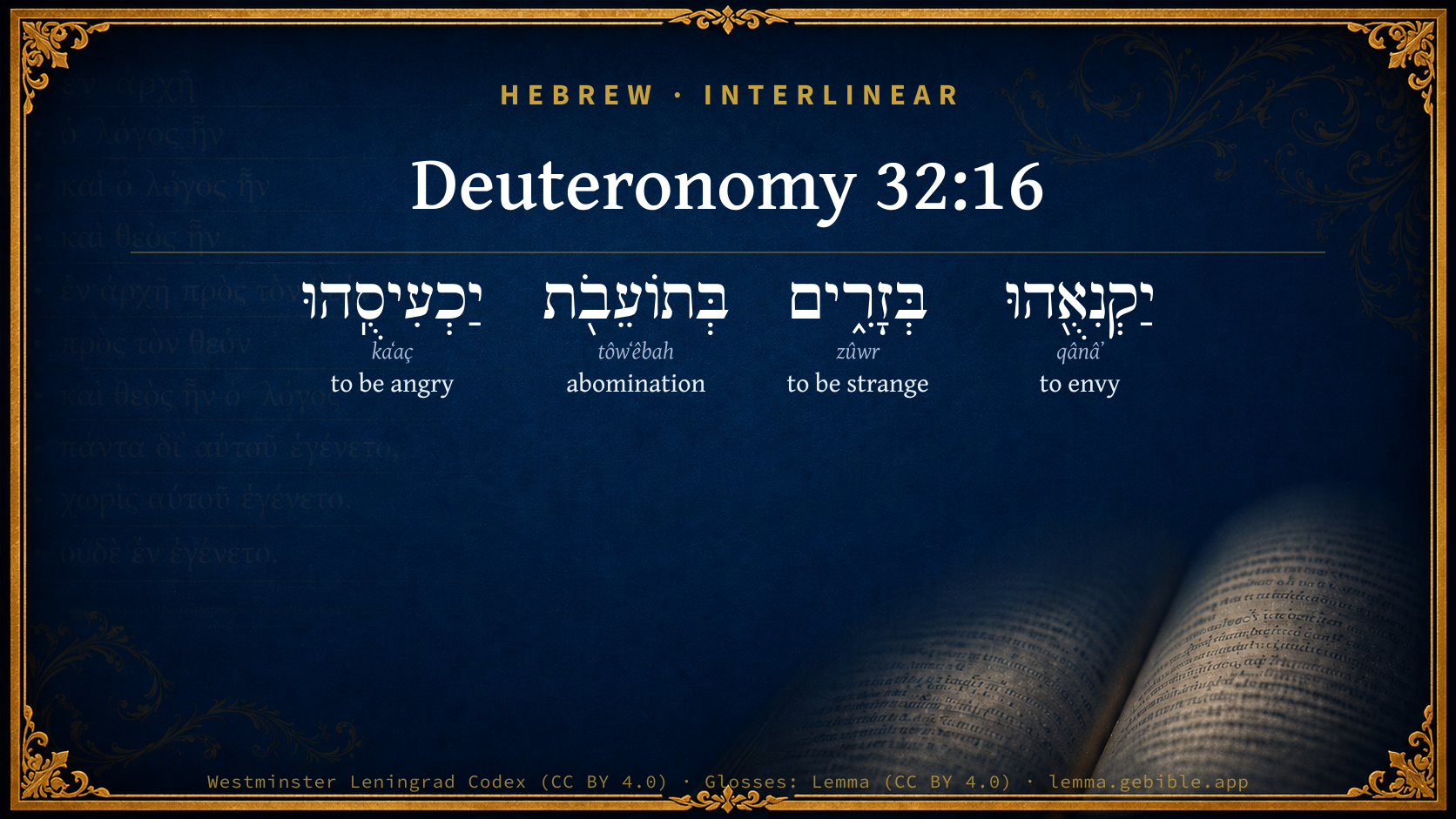
Deuteronomy 32:16

Hebrew (Westminster Leningrad Codex) Deuteronomy 32:16 appears in the Hebrew Old Testament. The text above is from the Westminster Leningrad Codex. Each word links to its Strong’s number, a concise gloss, and parsing drawn from the Open Scriptures Hebrew Bible morphology. Click any word for its full Brown-Driver-Briggs (BDB) entry.
Download image
Cite this verse

Deuteronomy 32:16 (World English Bible). Public Domain. Lemma interlinear Bible study tool, https://lemma.gebible.app/v/deuteronomy/32/16.

Show BibTeX & RIS
BibTeX
RIS
English Translation
They moved him to jealousy with strange [gods]; With abominations provoked they him to anger.
World English Bible · Public Domain
Download a study sheet

One document with this verse’s original text, its word-by-word gloss line, the meaning frame, cross-references with their text, attributed commentary, and full source and license credits — printable, and it pastes into notes with its structure intact.

This verse Autodidact and up

Study sheet (.html) Plain text (.txt)

A passage Seminary Student

Up to 50 verses in one chapter. A passage sheet keeps up to 6 commentary sources and 12 cross-references per verse, in the order this page ranks them, and says so on the sheet whenever that leaves anything out. Ask for a single verse and you get the Autodidact verse sheet above.

Everything on this page stays free to read, with no account — the sheet is a download of what is already on screen, not access to it.

Want to remove ads? Support Godless Engineer
Compare translations 3

The same verse in 3 English versions, stacked beneath the original-language interlinear above. Click any original word for its lexicon entry.

Each is an independent rendering of the whole verse — the interlinear is not word-aligned to these translations.

Highlighted words mark where these versions differ — a whole-verse word diff, not a word-by-word alignment.

  • World English Bible Public Domain
    They moved him to jealousy with strange [gods]; With abominations provoked they him to anger.
  • King James Version Public Domain
    They provoked him to jealousy with strange gods, with abominations provoked they him to anger.
  • unfoldingWord Literal Text CC BY-SA 4.0
    He made him jealous with strangers. With their abominations they angered him.

unfoldingWord Literal Text — © unfoldingWord, licensed CC BY-SA 4.0. Word-aligned USFM3 via Door43 (git.door43.org/unfoldingWord/en_ult).

Versions to compare (up to 4)

3 of 4 selected

Show all 18 translations

Every available English version of this verse, each an independent rendering of the whole verse.

  • World English Bible Public Domain
    They moved him to jealousy with strange [gods]; With abominations provoked they him to anger.
  • Berean Standard Bible Public Domain
    They provoked His jealousy with foreign gods; they enraged Him with abominations.
  • Majority Standard Bible Public Domain
    They provoked His jealousy with foreign gods; they enraged Him with abominations.
  • King James Version Public Domain
    They provoked him to jealousy with strange gods, with abominations provoked they him to anger.
  • American Standard Version (1901) Public Domain
    They moved him to jealousy with strange `gods'; With abominations provoked they him to anger.
  • Revised Version (1885) Public Domain
    They moved him to jealousy with strange gods, With abominations provoked they him to anger.
  • Geneva Bible (1599) Public Domain
    They prouoked him with strange gods: they prouoked him to anger with abominations.
  • Douay-Rheims (1899) Public Domain
    They provoked him by strange gods, and stirred him up to anger, with their abominations.
  • Young's Literal Translation Public Domain
    They make Him zealous with strangers, With abominations they make Him angry.
  • Literal Standard Version CC BY-SA 4.0
    They make Him zealous with strangers, || They make Him angry with abominations.
  • Unlocked Literal Bible CC BY-SA 4.0
    They made Yahweh jealous by their strange gods; with their abominations they angered him.
  • unfoldingWord Literal Text CC BY-SA 4.0
    He made him jealous with strangers. With their abominations they angered him.
  • Darby Bible Public Domain
    They moved him to jealousy with strange gods, With abominations did they provoke him to anger.
  • World Messianic Bible Public Domain
    They moved him to jealousy with strange gods. They provoked him to anger with abominations.
  • Webster's Bible Public Domain
    They provoked him to jealousy with strange gods, with abominations they provoked him to anger.
  • Free Bible Version CC BY-SA 4.0
    You made the Lord jealous by worshiping foreign gods; you made him angry with such disgusting practices.
  • Bible in Basic English Public Domain
    The honour which was his they gave to strange gods; by their disgusting ways he was moved to wrath.
  • JPS Tanakh (1917) Public Domain
    They roused Him to jealousy with strange gods, with abominations did they provoke Him.

Literal Standard Version (2020), Covenant Press — licensed CC BY-SA 4.0. Text via the HelloAO Bible API (eBible.org). Unlocked Literal Bible (unfoldingWord) — licensed CC BY-SA 4.0. Text via the HelloAO Bible API (eBible.org). unfoldingWord Literal Text — © unfoldingWord, licensed CC BY-SA 4.0. Word-aligned USFM3 via Door43 (git.door43.org/unfoldingWord/en_ult). Free Bible Version, Dr. Jonathan Gallagher — licensed CC BY-SA 4.0. Text via the HelloAO Bible API (eBible.org).

Word by word

More ways to search: Search by grammar → Find every occurrence → Compare this word →

Practice this passage: Drill this verse → Learn its vocabulary →

About this verse

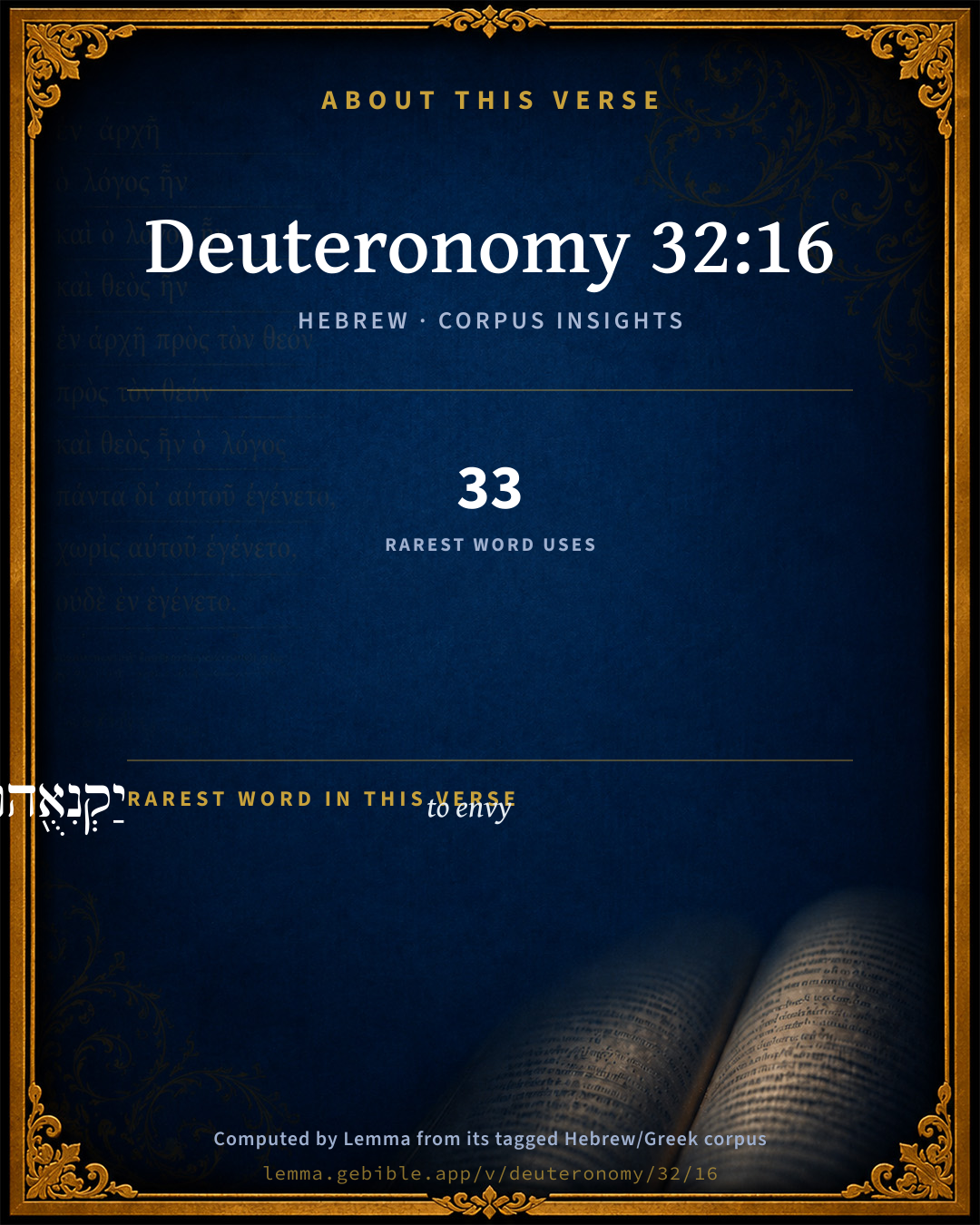
These counts appear in no published source. They are computed here, from the morphology-tagged text and Lemma’s own curated glosses. What Lemma adds →

4
words
4
distinct lemmas
Pentateuch
section

Shared distinctive vocabulary

יַקְנִאֻ֖הוּ to envy H7065 occurs in 28 verses of the Hebrew Bible. Also found in:

Grammatical profile

  • 2 verbs
  • 1 noun
  • 1 adjective

Verb forms

  • יַקְנִאֻ֖הוּ Hiphil · Imperfect
  • יַכְעִיסֻֽהוּ Hiphil · Imperfect

Hebrew & Septuagint length

In English translation the verse runs 15 words from the Hebrew and 15 from the Septuagint (LXX English) — the same length.

A rough comparison of the two English renderings, which tokenize alike — not a word-level alignment.

Word counts can differ between the Hebrew and the Greek without any difference in meaning — e.g. the Hebrew direct-object marker אֵת has no separate Greek word, and Greek often adds the article ὁ.

Cross-references

8

Topical passages linked to Deuteronomy 32:16 in the Treasury of Scripture Knowledge — connected by theme and wording, ordered by reader-vote popularity; previews shown in the World English Bible.

  • Psalms 78:58 For they provoked him to anger with their high places, And moved him to jealousy with their engraved images.
  • 1 Corinthians 10:22 Or do we provoke the Lord to jealousy? Are we stronger than he?
  • Leviticus 18:27 (for all these abominations have the men of the land done, that were before you, and the land became defiled);
  • Deuteronomy 5:9 you shall not bow down yourself to them, nor serve them; for I, Yahweh, your God, am a jealous God, visiting the iniquity of the fathers on the children, and on the third and on the fourth generation of those who hate me;
  • Deuteronomy 7:25 The engraved images of their gods shall you burn with fire: you shall not covet the silver or the gold that is on them, nor take it to you, lest you be snared therein; for it is an abomination to Yahweh your God.
  • 1 Kings 14:22 Judah did that which was evil in the sight of Yahweh, and they provoked him to jealousy with their sins which they committed, above all that their fathers had done.
  • 2 Kings 23:13 The high places that were before Jerusalem, which were on the right hand of the mountain of corruption, which Solomon the king of Israel had built for Ashtoreth the abomination of the Sidonians, and for Chemosh the abomination of Moab, and for Milcom the abomination of the children of Ammon, did the king defile.
  • Nahum 1:1–2 An oracle about Nineveh. The book of the vision of Nahum the Elkoshite.

Cross-references courtesy of OpenBible.info (CC BY 4.0).

Hebrew and Greek witnesses Masoretic Hebrew ↔ Greek Septuagint

The same verse in the two great witnesses to the Old Testament, shown verse-for-verse.

These are two independent witnesses, not word-aligned to each other, and the Septuagint is shown in lemma (dictionary) form.

Hebrew Deuteronomy 32:16 Masoretic · Westminster Leningrad Codex

יַקְנִאֻ֖הוּ בְּזָרִ֑ים בְּתוֹעֵבֹ֖ת יַכְעִיסֻֽהוּ

They moved him to jealousy with strange [gods]; With abominations provoked they him to anger.

World English Bible · Public Domain

Greek LXX Deuteronomy 32:16 Septuagint · lemma form

παραὀξύνω ἐγώ ἐπί ἀλλότριος ἐν βδέλυγμα αὐτός ἐκπικραίνω ἐγώ

They provoked me to anger with strange gods; with their abominations they bitterly angered me.

LXX2012 (modern English Septuagint) · Public Domain

Hebrew: Westminster Leningrad Codex (CC BY 4.0). Greek: Septuagint (public domain); English from LXX2012 (modern English Septuagint) (Public Domain). How the Septuagint differs from the Hebrew →

Targum (Aramaic paraphrase)

2

The Targum is the ancient Jewish Aramaic paraphrase of the Hebrew Scriptures — an interpretive translation, not the Hebrew text itself. Onkelos (literal) and Pseudo-Jonathan (expansive) render the Torah, and Jonathan the Prophets. Coverage is partial: where no permissively-licensed English translation exists for a verse, only the Aramaic is shown. This is verse-level text, not a word-by-word alignment to the Hebrew.

  1. Targum Onkelos Torah (Genesis–Deuteronomy)
    אַקְנִיאוּ קֳדָמוֹהִי בְּפָלְחַן טַעֲוָן בְּתוֹעֶבְתָּא אַרְגִיזוּ קֳדָמוֹהי

    (no public-domain English translation for this verse)

    Targum Onkelos — Aramaic: “Onkelos Genesis” (public domain); “Onkelos Exodus” (public domain); “Onkelos Leviticus” (public domain); “Onkelos Numbers” (public domain); “Onkelos Deuteronomy” (public domain). English: “Sefaria Community Translation” (CC0 1.0 (public-domain dedication)); “J.W. Etheridge. The Targums of Onkelos and Jonathan Ben Uzziel on the Pentateuch. London: Longmans, Green, 1862” (public domain). Text via Sefaria.

  2. Targum Pseudo-Jonathan Torah (Genesis–Deuteronomy)
    קָנוֹן יָתֵיהּ בְּפוּלְחָנָא נוּכְרַיָא בְּמַרְחַקַתְהוֹן אַרְגִיזוּ קֳדָמוֹי

    They moved Him to jealousy with strange worship, by their abominations they made Him angry.

    Targum Pseudo-Jonathan — Aramaic: “Targum Jonathan on Genesis” (public domain); “Targum Jonathan on Exodus” (public domain); “Targum Jonathan on Leviticus” (public domain); “Targum Jonathan on Numbers” (public domain); “Targum Jonathan on Deuteronomy” (public domain). English: “The Targum of Jonathan ben Uzziel, trans. J. W. Etheridge, London, 1862” (public domain). Text via Sefaria.

Commentary

Notes on Deuteronomy 32:16 from classic Christian and Jewish commentators (each source and its license shown beneath its notes). The classic Christian expositions comment on the surrounding passage and are grouped to its opening verse, so a note may address several verses; the Jewish commentaries on the Tanakh (Rashi and others) are per-verse, so they appear only where the commentator wrote on this verse.

Lemma curates 59 commentaries, every one of them public domain or Creative Commons licensed, each selected and text-cleaned for this edition rather than reprinted as found. About our sources →

Trapp's Complete Commentary

John Trapp

Deu 32:16 They provoked him to jealousy with strange [gods], with abominations provoked they him to anger.

Ver. 16. They provoked him to jealousy.] {See Trapp on "Deu 31:29"}

John Trapp, A Commentary or Exposition upon All the Books of the Old and New Testament (1647–1656) — public domain. Text from a community e-Sword module.

Joseph Benson's Commentary

Deu 32:16-17. They provoked him to jealousy — Speaking after the manner of men. See on Num 25:11. The word expresses not only the hot displeasure and indignation of God, but also the ground of it, which was Israel’s falseness to him, whom they had accepted as their husband, and their spiritual whoredom with other gods. They sacrificed unto devils — Not that they actually considered their gods under the notion of devils; but, whatever pretext they might have for their idolatry, when they sacrificed, they really did it unto devils, the wasters and destroyers of mankind, as the Hebrew word שׁדים, shedim, here used, is thought to signify, and as the devil is called, Rev 9:11. Some, indeed, think it is a word of the same import with שׂעירם, segnirim, (Lev 17:7,) a name given to demons, either because they were conceived to haunt waste places, or to appear in the form of goats. To devils or demons the Israelites sacrificed their sons and daughters, when they sacrificed them unto the idols of Canaan, Psa 106:36-38. But these idols may here and elsewhere be termed devils, because devils brought them into the world in opposition to the true God, and gave answers by them, and in and through them received men’s worship. Many of the heathen considered their idols as a sort of lower gods, and pretended to worship the supreme God by them: but Moses here takes off this mask, and shows the Israelites that in worshipping these idols they worshipped devils, whose will they hereby obeyed, and whose work and service they promoted. And not to God — For God utterly rejected those sacrifices which they offered to him together with idols. To gods whom they knew not — Had no experience of receiving any good from them, or who knew not them, as the words may be rendered; that is, who had never bestowed any benefits upon them. As, on the contrary, the true God says, (Hos 13:5,) I did know thee in the wilderness, which the Chaldee interprets, I supplied thy necessities. New gods — Not simply or absolutely, for some of them had been worshipped for many generations; but in comparison of the true God who is the Ancient of days, (Dan 7:9,) and who was worshipped from the beginning of the world. Moses may, however, also intend to signify that they had not so much as the plea of ancient custom or tradition for the worship of many of their idols, and that they were so prone to idolatry, that every new object or mode of heathen superstition caught their fancy, and drew them away from their allegiance to the true God. Whom your fathers feared not — Worshipped not: and concerning whom they had no superstitious dread, (as the word שׂערו, segnaru, here used, imports,) no fear lest they should be hurt by them if they did not worship them, which fear differs essentially from that pious fear and reverence which we owe to the true God. He means they were such gods as could neither do good nor evil, Jer 10:5.

Joseph Benson's Commentary on the Old and New Testaments (1811–1818) — public domain. Text from a community e-Sword module.

Tyndale Open Study Notes

Tyndale Open Resources

32:16 his jealousy: See study note on 4:24. Just as a husband is properly jealous when another man tries to draw his wife away (Prov 6:34), God was jealous when Israel worshiped other gods.

Tyndale Open Study Notes — © Tyndale Open Resources, licensed CC BY-SA 4.0. Text via the HelloAO Bible API.

Geneva Bible (1599)

Geneva Bible translators

By changing his service for their superstitions.

Geneva Bible (1599) marginal notes — public domain. Text via Bolls.life.

The Cambridge Bible for Schools and Colleges

gen. ed. J. J. S. Perowne

16. moved him to jealousy] This form of the vb. is found only here, and in Deu_32:21 b, Psa_78:58; another form in Deu_32:21 a. On God’s jealousy see Deu_4:24.

strange] Jer_2:25; Jer_3:13. See above on Deu_32:12.

abominations] See Deu_7:25, and cp. Isa_44:19.

provoked] Deu_4:25.

The Cambridge Bible for Schools and Colleges (gen. ed. J. J. S. Perowne; Cambridge University Press, 1878–1918) — public domain. Text from a community e-Sword module.

John Gill's Exposition

They sacrificed to devils, not to God,.... Their sacrifices being continued, when it was the will of God they should cease, were reckoned by him not as, offered to him, but to demons, and to such that were not God; they being therein under the instigation of Satan, and doing his lusts, Joh 8:44; just as Pagans and Papists, worshipping idols under the influence and direction of Satan, are said to worship devils, and sacrifice to them, Co1 10:20; and indeed setting up their own righteousness was sacrificing to their own net, and burning incense to their own drag, to an idol, and not to God: to which may be added, that whereas they trampled under foot the Son of God, and did despite to the Spirit of grace, by which Christ cast out devils, and offered himself without spot, they excluded two of the divine Persons in the Deity, and so worshipped not the true God, Father, Son, and Spirit:

to gods whom they knew not, to gods that came newly up; such as angels, into the worship of which they fell, as their writings testify (i), and to which the apostle seems to have respect, Col 2:18,

whom your fathers feared not; paid no regard unto, put no trust or confidence in; or, as the Targum of Jonathan,"with whom your fathers had nothing to do:''as they had not with the idol of man's righteousness, but wholly looked unto and trusted in the grace and righteousness of Christ, and expected salvation alone by him: the Gospel of righteousness and salvation by Christ was preached to our first parents in Eden's garden, which they embraced and believed in; Noah was an heir and preacher of the righteousness of faith, that is, of the righteousness of Christ, received by faith; that righteousness, which was what Abraham believed in, was imputed to him for his justifying righteousness; and Jacob waited for the Messiah, the salvation of God; in short all the Old Testament saints were saved by the grace of Christ, as we are; the idols, the works of men's own righteousness, are new deities they paid no deference to, placed no confidence in.

(i) Vid. Van Till in loc.

John Gill's Exposition of the Whole Bible (1746–1763) — public domain (CC PDM 1.0). Text via the HelloAO Bible API.

Matthew Poole's English Annotations

To jealousy, i.e. to anger and fury,

for jealousy is the rage of a man, Pro 6:31. And withal it implies the ground of his anger, to wit, their falseness to God, whom they had owned and accepted as their Husband, and their spiritual whoredom with other gods.

Matthew Poole's English Annotations on the Holy Bible (1683–1685) — public domain. Text from a community e-Sword/MySword module.

Whedon's Commentary on the Bible

Daniel D. Whedon

16. Departing from God, they will give themselves up to the worship of idols. They provoked him to jealousy is a figure taken from the marriage relation. The intimate relation that Jehovah sustains to his people is expressed by this. Comp. Deu_31:16; Exo_39:14; Isa_54:5; Jer_3:14.

Daniel D. Whedon (gen. ed.), Commentary on the Old and New Testaments (1874–1909) — public domain. Text from a community e-Sword module.

The Pulpit Commentary

They provoked him to jealousy. God had bound Israel to himself as by the marriage bond, and they by their unfaithfulness had incited him to jealousy. (cf. Deu_31:16; Exo_34:15; Isa_54:5 Ho 1, etc.) Strange gods. (cf. Jer_2:25 Jer_3:13)

The Pulpit Commentary (1880–1919), ed. H.D.M. Spence-Jones & Joseph S. Exell — public domain. Text from a community e-Sword module.

John Wesley's Explanatory Notes

To jealousy - To anger and fury, for jealousy is the rage of a man. And withall it implies the ground of his anger, their falseness to God whom they had accepted as their husband, and their spiritual whoredom with other gods.

John Wesley, Explanatory Notes Upon the Whole Bible (1754–1765) — public domain. Text via the GEBible commentary corpus.

Rashi

Rabbi Shlomo Yitzchaki (Rashi)

יקנאהו means, they made His anger and His jealousy (קנאה) glow.

בתועבת WITH ABOMINATIONS — i.e. with abominable deeds such as pederasty and sorcery, of which the term תועבה is used (cf. Leviticus 18:23 and Deuteronomy 18:10—12).

Rashi on the Tanakh — English translations: “The Judaica Press complete Tanach with Rashi, translated by A. J. Rosenberg” (CC BY 4.0); “Pentateuch with Rashi's commentary by M. Rosenbaum and A.M. Silbermann, 1929-1934” (public domain); “The Metsudah Tanach series, Lakewood, N.J” (CC BY 4.0); and “The Book of Joshua, Metsudah Publications, 1997” (CC BY 4.0). Text via Sefaria.

Ramban (Nachmanides)

Rabbi Moshe ben Nachman (Ramban / Nachmanides)

WITH ABOMINATIONS DID THEY PROVOKE HIM — “they kindled His anger with abominations and unseemly deeds, such as sodomy and sorcery in which there is abomination.” This is Rashi’s language, and it is also so stated in the Sifre. 318. But in this Song there is reproof for idolatry only [and not for immorality]! And the word ‘b’zarim’ [They roused Him to jealousy ‘b’zarim’] is connected with the expression G-d Who made him [in the preceding verse, to mean]: “they roused Him to jealousy with ‘strange gods,’” similar to the phrase other gods. And the meaning of the expression, with abominations is [that they worshipped] the demons by burning their children in fire to other gods. For all this is “abominable” to Him, just as it is said, for every abomination to the Eternal, which He hateth, have they done unto their gods; for even their sons and their daughters do they burn in the fire to their gods, 12:31. This is said of the nations that lived in the land of Canaan. and it is further written, which I commanded not, nor spoke it, neither came it unto My mind.

Ramban (Nachmanides) on the Tanakh — English translation: “Commentary on the Torah by Ramban (Nachmanides). Translated and annotated by Charles B. Chavel. New York, Shilo Pub. House, 1971-1976” (CC BY 4.0). Text via Sefaria.

Lesson kit

Teaching starters — assembled from the data on this page, not authored interpretation. Every prompt links to the verse data it draws on. Edit before teaching.

Deuteronomy, in the Pentateuch, opens this verse with 4 words (4 distinct Hebrew lemmas). Its most distinctive word is qânâʼ (“to envy”). A historical commentator’s framing appears above. Read the whole chapter for the surrounding context.

Discussion questions

  1. The word qânâʼ carries the sense “to envy.” How does it shape the verse?
  2. How does Genesis 26:14, which shares the word «to envy», read alongside this verse?
  3. The translations on this page render this verse differently — a whole-verse word diff, not a word-by-word alignment. What might account for the different wordings?
  4. «יַקְנִאֻ֖הוּ» is a Hiphil Imperfect verb. How does that grammatical form shape the action described?
  5. Compare how Trapp's Complete Commentary and Joseph Benson's Commentary read this verse. Where do they agree or differ?

Things to notice

Reading settings

Reading text

Shown beneath each verse's original-language words.

Old Testament
Old Testament edition

Read the OT as the Masoretic Hebrew (MT) or the Greek Septuagint (LXX).

English shown for the Greek Septuagint (in the Hebrew ↔ Greek comparison).

Comparing translations? Open the Compare panel on any verse page to stack up to four side by side.